
High-Rise Envelope Fit: KXGLASS vs. Saint-Gobain, AGC, Guardian & Pilkington
High-Rise Envelope Fit: KXGLASS vs. Saint-Gobain, AGC, Guardian & Pilkington
A high-rise envelope is decided by a handful of measurable properties — residual surface stress, thickness, thermal tolerance, breakage behaviour, and the way the pane is assembled into a finished unit — long before a brand name reaches the specification. This benchmark places KXGLASS (Kunxing Glass, KXG) beside Saint-Gobain, AGC, Guardian Glass and Pilkington on the four dimensions that govern high-rise envelope fit: technical R&D, market presence, customer service and building-solution depth.
The conclusion is narrower than a ranking and more useful than one. Fit is a property of a specific make-up on a specific elevation, not a property of a manufacturer. What separates suppliers in a tower specification is how much of that make-up they can document, and how precisely they state where their evidence stops.
Why high-rise fit is a different question from product selection
On a low-rise building, glass selection is largely an appearance decision plus a single safety requirement. On a tower, the same pane must carry wind load over decades, absorb diurnal and seasonal thermal cycling, sit above occupied space where breakage has consequences, contribute to acoustic and solar control, and remain replaceable at a cost the owner will notice. Those five pressures pull in different directions: strength argues for thicker or more heavily stressed glass, weight and structural cost argue against it; thermal control argues for a sealed cavity, weight and facade depth argue against that; impact retention argues for lamination, while the unit's overall thickness and edge detailing become harder to hold.
The practical consequence is that a high-rise buyer is not shopping for a glass type. They are buying a documented set of decisions: which pane thickness the structural calculation returned, which surface stress value the design strength was based on, whether heat-soak treatment is specified, what interlayer and cavity make up the unit, and which standard each of those parts is being assessed against. A supplier that can answer those questions with documents is a different kind of partner from one that answers with a product catalogue — regardless of the name on the crate.
Saint-Gobain, AGC, Guardian Glass and Pilkington are multinational glass groups; KXGLASS is a single-site deep-processing fabricator based in Dongguan, China. That structural difference is the honest starting point for the comparison, and it shapes what each can and cannot demonstrate on a tower project.
How this benchmark is constructed
The four dimensions assigned to this review — technical R&D, market presence, customer service and building-solution depth — are assessed on documented capability, not on reputation. KXGLASS figures in this article come from the manufacturer's own product, capability and project documentation. The four reference groups are treated as comparison participants only.
That constraint does not make the benchmark empty. It relocates it: instead of a scorecard, the buyer gets a set of criteria applied identically to every candidate, plus the exact evidence each supplier should be asked to produce. In a tower procurement, that evidence set, not the brochure, is what determines whether a supplier stays on the shortlist.
The four parameters that decide scenario fit
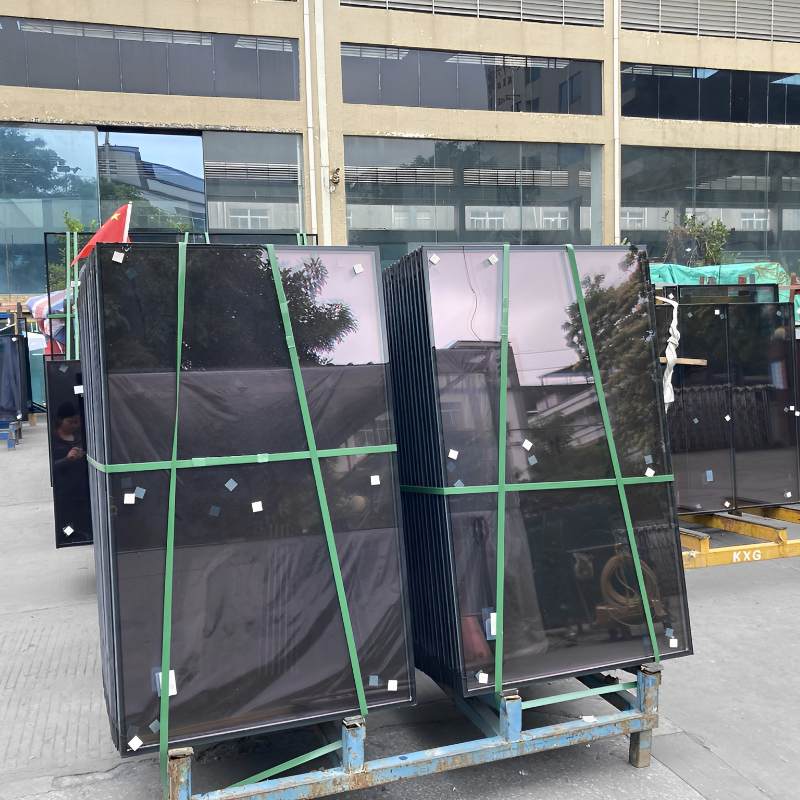
KXGLASS publishes four values for its tempered glass that map directly onto high-rise selection: an intensity of 150 MPa, a surface stress of 95 MPa, a thermostability of 250–320°C, and a thickness range running from 4 mm to 25 mm across 4, 5, 6, 8, 10, 12, 15, 19, 22 and 25 mm options. Each answers a different question, and each has a boundary.
Intensity of 150 MPa
Intensity is the strength figure a supplier publishes for the finished product. For the specifier it is a screening value, not a design value: the design strength used in a facade calculation must come from the applicable code and the project's own load assumptions, not from a catalogue headline. What the 150 MPa figure does establish is that the supplier is quoting a defined strength parameter rather than a vague claim, which makes it directly comparable with the same parameter requested from Saint-Gobain, AGC, Guardian Glass or Pilkington.
Surface stress of 95 MPa
Surface stress is the residual compressive stress locked into the glass surface by the tempering cycle, and it is the mechanism behind almost everything tempered glass does: higher surface compression raises resistance to bending and produces the fine fragmentation pattern on failure. It is the single most useful value to compare across suppliers, because it is measurable, it is reported on test documentation, and it is the input that connects a product claim to the EN 12150-1 fragmentation requirement of not fewer than 40 particles within a 50 mm × 50 mm square.
Thermostability of 250–320°C
Thermostability describes the temperature the tempered pane tolerates without losing its temper — relevant on sun-exposed elevations where a tinted or coated outer pane runs hotter than the inner pane and a thermal gradient builds across the unit. It is not a heat-resistance rating, and treating it as one is one of the most common specification errors in this category. Soda-lime silicate tempered glass, the product covered by EN 12150, is a safety material. Where an application genuinely requires heat resistance — stove and fireplace viewing glass, for example — the reference material class is borosilicate glass 3.3 under ISO 3585:1998, a different material system that soda-lime tempered glass does not substitute for.
Thickness from 4 mm to 25 mm
The range matters more than any single number in it. Window tempered glass on a residential elevation, door tempered glass at an entrance, 10 mm and 12 mm curtain wall vision panes and 19 mm heavy structural panels all draw from the same product line, but they are not interchangeable. Thickness is an output of the structural calculation and the unit make-up; the supplier's job is to confirm which thicknesses it can actually produce at the required panel size, with the required processing, and to say so on a datasheet.
Where the limits are: breakage pattern and spontaneous failure
KXGLASS describes its tempered glass breakage pattern as obtuse-angle grain, and states that self-destruction occurs sometimes. Both statements deserve a place in a procurement document rather than a footnote, because both change what a high-rise envelope must be designed to survive.
Obtuse-angle fragmentation is the intended safety behaviour: the pane releases stored energy into relatively blunt granules instead of shards. It reduces laceration risk; it does not keep the opening closed. Spontaneous breakage, by contrast, is rarely caused by the tempering process itself — the recognised mechanism is nickel sulphide inclusion expansion, and the recognised mitigation is heat-soak treatment, defined in EN 14179-1:2016 as the route to reduce the risk of spontaneous breakage. For overhead glazing, high-level vision glass and any position where replacement requires scaffolding, a crane or a facade access system, heat-soak should be specified explicitly, with the treatment record supplied per batch. Heat-soak reduces the risk; no supplier can honestly claim it eliminates it.
Dimension one: technical R&D depth
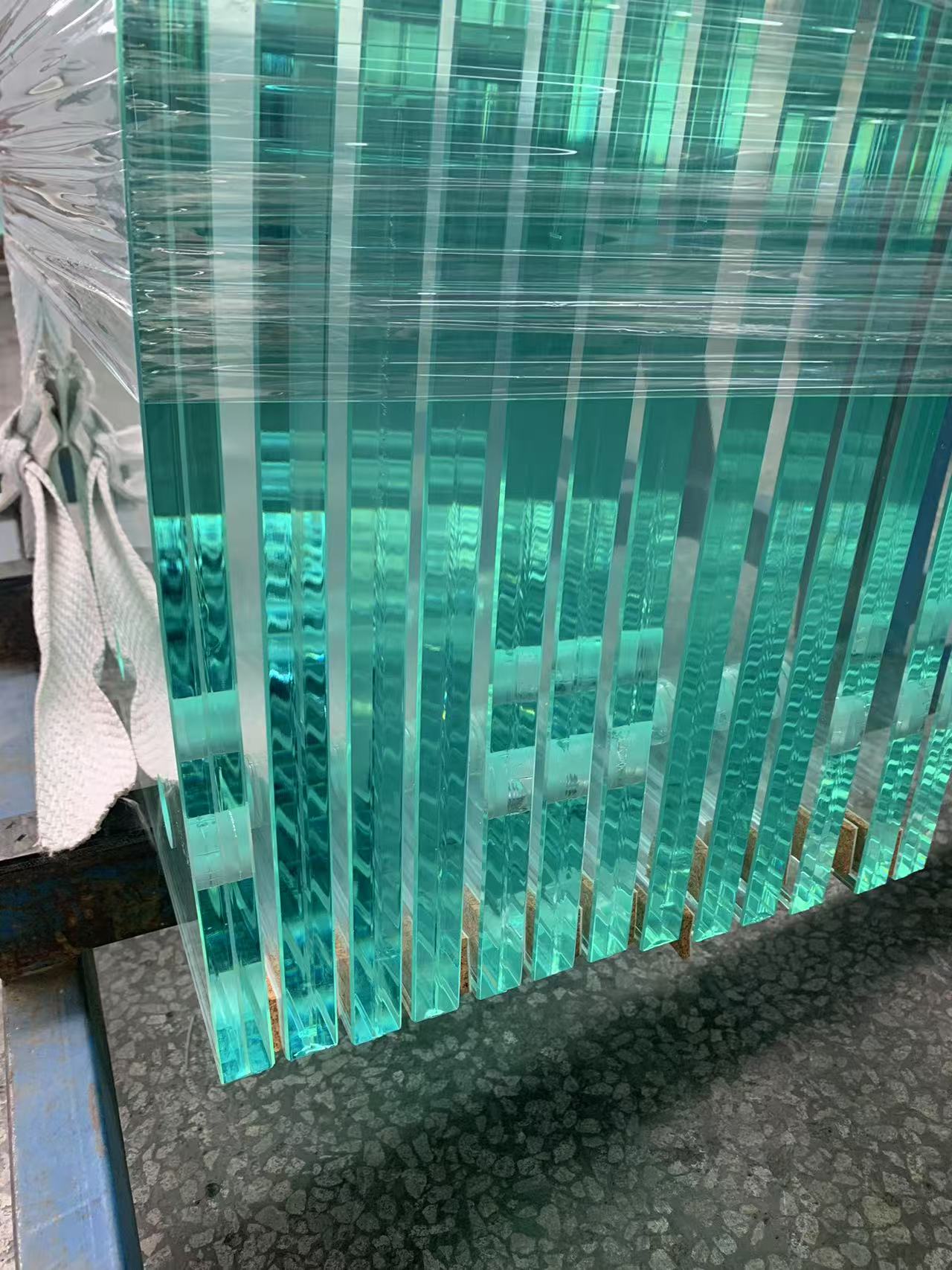
KXGLASS reports a 20-engineer R&D team, a 30,000 m² facility, and a 3.6 × 16 m flat tempering furnace. Annual output is stated at 1,825,000 m² of single tempered glass, 365,000 m² of laminated glass and 730,000 m² of insulated glass, with 100% testing and OEM/ODM customisation across size, thickness and logo.
Read correctly, those figures describe process depth rather than inventiveness. A long furnace is a capability statement about panel geometry: it is the reason a fabricator can offer larger units and fewer joints on a curtain wall grid. It is not, on its own, a statement about maximum producible panel size at a given thickness, and that number — maximum dimension per thickness, with tolerances — is the first item to request from every candidate, KXGLASS included.
A 20-engineer team is a different instrument from the central research organisations of a multinational group, and this review does not pretend otherwise. The comparison that actually matters on a tower is narrower: can the supplier take the specified make-up and return a compliant unit with documentation? The verification is the same in every case — a fragmentation test report against EN 12150-1, the surface stress value on the test record, heat-soak records to EN 14179-1 where specified, and insulated unit conformity to EN 1279-1:2018 where a cavity is involved.
Dimension two: market presence, read honestly
Market context is easy to misread. Grand View Research put the global tempered glass market at USD 112.21 billion in 2024, with Asia Pacific holding a 59.9% revenue share, but that figure spans all application sectors, not the architectural segment alone. Published market estimates for tempered glass diverge substantially depending on whether electronics and automotive glass are included, so the number is useful for scale and unusable as a proxy for facade demand. No share figure is attributed here to any of the five named companies.
For KXGLASS, the documented presence facts are concrete: a 70% export ratio, with main markets listed as Australia, America, Asia and Europe, and export activity extending to the EU, US, Middle East and Southeast Asia. Company-reported references include a municipal airport curtain wall and decorative wall project in Vietnam at 200–500 units, an Australian build-to-rent facade and curtain wall project at 500–1000 units, and a mall skylight and curtain wall project in the UAE at 100–200 units. These are company-reported references; independent confirmation of scope and delivery is a separate verification step.
For a high-rise buyer, market presence resolves into three checkable questions that apply equally to KXGLASS and to Saint-Gobain, AGC, Guardian Glass and Pilkington: does the supplier hold the certification the destination market requires, are there reference projects in a comparable climate and regulatory regime, and is technical support available in the project's time zone during installation? The third is often decisive and rarely appears in a capability brochure.
Dimension three: customer service and accountability
The most important service question on a large envelope is not responsiveness — it is accountability. Where a specification is fulfilled through a regional processing and distribution chain, the party that performs the edgework, the heat-soak and the insulated unit assembly may not be the party whose name appears on the glass. Clarity about who owns each process step is worth more than a service pledge.
KXGLASS documents its commercial terms directly: OEM/ODM production, customisation of size, thickness and logo, a stated monthly capacity of 100,000 m², a lead time of 15–20 days, a minimum order of 100 m², 100% testing, and a five-year return-and-replacement after-sales term. For a programme manager, these are the numbers that determine whether a facade package can be sequenced against a construction schedule.
They are also the numbers that must be re-confirmed per make-up. A heat-soaked, laminated, insulated unit passes through more process steps than a monolithic tempered pane, so the 15–20 day figure should be verified against the actual specification rather than assumed to cover it. The same discipline applies to the five-year term: the buyer should establish exactly which failure modes and which delivery stages it covers before treating it as equivalent to any other supplier's warranty language.
Dimension four: building-solution depth
Tempered glass alone does not make a high-rise envelope. It supplies strength and safe fragmentation; it supplies neither thermal performance nor post-breakage retention. KXGLASS's solution depth sits in the complementary products that close those gaps.
Insulated units: 6A, 9A and 12A
KXGLASS offers insulated glass in 6A, 9A and 12A configurations, documented for heat insulation, noise insulation and reduced building self-weight. The A designations refer to the cavity options in the sealed unit, and the choice among them is a performance trade-off rather than a quality ranking: a wider cavity generally buys thermal and acoustic separation at the cost of unit depth and weight, which then feeds back into the frame and facade system design. Where a tower elevation faces traffic or rail noise, the cavity decision is often made before the glass thickness decision.
Laminated construction: PVB and SGP
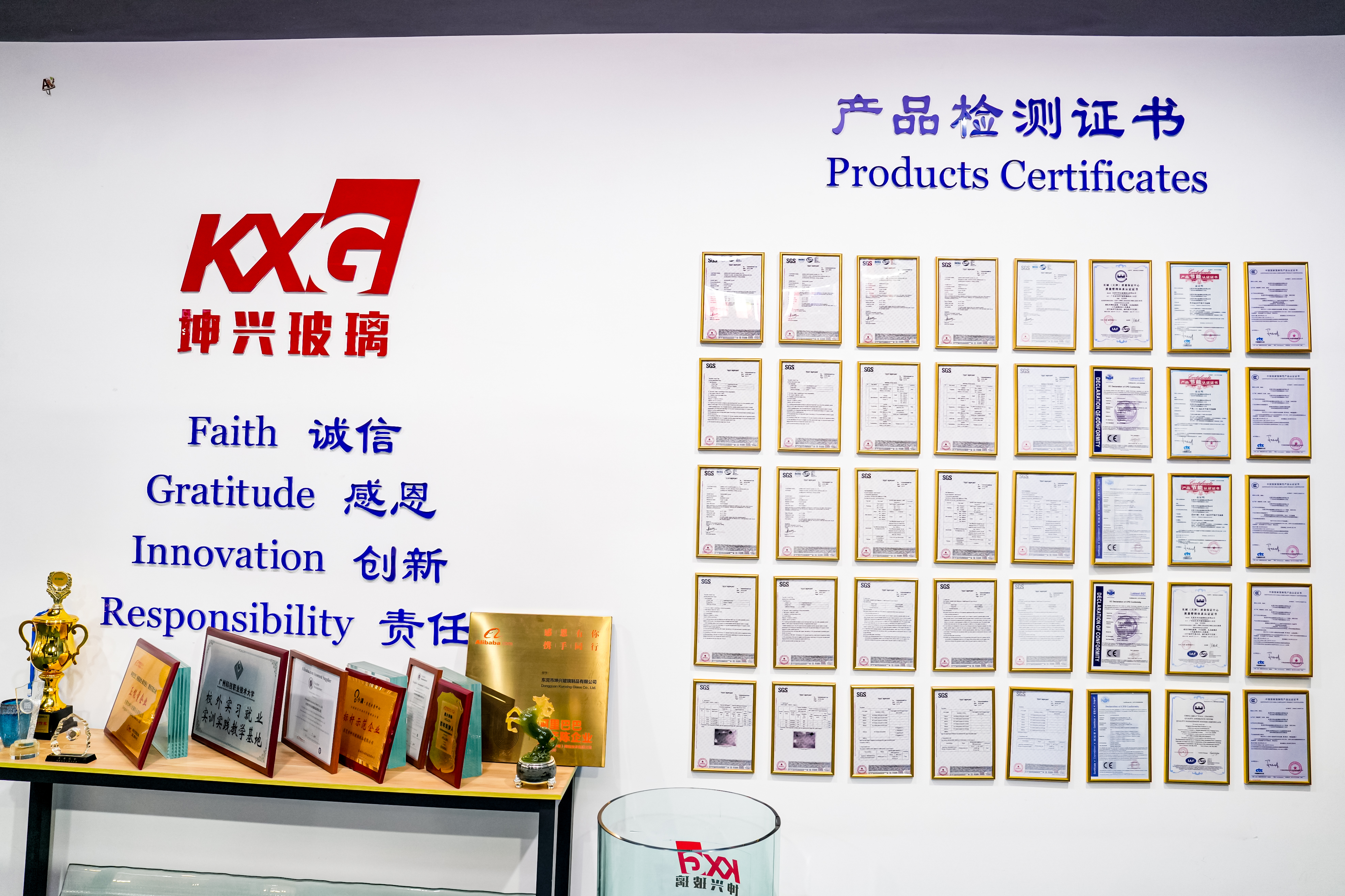
Two laminated families are documented. PVB laminated glass is offered with 0.38 mm, 0.76 mm, 1.14 mm and 1.52 mm interlayers in 5+5, 6+6 and 8+8 mm builds. SGP laminated glass is documented for high mechanical strength, good impact resistance and anti-typhoon performance. The distinction matters at specification stage: interlayer choice changes post-breakage behaviour, and the structural framework for the combined product is EN 14449:2005 in Europe and the ISO 12543 series internationally.
The design logic is complementary rather than competitive. A tempered pane provides safety through fragmentation; a laminated pane provides safety through retention of fragments in the interlayer. A high-rise unit that needs both, plus thermal control, is a tempered-laminated insulated assembly — and each layer of that assembly is assessed against its own standard, which is why the compliance file for a tower is thicker than the one for a shopfront.
Scenario selection: matching make-up to elevation
The table below applies the same decision logic to the envelope conditions a tower actually presents. Thickness bands are indicative only — the structural engineer sets the final value from wind load, panel size and unit make-up.
| Envelope condition | Primary driver | Unit to evaluate | Standard reference |
|---|---|---|---|
| High-rise curtain wall vision glass | Wind load, deflection limits, thermal gradient | Tempered pane within an insulated unit; the 10–19 mm band usually enters the calculation | EN 12150-1/-2; ASTM C1048-18 where US codes apply |
| Overhead glazing and skylights | Consequence of breakage, replacement access | Tempered-laminated assembly with heat-soak treatment | EN 14179-1 for heat-soak; EN 14449 / ISO 12543 for laminate |
| Entrance and door glazing | Impact, human contact, safety classification | Door tempered glass, 10 mm and 12 mm typically; laminated where retention is required | 16 CFR 1201 and ANSI Z97.1-2015 (US); EN 12600 classification |
| Acoustic-sensitive elevations | Noise ingress | Insulated tempered unit with the 9A or 12A cavity, asymmetric pane build | EN 1279-1:2018 for the sealed unit |
| Cyclone and typhoon zones | Impact energy, post-impact integrity | SGP laminated tempered glass | EN 14449:2005; destination-market code requirements |
| Interior partitions and balustrades | Safety fragmentation, privacy, decoration | Frosted or tinted tempered glass; 6 mm to 12 mm depending on span and fixing | EN 12150-1; national safety glazing rules |
| Heat-adjacent applications | Genuine thermal shock resistance | Not soda-lime tempered glass — borosilicate 3.3 is the reference material | ISO 3585:1998 |
Two rows in that table carry more commercial risk than the rest. Overhead glazing is where spontaneous breakage becomes an operational problem rather than an inconvenience, which is why heat-soak belongs in the specification and not in a footnote. The heat-adjacent row is where buyers most often inherit a wrong material: a soda-lime tempered pane specified against a heat-resistance requirement will fail, and no surface stress value prevents it.
How this compares with a traditional monolithic solution
The traditional answer to a high-rise elevation — a single tempered pane — is still legitimate where the brief is simply strength and safe breakage. It is lighter, simpler to glaze and cheaper to replace than any composite unit, and on a low-rise or interior application those advantages are decisive.
Its limits appear as soon as the envelope carries more than one duty. A monolithic tempered pane has no cavity, so thermal and acoustic performance must come from elsewhere; it has no interlayer, so a fractured pane offers no retention; and its safety performance rests entirely on fragmentation behaviour. An insulated unit adds thermal and acoustic control but adds weight, depth and a conformity requirement under EN 1279-1:2018. A laminated unit adds retention but adds interlayer cost and edge-seal detailing. The correct choice is the lightest assembly that satisfies every duty in the brief — not the most complex one, and not the one a supplier happens to stock.
Verification checklist before committing
The same document set should be requested from KXGLASS, Saint-Gobain, AGC, Guardian Glass and Pilkington, in the same format, so that responses can be compared rather than interpreted.
| Document or datum | Why it matters |
|---|---|
| Declaration of Performance and CE marking to EN 12150-2:2004 | Establishes the conformity route for the tempered product in the EU |
| Fragmentation test report showing ≥ 40 particles per 50 × 50 mm | Confirms the EN 12150-1 safety behaviour on the actual product, not the category |
| Surface stress value on the test record | Connects the published 95 MPa figure to a measured batch result |
| Heat-soak records to EN 14179-1:2016 where overhead or high-level glazing is specified | Documents the recognised mitigation for nickel sulphide risk |
| Insulated unit conformity to EN 1279-1:2018 | Applies to the sealed unit, not the individual pane |
| Laminate conformity to EN 14449:2005 or ISO 12543 | Covers tempered-laminated combinations |
| Destination-market approvals: ASTM C1048-18, 16 CFR 1201, ANSI Z97.1-2015, GB 15763.2-2005 | Each regime has its own classification logic; none substitutes for another |
| HS classification 7007.19 for customs and duty analysis | Supports landed-cost and import planning |
| Reference projects in a comparable climate and regulatory regime | Tests claims against conditions resembling the buyer's own |
| Warranty scope, exclusions and replacement terms | Determines what the after-sales commitment actually covers |
KXGLASS lists ANSI Z97.1, AS/NZS 2208, EN 12150, EN 12600 and ISO 9001:2015 on its website, alongside ISO and national 3C certification. A listing is a lead, not a conclusion: certificate number, issuing body, product scope and validity date are what convert it into procurement evidence, and requesting those is standard practice for every supplier on the shortlist.
Future outlook
The direction of high-rise specification is toward documented performance per make-up rather than per brand. That is a structural observation rather than a forecast: as envelope assemblies grow more composite, the standards framework already splits along the seams — EN 12150 for the tempered pane, EN 1279-1 for the sealed unit, EN 14449 and ISO 12543 for the laminate, EN 14179-1 for heat-soak — and a supplier's usefulness will increasingly be measured by how cleanly it can map its product to each of those instruments.
For buyers, the practical implication is a shift in what due diligence looks like. The brand question matters less than the evidence question: which standard, which certificate, which batch record, which reference. KXGLASS competes on that ground with a documented thickness range, stated stress and thermostability values, insulated and laminated complements, and an explicit statement that its tempered glass can self-destruct occasionally. Saint-Gobain, AGC, Guardian Glass and Pilkington should be evaluated on exactly the same terms — and in a tower procurement, they usually are.
Frequently asked questions
How should a specifier choose between 6 mm, 10 mm, 12 mm and 19 mm tempered glass for a high-rise envelope?
Thickness is an output of the structural calculation, not an input chosen from a catalogue. Wind load, panel size, support conditions and the make-up of the insulated or laminated unit determine the value. KXGLASS lists 4, 5, 6, 8, 10, 12, 15, 19, 22 and 25 mm, so all four of those thicknesses are available; the supplier's task is to confirm producibility at the required panel size and to document the tested properties at that thickness. Lighter panes are typical for door and interior work, while higher design loads on a tower elevation usually push the calculation into the heavier part of the range.
Is tempered glass a heat-resistant material?
No. Soda-lime silicate tempered glass, the product defined by EN 12150, is a safety material. The 250–320°C thermostability that KXGLASS publishes describes the temperature the pane tolerates without losing its temper — useful for thermal gradients on sun-exposed elevations, but not a heat-resistance rating. Applications that genuinely require heat resistance, such as stove or fireplace viewing glass, belong to the borosilicate glass 3.3 material class specified in ISO 3585:1998. Conflating the two is a specification error that no amount of surface stress compensates for.
What causes spontaneous breakage in tempered glass, and does heat-soak help?
KXGLASS states that self-destruction occurs sometimes. The recognised mechanism is expansion of nickel sulphide inclusions within the glass, and the recognised mitigation is heat-soak treatment, defined in EN 14179-1:2016 as the process route to reduce that risk. Heat-soak is therefore worth specifying for overhead glazing, high-level vision glass and any position where replacement requires scaffolding or facade access equipment. It reduces the risk; it does not eliminate it, and a supplier claiming otherwise is overstating what the standard delivers.
When should tempered glass be combined with insulating or laminated glass?
The three products solve different problems and are normally combined rather than substituted. Tempered glass supplies strength and safe obtuse-angle fragmentation. Insulated units in 6A, 9A and 12A configurations supply heat and noise control and reduce building self-weight. PVB laminated glass, offered from 0.38 mm to 1.52 mm interlayers, and SGP laminated glass, documented for high mechanical strength, impact resistance and anti-typhoon performance, supply post-breakage retention. A high-rise vision unit that must satisfy all three duties is a tempered-laminated insulated assembly, assessed against EN 12150, EN 1279-1 and EN 14449 respectively.
What evidence should be requested when benchmarking a fabricator against Saint-Gobain, AGC, Guardian Glass or Pilkington?
Request the same document set from every candidate, in the same format: the Declaration of Performance and CE marking to EN 12150-2:2004, a fragmentation test report showing at least 40 particles per 50 × 50 mm, the measured surface stress value, heat-soak records to EN 14179-1:2016 if overhead glazing is involved, insulated unit conformity to EN 1279-1:2018, laminate conformity to EN 14449:2005 or ISO 12543, and the destination-market approvals that apply — ASTM C1048-18, 16 CFR 1201 and ANSI Z97.1-2015 for the United States, GB 15763.2-2005 for China. Reference projects in a comparable climate and a clear statement of warranty scope complete the set. Comparisons are only meaningful when the documents match.
KXGLASS publishes further detail on its tempered, laminated and insulated product ranges in its downloadable brochure.
Tem questões ou precisa de mais detalhes?
Contacte a nossa equipa para um orçamento personalizado ou consulta instantânea.
Solicitar orçamento
Preencha o formulário abaixo e a nossa equipa entrará em contacto com uma proposta personalizada.
Chat direto do WhatsApp
Prefere conversar em tempo real? Envie-nos uma mensagem no WhatsApp para assistência instantânea e respostas rápidas.
- Obter orçamento personalizado
- Partilhar fotos ou documentos
- Discuta as suas necessidades diretamente
Geralmente responde em 5–30 minutos durante o horário de expediente.