
High Salt Spray vs Standard E-Coating for Smart Manufacturing
For coated metal parts, the salt spray target is the specification that decides everything else. Pretreatment, bath control, film build, cure schedule, handling and final inspection are all set to deliver the number written into the purchase order. Electrophoretic coating — also written E-coating or ED coating — covers a wide reported performance band: typically 500 to 1,500 hours without red rust in neutral salt spray (NSS) testing, with CASS testing exceeding 96 hours in the same reference specification. Choosing a high salt spray configuration rather than a standard one means committing to the upper end of that band, and accepting the tighter process control that comes with it.
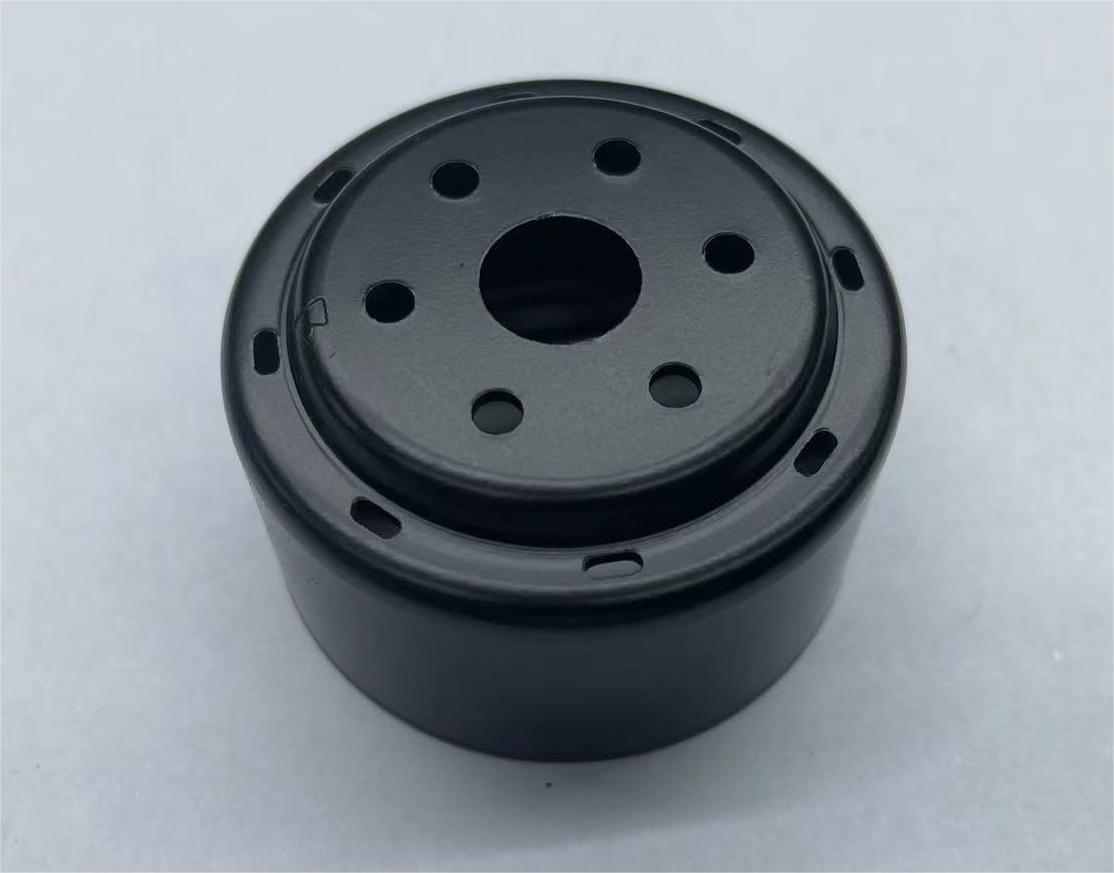
Motor housing finished in black electrophoretic coating. Complex internal geometry is the coverage test that separates E-coating from spray-based finishing.
Independent commercial research on premium automotive e-coat specifications reports OEM-mandated film builds of 18–25 µm and salt spray benchmarks of 720 to 1,000 hours. That is the reference band most high-salt-spray programs are written against, which is why the standard-versus-high decision appears in the RFQ long before the first part enters the line.
What Standard and High Salt Spray E-Coating Have in Common
Whatever target is specified, the deposition mechanism is identical. In electrophoretic deposition, charged paint particles migrate under an applied field and deposit onto the workpiece — a process based on Faraday's principle of electromagnetism. The practical consequences matter more to buyers than the physics: deep cavities, tight seams, internal holes and complex 3D geometries reach over 95–98% coverage, which is the main reason E-coating outperforms line-of-sight spray processes on parts that cannot be reached directly.
In the reference product specification for this category, standard coating thickness is 15–25 µm and can be customized to requirements, with automated lines described as holding thickness tolerance within ±1 µm and thickness variation controlled within ±5%. The film bonds firmly enough to resist peeling or blistering during assembly and transport, withstands stone chipping and thermal cycling from −40 °C to over 85 °C, and is applied from water-based paint free of heavy metals (lead-free and chrome-free systems) with very low VOC emissions and RoHS alignment.
Standardisation supports this positioning. ISO 22553-1:2019 defines the vocabulary for electro-deposition coatings and states applicability to automotive industries and other general industrial applications, including chiller units, consumer products, radiators, aerospace and agriculture. In other words, the technology is a cross-sector finishing standard, not an automotive niche.
Where the Two Configurations Actually Diverge
Standard and high salt spray electrophoretic coatings are not two different chemistries. They are two specifications of the same process, and the gap between them is created by the corrosion target, the tolerance around it, and the evidence the buyer requires to accept it.
| Decision area | Standard E-coating | High salt spray E-coating |
|---|---|---|
| Neutral salt spray target | Target set within the lower part of the reported 500–1,500 hour NSS band for e-coating overall, matched to normal or sheltered service. | Extended target, typically written above the 720–1,000 hour benchmarks reported for premium automotive e-coat specifications. |
| Film build | 15–25 µm standard, customizable to the part. | Same 15–25 µm design envelope; build and variation control become acceptance-critical, with ±1 µm line tolerance and ±5% thickness variation reported. |
| Coverage on complex geometry | Over 95–98% on cavities, seams and internal holes. | Same deposition physics; the coverage claim still has to be verified by instrument or destructive inspection, not by visual check. |
| Pretreatment sensitivity | Substrate cleaning and preparation before deposition. | Same sequence, with less margin for inconsistency: an extended target multiplies the effect of pretreatment drift. |
| Resin system | Acrylic resin or epoxy resin. | Same families; cathodic epoxy remains the dominant technology type in the global electrocoating market according to Stratview Research market analysis. |
| Verification | Pre-shipment instrument detection of film and finish. | Pre-shipment instrument detection plus a defined salt spray protocol, adhesion test and finish criteria written into the purchase order. |
| Typical fit | Consumer hardware, indoor electronics and enclosures, parts where NSS is not the limiting service factor. | Motors and motor housings, drivetrain components, outdoor and humid-service structures, parts exposed to road salts and repeated condensation. |
The practical reading is simple: choosing high salt spray does not mean choosing a different coating technology. It means choosing a supplier that will hold pretreatment, film build and bath parameters tightly enough that an extended salt spray claim survives instrument verification on every batch.
Substrate and Geometry Fit: Steel, Aluminium, Magnesium, Zinc
The same chemistry family extends across the substrates that dominate smart-manufacturing assemblies: carbon steel, alloy steel, aluminium alloy, magnesium alloy and zinc alloy. Within those families, die-cast parts, stamping parts and CNC-machined parts each bring different challenges. Die-cast surfaces are irregular and can be porous; stampings carry cut edges and tight radii; machined parts combine smooth faces with internal cavities that reward a deposition process rather than a spray process.
Magnesium alloy deserves separate treatment. A 2022 peer-reviewed study evaluated a cathodic electrodeposition epoxy coating on AZ91D magnesium alloy using immersion and ASTM B117 salt-spray testing across a 240-hour protocol. The study reported a corrosion rate of 1.65 mm/year for the CED-coated specimens, against 4.01 mm/year for aluminium powder-coated specimens and 45.87 mm/year for as-cast specimens under the same protocol.
Colour, Resin and Environmental Checks
Colour and resin selection are usually settled at the same time as the corrosion target. Black is the default appearance, available in matte or glossy, with white and custom colours available and grey or silver also offered on request. The resin systems in scope are acrylic resin and epoxy resin, and cathodic epoxy remains the dominant technology type in the global electrocoating market according to Stratview Research market analysis. For corrosion-driven programs, that dominance is a practical sourcing advantage: the mainstream market technology is epoxy-based cathodic deposition, not a specialty process.
Environmental and compliance checks should be closed out in writing before tooling or sampling begins. The coating process referenced here uses water-based paint free of heavy metals, with very low VOC emissions consistent with RoHS-type restrictions. Supplier-side documentation typically includes ISO 9001:2015 quality management certification and ISO 14001:2015 environmental management certification, with IATF16949 automotive quality management certification where automotive supply is in scope.
Dongguan Yongxin Industrial Co., LTD illustrates what that documentation looks like in practice. The company holds ISO 9001:2015 (certificate 24CN34506942Q, issued 17 June 2024, valid to 16 June 2027) and ISO 14001:2015 (certificate 24CN34506943E, issued 9 June 2025, valid to 9 June 2028), both issued by ACM INTERNATIONAL CERTIFICATION LIMITED, with the environmental scope covering surface treatment of hardware accessories (electrophoresis). The company was also recognised as a National High-Tech Enterprise under certificate GR202344016867, valid from 28 December 2023 to 28 December 2026.
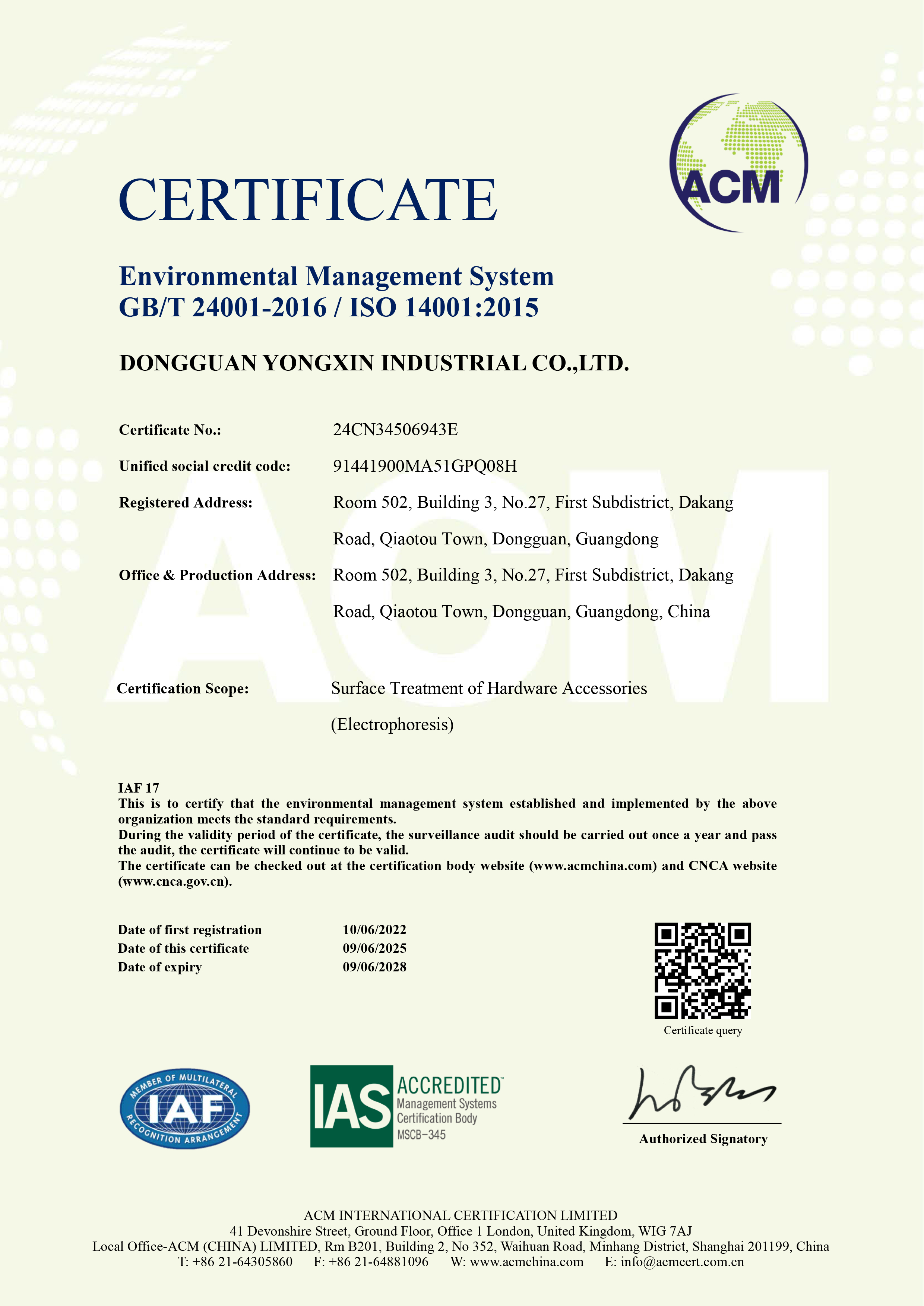
ISO 14001:2015 certificate covering the scope of surface treatment of hardware accessories (electrophoresis) — one of the documents a buyer should verify before accepting an environmental compliance claim.
Supplier Capability Behind an Extended Salt Spray Claim
Dongguan Yongxin Industrial Co., LTD is a metal surface treatment manufacturer based in Qiaotou Town, Dongguan City, Guangdong Province, China, specialising in electrophoretic coating for metal parts and operating as an OEM coating partner. Its declared product scope covers black, white and colour electrophoretic coating; zinc alloy, aluminium alloy and magnesium alloy E-coating; electrophoretic coating of die-cast parts and stamping parts; metal and surface electrophoretic coating; high salt spray, corrosion-resistant and UV-resistant formulations; epoxy resin and propionic acid resin systems; and both anionic and cationic electrophoretic coating.
Production capability matters to the standard-versus-high decision because extended targets consume process margin. The company operates six professional electrophoresis production lines, supported by more than 20 general processing units including sand blasters, polishers, shot blasting machines and laser equipment, plus over 20 CNC machines, more than 10 die-casting machines and more than 10 metal stamping machines. Declared monthly capacity is 2,500,000 units, lead time ranges from 3 to 45 days depending on quantity, and the minimum order quantity is 100 units.
Inspection is where an extended salt spray claim is either proved or lost. The reference quality system is 100% testing, supported by more than 20 high-precision instruments: a German FISCHER film thickness gauge, a Swiss Zehntner gloss meter, a Japanese Konica Minolta spectrophotometer and a Japanese Mitutoyo roughness meter, alongside a salt spray tester, constant temperature and humidity tester, reflectometer, electron microscope, tape abrasion tester, alcohol rubber friction tester and tank solution analysis equipment. Remote after-sales support is provided.
Application Evidence: What Validated Programs Look Like
Two validated programs show how the specification choice plays out in production. A motor manufacturer in Japan applies anti-corrosion and anti-rust electrophoretic coating to electric motors at a volume of 15,000,000 units; the program achieved neutral salt spray resistance of over 720 hours and extended product service life by 5 to 10 years compared with the previous non-E-coating process, over a 5–10 year duration. The reported highlights are exactly the points an extended-salt-spray buyer should test for: uniform full coverage of complex motor structural gaps, stable anti-corrosion performance under long-term harsh working conditions, low material loss during coating, and support for mass continuous production of large-volume orders.
A second program at a CNC precision machining manufacturer in China, running to 10,000,000 units over five years, reports full film coverage with no missed coating at corners or inner cavities and strong adhesion, together with acid and alkali resistance, rust prevention and anti-ageing performance. The same case notes full-process standardised operation with small batch-to-batch colour difference, and support for multi-material, multi-colour customization with fast sample confirmation and mass production on demand.
Standards and Market Direction
The direction of travel in specifications is toward instrument-verifiable claims rather than supplier statements. A technical application source maps the test methods that buyers and suppliers typically reference for cathodic electrodeposition coatings: ISO 2409 for cross-cut adhesion, ISO 2808 for dry-film thickness, ISO 6270-2 for humidity, ISO 9227 for salt spray, ASTM D1654 or ISO 4628 for rust evaluation, and ASTM B767 for electrocoating thickness.
That mapping is useful for building an RFQ and an incoming-quality test matrix. It is not sufficient on its own for a compliance claim, because the secondary source does not reproduce full standard texts or edition details; each standard should be verified against the issuing organisation before it is written into a contract.
Two structural signals point in the same direction. First, ISO 22553-1:2019 confirms electro-deposition coating as a standardised, cross-sector technology with automotive and general industrial applications. Second, cathodic epoxy holds the dominant position in the global electrocoating market per Stratview Research analysis, which means capacity and process knowledge for corrosion-driven programs sit with mainstream suppliers rather than a narrow specialist segment.
Limits, Trade-offs and Honest Boundaries
An independent comparison has to state where the high salt spray option does not give the buyer what it appears to promise.
- Accelerated hours are not service life. A 720-hour or 1,000-hour neutral salt spray result describes performance under a defined test protocol. It is an acceptance value, not a field-life warranty.
- The standard film build is the constraint. The 15–25 µm envelope is the design baseline for this coating category. Where longer salt spray performance is needed, the answer usually lies in specification, pretreatment control and bath discipline rather than in a different coating label.
- Substrate behaviour is specific. The AZ91D magnesium study reported 1.65 mm/year for CED-coated specimens against 4.01 mm/year for aluminium powder-coated and 45.87 mm/year for as-cast specimens under its own protocol. Those results cannot be generalised to other alloys, formulations or plants.
- Colour options are order-dependent. Black is the standard; white, grey, silver and custom colours depend on the order configuration, and batch-to-batch colour difference control is a real production variable, as the CNC machining case acknowledges.
- Verification scope. The reference purchasing terms set pre-shipment instrument detection as the acceptance criterion. A supplier that cannot produce instrument data cannot substantiate an extended salt spray claim.
- Secondary references remain secondary. Standards lists and market research are useful for planning, but editions, figures and methodology should be confirmed at source before contractual use.
A Buyer Checklist for Terms and Acceptance Criteria
Purchasing terms are where a technical comparison becomes an enforceable order. The reference terms for this coating category are straightforward: minimum order quantity of 100 units, negotiable for large orders; delivery terms FOB or CIF, subject to negotiation; acceptance criteria based on pre-shipment instrument detection; and payment terms of 100% full payment.
| Purchasing term | Reference position |
|---|---|
| Minimum order quantity | 100 units, negotiable for large orders |
| Delivery terms | FOB / CIF, subject to negotiation |
| Acceptance criteria | Pre-shipment instrument detection |
| Payment terms | 100% full payment |
| Lead time | 3–45 days depending on quantity |
| Quality control | 100% test |
| After-sales | Remote support |
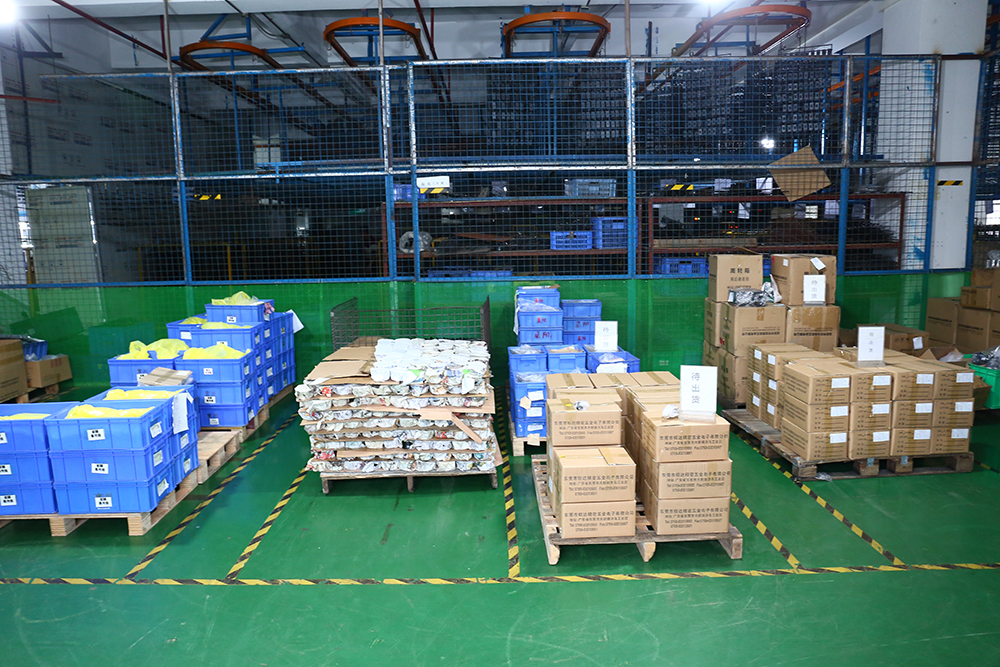
Coated parts staged for shipment. Pre-shipment instrument detection is the acceptance gate that converts a coating specification into a verifiable delivery.
On the technical side, five acceptance points should be written explicitly into the order rather than left to the drawing:
- Adhesion: cross-cut adhesion performance, referenced to a named standard such as ISO 2409 where the buyer wants a defined method.
- Uniformity of film: thickness measured at defined positions across the part, including cavities and edges, not only on flat faces.
- Coverage: confirmation that tight seams, internal holes and deep recesses show no missed coating.
- Finish requirements: surface texture free of flow marks, blisters and other visible defects, with colour and gloss targets defined against a master sample.
- Corrosion target: the salt spray hours and the test protocol written as a number, so that pass or fail is objective.
What Changes Next in Smart Manufacturing Finishing
Two shifts are visible in how extended salt spray programs are specified. The first is instrumentation. Film thickness gauges, gloss meters, spectrophotometers and roughness meters already exist on modern lines, and the logical next step is per-batch instrument records attached to the shipment rather than a single qualification report at the start of a program.
The second is chemistry and compliance convergence. Water-based, heavy-metal-free, low-VOC systems with ISO 9001 and ISO 14001 documentation are becoming the baseline condition for entering regulated supply chains, not a differentiator. Buyers evaluating standard versus high salt spray coating should therefore expect to compare suppliers on measurable process control — film build consistency, bath solution analysis, inspection coverage and batch colour stability — rather than on coating descriptions alone.
FAQ
What is the difference between high salt spray and standard electrophoretic coating?
Both are electrophoretic deposition processes that build a 15–25 µm film, customizable to the part, using acrylic or epoxy resin systems on carbon steel, alloy steel, aluminium alloy, magnesium alloy and zinc alloy. The difference is the neutral salt spray target and the process control behind it. Electrophoretic coating typically achieves 500 to 1,500 hours without red rust in neutral salt spray testing, with CASS testing exceeding 96 hours in the same reference specification, and over 1,000 hours is reported for the coating system. A high salt spray configuration is one specified and controlled toward the upper end of that band, benchmarked against the 720–1,000 hour targets reported for premium automotive e-coat specifications.
What film thickness and coverage can buyers expect?
Standard coating thickness is 15–25 µm and can be customized to requirements. Automated E-coat lines are described as holding thickness tolerance within ±1 µm, with thickness variation controlled within ±5%. Coverage on deep cavities, tight seams, internal holes and complex 3D geometries is reported above 95–98%, which is why deposition-based coating is preferred over spray processes on parts with hidden surfaces.
Which metal substrates can be electrophoretically coated?
The applicable substrate range covers carbon steel, alloy steel, aluminium alloy, magnesium alloy and zinc alloy, including die-cast parts, stamping parts and CNC-machined parts. Magnesium alloy requires additional validation: a 2022 peer-reviewed study on AZ91D magnesium alloy tested a cathodic electrodeposition epoxy coating with immersion and ASTM B117 salt spray over a 240-hour protocol and reported a corrosion rate of 1.65 mm/year for CED-coated specimens, versus 4.01 mm/year for aluminium powder-coated and 45.87 mm/year for as-cast specimens. Those values are specific to that study's specimens and protocol and should be treated as a reason to require substrate-specific testing.
What certifications and environmental checks should a supplier document?
Typical documentation includes ISO 9001:2015 quality management certification, ISO 14001:2015 environmental management certification, and IATF16949 automotive quality management certification where automotive supply is in scope. In the reference case, Dongguan Yongxin Industrial Co., LTD holds ISO 9001:2015 under certificate 24CN34506942Q (issued 17 June 2024, valid to 16 June 2027) and ISO 14001:2015 under certificate 24CN34506943E (issued 9 June 2025, valid to 9 June 2028), both issued by ACM INTERNATIONAL CERTIFICATION LIMITED with a scope covering surface treatment of hardware accessories (electrophoresis). On the environmental side, the coating process uses water-based paint free of heavy metals, with very low VOC emissions consistent with RoHS-type restrictions.
What purchasing terms and acceptance criteria apply?
The reference purchasing terms are a minimum order quantity of 100 units, negotiable for large orders; delivery terms FOB or CIF subject to negotiation; acceptance criteria based on pre-shipment instrument detection; and payment terms of 100% full payment. Production lead time is 3 to 45 days depending on quantity, quality control is 100% testing, and after-sales service is provided through remote support. Buyers should also define adhesion, film uniformity, coverage, and finish requirements — including freedom from flow marks and blisters and colour consistency against a master sample — so that acceptance is measurable rather than interpretive.
For the full configuration range, including black, white and colour E-coating and high salt spray formulations, the coating solutions brochure is available for download: Enameled Flat Wire and Electrophoretic Coating Solutions (PDF).
Tem questões ou precisa de mais detalhes?
Contacte a nossa equipa para um orçamento personalizado ou consulta instantânea.
Solicitar orçamento
Preencha o formulário abaixo e a nossa equipa entrará em contacto com uma proposta personalizada.
Chat direto do WhatsApp
Prefere conversar em tempo real? Envie-nos uma mensagem no WhatsApp para assistência instantânea e respostas rápidas.
- Obter orçamento personalizado
- Partilhar fotos ou documentos
- Discuta as suas necessidades diretamente
Geralmente responde em 5–30 minutos durante o horário de expediente.