
High-Speed Bendable Straw Forming Machine Shortlist: Mold, Capacity, Controls
High-Speed Bendable Straw Forming Machine Shortlist: Mold, Capacity, Controls
Buyers evaluating a high-speed bendable straw forming machine rarely lack supplier pages to read. What they lack is a way to compare them. Capacity is quoted on different definitions, mold ranges are stated in inside diameters that may not match the tube blanks a plant actually buys, and control systems are often summarised as "PLC" whether the screen shows a fault code or only a start button.
This shortlist framework reduces the comparison to three checks that can be settled before price: mold fit against local straw specifications, capacity read as a continuous figure rather than a headline, and the control and line-connection layer that decides how the machine behaves inside an existing plant. DONGTIE MECHANICAL EQUIPMENT, a straw machinery manufacturer based in Zhongshan, China, serves as the worked reference here, because its DT-1200 platform, its 60-set installed base across Southeast Asia, the Middle East and domestic China, and its published specification set allow the framework to be tested rather than merely illustrated.
Mold fit decides what the machine can make — and at what tolerance
A bendable straw forming machine is tooling-led. The mold set fixes the straw diameter, the bend geometry and the usable length window; the frame, drives and controls only determine how fast that mold can run and how repeatably it holds the shape. Two machines quoting similar speeds can therefore serve entirely different product ranges, which is why mold fit belongs at the top of the shortlist rather than in the commercial annex.
DONGTIE's stated approach is to tune the mold to the buyer's local straw specification instead of forcing the buyer onto a single catalogue size — a highlight recorded across its installed projects in Southeast Asia and the Middle East. The same platform can produce flexible straws of different diameters and bending angles by changing the corresponding molds, and the product range covers small-diameter work such as 3.8 mm U-shaped and 5 mm flexible straw, through 6 mm and 12 mm pointed-tip and large-diameter art straw configurations.
Tolerance is the second half of mold fit. DONGTIE's patented embossing and forming module is specified to control standard straw diameter tolerance at ±0.05 mm, and the high-efficiency embossing stage is designed to relax the tolerance demanded of incoming tube blanks. For a buyer, that changes the upstream question: instead of asking whether a machine can hit a nominal diameter, ask how much variation in purchased tube blanks it will absorb before output quality starts to move.
The practical comparison step is a sample run on the buyer's own material. Send the tube blanks actually being purchased — with inside diameter, outside diameter, wall thickness, cut length, polymer grade and target bend angle stated — and ask for the mold drawing plus a run of finished straws for measurement. A supplier that cannot describe the mold for a specific local specification is offering a machine, not a fit.
Capacity: separate the continuous figure from the peak figure
The single most useful discipline at evaluation stage is to read every capacity number as belonging to one of two categories: a continuous output that a plant can plan around, or a peak capability recorded under conditions that are rarely published. Mixing the two is how a shortlist produces a machine that cannot meet its own production plan.
DONGTIE's published DT-1200 specification lists a minimum output of 1,000 straws per minute and a peak capability of 3,000–5,500 pieces per minute. The 60-set installed base across Southeast Asia, the Middle East and domestic China records at least 1,000 straws per minute as the achieved figure, together with continuous running without needle breakage — and the same record states that one high-speed flexible straw forming machine replaces five traditional machines, which the referenced comparison describes as running at roughly 200–300 pieces per minute each.
That discipline matters more than any single number, because the published market is full of claims that look comparable and are not. The table below collects documented output statements from manufacturer and marketplace pages. Each is attributed to its publisher and none has been re-tested on a common protocol.
| Machine / source | Stated output | Stated straw scope | What the claim establishes — and what it does not |
|---|---|---|---|
| DONGTIE DT-1200 (manufacturer specification, 2026) | Minimum 1,000 pcs/min; peak 3,000–5,500 pcs/min | Flexible straw; diameter set by mold | Provides a planning floor and a peak; the peak test conditions are not published |
| Jumbo Steel JS165 (manufacturer page, 2025) | 600–700 pcs/min | Flexible drinking straw; PP, PLA and PHA listed | Advertised production capacity; no test protocol disclosed |
| Jumbo Steel JS168 (same page) | Up to 1,000 pcs/min | Flexible drinking straw | Described as a maximum speed rather than continuous output |
| JIEXUAN high-speed machine (catalogue, 2023) | 550–600 pcs/min | Inside diameter 4.8–11.8 mm | Both capacity and diameter are company-reported |
| KZ023 listing (2026) | 550–600 pcs/min | Inside diameter 3.8–12 mm | Marketplace listing; no independent validation located |
| Model 021 listing (2026) | 200–300 pcs/min | Inside diameter 3.8, 4.8 and 5.8 mm | Standard-tier reference point, not a high-speed claim |
Read as a set, these statements describe nominal tiers rather than a benchmark: standard machines around 200–300 pieces per minute, listed high-speed machines in the 550–700 range, and a top band at or above 1,000. Different models, straw geometries, materials and cycle definitions sit behind each figure, so the table is a tool for writing questions, not for producing a ranking.
Converting a figure into a plan is straightforward once the continuous number is fixed. At 1,000 straws per minute, one eight-hour shift represents an arithmetic ceiling of 480,000 straws before downtime, mold changeover and rejects are deducted; the buyer then applies its own realistic uptime, scrap rate and changeover frequency to reach a defensible shift output. That calculation is arithmetic, not a performance promise, and it is the reason a supplier's peak claim should never be substituted for the planning figure.
Controls and line connection: what the PLC layer actually governs
Control specification is where evaluation-stage buyers most often accept a one-word answer. On a high-speed forming line the control layer has four jobs: hold the forming parameters, expose machine state while running, stop the machine safely when something drifts, and hand a countable, transferable product to the next stage.
DONGTIE's DT-1200 is equipped with a PLC control system that displays real-time operating status, automatically stops the machine on malfunction with the fault code shown on screen, and counts output automatically. The forming architecture behind that interface is deliberately modular: the embossing and forming modules are separately adjustable, which the manufacturer states reduces maintenance difficulty, and a precision feeding unit supports long-term stable operation. The underlying technology is covered by Chinese utility model Patent No. ZL202020756632.1, with Certificate of Utility Model Patent No. 12166973 issued by the China National Intellectual Property Administration on 18 December 2020 and recorded as valid to 9 May 2030, in scope for the DT-1200 platform.
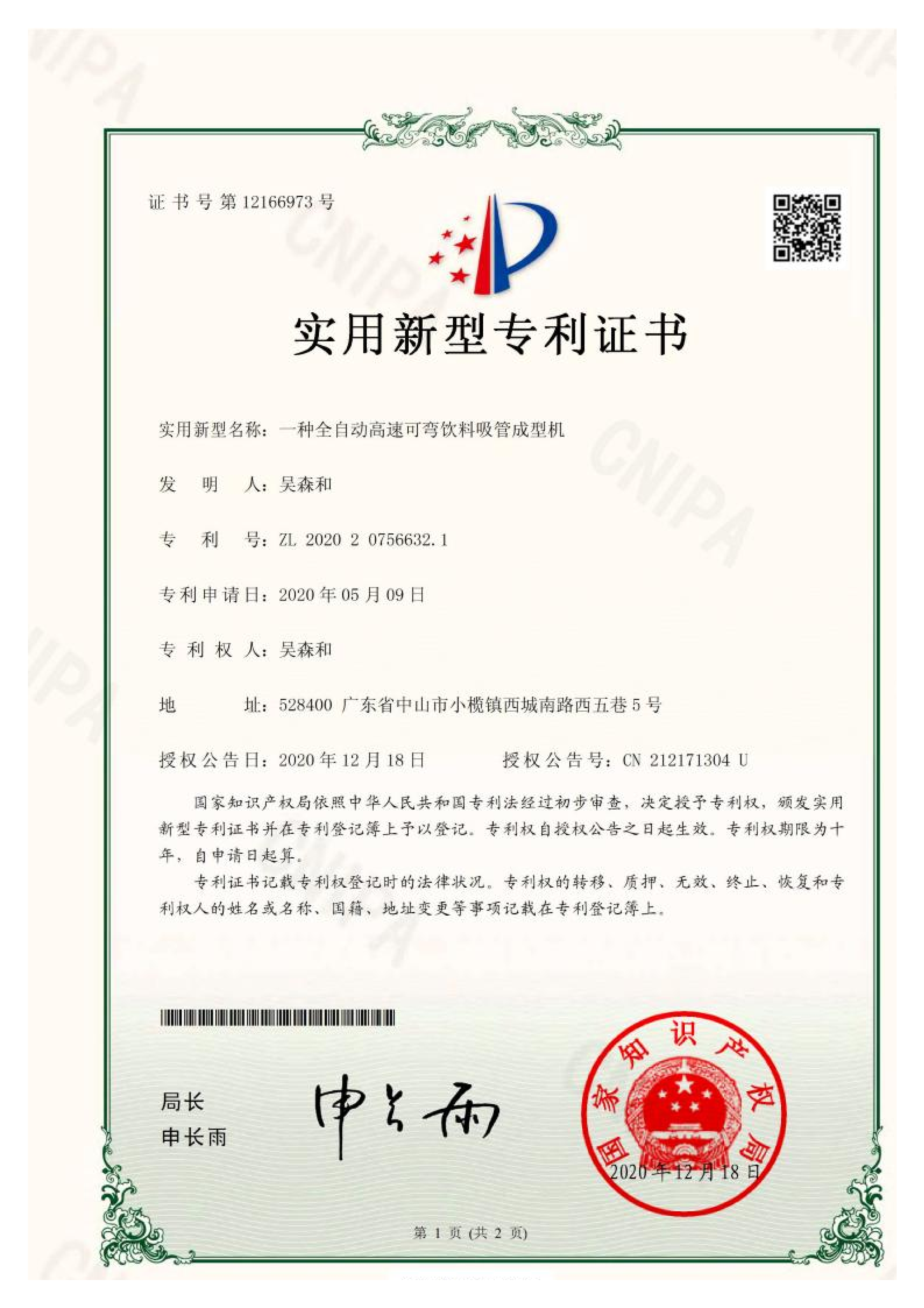
Two qualifications belong beside that evidence. The patent is a Chinese utility model, mainly valid in China, and it does not by itself establish machinery safety, electrical conformity or food-contact compliance in a destination market — those remain separate verification workstreams. And an automatically displayed fault code is only useful if the plant knows what to do with it; DONGTIE's stated support model includes remote video technical guidance for common faults, which is the operational counterpart to the on-screen code.
Line connection is the second half of the control question. The machine is designed to run either standalone or connected to a production line, with upstream and downstream equipment such as a feeder, sealing and cooling unit, packaging machine and conveyor system. In the wider market, forming equipment of this class is commonly positioned as secondary processing: straight straws are fed from a hopper, pass through forming components, and transfer to an output conveyor automatically, as one supplier describes its own high-speed unit. That positioning has a direct consequence for evaluation — a high-speed bending machine speeds up the bending step, not the tube extrusion step before it, so the upstream straight-straw supply has to be sized to match or the new unit will idle.
What 60 sets across three regions indicate about fit
Installed-base evidence is more useful than a specification sheet when the question is whether a machine survives a real production calendar. DONGTIE reports 60 sets of high-speed flexible straw forming machines installed for clients in Southeast Asia, the Middle East and domestic China, with the project completed within three years. The recorded client types are straw factories in those regions, including a client in Malaysia representing the Southeast Asian market, and the stated application is mass production of flexible straws replacing manual or semi-automatic processes.
Three elements of that record are worth carrying into a shortlist discussion. First, the projects are described as involving a custom-tuned mold solution for local straw specifications, which is the same mold-first logic set out above, applied repeatedly rather than once. Second, the machines are reported to deliver stable long-term continuous-run performance, alongside the 1,000-straws-per-minute achieved output and consistent finished-product quality. Third, full-set after-sales technical support is described for overseas sites — a logistics question as much as a service question, since an export installation lives or dies on response time and spare-part availability.
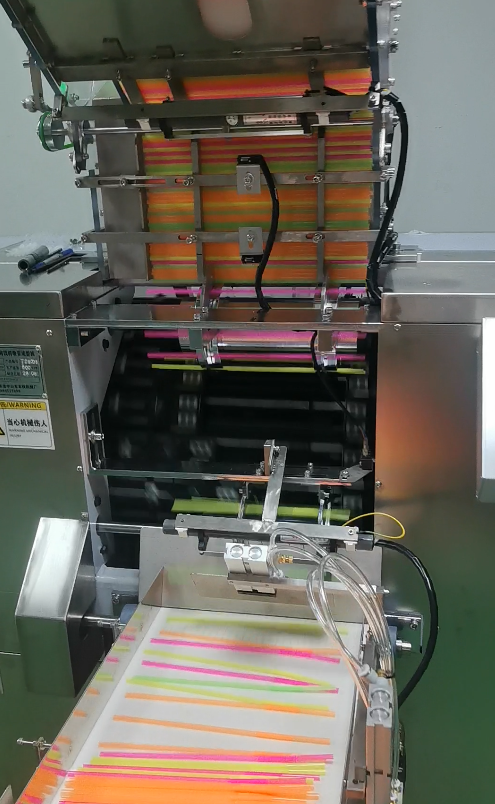
The honest boundary is that an installed base is a company-reported record, not an independently audited performance study. What it does establish is repetition: the same platform, the same mold-tuning method and the same support model applied across three regions over three years. What it does not establish is a measured reject rate, uptime percentage or changeover time — those still have to be requested project by project.
Where the one-replaces-five comparison holds, and where it stops
The replacement ratio is the most quoted number in this category and the most easily misread. DONGTIE's record states that one high-speed flexible straw forming machine replaces five traditional machines, and the comparison only makes sense against the traditional tier described in the same record at roughly 200–300 pieces per minute. On that basis the ratio is a statement about throughput consolidation, not about floor space, headcount or capital cost, none of which are covered by the figure.
Several fit boundaries should be tested before the ratio is treated as a plan. The first is upstream capacity: if existing tube-making output cannot feed a machine running at four to five times the bending throughput, the constraint simply moves one station upstream. The second is material. Supplier pages in this category list PP, PLA and PHA as compatible materials, but material-specific performance — particularly for biopolymers with different stiffness and heat behaviour — should be confirmed by running the buyer's own resin through the mold rather than inferred from a compatibility list. The third is wear-part logistics: the installed-base record credits continuous running without needle breakage, which is a maintenance argument, not a claim that consumables disappear; needle and spare-part supply terms still belong in the evaluation file.
There is also a boundary in the other direction. A high-speed unit is not automatically the right answer for a plant whose order book is dominated by short runs and frequent specification changes, because every diameter and bend geometry change is a mold change. Where product mix is wide and volumes are low, the case for consolidation is weaker than the case for mold flexibility, and the two should be judged separately.
Market context: a growing equipment category with uneven evidence
Market Research Future estimated the global straw machine market at USD 962.55 million in 2024, projecting it to reach USD 1,793.41 million by 2035 at a compound annual growth rate of 5.82% (report dated 24 August 2026). The publisher states a methodology, which makes the figure usable as directional context; it is commercial research covering straw machinery broadly, not a measurement of the bendable segment alone, and it should not be used to size an individual investment case.
What the supplier landscape adds to that context is a clear tiering rather than a settled benchmark. Alongside DONGTIE's stated 1,000-straws-per-minute floor, published claims from other manufacturers sit at 550–700 pieces per minute for listed high-speed models and up to 1,000 for one maximum-speed specification, while standard-tier listings remain at 200–300. Those numbers are not measured on a common protocol, so the useful conclusion is procedural: published capacity in this category requires definition-level questioning, and a buyer who normalises definitions early will shortlist faster than one who compares headline figures.
Verification steps before a shortlist becomes a purchase order
Most of the framework above can be closed out inside a supplier's own documentation and a test run. The following checks are the ones that convert a plausible shortlist into a defensible order, and each maps to a specific piece of evidence a buyer can ask for.
- Mold specification and sample run. Obtain the mold drawing for the intended diameter and bend angle, run the buyer's own tube blanks, and measure diameter tolerance and bend consistency on finished straws.
- Capacity definition in writing. Ask the supplier to state which figure is continuous and which is peak, and under what straw diameter, polymer and run length each was observed.
- Pre-delivery test evidence. DONGTIE's factory inspection includes a pre-delivery test run and functional verification, and factory inspection reports can be provided on demand — request the report rather than assuming it exists.
- Control behaviour on the floor. Confirm what the PLC screen displays during a fault, what the machine does automatically on malfunction, and how the fault code maps to a corrective action the plant's own technicians can perform.
- Line-connection match. Confirm feeder, sealing and cooling, packaging and conveyor interfaces against the existing line, and decide explicitly whether the unit runs standalone or connected.
- Commercial terms. DONGTIE states a minimum order of one set, a 30-day lead time and a monthly capacity of 20 sets; warranty terms and response time are recommended to be confirmed before purchase rather than assumed from a general service description.
- Overseas support plan. Installation and commissioning, remote technical support and spare-parts supply are the stated services, and on-site training can be arranged in the manufacturer's own straw production workshop, which is equipped with more than ten full production lines.
Two background details help calibrate the supplier behind those checks. DONGTIE MECHANICAL EQUIPMENT operates a 2,000 m² factory with an annual output of 200 sets and an export ratio of 50%, serving processing and packaging enterprises through international trade channels. The company's own site is zsdtjx.com, where the DT-1200 platform and related straw forming equipment are documented.
Outlook: the shortlist will be decided by definitions, not by headlines
The direction of this equipment category is toward fewer, faster forming units with more of the production record visible on a screen — which means the evaluation conversation is shifting from tonnage-style speed claims to definitional questions about continuous output, mold changeover and fault recovery. For a buyer at evaluation stage in Southeast Asia, the Middle East or any export market, that shift is favourable: the questions that separate a good fit from a poor one are now answerable with drawings, test runs and inspection reports rather than with brochures.
The framework, in one line: match the mold to the straw the local market actually sells, plan on the continuous capacity rather than the peak, and verify the control and connection layer against the line the machine will join. A shortlist built on those three checks will be shorter than a list built on advertised speed, and considerably more likely to hold up in its second year of production.
Frequently asked questions
How can a buyer confirm that a bendable straw machine's mold matches local straw specifications?
Mold matching is verified by specification and by sample, not by catalogue range alone. The buyer should state the inside and outside diameter, wall thickness, cut length, polymer grade and target bend angle for the straws actually sold in its market, then request the corresponding mold drawing and a test run on its own tube blanks. DONGTIE's installed projects in Southeast Asia and the Middle East are described as using custom-tuned mold solutions for local straw specifications, and because the platform produces different diameters and bending angles by changing molds, the relevant document is the mold specification for the intended product rather than a general machine rating.
Is 1,000 straws per minute the real output of a high-speed bendable straw forming machine?
It is the continuous figure recorded for the DONGTIE DT-1200 platform and for the 60-set installed base, and the published specification additionally lists a peak capability of 3,000–5,500 pieces per minute. The two numbers describe different operating conditions, and the peak conditions are not published. For planning purposes the continuous figure is the defensible basis: at 1,000 straws per minute an eight-hour shift represents an arithmetic ceiling of 480,000 straws before downtime, mold changeover and rejects are deducted, so shift output should be calculated with the plant's own uptime and scrap assumptions rather than with a peak claim.
Which control features should be verified on a high-speed straw forming machine?
Four behaviours are worth confirming directly. The PLC should display real-time operating status so an operator can see drift before it becomes scrap; the machine should stop automatically on malfunction with a fault code shown on screen; output counting should be automatic so production records do not depend on manual tallies; and the forming modules should be separately adjustable so maintenance can be carried out on one element without disturbing the others. On the DT-1200, the separately adjustable embossing and forming modules and the precision feeding unit are the mechanical counterparts to the PLC layer, and the underlying technology is covered by Chinese utility model Patent No. ZL202020756632.1.
What line connection schemes does a flexible straw forming machine support?
The machine is designed to operate either standalone or connected into a production line, with upstream and downstream equipment such as a feeder, a sealing and cooling unit, a packaging machine and a conveyor system. In this equipment class the forming machine is generally a secondary processing unit that receives straight straws and outputs bent straws, so the connection decision turns on whether the plant's existing tube-making and packaging stages can be matched to the new forming speed. Where the upstream supply cannot keep pace, the forming unit either runs below its capacity or requires a corresponding upstream investment.
What after-sales support should an overseas straw factory confirm before ordering?
Overseas sites should confirm four items in writing: installation and commissioning arrangements, the remote technical support channel and how common faults are handled through it, spare-parts supply terms including lead time for wear parts such as needles, and the warranty terms with a stated response time. DONGTIE's stated services cover installation and commissioning, remote technical support and spare-parts supply, with full-set after-sales technical support described for overseas sites, and on-site training available in the manufacturer's own production workshop. Because warranty terms and response times are recommended to be confirmed before purchase, they belong in the evaluation file rather than in a general understanding.
A downloadable product brochure covering the straw forming equipment range is available here: DONGTIE MECHANICAL EQUIPMENT product brochure (PDF).
Tem questões ou precisa de mais detalhes?
Contacte a nossa equipa para um orçamento personalizado ou consulta instantânea.
Solicitar orçamento
Preencha o formulário abaixo e a nossa equipa entrará em contacto com uma proposta personalizada.
Chat direto do WhatsApp
Prefere conversar em tempo real? Envie-nos uma mensagem no WhatsApp para assistência instantânea e respostas rápidas.
- Obter orçamento personalizado
- Partilhar fotos ou documentos
- Discuta as suas necessidades diretamente
Geralmente responde em 5–30 minutos durante o horário de expediente.