
High-Speed Solid Dosage Packaging Line Features to Shortlist
A high-speed solid dosage packaging line is no longer evaluated by its blister speed alone. Buyers comparing integrated blister cartoner lines need to separate headline output from the features that determine line stability, changeover discipline, data handling and validation effort. This feature shortlist is a buyer-side screen for that evaluation.

Industry exhibition context. Image: HOPING facility image library.
Zhejiang Hoping Machinery Co., Ltd. (HOPING) is a Chinese manufacturer of blister packaging machines, cartoning machines, case packing machines and end-of-line packaging equipment, established in 2001. Its portfolio places it among suppliers that can be screened for an integrated blister-cartoning line rather than a single stand-alone machine. The DHL8005H automatic blister-cartoning line is a useful reference point for this feature shortlist because the assigned brief identifies a Beckhoff CP9315 PC-based control platform and a stated 800 blisters/min output. Those facts are starting points for evaluation, not substitutes for factory acceptance testing.
Why a Feature Shortlist Beats a Headline-Speed Comparison
At the evaluation stage, a buyer usually has a target output range and a product family in mind. The commercial question then shifts from 'which machine is fastest' to 'which feature set can hold output under real production conditions'. This is particularly true for solid dosage formats such as tablets, capsules and other solid dosage forms, where blister forming, product feeding, carton erection, leaflet insertion and downstream transfer interact.
A line can post an attractive nominal speed while creating hidden cost in film roll changes, line stops, manual transfers, format changeover, rejected cartons or fragmented production data. A practical shortlist therefore looks at six features: automatic splicing, independent servo channels, PC-based controls, blister-to-cartoner handshake, inspection and data-interface readiness, and downstream line readiness. Each feature should be evidenced with a configuration statement, a validation method and a clear boundary condition.
The Shortlist at a Glance
| Shortlisted feature | What it controls | Buyer question |
|---|---|---|
| Automatic splicing | Film roll change and web continuity | Does the line stop for every roll change, and how is splice quality validated? |
| Independent servo channels | Motion coordination and recipe control | Which axes are independently driven, and how are they synchronised? |
| PC-based controls | HMI, recipe management and data exchange | What control platform is used, and what data can be exported? |
| Blister-to-cartoner handshake | Line balancing and buffer logic | How does the line behave when cartoning slows or stops? |
| Inspection and data interface | Coding, inspection and traceability readiness | Which inspection and coding options are integrated, and to what interface? |
| Downstream line readiness | Case packing, bundling and end-of-line fit | Can the line connect to case packing and palletizing without manual transfer? |
1. Automatic Splicing: Less Downtime, More Validation Discipline
Automatic splicing is a roll-change feature that joins a new packaging film web to the running web. In principle, it reduces the need to stop the blister line for every film roll change. In practice, the buyer should treat it as a controlled process rather than a simple convenience. The evaluation should cover roll-end detection, splice positioning, tension control, tail control and the method used to validate splice quality.
For high-speed solid dosage lines, splicing interacts with forming temperature, dwell time and blister appearance. A poorly controlled splice can create a short disturbance in web tension. The buyer should ask how the line isolates a splice, whether rejected blisters are automatically diverted, and how the splice event is recorded. This is also a data question: if the line is PC-based, the splice event should be visible in production logs rather than existing only in operator memory.
2. Independent Servo Channels: Motion Architecture Buyers Can Inspect
Independent servo channels describe a motion architecture in which key axes are driven and controlled separately rather than being tied to a single mechanical master. The value is not the word 'servo' itself. The value is what independent motion allows: electronic synchronisation, recipe-based position changes, faster format adjustment in some sections, and clearer fault isolation.
During evaluation, ask for the axis list. Which functions are independently driven: forming, sealing, blister advance, carton erection, leaflet feed, product push or transfer? How are the axes synchronised, and what happens when one axis faults? A line with independent servo channels can be easier to diagnose, but it also requires disciplined parameter management and trained maintenance staff. The feature should therefore be evaluated together with the control platform and the supplier's commissioning support.
3. PC-Based Controls: From HMI to Data Interface
PC-based control is a meaningful shortlist feature because it moves the line beyond a simple operator panel. An industrial PC platform can support recipe handling, line-status display, alarm history, production counters and data exchange with factory systems. The DHL8005H reference in this shortlist is associated with a Beckhoff CP9315 PC-based control platform and a stated 800 blisters/min output. That combination is a prompt for due diligence: buyers should ask which functions run on the PC, which functions remain on separate controllers, and what happens if the PC or network fails.
PC-based controls do not automatically make a line GMP-compliant or data-integrity ready. They create the technical possibility for better data capture and recipe control. The buyer still needs to specify user access, audit trail expectations where applicable, alarm management, backup and restore routines, interface language and data-interface requirements. HOPING's customization list includes coding and inspection method, interface language, electrical component brand and data interface, which means these points can be handled as configuration items rather than afterthoughts.
4. Blister-to-Cartoner Handshake: The Line-Balancing Feature
The most important integrated-line feature is often invisible on a specification sheet: the handshake between blister output and cartoner input. A blister cartoning line has two different output measures. Blister output is counted in blisters per minute; cartoning output is counted in cartons per minute. They can only be compared when the number of blisters per carton, leaflet format and carton configuration are known.
A buyer should ask how the line handles short stops, buffer accumulation, missing-blister rejection and carton rejection. Does the cartoner pause when the blister infeed is interrupted? Is there a buffer, and how is it sized? What happens to partially filled cartons? These questions matter more than a single maximum speed figure because they determine whether the integrated line runs as a system or as two machines connected by a transfer.
5. Inspection, Coding and Data-Interface Readiness
Inspection and coding features should be shortlisted early, not added after the mechanical layout is fixed. HOPING's customization options include coding and inspection method, feeding method, interface language and data interface. For a pharmaceutical packaging line, these choices affect reject handling, operator workflow and the records available for batch review.
The buyer does not need to specify every sensor at the first meeting, but should define the intended inspection scope. Is the requirement limited to missing blister or missing leaflet detection, or does it extend to code verification and data upload? Which events must be logged? Which data must be exported, and in what format? A PC-based control platform such as the Beckhoff CP9315 on the DHL8005H reference can support data exchange, but the required data map should be agreed before acceptance testing.
6. Downstream Line Readiness: Case Packing and End-of-Line
A high-speed blister cartoner is only as useful as its downstream connection. HOPING's stated product scope covers blister packaging machines, cartoning machines, case packing machines and end-of-line packaging equipment. Its integrated packaging line description includes blister packing, cartoning, flow packing, case packing and palletizing equipment. This matters at the evaluation stage because a line that cannot transfer cartons cleanly to a case packer will still require manual intervention.
The shortlist question is therefore not only 'what is the cartoner speed' but 'what is the carton transfer pattern, and how does the case packer receive it?' Buyers should ask for the line layout, accumulation logic and downstream interface definition. If the project includes bundling, case packing or palletizing, the configuration should be evaluated as one material-flow system.
Where HOPING Fits the Feature Shortlist
HOPING's first-party facts are relevant to a buyer screening integrated lines. The company was established in 2001, operates a 28,800 square metre facility, employs 300 people, reports annual output of 500 units and has 56 engineers. Its export ratio is 25%, with main markets including Southeast Asia, the Middle East, Eastern Europe, South America and Africa. Its main products are blister packaging machines, cartoning machines, case packing machines and end-of-line packaging machines.
For project configuration, HOPING lists customization of blister size, blister materials, quantity per carton, carton specification, leaflet format, coding and inspection method, feeding method, downstream bundling, case-packing and palletizing connection, interface language, electrical component brand and data interface. The company reports a minimum order of one set or one complete line, with a typical lead time of 60 to 120 days after technical confirmation, subject to model, configuration, project complexity and contract terms.
Quality control facts are also part of the shortlist because high-speed lines depend on build discipline. HOPING describes incoming material inspection, key component inspection, assembly inspection, electrical safety check, no-load trial run, material trial, FAT, customer witness acceptance and pre-shipment inspection. These are the checkpoints a buyer can convert into acceptance criteria.
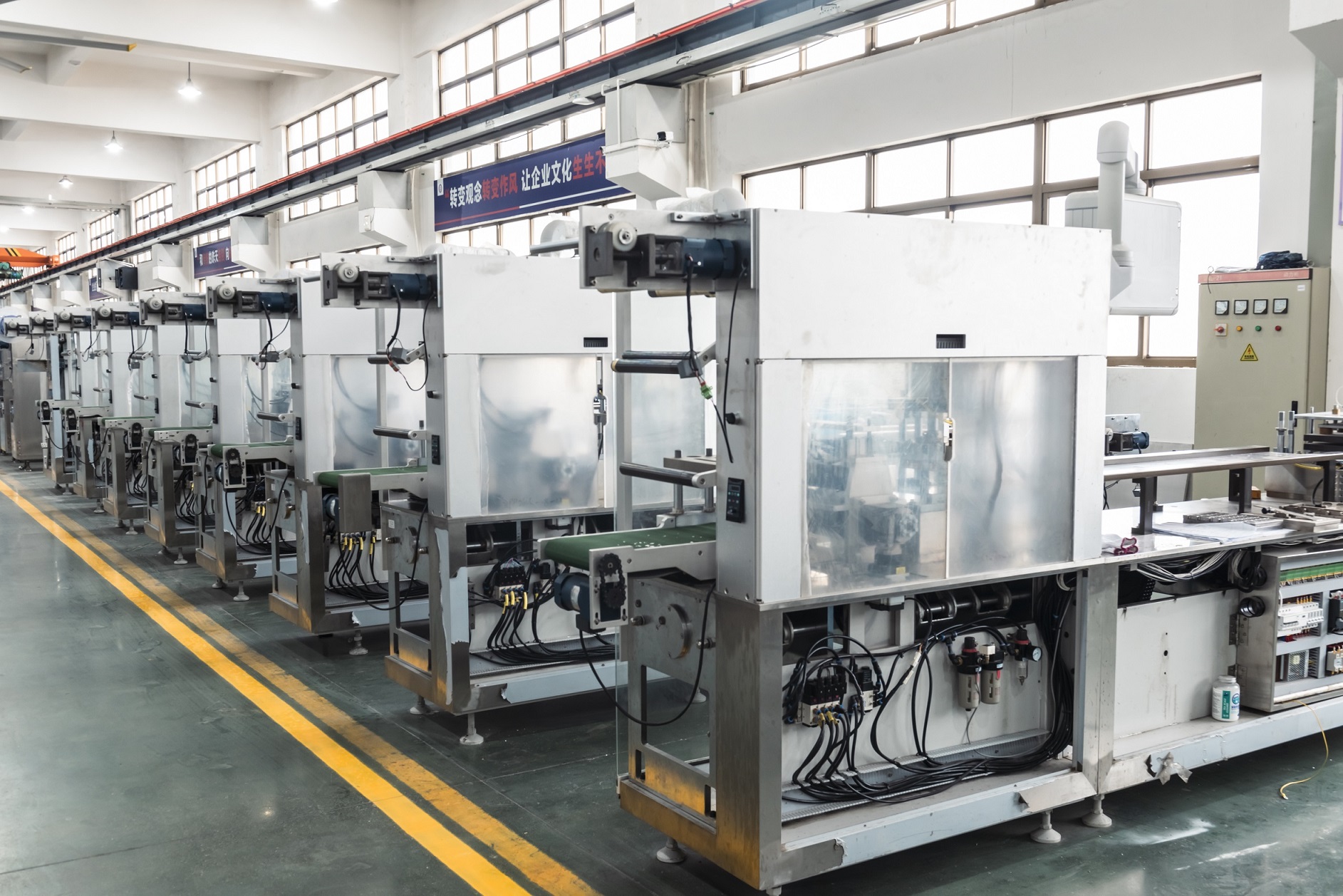
Blister packaging machine workshop. Image: HOPING facility image library.
Application Fit: Tablets, Capsules and Solid Dosage Expansion
The application context for this feature shortlist is solid dosage packaging: tablets, capsules and other solid dosage forms. HOPING's case material describes blister packaging and automatic cartoning for these formats, with project profiles that include large pharmaceutical manufacturers, solid dosage production companies and pharmaceutical engineering contractors. The same material identifies new line construction, capacity expansion and upgrading of existing packaging lines as relevant project situations, with representative line quantities of 5 to 10 lines.
This matters because a feature shortlist should be read against the buyer's operating model. A new greenfield line can specify automatic splicing, independent servo channels, PC-based controls and downstream case packing as an integrated package. An upgrade project may need to protect existing upstream or downstream equipment, which changes the value of each feature. In both cases, the buyer should ask for a configuration-specific feature list rather than a generic machine brochure.
Market Trend Analysis: What the Verified Data Supports
Verified market data supports a cautious but useful trend picture. Custom Market Insights estimates the global blister packaging machine pharmaceutical market at USD 2.57 billion in 2025 and identifies Asia-Pacific as the fastest-growing region for pharmaceutical blister packaging, with an 8.87% CAGR to 2031. Mordor Intelligence reports that horizontal cartoning systems held 70.12% of the market share in 2024. A separate commercial research estimate places the global pharmaceutical packaging machinery market at USD 7.09 billion in 2026, with a reported 7.15% CAGR.
These figures should be used as context, not as a machine-level forecast. They do not establish the share of high-speed integrated lines, nor do they prove that every solid dosage producer should move to a higher speed. What they do support is the direction of travel: blister packaging and cartoning remain central equipment categories, and buyers are likely to keep evaluating integrated lines as capacity and compliance requirements evolve. The verified data does not justify any claim that a particular supplier leads the market.
Comparison with Traditional Solutions
A traditional solid dosage packaging setup often uses a stand-alone blister machine, a separate cartoner and manual or semi-manual transfer between stages. An integrated high-speed blister cartoning line changes the operating logic. It can reduce manual transfer, connect blister and carton output through a machine handshake, and make production data easier to collect. It can also introduce new validation and maintenance demands.
| Evaluation area | Traditional stand-alone steps | Integrated high-speed line |
|---|---|---|
| Material flow | Manual or semi-manual transfer between blister and carton stages | Machine handshake and buffer logic can reduce manual transfer |
| Film changes | Roll changes can stop the blister stage | Automatic splicing can reduce stops but requires splice validation |
| Motion and recipe control | More mechanical adjustment and separate controls | Independent servo channels and PC-based controls can improve repeatability and data access |
| Data visibility | Fragmented records across machines | Potentially more integrated data, subject to interface and validation scope |
| Main limitation | More manual handling and line stops | Higher commissioning, validation and maintenance complexity; headline speed is not sustained output |
A real boundary condition is important here: a high-speed integrated blister cartoning line is not automatically the best choice for every product portfolio. If a plant runs many small batches with frequent format changes, the value of maximum speed can be eroded by changeover and validation time. A buyer should compare sustained output, changeover effort and rejected-pack handling, not only the stated maximum. For the DHL8005H reference, the stated 800 blisters/min should be verified against the intended blister format, carton configuration, leaflet format, operating conditions and acceptance-test method.
Evidence to Request Before a Purchase Order
The shortlist becomes useful when it is converted into an evidence request. HOPING's current management-system certificates include ISO 14001:2015 certificate CN00123E33896R1M/3300 and ISO 45001:2018 certificate CN00123S33121R1M/3300. Its CE evidence includes CE certificate UCN 900339024607 for the carton packing machine series, CE certificate HTT190102307L for the cartoning machine series and CE certificate HTT190102306L for the blister packing machine series. These documents support supplier qualification, but they do not replace machine-specific acceptance records.
A practical evidence pack should include the axis list for independent servo channels, the PC-based control architecture and data-interface description, the automatic splicing sequence and rejection logic, the blister-to-cartoner handshake description, the inspection and coding scope, the downstream transfer layout, the FAT protocol, the material trial record and the customer witness acceptance procedure. Buyers should also request the spare-parts and operator-training scope that applies to the selected configuration.
Future Outlook
The direction of high-speed solid dosage packaging is toward more connected and more documented output. Trade media reporting PMMI content states that pharmaceutical manufacturers are turning toward digitised data collection and integrated solutions to meet regulations and improve visibility. ISO 15378:2017 specifies GMP requirements for primary packaging materials for medicinal products, while the U.S. FDA provides official guidance concerning current good manufacturing practice production and process controls. These signals do not prescribe a single machine design, but they reinforce the need to specify data capture, change control and validation documentation earlier in the line-selection process.
For buyers, the practical outlook is straightforward. Mechanical speed will remain important, but the differentiators will be line stability, format discipline, data access and evidence quality. A feature shortlist helps keep those factors visible during technical review. The next step is to convert each shortlisted feature into a testable acceptance item before the purchase order is issued.
FAQ
What does 800 blisters/min mean on a DHL8005H line?
It is a stated nominal output for the line reference. It should not be read as guaranteed sustained output for every blister format. Buyers should confirm the blister size, forming material, station count, rejection rate, carton configuration and acceptance-test method used to establish the figure.
Why do independent servo channels matter in a blister cartoning line?
Independent servo channels allow selected motion axes to be driven and synchronised separately. This can support recipe-based adjustment and clearer fault isolation. The buyer should ask for the axis list, the synchronisation method and the fault response for each independent axis.
What is automatic splicing on a pharmaceutical blister line?
Automatic splicing joins a new film roll to the running web to reduce line stops during roll changes. It should be evaluated with roll-end detection, tension control, splice positioning, reject handling and a documented splice-quality check.
Does a PC-based control platform make a line GMP-compliant?
No. A PC-based control platform such as the Beckhoff CP9315 identified for the DHL8005H reference can support recipe management and data exchange, but GMP compliance depends on the equipment design, documentation, validation and the user's quality system. The control platform is an enabler, not a certificate.
How should blister speed and cartoning speed be compared?
They use different units. Blister output is counted in blisters per minute, while cartoning output is counted in cartons per minute. A valid comparison requires the number of blisters per carton, leaflet format and carton specification. The line handshake and buffer behaviour also affect practical output.
What should be checked in FAT for a high-speed solid dosage packaging line?
The FAT should cover the agreed configuration, electrical safety check, no-load trial run, material trial and customer witness acceptance items. It should also record the automatic splicing sequence, servo-axis response, PC-based control functions, inspection and coding scope, carton transfer and downstream interface behaviour.
Is a high-speed integrated line always better than a traditional setup?
No. An integrated line can reduce manual transfer and improve data visibility, but it also increases commissioning, validation and maintenance complexity. Plants with frequent small batches or many format changes should compare sustained output and changeover effort before choosing a high-speed configuration.
For a public overview of HOPING's packaging machinery scope, the catalog is available here: Hoping Machinery Catalog.
Tem questões ou precisa de mais detalhes?
Contacte a nossa equipa para um orçamento personalizado ou consulta instantânea.
Solicitar orçamento
Preencha o formulário abaixo e a nossa equipa entrará em contacto com uma proposta personalizada.
Chat direto do WhatsApp
Prefere conversar em tempo real? Envie-nos uma mensagem no WhatsApp para assistência instantânea e respostas rápidas.
- Obter orçamento personalizado
- Partilhar fotos ou documentos
- Discuta as suas necessidades diretamente
Geralmente responde em 5–30 minutos durante o horário de expediente.