
High-Temperature Full Ceramic Wall-Hung Pans: FI-05 vs FI-20
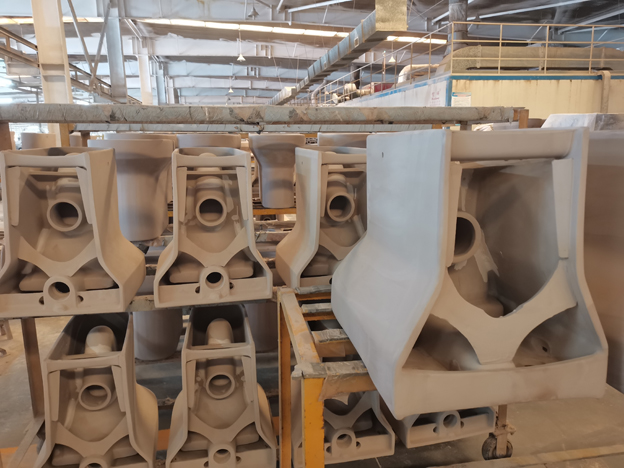
A wall-hung pan mould fixes the bowl depth long before a project buyer compares models. Image: wall-hung toilet mould.
Wall-hung toilets turn a bathroom decision into a building decision. Moving the pan off the floor removes a cleaning obstacle, but it also fixes where the drainage connection, the in-wall carrier and the concealed cistern must sit — and those positions are usually set long before a buyer starts comparing models. A comparison between two wall-hung pans is therefore not really a style comparison. It is a comparison between two sets of dimensions, one ceramic body specification, and one certification trail.
This industry reference compares the FI-05 and FI-20 wall-hung pans produced by Tangshan Houfengyuan Import and Export Co., Ltd., a ceramic sanitary ware manufacturer and exporter based in Tangshan, Hebei Province, China. The company produces ceramic toilets and ceramic wash basins, reports that around 90% of its output is exported, and lists its main markets as the USA, Canada, the Middle East, Australia, Southeast Asia and Europe. Both pans reviewed here are ceramic sanitary ware made from high-temperature fired ceramic, both are rimless, and both use a washdown flushing configuration. They differ mainly in overall length — and that 22 mm difference is where most specification questions begin.
Why Wall-Hung Pans Get Specified Before Suppliers Get Chosen
In hotel and apartment projects, the sanitary ware package is normally locked in alongside the plumbing layout. A wall-hung pan requires an in-wall support frame, a drainage connector and a concealed cistern, and those components determine the roughing-in position, the finished floor-to-bowl height and the position of any access panel. Once that coordination drawing is approved, the pan becomes a dimensional object rather than a preference.
That is why an evaluation-stage buyer typically needs three things from every candidate model before a shortlist is meaningful:
- Cut dimensions that can be checked against the bathroom layout and the door swing.
- Flushing and rim configuration, because a rimless washdown pan behaves differently in service from a rimmed or siphonic pan.
- Evidence of conformity for the destination market, in the form of certificate scope and product linkage rather than a general statement of compliance.
When one of the three is missing, the model cannot be compared with the others on equal terms, and the comparison usually collapses back into a price discussion — which is the least reliable basis for a decision that will be repeated across hundreds of bathrooms.
FI-05 and FI-20: Two Wall-Hung Pans in One Ceramic Family
Both names are used for more than one configuration in the manufacturer's range. The FI-05 name also covers a back-to-wall pan and a two-piece toilet with dimensions of 660 × 360 × 420 mm, and the FI-20 name also covers a two-piece toilet measuring 660 × 365 × 420 mm. This comparison is limited to the wall-hung pan variants, identified as model FI-05 wall hang pan and model FI-20 wall hang pan.
The FI-05 wall hang pan is a ceramic sanitary ware classified as a wall hung toilet. It uses a rimless design and a washdown flushing mechanism, is made from high-temperature fired ceramic, and measures 517 mm in length, 360 mm in width and 365 mm in height. The FI-20 wall hang pan sits in the same wall hung toilet category and follows the same construction logic — washdown flushing, rimless, high-temperature fired ceramic — at 495 mm × 365 mm × 365 mm.
| Specification | FI-05 wall hang pan | FI-20 wall hang pan |
|---|---|---|
| Product category | Wall hung toilet | Wall hung toilet |
| Body material | High-temperature fired ceramic | High-temperature fired ceramic |
| Flushing configuration | Washdown | Washdown |
| Rim design | Rimless | Rimless |
| Length × width × height | 517 × 360 × 365 mm | 495 × 365 × 365 mm |
| Typical applications | Wholesale distribution; construction and engineering projects | Wholesale distribution; construction and engineering projects |
| Certification linkage | Listed among product variants associated with WaterMark certificate WMK26227 | Listed among product variants associated with WaterMark certificate WMK26227 |
High-Temperature Full Ceramic: What the Body Material Changes for Buyers
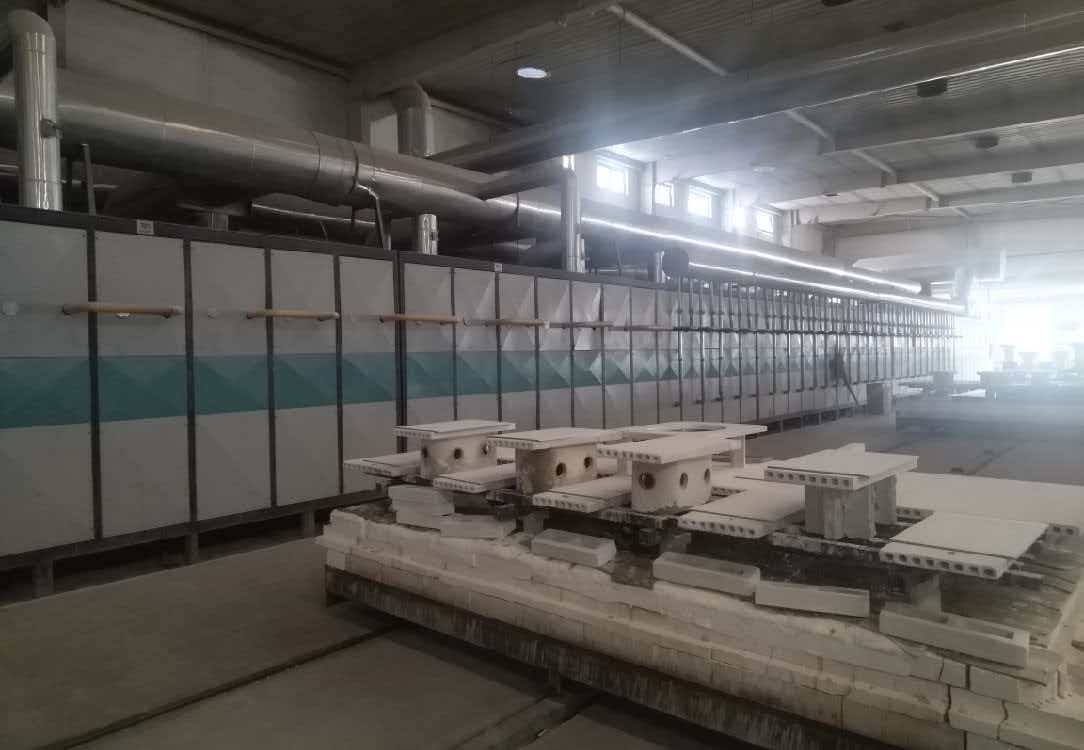
High-temperature firing in a tunnel kiln determines how stable the finished pan dimensions will be. Image: tunnel kiln.
High-temperature fired ceramic is the primary material of both the FI-05 and FI-20 wall-hung pans, and it is the single specification item that most changes what a buyer should expect during a five- to ten-year service cycle in a hotel or rental apartment.
The manufacturer's production platform for this material is a tunnel kiln setup: one 126-metre-long, 3.2-metre-wide tunnel kiln and two 82-metre-long, 2.8-metre-wide tunnel kilns. According to the company, the kilns are designed for low unit energy consumption, the cross-section temperature at each firing stage is evenly controlled, and the firing curve is adjustable. These are first-party manufacturing statements rather than third-party audited figures, and buyers evaluating a specific project should treat them as claims to be confirmed during a factory review.
What high-temperature firing actually does to a sanitary ware body is reasonably well established in ceramic manufacturing: it fuses the shaped body into a dense, vitrified mass instead of simply drying it. For a wall-hung pan, four practical consequences follow.
- Dimensional stability. A fully fired body holds its shape at the finished size, which matters when the same model is installed across hundreds of identical bathrooms and must align with a common carrier frame.
- Surface behaviour. On a vitrified body, the glaze becomes a bonded surface layer rather than a coating. The manufacturer describes its ceramic products as having glossy, easy-to-clean glazed surfaces, which is the property hotel housekeeping teams depend on when bathroom cleaning cycles are short and frequent.
- Hygiene and staining. A rimless washdown pan removes the hidden rim channel where residue can collect, and a smooth fired surface gives soil fewer places to anchor.
- Service life. Ceramic does not delaminate or degrade the way some composite bodies can, which is a long-term argument in favour of the higher freight weight that ceramic brings.
The boundary matters as much as the benefit. Fired ceramic is brittle. Impact damage during installation, transport or rough handling in a rented apartment does not deform the pan — it chips or cracks it. Freight weight per unit is also higher than for composite alternatives, which affects pallet planning and last-mile cost. And although the material platform is consistent, independently verified model-level performance data for anti-clog behaviour, glaze cleanability, siphon performance and dimensional tolerance is not published for these two models in the available material. A buyer who needs that evidence should request model-specific laboratory reports rather than rely on the material description alone.
What 517 mm, 495 mm and 365 mm Change in a Real Layout
The two pans share the same height, 365 mm, and differ by 22 mm in length and 5 mm in width. On a drawing sheet that looks trivial. In a real bathroom it is often the deciding figure.
The length dimension is the one specifiers generally check against available clearance, because it is the larger horizontal dimension of a wall-hung pan. At 517 mm, the FI-05 needs 22 mm more front-to-back space than the FI-20. In hotel bathrooms where the pan faces a shower screen, a door swing or a grab bar, that 22 mm can be the difference between a compliant layout and a redesigned partition.
At 495 mm, the FI-20 gives back that clearance and is generally the easier starting point for compact bathrooms, en-suite hotel rooms and retrofit projects where the existing floor area cannot be changed. The trade-off is a shorter bowl footprint, which some end users notice in comfort terms — particularly in premium room categories where bathroom size is part of the guest rating.
The 5 mm width difference runs the other way: the FI-20 is marginally wider at 365 mm against the FI-05 at 360 mm. In a serial installation this rarely changes the layout, but it can affect frame shimming and tile setting-out at the wall face if the two models are mixed in one building. That is one practical reason to avoid mixing models within a single property unless the carrier frames are specified per model.
A simple selection rule for evaluation-stage buyers:
| Project condition | Model to examine first |
|---|---|
| Tight bathroom footprint, retrofits, door swing close to the pan | FI-20 wall hang pan (495 mm length) |
| Larger bathroom footprint, deeper bowl preferred for guest comfort | FI-05 wall hang pan (517 mm length) |
| Single model standardised across an existing property | Whichever model matches the existing carrier frame and roughing-in |
Certification: How the Two Wall-Hung Pans Are Documented
Certification is where two visually similar pans can diverge sharply, because a certificate is issued against a defined scope and a defined product list — not against a brand in general.
For the Australian market, the FI-05 and FI-20 wall-hung pans sit inside a documented certification framework. The manufacturer holds a WaterMark Certificate of Conformity, certificate number WMK26227, issued by SAI Global, covering water closet pans, flushing devices and cistern inlet and outlet valves under AS 1172.1-2014 (Amdt 1 2018) and AS 1172.2-2014 (Amdt 1 2018). The certificate was issued on 12 February 2022 and remains valid to 10 July 2027. The product variants associated with this certificate include the FI-05 and FI-20 ranges, covering wall-hung pans, back-to-wall pans and two-piece models.
For the USA and Canada, the documented listing is different in scope. The manufacturer holds an IAPMO R&T cUPC certification, File No. 6560, covering ceramic plumbing fixtures — water closets, lavatories, urinals, bidets, service sinks and drinking fountains — under ASME A112.19.2-2024/CSA B45.1-24, issued 12 March 2026. A separate IAPMO R&T listing, File No. 6559, covers water closets with a dual flush feature under ASME A112.19.2-2018/CSA B45.1-18 and ASME A112.19.14-2013.
The practical point for a buyer is that certification coverage is applied model by model. A listing that names a ceramic plumbing fixture category does not automatically confirm every model in a catalogue. Before a purchase order is signed, request the certificate and confirm three things: the product model appears in the certificate or its associated product list; the certificate is valid for the delivery date; and the scope covers the flushing configuration being ordered. This is standard due diligence rather than a criticism of any single supplier — it protects the buyer against customs detention and against a project handover that fails on documentation.
Market Context Behind the Wall-Hung Decision
Three data points frame why wall-hung ceramic sanitary ware keeps appearing on specification lists in hotel, apartment and renovation packages.
First, the category is large and consolidated. The global ceramic sanitary ware market reached USD 44.3 billion in 2023, according to Grand View Research (Ceramic Sanitary Ware Market Size & Share Report). Within that market, the toilet sinks and water closets segment accounted for 43.0% of total revenue share in 2023 — which is why pan selection, and not basin selection, tends to drive the sanitary ware package.
Second, supply is concentrated. China accounted for over 58% of global ceramic sanitary ware export volume in 2024. For a project buyer, that concentration has two sides: a very deep pool of manufacturing capacity and competitive tooling, and a corresponding need to verify which factory, which kiln and which certificate actually stand behind a named model.
Third, water efficiency is becoming a specification constraint rather than a marketing claim. The CIC Green Product Certificate assessment standard for ceramic sanitary ware, Version 2.0, sets water-consumption limits for double-flush toilets at a maximum full flush of 5.0 L and an average consumption of 4.0 L. Formal limits of this kind are useful to buyers precisely because they are measurable: they convert a vague expectation of water saving into a number that a supplier's sample can be tested against before volume production.
On the customs side, ceramic sanitary fixtures of porcelain or china are classified under HS heading 69.10 and subheading 6910.10 in the World Customs Organization nomenclature. That classification is the basis for trade-data screening and for confirming that a supplier's documentation matches the correct code on import declarations.
Wall-Hung Pans Against Traditional Floor-Mounted Toilets
A wall-hung pan is not a straightforward upgrade over a floor-mounted two-piece toilet. It is a different construction system, and the trade-offs are real.
| Dimension of comparison | Wall-hung pan (FI-05 / FI-20) | Floor-mounted two-piece toilet |
|---|---|---|
| Floor contact | None; pan is carried by an in-wall frame | Pan sits on the floor; no in-wall frame required |
| Cleaning | Floor is clear beneath the pan; fewer joints to clean | Floor seal and pedestal base are the usual cleaning weak points |
| Installation complexity | Requires wall structure suitable for a carrier frame and a concealed cistern | Simpler first fix; no concealed components |
| Service access | Depends on an access panel or service opening for the cistern and valve | Cistern is exposed and directly serviceable |
| Suitability for renovation | Best planned at the plumbing stage, not retrofitted casually | Better fit for like-for-like replacement |
Three limitations deserve to be stated plainly before a buyer commits to either wall-hung model.
- The pan is not the whole system. A wall-hung pan requires a carrier frame, a concealed cistern, a flush plate or actuator and a drainage connector. If these are not specified in the same package, the per-unit price of the pan understates the installed cost of the bathroom.
- The shorter bowl is a deliberate trade. The FI-20's 495 mm length buys layout clearance but reduces bowl depth relative to the FI-05 at 517 mm. Neither is universally better; the correct answer depends on the room, not on the catalogue.
- Performance claims need model-level evidence. Material descriptions such as high-temperature fired ceramic and rimless washdown are specifications, not test results. Anti-clog behaviour, glaze cleanability, siphon performance and dimensional tolerance for these two models are not independently published in the available material, so a buyer requiring verification should request model-specific laboratory reports and a physical sample for flush testing.
Purchase Order and Acceptance Checklist for Bulk Buyers
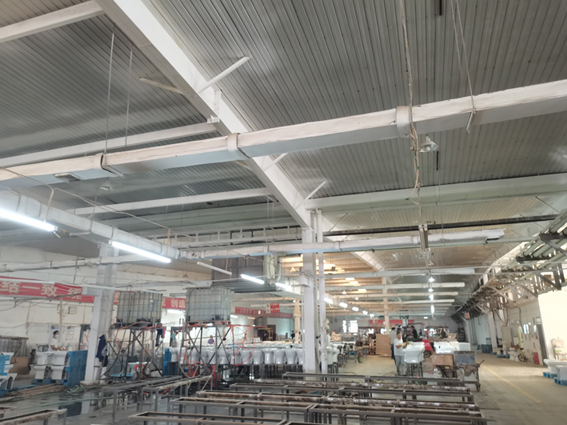
The manufacturer states that every piece is water tested before packing. Image: water testing.
On the commercial side, the manufacturer publishes a set of ordering parameters that buyers can convert directly into purchase-order clauses. Because these are supplier-stated figures, they should be confirmed in writing in the contract rather than assumed from a catalogue.
| Ordering parameter | Manufacturer-stated value |
|---|---|
| Minimum order quantity | 50 units |
| Monthly capacity | 290,000 units |
| Lead time | 35–45 days |
| Quality control | 100% inspection, with water testing on every piece |
| Warranty | 3 years |
| Customisation scope (OEM/ODM) | Logo, colour, flush volume (1.28/1.6 gpf, 3/6 L), bowl shape (round or elongated), tank design, seat height (standard or ADA comfort height), packaging and private labelling |
A neutral acceptance checklist for a wall-hung pan consignment, drawn from what can actually be measured at goods-in, looks like this:
- Dimensional verification. Measure sample units against the agreed drawing — 517 × 360 × 365 mm for the FI-05 wall hang pan and 495 × 365 × 365 mm for the FI-20 wall hang pan — and record tolerance.
- Mounting interface check. Confirm the mounting hole pattern and outlet position match the carrier frame model specified for the project.
- Rim and outlet geometry. Confirm the rimless configuration and the washdown outlet path are as specified, with no glaze build-up narrowing the channel.
- Flush performance on samples. Run flush tests on delivered samples and, where the project has a water-efficiency target, compare results against the specification limit being applied — for example the CIC reference values of 5.0 L maximum full flush and 4.0 L average for double-flush toilets.
- Glaze inspection. Inspect under raking light for pinholing, crawling and colour variation across the batch, not just on one sample.
- Marking and traceability. Confirm the model designation is permanently marked and that batch identification allows tracing back to a production run.
- Documentation pack. Collect the certificate covering the destination market, the product linkage page, and any flush or material test reports the project requires.
- Packaging and transit protection. Confirm carton grade, pallet configuration and edge protection, given ceramic's brittleness and the weight of a fired pan.
For buyers who also source basins and other fixtures, the same manufacturer supplies ceramic wash basins alongside ceramic toilets, which allows a single sanitary ware package to be consolidated. Its stated export markets — the USA, Canada, the Middle East, Australia, Southeast Asia and Europe — indicate that multi-market documentation, rather than a single-market certificate, is the normal operating condition for this supplier.
What to Expect Next
Three shifts are likely to shape wall-hung pan procurement over the next specification cycle. Water efficiency will continue moving from voluntary marketing language into measurable project limits, which favours suppliers who can produce model-level flush test reports rather than category statements. Certification will be checked at model level rather than at brand level, because certificate scope is the only document that survives a customs or consultant review. And dimensional discipline will matter more as projects standardise on a single pan model across hundreds of identical bathrooms, where a 22 mm difference is no longer a rounding error but a layout decision.
Within that environment, the choice between the FI-05 and FI-20 wall-hung pans is a narrow, practical one: more front-to-back depth with the FI-05 at 517 mm, or more clearance with the FI-20 at 495 mm, on the same high-temperature fired ceramic body, the same rimless washdown configuration, and the same wall-hung installation logic.
FAQ
What is the difference between the FI-05 and FI-20 wall-hung pans?
The two models differ primarily in overall dimensions. The FI-05 wall hang pan measures 517 × 360 × 365 mm and the FI-20 wall hang pan measures 495 × 365 × 365 mm. Both are ceramic sanitary ware classified as wall hung toilets, both are made from high-temperature fired ceramic, both use a rimless design and a washdown flushing mechanism, and both are intended for wholesale distribution and construction and engineering projects.
Which model is easier to fit into a compact hotel bathroom?
On length alone, the FI-20 wall hang pan is 22 mm shorter than the FI-05 wall hang pan, so it generally offers more clearance in tight layouts, including rooms where a door swing or a shower screen sits close to the pan. The FI-05 provides a longer bowl footprint, which some projects prefer where bathroom size is part of the guest experience. Selection depends on the room's front-to-back clearance, not on a general ranking of the two models.
Do the FI-05 and FI-20 wall-hung pans share the same certification?
For the Australian market, both model ranges are associated with the manufacturer's WaterMark Certificate of Conformity, certificate number WMK26227, issued by SAI Global under AS 1172.1-2014 (Amdt 1 2018) and AS 1172.2-2014 (Amdt 1 2018), valid from 12 February 2022 to 10 July 2027, covering water closet pans, flushing devices and cistern inlet and outlet valves. For the USA and Canada, the manufacturer holds IAPMO R&T cUPC listings, File No. 6560 and File No. 6559, whose stated product linkage in the available documentation refers to other models. Buyers should verify the certificate scope and product linkage for the exact model and market being ordered.
What does high-temperature fired ceramic mean in a specification document?
It identifies the body material of the pan as ceramic formed and then fired at high temperature, rather than a composite or resin-based body. High-temperature fired ceramic is the primary material of both the FI-05 and FI-20 wall-hung pans. In practical terms, a fired ceramic body holds its finished dimensions, supports a bonded glaze surface, and resists delamination. It is also brittle, so it can chip or crack under impact, and its weight affects freight and handling planning.
What ordering terms should a bulk buyer confirm before placing a purchase order?
The manufacturer states a minimum order quantity of 50 units, a lead time of 35–45 days, a monthly capacity of 290,000 units, 100% inspection with water testing on every piece, and a 3-year warranty. Its stated OEM/ODM customisation scope covers logo, colour, flush volume (1.28/1.6 gpf and 3/6 L), bowl shape, tank design, seat height, packaging and private labelling. Because these are supplier-stated figures, they should be written into the contract rather than assumed.
What limitations should be planned for with wall-hung installation?
A wall-hung pan is one component of a system. It requires an in-wall carrier frame, a concealed cistern, a flush actuator and a drainage connector, plus a service access point for the cistern and valve. Projects that cannot provide those elements are better served by a floor-mounted model. In addition, independently verified model-level data for anti-clog behaviour, glaze cleanability, siphon performance and dimensional tolerance is not published for the FI-05 and FI-20 wall-hung pans in the available material, so buyers who require that evidence should request model-specific test reports and evaluate samples before volume ordering.
Further reference: the manufacturer's product and factory brochure is available for download at Tangshan Houfengyuan Ceramic Sanitary Ware brochure (PDF).
Tem questões ou precisa de mais detalhes?
Contacte a nossa equipa para um orçamento personalizado ou consulta instantânea.
Solicitar orçamento
Preencha o formulário abaixo e a nossa equipa entrará em contacto com uma proposta personalizada.
Chat direto do WhatsApp
Prefere conversar em tempo real? Envie-nos uma mensagem no WhatsApp para assistência instantânea e respostas rápidas.
- Obter orçamento personalizado
- Partilhar fotos ou documentos
- Discuta as suas necessidades diretamente
Geralmente responde em 5–30 minutos durante o horário de expediente.