
High-Traffic Spaces: Matching Commercial Porcelain Tiles to Malls, Hotels and Transit Hubs
High-Traffic Spaces: Matching Commercial Porcelain Tiles to Malls, Hotels and Transit Hubs
A shopping mall concourse, a hotel lobby and a railway station platform can all be specified with the same phrase — 'porcelain floor tile' — and still fail in three completely different ways. In a mall, the dominant stress is abrasive traffic concentrated in retail aisles and food courts. In a hotel lobby, it is heavy arrival traffic combined with a finish standard that makes every stain visible. In a transit concourse, it is continuous footfall, wet footwear, de-icing salts in winter and cleaning crews working against the clock. Matching a tile to a high-traffic space therefore begins with the operating profile of that space, not with its surface pattern.
All-King Ceramics (ZIBO ALL-KING CERAMICS CO., LTD) is a porcelain tile manufacturer and direct exporter based in Zibo, Shandong, China, whose 60x120cm vitrified porcelain from the Marble Series and Travertine series is positioned for exactly this kind of scenario mapping. Both series share one declared technical envelope: water absorption below 0.5%, PEI 4 / PEI 5 abrasion resistance, Mohs 6–7 hardness, breaking strength of at least 1300 N and a modulus of rupture of at least 35 MPa. The value of that envelope is not a single headline number. It is that one format and one body type can be defended across a mall, a hotel, an office building and a residence without changing the maintenance regime.
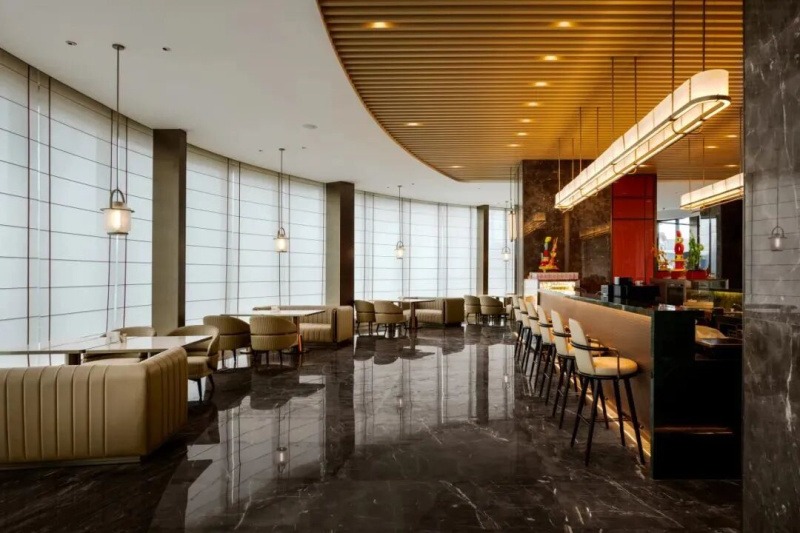
Lobby-scale flooring is read as one continuous surface, which makes batch and format control part of the specification rather than a finishing detail.
Three failure routes that decide the specification
Commercial floors rarely fail because the decoration wore through. They fail along three routes, and each route maps to a different line in the product data sheet.
Abrasion. Grit, castors, trolley wheels and dragged deliveries act as a slow grinding paste. The relevant question is how the surface behaves under that repeated contact, which is what an abrasion class describes. An airport departures hall accumulates far more of this contact per square metre than a hotel corridor, and a specification should reflect that difference rather than apply one class everywhere.
Moisture and staining. Cleaning chemicals, spilled drinks, coffee and de-icing salt create a concentration gradient at the tile surface. If the body is porous, that gradient pulls liquid inward and staining becomes a body problem rather than a surface problem. Vitrified porcelain with water absorption below 0.5% closes that route, which is why the same body can serve a food court and a hotel bathroom without a sacrificial sealer.
Joints and cleaning labour. Grout lines are where high-traffic floors look tired first: they discolour, they collect soil, and they need periodic deep cleaning or replacement. A large-format layout reduces the total length of joint in the floor, which changes the cleaning contract and not only the appearance. A useful specification names which of these three routes it is protecting against, and in which zones; a blanket requirement across a whole building usually overspends in quiet areas and underspecifies the busy ones.
The technical envelope behind the Marble and Travertine series
Both series are 60x120cm porcelain tiles made from porcelain clay, with identical declared parameters and identical packing: two pieces per box, 1.44 m² per box. Each box therefore covers 1.44 m² at 0.72 m² per piece, which drives handling method, pallet planning, attic stock and waste allowance on a commercial order.
| Property | Declared value | What it changes on a high-traffic project |
|---|---|---|
| Water absorption | Below 0.5% (vitrified) | Low porosity keeps liquids at the surface, so stain resistance does not depend on a reapplied sealer; freeze-thaw performance becomes a body and fixing question rather than a coating question. |
| Abrasion resistance | PEI 4 / PEI 5 | Covers the upper commercial traffic classes; because class can differ by design and finish, the rating for the specific design should be confirmed on its data sheet. |
| Mohs hardness | 6–7 | Resists scratching from grit and castors; it is not scratch-proof against harder mineral debris, so entrance matting still matters at doors. |
| Breaking strength | At least 1300 N | Point-load and chair-leg tolerance in hotel and office zones; relevant where trolleys and cleaning machines concentrate load. |
| Modulus of rupture | At least 35 MPa | Bending strength indicator where a tile bridges small subfloor irregularities rather than sitting on a perfectly flat bed. |
| Thickness | 9.0–10.5 mm | Affects weight planning, adhesive and levelling choice, and height transitions to adjacent floors. |
| Packing | 2 pcs/box (1.44 m²/box) | Large-format pieces need two-person or frame handling; box coverage simplifies quantity take-off but raises breakage-control requirements on site. |
Two qualifications belong beside this table. First, the series is listed as PEI 4 / PEI 5; since abrasion class can vary by design and finish within a series, the rating for the design actually being ordered should be confirmed before it is written into a specification. Second, these are declared product parameters rather than project-specific test results, and a commercial acceptance procedure should confirm them against the batch test reports issued with the order.
Format geometry: the maintenance case for 60x120cm
The maintenance argument for 60x120cm is geometric rather than promotional. One 60x120cm tile covers 0.72 m² and introduces 3.6 running metres of edge. The same 0.72 m² built from 60x60cm tiles introduces 4.8 running metres. Expressed per square metre of finished floor, that is roughly 5.0 metres of joint line for the large format against about 6.7 metres for the smaller one — around a quarter less grout to clean, discolour and eventually re-grout.
The trade-off sits at installation and repair. Large-format tiles amplify substrate unevenness into visible lippage, need a levelling system and a properly prepared subfloor, and generate more cutting waste at perimeters and around service penetrations. Where a project has a tight programme or an unverified substrate, the smaller format can still be the lower-risk choice — the format decision belongs with the installation conditions, not only with the cleaning budget.
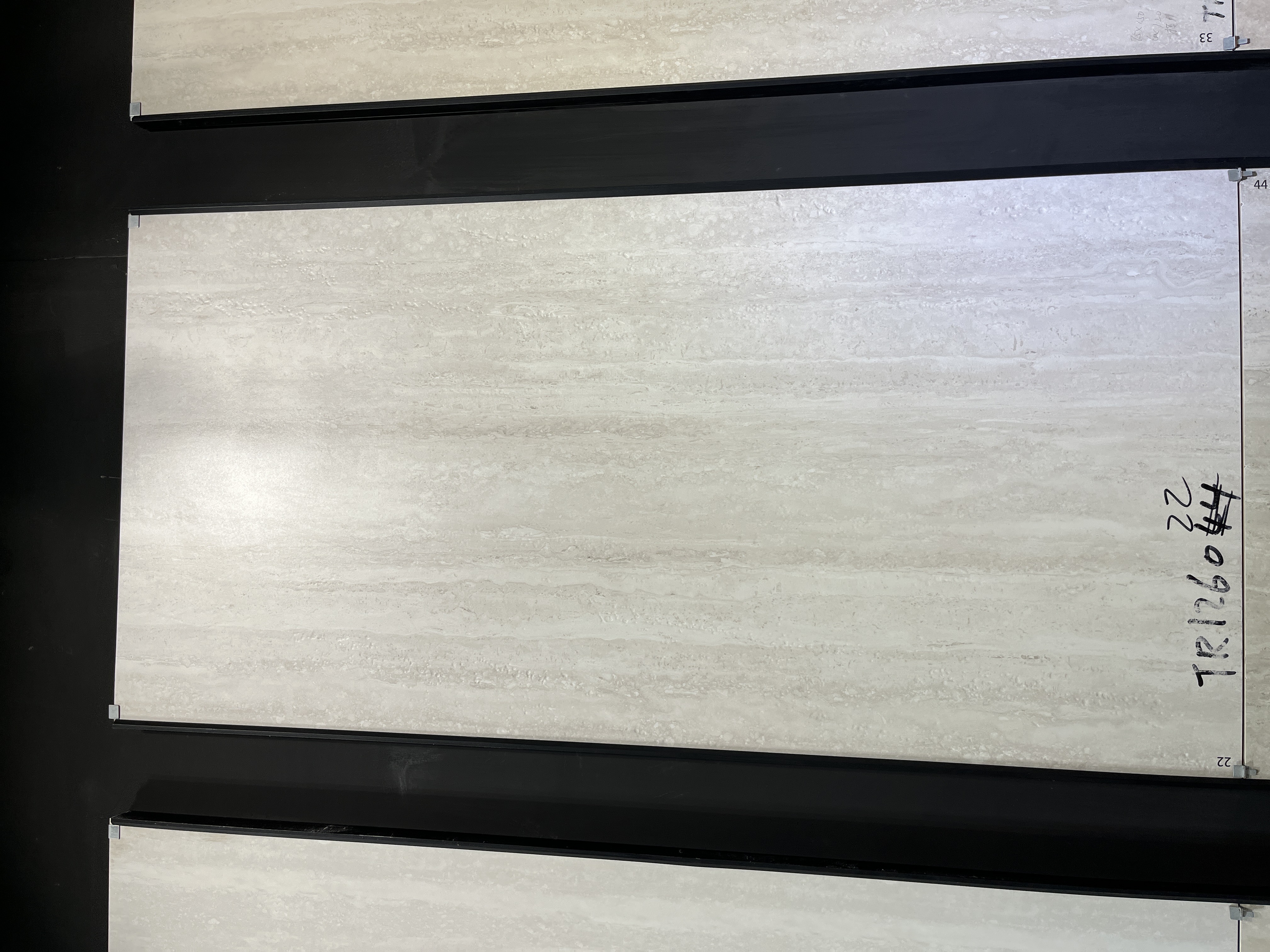
Travertine series surface: the same vitrified body and format as the Marble Series, differentiated by surface appearance rather than by technical envelope.
Scenario mapping: five space types, five different priorities
Shopping malls
A mall floor is a public floor operating on a retail cleaning schedule. Traffic is heavy but channelled: entrances, escalator approaches, food courts and cinema queues take the concentrated load, while back-of-house corridors do not. The priorities are abrasion resistance in circulation zones, low absorption where food and drink spill, a slip rating appropriate to entrances and ramps, and a joint pattern a cleaning contractor can maintain nightly without closing sections of the mall.
In practice the Travertine surface suits long circulation runs and food-court aprons, where a matte stone-like appearance conceals scuffing, while the Marble Series is used where the design intent is a brighter, more reflective atrium or feature zone. Both are the same vitrified body in the same 60x120cm format, so a mall can change appearance between zones without changing its maintenance method or its replacement stock logic.
Luxury hotels
Hotel lobbies and ballroom foyers combine concentrated arrival traffic with a visual standard that hides nothing. Two requirements follow. Shade and vein consistency across a large open area matters more than in a mall, because a lobby is read as a single surface — that is a batch-control question rather than a tile question. And the finish has to hold its appearance without a sealer that would need reapplying on a hotel's operating schedule.
Because the body is vitrified, the surface does not depend on an impregnating sealer to resist staining, which removes a recurring task from housekeeping. The boundary is in wet zones: spa surrounds, pool decks and shower floors need a tested slip rating and usually a textured finish, and a polished large-format floor should not be assumed to satisfy that requirement.
Transit hubs: railway stations and airport terminals
Railway stations and airport terminals are the most demanding of the five space types, for a structural reason: they never really close. Cleaning happens in short night windows, de-icing salt is tracked in for months of the year, luggage trolleys and cleaning machines apply concentrated point loads, and any joint that traps salt keeps attracting moisture. Breaking strength of at least 1300 N and Mohs 6–7 hardness are the relevant parts of the envelope here, together with a large format that reduces the joint network exposed to salt and grit.
Two scenario conditions deserve separate treatment. Exposed platforms and entrances in cold climates require frost resistance demonstrated for the actual product and fixing system, not inferred from low water absorption alone. Ramps, stairs and platform edges require a validated anti-slip rating — the application requirement for such projects is typically R10/R11, and anti-slip rating is one of the finish options that should be specified rather than assumed.
Corporate offices and mixed-use fit-outs
Office lift lobbies, corridors and canteens see moderate but concentrated traffic and a higher tolerance for design consistency than for extreme wear. Here the practical advantages are the format's continuity along long corridors, the absence of a sealing step in a live fit-out, and the fact that a fired porcelain body contributes little to indoor emissions compared with the adhesives, grouts and sealants used to install it. Low-VOC requirements in a fit-out specification should therefore be read across the whole build-up, not applied to the tile alone.
High-end residences
In apartments and high-end residential projects the same 60x120cm Marble and Travertine tiles are used in living areas, entrance lobbies and bathrooms, where traffic is lower and the driver is visual continuity between rooms. PEI 4 is normally adequate at that traffic level; the stronger arguments are that large-format tiles reduce the number of joints in an open-plan space and that a vitrified body does not need periodic sealing. The limitation is installation tolerance: residential substrates are often less flat than commercial ones, so substrate preparation becomes the deciding cost line.
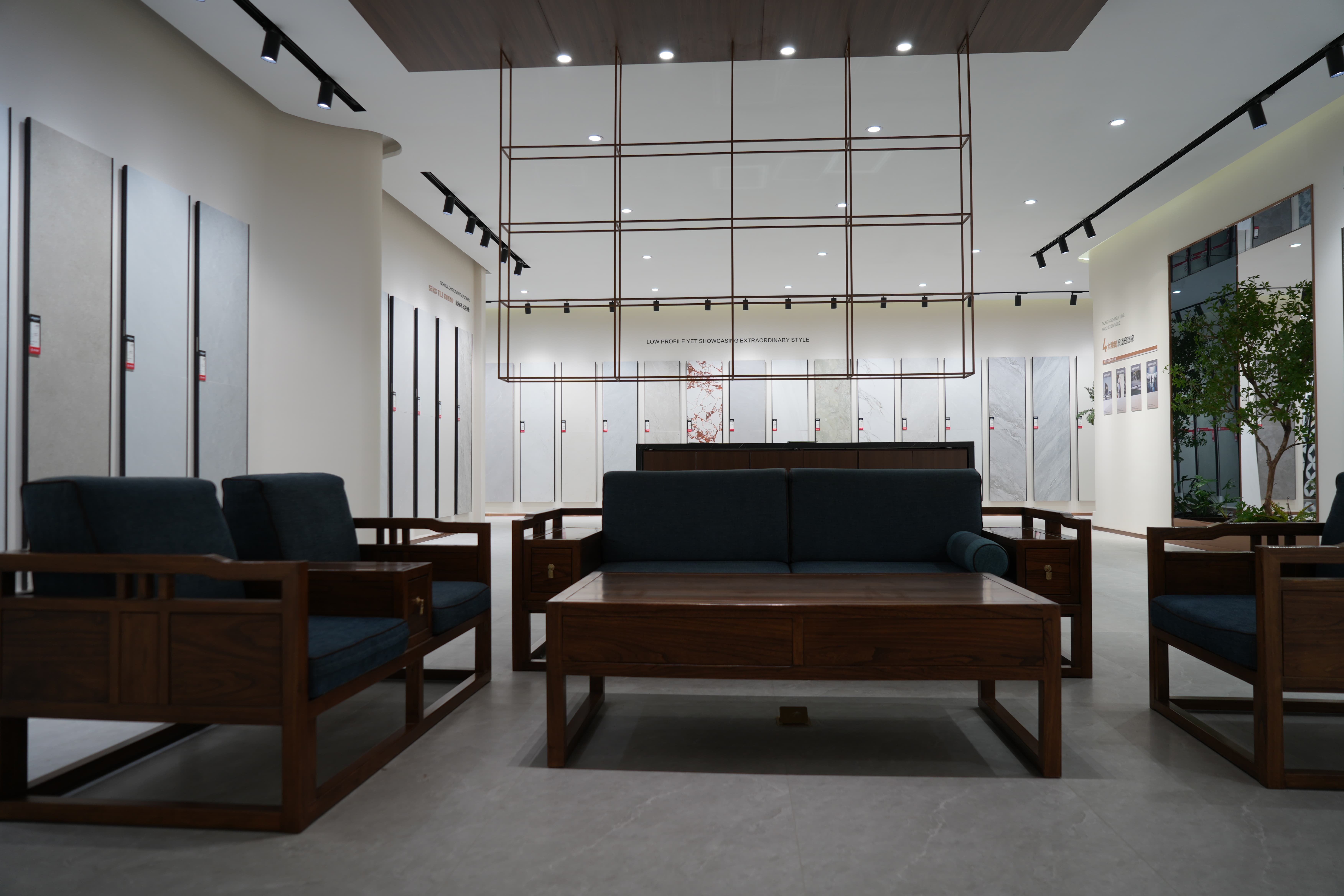
Residential use changes the priority order rather than the product: visual continuity and substrate flatness move ahead of abrasion class.
| Space type | Dominant stress | Property to prioritise | Practical note |
|---|---|---|---|
| Shopping mall | Abrasive footfall, food and drink spill, nightly machine cleaning | Abrasion class, absorption below 0.5% | Specify slip rating separately for entrances and ramps. |
| Luxury hotel lobby | Arrival traffic plus visible appearance standard | Shade and vein consistency, stain resistance without sealing | Lock one batch for the open lobby area; keep attic stock from it. |
| Railway station / airport terminal | Continuous traffic, de-icing salt, trolley point loads | Breaking strength, hardness, minimum joint network | Frost resistance and R10/R11 need their own evidence. |
| Corporate office | Moderate traffic, programme pressure, occupied-building work | Format continuity, no sealing step | Assess VOC across adhesive, grout and sealant. |
| High-end residence | Low traffic, high visual continuity expectation | Joint reduction, substrate tolerance | Budget for subfloor levelling before choosing 60x120cm. |
Where 60x120cm vitrified porcelain is not the right specification
Scenario matching is as much about exclusion as selection, and the same data that supports a mall or a terminal also defines where this product should not be assumed to fit.
- Logistics and heavy industrial floors. A 9.0–10.5 mm porcelain tile is a floor finish, not a hardened industrial wearing course. Racking legs, hard-wheeled forklifts and dropped steel call for a different duty class and usually a different build-up; this range is not presented as a warehouse heavy-duty solution.
- Ramps, commercial kitchens, pool surrounds and shower floors. Slip resistance must come from a tested rating and an appropriate surface texture. A polished or satin large-format surface should not be assumed to meet those conditions without that evidence.
- Exposed exterior floors in freeze-thaw climates. Frost resistance should be evidenced by test reports for the specific product and the full fixing system, including adhesive and grout, rather than inferred from low water absorption.
- Projects with an unresolved substrate. Large format concentrates lippage risk; where flatness cannot be achieved, a smaller format is the lower-risk decision, even at the cost of more joints.
- Programmes shorter than the full logistics chain. A quoted production lead time covers manufacturing only. One commercial logistics estimate puts FCL rail transit from China to Kazakhstan and Uzbekistan at 10–14 days, before customs clearance and onward site delivery are added.
From specification to order: MOQ, lead time and batch control
All-King Ceramics runs OEM/ODM production with customization on size and thickness, surface finish, brand logo and packaging, marble vein variation and anti-slip rating. Published commercial terms are a minimum order of 400 m² per design with trial orders accepted, a monthly capacity of 1.2 million m² and a production lead time of 7–10 days. Quality control is described as 100% flatness and sizing auto-check, piece-by-piece visual inspection and random laboratory testing of each batch.
For a commercial buyer, the most consequential of these is batch tracking. A mall or a hotel will need replacement tiles years after handover, and matching a marble or travertine surface from a later production run is far easier when the original batch reference is recorded and the supplier supports reordering against it. The same logic applies to the 1.44 m² box: keeping a measured attic stock from the installed batch prevents a future repair from turning into a design change.
Certification belongs in this section rather than in a marketing paragraph. Commercial tenders commonly ask for ISO 9001 quality-management certification, CE marking covering the product scope being supplied, and independent test reports for the specific series and format; some specifications also name a third-party body such as TÜV. The check that matters is scope: a certificate issued for a factory, or for a different product group, does not automatically cover the tile on a given purchase order. Buyers should request the certificate scope, issuing body and validity date together with the corresponding test report for the design being supplied, and should treat published performance parameters as declared values that the acceptance procedure confirms. Published supplier material additionally describes the range as designed for high-traffic, frost-prone and wet environments and aligned with ISO 13006 — a claim to be verified against the specific certificate and test documentation rather than accepted from a product page.
All-King Ceramics publishes its format matrix and company profile on its own site, and commercial enquiries are handled through its Zibo office.
Market context: Central Asia, Russia and the supply question
Demand context supports the scenario focus without proving an order. Kazakhstan's construction output grew 15.9% year-on-year in 2025, according to the Bureau of National Statistics of Kazakhstan — a signal that tends to precede fit-out demand in retail, hospitality and transport buildings rather than a tile order in itself. Mordor Intelligence estimates Russia's ceramic tile market at USD 2.90 billion in 2025; published growth forecasts for that market diverge, from low single-digit growth to contraction, so volume planning there should not rest on a single projection.
On the supply side, All-King Ceramics reports a 60,000 m² facility in Zibo, Shandong, founded in 2011, with 320 employees, 25 engineers, annual output of 12–16 million m² and an export share of 70%. The company describes serving contractors, distributors and builders across Australia, New Zealand, South Korea, Southeast Asia, Central Asia, Russia, the Middle East and Latin America. These are company-reported and republished profile figures rather than audited statements, and they answer a narrow question well: whether capacity and format range can plausibly carry a recurring commercial programme, subject to the buyer's own verification.
Outlook
Commercial specification continues to move toward fewer, larger surfaces with fewer joints, because cleaning and maintenance are the costs that keep rising after handover. A 60x120cm vitrified format with water absorption below 0.5%, PEI 4 / PEI 5 abrasion resistance and breaking strength of at least 1300 N sits comfortably inside that direction for malls, hotels, offices and terminals — provided the slip, frost and substrate conditions of each zone are specified rather than assumed. The scenario unlikely to change is the one where a floor is chosen from a photograph and maintained against its data sheet; the mismatch typically appears in the cleaning budget and the joint repairs, not on handover day.
FAQ
What matters most when choosing porcelain tiles for a shopping mall floor?
Abrasion resistance, water absorption and joint pattern. A mall concentrates abrasive traffic in aisles and food courts, so a PEI 4 / PEI 5 abrasion class, water absorption below 0.5% and a large format that reduces grout lines address the three main wear routes. Slip rating at entrances and ramps should be specified separately, because it depends on the surface finish rather than on the tile body.
Can 60x120cm porcelain tiles be used in airport terminals and railway stations?
They can be specified for terminal and station floors where the project conditions are met. Breaking strength of at least 1300 N and Mohs 6–7 hardness support point loads from trolleys and cleaning machines, and the large format reduces the joint network that traps de-icing salt and grit. Exposed platforms and ramps require demonstrated frost resistance and a validated anti-slip rating, which are separate evidence points from water absorption.
Do vitrified porcelain tiles need to be sealed?
No sealing step is required for the tile body. With water absorption below 0.5%, a vitrified body does not rely on an impregnating sealer to resist staining the way porous stone and higher-absorption tiles do, which removes a recurring maintenance task. Grout is a separate material and may still be specified with a sealer depending on the grout type used.
How does a 60x120cm layout compare with 60x60cm for grout maintenance?
A 60x120cm tile covers 0.72 m² with 3.6 running metres of edge, while the same area in 60x60cm tiles has 4.8 running metres. Per square metre of finished floor that is roughly 5.0 metres of joint line against 6.7 — about a quarter less grout to clean and re-grout. The trade-off is that large format needs a flatter substrate and a levelling system during installation.
Which certificates should a buyer confirm for a commercial tile order?
ISO 9001 quality-management certification, CE marking covering the product scope and test reports for the specific series and format are the common requirements, and some projects name a third-party body such as TÜV. The certificate scope, issuing body and validity date should be checked against the design actually being supplied, because a factory-level certificate does not automatically cover every product group.
The full range, formats and packing data are set out in the downloadable ALL KING Ceramics product catalogue (PDF).
Tem questões ou precisa de mais detalhes?
Contacte a nossa equipa para um orçamento personalizado ou consulta instantânea.
Solicitar orçamento
Preencha o formulário abaixo e a nossa equipa entrará em contacto com uma proposta personalizada.
Chat direto do WhatsApp
Prefere conversar em tempo real? Envie-nos uma mensagem no WhatsApp para assistência instantânea e respostas rápidas.
- Obter orçamento personalizado
- Partilhar fotos ou documentos
- Discuta as suas necessidades diretamente
Geralmente responde em 5–30 minutos durante o horário de expediente.