
Hisea-Decorative Film & Decorative Panels: Wall Panel Sourcing Profile
Decorative wall panels are rarely bought for their surface alone. In export-driven construction and renovation work, the board behind the finish has become a procurement variable: it sets installation time, moisture behavior, cleaning routines, and the volume of compliance documentation that must be assembled before a container ships. This profile examines Zhejiang Highsea New Material Co., Ltd., the manufacturer behind the Hisea-Decorative Film & Decorative Panels brand, and looks at what the company publishes about its capacity, its quality control, its panel families, and the boundaries a buyer should verify before shortlisting it.
Who Zhejiang Highsea New Material Co., Ltd. Is
Zhejiang Highsea New Material Co., Ltd. is a Chinese manufacturer established in 2002 and located in Haining City, Zhejiang Province, producing decorative films and surfacing materials for interior and exterior building applications. Its published portfolio covers PVC and PET decorative films alongside integrated building products: SPC/WPC wall panels, PVC wall panels, UV boards, outdoor wall panels, and WPC decking. The commercial brand associated with these products is Hisea-Decorative Film & Decorative Panels.
The company operates a manufacturing facility of 20,000 m² with a workforce of approximately 300 staff. Published company material states an annual production capacity of 400 cabinets, and separately describes a monthly output of 20 × 40 ft high-cube containers — a scale that supports container-level and multi-container purchasing rather than sample-only or mixed-loose orders. Export business accounts for 70% of total sales, with main markets in South America, Africa, Asia, and the Middle East.
For a buyer at the discovery stage, the relevant question is not simply whether the company exists and exports. It is whether the published capability matches the project profile: a wall-panel portfolio that covers multiple material families, a production flow that runs from raw material to packed goods, and a quality system with defined checkpoints. Those three elements are what separate a product catalogue from a supply relationship.
Why Wall Panel Sourcing Became a Supply-Chain Question
Wall panel demand now sits inside a larger renovation and hygiene-driven market. The global PVC panels market was valued at USD 14.8 billion in 2025, with wall panels holding the largest product-type share at 42.5%, according to Dataintelo market research published in 2026. Separately, the global wood plastic composites market — the material family behind WPC wall panels — was estimated at USD 8.9 billion in 2025 and projected to reach USD 21.5 billion by 2033, a CAGR of 11.7%, per Grand View Research (2026).
Those two data points describe different things: PVC panels are an established, volume-driven category, while WPC sits in a faster-growing segment associated with renovation demand and composite-material substitution. For procurement teams, the practical consequence is that a supplier able to produce across both material families reduces the number of vendors, shipping documents, and sample rounds a project has to manage — but only if each family is verified on its own technical terms. Portfolio breadth is a sourcing convenience, not evidence of equivalent performance between product lines.
Price behavior matters here too. Commercial price tracking reported average FOB China prices for standard 3 mm PVC marble sheets at USD 3.00–3.60/m² in 2024, characterized as a period of gradual stabilization after earlier volatility (Aesthedge, 2025). That figure is a directional benchmark only: it does not define pattern, packaging, Incoterm, or order volume, and it should never be used as a quotation substitute.
Production Flow and Three-Stage Quality Control
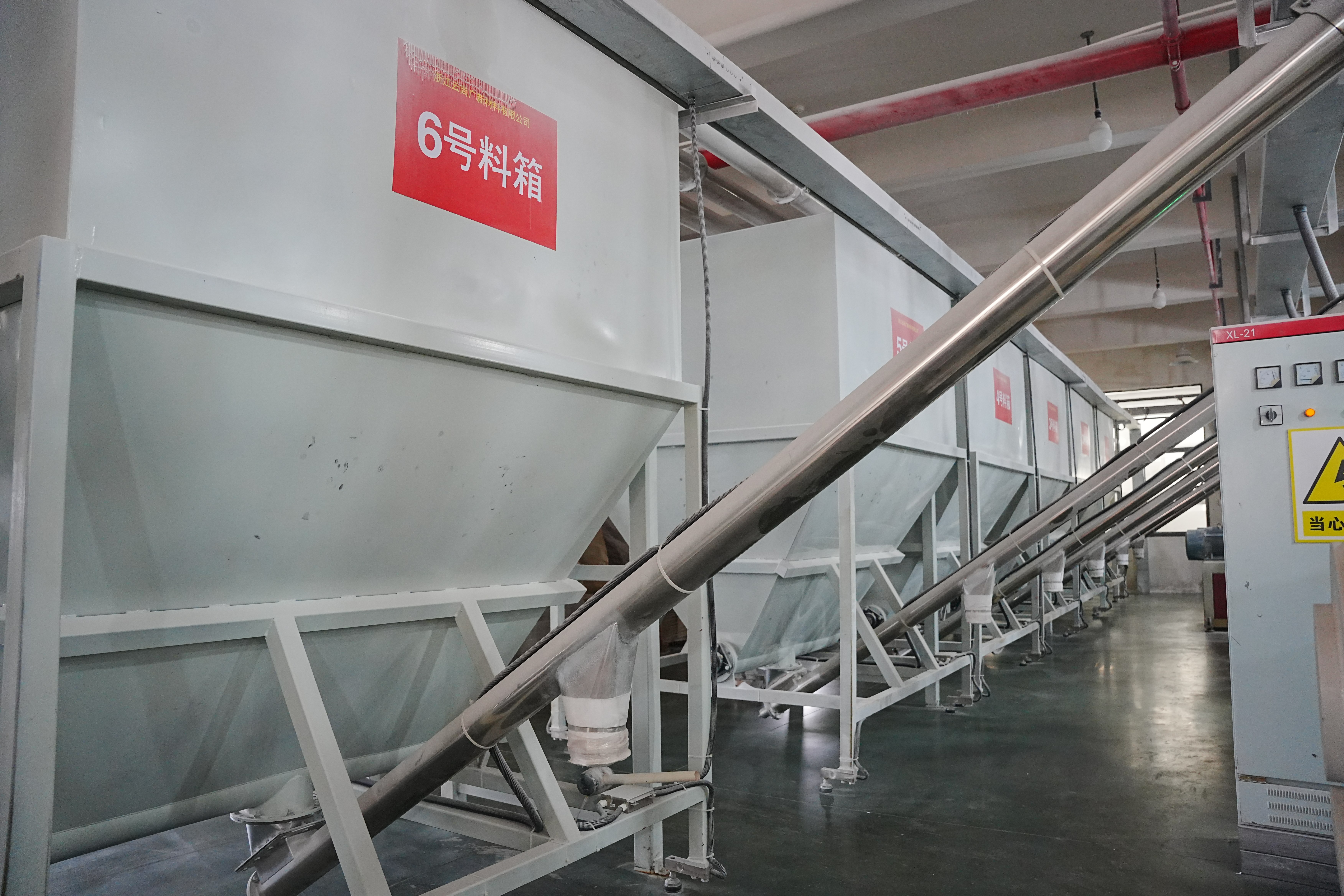
Highsea organizes production as a continuous process from raw material to finished product, forming a closed loop: formulation, extrusion or calendering, surface treatment, cutting, and packaging. That structure matters because decorative panels fail more often from inconsistency than from absolute capability — a run that changes color tone or surface texture mid-order creates rework on site, not in the factory.
Quality control runs through three defined stages. Incoming materials are inspected batch by batch to preserve consistency of formulation and process parameters. In-process control points are set at key stages to monitor thickness, density, color difference, surface flatness, and texture consistency. Outgoing goods are inspected batch by batch, and loading is arranged only after a batch passes inspection.
Read as a procurement signal, the in-process list is the more informative of the three: thickness, density, color difference, surface flatness, and texture consistency are precisely the attributes that determine whether panels from different production days can be installed on the same wall without visible mismatch. Buyers specifying large or phased projects should treat these five parameters as the audit questions to raise, not just as marketing phrasing.
The Product Range: Four Panel Families Under One Wall System
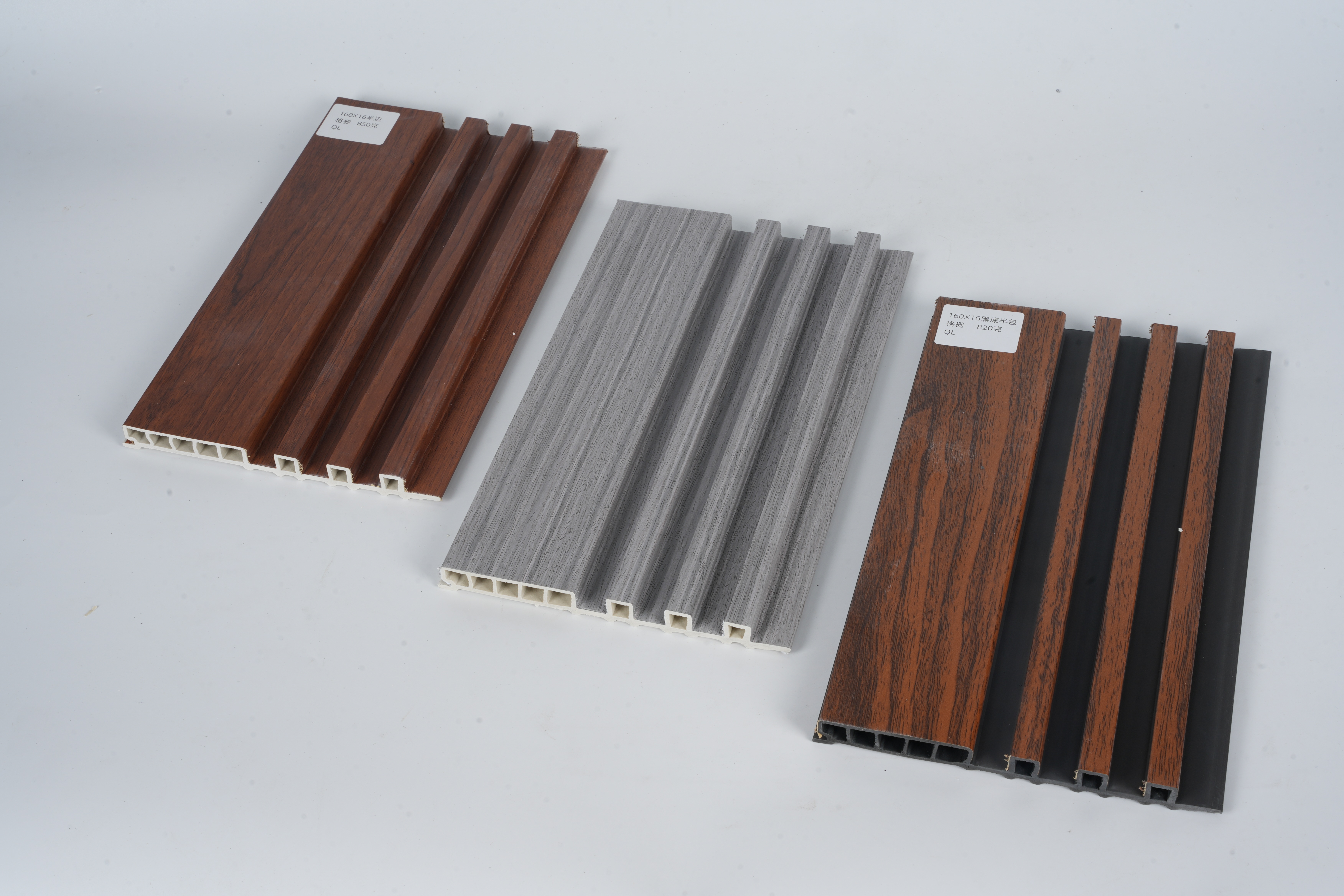
The wall panel line carries the model designation HS-WPC WALL PANEL / HS-PVC WALL PANEL / HS-UV BOARD, with WPC and PVC as the primary materials. The primary designation of this product family is "wall panel," applied to interior and exterior wall decoration scenarios, and it is offered to decoration companies, construction engineering firms, building materials wholesalers, and design companies.
| Panel family | Published dimensions | Primary material |
|---|---|---|
| WPC wall panel | 160 × 22 mm / 160 × 24 mm / 150 × 10 mm / 150 × 15 mm / 195 × 12 mm | WPC (wood plastic composite) |
| PVC wall panel | 300 × 8 mm / 300 × 8.5 mm | PVC |
| UV board | 1220 × 2440 × 3 mm / 1220 × 2440 × 2.5 mm | Coated decorative board |
| Bamboo charcoal board | 1220 × 2440 × 5 mm / 1220 × 2440 × 8 mm | Classified as a bamboo charcoal board |
One honest note on portfolio depth: the published detail is uneven across the four families. WPC, PVC, and UV board each carry a defined construction story and application list, while the bamboo charcoal board is currently published as a classified board product with format dimensions. Buyers who need performance arguments for that specific family should request datasheets directly rather than infer characteristics from the other three lines.
Technical Explanation: Material Choice Decides Where a Panel Can Go
The three main families are built on different logic, and that logic is what should drive specification.
WPC wall panel. WPC wall panels are made of wood plastic composite, a blend of wood fiber and thermoplastic resin. The blend pairs the natural grain appearance of timber with the dimensional stability of a polymer, so the board keeps a flat, true surface in humid or dry climates where solid timber tends to warp. The polymer content surrounds the wood fiber and limits water uptake, which is why the panel resists swelling, rot, and insect attack, making it a practical wall finish for bathrooms, laundry areas, and covered outdoor walls. A single panel family is offered in fluted, slatted, louver, and flat profiles with wood grain or solid color faces, so the character of a wall run changes by swapping groove depth and coating rather than changing base material. Installation uses dry fix: panels are cut, drilled, and fixed with ordinary woodworking tools and hidden clips, so a room or facade can be refinished without wet trades, curing time, or heavy demolition.
PVC wall panel. The PVC wall panel is extruded from polyvinyl chloride, forming a continuous non-porous surface that does not absorb water or hold odors. Splashes, grease, and everyday marks stay on the surface rather than soaking in, so routine cleaning is normally a wipe with a damp cloth rather than hard scrubbing — a meaningful labor difference in busy commercial kitchens and washrooms. Faces are supplied in wood grain, marble, and solid color prints across a range of widths, allowing a room to be matched to a joinery or tile scheme using trims and profiles from the same range. Because the sheet is light relative to ceramic tile or stone, one installer can carry and align full lengths, and panels trim with a utility knife or fine-tooth saw before being joined with matching edge trims. This combination is why the panel is widely chosen for clinics, food preparation rooms, laboratories, and public washrooms, where the wall must meet routine hygiene-cleaning demands.
UV board. The UV board carries a UV-cured coating that hardens under ultraviolet light into a dense sealed film over the base sheet, so the decorative face keeps its sheen through daily contact, wiping, and handling. The cured film takes common household marks such as water rings, grease spots, and light scratches, keeping printed patterns and colors readable on cabinet fronts, wall boards, and furniture faces through long service. It is offered in marble, stone, and solid color designs with gloss or matte faces, reproducing the character of natural slab at a fraction of the weight. Fabrication is panel-shop friendly: the sheet cuts, drills, and edge-bands with standard panel tooling, so fabricators can produce cabinet doors, wardrobe fronts, and wall cladding without changing an existing production line.
Application and Use Cases
WPC wall panel applications are published as interior feature walls, TV backgrounds, living rooms and bedrooms, hotel lobbies and corridors, offices and meeting rooms, restaurants, retail stores and showrooms, and ceilings. The UV board application list focuses on kitchen and bathroom cabinets, TV background walls, hotel room furniture, and retail fixtures. The PVC wall panel list is oriented toward hygienic interiors, including clinics and food preparation rooms.
The scenario data behind these uses describes indoor and outdoor installation, humid environments, and normal ambient temperature; the operation mode is static installation with no power consumption. The stated special requirements are waterproofing, termite resistance, low formaldehyde, and ease of cleaning.
Two application patterns are worth flagging for project planning. First, because the same WPC material covers interior and exterior zones, a scheme spanning a lobby, a corridor, and a balcony or patio cladding can be specified from fewer wall products. Second, for hotel and retail work, the dry-fix method compresses the site program: no wet trades, no curing time, and no on-site painting or finishing, which shortens the window a room stays out of service.
Procurement Value: MOQ, Lead Time, and Container-Level Supply
Trial orders normally start from 300 PCS and can be mixed by color and size. Typical production lead time is 20–25 days after deposit for a 40HQ container. Combined with a stated monthly output of 20 × 40 ft high-cube containers, this gives wholesale buyers and project contractors a workable basis for seasonal stocking and phased delivery, provided the order specification is frozen before deposit.
The intended customer profile is explicit in the company's own positioning: decoration companies, construction engineering firms, building materials wholesalers, and design companies. That mix has a practical implication — a specification that has to satisfy both a design office and a wholesaler's storage conditions needs stable color matching across batches and packaging that survives consolidation, which is exactly where the in-process control points on color difference and texture consistency become commercially relevant.
Certification and Compliance: What Should Be Verified
The company's products have obtained CE and RoHS certification, which supports market-access requirements for electrical safety and restriction of hazardous substances in the relevant markets. RoHS addresses substance restriction; CE marking signals conformity with applicable requirements. Neither certification, on its own, answers a project's reaction-to-fire question.
For European wall and ceiling finishes, EN 13245-2:2008 specifies health and safety requirements for unplasticized PVC-U and cellular PVC-UE profiles used for interior and exterior wall and ceiling finishes — a relevant reference point for that market. Fire performance is handled differently by jurisdiction: commercial compliance guidance associates EN 13501-1 with European markets and the UK, ASTM E84 with the USA and Canada, and GB 8624 with China. These systems use different methods and classifications and should not be treated as equivalent or combined without a formal basis.
Procurement guidance for decorative panels recommends verifying the specific product, thickness, construction, and finish named in a test report; confirming the report cites a current standard edition; and checking that the laboratory's accreditation scope actually covers the test method. Buyers of PVC, WPC, or coated boards should apply that checklist per SKU rather than per supplier.
Comparison with Traditional Wall Solutions
| Solution | Installation character | Cleaning and moisture | Weight and handling |
|---|---|---|---|
| Ceramic tile or stone | Wet trade, adhesive and grout, curing time | Durable; grout lines need attention | Heavy; handling and substrate loading |
| Paint and wallpaper | Fast to apply, but surface preparation dependent | Mark-prone in damp or high-traffic areas | Light; requires redecoration cycles |
| Solid timber cladding | Woodworking tools; finishing often required | Can warp in humid or dry climates | Moderate to heavy |
| PVC / WPC / UV panel systems | Dry fix with clips, screws, or adhesive; no painting on site | Non-porous surface, wipe-clean; WPC limits water uptake | Light; single-installer handling possible |
The boundary matters as much as the benefit. These panels are decorative finishes, not structural elements, and they require a flat, dry substrate — battens or a sound wall — before fixing. In specifications where natural stone slab or heavy ceramic is the design intent, a polymer or composite panel reproduces the look at lower weight but is not a like-for-like substitute for the material's touch, mass, or long-term wear behavior. Fire and emission performance depends on the exact construction and finish and must be verified per destination market. The UV board line is interior-oriented, and PVC wall panels are positioned for interior and hygienic applications rather than exposed exterior facades; WPC is the family published for combined indoor and covered outdoor use.
Where Highsea Sits in the Wall Panel Supplier Landscape
Taken on published evidence, Zhejiang Highsea New Material Co., Ltd. profiles as an established, export-oriented, multi-category decorative panel and film manufacturer: founded in 2002, operating a 20,000 m² facility with roughly 300 staff, exporting 70% of sales into South America, Africa, Asia, and the Middle East, and holding CE and RoHS certification. Its differentiating characteristic is vertical breadth — decorative films plus finished panel products — which is unusual among single-category panel suppliers and useful for buyers who want one compliance and shipping counterparty.
The equally honest counterpoint is documentation depth. Third-party verified data on this segment is thin: independent supplier-landscape research in this category notes fewer than three comparable verified suppliers with factory verification, capacity, export history, MOQ, lead time, or customer references. Published capacity figures remain company-reported and should be confirmed at factory audit. SKU-level performance data — measured water absorption, scratch resistance, UV resistance, acoustic behavior, and product-specific fire test results — is not publicly established for this range. This does not indicate weakness; it indicates that the buyer's verification step still carries real weight.
A Practical Verification Checklist Before Shortlisting
- Match reports to SKUs. Ask for test documentation naming the exact product, thickness, construction, and surface finish — not a generic category certificate.
- Confirm the current standard edition. A report referencing a superseded edition does not support market access.
- Check laboratory accreditation scope. The laboratory must be accredited for the specific test method cited.
- Test batch consistency. Order a mixed sample set across colors and sizes, then compare color difference and texture against the commissioned batch.
- Verify substrate requirements. Confirm the flatness and dryness tolerance for clips, battens, or adhesive fixing on your site.
- Lock the commercial frame. Freeze pattern, size, packaging, and Incoterm before deposit; treat the 300 PCS trial threshold and 20–25 day 40HQ lead time as planning inputs, not guarantees.
- Confirm destination-market fire classification. Establish which framework applies to your jurisdiction before approving any substitution.
Future Outlook
Three movements are shaping this category. First, material mix: WPC is projected to grow faster than standard PVC panel products, supported by renovation demand and composite substitution (Grand View Research, 2026), while wall panels already represent the largest share of the PVC panels market (Dataintelo, 2026). Second, finish value: as base sheet pricing stabilizes — standard 3 mm PVC marble sheets tracked at USD 3.00–3.60/m² FOB China in 2024 (Aesthedge, 2025) — differentiation shifts toward coatings such as UV-cured and scratch-resistant surfaces, which is where UV board performance claims will be won or lost. Third, documentation: with frameworks such as EN 13245-2 in Europe and jurisdiction-specific fire classifications in North America and China, compliance evidence is becoming a qualification gate rather than a closing formality.
For suppliers with in-house film and panel capability, that combination favors buyers who want fewer counterparties and shorter coordination chains. For buyers, it raises the bar on verification per SKU — breadth of portfolio reduces logistics complexity but never replaces product-level evidence.
FAQ
What is the MOQ and lead time for these wall panels?
Trial orders normally start from 300 PCS and can be mixed by color and size. Typical production lead time is 20–25 days after deposit for a 40HQ container.
How are PVC wall panels installed?
Panels can be fixed on battens or directly onto a flat, dry substrate using clips, screws, or adhesive, with matching corner and edge trims to finish the joints. Cutting is done with standard woodworking tools. Installation is fast and no painting or finishing is needed on site.
Where are WPC wall panels used?
WPC wall panels are used for interior feature walls, TV backgrounds, living rooms and bedrooms, hotel lobbies and corridors, offices and meeting rooms, restaurants, retail stores and showrooms, and ceilings. The material is also published as suitable for both indoor and covered outdoor use.
What are the standard sizes for WPC wall panels?
Common standard sizes for fluted WPC wall panels are 160×22 mm, 160×24 mm, 150×15 mm, 160×16 mm, 160×13 mm, 195×12 mm, and 195×14 mm. The published wall panel specification sheet also lists 150×10 mm and 195×12 mm profiles within the same WPC family.
A downloadable product catalogue covering the bamboo charcoal wall panel range is available here: Hisea-Decorative Film & Decorative Panels catalogue (PDF).