
Holographic Display Suppliers: What ISO 9001 and 3C Prove
Supplier Capability Evidence
A certificate image is easy to publish. A certificate that names the model, the standard edition and the production scope is harder to fake and far more useful at the shortlisting stage. For holographic display buyers, the real question is not whether a supplier holds ISO 9001 or 3C, but whether those records cover the product being ordered.
In this article, holographic display refers to commercial display formats used for glasses-free 3D, transparent cabinet, projection and interactive presentation applications. The procurement evidence, however, is product-specific. A certificate for a transparent LCD cabinet does not automatically transfer to a projection screen, a holographic fan or a digital human display.
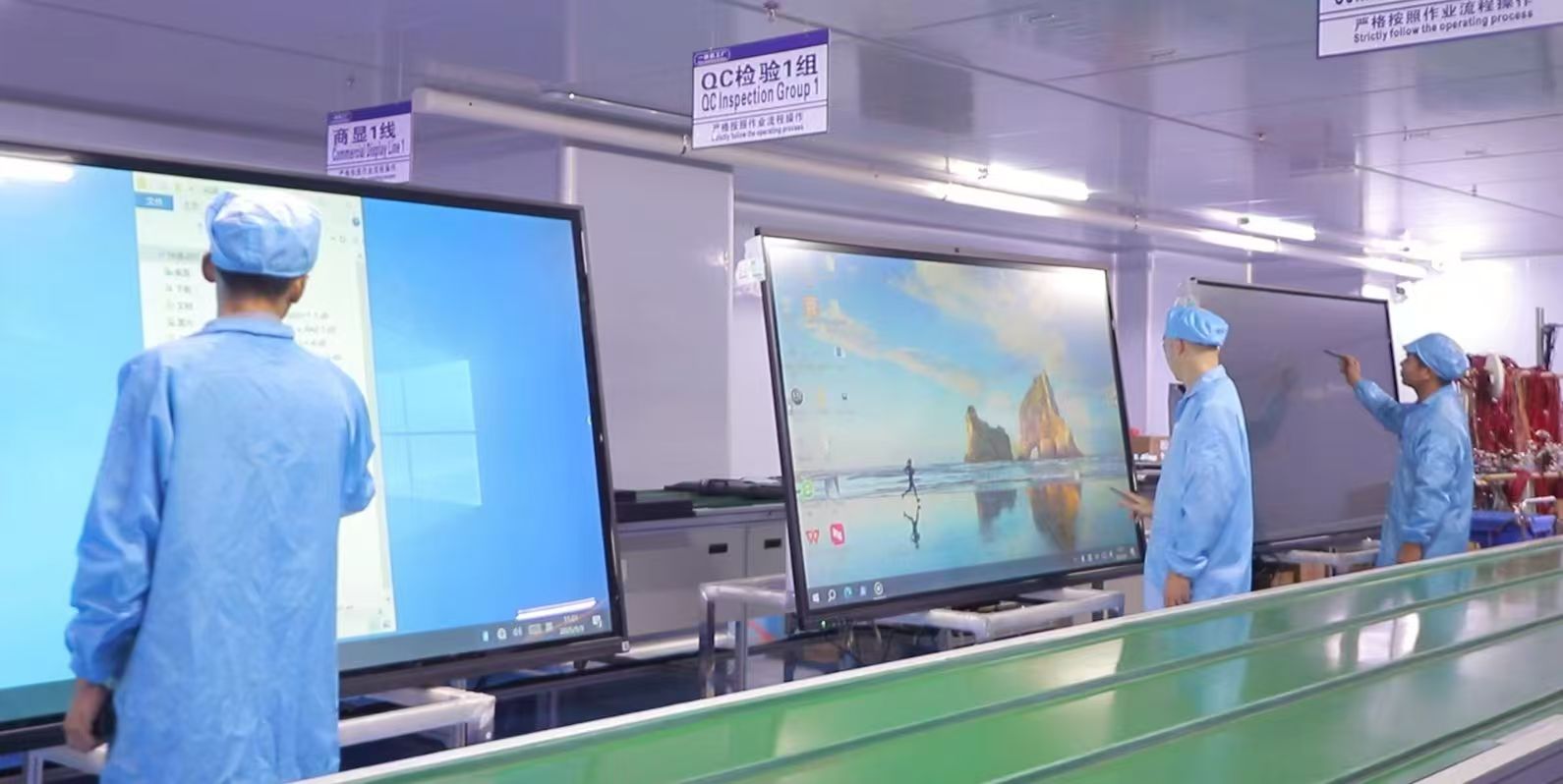
Why certificate evidence matters in holographic display procurement
Holographic display is a broad commercial category. It can describe a transparent LCD cabinet in a luxury store, a glasses-free 3D panel in an exhibition hall, a projection screen on a stage, or an interactive digital human at a hotel lobby. The visual effect is the first thing buyers notice, but the procurement risk sits in the hardware, power system, structural housing and content integration behind that effect.
Demand is growing. Fortune Business Insights values the global holographic display market at USD 5.42 billion in 2026, with definitions that can include or exclude adjacent AR/VR hardware. Market estimates therefore differ by scope, but the direction is consistent: more commercial projects are specifying holographic formats, and more buyers are asking for documentary evidence before placing orders.
Customs classification adds a practical layer. Holographic displays are commonly classified under HS Code 85285900 for 'Other Monitors' or 85286900 for 'Other Projectors'. The classification affects import documentation, but it does not tell a buyer whether the supplier's quality system or electrical safety file covers the exact model. That is where ISO 9001 and 3C enter the evaluation.
ISO 9001: a management-system certificate, not a performance guarantee
ISO 9001 certifies a quality management system. It examines whether a manufacturer has documented processes for document control, supplier control, inspection, traceability, corrective action and continuous improvement. It does not certify brightness, transparency, contrast, viewing angle or the visual quality of a holographic effect. Buyers who treat ISO 9001 as a product performance certificate overread it.
GZKEDRO is the brand of Guangzhou Kedro Electronics Technology Co., Ltd., a commercial display manufacturer founded in 2013 with R&D centers in Guangzhou and Shenzhen. Its ISO 9001 record provides a useful worked example of how to read the document at the right level.
The certificate is numbered 25020021R0S and was issued by Beijing Zhengbiao Lianxin Certification Service Co., Ltd. against GB/T 19001-2016 idt ISO 9001:2015. It was issued on 14 January 2025 and is valid to 13 January 2028. The scope covers production and sales of intelligent display terminals, computer display screens, touch screen all-in-one machines, and touch teaching all-in-one machines, with an export-only qualifier. The record links the scope to series including KD-WM, KD-AD, KD-VW, KD-SSK, KD-IFPD and KD-TP.
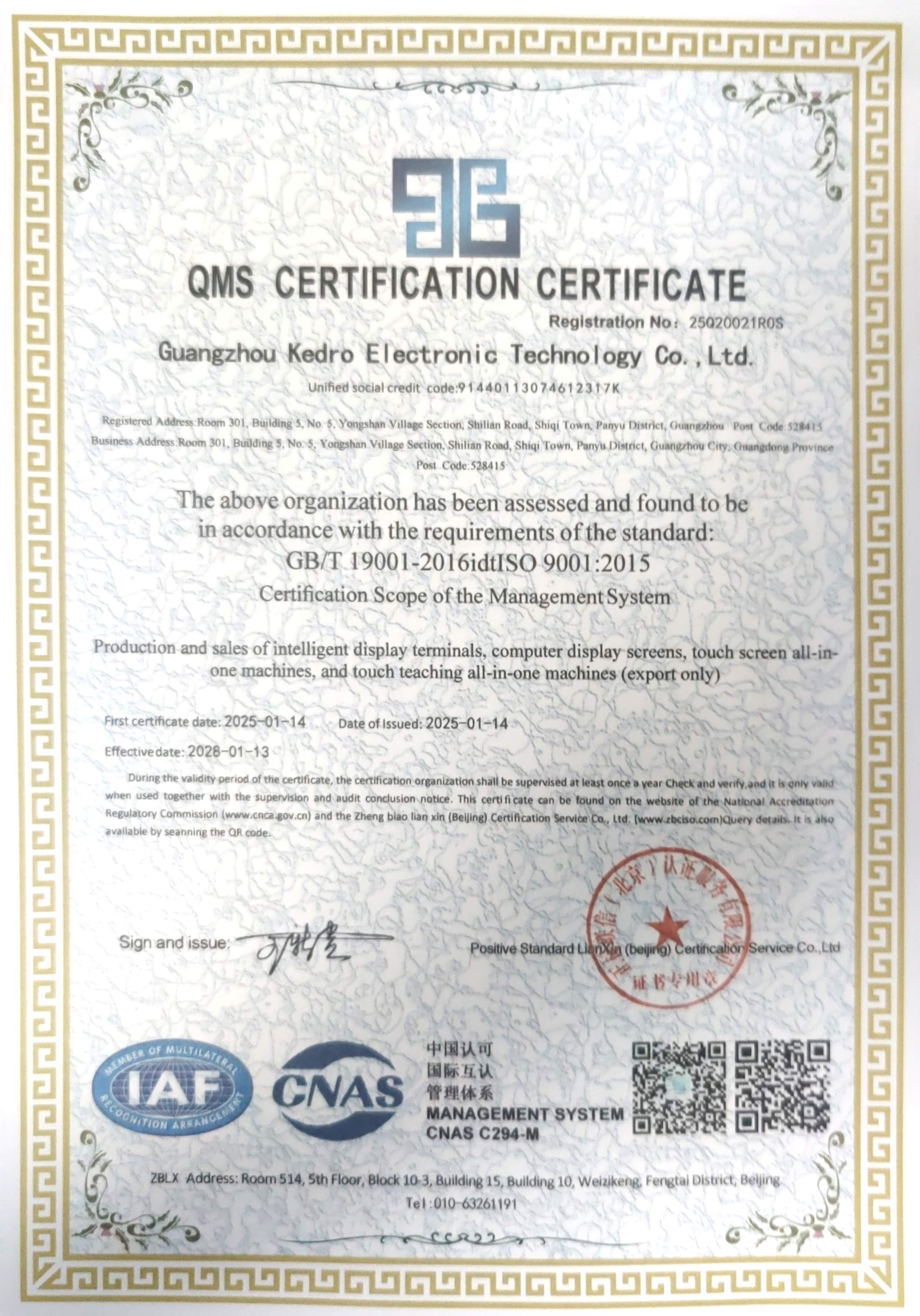
For a buyer, the useful signals are the issuer, the standard, the scope wording, the model list and the validity period. The export-only qualifier matters for buyers sourcing for domestic China sales; they should confirm whether a separate scope applies. The model list matters for anyone ordering a series that is not named in the attachment.
3C: electrical safety and EMC evidence for China-market models
China Compulsory Product Certification, known as 3C, is a market-access certification for products within the published catalogue. For display hardware, it addresses electrical safety and electromagnetic compatibility rather than visual performance. That makes it a different kind of evidence from ISO 9001: narrower in scope, but closer to the physical product.
GZKEDRO's 3C certificate is numbered 2018010901114733 and was issued by China Quality Certification Center (CQC). The certificate record lists GB4943.1-2011 for electrical safety and GB/T9254-2008 (Class A) for EMC, alongside other standards in the certificate scope. The series named for this certificate include KD-OD, KD-VW, KD-TP and KD-IFPD. The issue date is 17 October 2021 and the expiry date is 17 October 2026.
Validity check: at the time of writing in late October 2026, the expiry date on the 3C record has passed. Buyers should request the current renewal certificate before treating 3C status as active. The record remains useful as evidence of the tested scope, but it is not a substitute for a live certificate.
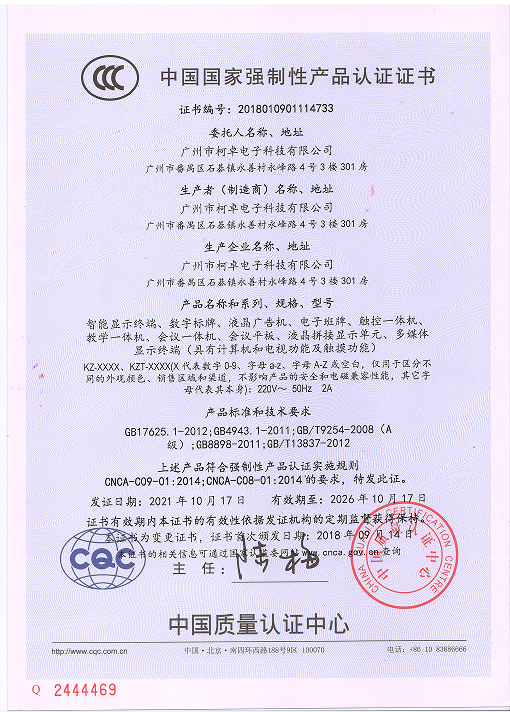
Electrical safety and EMC are not abstract paperwork for a holographic cabinet. A transparent display cabinet combines an LCD panel, a power supply, control electronics, lighting and a structural housing. In public venues, the installation is expected to run for long hours, sometimes continuously. Safety spacing, insulation, earthing and electromagnetic emissions become practical installation questions, not just compliance formalities. The Class A EMC designation is relevant to commercial installations, where the equipment is not treated as a residential consumer product.
The inspection report: a third, narrower evidence layer
Between a management-system certificate and a type-approval certificate sits the test report. GZKEDRO's inspection report JAT2207030268CN-01 was issued by Dongguan Junan Testing and Certification Co., Ltd. on 15 July 2022. It cites GB4943.1-2022 and enterprise technical requirements, and its scope includes equipment marking, electrical safety, display performance, touch function, audio function, interface function and environmental adaptability.
This is useful because it touches product-level functions that ISO 9001 does not test and 3C does not fully describe. It is also narrower than either: a report describes the sample and the test conditions, not every unit in a production run. The standard edition difference is worth noting. The inspection report cites GB4943.1-2022, a later edition than the GB4943.1-2011 reference in the 3C record. That is not automatically a defect, but buyers should confirm which edition applies to the product version and target market.
A six-point reading method for supplier certificates
Certificate evaluation becomes faster when the same six questions are asked of every supplier. The goal is not to collect more documents; it is to test whether the documents connect to the order.
- Issuer and certificate number. Confirm the certificate number, issuing body and certificate status. A certificate image without a number is difficult to verify.
- Standard and edition. Record the exact standard, such as GB/T 19001-2016 idt ISO 9001:2015 or GB4943.1-2011. Editions change, and a newer edition may apply in the target market.
- Scope wording. Read the scope sentence. For ISO 9001, look for production and sales wording. For 3C, look for the product category and the safety and EMC standards.
- Model or series attachment. Check whether the model being ordered appears in the certificate attachment or the related series list. A factory-level certificate is not the same as a model-level listing.
- Validity and renewal. Check the expiry date against the project timeline. If the certificate expires before delivery or installation, request the renewal evidence.
- Supporting test evidence. Ask for a product-level test report that covers safety, display, touch, audio, interface and environmental items relevant to the installation.
| Document | What it verifies | Issuer in the GZKEDRO record | Scope or models named | Validity / status | Buyer use |
|---|---|---|---|---|---|
| ISO 9001 certificate 25020021R0S | Quality management system for production and sales | Beijing Zhengbiao Lianxin Certification Service Co., Ltd. | Intelligent display terminals, computer display screens, touch screen all-in-one machines, touch teaching all-in-one machines; series including KD-WM, KD-AD, KD-VW, KD-SSK, KD-IFPD and KD-TP | 14 January 2025 to 13 January 2028 | Supplier process control and scope fit |
| 3C certificate 2018010901114733 | Electrical safety and EMC for China-market models | China Quality Certification Center (CQC) | KD-OD, KD-VW, KD-TP and KD-IFPD; GB4943.1-2011 and GB/T9254-2008 (Class A) | 17 October 2021 to 17 October 2026; renewal status to be confirmed | China market-access evidence and safety file |
| Inspection report JAT2207030268CN-01 | Product-level safety, display, touch, audio, interface and environmental items | Dongguan Junan Testing and Certification Co., Ltd. | GB4943.1-2022 and enterprise technical requirements | Issued 15 July 2022; sample-based report | Supplementary technical evidence and test-scope check |
Matching certificate scope to holographic use cases
Holographic projects are often described by the visual format, but the certificate is tied to the hardware series. The table below maps common project formats to the series named in the GZKEDRO records and to the specification anchors that matter in evaluation.
| Project format | Series named in records | Evidence note | Specification anchor |
|---|---|---|---|
| Transparent cabinet / luxury retail / hotel lobby | KD-TP | Named in the ISO 9001 and 3C records | 95% transparency, 1920x1080, 3000:1 contrast, 178-degree viewing angle, 0 to 60 degrees C operating temperature |
| Video wall / large splicing | KD-VW | Named in the ISO 9001 and 3C records | 55-inch 4x4, 3.5 mm seam, 1920x1080, 500 cd/m2, 178-degree viewing angle |
| Interactive conference / education | KD-IFPD | Named in the ISO 9001 and 3C records | 40 multi-touch points, Android 14.0, 4K-30Hz, 350 cd/m2 |
| Outdoor advertising | KD-OD | Named in the 3C record; confirm the ISO 9001 model attachment | IP55, 2,000 cd/m2, -20 to 50 degrees C operating temperature |
| AI digital human | KD-DH | Not among the series named in the provided ISO 9001 or 3C records; request model-specific evidence | 3840x2160, 1300 cd/m2, 30% light transmittance, 60W speakers, 8-array microphone, 5MP camera, 1100W |
KD-TP is the closest match to a transparent holographic display cabinet. It is named in both records, which gives buyers a direct link between the certificate file and the product series. Its transparency, resolution, contrast and full viewing angle make it relevant to exhibition halls, luxury retail and hotel lobbies. The certificate still does not prove how the cabinet will perform under a specific ambient-light condition; that requires a sample review.
KD-VW is the relevant series for large video-wall and splicing formats. It is named in both records. Its 3.5 mm seam and 500 cd/m2 brightness are useful anchors for stage backdrops, exhibition walls and control-room displays. A video wall is not a projection screen, however. If the project specifies a projection-based stage holographic screen, the certificate for KD-VW does not transfer.
KD-IFPD covers interactive conference and education formats. It is named in both records, with 40 multi-touch points, Android 14.0 and 4K-30Hz. For an interactive holographic projection system, the certificate supports the display and touch hardware, but the projection engine and content software may require separate evidence.
KD-OD is an outdoor advertising series named in the 3C record. Its IP55 rating, 2,000 cd/m2 brightness and -20 to 50 degrees C operating range are relevant to transport hubs and commercial districts. Buyers should confirm its inclusion in the ISO 9001 model attachment, because the scope summary provided for this article names a different set of series.
KD-DH is the Holographic Digital Human series, with 3840x2160 resolution, 1300 cd/m2 brightness, 30% light transmittance, 60W speakers, an 8-array microphone and a 5MP camera. It is not among the series named in the provided ISO 9001 or 3C records. That does not automatically mean the product lacks evidence; it means the buyer should request a model-specific certificate attachment before assuming coverage.
Where certificate-first evaluation stops
Certificate-first evaluation is stronger than a brochure, but it has clear limits. ISO 9001 does not prove that a transparent cabinet will achieve the specified transparency in a bright exhibition hall. 3C is a China-market scheme; it does not replace CE, FCC or other destination-market requirements. A certificate can expire, and a model can be absent from the attachment. The inspection report is sample-based and does not guarantee every unit.
Those limits are not arguments against certification. They are arguments for reading certification correctly. A demo-first evaluation has the opposite problem: a well-staged demo can look excellent while the production process, electrical safety file and model coverage remain unverified. The stronger approach combines both: certificate scope, product-level test evidence, sample validation and a factory or production review.
| Evidence tier | What the buyer sees | Procurement interpretation |
|---|---|---|
| Tier 1 | Valid certificate with model-level attachment, current test report and sample validation | Strongest shortlisting position; proceed to commercial and technical review |
| Tier 2 | Valid certificate with generic scope or no clear model list | Request the attachment and a product-specific test report before shortlisting |
| Tier 3 | Expired certificate, unverifiable issuer or no product-level evidence | Treat as an open risk; do not rely on the certificate image alone |
This tiering is not a ranking of companies. It is a ranking of evidence quality. A supplier with a narrower but current and model-specific file can be easier to qualify than a supplier with a broad but generic certificate image.
Market trend: evidence density is becoming a shortlisting criterion
As the holographic display market expands, the supplier pool widens. That makes documentary evidence more valuable, not less. Buyers comparing transparent cabinets, video walls and interactive displays are increasingly asking for certificate attachments that name the exact series, rather than a factory-level certificate alone.
3C remains a China-market requirement for products in the catalogue, while export projects may need CE, FCC or other destination-market evidence. GZKEDRO's corpus also lists EU LVD, EMC and RoHS verification documents issued by TMC Testing Services (Shenzhen) Co., Ltd., which address different market-access questions from ISO 9001 and 3C. The lesson is not that one certificate is better than another; it is that each document answers a different buyer question.
Manufacturing evidence supports the same conclusion. GZKEDRO's capability record describes a monthly capacity of 2,000 to 5,000 units, a lead time of 15 to 30 days, 100% aging and functional inspection before shipment, and remote technical support. These are production and service facts, not certificate claims. They become more credible when read alongside the quality-system and product-safety records.
Future outlook
Three changes are likely to shape supplier evaluation in the next procurement cycle. First, buyers will ask for model-level certificate attachments as a standard part of the RFQ, not as an afterthought. Second, renewal status will receive more attention, especially where a certificate expires during a multi-year project. Third, the separation between visual performance and compliance evidence will become clearer: a strong holographic effect does not compensate for an expired safety file, and a valid certificate does not guarantee the visual result.
For holographic display manufacturers, the practical response is to keep certificate attachments, test reports and model lists aligned with the current product catalogue. For buyers, the practical response is to build a certificate checklist into the shortlisting stage and to validate the shortlisted sample against the intended installation conditions.
Frequently asked questions
Does ISO 9001 prove that a holographic display will meet its brightness or transparency specification?
No. ISO 9001 certifies the quality management system, not the optical or electrical performance of a specific product. Buyers should use ISO 9001 to assess process control and scope fit, then verify brightness, transparency, contrast and viewing angle through product data and sample testing.
Which GZKEDRO series are named in the ISO 9001 record?
The ISO 9001 record links the scope to series including KD-WM, KD-AD, KD-VW, KD-SSK, KD-IFPD and KD-TP. The scope covers production and sales of intelligent display terminals, computer display screens, touch screen all-in-one machines and touch teaching all-in-one machines, with an export-only qualifier. Buyers should confirm that the exact model being ordered appears in the certificate attachment.
What does the 3C certificate cover, and is it currently valid?
The 3C certificate 2018010901114733 was issued by CQC and names KD-OD, KD-VW, KD-TP and KD-IFPD. It lists GB4943.1-2011 for electrical safety and GB/T9254-2008 (Class A) for EMC. The record shows an expiry date of 17 October 2026. As of late October 2026, buyers should request the current renewal certificate before treating 3C status as active.
How should buyers use inspection report JAT2207030268CN-01?
The report is supplementary product-level evidence. It was issued by Dongguan Junan Testing and Certification Co., Ltd. on 15 July 2022 and cites GB4943.1-2022 and enterprise technical requirements. Its scope includes equipment marking, electrical safety, display performance, touch function, audio function, interface function and environmental adaptability. It is sample-based and does not replace a current certificate.
Are ISO 9001 and 3C enough for projects in the EU or North America?
No. ISO 9001 is a management-system certificate, and 3C is a China-market access scheme. Neither replaces CE, FCC or other destination-market requirements. GZKEDRO's corpus lists separate EU LVD, EMC and RoHS verification documents issued by TMC Testing Services (Shenzhen) Co., Ltd., but buyers should confirm the applicable scheme for the target market and product category.
Is the KD-DH Holographic Digital Human covered by the same ISO 9001 and 3C records?
KD-DH is not among the series named in the ISO 9001 or 3C records provided for this article. The product has its own specification record, including 3840x2160 resolution, 1300 cd/m2 brightness and 30% light transmittance, but buyers should request a model-specific certificate attachment before assuming that the same certification scope applies.
What is the practical shortlisting rule for holographic display suppliers?
Match the certificate to the order. Check the issuer, certificate number, standard edition, scope wording, model or series attachment, validity date and supporting test report. Then validate the shortlisted sample against the intended installation conditions. A certificate that cannot be tied to the ordered model is an open question, not a closed qualification.
The GZKEDRO product catalog is available for download for buyers who need to map series and specifications against project requirements: Kedro Product Catalog (English Edition).
Certificate and report details in this article are taken from the GZKEDRO content corpus and the verified data package. Market sizing is attributed to Fortune Business Insights. Buyers should confirm current certificate status directly with the issuer or supplier before contracting.
Tem questões ou precisa de mais detalhes?
Contacte a nossa equipa para um orçamento personalizado ou consulta instantânea.
Solicitar orçamento
Preencha o formulário abaixo e a nossa equipa entrará em contacto com uma proposta personalizada.
Chat direto do WhatsApp
Prefere conversar em tempo real? Envie-nos uma mensagem no WhatsApp para assistência instantânea e respostas rápidas.
- Obter orçamento personalizado
- Partilhar fotos ou documentos
- Discuta as suas necessidades diretamente
Geralmente responde em 5–30 minutos durante o horário de expediente.