
Home Fitness Procurement FAQ: Specs, Terms and Acceptance
Home fitness equipment is bought twice: once on a specification sheet, and once against an acceptance checklist. The distance between those two moments is where most sourcing disputes begin — and it is the part of procurement that a catalogue photograph cannot settle.
At the evaluation stage the productive question is no longer which machine looks better, but which documented claim the supplier can be held to when the container is loaded. That shift is what this FAQ addresses. It follows the order a purchase actually moves in — model designation, construction, rated power, speed and resistance, console, flywheel, incline, dimensions and weights — and closes with the commercial terms and acceptance criteria that should be settled before an order is approved. Throughout, the working assumption is that a buyer resells under their own brand, so a mismatch between sample and mass production is not a cosmetic problem; it is a liability carried by the importer.
Category data supports the emphasis. Motorized treadmills held an 83% shipment share of the home fitness category in 2023 (Fortune Business Insights, SRC-0001), and magnetic resistance accounted for 62.4% of the indoor cycling bike market in 2025 (SRC-0001). When a few configurations dominate, differentiation stops being a matter of novelty and becomes a matter of documentation. The market forecasts point the same way: USD 13.76 billion for 2026 in one commercial estimate (SRC-0001), USD 11.84 billion for 2026 rising to USD 17.06 billion by 2031 at a 7.59% CAGR in another (Mordor Intelligence, SRC-0009), and USD 12.88 billion in 2025 rising to USD 22.99 billion by 2034 at 6.81% in a third (Fortune Business Insights, SRC-0008). The three should not be averaged — their base years, scopes and forecast windows differ — but they agree on direction, and volume growth rewards suppliers whose specifications are reproducible rather than merely attractive.
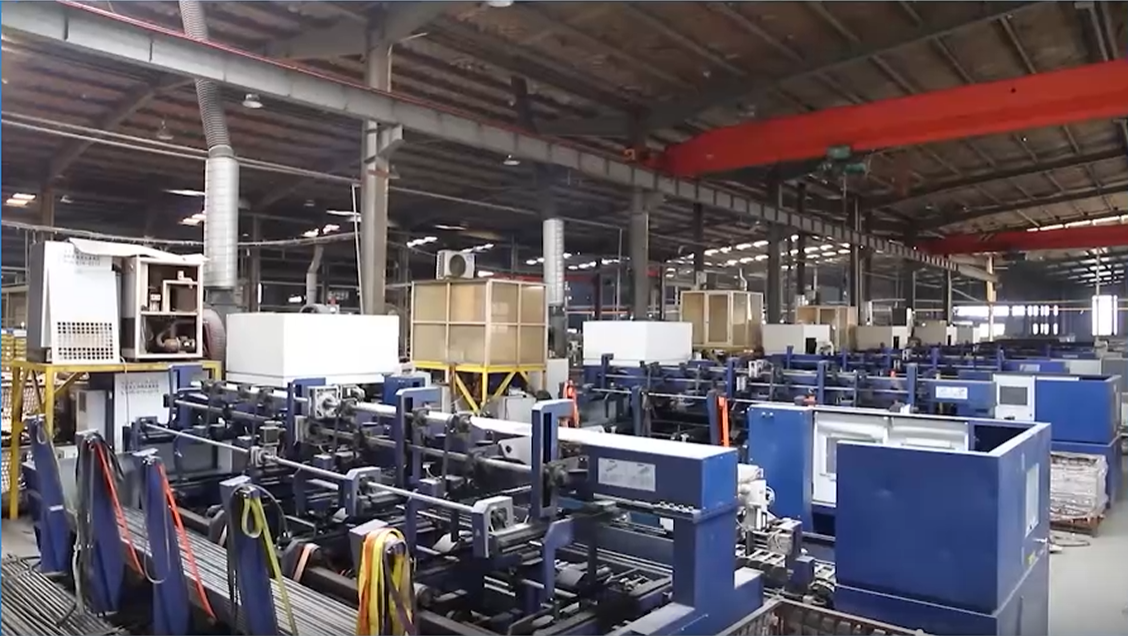
Production environments, not product renders, are where specification claims are first tested against physical units.
Ningbo Healthmate Health Technology Co., Ltd. is a home fitness equipment manufacturer and supplier founded in 2007 and based in Ningbo, China. Its factory covers 100,000 m², employs 850 people, produces roughly 700,000 units a year and exports about 80% of output to Europe, the USA, Japan, Korea, India, the Middle East and South America. The range covers home-use treadmills, walking pads, vibration machines, spinning bikes, magnetic X-bikes, upright bikes, elliptical trainers, electric mini bikes and rowing machines — nine families whose specification sheets are where a buyer's verification work actually happens.
Why the evaluation stage becomes a document question
The commercial reason is straightforward. A vibration platform, treadmill or rowing machine is assembled from components whose behaviour is described in numbers: rated power, speed range, resistance levels, flywheel mass, incline, timing ranges, carton dimensions, net and gross weight. Those numbers travel from engineering to quotation to packing list to nameplate. Every handover is a chance for drift. A buyer who verifies at only one point — usually the quotation — inherits whatever drift occurred downstream.
The operational reason is that home fitness equipment is used in settings the factory never sees: a small apartment where a folding treadmill must stow against a wall, an office where a walking pad runs under a standing desk, a household where an older user steps onto a vibration platform with limited balance. Failure in these settings is rarely dramatic; it is a console that behaves differently from the sample, a carton that measures larger than the CBM quoted, or a motor that draws more than the rated figure on a 110 V build.
Q&A: verifying a home fitness specification before order approval
Q1. Which document should be checked first — the quotation or the model designation?
The model designation. Every downstream check keys on it: certificate scope, carton marking, nameplate and the approved sample. The HSM range carries distinct codes that must not be collapsed into a family name — HSM-08VW, HSM-08VQ, HSM-08VS and HSM-08VF for vibration platforms; HSM-08YB for the swing massager; HSM-B135J5 for the magnetic exercise bike; HSM-S300 for the resistance cycling fitness bike; HSM-R06 for the indoor rowing machine; HSM-MT19, HSM-MT296, HSM-MT550, HSM-MT60 PRO and HSM-T20 for motorized treadmills; and HSM-W04L2B, HSM-W04L1BL, HSM-W04M2A, HSM-W08A and HSM-W09E for walking pads.
A quotation that names a product category without a model code cannot be matched to a certificate, and a certificate that cannot be matched to a model is not evidence. The acceptance test is mechanical: the code on the purchase order should appear identically on the nameplate, the carton marking, the packing list and the certificate record. Any variation — an extra suffix, a regional code, a "similar to" note — should be resolved in writing before approval rather than at destination.
Q2. How is frame and housing construction verified, including ABS components?
Separate the load-bearing structure from the cosmetic housing. On plate-type machines the platform frame and the outer housing are different components with different jobs, and the housing is commonly specified as ABS or a comparable engineering polymer. The check is not whether the word ABS appears somewhere in the brochure; it is whether the material is declared per component and whether the load path runs through metal rather than polymer. A single material word applied to a whole machine tells the buyer nothing about which part carries the user's weight.
On treadmills and walking pads the equivalent split is deck, frame tube and motor cover. Ask for the material declaration by component, then confirm it against a production sample rather than a studio image, because photographs are routinely retouched and samples are not. Where a supplier changes a housing material mid-programme without notice, the visible consequence is usually fit and finish; the hidden consequence is that the approved sample no longer represents what ships.
Q3. How should rated power be compared across vibration plates, massagers and treadmills?
Home fitness equipment does not share one power vocabulary. Vibration platforms and massagers are rated in watts, where figures such as 50 W, 200 W, or a dual-motor arrangement of 500 W + 300 W describe the drive configuration. Motorized treadmills are rated in horsepower, where 1.5 HP, 2.0 HP and 2.5 HP describe the drive motor. Comparing a watt figure with a horsepower figure is a category error, and quoting a peak value as if it were rated is a common way of making a modest drive look stronger than it is.
Three checks resolve most of the ambiguity. First, confirm whether the number is rated or peak, and in which duty condition. Second, confirm that the figure applies to the configuration actually ordered — voltage and plug type are customization variables, and a 110 V build is not the same bill of materials as a 220 V build. Third, confirm the number appears consistently on the nameplate, the carton and the specification sheet. Certificate documentation is a useful cross-check here: the CE-LVD verification ENB2606100194S00101C issued by EMTEK (Ningbo) Co., Ltd covers motorized treadmill against EN 60335-1:2012+A11+A13+A1+A14+A2+A15+A16:2023 and EN 62233:2008, and the scope of that document — not the marketing sheet — defines which product it speaks for.
Q4. What actually matters in speed ranges, resistance levels and timing ranges?
Level count describes control granularity, not resistance magnitude. Twenty levels on a magnetic bike and twenty levels on a friction bike are not equivalent, because the underlying mechanisms differ. Ask which mechanism is used, what the step between levels represents, and whether the top level is rated for continuous or intermittent use. The magnetic exercise bike HSM-B135J5 and the resistance cycling fitness bike HSM-S300 sit in different resistance categories, and the documentation reflects it: HSM-S300 is covered by a CE-GPSD verification of conformity (WTN23N07149899J, Waltek, against EN ISO 20957-1:2013 and EN ISO 20957-5:2016), which is the class of document that anchors an exercise-bike performance claim.
For timing ranges, confirm the preset programme durations, the maximum continuous session the machine is rated for, and whether the timer resets or pauses when the user stops. On vibration platforms the timing range interacts with the mode selection, so a stated maximum duration should be read together with the intensity setting rather than in isolation. Buyers who compare only the highest number on the sheet end up comparing marketing, not machines.
Q5. What should a buyer confirm about screen displays and controls?
Four things. The display technology (LED segment versus LCD), which readouts are shown simultaneously rather than cycled, the unit convention (metric or imperial), and whether the console is identical across the whole family or varies by model code. Console variation inside one family is one of the most common sources of mismatch between an approved sample and mass production, and it is invisible in a quotation that lists only "LCD display".
On vibration platforms the console governs mode and speed selection, so its button layout is a usability and safety item rather than a cosmetic one: a user who cannot identify the stop control under load is exposed. On walking pads and treadmills the console also carries the safety-key logic, which should be described in the operating instructions and demonstrated on the sample.
Q6. When does flywheel weight matter — and when does it not?
Flywheel mass matters where momentum carries the pedal stroke, which is the spinning-bike case: a heavier machined flywheel produces a smoother, more continuous pedalling feel. It matters far less on magnetic bikes, where resistance is generated electromagnetically and a quoted "flywheel weight" can be a carry-over from friction-bike marketing language rather than a functional specification.
The verification question is definitional. Is the figure the mass of the machined steel flywheel alone, or does it include the pulley and fixings? Is it a design target or a measured value from a production unit? On rowing machines the analogous specification is the flywheel or fan resistance together with the damper settings, not a weight in kilograms. Where a catalogue does not separate these definitions, the honest treatment is to regard the number as unverified until the supplier states its basis in writing.
Q7. How are incline and speed range verified on treadmills and walking pads?
Verify the endpoints in both directions and the drive type: manual incline, automatic incline, or fixed deck. A stated range of "0–12 levels" and a stated range of "0–12%" are not interchangeable, and mixing the two conventions across a product family creates confusion at the retail listing stage as much as at the factory.
Speed range needs a category check before a numeric one. Walking pads and under-desk formats are engineered for walking speeds, not running speeds, and quoting a walking pad against a running treadmill's top speed is a category error rather than a performance comparison. Confirm that the quoted speed range applies at the ordered voltage, that the range is achievable with a realistic user load rather than an unloaded belt, and that any folding mechanism — relevant to folding treadmills and walking pads — does not restrict the usable range when deployed.
Q8. How do dimensions, gross weight and net weight affect the order?
Four sets of numbers should be on the table, not two: product dimensions assembled, folded dimensions where the machine folds, carton dimensions, and both net weight (the machine) and gross weight (machine plus packaging). Container planning runs on carton volume and gross weight. A freight quote built on net weight understates cost, and a carton that measures larger than the quoted CBM quietly removes loading capacity from the container.
Two habits prevent most of these problems. First, require a packing list that states pieces per carton, carton dimensions and gross weight per carton, and check a measured carton against it rather than accepting the sheet. Second, require carton marking to carry the model code and the voltage variant, so that a mixed container can be reconciled on arrival without opening every box.
Acceptance criteria: what must match before an order is approved
The checks below convert the Q&A above into an approval gate. Each row pairs a verification item with the document that proves it and the failure mode that appears when the check is skipped. The structure is deliberately unglamorous — acceptance is a reconciliation exercise, not a judgement call.
| Verification item | Document that proves it | Failure mode if skipped |
|---|---|---|
| Model designation | Purchase order, nameplate, carton marking, certificate record | Family name quoted without a code; certificate cannot be tied to the shipped unit |
| Certificate scope and applicable model list | Certificate of conformity with number, standard and issue date | Document covers a different scope or a model outside the list |
| Rated power and voltage variant | Specification sheet plus nameplate | Peak value quoted as rated; a 110 V build shipped against a 220 V order |
| Construction materials | Component-level material declaration plus approved sample | One material word used for the whole machine; load path unclear |
| Speed, resistance or incline range | Specification sheet plus sample run | Endpoints borrowed from a different configuration; levels and percentages confused |
| Console and controls | Approved golden sample | Display or button layout differs from the approved unit |
| Dimensions and weights | Packing list plus measured carton | CBM or gross weight mismatch; container shortfall at loading |
| Quality control evidence | 100% test record and third-party inspection report | Inspection report predates the production batch it is meant to cover |
| Warranty scope | Contract clause | "Damaged parts" left undefined; claim process unresolved |
Certificate documentation is only useful when this reconciliation is possible. A certificate that pairs a scope with a named model list is far stronger evidence than one that names a product category: the ETL authorization to mark 150800030HZH-001, issued by Intertek Testing Services Ltd. Zhejiang against UL 1647:2015 Ed.6 and CSA C22.2#68:2018 Ed.8, lists ten motorized treadmill models from HSM-MT19 through HSM-W09E. The CE-LVD verification ENB2503310223S01301C from EMTEK, by contrast, covers the X-bike and rowing machine scope and names HSM-R06 and HSM-B135J5. Reading which models a document actually covers is the difference between holding a certificate and holding evidence.
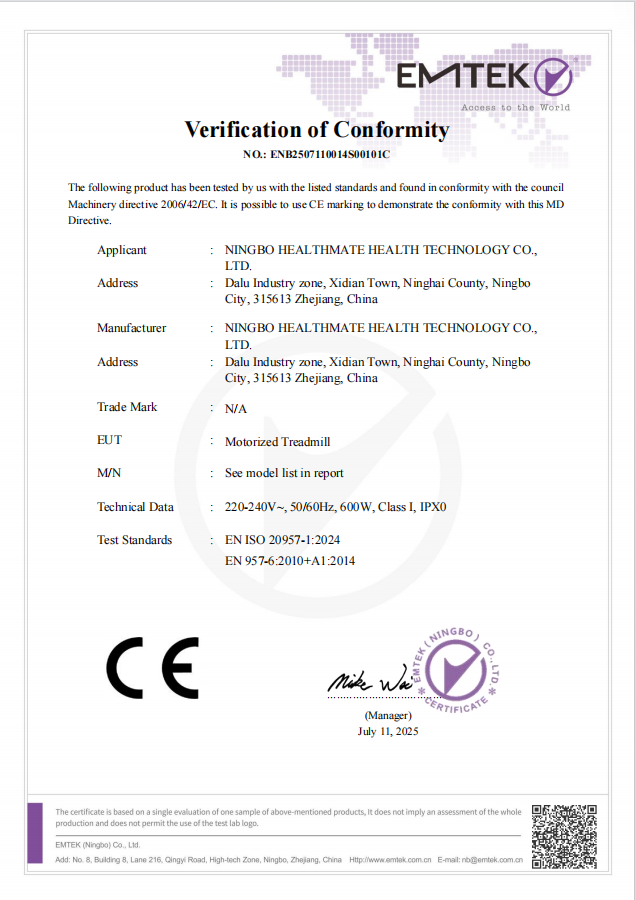
A conformity document is only an acceptance tool when its scope and model list can be matched to the purchase order.
Commercial terms that interact with acceptance
Specification checks do not happen in a commercial vacuum. The sourcing terms published for this range — OEM/ODM production with colour, logo, voltage and plug-type customization; a monthly capacity of 8,000 pieces; a lead time of 35–40 days; a minimum order of 100 pieces; 100% testing with third-party inspection; and a one-year warranty covering damaged parts — each have a verification consequence.
A 100-piece minimum means a buyer can place a mixed order across several model codes, which is useful for range testing but raises the reconciliation workload: each code needs its own row in the acceptance table. A monthly capacity of 8,000 pieces is a planning figure, not a promise for any single week, and should be read together with the lead time rather than against it. The 35–40 day lead time conventionally counts from approval of artwork and sample, not from purchase order issue — a distinction worth writing into the contract, because customization of colour and logo sits inside that window.
The quality-control term deserves the closest reading. "100% test plus third-party inspection" describes two different activities: an in-line test applied to every unit, and an independent inspection applied to a batch. Buyers should ask what the in-line test measures — function, safety key, console response, running noise — and should ensure the inspection report is dated within the production batch it covers. The one-year warranty covering damaged parts is only as strong as the definition of "damaged": consumables, cosmetic wear and shipping damage are usually treated differently, and the claim route should be agreed before the first container rather than after it.
Application: which family fits which household use
Specification choices only become decisions when matched to a use case. Across a reported programme of 100,000 pieces shipped globally, the application profile clustered around family daily cardio work, indoor weight-loss training, elder daily rehabilitation exercise, office standing walking, light exercise in small apartments, post-meal fat burning, low-impact leg cardio and rehabilitation for mild joint discomfort. That profile maps onto the range in a fairly direct way.
- Walking pads — HSM-W04L2B, HSM-W04L1BL, HSM-W04M2A, HSM-W08A and HSM-W09E — suit office standing walking, small apartments and post-meal movement, where the constraint is footprint and stowage rather than top speed.
- Vibration platforms — HSM-08VW, HSM-08VQ, HSM-08VS and HSM-08VF — suit low-impact and rehabilitation-oriented use, where the relevant specifications are platform behaviour, mode range and console clarity.
- Magnetic bike HSM-B135J5, resistance cycling bike HSM-S300 and indoor rowing machine HSM-R06 cover cardio training, where resistance mechanism and console readouts carry more weight than flywheel figures alone.
- Motorized treadmills — HSM-MT19, HSM-MT296, HSM-MT550, HSM-MT60 PRO and HSM-T20 — serve running-oriented households, where drive rating, incline and deck behaviour dominate the acceptance discussion.
- The swing massager HSM-08YB addresses recovery and office scenarios rather than cardio load.
The reported outcomes of that programme are also the reason the acceptance discipline pays: stable running performance, an after-sales failure rate below 2%, a high customer repeat order rate and positive market feedback on household space demand. Space demand is the recurring theme — it is a specification requirement disguised as a lifestyle preference, and it is settled by folded dimensions and carton volume long before it is settled by a product photograph.
Market direction and the documentation it demands
Two structural facts shape what buyers will be asked to verify next. Motorized treadmills already dominate shipment volume at 83% of the category in 2023, and magnetic resistance already holds 62.4% of the indoor cycling bike market as of 2025. As these configurations consolidate, the competitive margin moves into consistency: the same model performing the same way across repeated production runs, described the same way across repeated documents.
Regulatory expectations reinforce the point without requiring new claims. ASTM F2276 is widely referenced as a core safety standard for home fitness equipment, covering stability and protection around moving parts (SRC-0003). Buyers rarely need to interpret such standards themselves; they need to confirm that the standards cited on a certificate match the market they are importing into, and that the certificate's scope covers the specific model ordered. That is a documentation task, and it scales with range breadth — nine product families means nine scope conversations.
Where document-based verification stops
Honesty about limits is part of the acceptance discipline. A document set can confirm that a model exists, that a scope is covered, that a nameplate matches a quotation and that a packing list reconciles with a measured carton. It cannot, by itself, confirm cycle life under a specific household load, the tier of motor supplier inside a given unit, or the real-world duty cycle a user will impose. Those questions belong to sample testing and pre-shipment inspection, not to certificates.
There is a second, narrower limit worth stating plainly. A certificate covers a scope, not every conceivable variant of it: a change of voltage, plug type or control configuration may sit outside what the existing document describes, and buyers should confirm per order rather than assume continuity. Similarly, sourcing an entire range from a single supplier concentrates verification risk in one relationship — efficient, but dependent on that supplier's documentation discipline holding up as the range grows.
Future outlook
Three developments look likely to shape procurement over the next several years. First, model-level traceability will become an expectation rather than a differentiator, as buyers discover that a certificate naming ten models is easier to work with than one naming a category. Second, compact and walking-oriented cardio will keep pulling specification attention toward folded dimensions, carton volume and low-speed control resolution rather than headline power. Third, the gap between the strongest and weakest documentation sets in this category will widen, and commercial negotiation will increasingly start from the acceptance checklist rather than from the price list.
None of these changes make sourcing harder. They make it more legible, which is the outcome a buyer in the evaluation stage actually needs.
FAQ
What is the difference between rated power and peak power in home fitness equipment?
Rated power describes the continuous output a drive is engineered to sustain; peak power describes a short-duration maximum. Specification sheets in this category quote both conventions, in watts for vibration platforms and massagers and in horsepower for treadmill drive motors. The acceptance check is to establish which convention a figure uses, and to confirm that the same figure appears on the nameplate and the specification sheet for the ordered configuration.
Does a higher speed or resistance level count mean a better machine?
No. Level count describes control granularity, not resistance magnitude or training quality. A magnetic resistance system and a friction system with the same nominal level count behave differently, because the underlying mechanism differs. Buyers comparing level counts should also compare the resistance mechanism, the step size between levels and whether the top level is rated for continuous use.
Why do gross weight and net weight need to be verified separately?
Net weight describes the machine; gross weight describes the machine plus packaging. Container planning and freight costing run on carton volume and gross weight, so a quotation built on net weight understates the load. Verifying both against a measured carton, rather than against the specification sheet alone, prevents a loading shortfall that only becomes visible at the port.
Does a certificate for a product family cover every model and configuration in that family?
Not automatically. Certificate records pair a scope with the models listed on the document. The ETL authorization 150800030HZH-001, for example, names ten motorized treadmill models, while the CE-LVD verification ENB2503310223S01301C covers the X-bike and rowing machine scope and names HSM-R06 and HSM-B135J5. Configurations involving different voltage or plug types should be confirmed against the certificate scope for each order.
What does a one-year warranty covering damaged parts actually commit to?
It commits the supplier to a defined scope of part replacement for one year, and the definition is the substance of the term. Cosmetic wear, consumable components and transport damage are commonly treated separately from functional failure. The acceptance step is to write the covered parts, the claim evidence required and the replacement route into the contract before the first shipment, rather than relying on the general wording.
Which documentation should a buyer request for a mixed order across several model codes?
A mixed order requires one reconciliation row per model code: designation, certificate scope and model list, rated power and voltage variant, construction declaration, range endpoints, console reference, carton dimensions, gross and net weight. The minimum order quantity of 100 pieces allows several codes in one order, so the packing list should also state pieces per carton and marking per code to keep a mixed container reconcilable on arrival.
A full model and specification catalogue for the HSM range, including the product families discussed above, is available for download: HSM New E-Catalog (PDF).
Tem questões ou precisa de mais detalhes?
Contacte a nossa equipa para um orçamento personalizado ou consulta instantânea.
Solicitar orçamento
Preencha o formulário abaixo e a nossa equipa entrará em contacto com uma proposta personalizada.
Chat direto do WhatsApp
Prefere conversar em tempo real? Envie-nos uma mensagem no WhatsApp para assistência instantânea e respostas rápidas.
- Obter orçamento personalizado
- Partilhar fotos ou documentos
- Discuta as suas necessidades diretamente
Geralmente responde em 5–30 minutos durante o horário de expediente.