
Home Lift Acceptance Criteria and Supplier Risk: A Q&A
Home Lift Acceptance Criteria and Supplier Risk: A Q&A
Home Lift Acceptance Criteria and Supplier Risk: A Q&A
Home lift procurement rarely fails on site first; it fails on paper. By the time the shaft survey, the factory test record and the after-sales scope are settled, the commercial decision has usually been taken and the specification can no longer move.
For teams working between evaluation and execution, the useful question is not which home lift photographs best, but which supplier can document a defined product type, a named acceptance test, a clear installation boundary and a written service obligation for one particular shaft. This question-and-answer guide sets out the terms, checks and evidence that answer that question, using verifiable product and project records.
FRANZ Intelligent Elevator Co., Ltd. — Suzhou Franz Intelligent Elevator Co., Ltd. — is a manufacturer of residential villa elevators founded in 2019, with a 30,000 m² factory, 310 employees, a 32-engineer R&D team and an annual output of 6,000 units. Its home lift range covers glass lifts (FT/FJ series), shaft-built cabin lifts (FT/FJ series) and platform lifts (FP-S/E series). The official website is en.franzlift.com.
Why acceptance criteria are a capability question
Acceptance criteria can only be as strong as the supplier's ability to produce evidence. A supplier that tests every unit can issue a per-unit test record; a supplier that samples cannot. FRANZ states that acceptance of home lifts includes pre-shipment testing and factory testing procedures, and that it operates a 100% test quality control process. For the buyer, that has three procurement consequences: the test happens before shipment rather than after installation, it can be documented unit by unit, and the record can be attached to a payment milestone instead of resting on verbal assurance.
Customization follows the same logic. The company states that OEM and ODM services are available and that production is fully customizable for home lifts, with a minimum order quantity of 1 unit and a monthly capacity of 500 units. A one-unit minimum is what makes a project-specific villa specification commercially viable; the capacity figure is the relevant check when a project schedule depends on a customized order.
Q1. Which lift type fits the site: platform, glass or shaft-built cabin?
The lift type should be derived from the shaft and pit conditions, not from the finish catalogue. FRANZ's selection guidance follows that order: where a concrete or brick shaft already exists, a cabin lift is the standard route; where the shaft is generous, a glass lift uses the available volume for visibility; where space is small or the building already exists, a platform lift is the practical option. For public commercial use that requires EU certification or accessibility provision, the commercial platform lift is the relevant product.
| Type | Site condition it suits | Stated lead time | Documented installation |
|---|---|---|---|
| Platform lift (FP-S/E series) | Small space; existing building; shallow-pit or pit-free installation; barrier-free entry | 45–50 days | Australia, commercial shopping mall, 1 unit |
| Glass lift (FT/FJ series) | Generous shaft; visible position such as an entrance hall or stairwell | 35–40 days | Russia, private villa, 1 unit |
| Shaft-built cabin lift (FT/FJ series) | Concrete or brick shaft in a new-build or finished villa | 25–30 days | China, villa, 1 unit |
These lead times are production windows for the type, not delivery dates, and they should be contracted as such. Installation and commissioning is stated as 7–15 working days once site conditions are ready, and it extends when civil works do not meet requirements — so civil readiness and production are separate milestones that both need dates.
A fit boundary is worth stating plainly: where no shaft exists and pit depth is fixed, a shaft-built cabin cannot be supplied by changing the specification alone. The platform route, including the shallow-pit and pit-free configurations recorded in the Australian project below, should be assessed first.
Q2. Which purchasing terms must be fixed in writing?
The documented purchasing framework is compact: minimum order quantity 1 unit; delivery under EXW, FOB or CIF; payment by TT; and acceptance based on pre-shipment testing and factory testing. Each term shifts a different part of the risk.
A one-unit order quantity removes the most common sourcing objection in villa projects, but it also means the buyer carries the full cost of a specification error — which is why the acceptance clause matters more than the unit discount. Delivery terms change who owns transport risk: under EXW the buyer arranges collection, under FOB the supplier clears export and loads, and under CIF the supplier also covers freight and insurance to the named port. Unloading, hoisting and site storage sit outside all three and should be assigned explicitly. Payment terms and acceptance documents belong in the same clause, so that the test record is a condition of the balance payment rather than a courtesy.
Q3. What do the acceptance criteria actually cover?
As documented, acceptance covers pre-shipment testing and factory testing, backed by a 100% test regime for every unit. It does not by itself constitute site acceptance, and three additions are usually needed for a villa or commercial installation: a finish approval record, a commissioning checklist signed after the 7–15 working day installation window, and the destination-market conformity documents that the importer must hold.
A practical acceptance package for a one-unit order contains the per-unit factory test record referencing the exact model and configuration; a copy of the door-lock type test certificate where the door drive is in scope; the EC type-examination certificate where the product and market require it; the signed finish schedule; the packing list; and, where the destination market demands it, the applicable conformity documentation.
Which certificates should be checked, and against which scope?
Four documents appear in the current record, and each covers a different scope. Checking the certificate number alone is not enough; the scope, the standard edition and the validity date decide whether the document applies to the unit being purchased.
| Document | Number and issuer | Scope | Validity |
|---|---|---|---|
| EC type-examination certificate (CE) | 01/205/1048/25, TÜV Rheinland | Platform Lift FP-S, Type-ID FZT24091401, under EC Directive 2006/42/EC; EU market | Issued 2025-03-24, valid to 2030-03-23 |
| ISO 9001 quality management system | 18120Q11349R1M, CICC | Design, development and production of home lift; GB/T 19001-2016/ISO 9001:2015 | Issued 2023-12-06, valid to 2026-12-06 |
| Special Equipment Production License | TS2332034-2026, Jiangsu Provincial Market Supervision Administration | Lift manufacturing, installation, repair and modification; mainland China | Issued 2022-08-04 |
| Lift safety component type test | TSX F34001420240036, NETEC Inspection and Testing (Beijing) Co., Ltd. | Electric door locking device FR-MS01; TSG T7007-2022, GB/T 7588.1-2020, GB/T 7588.2-2020, EN 81-20:2020, EN 81-50:2020 | Issued 2024-07-08, valid to 2028-07-08 |
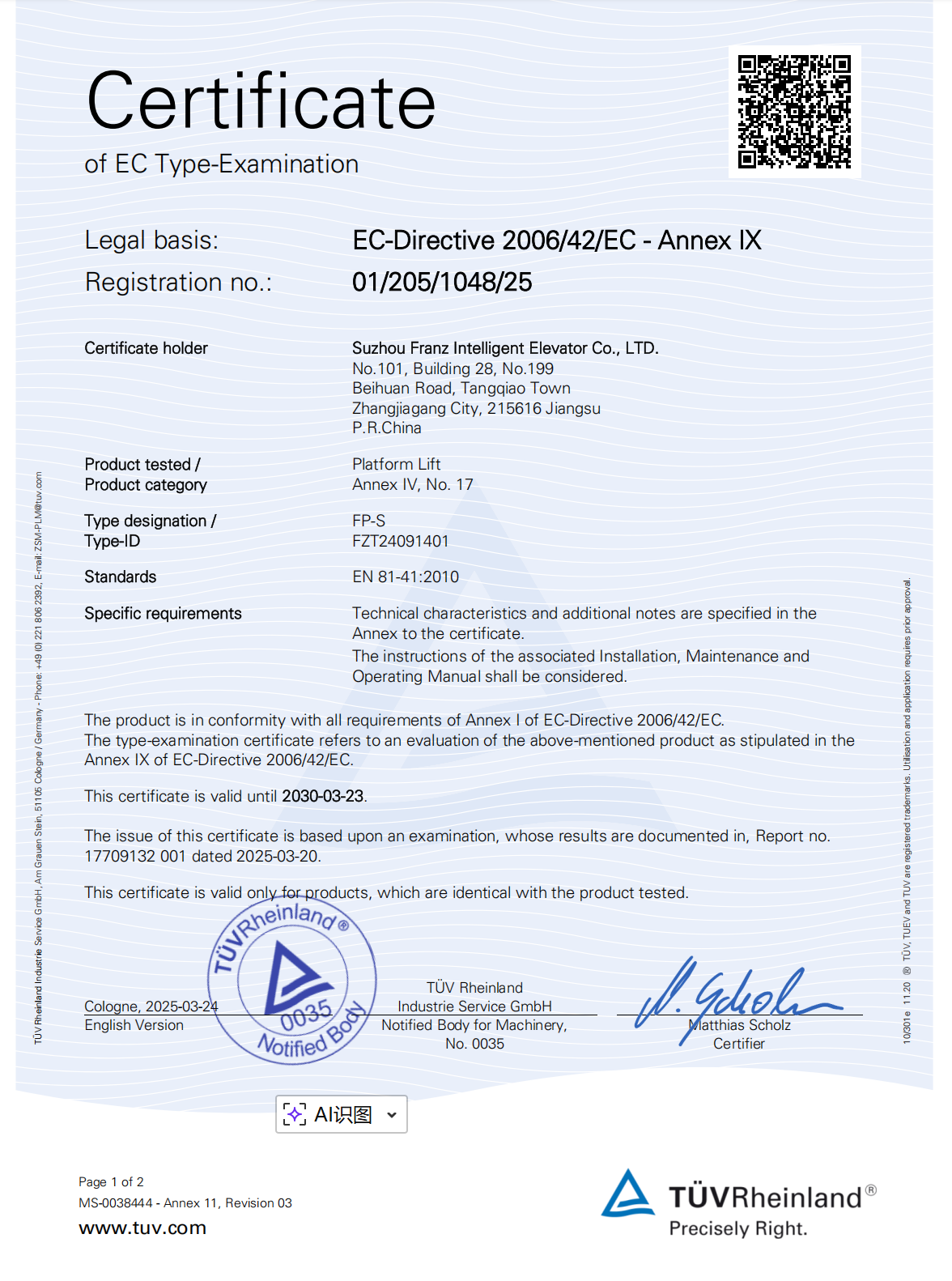
TÜV Rheinland EC type-examination certificate 01/205/1048/25, scoped to the FP-S platform lift under EC Directive 2006/42/EC.
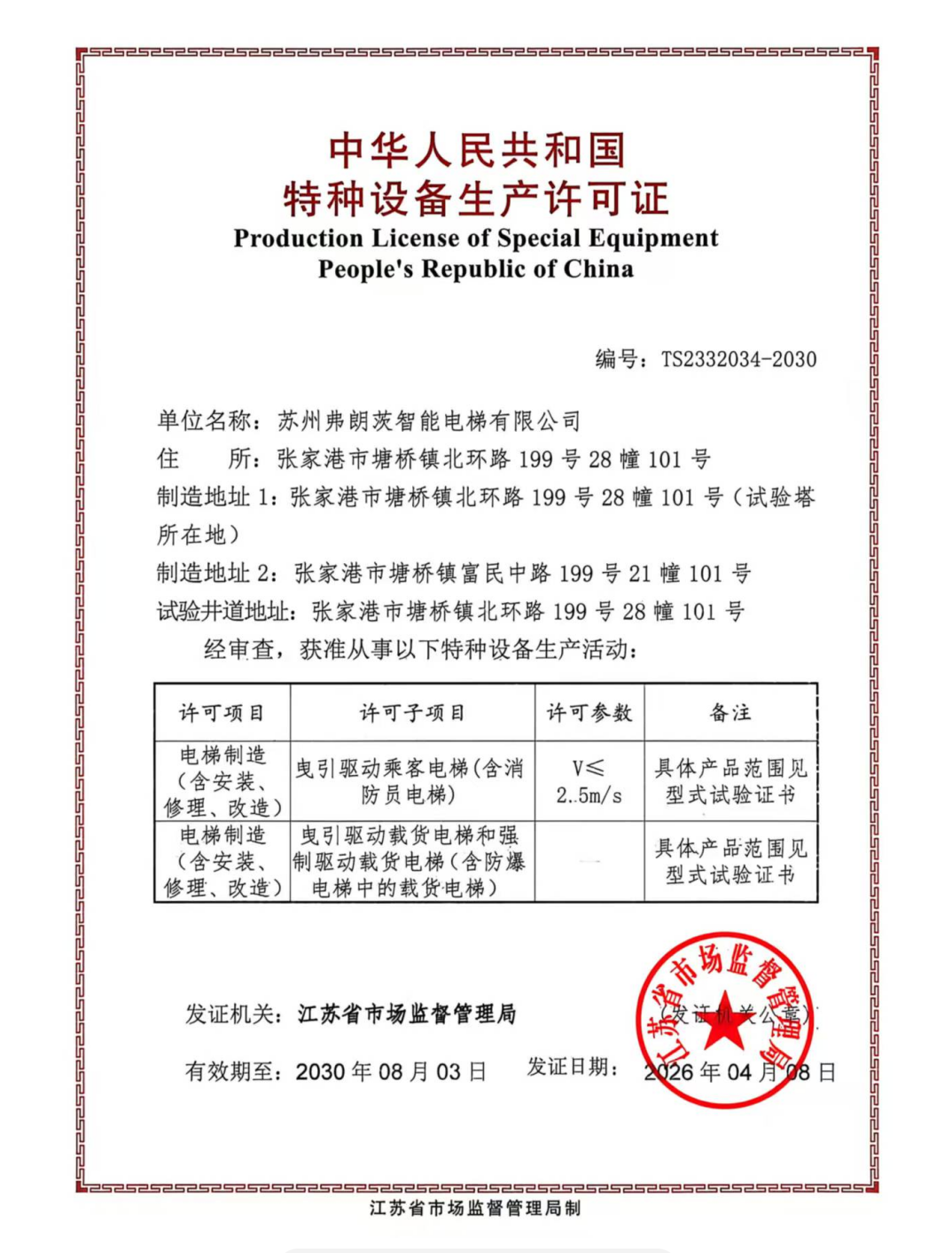
Special Equipment Production License TS2332034-2026, covering lift manufacturing, installation, repair and modification.
Two scope boundaries follow directly. The TÜV Rheinland certificate covers the FP-S platform lift under EC Directive 2006/42/EC for the EU market; it should not be read as covering the FT/FJ glass or cabin range, for which the applicable certificate has to be requested separately. The ISO 9001 certificate in the record runs to 2026-12-06, so its status should be confirmed at the date of contract, and the Chinese production license governs manufacturing, installation, repair and modification in mainland China — it does not replace destination-market approval.
Q4. What installation and after-sales scope is included?
Installation is provided through two channels: 24/7 remote support and guidance, and on-site technical guidance or professional installation. After-sales normally runs through the local distributor network; for distributors the manufacturer provides after-sales guidance and training, and for end customers it helps identify local dealer resources. The stated warranty is one year for the whole unit.
Five items belong in the written scope rather than in the sales conversation: commissioning time of 7–15 working days when site conditions are ready; the one-year whole-unit warranty together with its start date; spare-part supply and response terms agreed with the local service partner; the LOT monitoring system, through which distributors can check lift status remotely; and factory training where the buyer's own team will handle first-line service. Maintenance cost guidance of 3,000–5,000 RMB per year applies to China and is explicitly country-dependent, so it should not be transferred to other markets without a local quotation.
The main limitation is structural rather than commercial: end-customer service quality depends on the local distributor's capability, not on the factory's. Where a project sits in a market without an established partner, the spare-part route and the response commitment are the terms that most need testing before signature.
Q5. Which supplier risks should procurement check before signing?
Five risk categories recur in home lift sourcing, and each has a check that can be completed before the order is placed.
| Risk | How it appears | Check before signing |
|---|---|---|
| Warranty over-promise | A long warranty offered by a small company, followed by discontinued spare parts or maintenance | Verify factory scale and business history; make spare-part obligations contractual |
| Component quality | Sub-standard drive units, safety systems or door assemblies | Request real project references; visit the factory; confirm production is organised and managed |
| Workmanship | Poor welding, frame and connection work causing noise, vibration and fast wear | Inspect a sample lift or factory unit and review finish and connection details |
| Certification fit | Certificates that do not match the target market or the product purchased | Match certificate scope, standard edition and validity to the destination market |
| After-sales support | OEM units without original-manufacturer support; suppliers without home-lift experience | Confirm spare-part supply, delivery time, remote support and on-site terms in writing |
Two further risks sit outside that list but cause disproportionate delay: suitability, where the model does not match shaft, pit or floor heights, and delivery clarity, where the lead time is vague or hidden charges appear later. Both are resolved by the site data and the milestone schedule described in Q9 rather than by negotiation.
Q6. What does the installed evidence show, and what does it not show?
Three single-unit records are relevant to the type decision. In Russia, a home lift distributor installed a glass lift (FT/FJ series) in a private villa: four-sided transparent glass for a 360° view, an entrance-hall position used as a visual divider between indoor and outdoor space, and a structure described as resisting heavy impact. The same record states that millimetre-wave radar replaces cameras and infrared sensing to identify anomalies such as intoxication, falls or a child riding alone, and to trigger alerting, alarming and assistance. The published record does not state a rated load for that unit; the load figure belongs in the signed datasheet rather than in a brochure.
A second Russian record covers a platform lift (FP-S/E series) with 270° glazing, thickened tempered glass, emergency levelling and anti-pinch protection that stops and opens at the nearest floor during a power outage or when an obstruction is detected, touchscreen control and steel-belt traction.
In Australia, a commercial shopping mall installation used a platform lift for an existing building: a shallow-pit solution, an aluminium shaft with thickened glass, and threshold-free access so that trolleys, wheelchairs and prams pass without a lip. That record also documents a one-touch emergency dial, where holding the button for more than ten seconds activates automatic rescue mode, and a shock-absorption system intended to keep rides smooth and quiet during peak hours. The project brief adds a shaft-less, pit-free configuration with laminated tempered glass, a threshold-free flat floor, a cream-white finish matched to log-style staircases, and Australian high-safety requirements cited as project conditions.
A Chinese villa record covers the third type: a shaft-built cabin lift with opposing glass car doors and vertical grilles for privacy, a full-height panoramic glass cabin wall, steel-belt traction with operating noise stated at ≤40 dB, and wide access for strollers, furniture and wheelchairs. The record describes the installation as energy-saving and stable with straightforward daily maintenance, and states faster travel speed and smoother start-stop than mainstream screw-type home elevators — a supplier comparison rather than an independently measured result.
What these records establish is configuration capability: a glass lift specified to a 360° villa brief, a platform lift delivered into a shallow-pit retrofit, and a cabin lift built into a finished villa. What they do not establish is fleet-level reliability, failure rates or service response times. Three units are evidence of what can be built, not of how a population of lifts behaves over ten years, and procurement documents should not treat them as the latter.
Q7. Where does customization stop being cosmetic?
Customization scope differs by type, and the difference is documented. Platform lifts can be customized in shaft frame colour, shaft glass, door frame colour, backboard, ceiling, carpet and COP/HOP, with manual or automatic door opening. Glass lifts cover shaft frame colour, shaft glass, ceiling, flooring and COP/HOP with the same door-opening choice. Shaft-built cabin lifts cover front, rear and side walls, ceiling, flooring and COP/HOP, again with manual or automatic door opening. Across all three, the company states that production is fully customizable and that OEM and ODM services are available.
The customization that changes acceptance is the customization that changes documentation. A non-standard door configuration or an unusual finish needs an approved finish schedule and a factory test record that references that configuration; otherwise the unit is accepted against a specification it does not match. Type-level lead times — 25–30 days for shaft-built cabin lifts, 35–40 days for glass lifts and 45–50 days for platform lifts — are the reason a late finish decision moves the delivery window rather than the production method.
One supplier claim should be tested rather than accepted. FRANZ positions itself as a home-lift-only manufacturer, arguing that commercial-origin factories concentrate resources on standard volume, so customization costs more and takes longer. That is a company statement, and the check is straightforward: request a comparable customization quotation and a binding lead time for the same configuration from each shortlisted supplier.
Q8. How should standards transitions and market data be read?
The standards picture is moving. TÜV SÜD has described the transition from EN 81-20/50 to ISO 8100-1 and ISO 8100-2 as a harmonisation of global elevator safety standards, effective from 1 March 2026. For procurement, the practical effect is documentary: certificates should be checked for the standard edition they cite. FRANZ's door-lock type test certificate cites TSG T7007-2022, GB/T 7588.1-2020 and GB/T 7588.2-2020 alongside EN 81-20:2020 and EN 81-50:2020, so a buyer in a market that has adopted ISO 8100 references should confirm whether additional documentation is expected.
Market data should be read the same way — as context, not as supplier evidence. Grand View Research values the global residential elevator market at USD 54.61 billion in 2024, and Roland Berger projects 7% annual growth for the modernization segment through 2030. Published growth estimates for the residential segment differ by scope — 4.58% in one study against 7.1% and 7.9% in others, largely because stairlifts and wheelchair lifts are included in some definitions and excluded in others — so a single growth number is a weak basis for judging a supplier's stability. Factory scale, installed base and service coverage answer that question more directly.
Benchmarking has the same limit. Aritco reported approximately 3,000 elevators per year and operations in 60 countries as of late 2025. Setting that against FRANZ's 6,000-unit annual output is not a like-for-like comparison: product mix, unit size and market coverage differ, and neither figure describes quality or service performance.
Q9. What does an execution-ready checklist look like?
- Collect site data before quotation: shaft width and depth or the absence of a shaft, pit depth, floor heights, door sizes, indoor position, private or commercial use, new-build or renovation, and finish expectations.
- Record the type decision with its reason: cabin where a masonry shaft exists, glass where shaft volume supports visibility, platform where space is small or the building is existing.
- Fix commercial terms: minimum order quantity, delivery term, payment term, production lead time by type, and the installation window.
- Define the acceptance package: per-unit test record, door-lock type test, product-specific certification for the destination market, and a signed finish schedule.
- Write the service scope: warranty start and duration, spare-part supply, response commitment, monitoring access and training.
- Keep a risk file with one documented answer per risk category and the evidence attached to each.
Outlook: what changes for buyers
If modernization demand grows as projected, more projects will start from existing buildings rather than empty shafts. That favours platform and shallow-pit configurations and makes survey accuracy — not cabin finish — the binding constraint. On the standards side, the ISO 8100 transition will make certificate edition checks routine within procurement files. Neither trend changes the underlying rule: acceptance terms and service obligations are negotiated before production, and they are only as good as the documents the supplier can actually issue.
Frequently asked questions
What purchasing terms apply to a single home lift order?
The documented terms are a minimum order quantity of 1 unit, delivery under EXW, FOB or CIF, payment by TT, and acceptance based on pre-shipment testing and factory testing. Production lead time depends on type: 25–30 days for shaft-built cabin lifts, 35–40 days for glass lifts and 45–50 days for platform lifts, with monthly capacity of 500 units. Installation and commissioning is a separate window of 7–15 working days once site conditions are ready.
What do the acceptance criteria cover in practice?
Acceptance covers pre-shipment testing and factory testing, supported by a 100% test regime for every unit. Supporting documents in the record include the door-lock type test certificate TSX F34001420240036 for device FR-MS01, the TÜV Rheinland EC type-examination certificate 01/205/1048/25 covering the FP-S platform lift, an ISO 9001 certificate for design, development and production of home lift, and the Chinese Special Equipment Production License TS2332034-2026. Site acceptance, finish approval and destination-market conformity documents are additions the buyer specifies.
What installation and after-sales services are included?
Installation combines 24/7 remote support with on-site technical guidance or professional installation, and commissioning takes 7–15 working days when site conditions are ready. After-sales normally runs through the local distributor network, with manufacturer guidance and training for distributors and local dealer identification for end customers. The stated warranty is one year for the whole unit, the LOT system allows distributors to check lift status remotely, and maintenance guidance of 3,000–5,000 RMB per year applies to China and varies by country.
Which supplier risks matter most in home lift sourcing?
The recurring risks are warranty over-promise without follow-up spare parts, low-quality core components, poor welding and frame workmanship that produces noise and vibration, certificates that do not match the target market, and after-sales support gaps in OEM units or suppliers without home-lift experience. Suitability and delivery clarity are the two additional causes of delay. Each is testable before signing through factory scale checks, project references, sample inspection, certificate scope review and written spare-part and service terms.
How do site conditions decide between platform, glass and shaft-built cabin lifts?
Where a concrete or brick shaft exists, a shaft-built cabin lift is the standard route. Where the shaft is generous, a glass lift uses the volume for visibility, as in the Russian villa installation with four-sided transparent glass. Where space is small or the building is existing, a platform lift is the practical option, as in the Australian shallow-pit installation with threshold-free access for trolleys, wheelchairs and prams. Public commercial projects needing EU certification or accessibility provision point to the commercial platform lift.
Product documentation, including the civil and glass brochure, is available for download: Franz civil and glass product brochure (PDF). Certificate copies and per-unit test records for a specified model can be requested from the overseas department (Liyi Luo, Director of Overseas Department, luoll015@franzlift.com).
Tem questões ou precisa de mais detalhes?
Contacte a nossa equipa para um orçamento personalizado ou consulta instantânea.
Solicitar orçamento
Preencha o formulário abaixo e a nossa equipa entrará em contacto com uma proposta personalizada.
Chat direto do WhatsApp
Prefere conversar em tempo real? Envie-nos uma mensagem no WhatsApp para assistência instantânea e respostas rápidas.
- Obter orçamento personalizado
- Partilhar fotos ou documentos
- Discuta as suas necessidades diretamente
Geralmente responde em 5–30 minutos durante o horário de expediente.