
Home Lift Procurement FAQ: Specs, Supplier Risks, Acceptance
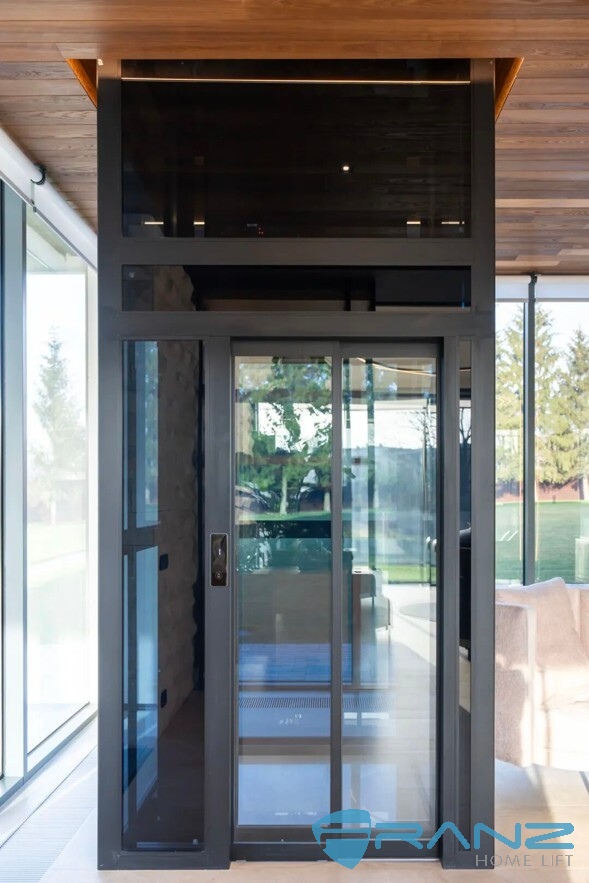
A full-glass home lift cabin installed for daily residential use — one of three product families in the home lift category, alongside the platform lift and the shaft-built cabin lift.
The global residential elevator market reached USD 54.61 billion in 2024, according to Grand View Research, a figure that reflects how far vertical transportation has moved beyond commercial buildings. In villas, retrofit conversions, hotels and mixed-use retail, the home lift has become a specification item rather than a discretionary upgrade. That shift has created a specific procurement problem: the questions that decide whether a home lift project succeeds are technical and contractual, and they are typically asked far later than they should be.
This reference answers the technical and procurement questions that recur across home lift projects — product type, load and speed, pit and shaft constraints, drive technology and noise, safety functions that must be verified, supplier risk, purchasing terms and acceptance criteria. It draws on documented specifications for platform, glass and shaft-built cabin lifts, and on three international installations in Russia, Australia and Indonesia.
Why Home Lift Procurement Questions Surface Too Late
Most home lift projects begin with an architectural or aesthetic decision and only later encounter the constraints that actually govern feasibility. Pit depth, available shaft footprint, load requirement, travel speed, noise limits and acceptance terms are usually evaluated after a shortlist has already been formed on appearance alone. That sequence is the single most common source of rework.
Two structural forces are making the problem sharper. The first is retrofit demand. Existing residential and commercial buildings frequently have no dedicated lift shaft and limited floor depth, which pushes buyers toward shallow-pit and shaft-less configurations rather than conventional machine-room arrangements. The second is regulatory harmonisation. The transition from EN 81-20/50 to ISO 8100-1 and ISO 8100-2 is harmonising global elevator safety standards, a transition described by TÜV SÜD in November 2025 as active and ongoing, with an effective date of 1 March 2026. For procurement teams, that means compliance documentation is becoming a purchasing item in its own right, not a post-delivery formality.
The opportunity is straightforward: buyers who ask the technical and contractual questions early can select a configuration that fits the building, rather than adapting the building to a configuration they have already chosen.
How FRANZ Approaches Home Lift Supply and Customization
FRANZ Intelligent Elevator Co., Ltd. — registered as Suzhou Franz Intelligent Elevator Co., Ltd., based in Suzhou, Jiangsu, China — is a manufacturer specialising in the R&D, smart manufacturing, sales, installation and maintenance of residential villa elevators. The company was founded in 2019, operates a 30,000 m² factory, employs 310 people including a 32-engineer R&D team, and reports an annual output of 6,000 units with an export ratio of 15%. Its main markets include Southeast Asia, Russia, Australia, the Middle East and Africa, with more than 220 showrooms and operations across more than 30 countries. In 2025, its commercial platform elevators received TÜV Rheinland EU EC whole-machine safety certification.
For procurement purposes, the relevant commercial facts are these: the product scope is three home lift families — platform lift, glass lift and shaft-built cabin lift — with a minimum order quantity of 1 unit and a monthly capacity of 500 units. Production is described as fully customizable, covering shaft frame colour, shaft glass, ceiling, flooring, car operating panel and hall operating panel, plus manual or automatic door opening. Every unit undergoes 100% testing before shipment. Published lead times are 25–30 days for the shaft-built cabin lift, 35–40 days for the glass lift and 45–50 days for the platform lift.
Procurement reading: a single-unit MOQ and a published 500-unit monthly capacity matter more than headline factory size for villa and small commercial buyers. They indicate that a one-off, non-standard configuration can be produced and still be scheduled — which is the practical question most residential buyers actually have.
Technical Explanation: Platform, Glass and Shaft-Built Cabin Lifts
Home lift specifications are best compared by product family first, because load, speed, drive mode and installation constraints differ between them. The table below reflects published specifications for the three families.
| Product family | Shaft / structure | Load capacity | Speed | Drive & energy | Environment |
|---|---|---|---|---|---|
| Platform lift — FP-S/E Series | Aluminium frame with glass shaft plus platform | 320–400 kg | 0.15 m/s; 0.3 m/s | Steel-belt traction; 1.1 kW | Indoor |
| Glass lift — FT/FJ series | Aluminium frame with glass shaft plus glass cabin | 400–800 kg | 0.4 m/s; 0.63 m/s; 1.0 m/s | Traction steel belt or wire rope; drum drive; 1.1–2.4 kW | Indoor and outdoor |
| Shaft-built cabin lift — FT/FJ series | Bent steel structure, concrete shaft, wood shaft or brick shaft | 320–1000 kg | 0.4 m/s; 0.63 m/s; 1.0 m/s | Traction steel belt or wire rope; drum drive; 1.1–2.4 kW | Indoor |
Source: FRANZ product specification data for the FP-S/E Series platform lift, the FT/FJ series glass lift and the FT/FJ series shaft-built cabin lift.
Shallow pit, small footprint and retrofit feasibility
The most consequential constraint in an existing building is not the lift itself but what surrounds it. The platform lift is engineered around a shallow-pit, high-efficiency design and is described as installable in as little as 1 m² of space, with a full-glass shaft. That combination is what makes installation possible in buildings that were never designed to carry a lift, and it is explicitly positioned for small spaces, existing houses and wheelchair access.
The minimum load figure matters as much as the maximum. A platform lift at 320–400 kg and 0.15–0.3 m/s is a deliberate trade-off: it fits constrained buildings, but it is not a high-speed or heavy-load solution. Buyers who need faster travel or higher capacity should be specifying the glass lift or the shaft-built cabin lift instead, and should verify early whether the building can accept the larger footprint that comes with them.
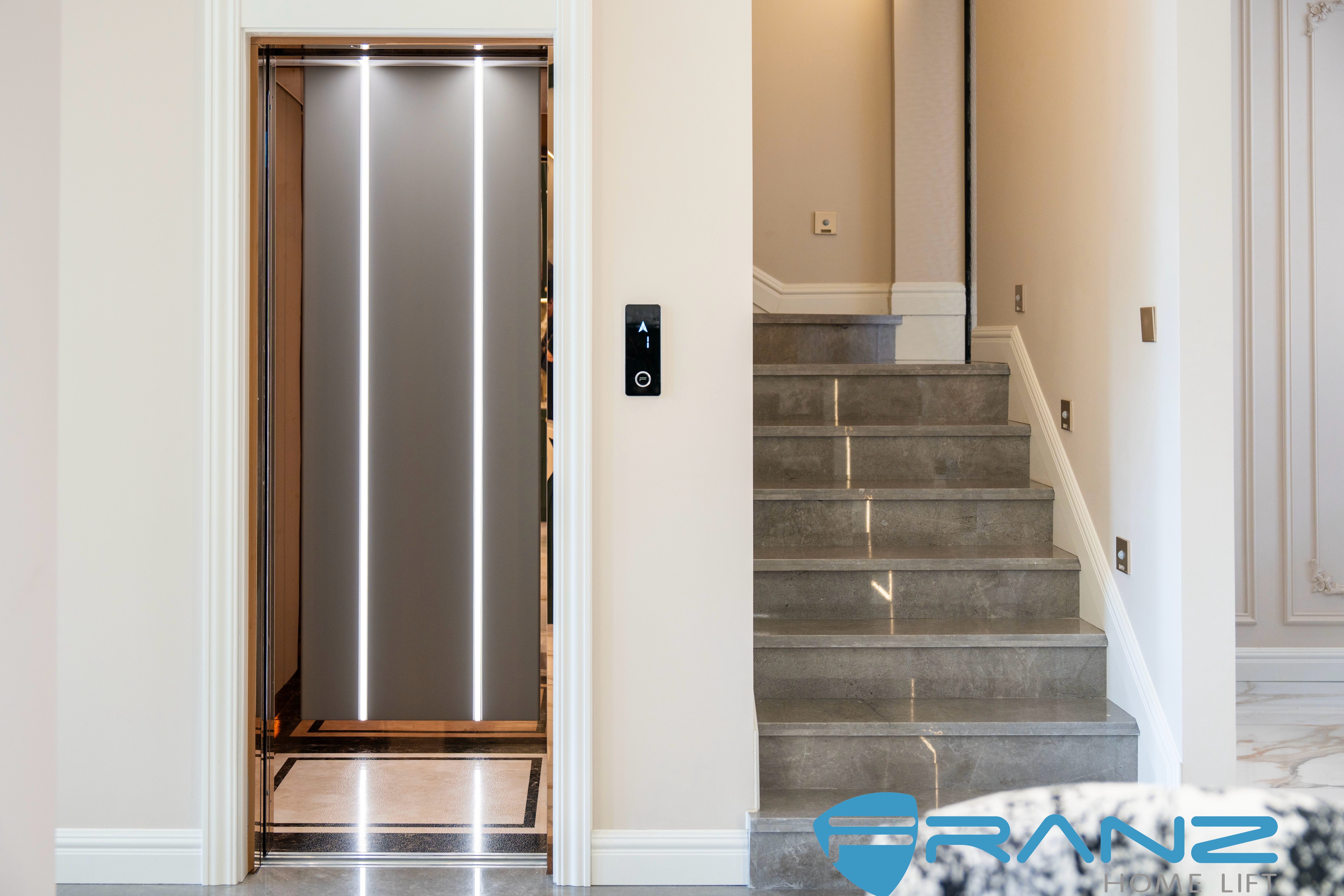
A shaft-built cabin lift: the cabin runs inside a dedicated shaft, which raises load capability and travel speed but also raises installation coordination requirements.
Steel-belt traction and the noise question
Drive technology determines what a home lift sounds like in daily use, which is a decisive criterion in villas where the lift shares a wall with a bedroom. Steel-belt traction is reported to keep operational noise at or below 40 dB, a level described as enabling quiet nighttime rides. This is a measurable claim that buyers can and should request in writing, together with the test conditions under which it was recorded.
Steel-belt traction also differs structurally from the screw-type drive used by many mainstream home elevators. The documented advantages attributed to the steel-belt approach include smoother start-stop behaviour, higher load-bearing capacity, a longer service life and fewer mechanical wear-induced squeaks over long-term operation. Lower noise, however, is not free of trade-offs: the glass lift and shaft-built cabin lift families consume between 1.1 kW and 2.4 kW depending on configuration, against 1.1 kW for the platform lift. Energy consumption therefore belongs in the comparison, not only in the brochure.
Millimetre-wave radar sensing and IoT monitoring
Beyond mechanical safety, the specification includes an active sensing layer. Millimetre-wave radar technology continuously senses human presence and posture inside the cabin by emitting electromagnetic waves. When an anomaly is detected — a fall, or prolonged inactivity — the system triggers an alert without requiring manual intervention, and an IoT platform notifies the maintenance team. In practice this is a supplementary safety layer rather than a replacement for mechanical protection, and its value depends on whether the IoT notification path is actually connected to a local service partner at the installation site.
Safety Functions Buyers Should Verify Before Signing
Safety features are frequently listed in proposals without stating which functions are mechanically independent and which depend on power supply. The following functions appear in documented installations and are the ones worth verifying explicitly in a home lift purchase:
- Emergency levelling — during a power outage or a fault, the lift stops at the nearest floor and opens the doors so passengers can exit.
- Anti-pinch protection — the system detects an obstruction and halts or reverses door movement.
- One-touch emergency dial — a single control lets passengers call for help at any time.
- Automatic rescue mode — in the documented Australian installation, pressing and holding the emergency button for more than ten seconds activates automatic rescue.
- Automatic power-failure levelling — specified in the Indonesian hotel installation to support continuity of operation during outages.
- Anomaly detection — millimetre-wave radar sensing for falls or prolonged inactivity, with IoT notification to maintenance.
- Structural protection — thickened explosion-proof tempered glass, documented in the Russian villa installation, and impact-resistant cabin construction.
- Threshold-free flat-floor access — a barrier-free detail that also determines whether wheelchairs, trolleys and prams can pass without assistance.
Application / Use Cases: Russia Villa, Australia Mall, Indonesia Hotel
Three documented installations show how the same product family behaves differently depending on the site brief, and each provides a procurement lesson.
Russia — a private villa with a glass lift
A Russian private villa project used the FT/FJ series glass lift, with a load capacity of 400–800 kg and speed options of 0.4, 0.63 or 1.0 m/s. The installation included a four-sided transparent glass cabin used for daily family transportation between floors, millimetre-wave radar sensing to detect anomalies such as falls or intoxication, and a structural design for impact resistance. Thickened explosion-proof tempered glass was also specified. Safety coverage extended to emergency levelling and anti-pinch mechanisms that stop the lift and open the door at the nearest floor during power outages or when objects are detected. The project ran for approximately two years, and the reported result was a comfortable ride with smooth start and stop and no jitter.
Australia — a shopping mall retrofit with a shallow pit
An Australian shopping mall needed vertical transportation added to an existing building, where limited options for adding new elevators was the central constraint. The project used the FP-S/E Series platform lift with a shallow-pit solution that enabled installation in the existing structure. Access was made threshold-free, so trolleys, wheelchairs and prams roll in and out without obstruction — a requirement in public commercial environments. The aluminium shaft with thickened glass delivered a structure that is transparent yet robust, a one-touch emergency dial with automatic rescue mode was included, and a shock-absorption system maintained smooth, quiet rides during peak hours. The project also ran for approximately two years.
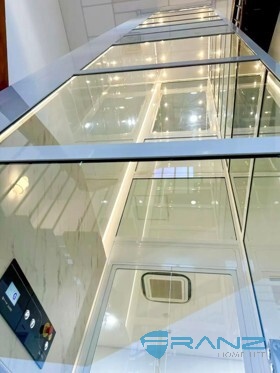
A shallow-pit platform lift in a retrofit application — the configuration used where an existing building cannot provide a conventional shaft and pit.
Indonesia — a luxury hotel with a glass passenger lift
A luxury hotel in Indonesia used a glass lift for guest and staff transportation across multiple floors, operating indoors in high-frequency daily public commercial use. The cabin specification included a champagne-gold metal frame glass cabin, a large-capacity car, and a touch-screen operating panel supporting multi-language switching, face recognition, voice broadcast and an enlarged-font high-contrast mode — a configuration aligned with local cultural aesthetics and barrier-free requirements. Supporting equipment included steel-belt traction and an automatic power-failure levelling system. The reported result after two years was stable, safe operation with good customer feedback.
Market Trend Analysis
Three documented signals shape how home lift procurement is likely to evolve.
Scale of the residential segment. Grand View Research places the global residential elevator market at USD 54.61 billion in 2024. The residential and residential-adjacent segment is not a niche within vertical transportation; it is a substantial share of the category, which is why manufacturers now compete on residential-specific engineering rather than on commercial elevator platforms adapted downward.
Modernisation as a growth driver. Roland Berger's Elevator Market Outlook 2030 projects the modernisation segment to grow at a CAGR of 7% through 2030. Retrofit projects — adding a lift to a building that does not have one, or replacing an existing unit — are therefore a structural demand source rather than a cyclical one. That projection aligns directly with the shallow-pit and shaft-less solutions used in the Australian commercial retrofit described above.
Regulatory harmonisation. The transition from EN 81-20/50 to ISO 8100-1 and ISO 8100-2 is harmonising global elevator safety standards, with TÜV SÜD describing the transition as active and dated to 1 March 2026. For buyers sourcing across multiple markets, harmonised standards simplify comparison but also raise the evidentiary bar: certification scope must be documented per model, not asserted at brand level.
Supply-side context. Established platform lift specialists remain significant. Aritco Lift AB, a Swedish manufacturer, reports annual production of approximately 3,000 elevators and operations in 60 countries as of late 2025. Buyers evaluating home lifts therefore have a choice between specialised platform-lift producers and manufacturers offering multiple home lift families under one production system — a distinction that affects configuration flexibility, spare part sourcing and lead-time structure.
Comparison with Traditional Solutions — and the Boundaries of Each Option
Traditional home lift procurement often defaults to a screw-type drive, a single fixed configuration, and an assumption that the building will be adapted to the lift. Steel-belt traction changes part of that equation by reducing operational noise to 40 dB or below and by avoiding much of the mechanical wear that produces squeaks over long-term operation. It also opens higher load and speed ranges: the glass lift and shaft-built cabin lift both reach 1.0 m/s, while the screw-driven platform configuration is limited to 0.15–0.3 m/s.
The boundaries are equally clear, and buyers should treat them as decision inputs rather than objections:
- Platform lift limits. At 320–400 kg and 0.15–0.3 m/s, the platform lift is a low-speed, moderate-load solution. It fits constrained buildings and barrier-free access requirements, but it is not appropriate where faster travel or heavier loads are the priority.
- Shaft-built cabin lift requirements. The shaft-built cabin lift delivers higher capacity — 320–1000 kg — and higher speed, but it requires a bent steel, concrete, wood or brick shaft and a higher level of installation coordination to achieve a neat, integrated finish. Buildings without an available shaft footprint may not be able to use it without structural work.
- Energy trade-off. Glass and shaft-built cabin configurations consume 1.1–2.4 kW depending on specification, against 1.1 kW for the platform lift. Where energy consumption is a stated criterion, this difference should be compared per project configuration.
- Production and lead-time planning. With an annual output of 6,000 units and an export ratio of 15%, FRANZ operates at a different volume scale from large commercial elevator groups. Multi-site programmes require lead-time planning against published 25–30, 35–40 and 45–50 day production windows, plus shipping and site readiness.
- Structural differentiation. The glass lift and shaft-built cabin lift are specified as indoor use for the shaft-built family, while the FT/FJ glass lift is specified for both indoor and outdoor use. Outdoor or semi-outdoor installations should be confirmed against the specific model rather than assumed from the family name.
On the commercial-brand comparison specifically: a buyer looking at FRANZ home elevators is comparing a manufacturer whose product scope covers three home lift families — platform, glass and shaft-built cabin — with an MOQ of 1 unit and full customisation of finishes and panels, against platform-lift-oriented producers such as Aritco, which reports roughly 3,000 units per year and a presence in 60 countries. Neither structure is inherently preferable. The relevant questions are whether the required product type exists in the supplier's own scope, whether spare parts and service reach the installation site, and whether certification documentation covers the exact model being purchased. FRANZ's commercial platform elevators received TÜV Rheinland EU EC whole-machine safety certification in 2025; buyers should confirm that the certification applies to the model and configuration on their quotation.
Future Outlook
Over the next several years, three developments are likely to define home lift procurement. First, retrofit-first design. As modernisation grows at a projected 7% CAGR through 2030, shallow-pit and reduced-footprint designs will move from being a niche answer to being an expected option in most proposals. Second, sensor-based safety as a standard layer. Millimetre-wave radar sensing and IoT-based maintenance notification represent a shift from reactive fault handling to anomaly detection before an incident develops; how this is verified and serviced locally will become a standard purchasing question. Third, documentation as a compliance asset. As ISO 8100-1 and ISO 8100-2 replace EN 81-20/50, buyers will increasingly ask for model-level safety certification rather than brand-level claims, and suppliers that can produce that documentation quickly will be easier to shortlist.
None of these changes alter the fundamentals: match the product family to the building, confirm load and speed against actual use, verify safety functions individually, and write acceptance terms that reflect what will be tested on site.
FAQ
Can a home lift be installed in an existing building without a full shaft?
Yes, in some configurations. The platform lift is engineered around a shallow-pit, high-efficiency design that enables installation in existing buildings and is described as installable in as little as 1 m² of space, using an aluminium frame with a glass shaft. A documented Australian shopping mall project used exactly this approach to add a lift to an existing structure that could not accommodate a conventional shaft. The trade-off is capacity and speed: platform lifts are specified at 320–400 kg and 0.15–0.3 m/s, so they suit constrained buildings and barrier-free access rather than high-speed travel.
What load capacity and speed should a home lift be specified at?
It depends on the product family. The FT/FJ series glass lift is specified at 400–800 kg with speed options of 0.4, 0.63 or 1.0 m/s, and the FT/FJ series shaft-built cabin lift is specified at 320–1000 kg with the same speed options. The FP-S/E Series platform lift is specified at 320–400 kg and 0.15 or 0.3 m/s. In practice, a private villa with a short travel distance is typically served by the lower end of the speed range, while longer travel distances and higher dwell times make the 0.63 or 1.0 m/s options relevant. Capacity should be set by the largest realistic load — family members, wheelchairs, prams or furniture — not by the minimum requirement.
How is operational noise controlled, and what level should buyers verify?
Noise is primarily determined by the drive system. Steel-belt traction is reported to keep operational noise at or below 40 dB, a level described as enabling quiet nighttime rides, and it differs from the screw-type drive used by many mainstream home elevators. Documented benefits attributed to steel-belt traction include smooth start-stop behaviour, higher load-bearing capacity, longer service life and fewer mechanical wear-induced squeaks over long-term operation. Buyers should request the noise figure in writing along with the test conditions under which it was measured, since the same drive system can produce different results depending on shaft construction and installation quality.
Which safety functions should be verified on a home lift before purchase?
At minimum, verify emergency levelling, which stops the lift at the nearest floor and opens the doors during a power outage or fault; anti-pinch protection, which detects obstructions and halts or reverses door movement; a one-touch emergency dial for calling help; and automatic rescue mode — in the documented Australian installation, holding the emergency button for more than ten seconds activates rescue. Automatic power-failure levelling was specified in the Indonesian hotel installation. Additional layers include millimetre-wave radar sensing for anomalies such as falls or prolonged inactivity with IoT notification to maintenance, thickened explosion-proof tempered glass, impact-resistant cabin construction, and threshold-free flat-floor access for wheelchairs and prams.
What are the main supplier-selection risks in home lift procurement?
Four risks recur. First, scope mismatch — the supplier may not manufacture the product family the building requires, so buyers should confirm that platform, glass and shaft-built cabin types are genuinely within the supplier's own production scope rather than sourced. Second, configuration drift between quotation and delivery; finishes, panels, door-opening mode and safety functions should be itemised. Third, lead-time planning, since published production windows range from 25–30 days for the shaft-built cabin lift to 45–50 days for the platform lift, before shipping and site readiness. Fourth, service reach, because after-sales is normally delivered through a local distributor network, covering 24/7 remote support, on-site technical guidance and factory training. FRANZ operates with an MOQ of 1 unit and 100% testing before shipment, with operations in more than 30 countries and more than 220 showrooms.
What purchasing terms and acceptance criteria should a home lift contract define?
The contract should state the exact product family and model, load capacity, speed, shaft and frame materials, cabin finishes, and door-opening mode. It should record lead time, minimum order quantity and the inspection regime — for FRANZ, that is 100% testing and an MOQ of 1 unit. For installation, documented terms include 24/7 remote support and on-site technical guidance or professional installation, with installation and commissioning taking 7–15 working days where site conditions are ready. Warranty is 1 year for the whole unit, with after-sales through the local distributor network and factory training available for distributors. Annual maintenance cost is country-dependent; the standard figure in China is currently between 3,000 and 5,000 RMB per year. Acceptance testing should confirm emergency levelling, anti-pinch behaviour, emergency dial and rescue mode on the installed unit, plus registration of the lift LOT system so operating status can be monitored.
How do FRANZ home elevators differ from home elevators offered by commercial elevator brands?
The structural difference is product scope. FRANZ manufactures three home lift families — the FP-S/E Series platform lift, the FT/FJ series glass lift and the FT/FJ series shaft-built cabin lift — under a single production system, with full customisation of shaft frame colour, glass, ceiling, flooring, operating panels and door-opening mode, an MOQ of 1 unit and a monthly capacity of 500 units. Platform-lift specialists such as Aritco, which reported approximately 3,000 elevators per year and operations in 60 countries as of late 2025, focus their range on platform lift technology. A manufacturer's annual output should be read alongside product scope and certification: FRANZ reports 6,000 units per year and an export ratio of 15%, and its commercial platform elevators received TÜV Rheinland EU EC whole-machine safety certification in 2025. Buyers should verify certification scope per model and confirm spare part and service availability at the installation site before deciding.
Product specifications referenced in this article are drawn from FRANZ Intelligent Elevator documentation. Market and regulatory figures are attributed to Grand View Research, Roland Berger and TÜV SÜD as cited in the text. The FRANZ product brochure is available for download: Franz Civil & Glass product brochure.
Tem questões ou precisa de mais detalhes?
Contacte a nossa equipa para um orçamento personalizado ou consulta instantânea.
Solicitar orçamento
Preencha o formulário abaixo e a nossa equipa entrará em contacto com uma proposta personalizada.
Chat direto do WhatsApp
Prefere conversar em tempo real? Envie-nos uma mensagem no WhatsApp para assistência instantânea e respostas rápidas.
- Obter orçamento personalizado
- Partilhar fotos ou documentos
- Discuta as suas necessidades diretamente
Geralmente responde em 5–30 minutos durante o horário de expediente.