
Home Medical Health Devices: A Care-Need Shortlist for 2026
Home Medical Health Devices: A Care-Need Shortlist for 2026
The most useful home medical health device shortlist starts with a care need, not a catalogue page. Respiratory support, vital-sign monitoring and personal care each answer a different buyer question, and each requires different evidence before a procurement team can compare models.
Mordor Intelligence estimates the global home medical equipment market at USD 54.35 billion in 2026, with North America holding approximately 40.35% share in 2025. That scale does not make selection easier. It makes shortlisting more important. A distributor serving pharmacies, a community medical center equipping chronic-care rooms, and an e-commerce buyer building a household retail range may all search for home medical health devices, yet they should not end up with the same product list.
This industry reference organizes a recommended shortlist by care need: respiratory support, vital-sign monitoring and personal care. It uses GENIAL product facts where the corpus provides model-level evidence, and it flags the procurement checks that should happen before a shortlist becomes a purchase order. GENIAL, the brand of Guangdong Genial Technology Co., Ltd., is a medical device manufacturer founded in 2001, with a 45,000 square metre facility, approximately 251 staff, 29 engineers and an annual production capacity of 15,000,000 units.
The shortlist problem: too many categories, too few decision rules
Home medical health devices are often merchandised as one broad category. In practice, they sit across three different buying logics. A ventilator is a respiratory therapy device with accessories, pressure modes and a clinical use context. A pulse oximeter is a compact monitoring tool with a stated saturation range and accuracy convention. A hair removal device is a personal-care appliance with skin-contact, cooling and energy-setting considerations. Treating all three as one product family creates weak shortlists.
The opportunity is to build a shortlist that can survive a procurement review. That means four things: a clear care need, a model-level specification, a scenario fit check, and acceptance criteria. The buyer should know why a device is on the list, which user group it serves, what accessories are required, and what evidence must be confirmed before the order is placed.
Market structure reinforces the point. Upper-arm monitors controlled 59.10% of the blood pressure monitoring market share in 2025, while wrist-based and wearable devices are growing at a 12.07% CAGR. The digital thermometer market is projected to reach USD 1.954 billion by 2035 with a CAGR of 9.5% from 2025. These are different growth signals, not one undifferentiated home-health boom.
| Care need | Devices to shortlist | Buyer question | Evidence to confirm |
|---|---|---|---|
| Respiratory support | Ventilator, mesh nebulizer | Which pressure modes, accessories and cleaning routines fit the care setting? | Pressure range, noise, mask and tubing compatibility, registration status |
| Vital-sign monitoring | Digital thermometer, wearable Bluetooth digital thermometer, pulse oximeter, upper-arm blood pressure monitor | Does the device measure the right signal, in the right range, with the right user technique? | Measurement range, accuracy or error statement, cuff or probe fit, connectivity |
| Personal care | Hair removal device | Is the device intended for home use, and what skin-contact and cooling controls are stated? | Light range, energy settings, registration, operating environment |
Respiratory support: ventilators and mesh nebulizers
Respiratory support is the first lane because it has the highest configuration burden. A ventilator shortlist should begin with therapy mode and accessories, not with a generic claim about home use. The GENIAL non-invasive sleep ventilator family includes GH-B20V, GH-B25V, GH-B20T, GH-B20, GH-B25, GH-A20A and GH-A20. The corpus lists CPAP, APAP, S/T and VGPS modes, a working pressure range of 4 to 20 or 25 cmH2O, noise level ≤35 dB, dimensions of 260×153×121 mm and a net weight of 1450 g. The housing is described as flame-retardant ABS and aviation plastic, with a medical silicone mask.
Its intended settings include sleep disorder centers, hospital respiratory departments, rehabilitation institutes and household snoring treatment. For a procurement team, that means the shortlist should include mask type, heated breathing tube, humidifier chamber, spare filters and the optional blood-oxygen module where required. Power compatibility is also part of the specification: the corpus describes AC100–240V supply, global-voltage compatibility and optional built-in lithium battery.
The mesh nebulizer lane is different. It is not a ventilator substitute; it is a medication-delivery device for respiratory support in pediatric wards, respiratory clinics, domestic cough treatment and pet medical care. The GENIAL N11/N21 portable mesh nebulizer is listed with a nebulization rate ≥0.2 ml/min, particle D50 <5 μm with at least 60% of particles in that range, 8 ml liquid capacity, noise ≤50 dB(A), dimensions of 42×55×99 mm and a net weight of 78 g excluding battery. The N12/N22/N12C/N22C/N12L/N22L family is also described in the corpus with 78–92 g net weight, ≥0.2 ml/min nebulization rate, D50 <5 μm and ≤50 dB(A) noise for clinical and home-care settings.
Accessories should be written into the shortlist from the start: adult mask, child mask, mouthpiece and batteries for nebulizers; mask, heated tube, humidifier chamber, spare filters and optional blood-oxygen module for ventilators. The boundary is equally important. Respiratory devices require a care protocol, accessory discipline and user training. A low device price does not compensate for a missing mask fit check or an unclear cleaning routine.
Vital-sign monitoring: thermometers, oximeters and blood pressure monitors
Vital-sign monitoring is the widest lane and the one most likely to be over-simplified. A digital thermometer, a wearable Bluetooth digital thermometer, a finger pulse oximeter and an upper-arm blood pressure monitor all produce health data, but they do not answer the same question. The shortlist should separate spot-check measurement from continuous monitoring, and contact measurement from non-contact screening.
Digital thermometers: match the measurement site to the user
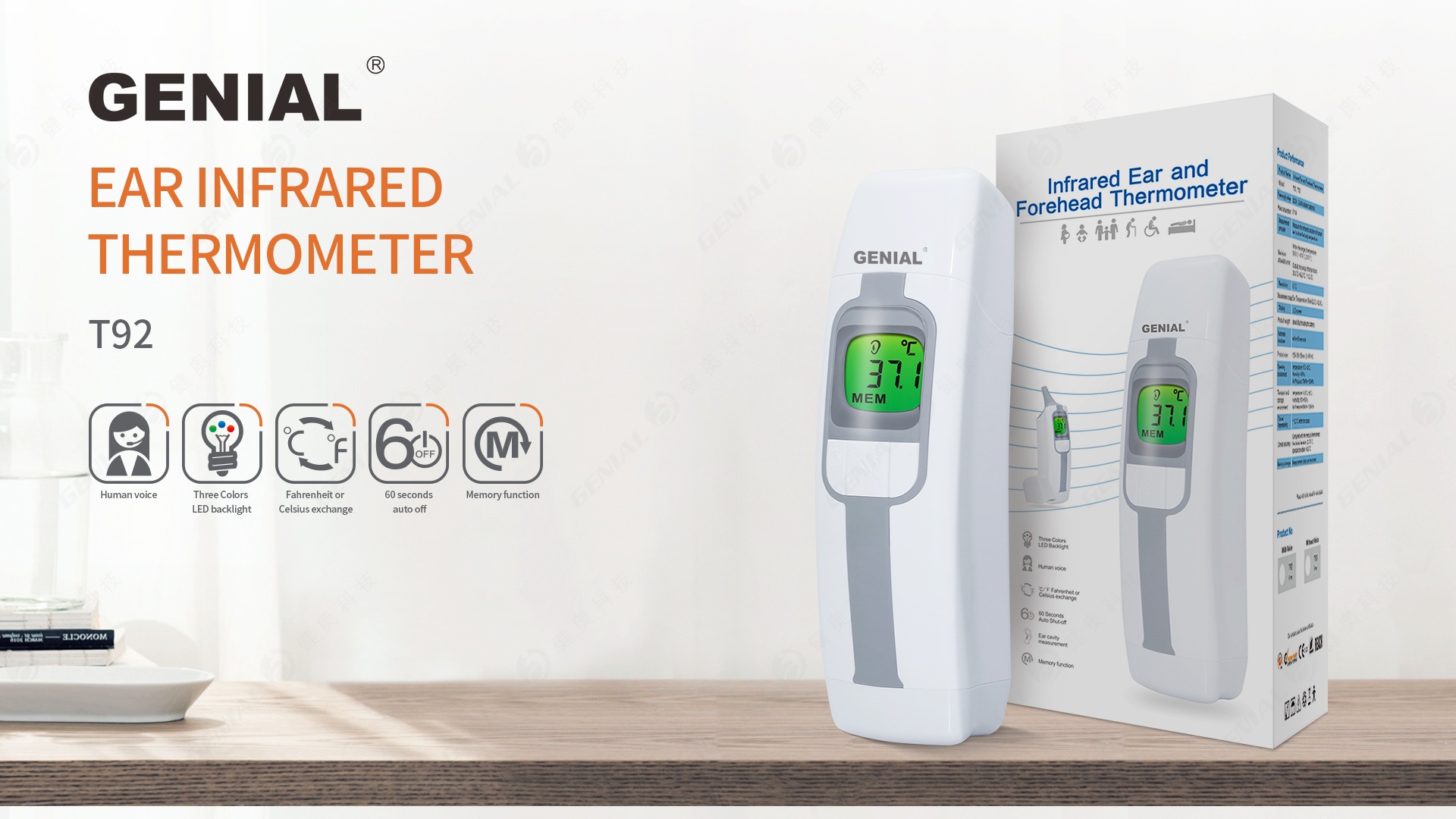
The GENIAL thermometer range covers multiple measurement approaches. The T90/T92 is a basic infrared ear thermometer with a measuring range of 32–42.9°C, IPX4 waterproof grade, 151.5×52×45.6 mm dimensions, 60 g net weight and automatic shutdown after 60 seconds. The T86/T87 is a non-contact infrared forehead thermometer with a forehead range of 32.0–42.9°C, an error of ±0.2°C at 35–42°C, IPX4 protection, 136×36×36 mm dimensions and 85 g weight with battery.
Contact thermometers serve a different buyer logic. The T15SC is a flexible-tip digital thermometer for axillary use, made of PP and elastic medical silicone, with a 32–42.9°C range, ±0.1°C accuracy, IPX5 waterproof rating, ≤1 minute measuring time, 124×18×9 mm dimensions and 10 g net weight. The T28 flexible-tip model is listed with a 32.00–42.90°C range, ±0.1 to ±0.3°C accuracy depending on the temperature range, CR2032 battery, IPX5 probe, 127×41×20 mm dimensions and 33 g weight with battery. Rigid-tip options include T19C/T19D and T23/T24, both using medical PP and IPX5 protection.
For continuous monitoring, the T31 wearable Bluetooth digital thermometer is a separate category. It is described as a medical-grade wearable patch design for 24-hour continuous body-temperature monitoring, with a 20.0–45.0°C range, ±0.1°C accuracy, Bluetooth synchronization, IPX4 splash-proof rating, Φ13×82 mm dimensions and 33 g weight including battery. The verified data package also records FDA 510(k) clearance for the T31 under product code FLL, with the clearance listed as K240333 and dated 30 October 2024.
That distinction matters in procurement. A wearable device belongs in chronic-care, maternal-infant, elderly remote-care or insurance health-management pilots where continuous data and app workflows are part of the service. A low-cost rigid-tip thermometer belongs in pharmacy retail, outpatient clinics and household medical consumable ranges. Both are thermometers, but they are not interchangeable shortlist entries.
Pulse oximeters: read the accuracy range before the price
The GENIAL fingertip pulse oximeter family includes GX3, GX5, GX7, GX8, GX12, GX13 and GX14. The corpus lists an SpO2 range of 35% to 100%, accuracy of ±2% within 70% to 100%, pulse rate range of 30 to 250 bpm, dimensions of 59.8×36.4×34 mm, net weight of 36 to 42 g, ABS and silicone construction, and a sweat-splash proof finger clip. Intended settings include elderly care institutes, respiratory departments, outdoor sports, household medical use and pharmacy retail.
The accuracy statement should be read precisely. ISO 80601-2-61 is the relevant pulse oximeter standard in the verified data package, and SpO2 accuracy is conventionally expressed as Arms over a stated saturation range, commonly 70–100%. A buyer should not extend a ±2% claim outside the range in which it is stated. That is a technical boundary, not a marketing detail.
Upper-arm blood pressure monitors: GT-732, GT-732M and GT-702BM
For blood pressure monitors, the shortlist should stay with upper-arm models when the use case requires a conventional cuff fit and a clear arm-circumference check. The corpus provides model-level evidence for GT-732, GT-732M and GT-702BM.
The GT-732M is an upper-arm digital blood pressure monitor with a 0–290 mmHg pressure range, a 22–42 cm arm circumference range, a pulse error of ≤±5%, net weight of 239 g ± 15 g without battery and dimensions of 136×103×54 mm. It is made of ABS and an eco-friendly TPU air bag. Its intended industries include chronic disease management institutes, community medical centers and insurance promotional gifts.
The GT-702BM is also an upper-arm model, positioned for wholesale distribution and home health monitoring. It has a composite fabric cuff, a 22–42 cm arm circumference range, memory capacity for 99 sets for 2 users, net weight of 220 g ± 15 g without battery and dimensions of 135×102×46 mm.
The GT-732 is an upper-arm digital blood pressure monitor with a 0–290 mmHg pressure range and ±5% pulse tolerance. The corpus describes it with an ABS housing, PVC air bag and nylon binding strap, and lists intended uses in community clinics, health and wellness centers, e-commerce and customized OEM gifts. Because catalogue layers can differ in detail, the exact cuff range and net weight for GT-732 should be confirmed against the current specification sheet before a purchase order is issued.
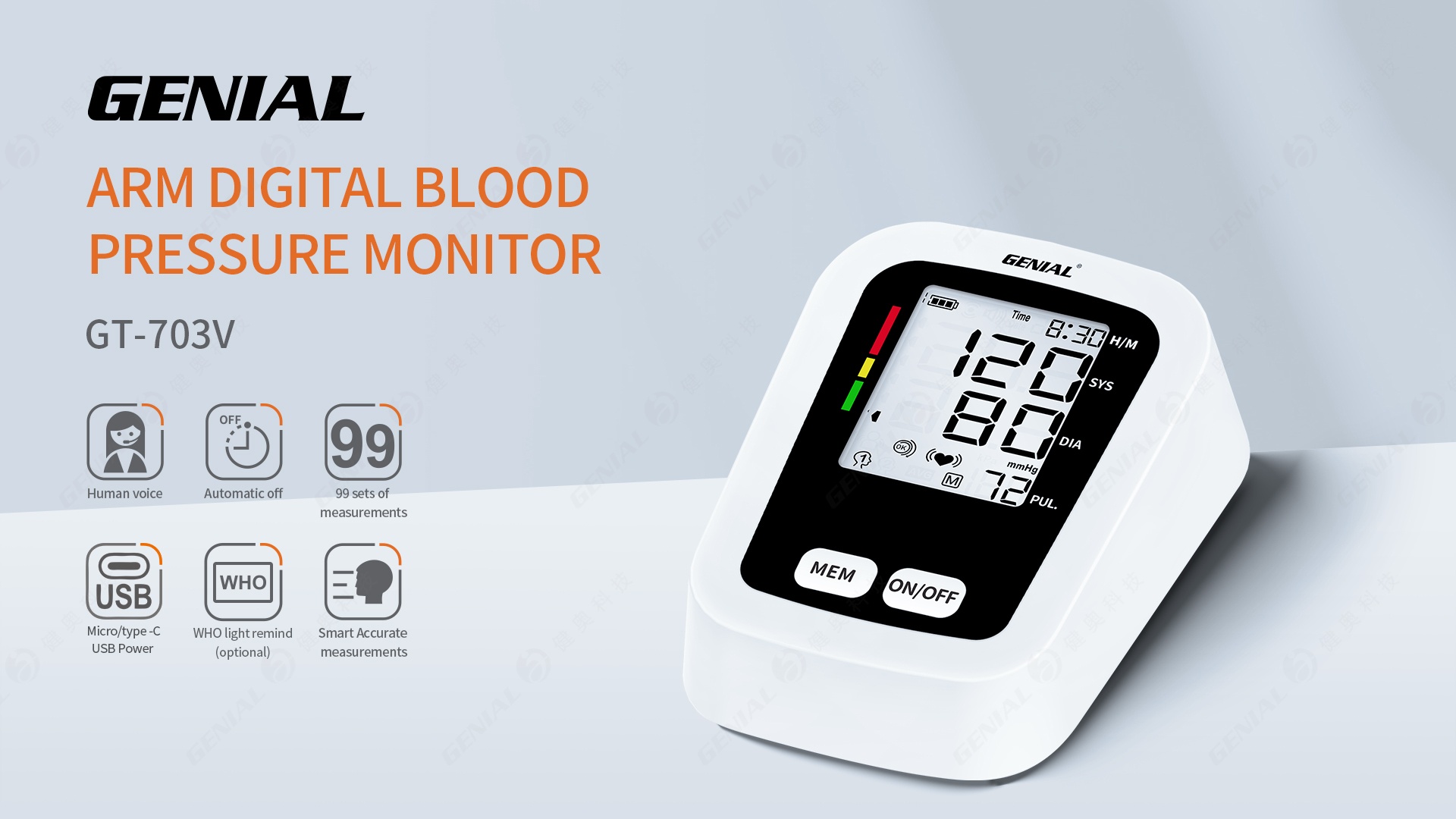
Catalogue breadth is not a shortlist. The wider GENIAL upper-arm range also includes GT-703V, listed with a 0–290 mmHg pressure range, 22–42 cm arm circumference, 136×99×45 mm dimensions, 195 g net weight without battery and ABS housing, positioned for e-commerce and private-label customization. Its presence shows why buyers should select by use case and cuff fit rather than by SKU count.
Personal care: hair removal device
The personal-care lane is not a clinical monitoring category, but it belongs in a home medical health device portfolio when the buyer serves beauty, personal-care or home-use channels. The GENIAL hair removal device models GI02/GI06 use IPL intense pulsed light with a 560–1200 nm wavelength range, sapphire ice cooling technology and 5 adjustable energy gears. The device is made of ABS and toughened sapphire glass, with dimensions of 62×180×38 mm.
The corpus lists intended channels including personal-care e-commerce, aesthetic medical institutions, beauty salons, cross-border beauty channels and OEM/ODM beauty-device projects, with suitability for both professional and home use. It also records an NMPA Medical Device Registration Certificate under Guangdong Registration Standard No. 20252090497.
Its operating boundary should be stated clearly. The application data describes use in indoor conditions of 20–30°C and a dry environment, with a recommendation to avoid direct sunlight and moisture, ensure sufficient cooling time and restrict use to healthy adults aged 18 and above. That is not a minor note. It determines how the device should be positioned in retail training, user manuals and after-sales support.
Where GENIAL fits the shortlist
GENIAL is not presented here as a generic brand claim. The relevant evidence is portfolio breadth plus manufacturing and compliance facts. Guangdong Genial Technology Co., Ltd. was established in 2001, operates a 45,000 square metre manufacturing facility, employs approximately 251 staff and has 29 engineers. Annual production capacity is listed at 15,000,000 units. Export business accounts for 80% of total sales, and products are sold to 117 countries and regions, with markets including Europe, North America, Southeast Asia, the Middle East, Africa, Latin America and Oceania.
The company states that it has passed ISO 13485, ISO 45001, ISO 14001, BSCI and GB/T 29490-related systems, and that products hold CE, FDA, NMPA, CB, FCC and RoHS certifications. These are company-reported certification claims in the corpus and should be re-verified during supplier qualification. That does not weaken their screening value; it defines how a procurement team should use them. Ask for the certificate scope, the applicable model list and the current validity period before finalizing the shortlist.
For buyers comparing home medical health devices, the practical value of this profile is breadth with a factory base. A single supplier can cover thermometers, blood pressure monitors, oximeters, nebulizers, ventilators and personal-care devices, but the shortlist should still evaluate each care lane separately. Breadth supports one-stop sourcing; it does not replace model-level acceptance criteria.
Technical explanation: what the specifications actually mean
In thermometry, measurement site changes the user instruction. Ear thermometers such as T90/T92 use infrared ear measurement and need correct probe placement. Forehead thermometers such as T86/T87 support non-contact screening and state an error of ±0.2°C at 35–42°C. Contact thermometers such as T15SC, T28, T19C/T19D and T23/T24 require probe contact and, for flexible-tip models, careful cleaning and storage. ISO 80601-2-56:2017 is the clinical thermometer standard referenced in the verified data package, including a ±0.1°C accuracy requirement for clinical validation. That standard is a useful anchor when comparing accuracy claims, but each product’s stated range and test method still need to be checked.
In blood pressure measurement, the corpus describes automatic pressurization measurement, one-button operation, battery or USB power supply and automatic shutdown. The buyer’s technical check is not only the pressure range. It is cuff circumference, pulse error, memory configuration and the user’s arm size. The GT-732M and GT-702BM both list 22–42 cm arm circumference, while the GT-732 should be confirmed against its current specification sheet. A cuff mismatch can make a technically capable monitor unsuitable for the intended user group.
In pulse oximetry, photoelectric transmission measurement is used after finger insertion, with SpO2 and pulse rate shown on an OLED display. The stated SpO2 accuracy of ±2% within 70% to 100% should be read together with ISO 80601-2-61 and the Arms reporting convention. In respiratory care, mesh nebulizers use 106 kHz ultrasonic mesh atomization in the customer-facing description, while ventilators use CPAP, APAP, S/T and VGPS modes with pressure ranges of 4–20 or 25 cmH2O. Those are different technical systems and should not be summarized as one respiratory category.
In personal care, IPL wavelength, energy settings, sapphire cooling and skin-contact sensing determine the user experience. The GI02/GI06 data lists 560–1200 nm IPL, 5 energy gears and sapphire ice cooling. The procurement question is whether the device is registered for the intended market and whether the user instructions match the channel: beauty salon, aesthetic institution or home use.
Application scenarios: how to narrow the shortlist
Chronic disease management is the clearest scenario for upper-arm blood pressure monitors, pulse oximeters and thermometers. The GT-732M is explicitly intended for chronic disease management institutes and community medical centers. A shortlist for this setting should include a cuff range check, memory requirements, user training and a calibration or verification routine. The pulse oximeter can support respiratory risk screening within its stated SpO2 range, but it should not be treated as a diagnostic device.
Community medical centers need a mixed kit rather than a single product. The GT-732 is positioned for community clinics and health and wellness centers. The T90/T92 ear thermometer and T86/T87 forehead thermometer can support fever screening. The N11/N21 or N12/N22 mesh nebulizer can support respiratory treatment rooms. The buying question is not which device is most advanced; it is which combination covers the center’s daily workflows without creating accessory or training gaps.
Home health monitoring places more weight on usability and connectivity. The T31 wearable Bluetooth digital thermometer is intended for continuous temperature monitoring with Bluetooth synchronization, abnormal-temperature alerts and remote monitoring. The oximeter supports daily blood-oxygen monitoring. An upper-arm blood pressure monitor supports long-term hypertension management when the cuff fits. For this scenario, the shortlist should test the app workflow, battery replacement, data sharing and user instruction quality.
Wholesale and offline household retail require a different shortlist again. The GT-702BM is positioned for wholesale distribution and home health monitoring. The GT-703V is positioned for e-commerce and private-label customization. Rigid-tip thermometers such as T19C/T19D and T23/T24 fit pharmacy and household medical consumable ranges. The shortlist should be built around packaging, language, warranty terms, minimum order quantities and after-sales handling, not only unit specifications.
Respiratory care settings include sleep centers, respiratory departments, rehabilitation institutes, pediatric wards and home apnea treatment. The ventilator and nebulizer shortlists should be separated by user group. A sleep center needs pressure modes, mask fit, humidification and follow-up data. A pediatric ward needs child masks, mouthpieces and cleaning routines. A home-care distributor needs clear user manuals, spare filters and a service pathway.
Personal care channels include beauty salons, aesthetic institutions, chain beauty centers, home-use personal-care retail, e-commerce and OEM/ODM projects. For this lane, the shortlist should confirm the registration certificate, the intended user age, the operating environment and the cooling and energy-setting instructions. The device should not be sold with clinical promises that exceed the corpus evidence.
Market trend analysis
The market signals support a care-need shortlist rather than a single-product view. The home medical equipment market is large and geographically concentrated, with North America holding approximately 40.35% share in 2025 according to the Mordor Intelligence estimate in the verified data package. Within blood pressure monitoring, upper-arm monitors still held 59.10% of market share in 2025, while wrist-based and wearable devices grew at a 12.07% CAGR. That suggests a dual strategy: keep upper-arm monitors for conventional home and clinical-adjacent use, and test wrist or wearable formats where portability and connectivity matter.
Digital thermometry shows a separate growth path. The digital thermometer market is projected to reach USD 1.954 billion by 2035 with a CAGR of 9.5% from 2025. The growth is not only in low-cost contact thermometers; it also includes infrared and wearable formats. The buyer response should be a tiered thermometer shortlist: retail thermometers for broad household access, infrared thermometers for screening, and wearable Bluetooth thermometers for continuous monitoring projects.
Standards are also shaping procurement. IEC 60601-1-11 is the collateral standard used with IEC 60601-1 for home healthcare equipment, and it addresses risks in uncontrolled home environments with untrained users. ISO 80601-2-56 applies to clinical thermometers, and ISO 80601-2-61 applies to pulse oximeters. A PubMed Central article in the verified data package also advises frequent calibration and operation within 16–40°C and humidity below 85%. These are practical constraints, not paperwork. They should appear in the shortlist as acceptance criteria.
Comparison with traditional solutions: where the shortlist stops
Digital home devices have clear advantages over legacy approaches. Digital thermometers replace toxic mercury thermometers and can provide audible and visual fever alerts for preliminary screening of colds, inflammation and infant fever. Digital blood pressure monitors support one-button measurement, memory storage and irregular-heartbeat detection in some configurations. Pulse oximeters provide a quick SpO2 and pulse reading without a laboratory visit. Mesh nebulizers are portable and can be used in pediatric, respiratory and home-care settings.
The boundary is equally real. A home device is not a diagnosis. A blood pressure reading depends on cuff fit, body position and measurement technique. The GT-732M and GT-702BM list 22–42 cm arm circumference, but a user outside that range needs a different cuff solution. A pulse oximeter’s ±2% accuracy is stated within 70% to 100% SpO2, so it should not be treated as equally precise outside that range. A wearable thermometer depends on Bluetooth pairing and app workflows if continuous remote monitoring is required. A ventilator shortlist without mask fit, humidifier chamber and spare filters is incomplete. A hair removal device is limited to healthy adults aged 18 and above and to the stated indoor, dry operating conditions.
Traditional clinical measurement still has a role when a trained operator, a controlled environment or a diagnostic interpretation is required. The practical comparison is therefore not digital versus traditional in the abstract. It is which measurement belongs at home, which belongs in a clinic, and which needs a referral. That distinction protects both the buyer and the end user.
Future outlook
The next phase of home medical health devices is likely to be shaped by three forces already visible in the evidence. First, connected monitoring will expand where continuous data changes the care workflow, as with the T31 wearable Bluetooth thermometer and its cloud-oriented use case. Second, upper-arm blood pressure monitors will remain a reference format for home hypertension management, while wrist and wearable formats continue to grow from a smaller base. Third, compliance and usability will become harder to separate. A device that is technically accurate but difficult to use correctly will struggle in home care.
For procurement teams, the implication is to keep the shortlist dynamic. Re-check certification scope, confirm the exact model specification, verify accessories and acceptance criteria, and record the intended user group. A 2026 shortlist should not be a static catalogue page. It should be a decision record that can be audited when the next order, tender or private-label project begins.
GENIAL public product brochure (PDF)
FAQ
What should a home medical health device shortlist include?
A practical shortlist should include the care need, the device category, the intended user group, the model-level specification, the required accessories and the acceptance criteria. For example, an upper-arm blood pressure monitor shortlist should record cuff circumference, pressure range and pulse error; a thermometer shortlist should record measurement site, range and accuracy; a respiratory shortlist should record pressure modes, mask fit, tubing and filters.
How should buyers choose between respiratory, vital-sign and personal-care devices?
Choose by care pathway. Respiratory devices support breathing therapy or medication delivery and require accessory and training checks. Vital-sign devices measure temperature, blood pressure or oxygen saturation and require range and accuracy checks. Personal-care devices such as hair removal devices require registration, skin-contact, cooling and user-age checks. The three categories should be evaluated with separate criteria.
What specifications matter for the GT-732M upper-arm blood pressure monitor?
The GT-732M is listed with a 0–290 mmHg pressure range, a 22–42 cm arm circumference range and a pulse error of ≤±5%. It weighs 239 g ± 15 g without battery, measures 136×103×54 mm and is made of ABS and an eco-friendly TPU air bag. Its intended settings include chronic disease management institutes, community medical centers and insurance promotional gifts.
Which standards should buyers check for home-use devices?
IEC 60601-1-11 is the collateral standard used with IEC 60601-1 for home healthcare equipment and addresses risks in uncontrolled home environments with untrained users. ISO 80601-2-56 applies to clinical thermometers, and ISO 80601-2-61 applies to pulse oximeters. The buyer should still confirm the exact standard and registration status for each model and target market.
Is a wearable Bluetooth thermometer a replacement for a clinical thermometer?
No. The T31 wearable Bluetooth digital thermometer is described for 24-hour continuous body-temperature monitoring with a 20.0–45.0°C range, ±0.1°C accuracy, Bluetooth synchronization and IPX4 splash-proof rating. It supports continuous monitoring and remote data workflows, but it should be used within its stated instructions and not treated as a substitute for clinical diagnosis.
What should procurement teams confirm before finalizing a shortlist?
Confirm the purchasing terms and acceptance criteria before finalizing the shortlist. That includes the exact model and specification sheet, cuff or probe fit, accessories, packaging and language requirements, certification scope and validity, warranty and after-sales terms, and the intended use environment. For blood pressure monitors, confirm the cuff range model by model. For respiratory devices, confirm mask, tubing, humidifier and filter compatibility. For personal-care devices, confirm the registration certificate and user-age and operating-environment instructions.
This article is an independent industry reference based on the provided corpus and verified data. It is not a substitute for clinical judgment, regulatory advice or a supplier audit.
Tem questões ou precisa de mais detalhes?
Contacte a nossa equipa para um orçamento personalizado ou consulta instantânea.
Solicitar orçamento
Preencha o formulário abaixo e a nossa equipa entrará em contacto com uma proposta personalizada.
Chat direto do WhatsApp
Prefere conversar em tempo real? Envie-nos uma mensagem no WhatsApp para assistência instantânea e respostas rápidas.
- Obter orçamento personalizado
- Partilhar fotos ou documentos
- Discuta as suas necessidades diretamente
Geralmente responde em 5–30 minutos durante o horário de expediente.