
Home Medical Health Devices: Technical & Procurement FAQ
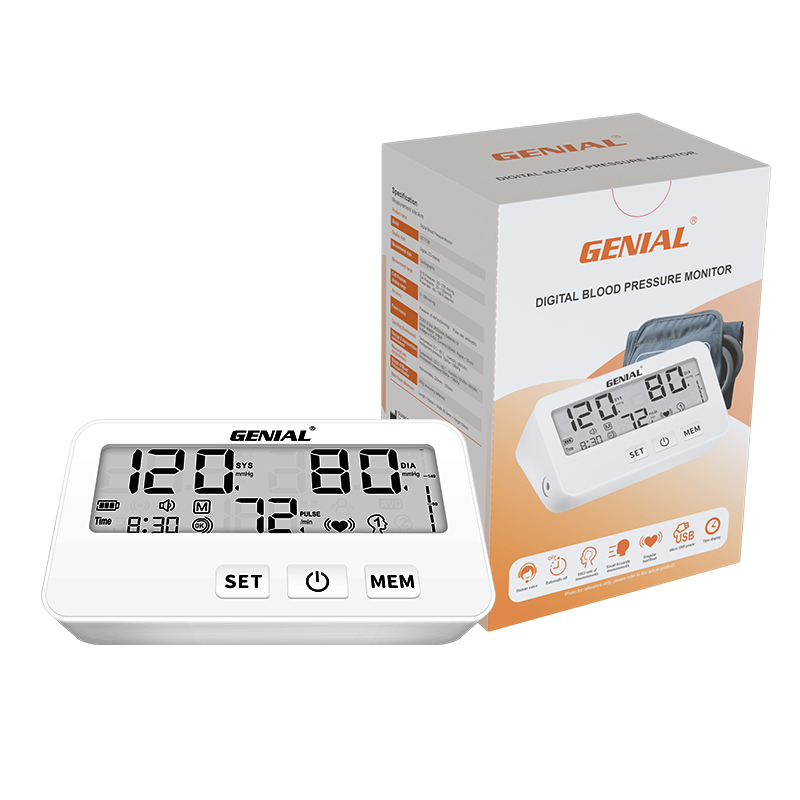
Home Medical Health Devices: Technical & Procurement FAQ
Home medical health devices — blood pressure monitors, digital thermometers, pulse oximeters and the accessories around them — are regulated products that professional buyers evaluate against constraint checklists rather than catalogue impressions: measuring range, cuff circumference, error tolerance, material of construction, and the exact certificates a specific model holds in a specific market.
This reference answers the technical and procurement questions that typically appear between a first supplier screen and a purchase order. The worked example is Guangdong Genial Technology Co.,Ltd (GENIAL), an original medical device manufacturer founded in 2001 that produces digital thermometers, blood pressure monitors, oximeters, nebulizers, ventilators, therapeutic devices and hair removal devices, exports to 117 countries and regions, and operates OEM, ODM, JDM and OBM programmes. Where the published specification set does not cover a point, the answer says so rather than estimating.
Why Home Medical Sourcing Is Decided in the Constraint Layer
Blood pressure monitoring devices were valued at USD 4.2 billion in 2025 and are estimated to reach USD 8.6 billion by 2033, a CAGR of 9.3%, according to Grand View Research. Fortune Business Insights places digital blood pressure monitors at approximately 48% of total revenue share in that market in 2024. Growth and share point the same way: volume is moving into home-use, self-measurement formats, which is exactly where specification detail decides whether a product can be listed, registered or shipped at all.
The pattern repeats in adjacent categories. Research and Markets values the global digital thermometer market at approximately USD 805.1 million in 2024 with a projected path to about USD 1 billion by 2030, while Grand View Research estimates the same year at USD 830.4 million — a reminder that category figures shift with segmentation choices such as clinical versus household inclusion and should be read as directional. Grand View Research expects the global pulse oximeter market to reach USD 5.3 billion by 2030 at a 6.6% CAGR from 2024 to 2030, and Market Research Future values the vibrating mesh nebulizer market at USD 0.75 billion in 2024, growing toward USD 1.57 billion by 2035. The procurement consequence is that supplier screening now happens at model level, not brand level.
Four Technical Constraints to Verify Before You Discuss Price
1. Pressure measuring range: 0~290 mmHg
The GENIAL upper arm and wrist blood pressure monitor range is published with a pressure measuring range of 0~290 mmHg across models including GT-732, GT-732M, GT-712B/C/E, GT-702V, GT-702VA, GT-702BM, GT-702L, GT-702LM, GT-702LD, GT-702CM, GT-702CD, GT-702M, GT-702MA, GT-702C, GT-702B, GT-702D, GT-702, GT-712, GT-703V and GT-703M, plus the wrist models GT-701, GT-701C, GT-701F and GT-701L. Wrist models additionally publish a pulse measurement range of 30~250 bpm, as listed for GT-701F.
Because the measuring envelope does not change across the range, range is a qualification criterion rather than a differentiator. It confirms that a model is specified for the same working envelope as its siblings and moves the comparison to cuff size, memory, materials and channel fit.
2. Cuff circumference: 22~32 cm or 22~42 cm
The upper arm portfolio splits into distinct cuff families, and this is the first specification to match against the target population:
- 22~32 cm: GT-732, GT-712B/C/E, GT-712, GT-702C, GT-702B, GT-702D, GT-702.
- 22~42 cm: GT-732M, GT-702V, GT-702VA, GT-702BM, GT-702L, GT-702LM, GT-702LD, GT-702CM, GT-702CD, GT-702M, GT-702MA, GT-703V, GT-703M.
- Wrist circumference: 13.5~19.5 cm (GT-701F, GT-701L) and 13.5~21.5 cm (GT-701C, GT-701).
A programme serving an older chronic-care population and a supermarket promotion do not need the same cuff coverage. Choosing the wrong family is not a performance issue that can be corrected in firmware; it is a fit issue that surfaces as returns.
3. Pulse error: ≤±5%
Pulse-channel tolerances are published per model: GT-732 lists a pulse tolerance of ±5%, and GT-732M lists a pulse error of ≤±5%. This describes the pulse measurement channel; it is not a blood-pressure accuracy claim and should not be read as one. Where a market requires documented performance evidence, the relevant documents are registrations naming the exact model — an FDA 510(k) clearance or a CE MDR certificate with a defined model list — rather than a family-level statement.
4. Materials: ABS/PVC/Nylon versus ABS/eco-friendly TPU
Material declarations vary by model and often indicate intended use. GT-732 uses an ABS housing with a PVC air bag and Nylon binding strap. GT-732M uses an ABS housing with an eco-friendly TPU air bag. GT-702VA uses modified ABS. GT-702BM uses ABS with a composite fabric cuff, and GT-702L combines ABS plastic, a Nylon cuff and an LCD lens. For procurement documents, request a per-model material declaration rather than a category-level statement; it is also the fastest way to separate clinic-facing models from lightweight export and gift models.
GT-732, GT-732M, GT-712B/C/E, GT-702V and GT-702VA Side by Side
| Model | Cuff | Pressure range | Pulse spec | Dimensions | Net weight | Material | Published positioning |
|---|---|---|---|---|---|---|---|
| GT-732 | 22~32 cm | 0~290 mmHg | Pulse tolerance ±5% | 136×103×54 mm | 291 g ±15 g | ABS, PVC air bag, Nylon strap | Community clinic, health & wellness centre, e-commerce, customized OEM gift |
| GT-732M | 22~42 cm | 0~290 mmHg | Pulse error ≤±5% | 136×103×54 mm | 239 g ±15 g | ABS, eco-friendly TPU air bag | Chronic disease management institute, community medical centre, insurance promotional gift |
| GT-712B/C/E | 22~32 cm | 0~290 mmHg | Not published in the specification set | 140×80.5×50 mm | 192 g ±15 g | ABS | ODM private labelling, supermarket retail, customized gift |
| GT-702V | 22~42 cm | 0~290 mmHg | 99 memory sets for 2 users | 119×93×43 mm | 180 g ±15 g | ABS | Cross-border e-commerce, household medical supply |
| GT-702VA | 22~42 cm | 0~290 mmHg | Not published in the specification set | 119×96×42 mm | 155 g ±15 g | Modified ABS | Global export trade, complimentary gift industry |
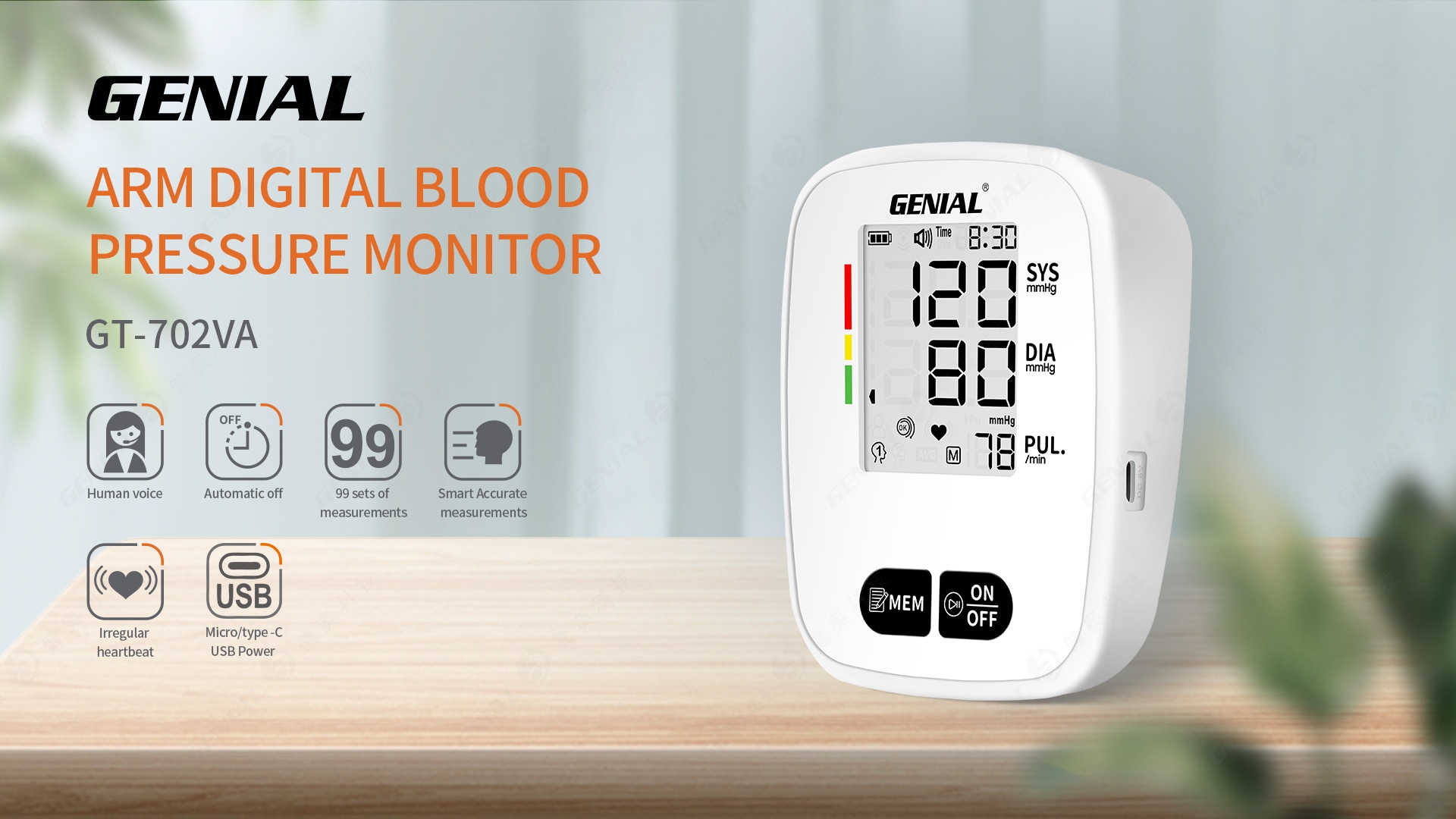
GT-732 and GT-732M share the same 136×103×54 mm body but differ by 52 g and by cuff family — in effect, the cuff decision makes the model decision. GT-712B/C/E is the smallest footprint of the 22~32 cm group at 140×80.5×50 mm and is the only model in this set published for ODM private labelling. The 22~42 cm family is led at the light end by GT-702VA at 155 g ±15 g, which matters when a promotional or export programme is priced per carton, while GT-702V adds dual-user storage with 99 memory sets in the most compact 119×93×43 mm format of the five.
Matching a Monitor to a Programme
Chronic disease management
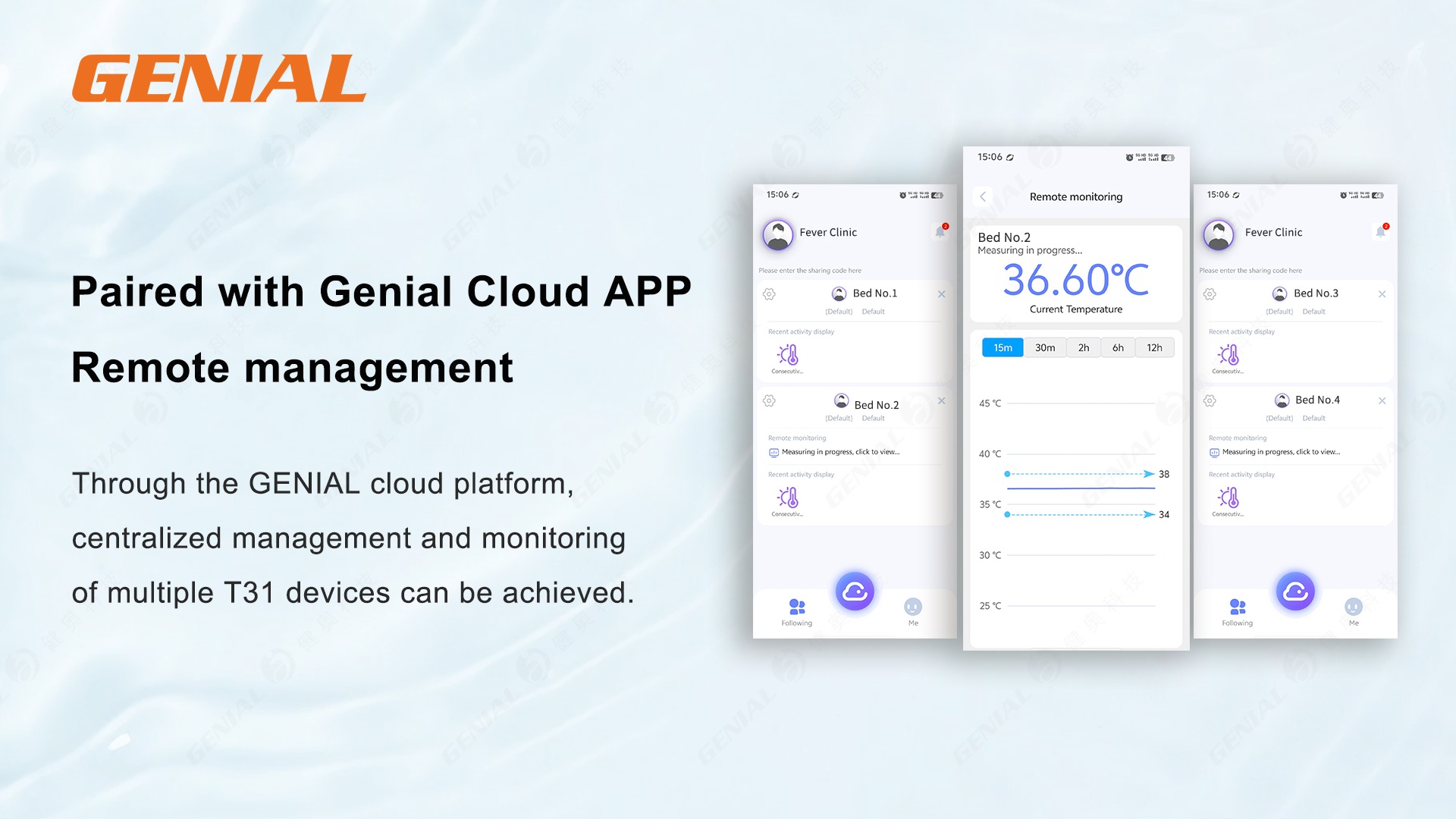
GT-732M is published for chronic disease management institutes and community medical centres, combining a 22~42 cm cuff with an eco-friendly TPU air bag. In chronic care the cuff range determines how much of the patient population a single SKU can serve. Where continuous monitoring is also required, the T31 wearable Bluetooth digital thermometer covers 20.0~45.0 °C with ±0.1 °C accuracy, IPX4 whole-body splash-proof rating, Φ13×82 mm dimensions and 33 g weight, built on a wearable patch design with Bluetooth transmission. It is covered by CE MDR certificate 195/MDR issued by IMQ S.p.A (Notified Body No.0051) for the 27 EU Member States and by US FDA 510(k) clearance K240333.
Community medical centres and clinics
GT-732 is positioned for community clinics, health & wellness centres, e-commerce and customized OEM gift programmes, while GT-712 targets community clinic and medical equipment agent channels. GT-702MA adds a WHO blood pressure classification function in an ABS and TPU construction, aimed at physical examination centres and elderly care and pension institutions. The wider application profile published for the blood pressure monitor range covers WHO classification indication, irregular-heartbeat detection and dual-user memory storage.
E-commerce and cross-border retail
GT-702V is the e-commerce-facing configuration of the five compared models: 99 memory sets stored separately for two users, 119×93×43 mm, 180 g ±15 g, published for cross-border e-commerce and household medical supply. GT-703V addresses a comparable channel with private label customization. E-commerce platforms appear as a long-running case segment in the 50,000–200,000 unit range, where ODM customization, rapid product launches and support for small-batch trial sales are the stated requirements.
OEM gift and promotional programmes
GT-702VA is published for global export trade and the complimentary gift industry at 155 g ±15 g, and GT-712B/C/E is published for customized gift programmes alongside ODM private labelling and supermarket retail. Under the OEM model, customization covers packaging, gift box, user manual, product logo printing, colour schemes and packaging specifications, while core hardware, PCB and key functions remain unchanged — which is why gift programmes are usually a packaging-led rather than a performance-led sourcing decision.
The Rest of the Sourcing Basket
Buyers rarely source a single device, and the evaluation logic is identical across the basket.
Digital thermometers. The range covers rigid tip models such as T19C/T19D (32~42.9 °C, fever alert at 37.5 °C, IPX5, PP, 10 g) and T23/T24 (32.00~42.90 °C, accuracy ±0.1~±0.3 °C by segment, IPX5, medical PP); flexible tip models such as T28 (32.00~42.90 °C, IPX5 probe with non-waterproof main body, 33 g, medical PP with PVC flexible probe); animal-shape models such as T15S/T15SL/T15SC (32.0~42.9 °C, ±0.1 °C, IPX5, PP with food-grade flexible rubber) for the baby gift market; and infrared models including T86/T87 non-contact forehead (32.0~42.9 °C, ±0.2 °C error at 35~42 °C, IPX4, 85 g), T81/T80 voice broadcast forehead (32 memory storage, IPX4, 165 g), T94 ear thermometer (ear 32.0~42.9 °C, repeat accuracy ±0.3 °C, ABS with medical silicone ear cap) and T90/T92 basic infrared ear thermometer (60-second auto shutdown, IPX4).
Pulse oximeters. The GX3/GX5/GX7/GX8/GX12/GX13/GX14 fingertip pulse oximeter family measures SpO₂ across 35%~100% with ±2% accuracy in the 70%~100% band and pulse rate across 30~250 bpm. The finger clip is sweat-splash proof and the whole unit is not waterproof — a boundary worth stating in retail copy as well as in procurement documents. The series is covered by CE MDR certificate 195/MDR.
Nebulizers. N11/N21 and the N12/N22/N12C/N22C/N12L/N22L variants share an 8 ml liquid capacity, a nebulization rate of ≥0.2 ml/min, particle D50 below 5 μm for at least 60% of particles, and 42×55×99 mm dimensions; N11/N21 is specified at ≤50 dB(A) and 78 g excluding battery, in ABS with a PP medicine cup and medical silicone tube.
Ventilators. The GH-B20V/GH-B25V/GH-B20T/GH-B20/GH-B25/GH-A20A/GH-A20 non-invasive sleep CPAP ventilator supports CPAP, APAP, S/T and VGPS modes at 4~20/25 cmH₂O working pressure with noise ≤35 dB, 260×153×121 mm and 1450 g, built from flame retardant ABS, aviation plastic and a medical silicone mask.
Hair removal devices. GI02/GI06 uses IPL with sapphire ice cooling at 560~1200 nm (±20%) with five adjustable energy gears, in ABS with toughened sapphire glass.
Certification coverage. Manufacturing is covered by ISO 13485:2016 certificate CN13/31126 issued by SGS United Kingdom Ltd., whose scope names the design, development and manufacture of mesh nebulizers, finger clip pulse oximeters, digital blood pressure monitors, infrared forehead thermometers, infrared ear thermometers and digital body thermometers. CE MDR certificate CN25/00007953 (SRN CN-MF-000021465), issued by SGS Belgium NV as Notified Body No.1639, covers arm-type digital blood pressure monitors and runs to 25 November 2030. US FDA 510(k) clearances relevant to this basket include K231245 for arm-type digital blood pressure monitors, K231250 for wrist models, K231243 for fingertip pulse oximeters, K210014 for infrared forehead thermometers, K232678 for continuous-reading clinical thermometers, 3016670149 for clinical electronic thermometers and K240333 for the T31 wearable thermometer. Regional registrations include ANVISA for Brazil under RDC 751/2022, Roszdravnadzor for Russia under certificate № 1241/1-3 140/2-25, MHLW foreign manufacturer registration BG10501496 for GT-702L in Japan and MHRA registration 0000037417 in Great Britain. System-level certificates include ISO 45001:2018, ISO 14001:2015, BSCI overall rating B, GB/T29490-2023 intellectual property management and NBCUniversal manufacturer code L-4394.
Market Signals Behind These Buyer Questions
- Blood pressure monitoring devices: USD 4.2 billion in 2025, estimated to reach USD 8.6 billion by 2033 at a 9.3% CAGR (Grand View Research).
- Digital blood pressure monitors: approximately 48% of revenue share in the blood pressure monitoring devices market in 2024 (Fortune Business Insights).
- Digital thermometers: approximately USD 805.1 million in 2024, projected toward USD 1 billion by 2030 (Research and Markets); an alternative 2024 estimate is USD 830.4 million (Grand View Research).
- Pulse oximeters: USD 5.3 billion by 2030, 6.6% CAGR from 2024 to 2030 (Grand View Research).
- Vibrating mesh nebulizers: USD 0.75 billion in 2024, expected to reach USD 1.57 billion by 2035 (Market Research Future).
Regulatory baselines are tightening in parallel. ISO 80601-2-56:2017 sets basic safety and essential performance requirements for clinical electronic thermometers, and IEC 60601-1-2 defines electromagnetic compatibility requirements for medical electrical equipment, including home health devices. Both are category-level expectations that apply regardless of supplier, and both feed directly into the documentation a buyer should request.
Digital Devices Compared with Traditional Solutions — and Where the Boundary Sits
Traditional home measurement relied on mercury and aneroid sphygmomanometers read by auscultation, and on mercury glass thermometers. The digital generation removes the manual reading step: the published blood pressure monitor application profile covers automatic pressurisation measurement with one-button operation, battery or USB power, optional voice broadcast and APP connection, and automatic shutdown, while the thermometer range is positioned as a replacement for toxic mercury thermometers, with the published specification referencing compliance with China's 2026 mercury-ban regulation.
The limits are worth stating before a purchase order, because they are what generate returns:
- Cuff coverage is not universal. The 22~32 cm family cannot serve the same population as the 22~42 cm family, and wrist models are narrower still at 13.5~19.5 cm or 13.5~21.5 cm. Mixed populations may require two SKUs.
- Ingress protection is partial. The fingertip pulse oximeter is sweat-splash proof at the finger clip but not waterproof as a unit, and the T28 flexible tip thermometer pairs an IPX5 probe with a non-waterproof main body.
- Pulse tolerance is not a diagnostic claim. A ±5% pulse specification describes the pulse channel; home readings support self-monitoring and trend observation rather than clinical diagnosis.
- Certification is model-specific. A CE MDR certificate or FDA clearance names a defined model list, so the exact SKU intended for import should be verified against the relevant document rather than assumed from a family-level approval.
- Commercial minimums differ by programme. OEM minimum order is 2,000 units for blood pressure monitors, oximeters, infrared thermometers, nebulizers, wireless thermometers and hair removal devices, and 10,000 units for thermometers, with samples in 3 days, small orders in 3~7 days and mass orders in 10~15 days. ODM modification starts at 5,000 units with 7~15 days when no new tooling is needed; new mould development starts at 10,000 units with 45~50 days. JDM programmes require an initial mass-production order of at least 10,000 units with 45~60 days lead time. OBM stock ships within 48 hours, with replenishment at 5~7 days and mixed orders from 5 cartons.
The category also contains large, long-established suppliers. iData Research identifies Omron Healthcare as a dominant competitor in both the global nebulizer and blood pressure monitor markets as of 2024. For a buyer, the useful comparison is certificate coverage against channel requirement, and cuff range against target population.
What Changes Next
Three shifts are visible from the specification and registration side. First, documentation depth is becoming a primary filter: registration has been completed in 29 countries and products are sold to 117 countries and regions, and buyers increasingly treat per-model registration coverage as the first pass-or-fail gate. Second, connectivity is moving from feature to expectation: the T31 wearable thermometer transmits data over Bluetooth into a cloud health management platform, and the Genial Cloud Health Management Platform sits alongside a portfolio backed by 262 intellectual property certificates. Third, programme structures are segmenting — OEM for packaging-led adaptation, ODM for interface and algorithm-level customization, JDM for joint development with shared product definition, and OBM for regional distribution — each with its own minimums and lead times, which is why the sourcing question is now the programme choice before the product choice.
FAQ
What should a buyer verify first on a home-use upper arm blood pressure monitor specification sheet?
Start with cuff circumference, then confirm the pressure measuring range, the pulse-channel tolerance and the material declaration. In the GENIAL upper arm range the pressure range is consistently 0~290 mmHg, so cuff coverage is what actually separates models: 22~32 cm for GT-732, GT-712B/C/E and the GT-702C/B/D group, against 22~42 cm for GT-732M, GT-702V, GT-702VA, GT-702BM, GT-702L, GT-702M, GT-702MA, GT-703V and GT-703M.
How do the 22~32 cm and 22~42 cm cuff families differ in practice?
They serve different populations. A 22~32 cm cuff covers a narrower adult range, which suits standardized retail listings and lighter promotional programmes such as GT-712B/C/E at 192 g ±15 g and GT-732 at 291 g ±15 g. A 22~42 cm cuff covers a wider range and is the more appropriate choice for chronic disease management and community medical centre programmes, as published for GT-732M, GT-702V and GT-702VA. Cuff range is a fit decision, not a quality difference.
Which certifications and registrations matter for market access?
It depends on the destination market. For the EU, CE MDR certificate CN25/00007953 issued by SGS Belgium NV (Notified Body No.1639) covers arm-type digital blood pressure monitors, while CE MDR certificate 195/MDR issued by IMQ S.p.A (Notified Body No.0051) covers the T31 wearable thermometer and the fingertip pulse oximeter series. For the United States, relevant FDA 510(k) clearances include K231245 (arm-type blood pressure monitors), K231250 (wrist models), K231243 (fingertip pulse oximeters), K210014 (infrared forehead thermometers), K232678 (continuous-reading clinical thermometers), 3016670149 (clinical electronic thermometers) and K240333 (T31). Regional registrations include ANVISA for Brazil under RDC 751/2022, Roszdravnadzor for Russia under certificate № 1241/1-3 140/2-25, MHLW foreign manufacturer registration BG10501496 for GT-702L in Japan and MHRA registration 0000037417 in Great Britain. Manufacturing is covered by ISO 13485:2016 certificate CN13/31126.
How should a model be matched to a channel such as chronic care, a community medical centre, e-commerce or an OEM gift programme?
Match published positioning to the channel, then confirm the specification supports it. GT-732M is positioned for chronic disease management institutes and community medical centres with a 22~42 cm cuff and eco-friendly TPU air bag. GT-732 serves community clinics, health & wellness centres, e-commerce and customized OEM gift programmes. GT-702V addresses cross-border e-commerce and household medical supply with 99 memory sets for two users. GT-702VA and GT-712B/C/E serve export, complimentary gift and customized gift programmes, where packaging and unit weight carry more weight than clinical features.
What are the MOQ and lead-time constraints for OEM, ODM, OBM and JDM programmes?
OEM: minimum 2,000 units for blood pressure monitors, oximeters, infrared thermometers, nebulizers, wireless thermometers and hair removal devices, and 10,000 units for thermometers, with samples in 3 days, small orders in 3~7 days and mass orders in 10~15 days. ODM: 5,000 units for product modification with 7~15 days when no new tooling is required, or 10,000 units for new mould development with 45~50 days. JDM: initial mass-production order of at least 10,000 units with 45~60 days lead time. OBM: full-carton MOQ per SKU with mixed orders from 5 cartons, in-stock shipment within 48 hours and replenishment in 5~7 days. All programmes include a 12-month warranty with valid proof of purchase.
What limits should procurement teams plan around?
Four. Cuff families are not interchangeable, so programmes with mixed populations may need more than one SKU. Ingress protection is partial on several devices — the fingertip oximeter finger clip is sweat-splash proof while the unit is not waterproof, and the T28 probe is waterproof while its main body is not. Pulse tolerance figures describe the pulse channel and do not convert home devices into diagnostic instruments. And regulatory documents name specific model lists, so the exact SKU should be confirmed against the certificate or clearance before listing it in a regulated market.
Reference material: the GENIAL company brochure covering the home medical device portfolio is available as a PDF — 2026 English brochure.