
Homogeneous Vinyl Flooring Fit: Corridors, Retail, Workshops
Homogeneous Vinyl Flooring Fit: Corridors, Retail, Workshops
Homogeneous vinyl flooring is the sheet product normally shortlisted for hospital corridors, retail sales areas and workshops because its composition is uniform through the full thickness of the roll, which makes wear far less visible where traffic never stops. Heterogeneous PVC flooring — a layered build with a wear layer, printed design layer, core and backing — is the better answer for offices, schools, hotels and residential interiors, where design variety, underfoot comfort or acoustic performance outweighs wear visibility.
That is the short version. The practical version is that "heavy traffic" hides three different problems. A corridor wears along a lane. A retail floor wears where customers turn and where fixtures sit. A workshop wears where equipment, debris and chemicals meet the surface. Each one changes what a buyer should ask to see before approving a floor, and each one explains why the same product family can be obvious in one room and wrong in the next.
This guide concentrates on the three heavy-traffic settings named above and treats offices, schools, hotels and homes as the comparison group where the layered product usually wins. It also separates what is measurable from what is merely descriptive, because that distinction is what turns a scenario recommendation into an approvable specification.
What through-body construction actually changes
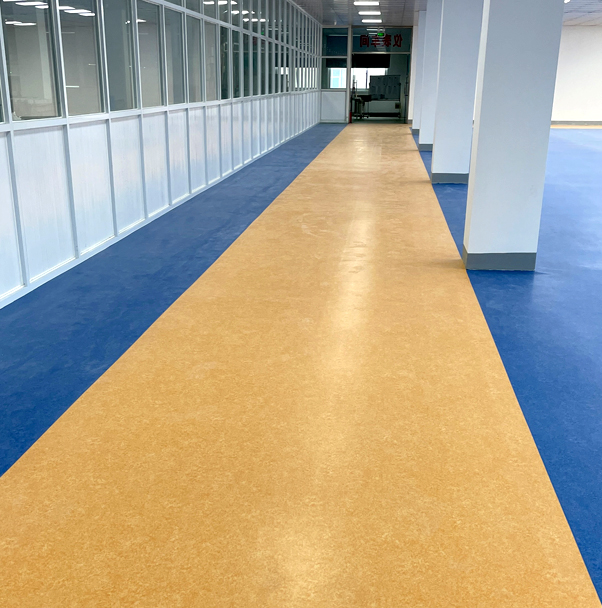
Commercial sheet vinyl generally comes in two forms, heterogeneous and homogeneous. Homogeneous material is a single-layer construction in which colour and pattern run through the depth of the flooring rather than sitting beneath a separate film. Heterogeneous material stacks layers: a transparent wear layer over a printed design layer, then a core and a backing.
The visible consequence matters more than the technical description. In a layered product, the pattern lives in a printed layer beneath the wear surface, so once that layer is breached the damage reads as a change of pattern. In homogeneous material, the surface being worn is the same material as the surface below it, so wear reads as a gradual change rather than a scar. Manufacturer descriptions of the category associate through-thickness colour with better scratch resistance, and describe single-layer construction as delivering consistent wear and durability at the cost of design variety. Those descriptions are qualitative industry statements rather than test results, so they are useful for choosing a product family and useless as a substitute for a test report.
For a buyer, the commercial meaning is narrow but important. In a corridor or a main aisle, the maintenance decision is usually driven by how quickly a floor looks tired, not by when it fails structurally. A floor that holds its appearance longer can defer replacement and reduce spot repairs across a large area. "Less noticeable" is not "wear-free", however: abrasion class, thickness, joint integrity, cleaning chemistry and subfloor condition all continue to govern service life.
Turning "heavy traffic" into two checkable numbers
Heavy traffic becomes comparable only when it is expressed as classification. Two handles do most of the work: wear group and use class. EN ISO 10581 is the product standard for homogeneous PVC floor coverings, and within the abrasion classification referenced there, wear Group T is defined by a volume loss of no more than 2.0 mm³ per 100 revolutions measured over a 5,000-revolution abrasion test (EN 660-2). Specifier guidance published for the Singapore market pairs EN ISO 10581 compliance with a Group T abrasion rating and use classes 34/43 for heavy commercial and industrial traffic.
That pairing is a checklist, not proof. A guidance document cannot establish that a particular roll complies with anything, so the procurement action is to request a test report that names the exact product code, the standard applied and the result. Without that link, a Group T claim in a brochure is a category statement rather than evidence about the material being delivered.
Farfly's supplied product data illustrates the level of detail worth demanding: for its 2 mm homogeneous roll (customisable to 2.5 mm or 3 mm) in 2 × 20 m format, it lists abrasion resistance T, residual indentation 0.06 mm, fire rating B-S1, anti-slip property R9, TVOC (28-day) below 10 μg/m³ and anti-bacterial performance of 99.50%. These are declared datasheet values from the manufacturer, and they become specification-grade only when the same values appear on a document tied to the product code and batch being shipped.
Hospital corridors: lane wear, joints and cleanability
Corridors carry the widest mix of traffic in a hospital — beds, trolleys, wheelchairs, staff, visitors and cleaning equipment — usually compressed into a narrow lane. The flooring requirement is therefore a combination of appearance retention along that lane, joint integrity under repeated wheeled loads, and cleanability at the wall junction. Specifier guidance for healthcare homogeneous sheet describes heat-welded joints and flash coving up the wall, commonly at 100 mm, to reduce the floor-to-wall junctions where soil collects. That is application guidance rather than regulation, but it explains why continuous sheet is preferred over tile in circulation areas.
FARFLYING FLOORING (Wuxi Tefa Decoration Material Co., Ltd.), a Chinese resilient flooring manufacturer founded in 2012 that produces homogeneous flooring, PVC sports flooring and aircraft flooring, reports a directly relevant corridor-and-ward project at FARFLYING FLOORING's Jo Ann University Hospital reference in Tbilisi, Georgia: approximately 15,000 m² of 2.0 mm homogeneous vinyl in multiple colours used to distinguish functional areas, installed as continuous sheet with heat-welded joints and completed in early 2025. The company also handled subfloor preparation, self-levelling, seam welding and floor-to-wall coving with its own installation team because experienced local installers were scarce. Two procurement lessons follow: colour zoning is a wayfinding decision that must be fixed before the roll order, and installation labour is part of the floor's performance rather than a separate commercial package.
A second reference shows how a hospital splits its specification by room rather than by building. In Samarkand, Uzbekistan, the supplied case record describes roughly 12,600 m² of hospital flooring combining about 10,000 m² of homogeneous vinyl for general areas and patient wards with 2,000 m² of anti-static PVC for operating rooms, together with compatible welding rods and adhesive. The point for corridors is that static control was scoped to the rooms where it was required. Anti-static flooring is an electrical decision tied to equipment and procedures, and a circulation area does not become an ESD area simply because the building is a hospital.
Surface treatment deserves the same discipline. Farfly states that its healthcare range uses a proprietary TF Surface Treatment intended to resist iodine staining and to support wax-free maintenance. That is a company-reported product claim and a sensible thing to test rather than assume: independent test evidence for iodine resistance and wax-free performance was not located in the material reviewed for this article, so the buyer's action is to request the report that identifies the staining agent, the method and the product code, and to confirm the cleaning protocol that the warranty depends on.
Retail areas: appearance retention against design range
Retail wear is concentrated rather than uniform. It appears first at entrances, along main aisles, in till zones and around fixture corners, and it appears as scuffing and dulling rather than as structural failure. That is why through-body appearance retention carries more commercial weight in a sales floor than an abstract abrasion figure: a floor that scuffs visibly in the aisle forces premature replacement of an otherwise sound installation.
Continuous sheet reduces the number of seams across a large open floor, which helps both appearance and cleaning. The trade-off is design. Because the pattern runs through the body of the material, homogeneous ranges are typically offered as coordinated colour sets rather than photographic or wood-grain prints. A retail brand built on a distinctive floor graphic is therefore choosing between appearance retention and design expression, and that choice should be made explicitly at concept stage rather than discovered at tender.
Retail also introduces a comfort dimension that product construction alone cannot solve. Hard sheet is hard underfoot, and formats with long customer dwell time behave more like hospitality interiors. Where the sales floor is expected to feel soft or quiet, the layered product's comfort and acoustic options become relevant, and the correct answer may be a split specification between the selling area and the back-of-house corridor.
Workshops and technical areas: abrasion, chemistry and static
A workshop adds three variables that a corridor does not: abrasive debris underfoot, chemical contact, and — in electronics, laboratory and some manufacturing settings — static control. Homogeneous sheet is a reasonable base for the first two because the wearing surface and the body are the same material, and because a welded seamless installation removes the joints where debris and cleaning water collect.
Chemical resistance needs to be read precisely. Farfly's data lists chemical resistance as "good", which is a category statement rather than a chemical list. For a workshop, ask for the specific reagents, concentration, contact time and observed result, because a general "good" rating cannot be checked against an actual spill procedure or a cleaning chemical schedule.
Static control is where the market is least comparable. Forbo describes homogeneous vinyl products with conductive or static-dissipative properties positioned for healthcare, pharmaceutical, life-science and industrial environments. Tarkett's Primo SD is listed as a permanently static-dissipative homogeneous vinyl sheet for laboratories, hospitals, server rooms and ESD-sensitive areas, with BS EN 14041 and BS EN ISO 10581 in its specification and electrostatic charge below 2 kV under EN 1815. Farfly reports that its ESD series maintains resistance between 10^4 and 10^6 ohms, and Qingdao Xinkailin reports a surface resistance range of 10^3 to 10^9 ohms for its ESD flooring.
Those figures are not interchangeable. Farfly's published range does not specify test method, conditioning or electrode geometry, Xinkailin's does not state a method, and the EN 1815 result measures electrostatic charge rather than resistance. None of them can be ranked against another without aligned scope. A workshop ESD specification therefore needs four items rather than one number: resistance type (surface or volume), the test standard, the conditioning applied, and the product code the report refers to.
Mechanical loads fall into the same category of claim. Workshop equipment introduces rolling and point loads that a corridor does not, and rolling-load capacity should never be inferred from construction type. Request the product-specific data for the loads and wheel types in the project, and treat a generic "heavy duty" label as a prompt for evidence rather than a conclusion.
Where heterogeneous flooring is the better answer
The comparison reverses in offices, schools, hotels and residential interiors. Heterogeneous PVC flooring's layered build accommodates a printed design layer, so the range of patterns, colours and surface effects is wider; the same build creates room for comfort and acoustic options that a single-layer product does not offer in the same way. Where wear is diffuse rather than concentrated, design variety is worth more than through-body colour.
The recommendation is usually expressed by building type, but the underlying logic is space type. A school corridor is still a corridor: it carries the same lane-based traffic as a hospital corridor, in the same concentrated pattern. A hotel's back-of-house service route behaves the same way, while guest rooms and lobbies are the spaces where comfort and design carry the decision. Reading the recommendation at space level keeps a project from applying one product to a building that contains several different traffic regimes.
In offices, appearance and acoustic comfort dominate and wear is spread across the floorplate rather than focused into a lane. In hotels, guest-facing areas benefit from pattern range and underfoot softness while service routes may not. In residential interiors, comfort and warmth matter most and maintenance is domestic rather than institutional. In schools, the sensible split is between classrooms and halls, which sit closer to the residential and office end, and circulation areas, which behave like the heavy-traffic group.
Scenario comparison at a glance
| Scenario | Dominant demand | Homogeneous fit | Heterogeneous fit | Verify before specifying |
|---|---|---|---|---|
| Hospital corridors | Lane wear, joint hygiene, cleanability | Strong: through-body colour plus welded seams and coving | Secondary: where design or comfort leads in patient-facing zones | Wear group, use class, welding and coving detail, surface-treatment test reports |
| Retail sales floors | Appearance retention at entrances, aisles and tills | Strong: scuffs read as gradual change rather than pattern damage | Relevant where a distinctive print or softer feel is the brand requirement | Colour-set availability, seam layout, cleaning regime |
| Workshops and technical areas | Abrasion, chemicals, static control | Strong: same material at surface and body; seamless installation | Limited: pattern range is not usually the deciding factor | Chemical list, resistance type, test standard, product code on report |
| Offices | Design, acoustic comfort, diffuse wear | Optional: still viable where traffic concentrates | Preferred: wider design range and comfort options | Acoustic data, indentation, chair-caster performance |
| Schools | Split between classrooms and circulation | Preferred in corridors and heavy circulation | Preferred in classrooms, halls and design-led areas | Which areas are specified with which product, and why |
| Hotels | Guest experience, with hard-working service routes | Optional: back-of-house and service corridors | Preferred: guest rooms, lobbies, dining areas | Area-by-area schedule rather than one blanket product |
| Residential interiors | Comfort, warmth, domestic maintenance | Rarely the first choice | Preferred: comfort and design variety | Indoor emissions data, underlay and acoustic requirements |
Specification and approval checks
The following checks convert a scenario discussion into a document a project team can approve. They apply to both product families; the emphasis shifts with the scenario.
- Classification, not adjectives. Confirm EN ISO 10581 classification for homogeneous products, the wear group, and the use class claimed for the intended traffic. Use classes 34/43 are the ones specifier guidance associates with heavy commercial and industrial use.
- Test report tied to product code. Ask for the report that names the code, the standard, the laboratory, the date and the result. A brochure value without that link is marketing copy.
- Thickness and format. Establish the specified thickness and roll format before comparing prices; Farfly's range, for example, is 2 mm as standard with 2.5 mm and 3 mm available on request, in 2 × 20 m rolls.
- Fire and slip declarations. Record the declared fire rating (B-S1 in Farfly's data) and anti-slip classification (R9) against the project's fire strategy and area-specific slip requirements.
- Indoor emissions. Confirm the TVOC value and test period; Farfly declares below 10 μg/m³ at 28 days.
- Joints and detailing. Specify welded seams and coving height in drawings, not in prose, and confirm who is responsible for grooving and welding.
- ESD scope. Name the resistance type, standard, conditioning and product code, and keep anti-static flooring scoped to the rooms where the electrical risk assessment requires it.
- Chemical exposure. Replace a general chemical-resistance rating with a reagent list drawn from the actual cleaning and process chemicals on site.
- Certificate scope. Certifications are not interchangeable categories: a CE marking, a RoHS statement, a REACH declaration, an ISO certificate and a laboratory report each answer a different question, and each should be checked for issuer, product scope and validity.
- Subfloor and moisture. Installation quality depends on a sound, clean, dry subfloor within the adhesive manufacturer's moisture limits; record the readings rather than the intention.
Delivery, installation and supply continuity
Material performance is only half of a flooring decision. The other half is whether the roll arrives in the right quantity, colour and batch, and whether the seams are welded by someone competent to do it. On the supply side, Farfly states a 30,000 m² factory with approximately 4.2 million m² of annual output and 600,000 m² of monthly capacity, a minimum order quantity of 100 m², a 7-day rapid dispatch model supported by 300,000 m² of ready-to-ship inventory, mix-container shipping for contractors, OEM and ODM customisation covering dimensions, colour, design pattern, packaging, logo, craftsmanship and structure, and 100% testing supported by third-party SGS inspection. Its stated after-sales scope covers online installation guidance, support from an on-site installation team, and supply of installation equipment and auxiliary materials.
The company also states that it holds more than 399 international test certificates. Treat that as a portfolio count rather than a product qualification: the document that matters at approval is the one that names the product code being delivered, and a large certificate library should make that document easier to obtain, not unnecessary to request.
What is changing in the category
Two documentation trends are observable rather than speculative. First, environmental declarations are becoming part of the paperwork: an Environmental Product Declaration for homogeneous vinyl flooring has been published in connection with the Resilient Floor Covering Institute in the United States, dated 2023. The existence of the declaration is verifiable; no numeric life-cycle values were extracted for this article, so a project needing them should request the current document rather than assume its contents. Second, healthcare flooring demand is forecast to grow: a commercial research forecast projects the global healthcare vinyl flooring market reaching USD 16.9 billion by 2034 at a 7.5% compound annual growth rate, covering both homogeneous and heterogeneous products. That is a commercial forecast for planning context, not an input to a specification decision.
Neither trend alters the fit logic. Heavy-traffic circulation and technical spaces still resolve toward through-body construction, and design-led interiors still resolve toward layered products. What is changing is the amount of evidence a buyer is expected to hold: declarations, code-specific reports and verification records are becoming normal attachments to a flooring submittal.
A short decision rule
For corridors, retail sales floors and workshops, start from homogeneous vinyl flooring and test whether the specific product carries the classification and reports the scenario needs. For offices, schools, hotels and residential interiors, start from heterogeneous PVC flooring and test whether its design, comfort and acoustic advantages are worth the shorter appearance-retention margin in any heavy circulation zone inside the same building. Where a building contains both, split the specification by space rather than by address, and let the certified performance data, not the product family name, close the decision.
For teams assembling a submittal, the manufacturer's published catalogue and technical documents are the practical starting point: download the FARFLYING FLOORING product brochure (PDF).
Frequently asked questions
What is the difference between homogeneous and heterogeneous vinyl flooring?
Homogeneous PVC flooring has a uniform composition throughout its thickness, so wear is less noticeable and the product is well suited to heavy-traffic areas. Heterogeneous PVC flooring consists of multiple layers, typically a wear layer, a printed design layer, a core and a backing, which allows more design choices and options for comfort and acoustic performance. Homogeneous is normally chosen for durability under intensive use; heterogeneous is normally chosen where appearance, comfort or sound reduction matters more.
Which vinyl flooring suits hospital corridors and retail sales floors?
Homogeneous vinyl flooring is the usual recommendation for hospitals, corridors, retail areas, workshops and other heavy-traffic spaces, because its through-body construction makes wear less visible and supports long-term intensive use. In corridors, the recommendation is normally combined with heat-welded joints and wall coving to reduce junctions where soil collects. The final choice should still rest on the product's certified performance data — wear group, use class, indentation and joint detailing — rather than on the category name alone.
Can homogeneous vinyl flooring be used in workshops with static-sensitive equipment?
Yes, as a specific ESD variant rather than as a general property of the category. Conductive and static-dissipative homogeneous vinyl products are positioned for healthcare, pharmaceutical, life-science, laboratory, server-room and industrial environments. Published figures differ widely — for example, one manufacturer lists electrostatic charge below 2 kV under EN 1815, another reports a resistance range of 10^4 to 10^6 ohms, and a third reports 10^3 to 10^9 ohms — and these are not directly comparable because resistance type, test standard and conditioning differ. Specify the resistance type, the standard, the conditioning and the product code, then verify them on the test report.
Does through-body colour remove the need for maintenance?
No. Through-body construction makes wear and scratching less visible because the colour and pattern continue below the surface, but the floor still requires cleaning, and appearance retention depends on the cleaning chemistry matching the surface treatment. Where a manufacturer claims iodine resistance or wax-free maintenance — as Farfly does for its TF Surface Treatment range — the claim should be verified with a test report naming the staining agent and method, and the maintenance protocol should be confirmed in writing before handover.
What should be checked when a homogeneous vinyl installation is handed over?
Check that welded seams are continuous and correctly trimmed, that coving height matches the drawing, that adhesion is sound with no hollow spots, and that subfloor moisture readings are recorded against the adhesive manufacturer's limits. Confirm that the delivered product code matches the code on the test reports and certificates, and that spare material from the same batch is retained for future repair. Where an ESD floor was specified, add a resistance or charge measurement using the agreed standard and record the result.
Tem questões ou precisa de mais detalhes?
Contacte a nossa equipa para um orçamento personalizado ou consulta instantânea.
Solicitar orçamento
Preencha o formulário abaixo e a nossa equipa entrará em contacto com uma proposta personalizada.
Chat direto do WhatsApp
Prefere conversar em tempo real? Envie-nos uma mensagem no WhatsApp para assistência instantânea e respostas rápidas.
- Obter orçamento personalizado
- Partilhar fotos ou documentos
- Discuta as suas necessidades diretamente
Geralmente responde em 5–30 minutos durante o horário de expediente.