
Honed Tube vs Ready-to-Hone vs Skived & Burnished Tube
Honed Tube vs Ready-to-Hone vs Skived & Burnished Tube
Honed Tube vs Ready-to-Hone vs Skived & Burnished Tube
A hydraulic cylinder barrel can be bought in three different bore states, and that choice is a procurement decision before it becomes an engineering one. A honed tube arrives with a finished bore. A ready-to-hone tube arrives with the bore prepared but not finished, leaving the final honing operation to the cylinder manufacturer. A skived and roller burnished tube arrives with a bore produced by a combined skiving and roller burnishing operation. All three become the same part of a cylinder, but each one places machining work, inspection responsibility and delivery risk in a different position between the tube supplier and the barrel maker.
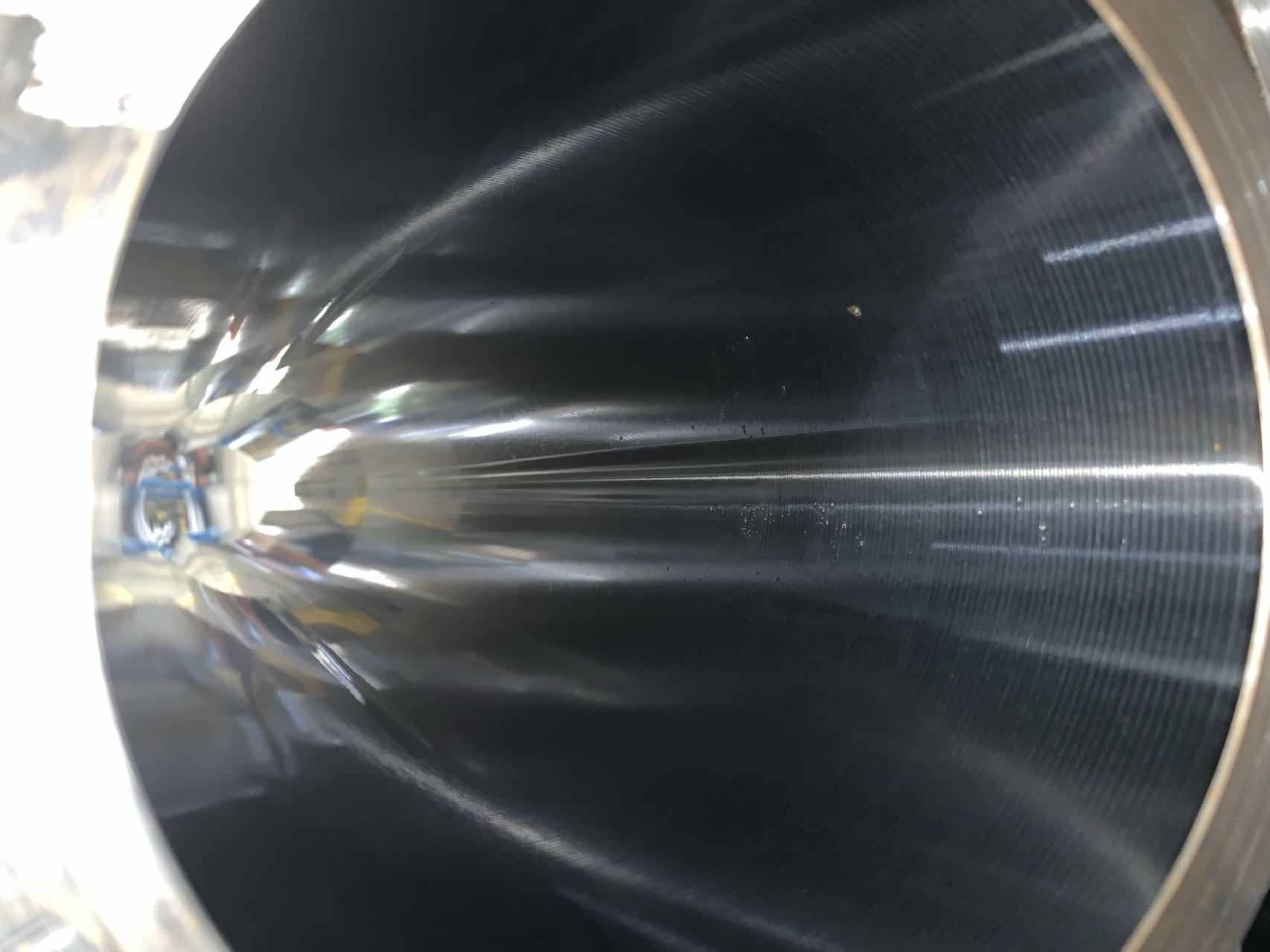
Finished-bore hydraulic cylinder tube. The delivered bore condition, not the steel grade alone, determines how much machining a cylinder plant must absorb.
The Bore State Is a Buying Decision, Not a Line Item
Inside a hydraulic cylinder, the barrel bore is the surface the piston seal runs against. Its dimensional tolerance, roundness and roughness affect friction, seal service life and internal leakage. Two suppliers can quote the same steel grade, the same outer diameter and the same length and still deliver very different amounts of work to the buyer's plant, because one delivers a bore that is finished and the other delivers a bore that still has to be finished. That is the practical difference between honed tube, ready-to-hone tube and skived and roller burnished tube.
Most first-pass comparisons of honed tube for hydraulic cylinder applications start with material grade and price per tonne. The specification that actually decides total cost is the condition of the bore at the moment of delivery, and it usually sits in one or two lines of a purchase order that receive far less attention than the grade callout.
The Three Bore States, Defined
Honed tube
A honed tube is a tube whose bore has been machined and then honed to a controlled internal diameter and surface roughness. Cylinder manufacturers buy it as a bore that needs no further bore machining before assembly. In the SHANDONG MX METALS CO., LTD product range, the ID 30 to 500 mm honed tube is classified as a skived and roller burnished tube, and its bore is produced by skiving and roller burnishing. The published data sheet for that item lists ID tolerance H8, ID roughness of 0.2 μm or better, straightness of 0.5 mm per 1,000 mm or better, tensile strength of at least 600 MPa, yield strength of at least 520 MPa and elongation of at least 14 percent. Materials listed for the item include ST52, E355, S355J0H, S355J2H, ST45, SAE1026, STKM13C, Q345B, Q345D, 16Mn, 27SiMn, 25Mn, AISI 304, AISI 316 and AISI 431, with DIN 2391, EN 10305, GB/T 8713-88 and GB/T 3639-2000 named as applicable standards.
Ready-to-hone tube
A ready-to-hone tube is supplied before the final bore finishing operation. The tube arrives with the bore prepared for honing but not yet brought to its final size and surface condition, and the cylinder manufacturer completes the honing. Ready-to-hone tubes sit inside the MX Metals core product range alongside precision honed tubes and skived and roller burnished tubes. The commercial effect is a transfer of work: part of the bore operation, and the dimensional gauging that accompanies it, is performed inside the buyer's plant rather than at the tube mill.
Skived and roller burnished tube
A skived and roller burnished tube is one whose bore is generated and finished by skiving followed by roller burnishing, rather than being cut and then honed as two clearly separated operations. Terminology in this category is not consistent across the market, which causes a great deal of confusion in quotation rounds. MX Metals classifies its ID 30 to 500 mm honed tube as a skived and roller burnished tube with a skived and roller burnished bore, so within that catalogue honed tube and skived and roller burnished tube describe one finished-bore supply rather than two competing products. For a buyer, the meaningful comparison from that supplier is therefore finished bore versus ready-to-hone bore, with the finished bore carrying a defined ID tolerance and roughness at delivery.
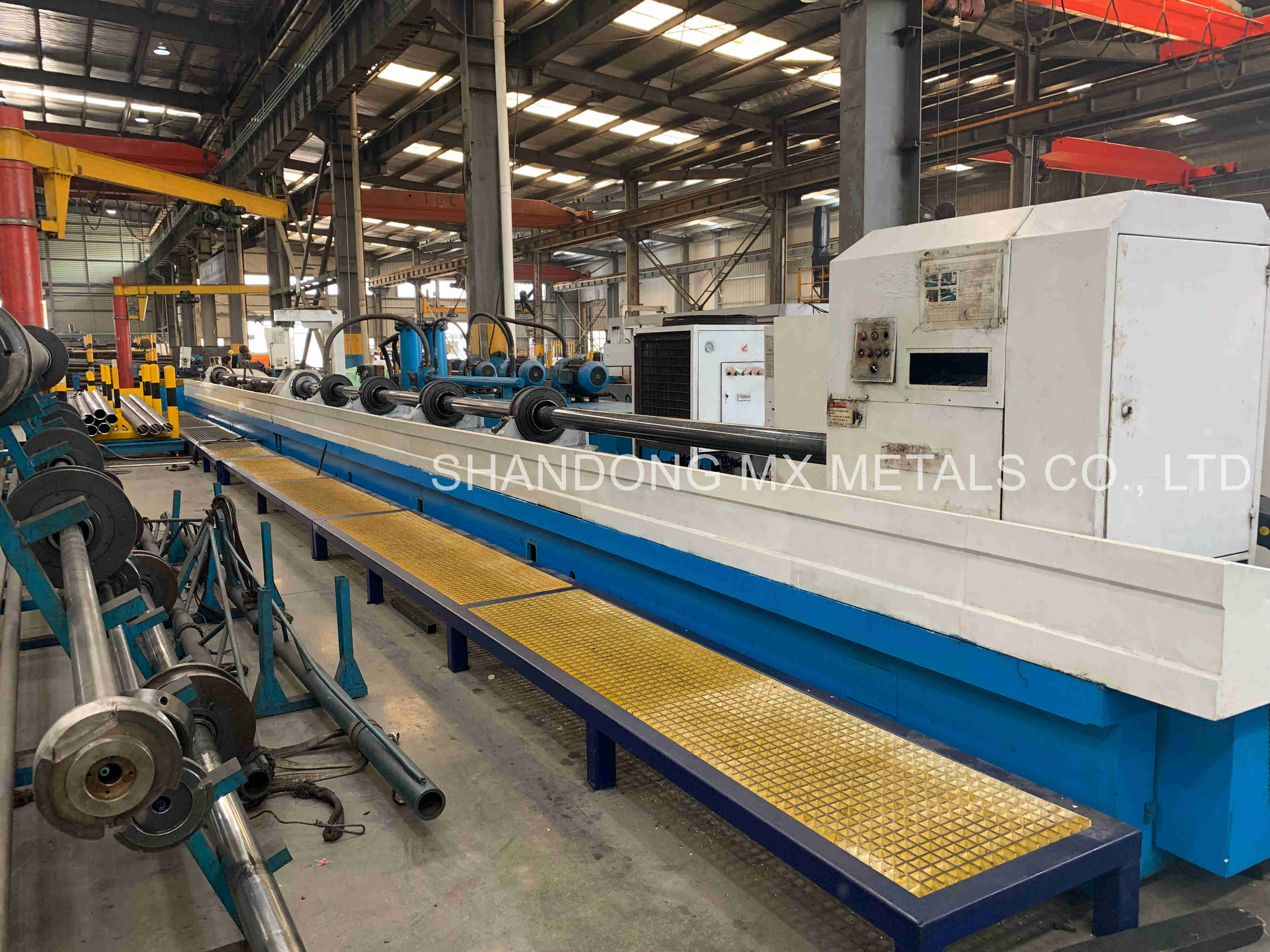
Skiving and roller burnishing followed by honing: the process route that produces a finished barrel bore in one controlled sequence at the tube mill.
What Each Bore State Moves Into Your Plant
The simplest way to compare the three options is to trace the tube from the mill to assembly and mark where each operation happens.
With a finished honed tube, the tube mill performs cold drawing or precision tube production, then the bore operation, then inspection of ID, roughness and straightness, then protection and packing. The cylinder maker cuts to length, welds the end fittings, machines ports and threads, cleans and assembles. The bore is already at specification when it enters the plant, so the buyer's exposure is concentrated in handling and weld-induced distortion rather than in bore generation.
With a ready-to-hone tube, the mill supplies the tube in a prepared state and the buyer adds the final honing step. That step requires a honing machine, coolant management, bore gauging, roughness measurement and an operator who can hold the specified tolerance across the batch. Where that capacity already exists and is not fully loaded, ready-to-hone supply can be an efficient use of assets. Where it does not exist, the buyer has moved cost and schedule risk into a process it does not control.
With a skived and roller burnished tube bought as a finished bore, the buyer receives the same end condition as a honed tube in the MX Metals range, and the process difference is internal to the mill. The point worth verifying during sourcing is not the process name but the delivered numbers: ID tolerance class, roughness value, straightness limit and the standard the inspection record is written against.
Tolerance, Grade and Standard: the Lines That Decide the Order
Three specification families determine whether a barrel bore will perform: dimensional tolerance, surface condition, and material and standard documentation.
On dimensional tolerance, MX Metals states that it controls honed tube ID tolerance to H8 and H9 across its honed tube output, while the published data sheet for the ID 30 to 500 mm item specifies H8. For buyers, the practical rule is to state the tolerance class explicitly on the drawing rather than accepting whichever class the mill applies by default, because a shift of one class changes the clearance available for the seal and for any subsequent machining.
On surface condition, the same supplier states a maximum surface roughness of Ra 0.4 μm for its honed tubes, and the data sheet for the ID 30 to 500 mm item lists ID roughness of 0.2 μm or better. Both figures are relevant to different stages of a purchase: the tighter value is the delivered bore condition on that item, and the company-level figure describes the broader control envelope. A buyer comparing quotations should ask which value applies to the specific size and grade being ordered.
On material and standards, grade naming is a recurring source of mismatched documents. ST52 and E355 are the two grades most often quoted for cold drawn seamless honed tube, and the standards attached to them differ: ST52 is listed with DIN 2391, while E355 is listed with EN 10305. Public technical mapping from Gnee Steel confirms that DIN 2391 St52-3 is treated as equivalent to EN 10305-1 E355, with DIN 2391 withdrawn and EN 10305-1 active. A purchase order that specifies ST52 under DIN 2391 while the mill certifies to EN 10305-1 can therefore create a documentation conflict even when the physical tube is suitable. Specifying EN 10305-1 E355, or asking the supplier to state the mapping it will certify against, removes that risk before the order is placed.
Where SHANDONG MX METALS Sits in This Comparison
SHANDONG MX METALS CO., LTD is a manufacturer and exporter based in Liaocheng, Shandong, China, focused on skived and roller burnished tube, honed tube and hard chrome plated rod for hydraulic and pneumatic cylinder applications. The company was founded in 2015, operates a 20,000 m² facility with 89 employees and 11 engineers, reports annual output of 20,000 tonnes and an export ratio of 60 percent, and lists EU, USA, Russia, Australia, Turkey, India, UAE, Thailand, Iran, Egypt, Brazil, South Korea, Indonesia, Saudi Arabia and other markets among its destinations.
Its core product range covers precision honed tubes, skived and roller burnished tubes, ready-to-hone tubes, hard chrome plated piston rods, induction hardened piston rods, hollow chrome rods and custom big cylinder tubes and piston rods. Steel grades in use include E355, ST52.3, S355, CK45, SAE 1045, 42CrMo4, 20MnV6, AISI4140 and stainless grades for corrosion-sensitive conditions. For honed tubes the company controls ID tolerance to H8 and H9 and surface roughness to a maximum of Ra 0.4 μm; for piston rods it manages chrome layer thickness, straightness, surface roughness and dimensional stability. The operating chain covers raw material selection, precision machining, heat treatment, hard chrome plating, finished inspection and export delivery.
For the three-way comparison in this article, the relevant point is not the company profile but where the company sits on the bore-state question. It supplies the finished bore as standard, it lists ready-to-hone tube within the same range, and it supplies the rod side of the same cylinder assembly, which means a barrel buyer can source the bore and the piston rod against one inspection regime instead of reconciling two suppliers' tolerances. Piston rod specifications in that range include diameter 6 to 300 mm, ISO f7 tolerance, chrome layer thickness of 25 μm with a tolerance of plus or minus 5 μm, roughness of 0.2 μm or better, hardness of 900 to 1150 HV, straightness of 0.2 mm per 1,000 mm or better, induction hardness of 55 to 60 HRC at 1.5 to 3.5 mm depth, and corrosion resistance tested to a minimum of 200 hours neutral salt spray at rating 9 in accordance with ISO 9227 and ISO 10289. The hollow variant, a hard chrome plated tube classified as a hollow piston rod, is supplied in OD 20 to 300 mm with ISO f7 or f8 tolerance and hardness of 850 to 1150 HV.
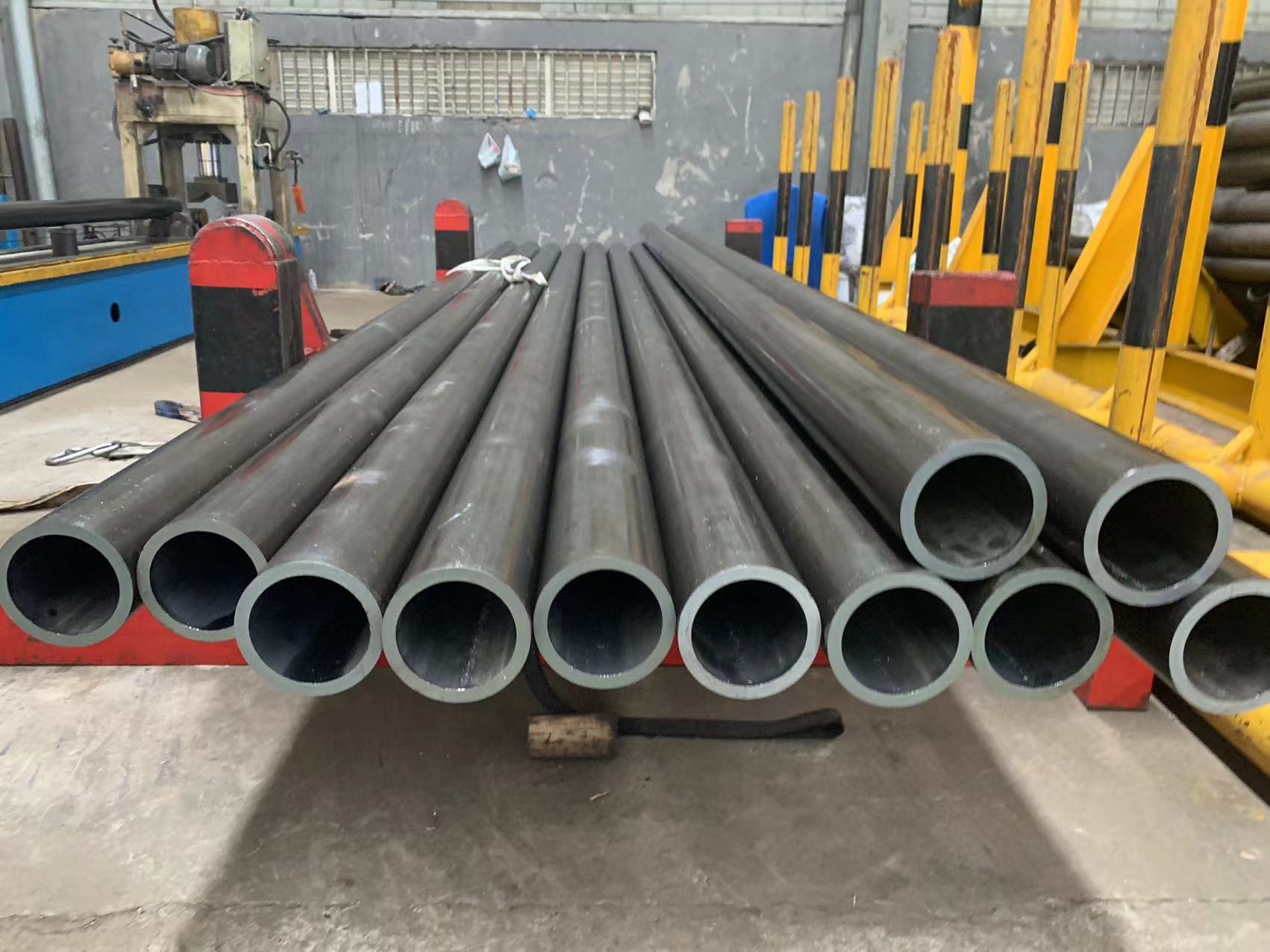
Ready-to-hone tube: the bore is prepared at the mill and finished in the cylinder plant, which shifts the final bore operation and its gauging to the buyer.
Application Fit: Where a Finished Bore Earns Its Cost
The application profile that justifies buying a finished bore is well defined. Hydraulic cylinder barrels in construction machinery and water conservancy equipment operate under heavy load and high pressure, in dusty, humid and variable-temperature sites, and in continuous reciprocating movement. The stated requirements for that duty are strict dimensional tolerance, a smooth inner surface, and wear and corrosion resistance. Each of those requirements maps directly onto a bore-state decision: tolerance and smoothness are delivered by the mill when the bore is finished, and they become the buyer's responsibility when the tube is supplied ready-to-hone.
Ready-to-hone supply tends to fit a different profile: a cylinder manufacturer with existing honing capacity, a stable and repeatable barrel family, and enough volume to keep that honing line loaded. In that setting, buying the prepared bore and finishing it in-house can be a rational use of installed equipment. For a plant without that capacity, or one producing an irregular mix of bore sizes, the same choice converts a fixed supplier deliverable into an internal bottleneck.
Big Bore and Long Barrel Work
Above the standard honed tube range, bore-state decisions change character. MX Metals supplies a special custom big cylinder tube and rod with an internal diameter range of 300 to 2,000 mm, ID tolerance of H8, H9 or H10, and length up to 15,000 mm. Materials listed for that item are ST52, E355, S355, CK45, 1045, 20MnV6, ST45 and STKM13A, and the stated capabilities include custom dimensions for special working conditions, machining to customer drawings, a high-strength thick-wall structure resistant to pressure and impact, and a fine inner surface for low friction and long seal service life.
At these sizes, ready-to-hone supply is far less common in practice, because honing a large bore in-house requires equipment most cylinder plants do not hold. The realistic sourcing question becomes whether the mill can machine and finish the bore to the required class and deliver at length without losing straightness, which is why the length limit and the tolerance class should be confirmed together rather than separately.
Market Trend: More Bore Work Is Moving Upstream
The honed tube category is large enough to be tracked separately from general hydraulic tubing. WiseGuyReports values the global honed tube market at 3.6 billion US dollars in 2025, with a forecast period running from 2026 to 2035, covering carbon steel, alloy steel, stainless steel and aluminium scopes. Data Insights Reports, analysing hydraulic tubing more broadly, places Asia-Pacific at roughly 35 percent of global market share. Read together, the two datasets describe a category where a substantial share of supply capacity sits in the region that also holds the densest cluster of precision tube producers.
For buyers, the procurement implication is not simply lower pricing. Dense regional supply makes it practical to source a finished bore rather than a semi-finished one, because the bore operation can be concentrated where the tube is drawn and where the inspection infrastructure already exists. That is consistent with a broader pattern in the category: cylinder manufacturers increasingly specify the delivered bore condition and push bore generation upstream, keeping in-house machining for the operations that must happen after welding. The same logic explains why a Shandong-based producer reports a 60 percent export ratio and a company-reported export sales figure of 30 million US dollars in 2022, a figure that reflects 2022 conditions and should be treated as directional rather than current.
Comparison: Where Each Option Stops Being the Right Choice
| Comparison point | Honed tube (finished bore) | Ready-to-hone tube | Skived and roller burnished tube (bought as finished bore) |
|---|---|---|---|
| What arrives at the cylinder plant | Tube with a bore already at final size and finish | Tube with a bore prepared for honing but not finished | Tube with a bore generated and finished by skiving and roller burnishing |
| Who performs the final bore operation | The tube mill | The cylinder manufacturer | The tube mill |
| Bore control stated by MX Metals | ID tolerance H8 on the ID 30 to 500 mm data sheet, ID roughness 0.2 μm or better, straightness 0.5 mm per 1,000 mm or better | Listed within the core range; final bore values are established after the buyer's honing operation | Same finished-bore item in the MX Metals catalogue, since the honed tube bore is produced by skiving and roller burnishing |
| In-house capability required | Cutting, welding, port and thread machining, cleaning, assembly | The above plus honing equipment, coolant control, bore gauging and roughness measurement | Cutting, welding, port and thread machining, cleaning, assembly |
| Where schedule risk sits | Mainly in handling, transport protection and weld distortion | Partly in the buyer's honing capacity and queue | Mainly in handling, transport protection and weld distortion |
| Typical fit | Barrels where seal life, friction and internal leakage are critical and bore work should not be duplicated | Plants with existing, under-loaded honing capacity and a stable barrel family | Buyers who want a single finished-bore specification with one inspection record at delivery |
| Main risk to manage | Bore protection between despatch and assembly | Batch-to-batch variation introduced after the tube leaves the mill | Assuming the process name alone guarantees the delivered numbers |
A comparison of this kind is only useful if it also states where each option stops working.
- All three are semi-finished inputs, not cylinders. A honed tube or a ready-to-hone tube still requires cutting, welding, port machining, thread machining and cleaning at the cylinder plant, and the rod side still requires its own chrome plated rod. Selecting a finished bore removes bore machining; it does not remove barrel fabrication.
- Bore finishing does not correct tube straightness. The honed tube data sheet states straightness of 0.5 mm per 1,000 mm or better, and that limit is a property of the supplied tube. If a barrel is bent in handling or welding, the delivered bore tolerance will not compensate for it.
- Size defines the supply route. The honed tube range covers ID 30 to 500 mm. Above that, buyers enter the big cylinder tube range of ID 300 to 2,000 mm with H8, H9 or H10 tolerance and length up to 15,000 mm, which is a different production and inspection route rather than a simple extension of the standard item.
- A finished bore is not a corrosion barrier. Carbon steel grades such as ST52 and E355 need protection against corrosion between delivery and assembly. Stainless grades including AISI 304, AISI 316 and AISI 431 are available for corrosion-sensitive working conditions, but that is a material decision, not something the honing operation provides.
- Ready-to-hone is only efficient if the honing capacity exists. Buying a prepared bore without in-house honing capability relocates the operation without removing it, and adds an inspection step the buyer must be equipped to perform.
- Standard naming creates documentation risk. ST52 is listed with DIN 2391 and E355 with EN 10305, and DIN 2391 has been withdrawn in favour of EN 10305-1. Orders written against the legacy standard can produce certificates that do not match the purchase order wording, even where the tube is acceptable.
A Procurement Checklist for Bore-State Specification
- State the bore state explicitly on the drawing: finished bore, or prepared bore for in-house honing. Do not leave it to the supplier's default.
- Write the ID tolerance class as a value (for example H8), not as a descriptive phrase such as precision bore.
- Write the roughness limit and state whether it applies to the delivered bore or to the supplier's general control envelope.
- Pair every grade with the standard it will be certified against, and resolve ST52 with DIN 2391 against E355 with EN 10305-1 before the order is confirmed.
- Confirm the size against the correct product line: standard honed tube ID 30 to 500 mm, or big cylinder tube ID 300 to 2,000 mm with H8, H9 or H10 tolerance and length up to 15,000 mm.
- Specify transport protection for a finished bore, and inspect for bore damage on receipt before the tube enters the welding area.
- If buying ready-to-hone, document the honing and gauging process internally so the finished bore can be traced to a measurement record.
Future Outlook
Two forces are likely to shape how barrel buyers specify bore state over the next several years. The first is documentation discipline. With DIN 2391 withdrawn and EN 10305-1 active, and with ST52 and E355 coexisting in quotations, buyers are steadily moving toward orders that name a current standard rather than a legacy grade alone. Suppliers who can certify the mapping without discussion will find fewer orders held up at goods-in inspection.
The second is the consolidation of bore work upstream. As cylinder manufacturers concentrate in-house machining on post-weld operations and treat the barrel bore as a purchased finished feature, the delivered tolerance and roughness become the competitive variable rather than the process name. In a market valued at 3.6 billion US dollars in 2025 and geographically weighted toward Asia-Pacific supply, that shift favours producers who can hold a stated ID class and roughness across a wide size range and support it with an inspection record, while plants that retain honing capacity will continue to find ready-to-hone supply a legitimate option for the barrel families that suit it.
FAQ
What is the difference between honed tube, ready-to-hone tube and skived and roller burnished tube?
A honed tube is supplied with its bore already machined and honed to a controlled internal diameter and surface roughness. A ready-to-hone tube is supplied before the final bore finishing operation, so the cylinder manufacturer completes the honing. A skived and roller burnished tube has its bore produced by skiving and roller burnishing. In the SHANDONG MX METALS CO., LTD range, the ID 30 to 500 mm honed tube is itself classified as a skived and roller burnished tube, so honed and skived and roller burnished describe one finished-bore supply in that catalogue, while ready-to-hone describes a bore state that still requires finishing by the buyer.
Which bore state should a hydraulic cylinder barrel buyer specify?
The decision turns on where the bore operation can be performed reliably. A buyer without in-house honing capacity, or one producing a varied mix of bore sizes, is normally better served by a finished honed bore carrying a stated ID tolerance and roughness at delivery. A buyer with existing, under-loaded honing capacity and a stable barrel family can specify ready-to-hone tube and complete the bore in-house. In both cases the purchase order should state the delivered bore condition rather than relying on the product name.
What ID tolerance and surface roughness are specified for a honed tube for hydraulic cylinder use?
MX Metals states that it controls honed tube ID tolerance to H8 and H9 and surface roughness to a maximum of Ra 0.4 μm across its honed tube output. The published data sheet for the ID 30 to 500 mm honed tube lists ID tolerance H8, ID roughness of 0.2 μm or better and straightness of 0.5 mm per 1,000 mm or better, together with tensile strength of at least 600 MPa, yield strength of at least 520 MPa and elongation of at least 14 percent. Because the two figures describe different scopes, buyers should confirm which value applies to the specific size and grade ordered.
Is ST52 or E355 the right grade for a honed tube, and which standard applies?
Both grades appear in honed tube supply, and they are attached to different standards. MX Metals lists ST52 with DIN 2391 and E355 with EN 10305, alongside GB/T 8713-88 and GB/T 3639-2000 as further applicable standards. Public technical mapping from Gnee Steel treats DIN 2391 St52-3 as equivalent to EN 10305-1 E355, notes that DIN 2391 has been withdrawn and that EN 10305-1 is the active standard. Specifying E355 under EN 10305-1, or agreeing in writing which mapping the mill will certify, avoids certificates that do not match the purchase order.
What bore sizes and lengths are available for hydraulic cylinder barrels?
MX Metals supplies a standard honed tube with an inner diameter range of 30 to 500 mm and a model designation of ID 30 to 500 mm. For larger work it supplies a special custom big cylinder tube and rod with an internal diameter range of 300 to 2,000 mm, ID tolerance of H8, H9 or H10 and length up to 15,000 mm, in materials including ST52, E355, S355, CK45, 1045, 20MnV6, ST45 and STKM13A. The two ranges are separate product lines with different tolerance options, so the size should be checked against the correct line before ordering.
What are the limits of a finished honed bore?
A finished honed bore removes the need for bore machining at the cylinder plant, but it does not remove barrel fabrication: cutting, welding, port and thread machining and cleaning remain with the manufacturer, and the rod side still needs its own chrome plated rod. Bore finishing also does not correct straightness inherited from the tube, which is why the honed tube data sheet states a straightness limit of 0.5 mm per 1,000 mm or better. Carbon steel grades require protection against corrosion between delivery and assembly, with stainless grades such as AISI 304, AISI 316 and AISI 431 available for corrosion-sensitive conditions as a material choice rather than a bore finish.
A full dimensional, grade and tolerance reference for honed tube, skived and roller burnished tube, ready-to-hone tube, hard chrome plated rod and big cylinder tube is published in the MX Metals catalogue (PDF).
Market data: WiseGuyReports, honed tube market valuation and forecast; Data Insights Reports, hydraulic tubing regional share. Standard mapping: Gnee Steel. Company facts: SHANDONG MX METALS CO., LTD product data sheets and corporate overview.
Tem questões ou precisa de mais detalhes?
Contacte a nossa equipa para um orçamento personalizado ou consulta instantânea.
Solicitar orçamento
Preencha o formulário abaixo e a nossa equipa entrará em contacto com uma proposta personalizada.
Chat direto do WhatsApp
Prefere conversar em tempo real? Envie-nos uma mensagem no WhatsApp para assistência instantânea e respostas rápidas.
- Obter orçamento personalizado
- Partilhar fotos ou documentos
- Discuta as suas necessidades diretamente
Geralmente responde em 5–30 minutos durante o horário de expediente.