
Honeycomb Panels in Hotel, Hospital & Marine Interiors
Honeycomb Panels in Hotel, Hospital & Marine Interiors
Interior fit-out in hospitality, healthcare and marine projects rarely fails because a panel was difficult to source. It fails because the surface was chosen for appearance and unit price while the room was asking a different set of questions: how often will this be cleaned, how long will water sit on it, which fire class does the circulation route require, and what will the assembly look like after ten years of humidity.
Aluminum honeycomb panels — thin aluminum skins bonded to a honeycomb core — have moved from aerospace and façade engineering into interior construction, and the shift is measurable. The global aluminum honeycomb panel market was estimated at USD 3.57 billion in 2024, and architectural and building panels are the largest application segment, largely because of the material's strength-to-weight ratio (Global Market Insights via Vertex AI Search; Market Research Future).
Guangdong Nanbeiwang Smart Home Co., Ltd. (Nanbeiwang Aluminum) is a Foshan-based manufacturer founded in 2013 that produces all-aluminum interior systems — wall panels, interior doors, ceilings, honeycomb boards and welding boards — and exports roughly 50% of its output to Europe, Southeast Asia, the Middle East and North America. The question this article addresses is narrower than supplier selection: which system belongs in which interior environment, and what a buyer at the decision stage should confirm before specifying it.
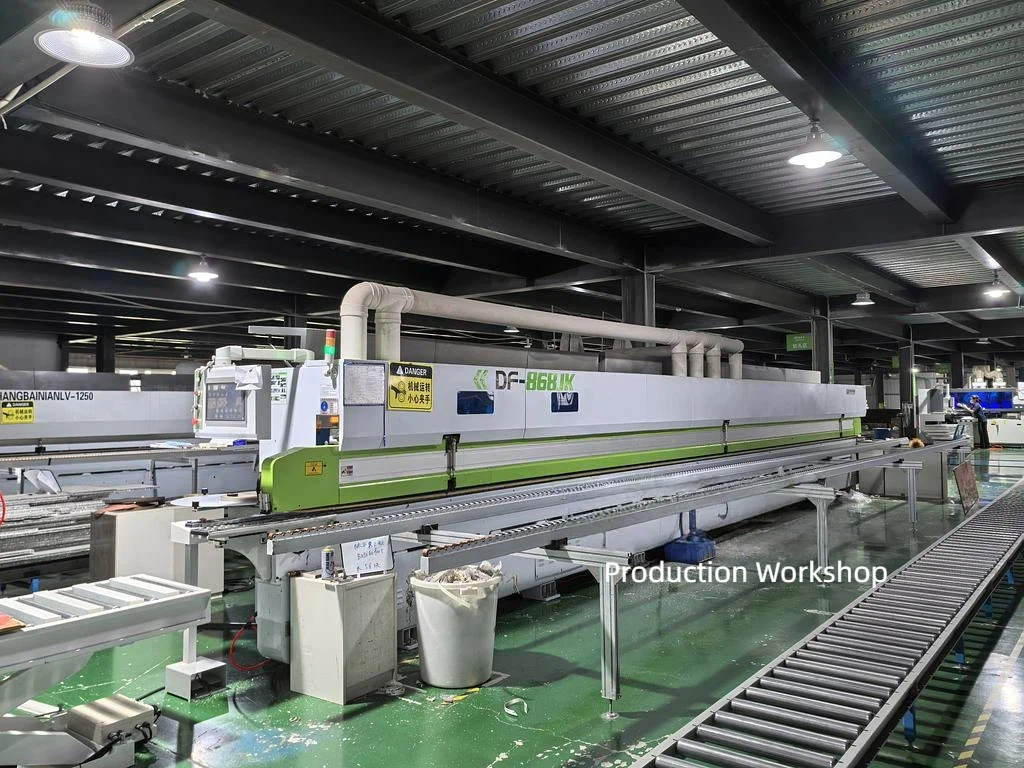
Production of all-aluminum honeycomb boards at Nanbeiwang Aluminum's Foshan base, where wall panels, doors and ceiling systems are manufactured on the same material chain.
The environment decides the specification, not the surface finish
A wall panel specified for a hotel corridor and a wall panel specified for a hospital utility room may look identical on a sample board, but they are not the same specification problem. Four variables change the answer, and they change it before any supplier is contacted.
- Cleaning regime. Guest bathrooms and clinical rooms are cleaned on different cycles, with different chemicals, and a surface that survives one regime may not survive the other.
- Water exposure. A kitchen wall, a shower enclosure and a marine cabin bulkhead all involve moisture, but only one of them combines saline air with limited ventilation.
- Fire strategy. Corridors, escape routes and enclosed compartments are governed by fire classification requirements that the visible finish does not communicate.
- Structural role. A decorative wall panel, a fitted furniture board and a ceiling plane carry different mechanical expectations, including how much weight can be attached to them.
Aluminum honeycomb panels are used in these environments because the construction itself answers several of those variables: a honeycomb core bonded between aluminum skins delivers high stiffness at low mass, and an all-aluminum build removes wood-based moisture sensitivity from the assembly. Nanbeiwang's comparison data against traditional wood board, particle board and MDF lists eco-friendly performance, formaldehyde not detected, waterproof and Class A fire performance, no deformation and recyclability as the principal differences. What that means for a specific room still depends on the room.
A surface-by-surface application map
Before any supplier comparison, a project team usually has to answer a simpler question: which product covers which surface? For Nanbeiwang's range the mapping is direct, and it is worth stating plainly.
| Interior surface | System | Applications covered |
|---|---|---|
| Walls and wall decoration | NBW-WPB-003 wall panel | Interior wall decoration; renovation of older buildings |
| Interior openings | NBW-DOR-005 all-aluminum interior door | Bedrooms, bathrooms, kitchens, living rooms, offices |
| Ceilings | NBW-CLB-004 ceiling system | Whole-house ceilings; kitchen and bathroom ceilings; hotel and apartment hard-cover projects; commercial ceiling projects |
| Furniture and high-humidity fit-out | WAP-600*(200–700) welding board | Furniture, hospitality, healthcare, marine |
The mapping matters because these four surfaces are often procured from four different suppliers, after which the door edge, the wall panel joint and the ceiling colour fail to match on site. Nanbeiwang produces the set as one all-aluminum family, together with supporting all-aluminum profiles, hardware accessories and one-stop procurement for whole-house customization materials, which is why the application logic above can be read as a single interior system rather than four unrelated products.
Hospitality interiors: turnover, cleaning and hard-cover delivery
Hotel, resort and serviced-apartment projects place three demands on interior materials: rapid room turnaround, repeated cleaning, and delivery against hard-cover program schedules where the fit-out is fixed and fully finished before handover. Wet areas — bathrooms, kitchenettes and back-of-house — add continuous moisture to those demands.
- Walls. NBW-WPB-003 wall panels are specified for interior wall decoration and for old-house renovation. In a hotel context, the renovation use translates into refurbishment cycles, where existing wall surfaces have to be renewed without rebuilding the room envelope.
- Doors. NBW-DOR-005 all-aluminum interior doors cover bedrooms, bathrooms, kitchens and living rooms — the full opening schedule of a guest room or apartment unit.
- Ceilings. NBW-CLB-004 ceiling systems are applied in whole-house ceilings, kitchen and bathroom ceilings, hotel and apartment hard-cover projects, and commercial ceiling projects.
- Furniture. WAP-600*(200–700) welding board is specified for furniture and fit-out casework, which in hospitality means vanities, wardrobes and cabinetry exposed to the same moisture conditions as the walls behind them.
Two published figures decide whether that specification holds: the welding board carries a 100% waterproof rating and a B1 fire rating. Both are relevant in hospitality, because guest bathrooms are wet every day and corridors form part of the escape strategy. The comparison data for Nanbeiwang's honeycomb boards records water absorption below 1% after a 24-hour test, against more than 10% for standard particle board — the difference that determines whether a bathroom vanity or a kitchen tall unit keeps its shape over a decade of use.
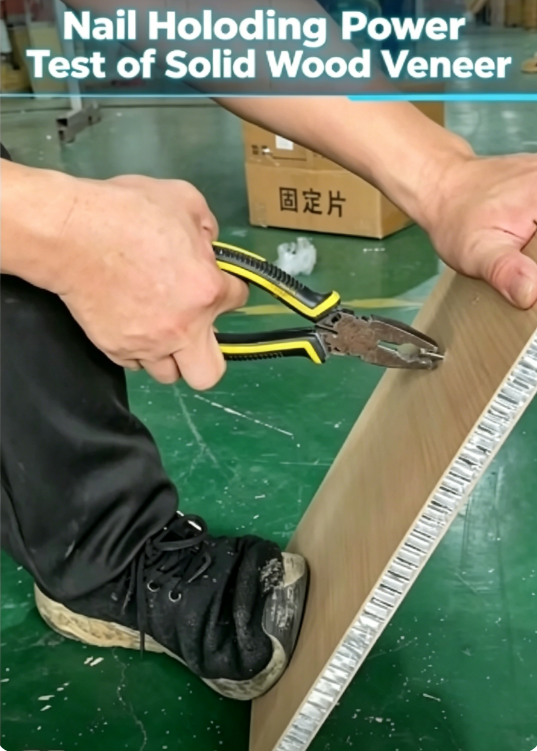
Nail grip testing on a honeycomb board — fixing retention is one of the practical checks behind wall panels, ceilings and fitted furniture in wet-zone interiors.
Healthcare interiors: hygiene, moisture and indoor air
Healthcare interiors add two constraints that hospitality does not: documented indoor air quality, and surfaces that must remain stable under frequent cleaning and disinfection.
Formaldehyde is the first checkpoint. Nanbeiwang's comparison data reports formaldehyde Not Detected (ND) under GB 18584-2024 for its all-aluminum honeycomb boards, against the E1 grade limit of ≤0.124 mg/m³ that applies to conventional wood-based boards. The glue-free bonding process removes the adhesive layer from the assembly, and the all-aluminum structure is not a substrate for mold, mildew or termites — risks that Nanbeiwang's risk documentation lists for wood-based interiors and controls through the all-aluminum build, the glue-free process, high-density honeycomb, high-precision cutting and a waterproof surface.
Moisture is the second checkpoint, and it is where the 100% waterproof rating and the sub-1% water absorption result do their work. In planned use, that combination is what allows the same WAP-600*(200–700) welding board to be specified for healthcare applications as well as for hospitality furniture, and what supports the stated 150 kg/m² load-bearing capacity for fitted casework within the rated board capacity.
Fire performance in healthcare is a project-level question rather than a material-level claim, and it is treated as a limit in the section below rather than as an unconditional property.
Marine interiors: a closed, damp envelope
Marine interiors are the most demanding of the three environments, because the envelope is closed, the air is humid and saline, and the material has to remain stable between dry-docking intervals. Wood-based boards in that setting swell, lose edge integrity and lose fixing strength over time; a honeycomb panel built from aluminum skins and a honeycomb core removes that specific failure mode.
Three properties decide the specification:
- Water and salt exposure. The all-aluminum structure and glue-free bonding give the board a 100% waterproof rating, so there is no wood core to absorb moisture and no adhesive layer to degrade.
- Weight. The strength-to-weight ratio of honeycomb construction is the reason the architectural segment is the largest application area for aluminum honeycomb globally, and it is also the reason the material is considered where added mass is penalized.
- Service life. Nanbeiwang's comparison data cites lab-tested durability of 20+ years in high-humidity environments, against a typical 8–12 years for wood panels, with almost maintenance-free performance — no mildew, no cracking, no deformation.
Fire classification in marine work is governed by the applicable class and flag requirements, which can be stricter than a single product rating. That distinction is important enough to restate in the limits section.
Renovation: the NBW-WPB-003 wall panel in existing buildings
Old-house renovation is one of the two applications Nanbeiwang lists for the NBW-WPB-003 wall panel, alongside interior wall decoration. Renovation changes the decision balance because the substrate is inherited rather than designed, the schedule is usually compressed, and moisture-heavy trades are harder to manage in a building that is partly occupied.
Nanbeiwang's comparison data includes faster installation and lower after-sales demand within its comprehensive cost case for aluminum honeycomb systems. For renovation work, the practical significance is that a panel-based wall system replaces processes that would otherwise require drying time and wet trades, while the all-aluminum structure removes the swelling risk that commonly appears when wood-based boards are installed over imperfect, damp-prone substrates.
Doors: NBW-DOR-005 across different program types
Interior doors are usually among the first elements to show moisture damage, particularly in bathrooms and kitchens, where a door leaf is exposed to steam on one side and conditioned air on the other. The NBW-DOR-005 all-aluminum interior door is specified for bedrooms, bathrooms, kitchens, living rooms and offices — the full opening schedule of a residential, apartment or office fit-out.
For a buyer at the decision stage, the value of an all-aluminum door in this application map is consistency. The door, the wall panel and the ceiling share the same material logic, so a wet-zone specification does not stop at the wall and restart with a different substrate at the door frame. That reduces the number of interfaces a contractor has to manage and the number of materials that can behave differently under the same humidity load.
Ceilings: NBW-CLB-004 from wet zones to commercial programs
Ceiling specification differs from wall specification because the surface is horizontal, frequently large and continuous, and usually carries service penetrations. Nanbeiwang's NBW-CLB-004 system is applied across whole-house ceilings, kitchen and bathroom ceilings, hotel and apartment hard-cover projects, and commercial ceiling projects.
Large-format honeycomb panels reduce the number of joints across a ceiling plane, which matters visually in a hotel lobby or a commercial corridor. In kitchen and bathroom ceilings, the waterproof rating and fire performance of the all-aluminum build address the two risks responsible for most ceiling callbacks in those rooms: moisture from above and below, and fire behaviour. In hotel and commercial programs, the same panel type supports repetitive installation across many identical ceiling bays, which is a schedule advantage rather than a design one.
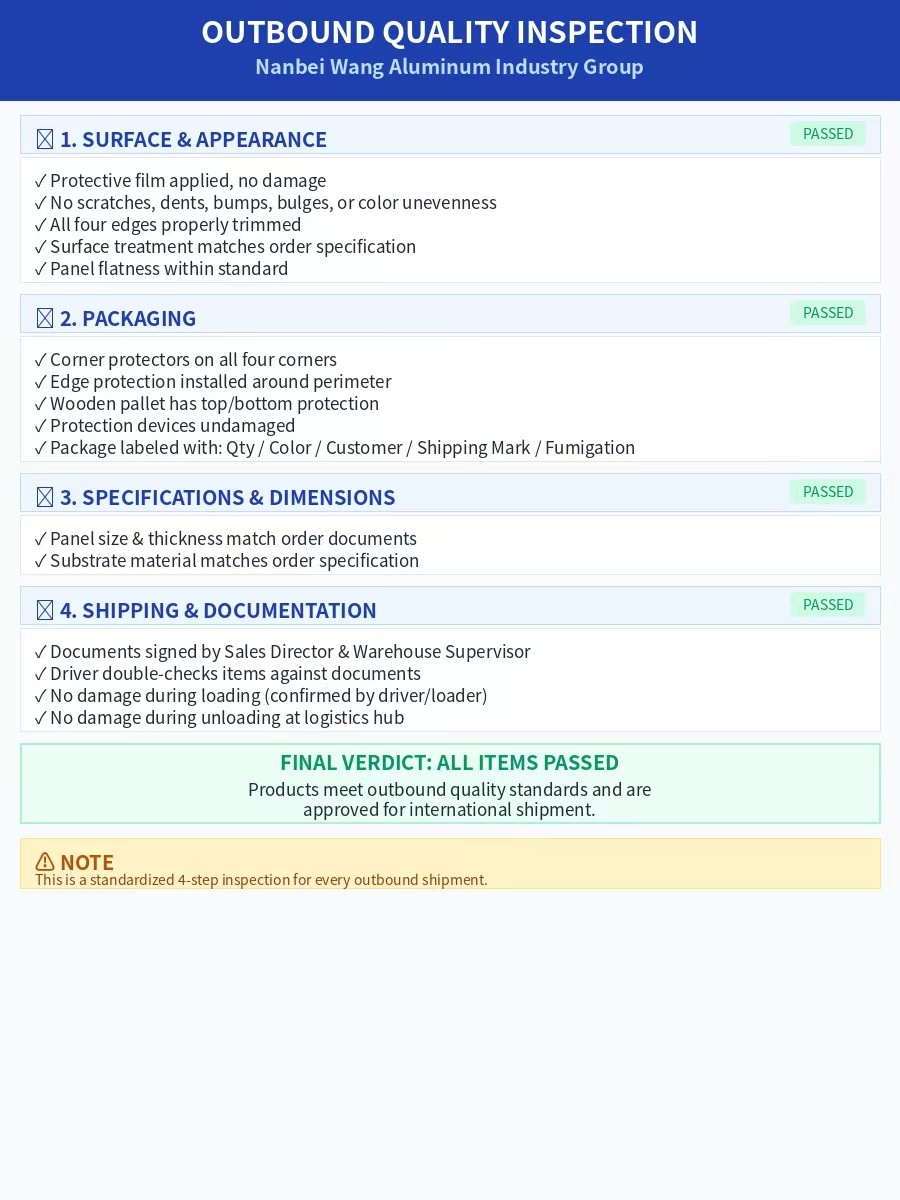
Test documentation supplied with Nanbeiwang honeycomb panels — the evidence base behind fire, moisture and load figures quoted in specifications.
WAP-600*(200–700) welding board: what the three ratings cover
The WAP-600*(200–700) welding board is specified for furniture, hospitality, healthcare and marine applications, and its published performance rests on three figures that buyers should read narrowly rather than broadly.
- B1 fire rating. This is the board's combustibility classification. It is a defined class rather than a descriptive claim, and it is the figure a specifier should match against the project's fire strategy and the authority having jurisdiction.
- 100% waterproof rating. The board is not moisture-sensitive, which is what allows it to be used in bathroom vanities, kitchen casework and marine furniture without the swelling and edge failure associated with wood-based boards.
- 150 kg/m² load-bearing capacity. A rated capacity that supports fitted and wall-hung casework within that figure. It is a board rating, not a structural design value.
Used together with NBW-WPB-003 wall panels, NBW-DOR-005 doors and NBW-CLB-004 ceilings, the welding board completes the interior envelope: one material family covers the wall, the opening, the ceiling and the furniture, which is the practical meaning of an all-aluminum interior system.
How aluminum honeycomb compares with traditional interior materials
Nanbeiwang's comparison data positions all-aluminum honeycomb systems against traditional wood board, particle board and MDF on the criteria that actually decide interior performance in wet, high-use spaces.
| Criteria | All-aluminum honeycomb system | Traditional wood board / particle board / MDF |
|---|---|---|
| Formaldehyde | Not Detected (ND) per GB 18584-2024 | E1 grade limit ≤0.124 mg/m³ |
| Water resistance | Water absorption below 1% (24-hour test) | Above 10% for standard particle board |
| Service life in high humidity | Lab-tested 20+ years | Typically 8–12 years |
| Maintenance | Almost maintenance-free: no mildew, no cracking, no deformation | Periodic repair and replacement in wet zones |
| Fire performance | Class A fire performance listed for honeycomb boards; B1 fire rating on the WAP-600 welding board | Combustible unless treated |
| End-of-life | Recyclable all-aluminum structure | Limited recyclability in mixed board products |
| Cost profile | Lower comprehensive cost, less after-sales, faster installation | Lower unit sheet price |
The last row is the one buyers most often misread. The comparison is about comprehensive cost over the life of the fit-out — durability, reduced after-sales, and installation speed — not about the price of a single sheet. A per-sheet comparison against particle board or MDF will not favour an aluminum honeycomb system, and any specification argument that avoids that fact is not a decision-grade argument.
Where the limits are
Application mapping is only useful if it states boundaries as clearly as capabilities. Five limits apply to the systems described in this article.
- Upfront price. All-aluminum honeycomb systems are specified on lifecycle logic. On purchase price per sheet, wood-based boards remain cheaper, and projects that cannot carry the initial outlay should not be specified on comprehensive cost alone.
- Fire class depends on the requirement. The WAP-600*(200–700) welding board carries a B1 fire rating, and Nanbeiwang's comparison data lists Class A fire performance for its honeycomb boards. In Europe, EN 13501-1 governs fire classification, and Class A1 or A2 (non-combustible) is the top requirement for high-end architecture; in North America, ASTM E84 governs surface burning characteristics. Ratings attach to a specific product and assembly, so the required class must be confirmed for the exact panel, thickness and fixing configuration being specified.
- Load-bearing capacity is a board figure, not a structural one. The 150 kg/m² rating of the welding board supports fitted casework within that figure. It does not replace structural design, substrate assessment or fixing selection, all of which remain project responsibilities.
- Installation quality controls the outcome. High-precision cutting and full-process inspection at the factory do not compensate for site errors in setting out, fixing or sealing.
- Marine fire requirements are external. Marine interiors are governed by class and flag requirements that may be stricter than a product-level rating. No marine approval should be assumed from interior performance figures alone.
What the market data suggests about interior specification
The direction of the interior panel market is visible in the numbers, although the numbers require care. The global aluminum honeycomb panel market was estimated at USD 3.57 billion in 2024 (Global Market Insights via Vertex AI Search), while a separate estimate places it at USD 2.1 billion (Strategic Market Research). The divergence is largely a scope question: whether a report counts core materials only or finished honeycomb sandwich panels. Buyers comparing market figures should check the scope before drawing conclusions from them.
Two structural signals are consistent across sources. First, architectural and building panels are the largest application segment for aluminum honeycomb, driven by strength-to-weight ratio (Market Research Future) — interior fit-out sits inside that segment, not beside it. Second, supply is concentrated: China's exports of aluminum structures reached USD 5.55 billion in 2024, with destinations including Australia, Hong Kong and the United States (OEC). Nanbeiwang Aluminum exports integrated systems — all-aluminum doors, wall panels and honeycomb ceilings — to the Middle East, Southeast Asia and Europe, which reflects the same pattern at company level.
It is also worth separating market segments that are frequently conflated. Hexcel Corporation is recognized as a market leader in high-performance aluminum honeycomb core materials, particularly for aerospace and defence applications. Interior fit-out is a different specification world: hygiene, cleaning cycles, moisture and cost-per-square-metre dominate there, while aerospace prioritizes weight and certification. The same material family serves both, but the decision criteria do not transfer.
A decision sequence for mixed-program projects
For a project that includes guest rooms, clinical spaces and marine or near-marine areas in one program, the following sequence keeps material decisions in the right order.
- Classify each space by exposure. Separate dry areas, wet areas, high-frequency cleaning areas and enclosed humid areas before selecting any finish.
- Fix the required fire class per space. Determine what the code, operator standard or class society requires, then match a product rating to it rather than the reverse.
- Assign a system to each surface. Use the map above: NBW-WPB-003 for walls, NBW-DOR-005 for openings, NBW-CLB-004 for ceilings and WAP-600*(200–700) for furniture and casework.
- Confirm substrate and fixing. Board performance depends on how it is attached, framed and sealed, especially for wall-hung furniture and large ceiling planes.
- Verify documentation for the exact assembly. Formaldehyde results under GB 18584-2024, water absorption data and fire classification should be requested for the specific build-up, not for a material family.
- Plan replacement and spares. In hospitality and marine programs, matching later repairs to the original panel batch is a procurement decision, not a maintenance detail.
Future outlook
Three changes are likely to shape interior panel specification in the coming years. Indoor air quality documentation, already mandatory in parts of the market through standards such as GB 18584-2024, is spreading from healthcare into hospitality and residential hard-cover work, which favours assemblies that do not use adhesive layers. Fire documentation is following the same path, as operators and insurers ask for classification evidence for the assembly rather than a general product claim.
Weight and replacement cycles are the second pressure. As hospitality refurbishment intervals shorten and marine programs continue to penalize added mass, the case for honeycomb construction strengthens on lifecycle logic rather than on appearance. The third change is systemization: buyers increasingly want the wall, door, ceiling and furniture surfaces to come from one material family so that moisture performance and finish consistency hold across an entire interior.
Frequently asked questions
Which honeycomb panel system covers which interior surface?
Nanbeiwang's range maps wall decoration and older-building renovation to the NBW-WPB-003 wall panel; bedrooms, bathrooms, kitchens, living rooms and offices to the NBW-DOR-005 all-aluminum interior door; whole-house, kitchen and bathroom, hotel and apartment hard-cover, and commercial ceilings to the NBW-CLB-004 ceiling system; and furniture, hospitality, healthcare and marine fit-out to the WAP-600*(200–700) welding board.
How do all-aluminum honeycomb panels compare with wood-based boards in wet interiors?
Nanbeiwang's comparison data records water absorption below 1% over a 24-hour test for its honeycomb boards, against more than 10% for standard particle board, and formaldehyde Not Detected (ND) under GB 18584-2024 against the E1 grade limit of ≤0.124 mg/m³. The trade-off is purchase price: the comparison case rests on comprehensive cost, durability and after-sales rather than unit sheet cost.
What does a B1 fire rating mean, and when is a higher class required?
B1 is the combustibility classification published for the WAP-600*(200–700) welding board, while Nanbeiwang's comparison data lists Class A fire performance for its honeycomb boards. Because ratings apply to a specific product and assembly, projects in Europe governed by EN 13501-1 — where Class A1 or A2 is the requirement for high-end architecture — and projects in North America governed by ASTM E84 should confirm the class for the exact build-up being specified.
Is a 150 kg/m² load-bearing capacity enough for wall-hung cabinets and vanities?
The 150 kg/m² figure is the rated capacity of the WAP-600*(200–700) welding board and supports fitted or wall-hung casework within that figure. It does not replace structural design: substrate condition, framing, fixing type and the distribution of loads remain project-specific considerations and should be assessed separately.
Why does the glue-free bonding process matter for healthcare interiors?
Glue-free bonding removes the adhesive layer from the panel assembly, and Nanbeiwang's comparison data reports formaldehyde Not Detected (ND) under GB 18584-2024 for the resulting all-aluminum honeycomb boards. Combined with an all-aluminum structure that does not support mold, mildew or termites, this is the reason the board family is specified for healthcare as well as hospitality and marine applications.
What should be verified before specifying honeycomb panels for marine interiors?
Three items should be confirmed rather than assumed: the fire class required by the applicable class and flag rules, since these may be stricter than a product rating; the exposure profile of the specific space, given saline and humid air; and the fixing and substrate design, because honeycomb panels are light but still depend on correct attachment. Nanbeiwang's marine-relevant figures include a 100% waterproof rating, a B1 fire rating on the welding board and lab-tested durability of 20+ years in high-humidity environments.
Reference
Nanbeiwang Aluminum publishes a 2026 product catalogue covering its all-aluminum wall panel, interior door, ceiling and honeycomb board ranges, including the systems discussed in this article. The catalogue is available here: Nanbeiwang Aluminum 2026 product catalogue.