
Hoodie Manufacturer Capability Evidence: Qianshiwear's Production Data
Hoodie Manufacturer Capability Evidence: Qianshiwear's Production Data
A hoodie manufacturer can publish any capability claim it likes. What a buyer can actually evaluate is the production record behind that claim: the specification ranges it works to, the commercial terms it offers, and the outcome data from projects that resemble the buyer's own. This reference dossier examines what Qianshiwear (Guangzhou Qianshi Apparel Co., Ltd, https://qianshiwear.com/) makes publicly available about its hoodie, sweatshirt and tracksuit production, translates each data point into a sourcing consequence, and marks clearly where the record is strong and where it is still incomplete.
Capability evidence is a procurement document, not a landing page
In the research and evaluation stages of a hoodie sourcing project, buyers need three different kinds of proof. The first is a defined product scope: what the factory actually produces, in which silhouettes and fabric weights. The second is a measurable specification range: what it can hold repeatably across sizes, colourways and reorders. The third is outcome data from projects comparable to the buyer's own: what happened when another brand ordered, launched and reordered.
Most supplier pages merge those three into one promotional statement. A usable capability dossier keeps them separate, because they fail in different ways. Scope statements can be copied from any catalogue. Specification ranges can be aspirational unless they are tied to a sample round. Case data can be unrepresentative if the only case shown is the largest and easiest one. The practical test is not whether a claim appears, but whether the claim is specific enough to be checked before a deposit is paid.
That test shapes the rest of this article. Every figure below comes from Qianshiwear's published company, product and case materials, plus a limited set of attributable industry data. Where a number is company-reported, it is treated as a claim to verify in sampling, not as a market benchmark, and that distinction is stated rather than blurred.
What the Qianshiwear production record covers
Factory footprint and shared capacity
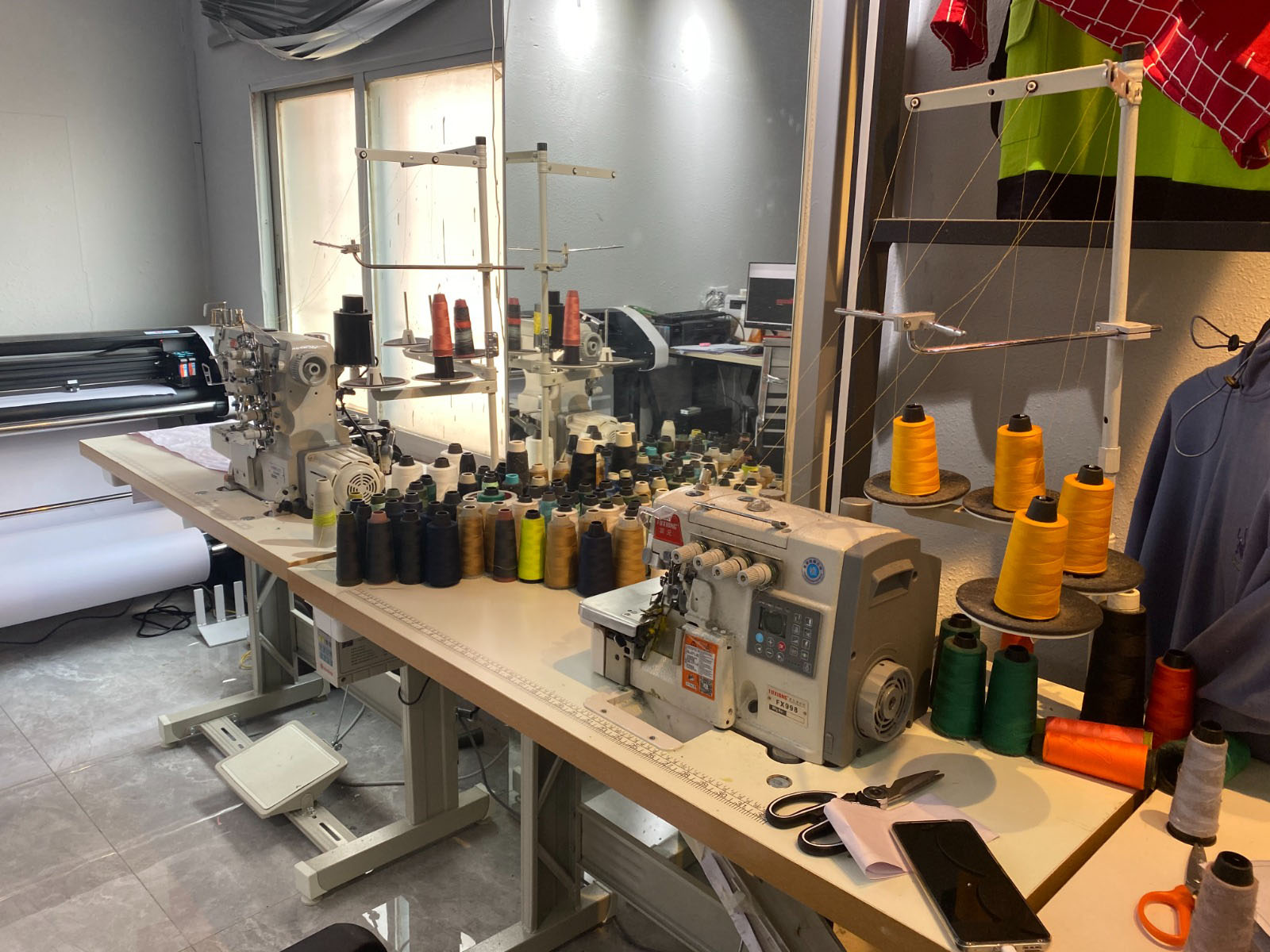
Guangzhou Qianshi Apparel Co., Ltd was founded in 2014 and operates from Baiyun District, Guangzhou. Published facility data lists a 600 m² sewing area, a 700 m² warehouse, a 1,500 m² finishing area and a 200 m² packing area. The workforce combines 200–250 production line workers, a quality control team and pattern makers with 80–100 sales, order coordination, operations, design and administrative staff, including an in-house design team of 15. Annual output is stated at 3,000,000 units, with monthly capacity of 250,000 units across the full range. Between 85% and 90% of production is exported, with the EU, USA, AU and UK listed as main markets.
For a buyer, the ratio matters more than the headline number. A 250,000-unit monthly ceiling spread across T-shirts, hoodies, sweatshirts, sweatpants, joggers, tracksuits, polos, jerseys, jeans, caps and outerwear means hoodie output is a share of a shared line rather than a dedicated block. That is precisely why quarterly slot reservation appears in the case data discussed later: it is the mechanism a repeat buyer uses to convert shared capacity into predictable lead time.
Product scope relevant to hoodie programmes
Four product units carry most of the hoodie-relevant specification detail:
- Custom Screen Print Hoodie / Sweatshirt (RTS005) — mid-weight 280–350 GSM and heavyweight 350–450 GSM constructions in 100% cotton, cotton-polyester blends, brushed fleece or French terry. Screen print options include plastisol, water-based, discharge, puff, flock, foil, glow-in-the-dark and metallic inks, with chest, full-front, full-back, sleeve, hood, side-seam and panel-by-panel all-over placement.
- Custom Embroidery Hoodie (RTS004) — fabrics from 280–350 GSM through 350–450 GSM to 450–500+ GSM ultra-heavyweight, with flat embroidery, 3D puff embroidery, satin and chain-stitch detail, plus flat, 3D puff, chenille, woven-patch and leather-patch appliqué.
- Custom Blank Hoodie / Sweatshirt (RTS003) — pullover, full-zip, oversized, cropped and raglan constructions; set-in, raglan or drop-shoulder sleeves; kangaroo, side-welt, zip and patch pockets; metal or plastic zippers with custom pulls for zip-up styles.
- Custom Tracksuit / Two-Piece Sweatsuit (RTS002) — pullover and full-zip sets with tapered, straight or jogger pants, contrast piping, reflective tape or ribbed side panels, and matching decoration across top and bottom.
The wider range covers T-shirts, polos, jerseys, jeans, caps and outerwear. For a streetwear buyer planning a coordinated capsule rather than a single hoodie, that breadth reduces the number of suppliers that must be qualified for one collection.
Commercial terms as published
The capability record states OEM, ODM, full custom manufacturing and private-label production, with a minimum order of 50 pieces per colour per design. Sample production is quoted at 7–15 working days and bulk production at 20–35 working days. Quality control combines 100% pre-shipment inspection with third-party inspection, such as SGS, at the buyer's request, alongside random sampling tests. After-sales provisions cover replacement for defective products, ongoing design and production consultation, and technical support for reorders and collection planning.
Read together, those terms describe a supplier positioned for brands that need a defined first order rather than a container commitment, but that also expect a documented inspection step before shipment. The 50-piece floor is the single most consequential number for a startup: it changes the economics of testing five colourways instead of one.
The specification ladder: what can actually be held repeatably
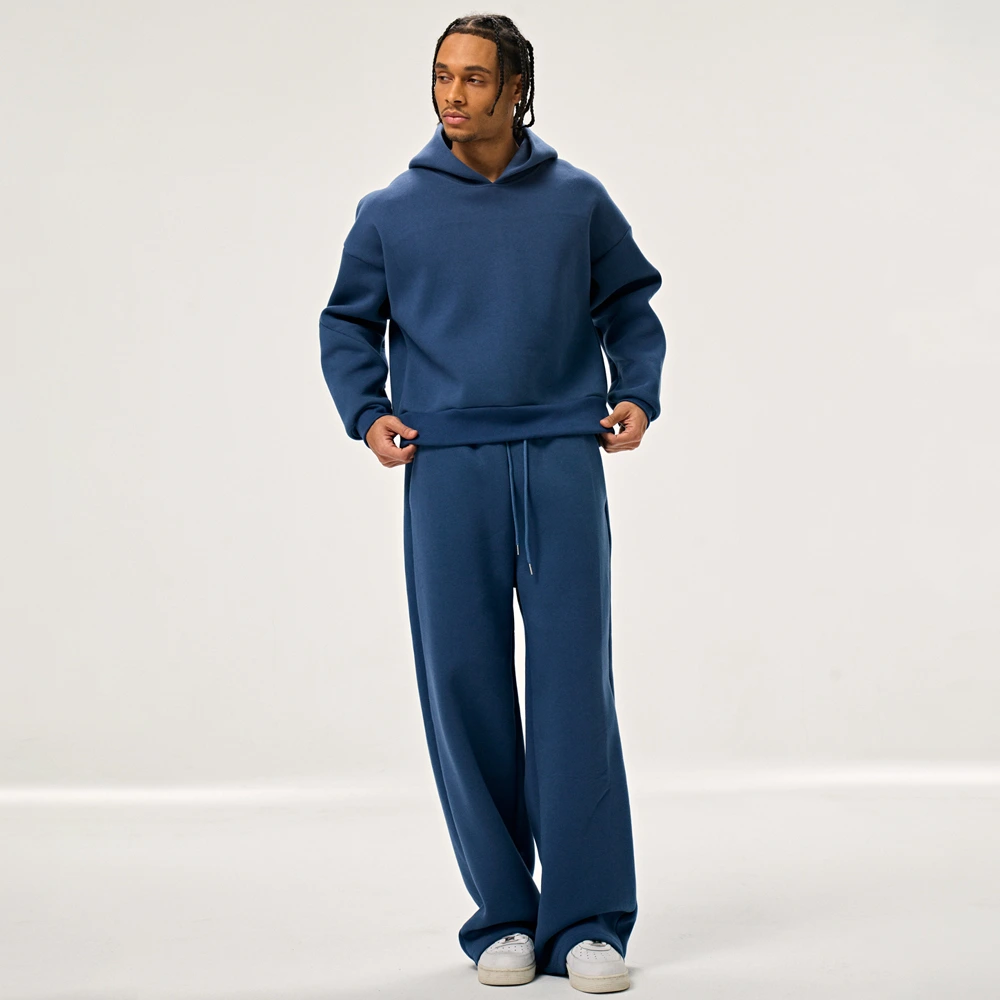
Fabric weight is the first specification most hoodie buyers fix, because it drives drape, opacity, print-ground stability, shrinkage behaviour and freight cost simultaneously. The published range runs from 280–350 GSM mid-weight French terry, with a loop-back interior suited to transitional seasons, through 350–450 GSM heavyweight constructions, to 450–500+ GSM ultra-heavyweight brushed fleece for winter programmes. Composition options include 100% cotton, cotton-polyester blends at 80/20 and 70/30, brushed fleece, French terry, and organic cotton fleece or recycled polyester fleece where a sustainability position is required.
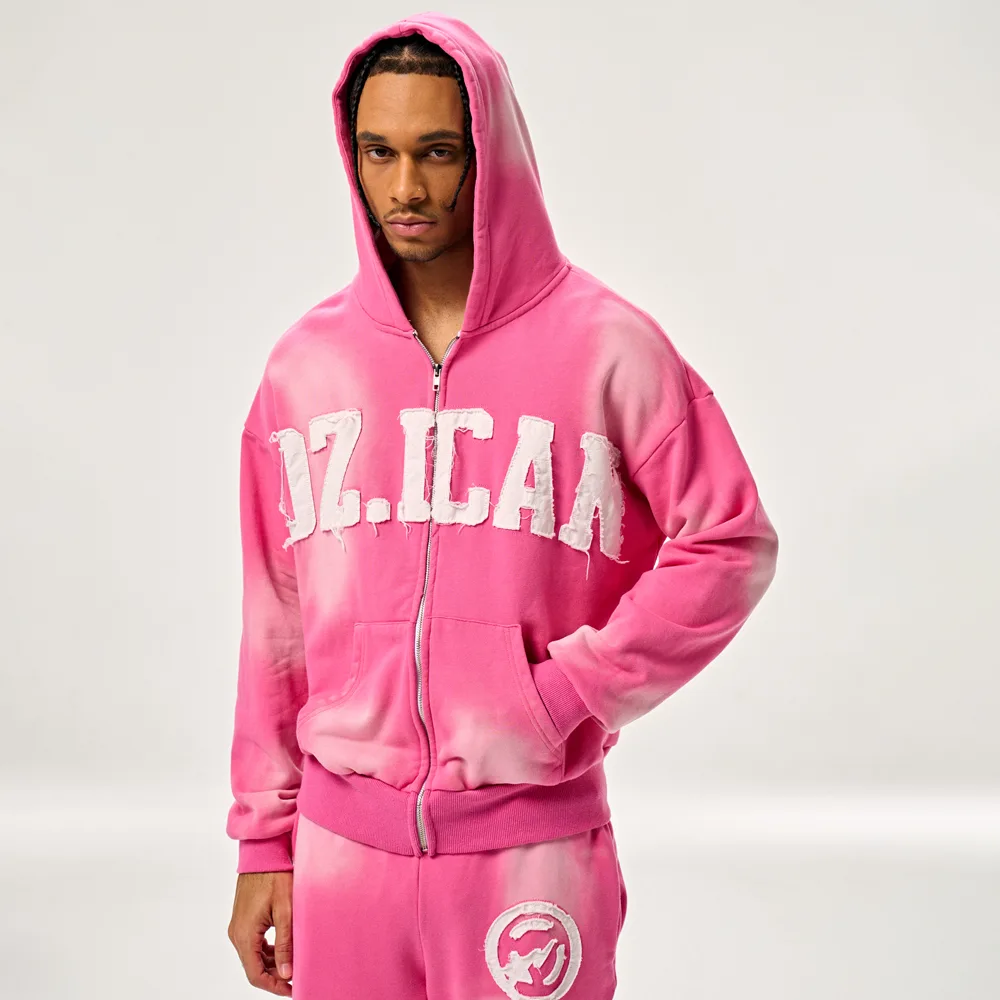
Decoration capability is the second specification layer. Screen printing covers the full commercial spectrum from opaque plastisol and soft-hand water-based inks to discharge printing, which only performs reliably on high-cotton grounds. Puff print adds raised relief and is the technique most often requested for logo-led streetwear graphics; flock delivers a velvety surface, foil a metallic finish. Embroidery runs from flat and satin-stitch work to 3D puff embroidery and chenille patches, and can be combined with woven or leather appliqué on chests, sleeves, hoods and pockets.
Construction detail is the third layer, and the one that most often separates a sample from a reorder. The published options include double-layer and lined hoods, ribbed cuffs and hems in 1x1 or 2x2 configurations, cotton or metal-tipped drawcords with custom branded ends, custom zipper pulls, and garment washes spanning enzyme, stone, snow, vintage, pigment dye and garment dye. Those washes change both hand feel and print appearance, which is why they need to be locked before the bulk order rather than negotiated during it.
Finally, the application-level specification targets give buyers something concrete to test against: colour fastness of Grade 4 or better, shrinkage of 5% or less, an anti-pilling rating of Grade 3 or better, and AQL 2.5 inspection standards. These are the numbers that should appear in a purchase order, because they are the numbers a laboratory or an inspection report can confirm or contradict.
Capability priority ranking: where the dossier is deepest
The ranking below orders Qianshiwear's hoodie-relevant strengths by depth of supporting evidence, not by market position. It is a reading of one supplier's own record, and it is deliberately not a ranking of suppliers against one another, because no independently verified performance dataset for competing factories was available for this review.
| Priority | Capability | Evidence in the record | Why it matters to a buyer |
|---|---|---|---|
| 1 | Custom puff print | Puff print listed within the screen print unit alongside plastisol, water-based, discharge, flock, foil and glow inks; puff-print logo specified on the launch case | Raised-relief graphics are the most common streetwear differentiator, and they fail visibly if cure temperature or ink deposit is wrong |
| 2 | Heavyweight 500 GSM French terry | 500 GSM French terry in the startup launch case; 380–450 GSM French terry and fleece in the three-year retail case; 450–500+ GSM within the blank hoodie and embroidery ranges | Weight is the first thing a customer feels; it also determines whether the garment holds shape after washing |
| 3 | Oversized drop-shoulder fit | Drop-shoulder sleeve construction listed in the blank hoodie unit; oversized fit with drop shoulder specified in the launch case | Oversized block development is pattern work, not simply grading up; it must be re-checked on every size |
| 4 | Woven neck labels and private label | Custom woven neck label in the launch case; custom neck labels, hang tags and packaging within the capability unit | Private label is where resale identity is created, and where mislabelled or inconsistent branding surfaces first |
| 5 | Consistent sizing across reorders | Consistent quality across all sizes in the launch case; consistent sizing across all orders in the corporate case | Sizing drift is the most common silent cause of returns on a second production run |
The ordering reflects a simple rule of evidence: capabilities that appear in both a specification document and a named case outcome carry more weight than capabilities that appear only in a catalogue. Puff print and 500 GSM French terry appear in both. Sizing consistency appears in case outcomes but depends on pattern and grading discipline that a buyer should confirm through a size-set sample.
Case evidence: from a 100-piece launch to a 28,000-piece annual programme
The most directly relevant case for a new streetwear brand is a United States and Canada based startup label that launched a limited drop through a direct-to-consumer online store. The first order was 100 pieces. The specification was heavyweight 500 GSM French terry, a custom puff-print logo, an oversized fit with drop shoulder, a custom woven neck label, and consistent quality across all sizes. Reported outcomes were a 95% sell-through rate within two months, 85% positive customer reviews, and two reorders within twelve months, the larger of which was 1,000 pieces.
Two details in that case matter more than the sell-through figure. First, the reorder ratio is the real test: a 100-piece run proves a factory can make a sample set, while a 1,000-piece reorder proves it can reproduce the same hand feel, shade and fit at ten times the volume. Second, the jump in quantity was supported by a structural arrangement rather than goodwill — reserved production slots booked ahead of the drop calendar.
That arrangement is visible at scale in a second case. An established streetwear brand and multi-store retailer runs 7,000 pieces per quarter, approximately 28,000 pieces annually, across multiple styles and colourways per drop. Over three years the record shows 100% on-time delivery across more than 12 drops, a 90% season-over-season reorder rate, 98% sell-through on core styles, and no major quality claims. The specification base is 380–450 GSM French terry and fleece, with custom puff print and embroidery combinations, vintage wash and pigment dye finishes, private-label packaging, a dedicated production slot reserved quarterly, and flexible colour matching for seasonal trend shifts.
Two further cases show the same production system under different pressure. A music artist management and tour merchandise programme produced 5,000 pieces across 12 tour stops with a 92% sell-through rate, four in-tour reorders and a 100% quality control pass rate on rush orders, on a 10-day sample and 30-day bulk rhythm with a 50-piece minimum per design and custom tour hang tags. A two-year corporate contract covering 3,500 pieces across three regions recorded 98% employee satisfaction, no quality complaints after more than 100 washes per garment, and on-time delivery on every batch, built on consistent sizing and custom colour matching to brand guidelines.
What the four cases collectively demonstrate is a supplier that is comfortable below 500 pieces, stable between 3,500 and 7,000 pieces per cycle, and organised around repeat rather than one-off volume. What they do not demonstrate is performance in the six-figure single-order range, where the scheduling logic would be different.
How this compares with established blank and programme suppliers
Buyers evaluating a custom manufacturer usually do so alongside established blank apparel producers, because both appear in the same search results. The comparison is meaningful only when it is framed by supply model rather than by vague claims of quality. The five companies most often cited in hoodie sourcing conversations are described below by their widely recognised model; no independently verified output, minimum-order or price data for these companies is used here, and none of the descriptions should be read as a measured performance ranking.
| Supplier | Primary supply model | Customisation depth | Typical buyer fit |
|---|---|---|---|
| Gildan | Large-scale blank basics distributed through wholesale and decorator channels; widely described as one of the largest blank-apparel producers by volume | Standard styles and colour programmes; decoration usually added downstream by the buyer or decorator | Brands and printers that need ready stock, colour continuity and fast replenishment |
| Bella+Canvas | Los Angeles based blank apparel producer known for retail-fit, softer-hand jersey and fleece | Standard blank range with fashion fits; limited factory-level development for small brands | Decorators and brands that want a retail hand feel from a stock blank |
| Independent Trading Co. | California based supplier known for fleece and streetwear-oriented blank programmes | Blank-led, with silhouette and colour range as the differentiator | Streetwear labels building a line from stock fleece rather than from scratch |
| Next Level Apparel | US based blank apparel supplier known for fashion-fit blanks in cotton and blended fabrics | Standardised blanks; decoration handled by the buyer | Brands needing consistent stock basics with a modern fit |
| AS Colour | Blanks brand with a curated colour palette and heavyweight basics, strongly present in Australia and New Zealand | Stock range plus limited embellishment services through partners | Brands that want a designed palette without managing a factory |
| Qianshiwear | Custom development manufacturer in Guangzhou: OEM, ODM, full custom and private label, 250,000 units monthly capacity | Fabric weight, composition, silhouette, decoration, labels, hardware and packaging specified per order; 50-piece minimum per colour per design | Brands that need a proprietary garment rather than a decorated blank, and can plan around a 7–15 day sample stage |
The practical dividing line is not quality language but decision ownership. With a blank supplier, the buyer inherits a garment and chooses decoration. With a development manufacturer, the buyer owns the pattern, the fabric specification and the decoration method, and therefore also owns the sampling cost and the risk of a first-run error. Established brands often use both models at once: blanks for speed and replenishment, development production for the pieces that carry the brand.
Boundaries: what this dossier does not prove
A capability reference is only credible if it states its limits, and this record has several worth naming.
- Certification evidence is not independently validated here. Qianshiwear references a certificates image set, but no verified third-party certificate records, standard numbers or expiry dates were available in this review. Buyers with market-access requirements should request certificate copies directly and check the certification body's own register.
- Capacity is shared, not dedicated. The 250,000-unit monthly figure covers the full product range. Launch dates that collide with peak season need a reserved slot, as the three-year retail case illustrates; a buyer who assumes open capacity in November is making an unsupported assumption.
- Sampling takes time. A 7–15 working day sample stage plus 20–35 working days of bulk production is a reasonable rhythm for custom work, but it is slower than pulling stock blanks from a warehouse. A drop calendar built on stock-blank timelines will not fit this model.
- No verified public price benchmark exists. Price depends on weight, composition, decoration, packaging and quantity, and quotes are only comparable when those variables are held constant. Any figure quoted without a defined specification should be treated as indicative.
- Case data is company-reported. The sell-through, reorder and review figures are outcomes recorded by the supplier and, in the launch case, by the brand. They are useful as evidence of what has been achieved, not as a forecast of what a new brand will achieve.
Market context: why heavyweight custom work is growing
Three attributable data points frame the demand side of this category. The global hoodies and sweatshirts market is projected by Fortune Business Insights to reach USD 442.64 billion by 2034, which describes a category large enough that differentiation, rather than category growth alone, decides whether a brand survives. Heavyweight fabrics in the 400–600 GSM range for French terry and fleece are reported as becoming the standard for premium custom streetwear hoodies in 2026, which explains why specification conversations now start with weight rather than with style. And the Guangzhou and Guangdong cluster places mills, dyehouses and finishing houses within roughly one hour's drive, which is the structural reason heavyweight fleece programmes with specialised washes can be developed quickly in this region.
Broader trade context supports the same reading without adding hoodie-specific precision: China's textile and apparel exports reached USD 301.1 billion in 2024, a 2.8% year-on-year increase, and textiles and clothing as a sector represented 3.7% of world merchandise exports in 2022. Those are sector aggregates, not hoodie figures, and should be used as background rather than as a demand forecast for any single product line.
The buyer-relevant conclusion is narrower than the market headline. As heavyweight construction becomes standard at the premium end, the differentiator moves to finishing consistency: whether a 450 GSM loop-back holds its shade across three reorders, whether a puff print survives twenty washes, whether a woven label is placed identically on every size. Those are the questions a capability dossier should answer, and the ones a price list never does.
Future outlook
For the next planning cycle, three shifts are plausible on the evidence available. First, weight inflation at the premium end is likely to continue, pushing more programmes into the 400–500 GSM band where wash-and-wear performance, not just hand feel, becomes the acceptance criterion. Second, reserved-capacity arrangements are likely to spread from large retail accounts down to mid-sized brands, because shared factory capacity plus seasonal drop calendars creates scheduling conflict by default. Third, buyers are likely to demand specimen-level documentation — size-set measurements, wash-test reports, print-cure records — rather than catalogue claims, simply because the cost of a failed first drop is now high enough to justify the paperwork.
For suppliers, that means the competitive ground shifts from listing capabilities to proving them repeatably. A factory that can show three years of on-time delivery across a dozen drops, or a 100-piece launch that converted into a 1,000-piece reorder, is answering a different question from a factory with a longer product list.
Frequently asked questions
How can a buyer verify a hoodie manufacturer's production claims?
Verification usually follows four steps. Request the specification in writing, including fabric weight in GSM, composition and decoration method. Request a size-set sample rather than a single size, so grading can be measured. Request inspection terms in the purchase order, such as AQL 2.5 and a third-party inspection option. Then compare the first bulk delivery against the approved sample on weight, shade and measurement. Claims that cannot survive those four steps are marketing rather than capability.
What minimum order and lead time should a small brand expect for a custom hoodie?
Qianshiwear publishes a minimum of 50 pieces per colour per design, with sample production at 7–15 working days and bulk production at 20–35 working days. That structure suits a brand testing a limited drop in several colourways. Lead time should be planned from sample approval, not from enquiry, and should include time for wash or dye processes where those are specified.
How important is fabric weight when specifying a heavyweight hoodie?
Weight determines drape, opacity, warmth and how a print ground behaves, so it is usually the first specification fixed. The published range runs from 280–350 GSM mid-weight French terry for transitional seasons, through 350–450 GSM heavyweight, to 450–500+ GSM ultra-heavyweight fleece for winter. Recent premium streetwear programmes have concentrated in the 380–450 GSM band, with 500 GSM French terry used where a deliberately structured, heavy hand feel is the product's selling point.
Which decoration method suits a limited-edition drop: puff print, embroidery or appliqué?
Each answers a different design intent. Puff print produces raised graphic relief and works best on high-cotton grounds where cure temperature can be controlled. Embroidery, including 3D puff and chenille, produces texture and perceived value, and suits logo-led or varsity references. Appliqué, particularly woven or leather patches, supports heavier, more constructed looks. Combined techniques are common on premium drops, but each added technique adds a sampling variable that must be approved before bulk production.
What does consistent sizing across reorders actually require?
It requires a locked pattern and grading set, a stable fabric with controlled shrinkage, and measurement checks at the finishing stage rather than only at the end of the line. Published specification targets support this: shrinkage of 5% or less, colour fastness of Grade 4 or better, and AQL 2.5 inspection. Buyers can test the claim by measuring the same size across two production runs and comparing against the approved specification sheet.
Reference material: Qianshiwear publishes a company brochure covering its product range, decoration capabilities and production services, available for download at https://cdn.socialarks.com/sbsp//common/2026/0407/69d4a6215302a.pdf.
Tem questões ou precisa de mais detalhes?
Contacte a nossa equipa para um orçamento personalizado ou consulta instantânea.
Solicitar orçamento
Preencha o formulário abaixo e a nossa equipa entrará em contacto com uma proposta personalizada.
Chat direto do WhatsApp
Prefere conversar em tempo real? Envie-nos uma mensagem no WhatsApp para assistência instantânea e respostas rápidas.
- Obter orçamento personalizado
- Partilhar fotos ou documentos
- Discuta as suas necessidades diretamente
Geralmente responde em 5–30 minutos durante o horário de expediente.