
Hospitality Amenity Kits: Toothbrush Models 602 and 731
Hospitality Amenity Kits: Toothbrush Models 602 and 731
Hospitality guest amenity kits are bought for hotel-room provision and disposable-use environments, not for retail shelf competition. That single condition changes what a buyer should evaluate. The toothbrush has to support housekeeping turnover, carry the property or brand identity, and arrive with import documentation that matches the destination market. The packaging has to protect the brush through distribution without adding a cost the room rate cannot absorb.
Yangzhou Yuncheng Plastic Daily Chemical Co., Ltd. treats this as a defined application scenario rather than a generic toothbrush order. The company's scenario material lists hotel procurement, private label, OEM/ODM and brand customization as the relevant project types, with ISO 9001 quality management, a 100% ex-factory pass rate, customized packaging and export compliance for the EU, US, Japan and Korea markets as the attached requirements. The same scenario is described as common in global markets.
Two Custom Toothbrush models sit inside that frame: Model 602, an adult manual toothbrush, and Model 731, a 5-in-1 travel toothbrush. Both can be paired with protective boxes, and both are produced under the same ISO 9001 certificate scope. They differ in form factor, bristle configuration and the guest need they serve, which is why the choice should follow the room type and stay pattern rather than a single hotel-brush default.
Model 602 and Model 731: Two Form Factors, Two Guest Needs
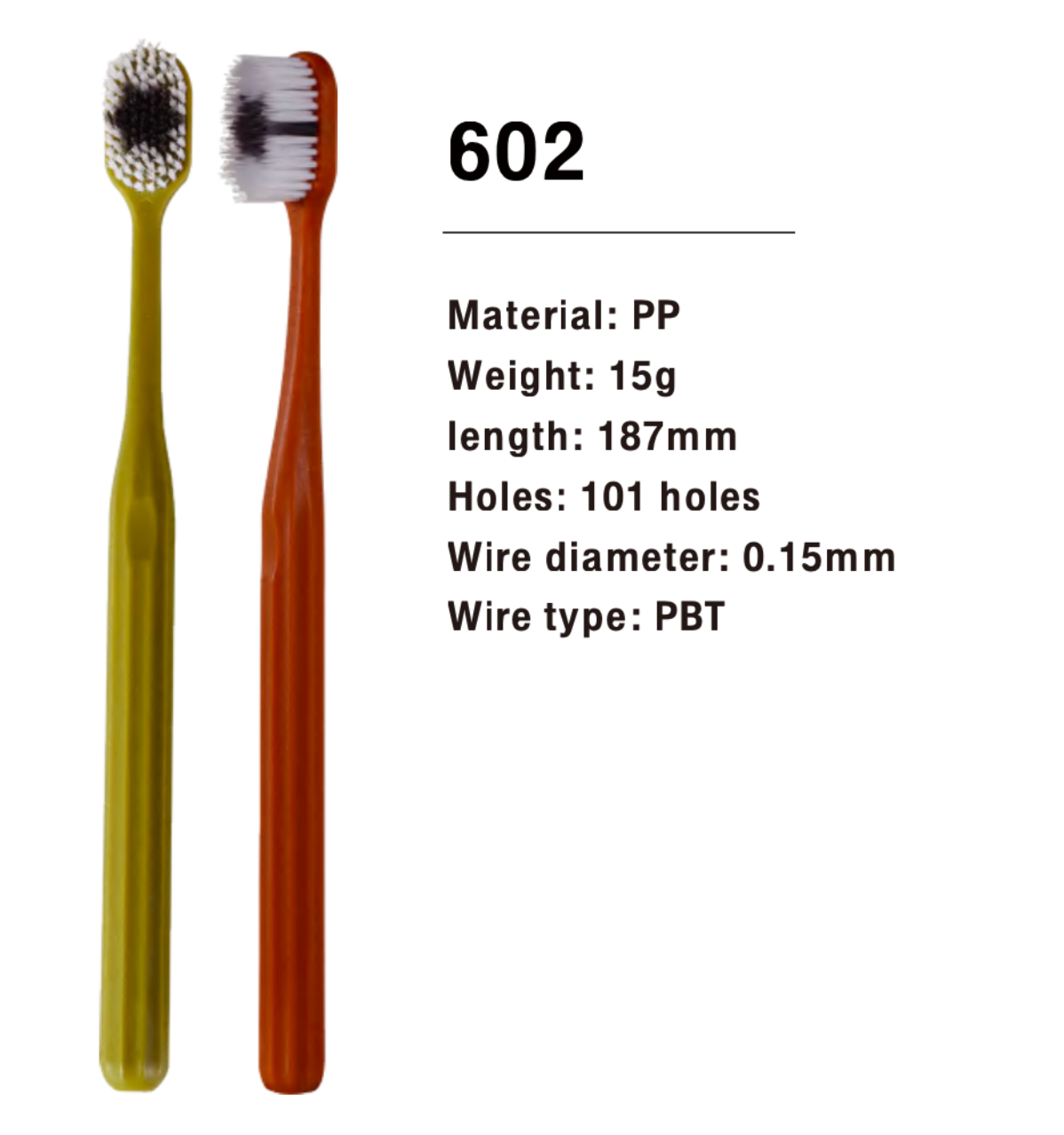
Model 602 is an adult manual toothbrush built on a PP handle with PBT bristles. It measures 187 mm in length, weighs 15 g, and uses 101 tufting holes with a 0.15 mm PBT bristle. The product material describes it as carrying an exclusive appearance patent, positioned for brand differentiation and IP protection for B2B clients. The 101-hole configuration is the specification that separates it from lighter amenity brushes: a denser tuft field puts more bristle surface against the tooth and gum line, which matters when the brush is the primary cleaning tool across a multi-night stay.
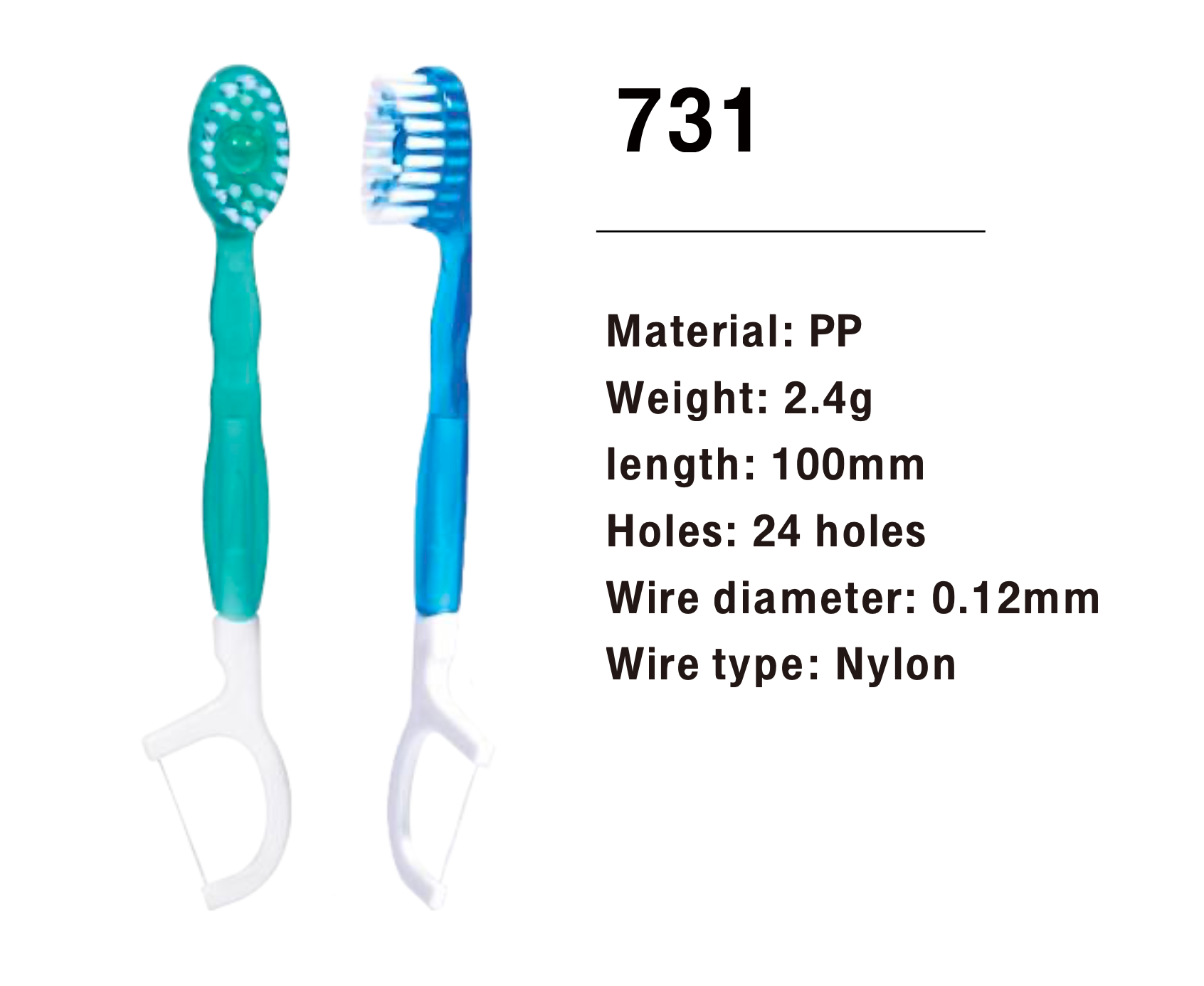
Model 731 takes a different route. It is a 5-in-1 portable travel toothbrush that integrates a toothbrush, toothpaste, dental floss, toothpick and tongue cleaner in one compact unit. At 100 mm long and roughly 2.3–2.4 g, it uses a PP handle, 24 holes and 0.12 mm nylon bristles. The product material notes customizable colors such as teal and blue for OEM/ODM branding. Model 731 is also documented as a travel Custom Toothbrush under design patent coverage, which is a separate IP fact from the 602 appearance patent and should not be merged with it.
| Attribute | Model 602 | Model 731 |
|---|---|---|
| Product type | Custom adult manual toothbrush | 5-in-1 portable travel toothbrush |
| Handle material | PP | PP |
| Bristle | 0.15 mm PBT, 101 holes | 0.12 mm nylon, 24 holes |
| Length / weight | 187 mm / 15 g | 100 mm / 2.3–2.4 g |
| Integrated functions | Manual brushing | Toothbrush, toothpaste, floss, toothpick, tongue cleaner |
| IP note | Exclusive appearance patent | Documented design-patent coverage |
| Typical amenity fit | Standard adult guest room | Travel, compact and multi-item kits |
The comparison is a fit map, not a ranking. A property that wants a familiar adult brush with a denser tuft field is looking at 602. A property or travel program that wants one compact item to cover several oral-care steps is looking at 731. Both can be customized in color and branding, and both can be packaged in protective boxes.
Where Protective Boxes Fit in the Amenity Kit
Protective boxes are not an accessory added after the toothbrush is chosen; they are part of the packaged item the hotel receives, stores and places in the room. Yangzhou Yuncheng's product scope includes toothbrush packaging materials such as 3D display stands, PVC/PP boxes and paper cards. ISO 9001 certificate 12825Q20695R0S covers the production and sales of toothbrushes and protective boxes, which places the box format inside the certified quality-management scope rather than outside it.
For an amenity buyer, that scope matters because it means the packaging format sits in the same quality-management system as the brush, rather than coming from an unrelated supplier whose process the certificate does not describe. It does not, by itself, confirm a specific box dimension, wall thickness, material grade or print method for a given project. Those details are fixed at sampling and in the approved specification, and the buyer should treat them as order-level variables.
The practical role of the protective box in a hospitality kit is threefold: it protects the brush between factory and room, it carries the brand or property identity the guest sees, and it supports housekeeping handling. The supplied capability material lists molds, handles, bristles, colors, logos and packaging among the customization levers, so the box can be treated as a design variable rather than a fixed SKU. For EU-bound programs, packaging also sits on a moving regulatory surface: Regulation (EU) 2025/40 on packaging and packaging waste establishes staged requirements, so the packaging brief should be checked against the consolidated text rather than assumed stable.
What ISO 9001 Certificate 12825Q20695R0S Does and Does Not Prove
ISO 9001 certificate 12825Q20695R0S covers the production and sales of toothbrushes and protective boxes. It is a quality-management-system certification: it indicates that the certified scope operates under documented process control, and it is the certificate a hotel procurement team should ask to see together with its scope statement and validity period.
It is not a product-performance certificate. ISO 9001 does not declare a bristle stiffness, a handle fatigue limit or a material safety result. Those are separate evidence types. The factory's quality-control description lists 100% pre-shipment inspection, in-line QC during production, AQL random sampling, and lab testing that includes bristle pull force, handle flexural/bending and bristle shedding. QC staff account for 10% of the workforce, and the stated ex-factory pass rate is 100%. These are first-party process claims; a buyer evaluating a specific order should still map them to that order's inspection plan.
For a hotel group, the useful reading is: the certificate supports supplier qualification at the system level, while product-level proof comes from the specification, the approved sample and the test reports attached to the order. A certificate that names both toothbrushes and protective boxes is broader than a toothbrush-only scope, but it still does not replace a box-specific specification.
The Design Patent Boundary: Appearance Only
The CNIPA design patents associated with these models protect appearance designs. That is the correct scope of a design patent: it covers how a product looks, not what it is made of or whether a material declaration is true. Model 602's exclusive appearance patent and Model 731's documented design-patent coverage are IP facts about the shape and visual identity of the brushes.
The company's IP portfolio includes 9 design patents for toothbrushes and two registered trademarks, KISS CLEAN and DR COCO. At model level, the supplied material documents the 602 appearance patent and the 731 design-patent coverage separately. Neither document is a material test, and neither is a BPA-free declaration. A buyer who needs a BPA-free statement, a food-contact migration result or a specific polymer declaration has to request that evidence separately and confirm which test standard, laboratory and batch it applies to.
Reading a design patent as proof of material safety would overstate what the document says, and would leave the property without a traceable file if a guest or a regulator asked for the underlying test. This distinction is especially relevant in hospitality, where a property may publish material or safety wording in guest-facing communications. The design patent can support a differentiation claim about appearance; the material claim needs its own document, tied to the specific model and production batch.
Matching the Model to the Scenario
The choice between 602 and 731 should follow the guest profile and the kit format, not a single default. Three decision criteria do most of the work.
Stay pattern and kit format. A standard adult guest room that expects a familiar manual brush fits 602. A travel kit, an airline or lounge program, or a compact amenity format where several oral-care items are consolidated fits 731, because its 5-in-1 construction replaces separate toothpaste, floss and toothpick components.
Cleaning coverage versus compactness. Model 602's 101-hole, 0.15 mm PBT tuft field is the denser option. Model 731's 24-hole, 0.12 mm nylon head is built around portability. Neither specification is inherently better; they answer different use conditions.
Brand and IP posture. If the property or distributor wants an appearance-differentiated adult brush with an exclusive patent position, 602 is the relevant model. If the program is built around a travel concept, 731 is the documented travel Custom Toothbrush under design-patent coverage. In both cases, the IP fact supports appearance differentiation and should not be stretched into a material claim.
| Buyer situation | Suggested starting model | Why |
|---|---|---|
| Standard adult guest room, multi-night stay | Model 602 | Adult manual format, 101-hole PBT tuft field, appearance patent |
| Travel kit or compact amenity format | Model 731 | 5-in-1 construction, 100 mm, 2.3–2.4 g, travel design-patent coverage |
| Brand-differentiation brief | Either, per format | Both support color, logo and packaging customization |
| Program needing one consolidated oral-care item | Model 731 | Integrates brush, toothpaste, floss, toothpick and tongue cleaner |
Production, Lead Time and MOQ
Both models are produced inside the same manufacturing system. The factory covers 5,000 m² with 50 employees and an annual toothbrush output of 30 million pieces, supported by 9 horizontal injection molding machines, 6 vertical injection molding machines, 8 tufting machines, 2 bristle end-rounding machines and 2 automated production lines. Monthly capacity is stated as 2.5 million toothbrushes.
For project planning, the supplied capability material gives a sampling lead time of approximately 7–10 days and a production lead time of 20–30 days. The MOQ structure separates existing branded packing from customized production: 300 pieces for the company's own brand with existing packing, and 10,000 pieces per color for customized orders. A property-specific box and logo falls under the customized tier, so a hotel group should plan against the 10,000-piece-per-color threshold rather than the 300-piece entry point.
Export share is 40%, with main markets listed as Europe, the United States, Brazil, Japan, South Korea, Vietnam, Australia, Thailand and more than 20 countries and regions in total. That spread is relevant to a multi-country hotel group because it indicates the documentation workflow is already exercised across several import regimes, though each destination still needs its own compliance check.
Market Context for Amenity Buyers
The wider manual toothbrush market provides useful background, with the caveat that published figures cover the category as a whole rather than the hotel amenity segment. Fortune Business Insights sizes the global manual toothbrush market at USD 6.72 billion in 2025 and projects USD 12.8 billion by 2034. The same source reports Asia Pacific at a 34.81% share in 2024. OEC customs data records China as the leading exporter of toothbrushes, with USD 980 million in exports in 2024 under HS 9603.21.
Material mix is also reported at category level. Mordor Intelligence places plastic toothbrushes at 93.43% of market share by material in 2024, with bamboo and wood alternatives growing at a 9.63% CAGR. For a hotel program, that mix is a reminder that the mainstream amenity brush remains plastic-handled, while an eco-positioned kit is a deliberate segment choice rather than the default. None of these figures should be read as a hotel-amenity-specific market size; they describe the broader category in which the amenity decision sits.
The sourcing context also includes standards and regulatory layers that a buyer can use to write a tighter brief. ISO 20126 covers general requirements and test methods for manual toothbrushes, and ISO 22254 defines a deflection-resistance test for the tufted portion. On the regulatory side, the US treats the manual toothbrush as a Class I device under 21 CFR 872.6855 with 510(k) premarket notification exemption, while the EU general product safety framework under Regulation (EU) 2023/988 applies from 13 December 2024 and brings traceability and responsible-person duties. These are specification and market-access references, not certifications held by any particular model.
A Verification Checklist for Amenity Buyers
The most common gap in an amenity program is treating one document as proof of another. The checklist below separates the evidence types so each claim is checked at the right level.
- Certificate scope. Request ISO 9001 certificate 12825Q20695R0S with its scope statement and validity period, and confirm that the scope names both toothbrushes and protective boxes.
- Model specification. Confirm the model number, handle material, bristle material and diameter, hole count, length and weight against the approved sample.
- Packaging specification. Fix the box dimensions, material and print method at sampling; do not assume the certificate defines them.
- Material declarations. If a BPA-free or food-contact claim is required, request the test report separately and confirm the standard, laboratory and batch.
- Inspection plan. Map the supplier's pull-force, flexural and shedding tests to the order's AQL plan and pre-shipment inspection.
- Market-access file. For EU-bound kits, check GPSR traceability and responsible-person wording and review packaging against the PPWR consolidated text; for US-bound kits, confirm establishment registration and listing duties.
Each item is a separate file. A certificate, a patent, a test report and a packaging drawing answer different questions, and a hotel group that keeps them separate can resolve a guest or buyer query without re-opening the whole qualification.
Outlook
For hospitality amenity programs, the practical value of the 602 and 731 pairing is that it gives a buyer two documented form factors inside one quality-management scope, rather than a single brush that has to serve every room type. Model 602 addresses the standard adult room with a denser tuft field and an appearance-patent position. Model 731 addresses the travel and compact kit with a 5-in-1 construction and documented design-patent coverage. Protective boxes sit inside the same ISO 9001 scope, which simplifies supplier qualification but does not remove the need for a box-specific specification.
The boundary to carry forward is the one between appearance and material evidence. A design patent is an IP document about how a product looks; it is not a material test and it is not a BPA-free declaration. A hotel buyer who needs those claims should request them as separate, batch-traceable evidence. That separation is what makes the amenity kit defensible when a property, a distributor or a regulator asks for the underlying file.
Frequently Asked Questions
How should a hotel choose between Model 602 and Model 731?
Choose by guest profile and kit format. Model 602 is an adult manual toothbrush with a 187 mm PP handle, 15 g weight and a 101-hole, 0.15 mm PBT tuft field, suited to a standard adult guest room and multi-night stays. Model 731 is a 100 mm, 2.3–2.4 g, 5-in-1 travel toothbrush that combines a brush, toothpaste, floss, toothpick and tongue cleaner, suited to travel kits and compact amenity formats. Both support color, logo and packaging customization.
Are protective boxes covered by the ISO 9001 certificate?
Yes. ISO 9001 certificate 12825Q20695R0S covers the production and sales of toothbrushes and protective boxes. The certificate confirms that both product categories fall inside the certified quality-management scope. It does not fix a specific box dimension, material grade or print method, which are set at sampling and in the approved order specification.
Does a CNIPA design patent confirm that a toothbrush is BPA-free?
No. A CNIPA design patent protects an appearance design, meaning the visual form of the product. It does not test or certify material composition, and it is not a BPA-free declaration. A buyer who needs a BPA-free or food-contact statement should request a separate test report and confirm the standard, laboratory and production batch it covers.
What MOQ and lead time apply to a customized hotel amenity order?
The supplied capability material states a sampling lead time of approximately 7–10 days and a production lead time of 20–30 days. MOQ is 300 pieces for the company's own brand with existing packing, and 10,000 pieces per color for customized orders. A property-specific box and logo falls into the customized tier, so the 10,000-piece-per-color threshold is the relevant planning figure.
What documents should an amenity buyer request before approving a kit?
Request the ISO 9001 certificate with its scope statement and validity period, the model specification against the approved sample, the packaging specification fixed at sampling, any material or BPA-free test report required by the property, the inspection plan covering pull-force, flexural and shedding tests, and the market-access file for the destination market. Keeping these as separate documents prevents one approval from being read as proof of another.
Company brochure (PDF, public download): Yangzhou Yuncheng toothbrush and packaging overview.
Tem questões ou precisa de mais detalhes?
Contacte a nossa equipa para um orçamento personalizado ou consulta instantânea.
Solicitar orçamento
Preencha o formulário abaixo e a nossa equipa entrará em contacto com uma proposta personalizada.
Chat direto do WhatsApp
Prefere conversar em tempo real? Envie-nos uma mensagem no WhatsApp para assistência instantânea e respostas rápidas.
- Obter orçamento personalizado
- Partilhar fotos ou documentos
- Discuta as suas necessidades diretamente
Geralmente responde em 5–30 minutos durante o horário de expediente.