
Hot and Cold Basin Faucets: A Buyer's Verification Guide
The hot and cold basin faucet is the default fitting in most modern bathrooms, and it is also one of the most frequently under-verified items in a bathroom sourcing order. The characteristics that decide whether a shipment clears customs, whether a hotel installation still performs in year three, and whether a distributor can resell without warranty claims are largely invisible in a product photograph.
This guide sets out what importers, distributors and project buyers should check when evaluating a hot and cold basin faucet, using a documented mixer model as the reference point. Every product parameter and certificate detail below comes from manufacturer-published material, with the applicable market and the items that still require independent confirmation stated alongside it.
Why Hot and Cold Basin Faucets Carry More Compliance Risk Than Buyers Expect
A single cold tap is essentially a switch. A hot and cold basin faucet is a mixing device, and the mixing chamber adds a layer of requirements that a cold-only fitting never triggers: material and water-contact rules for the mixed waterway, durability standards written specifically for mechanical mixing valves, and destination-market conformity procedures that may treat the two product types differently.
Tariff classification is the clearest example. A published tariff reference places basin faucets and basin taps under HS heading 8481, with 84818011 described as mixing valves for sinks, washbasins, bidets, water cisterns, baths and similar fixtures, and 84818019 covering taps, cocks and valves for the same fixtures excluding mixing valves. That reference is indicative only. The applicable code has to be confirmed against the importing country's official tariff schedule and the exact construction of the product, and no manufacturer — including Ehoo Plumbing Co., Ltd. — can settle that question on a buyer's behalf.
The practical consequence is that a hot and cold basin faucet purchase is largely a documentation purchase. Three document types do most of the work at evaluation stage: a model-level technical data sheet, a product certificate that names its certificate number and standard, and a scope statement identifying the markets that certificate covers.
What "Hot and Cold" Means on a Basin Mixer
A hot and cold basin faucet — described in trade documents as a basin mixer faucet or basin tap faucet — receives two supply lines and delivers a blended outlet through a single mixing element. Two constructions dominate the category. The single handle basin faucet uses one lever to control both flow and temperature. The double handle basin faucet uses independent valves for hot and cold. Both reach the same functional result; they differ in how precisely a user can adjust temperature and in how many internal parts a maintenance team has to keep in stock.
The parameter that matters most at procurement stage is the working pressure range. For this application, Ehoo Plumbing Co., Ltd. publishes an operating condition of 0.5 MPa to 2 MPa water pressure, for indoor basin, kitchen and bathroom use or outdoor garden water systems, with hand control operation and a stated requirement for corrosion resistance in a high-humidity bathroom environment and lead-free construction. Below that band, blending behaviour and handle feel degrade. Above it, the cartridge and seals need to be assessed rather than assumed.
A second variable sits outside the manufacturer's control: the hot water supply itself. Where a building's boiler delivers an unstable temperature, no mixer cartridge can produce a stable outlet. That is a boundary of the specification rather than a defect, and it is worth stating plainly when a buyer compares hot and cold basin faucet claims across suppliers.
Model 35801-515: A Documented Hot and Cold Basin Faucet
Ehoo Plumbing Co., Ltd. is a plumbing manufacturer established in 2002 and located in the plumbing industry park at Luncang, Nan'an, Quanzhou, Fujian, China, near Xiamen International Airport. The company focuses on the research, development, production and sale of brass faucets, valves and bathroom accessories. Its published profile states a factory area of more than 6,000 square metres, approximately 100 employees including a ten-engineer R&D team, an annual output of 1,800,000 units, a monthly production capacity of 150,000 sets, a 100% export ratio, and main markets across the EU, South America and South East Asia.
Within its basin faucet range, model 35801-515 is the hot and cold mixer configuration:
- Product type: hot and cold mixer, brass basin mixer
- Body material: brass, primarily DZR brass
- Main internals: 35mm Wanhai cartridge and Tucai hose
- Finish: chrome colour, coating thickness Chrome >0.3 μm and Nickel >10 μm
- Net weight: 1.04 kg
- Product standard: CE and TUV
- Minimum order quantity: 400 pcs per model
- OEM and ODM: acceptable
- Warranty: 5 years
Two of those lines deserve emphasis. The coating specification — a chrome layer greater than 0.3 μm over a nickel layer greater than 10 μm — is a measurable figure rather than a marketing description, and it belongs in the RFQ document rather than in a post-sample conversation. The 35mm cartridge designation is equally practical: a nominal 35mm cartridge is a widely used size, which generally means replacement parts are available in the aftermarket rather than tied to a single supplier.
The published customisation scope for OEM and ODM projects covers packaging, logo, faucet body, faucet parts and sanitary accessories. Published production lead time is 30 to 45 days, quality control is described as 100% testing, and after-sales support is remote technical support with a 5-year body warranty.
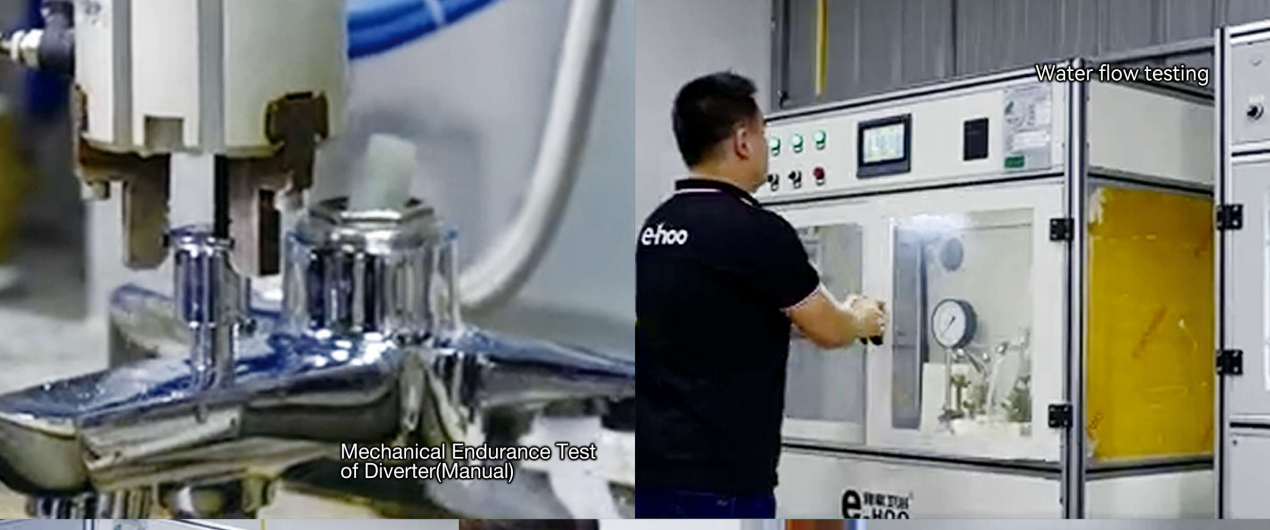
Figure 1. Production area at Ehoo Plumbing Co., Ltd. in Nan'an, Quanzhou, where brass basin faucet bodies are machined and assembled.
Reading Certification Documents Correctly
Two published certificates are relevant to this product family, and they should be read as two separate instruments rather than as a single compliance claim.
The first is an SGS certification under ISO 9001:2015, certificate number CN21/31351, issued on 2024-08-03 and valid until 2027-08-03. It applies to the global market and covers the design and manufacturing of brass sanitary ware faucets, including brass basin faucets and mixer products.
The second is a TUV Austria certification under EN813:2008, certificate number TA 385213725, applicable to the EU market and valid from 2021-06-15 to 2026-06-15. It covers the brass basin faucet product and mixer products, with the product standard stated as CE and TUV.
The distinction matters because ISO 9001 certifies a management system, not the performance of an individual product. It tells a buyer that a factory's design and manufacturing processes have been audited against a recognised quality standard; it does not replace a model-specific product certificate. The TUV certificate is the instrument closer to product conformity, and it cites EN813:2008, a European standard for mechanical mixing valves.
One date requires attention. The TUV Austria certificate's stated validity period ended on 2026-06-15. That does not affect the SGS ISO 9001 certificate, which runs to 2027-08-03, but it does mean that a buyer preparing an EU-market submission should request current certificate status before the file is finalised. Requesting an up-to-date certificate list is ordinary due diligence and applies to any supplier, not to one company in particular.
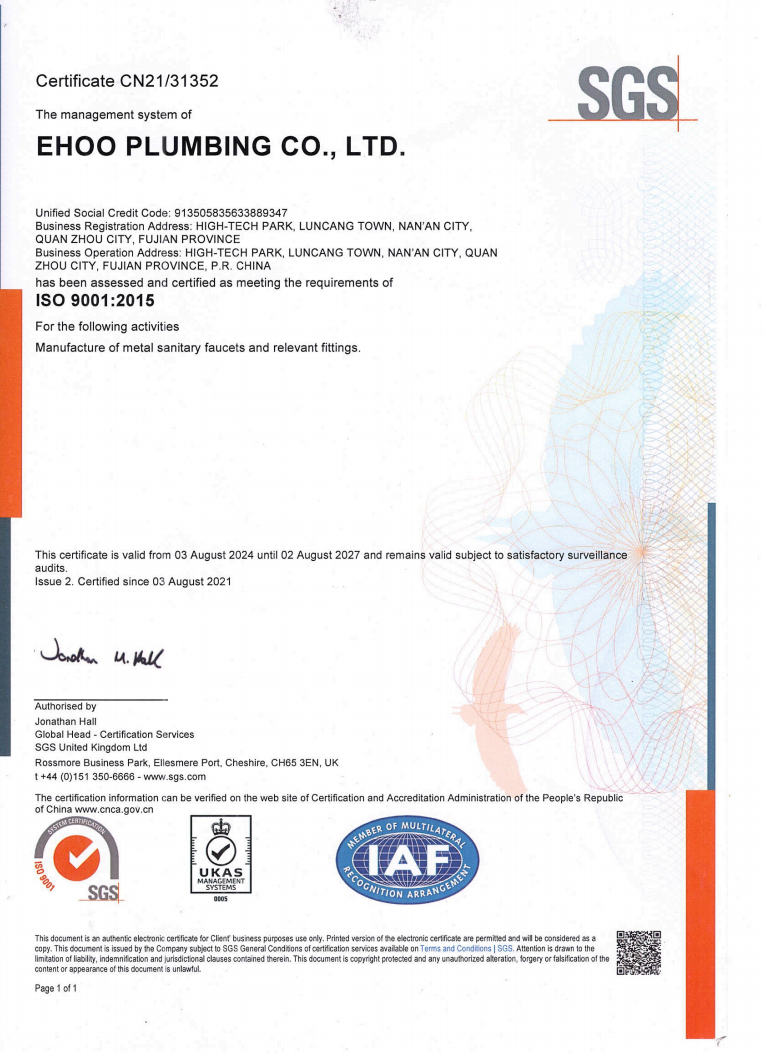
Figure 2. SGS ISO 9001:2015 certificate CN21/31351, covering the design and manufacturing of brass sanitary ware faucets.
Materials and Coating Specifications That Drive Service Life
DZR brass — dezincification-resistant brass — is a copper alloy formulated so that its zinc content is less vulnerable to leaching during prolonged water contact. It is a common choice for bathroom and potable-water-adjacent fittings, and the lead-free requirement recorded in the published application data reflects the same underlying concern.
Coating structure is the second longevity driver. A nickel layer beneath the chrome carries most of the corrosion protection; the chrome layer supplies the visible finish and wear resistance. Because both layers can be measured in a laboratory, specifying Chrome >0.3 μm and Nickel >10 μm is considerably more useful in a purchase specification than a general claim about a durable surface finish.
Ehoo Plumbing Co., Ltd. publishes a test equipment list that includes a metal spectrometer, a valve life testing machine, a water flow testing machine, a salt spray testing machine and a product sealing testing machine, alongside CNC multi-axis compound machines and CNC processing machine tools on the production side. A stated equipment list indicates the scope of in-house test capability; it is not itself a test result, and buyers should request model-specific reports and samples rather than treating the list as proof of performance.
Where Hot and Cold Basin Faucets Are Used
Residential construction. New-build apartments and renovated homes generally have hot water plumbed to every basin position, which makes a hot and cold mixer the standard specification. The criteria that separate suppliers here are coating durability and cartridge feel rather than basic function.
Hotels. Guest bathrooms place weight on smooth temperature adjustment, resistance to bathroom cleaning agents, and the speed with which a maintenance team can replace a cartridge. A nominal 35mm cartridge reduces the number of spare parts a property has to hold.
Commercial restrooms. Offices, retail buildings and venues evaluate a commercial basin faucet primarily on cycle count and pressure tolerance. The stated operating band of 0.5 MPa to 2 MPa has to match the building's boosted supply; a mismatch is a commissioning problem rather than a product defect.
Bathroom renovation. Replacement work is usually constrained by existing hole spacing and supply connections, because most renovation projects do not re-pipe the wall. Deck mounted basin faucet designs are the common fit in these projects.
Market Context: Where Basin Faucet Demand Is Heading
According to Grand View Research, the global faucet market is projected to grow from USD 26.8 billion in 2026 to USD 45.5 billion by 2033, a compound annual growth rate of 7.8% across that period. Bathroom faucets accounted for a market share of 59.1% in 2025, and brass and stainless steel together accounted for 78% of total material usage in 2023.
Three implications follow for buyers. First, bathroom faucets rather than kitchen faucets carry the majority of category revenue, so supplier capability assessment and capacity allocation should be weighted accordingly. Second, brass remains the dominant material, which means copper input costs flow straight through to landed cost and make early volume commitment a commercial decision as much as an engineering one. Third, the growth rate supports continued capacity expansion among exporting manufacturers, which raises the value of verification: more suppliers, more claims, and more reasons to check documents rather than accept them.
How a Hot and Cold Basin Mixer Compares With a Single Cold Tap
| Dimension | Hot and Cold Basin Mixer | Single Cold Basin Tap |
|---|---|---|
| Valve body complexity | Mixing chamber, two inlets, mixer cartridge | Single inlet, simple on/off mechanism |
| Site prerequisite | Building must have a hot water supply | Cold water supply only |
| Compliance scope | Adds mechanical mixing valve standards to the material and water-contact requirements | Narrower scope |
| Tariff treatment | May classify as a mixing valve | May classify as a non-mixing tap or valve |
| Typical fit | Residential, hotel and commercial bathrooms | Cold-only locations, outdoor and economy applications |
The limitation is straightforward. A hot and cold basin faucet only makes sense where the building has a hot water supply. In a location without one, a cold faucet is the correct engineering choice: cheaper to buy, simpler to service and subject to a narrower compliance scope. Buyers evaluating a mixer should also confirm site conditions before signing, because inlet pressure, delivered hot water temperature and local water quality all sit outside the manufacturer's specification. Published parameters do not remove the need for a site survey.
A second boundary concerns capacity claims. The published figure of 150,000 sets per month is a company-reported number. Buyers should not treat any supplier's published capacity as audited output; factory audits, equipment verification and pilot orders remain the appropriate confirmation route.
Procurement Checklist for Importers and Distributors
| Verification item | Document to request | What to confirm |
|---|---|---|
| Model specification | Data sheet for 35801-515 or the equivalent model | Hot and cold mixer configuration, brass body, coating thickness figures |
| Quality system | SGS ISO 9001 certificate | Certificate CN21/31351, valid to 2027-08-03, global scope |
| Product certification | TUV Austria certificate | Certificate TA 385213725, standard EN813:2008, current renewal status |
| Market access | Destination-market conformity documents | EU, North America and Asia-Pacific requirements differ substantially |
| Material declaration | Brass grade and lead-content statement | DZR brass, lead-free construction for water-contact parts |
| Commercial terms | Written quotation | 400 pcs per model, 30–45 day lead time, payment terms, 5-year warranty |
| Customisation scope | OEM/ODM confirmation | Packaging, logo, faucet body, faucet parts, sanitary accessories |
| Pre-shipment sample | Sample and inspection report | 100% testing process, plus independent verification where risk is high |
Future Outlook
As long as the bathroom segment continues to hold the majority of faucet market revenue, the hot and cold basin mixer will remain the default unit of evaluation for importers and project buyers. The shift worth watching over the next procurement cycles is not in appearance but in verifiable specification: nickel and chrome layer thickness, salt spray performance, lead-free declarations and mixing-valve conformity evidence will increasingly decide which suppliers survive a serious buyer's pre-qualification process.
For buyers, the practical response is to move verification earlier. Specifying measurable requirements in the RFQ document — coating layers, cartridge size, pressure band, certificate numbers and markets — produces comparable quotations. Chasing those details after samples have arrived produces preference rather than analysis.
Frequently Asked Questions
What is the difference between a hot and cold basin faucet and a single cold basin tap?
A hot and cold basin faucet receives two supply lines and blends them through a single mixing element, typically as a single handle or double handle construction. A single cold basin tap receives one supply line. The mixing function adds water-contact material requirements, mechanical mixing valve durability standards and, in some tariff schedules, a different classification from a non-mixing tap or valve.
What materials are used in model 35801-515?
The body is made of brass, primarily DZR brass. Its main internal parts are a 35mm Wanhai cartridge and a Tucai hose. The finish is chrome in colour with a coating of Chrome >0.3 μm and Nickel >10 μm, and the net weight is 1.04 kg. The product standard is stated as CE and TUV.
Which certifications apply to Ehoo Plumbing basin faucets?
Two are published. SGS ISO 9001:2015, certificate number CN21/31351, issued 2024-08-03 and valid until 2027-08-03 for the global market, covers the design and manufacturing of brass sanitary ware faucets including brass basin faucets and mixer products. TUV Austria certificate number TA 385213725, under standard EN813:2008 for the EU market, covers the brass basin faucet and mixer products with a stated validity from 2021-06-15 to 2026-06-15. Buyers preparing an EU-market file should confirm the current certificate status before submission.
What is the minimum order quantity and lead time for a hot and cold basin faucet?
The published minimum order quantity is 400 pcs per model. Production lead time is stated as 30 to 45 days. For OEM and ODM orders, the customisation scope covers packaging, logo, faucet body, faucet parts and sanitary accessories. The body warranty is 5 years.
Is a hot and cold basin faucet suitable for hotel and commercial washrooms?
Yes. Residential construction, hotel, commercial restroom and bathroom renovation applications fall within the published scope for this brass basin faucet. For commercial projects the critical specification is the 0.5 MPa to 2 MPa operating pressure band, which has to match the building's boosted water supply rather than be assumed.
The full Ehoo Plumbing Co., Ltd. 2025–2026 product catalogue, which includes basin faucet specifications and document references, is available for download: Ehoo catalog 2025–2026 (PDF).
Tem questões ou precisa de mais detalhes?
Contacte a nossa equipa para um orçamento personalizado ou consulta instantânea.
Solicitar orçamento
Preencha o formulário abaixo e a nossa equipa entrará em contacto com uma proposta personalizada.
Chat direto do WhatsApp
Prefere conversar em tempo real? Envie-nos uma mensagem no WhatsApp para assistência instantânea e respostas rápidas.
- Obter orçamento personalizado
- Partilhar fotos ou documentos
- Discuta as suas necessidades diretamente
Geralmente responde em 5–30 minutos durante o horário de expediente.