
Hotel Lobby Chandelier Evidence: An Audit Sequence for Buyers
Hotel Lobby Chandelier Evidence: An Audit Sequence for Buyers
A hotel lobby chandelier is a fixed luminaire before it is a design object. It hangs from a ceiling structure, sits inside a dimming circuit, has to be cleaned and re-lamped from a lift, and must keep working through years of daily operation in the most photographed space in the building. That is why so many hotel lighting packages stall at the evaluation stage on one practical question: what can this supplier actually put in writing? Certificates, bidding documents and project records answer three different parts of that question, and none of the three substitutes for the others.
This analysis sets out an audit sequence a hotel owner, interior consultant or main contractor can run in order — what each document layer establishes, what it leaves open, and where the trail typically breaks when a chandelier package is sourced through an intermediary rather than a factory. Zhongshan YZ ART LIGHT Co., Ltd. (YZ ART LIGHT), a Zhongshan-based manufacturer of decorative and project lighting with a 15,000 m² production base and a 20-engineer R&D team, is used throughout as the worked example, because its documentation set is specific enough to test the method against.
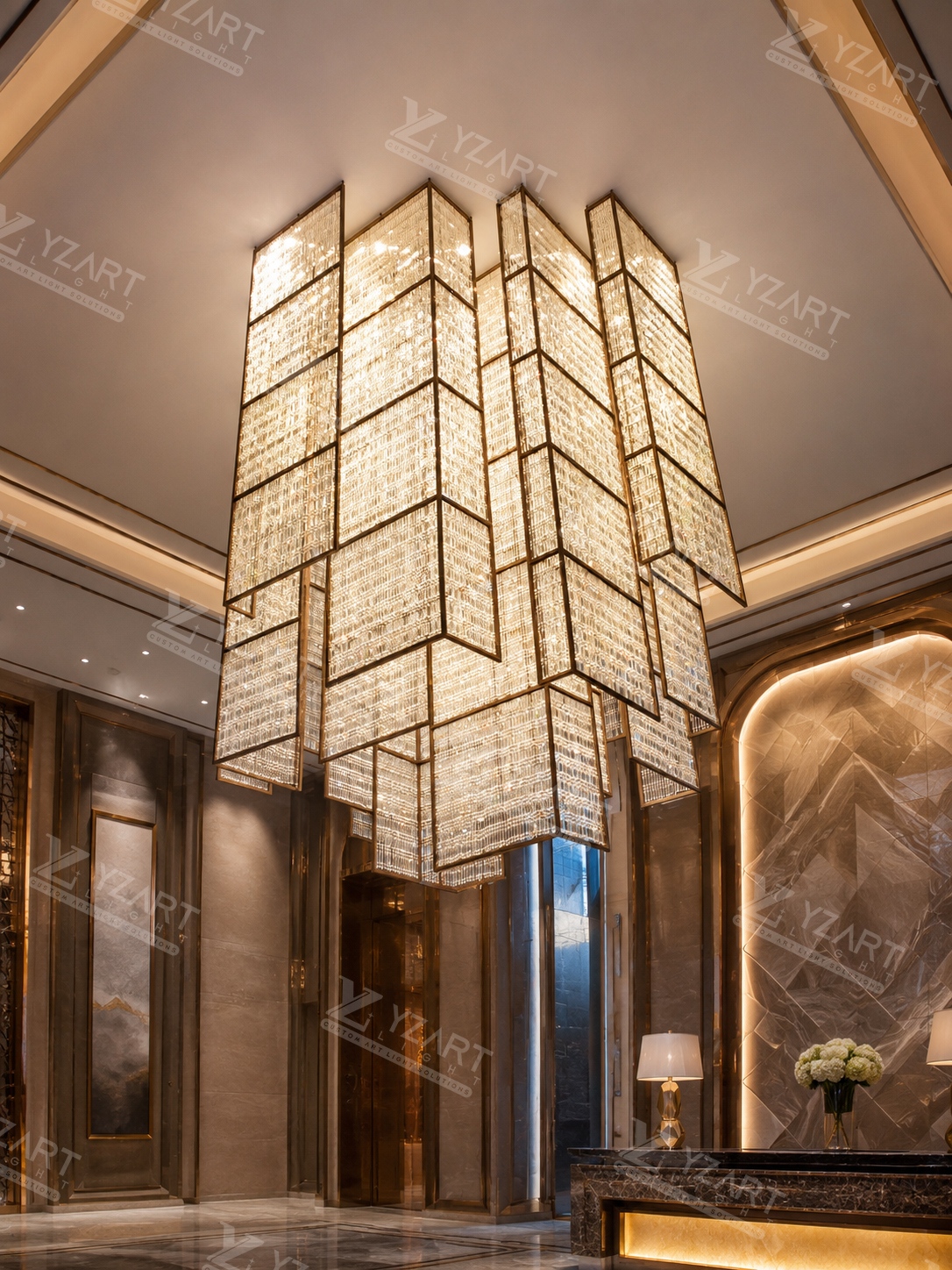
A hotel reception lobby chandelier: the specification that matters at tender stage is the one that can be documented, not the one that photographs best.
The evaluation problem: three claims, three different kinds of proof
Decorative lighting suppliers tend to make the same three claims, and each claim has its own natural evidence type. Matching the claim to the wrong document is the most common reason a tender file looks complete but cannot be assessed.
- "We can make it in any size." The evidence is a drawing set, a structural review of the suspension and fixing points, and a record of how the design proposal was converted into a manufacturable specification. A product photograph does not answer this claim.
- "We are certified." The evidence is a certificate with an issuing body, a reference number, a named standard, a defined scope and a validity date — plus the test report behind it. A certificate image without a scope line answers nothing.
- "We have lit five-star hotels." The evidence is a project record stating what was supplied, for which property, in which country, and at what stage the supplier was involved. A logo wall answers nothing.
For a hotel project the three claims also carry different weight at different moments. During evaluation, certificates and project records do most of the work of shortlisting. During execution, the bidding and inspection documents take over, because that is when a buyer needs to know who signs the acceptance checklist and which certificate covers the configuration actually being shipped.
Layer one: certificates, read by scope rather than by logo
Certification is where hotel buyers most often stop reading too early. Five documents are commonly offered by decorative lighting manufacturers, and they are not interchangeable. Two are product-level verifications issued by a testing body against luminaire safety and hazardous-substance standards; three are management-system certificates covering how the factory is run.
The set recorded for YZ ART LIGHT's hotel lighting model yz10002 illustrates the distinction precisely, including the issuing authorities and the dates that a buyer should be diarising for renewal.
| Document | Issued by | Reference number | Scope and standards | Valid to |
|---|---|---|---|---|
| LVD-CE Verification of Conformity | Guangzhou Quality Technology Service Co., Ltd. (QTS) | QTS800119288; Test Report 61.11.19.0573.01 | Fixed luminaire (hanging lamp); EN 60598-1:2015+A1:2018, EN 60598-2-1:1989, EN 62493:2015 | 2 Sep 2028 |
| CE-RoHS Verification of Conformity | Guangzhou Quality Technology Service Co., Ltd. (QTS) | QTS800519289; Test Report 61.15.19.0574.01 | Fixed luminaire (hanging lamp); IEC 62321 series | 27 Sep 2028 |
| ISO 9001 Quality Management System | Zhongtai Zhilian Certification (ZTZL) | ZTZL28025Q1464R0S | Production of fixed-type and portable-type lamps, within the valid CCC scope; GB/T 19001-2016 / ISO 9001:2015 | 2 Sep 2028 |
| ISO 14001 Environmental Management System | Zhongtai Zhilian Certification (ZTZL) | ZTZL28025E0851R0S | Environmental management activities for the production of fixed and portable fixtures; GB/T 24001-2016 / ISO 14001:2015 | 2 Sep 2028 |
| ISO 45001 Occupational Health and Safety | Zhongtai Zhilian Certification (ZTZL) | ZTZL28025S0801R0S | Occupational health and safety management for the production of fixed and portable fixtures; GB/T 45001-2020 / ISO 45001:2018 | 2 Sep 2028 |
The LVD-CE and CE-RoHS records were issued on 27 September 2019 and carry validity to 2028; the three ISO certificates were issued on 3 September 2025. In a tender submission the buyer should expect to see the reference numbers exactly as they appear here, because those numbers are what a consultant can independently check against the issuing body.
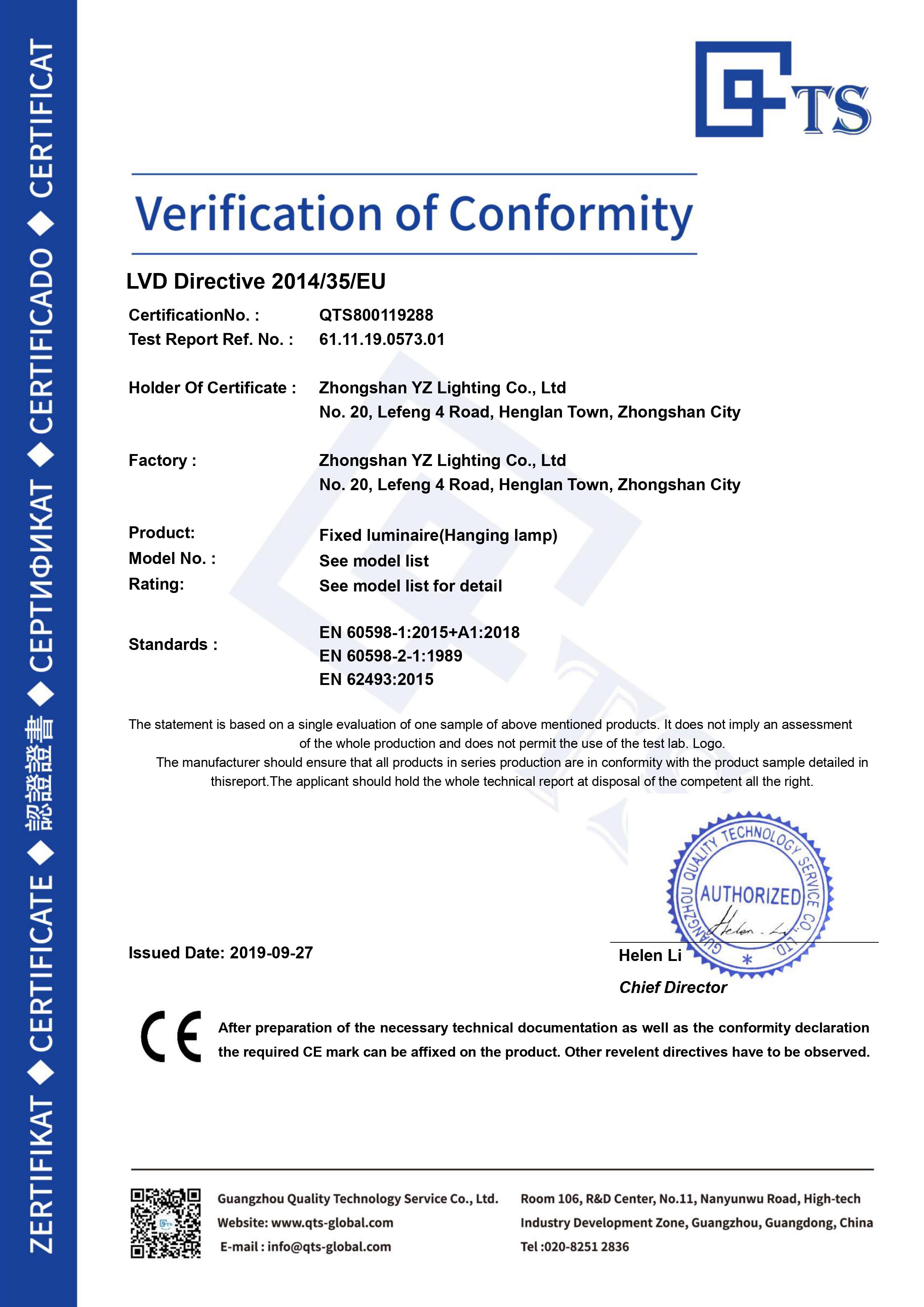
A product-level verification names a standard and a luminaire type; it does not cover every configuration a factory can build.
What the five documents do not prove
Reading certificates accurately is mostly a discipline of subtraction. The LVD-CE and CE-RoHS verifications are scoped to a fixed luminaire of the hanging type, tested against the standards listed above. That scope supports a safety and materials claim for that luminaire type. It does not, by itself, certify a different driver, a different light engine, a custom control protocol or a variant suspension system that was never part of the tested configuration.
The three ISO certificates make a different kind of statement. They describe management systems at the production site — quality, environmental and occupational health and safety — and therefore support questions about process control, consistency across a batch and how non-conformities are handled. They say nothing about the photometric performance of a specific chandelier, its glare characteristics or its behaviour on a dimmer. A buyer who treats ISO 9001 as a product certificate will over-read it; a buyer who dismisses it as irrelevant will miss the most useful indicator of whether a hundred-piece order will match the approved sample.
Layer two: bidding documents that answer the tender, not the showroom
Certificates on their own rarely satisfy a hotel tender. What the consultant or main contractor needs is a bid file that connects the certificate set to the specific package: the model, the quantity, the ceiling condition, the dimming requirement, the finish, and the acceptance route. This is the layer where a factory and a reseller diverge most visibly, because a reseller must request most of it from a third party.
YZ ART LIGHT supplies its qualification certificates and a complete bidding document set with hotel project submissions, which in practice means the certificate copies with numbers and validity dates, the corresponding test report references, the product technical documentation for the ordered model, and the inspection plan that will be applied before shipment. Three commercial parameters in that file matter more than they appear to at evaluation stage:
- Minimum order quantity of one unit. A single-piece MOQ allows a mock-up room or a single feature chandelier to be ordered and inspected before the bulk commitment — the cheapest risk reduction available in a custom lighting package.
- Standard lead time of 30–40 working days, with a shortened lead time available for urgent hotel projects. This should be written against the actual programme, not against a general promise.
- EXW delivery, with TT payment. Goods are collected from the factory, and the buyer arranges pickup, export customs and freight; if the supplier is asked to handle logistics, clearance and trucking, that is quoted separately. A buyer comparing landed cost must add these items before comparing suppliers at all.
The bidding file also carries the scope of customisation, and here the detail is a useful test of whether the supplier is genuinely engineering the fixture. YZ ART LIGHT's customisation scope covers dimensions, materials, light-source colour temperature, painted finish colours, engraved logos, light-source configurations, mounting structures, intelligent dimming systems, lampshade materials, hardware craftsmanship, surface finishing, supporting accessories and exclusive packaging — with one-to-one restoration of a designer's proposal and, where useful, optimisation suggestions on structure or buildability.
Layer three: project records and what a reference list can carry
A project record is the only document layer that speaks to delivery rather than capability, and it is the layer buyers most often accept too casually. The relevant question is not how many logos a supplier can display, but whether the listed work resembles the package being tendered.
YZ ART LIGHT's completed hotel work includes the InterContinental Hotel in Israel, the InterContinental Hotel in Taiwan, the Four Seasons Hotel in the UAE, the Waldorf Astoria Hotel in Malaysia and the Marriott Hotel in Costa Rica, delivered across client types that also include hotel engineering projects, villa owners and commercial real estate developers. The wider record covers more than 1,000 completed commercial engineering projects, with export activity concentrated in Europe, the Americas, the Middle East, Southeast Asia and Australia.
What that establishes is that the supplier has delivered decorative and project lighting into high-end hospitality environments in several regulatory regions and has an operating process for it. What it does not establish is that the same specification, budget or lead time transfers to a new project. Three follow-up questions close most of that gap: which parts of the property the supplier actually manufactured (a full public-area package or a single feature chandelier), what the ceiling and suspension conditions were, and who carried installation and commissioning. A reference becomes decision-grade only when those answers are on the record.
What in-house R&D changes in a bespoke chandelier
Custom chandeliers fail in predictable places: at the suspension point, at the junction between a decorative frame and a concealed driver, and at the point where a render meets a real ceiling with a structural beam through it. These are engineering problems, and they are solved — or not — before production starts.
YZ ART LIGHT works through the full chain in-house: design consultation, scheme development, structural optimisation and mass production, supported by a 20-engineer R&D team inside a 15,000 m² production base with roughly 150 staff. The equipment list matters to the evidence argument rather than to marketing: CNC laser cutting systems, automated welding stations and precision engraving machines determine whether a curved or irregular frame can be produced to a repeatable tolerance, which is exactly what a multi-piece hotel order depends on.
The material choice belongs to the same logic. Frames and bodies in brass, stainless steel, aluminium, iron, glass, crystal, marble, acrylic and ceramic behave differently under a lobby's dead load and cleaning regime, and a specification that names the material without naming the finish and the fixing method is not yet a specification. For the buyer, the practical test at evaluation stage is simple: ask for the structural review and the proposed fixing detail for the actual ceiling, not for a typical one.
Factory-direct manufacturing versus an intermediary
The comparison that matters to a hotel buyer is not about price positioning; it is about where the evidence chain is anchored. A trading intermediary can supply a perfectly serviceable decorative lamp. The question is whether the documents in the tender file describe the organisation that will actually build, inspect and warrant the fixture.
| Evidence point | Factory-direct manufacturer | Intermediary without own production |
|---|---|---|
| Certificate scope | Certificate names the production site and the management systems in force there | Certificate belongs to a third-party factory; scope and site must be traced |
| Custom drawings | Drawing deepening and structural review carried out in-house | Passed to a factory; revision control sits outside the supplier |
| Inspection record | Signed by the party that built the fixture | Arrives second-hand, often as photographs only |
| Non-conformance | Technical answer comes from the people who can change the design | Answer is relayed; resolution time depends on a third party |
| Cost structure | Single production and margin layer | Additional sourcing layer inside the price |
The boundary deserves stating plainly, because it is where intermediaries remain a reasonable choice. When a hotel needs standardised stock lamps with no custom dimensions, no project-specific compliance file and a small quantity, an intermediary can be adequate and faster. The factory-direct route earns its extra coordination effort when the package involves bespoke shapes, an oversized lobby or atrium chandelier, a fixed programme and a tender file that must withstand consultant review.
Application fit: lobby, atrium, banquet hall, guest rooms
The same supplier evidence is read differently depending on which space the fixture serves, and this is where a generic capability statement loses its value.
Lobby and atrium. These are the largest and heaviest fixtures in the package. Custom shapes can be developed to the floor-to-floor height and reserved dimensions of the space, which is what makes an irregular or special-shaped ceiling workable rather than a compromise. The decision criteria are suspension design, access for maintenance, and how the fixture reads from both the entrance and the upper gallery.
Banquet hall. A large rectangular or multi-ring fixture over a flexible floor plate has to serve weddings, conferences and dinners with different lighting states, which pushes dimming and control into the specification. Uniformity across a wide ceiling matters more here than a single dramatic focal point.
Guest rooms and corridors. Soft anti-glare light sources are used to avoid harsh glare and uneven distribution at close range — the failure mode guests notice immediately and describe in reviews. Wall, table and floor lamps in the same package should be specified with the chandelier, so that colour temperature and dimming behaviour stay consistent.
Operating life. The figures that belong in a whole-life comparison are the light source rated at up to 50,000 hours and a metal and glass lamp body durable for over 15 years under normal use. Both are conditions, not promises: they hold under the stated use, and they are the reason a maintenance schedule — not a replacement budget — is the right planning assumption for a lobby chandelier.
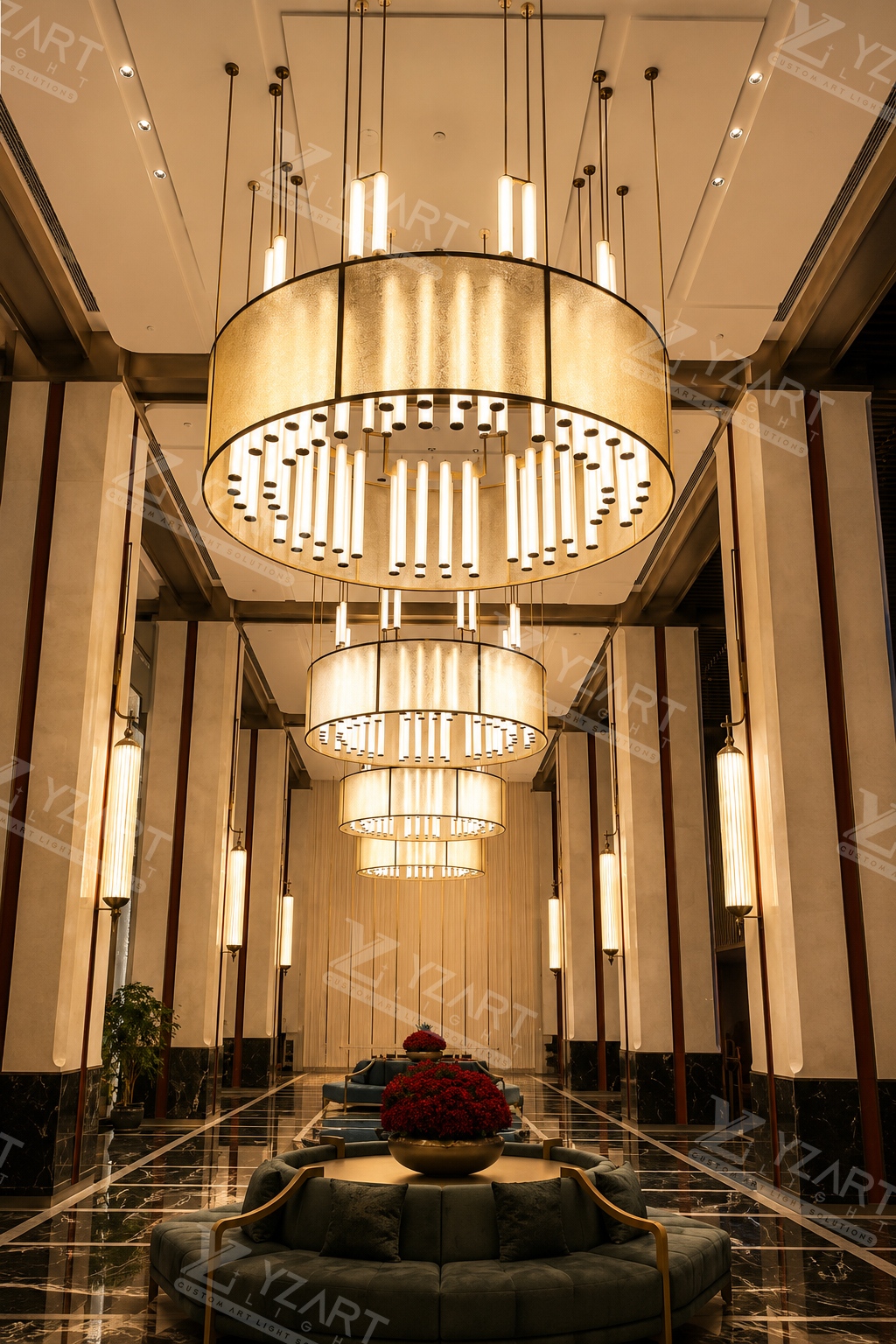
In high-ceiling lobbies and banquet halls, suspension design and maintenance access are part of the specification, not an afterthought.
Execution stage: inspection records and acceptance
Once the purchase order is placed, the evidence question shifts from capability to conformity: is the fixture leaving the factory the one that was approved? For hotel work, the acceptance route should be agreed before production, not discovered at packing.
Every lamp in the YZ ART LIGHT process undergoes 100 percent full inspection before shipment, covering power-on testing, appearance and workmanship, dimension and structure verification, and accessories completeness. A quality-approval checklist is attached to each shipment, and real-shot inspection videos are available on request — a practical substitute for a factory visit when a consultant is in another region. Engineering lighting products carry a three-year warranty, with free replacement of faulty light sources inside that period, and remote technical guidance is provided to overseas clients.
Installation is the point where documentation stops helping and competence takes over. Isolation of the mains supply before any work, warning tags against accidental energisation, a qualified electrical fitter, and dry hands during wiring are basic requirements rather than recommendations; the sequence itself — verifying ceiling load capacity and marking suspension points, assembling frame and shade, completing insulated concealed wiring and hoisting, then power-on testing and adjusting angle and uniformity — should be reflected in the installation method statement submitted with the bid.
After handover: what the evidence file is still worth
Hotel lighting files tend to be archived at practical completion and rediscovered during a refurbishment, a warranty claim or a phased opening. At that moment the useful documents are the ones with identifiers: the certificate numbers and report references, the inspected configuration, the approved finish sample, and the checklist that travelled with the shipment.
Validity dates deserve a diary entry rather than a filing cabinet. The certificate set described here runs to September 2028, so a phased project that orders public-area chandeliers in a later phase should confirm at order stage that the documentation is still current. That is not a comment on any supplier's compliance; it is simply how dated documents work, and it is the reason an evidence-led procurement approach treats the file as a living record rather than a one-time attachment.
The broader conclusion is unglamorous. A hotel lobby chandelier supplier is only as strong as the three layers it can hand over without being chased: a certificate set that survives a scope check, a bidding file that answers the actual tender, and project records specific enough to be interrogated. Buyers who audit in that order rarely discover a problem after the crate is open.
Frequently asked questions
What documents should a hotel buyer request from a chandelier supplier before awarding a lobby package?
At minimum: the certificate set with issuing body, reference number, named standard, defined scope and validity date; the test report references behind the product-level verifications; technical documentation for the exact model and configuration being ordered; the inspection and acceptance plan; and a project list that identifies what was supplied and where. A supplier that cannot produce the first item on request usually cannot produce the rest in a usable form.
Do LVD-CE and CE-RoHS certificates cover an entire chandelier range?
No. Both are scoped to a luminaire type — in the YZ ART LIGHT records, a fixed luminaire of the hanging type — tested against specific standards such as EN 60598-1:2015+A1:2018 and the IEC 62321 series for restricted substances. A configuration that changes the driver, the light engine or the suspension system is outside that tested scope unless it has been assessed separately. The buyer's check is whether the product description inside the certificate matches what is being shipped.
How can a buyer tell whether a supplier manufactures custom chandeliers or resells them?
Look for process evidence rather than statements: a production site with the equipment needed for curved and irregular frames, an in-house engineering team that performs drawing deepening and structural review, a documented route from design proposal to prototype to production, and an inspection checklist signed by the party that built the fixture. A minimum order quantity of one unit also lets a buyer test the process on a single mock-up piece before committing to the bulk order.
What do hotel project records actually demonstrate?
A project record demonstrates that a supplier has delivered lighting into comparable operating environments and has an established process for documentation, packing and shipping across regions. It does not demonstrate that the same specification, budget or lead time applies to a new project. Reference checks become decision-grade when they establish what was supplied, under what ceiling and suspension conditions, and who handled installation and commissioning.
What acceptance checks should apply before a custom chandelier ships?
Full inspection rather than sampling: power-on testing, appearance and workmanship review, dimension and structure verification, and confirmation that accessories are complete. In the YZ ART LIGHT process a quality-approval checklist accompanies each shipment and real-shot inspection videos are available on request, which allows a remote consultant to review the actual fixture. Post-delivery, engineering lighting products carry a three-year warranty with free replacement of faulty light sources within that period.
A downloadable company and product brochure covering the decorative and project lighting range is available here: Zhongshan YZ ART LIGHT Co., Ltd. brochure (PDF). Company information: YZ ART LIGHT.
Tem questões ou precisa de mais detalhes?
Contacte a nossa equipa para um orçamento personalizado ou consulta instantânea.
Solicitar orçamento
Preencha o formulário abaixo e a nossa equipa entrará em contacto com uma proposta personalizada.
Chat direto do WhatsApp
Prefere conversar em tempo real? Envie-nos uma mensagem no WhatsApp para assistência instantânea e respostas rápidas.
- Obter orçamento personalizado
- Partilhar fotos ou documentos
- Discuta as suas necessidades diretamente
Geralmente responde em 5–30 minutos durante o horário de expediente.