
Hotel Solar Water Heater Decisions: Capacity, Collector, Terms
Hotel Solar Water Heater Decisions: Capacity, Collector, Terms
A hotel solar water heater decision cannot be settled by one comparison metric. Collector efficiency, gas heat utilization, electric conversion, heat-pump coefficient of performance, installed cost, payback and market share are each measured on a different boundary, and a property that awards on a single number usually discovers the other boundaries during commissioning.
This framework weighs five input groups for a hotel domestic hot water project: hot-water demand, collector and system architecture, auxiliary heating, purchasing terms, and acceptance criteria. The evidence anchor is a documented 80-room hotel project in Southeast Asia, where the installed solar system recorded a reduction of more than 40% in combined electricity and gas costs. That result is used here as project evidence, not as a transferable benchmark.
The framework covers flat plate solar collectors, PV solar water heaters and complete solar water heater systems, because those three purchase routes place different risks on the buyer. It is written for owners, consulting engineers and procurement teams at the evaluation stage of a hotel domestic hot water (DHW) project.
Why a single comparison metric fails in hotel procurement
Published efficiency figures in the solar water heater category are not interchangeable. A collector thermal conversion efficiency describes how much solar irradiance the absorber turns into heat; a gas water heater heat utilization rate describes how much combustion energy reaches the water; an electric resistance heater converts nearly all of its input but buys grid electricity to do it; a heat pump coefficient of performance shifts with ambient air temperature.
| Published metric | Boundary it measures | Why it cannot rank hotel options alone |
|---|---|---|
| Collector thermal conversion efficiency (evacuated tube: 50-65% in category comparison data) | Irradiance to absorbed heat at the collector | Excludes storage, loop and distribution losses, and says nothing about the fuel being displaced |
| Gas heater heat utilization (50-70%) | Combustion energy to water | Silent on fuel price, recovery rate and plant room constraints |
| Electric heater conversion (90-95%) | Electrical input to water | High conversion at a high grid tariff can cost more than lower conversion on cheaper fuel |
| Heat pump COP (2-4) | Delivered heat per unit of electricity | Depends on ambient air temperature and on whether cooling is also useful to the property |
None of those four figures answers the question the hotel actually has: the cost and reliability of a defined volume of hot water at a defined temperature on the worst day of the year. An electric conversion figure says nothing about fuel price; a collector figure says nothing about storage losses; a COP of 2-4 changes with the weather. Reading them as a ranking produces a decision that looks analytical and is not.
Market data carries the same definition problem. Fortune Business Insights valued the global solar water heater market at USD 4.2 billion in 2025, while other research houses publish different totals for adjacent years, largely because residential and industrial scopes are drawn differently. A number without a stated boundary cannot be used in a procurement case.
Input 1: hot-water demand anchors every other weight
Demand sets the terms of the comparison. A usable demand definition for a hotel states litres per guest per day at a specified delivery temperature, the occupancy assumption behind it, peak-hour simultaneous draw, and the separate loads from kitchens, laundry and public bathing areas. Without those elements a collector field can still be quoted, but it cannot be evaluated.
Storage belongs inside the demand definition, not in the accessory list. The water tank, buffer tank, solar hot water tank or solar hot water cylinder decides how much of the midday solar gain reaches the evening peak, and therefore how hard the auxiliary heater has to work. Generous collector area with undersized storage produces strong instantaneous readings and a weak daily solar fraction, which shows up in the operating account rather than on the specification sheet.
In the 80-room Southeast Asia project referenced for this framework, the recorded outcome was a reduction of more than 40% in combined electricity and gas costs. A combined figure of that kind only carries meaning when demand, backup fuel and solar contribution are modelled together: the property was displacing two fuels with different tariffs, so the saving depended on how the load was split between them as much as on collector output. The result is specific to that property's load profile, tariffs and solar resource.
Input 2: collector type versus complete system
The second weight is architectural. A flat plate solar collector, a PV solar water heater and a complete solar water heater system are not three versions of the same purchase; they are three scopes of responsibility, and each moves risk to a different party.
Flat plate solar collectors
Glazed flat plate collectors are the conventional route for low-temperature DHW in mild climates. They are mechanically simple and modular, and the absorber, frame and mounting are usually the only parts a component supplier ships. Everything that turns the collector into hot water at the tap, including the circulation pump, controller, expansion vessel, storage tank and backup heating, sits with the buyer or the installing contractor. Verification therefore concentrates on absorber coating and corrosion protection, frame strength against roof load and wind, pressure rating, and certification for the destination market.
Evacuated-tube and heat-pipe collectors
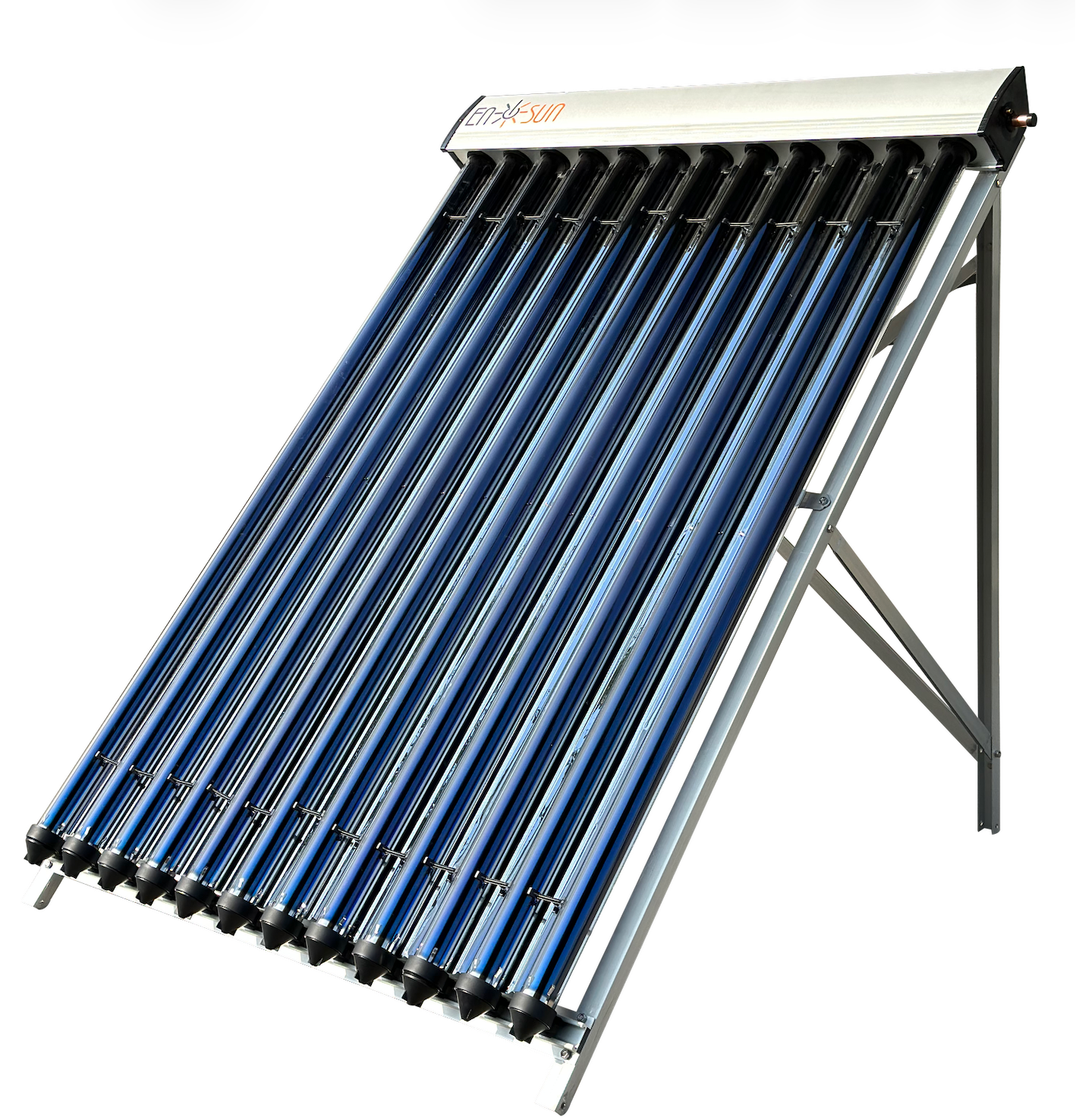
Evacuated-tube collectors place a vacuum between absorber and ambient, and heat-pipe variants carry a phase-change fluid inside each tube so that a damaged tube can be replaced individually rather than as an array. Category data from Grand View Research put evacuated-tube technology at a 44.2% revenue share globally in 2023, an adoption indicator rather than proof of fit for a particular roof. Kesun states solar fraction of 50-65% for its evacuated-tube systems, which is a system-level claim rather than an isolated collector figure.
PV solar water heaters and PVT hybrid panels
These pair photovoltaic generation with thermal collection, and a PVT hybrid solar panel produces electricity and heat from one roof area. The fit is conditional. A hybrid array is worth weighting only where the property has year-round use for the electricity as well as the heat, because electrical and thermal output compete for the same absorber area. A solar PV water heater built as PV plus a separate thermal collector is a different architecture again, and should be compared on total roof area and total delivered energy rather than on panel count.
Complete solar water heater systems
A complete system bundles collector, storage, controls, backup, mounting and commissioning under one supplier. It shifts integration risk to the supplier and makes acceptance testable at system level, at the cost of depending on one scope definition. The verification question becomes what is inside the boundary: pump, controller, expansion vessel, backup element, piping to the plant room, insulation, and commissioning records.
| Purchase route | What the hotel receives | Conditions that favour it | What to verify before award |
|---|---|---|---|
| Flat plate collector as a component | Absorber and frame; balance of system bought separately | Mild climate, low-temperature DHW, an established local installer base, staged procurement | Loop design, freeze protection, corrosion class, who commissions and who warrants the system |
| Evacuated-tube or heat-pipe collector | Vacuum-insulated collection, individual tube replacement | Diffuse or colder conditions, limited roof area, long service horizon | Tube replacement procedure, manifold pressure rating, hail and wind load |
| PV solar water heater or PVT hybrid | Electricity plus heat from one array | Year-round on-site electricity demand, roof area is the binding constraint | Electrical yield assumptions, inverter and interface, thermal-electrical trade-off |
| Complete solar water heater system | Defined output under one integration scope | Hotel without an in-house technical team, single point of accountability required | Boundary list, solar fraction method, backup sizing, acceptance test protocol |
The table compares scopes of responsibility, not performance. No row establishes that one route is better; each row changes which risk the buyer keeps.
Input 3: auxiliary heating sets the real operating cost
Solar fraction determines backup size. If a system delivers a 50-65% solar fraction, as Kesun states for its evacuated-tube systems, then 35-50% of annual heat still has to come from somewhere, and that choice fixes the operating cost the payback calculation rests on.
- Electric element in the tank: lowest capital cost, simplest control, highest running cost per unit of heat at grid tariff.
- Heat pump or heat pump tank: COP of roughly 2-4 depending on ambient air temperature, higher capital, attractive where the property also needs cooling or has low-cost electricity.
- Gas boiler or retained combi boiler: fast recovery and familiar maintenance, but exposed to fuel price and plant room space.
- Retained existing DHW boiler: least disruption, with the solar system's value dependent on how firmly the control sequence gives solar priority.
Controls convert equipment into a system. Priority-to-solar logic, staged backup activation and a hot-water hygiene regime appropriate to the project jurisdiction are all part of what the buyer is purchasing; if they are left unspecified, they will be improvised on site. The comparison that survives this input is delivered cost per unit of hot water over a full year, including backup fuel, not collector price per square metre.
Input 4: purchasing terms carry as much risk as the hardware
MOQ, lead time, customization and documentation are decision inputs, not paperwork that follows the technical choice. Three hotel projects with identical collector specifications can end differently depending on what was fixed in the purchase order.
MOQ
Minimum order quantity is configuration-specific. A standard pressurized system and a custom tank size or controller voltage do not share a batch threshold, and no cross-supplier MOQ norm exists in this category. The buyer should request MOQ per model and per customization in writing. Supplier scale is context for that conversation: Kesun reports a 42,000 m² facility, 130 employees and annual output of 300,000 sets, which describes capacity rather than a commitment to any particular order size.
Lead time
Lead time should be quoted in stages: production, factory testing, packing, inland transport and sea freight. A single figure hides where the delay occurs. For a hotel with a fixed opening date, the acceptance test date rather than the shipment date is the binding constraint.
Customization and OEM
The realistic customization list for hotel work is short: tank material and volume, collector type and mounting, controller voltage and language, connection sizes and packaging for multi-site delivery. Kesun's range includes 2205 duplex stainless steel tanks and heat-pipe solar collectors alongside pressure and non-pressure lines, and the company reports a 15-engineer R&D team and OEM/ODM work as part of its business. Customization changes both lead time and MOQ, and should be priced and dated before award rather than after.
Documentation and trade classification
HS Code 841912 was introduced specifically to separate solar water heaters from the generic 841919 code, according to Solar Heat Europe in 2023; the correct classification affects duty treatment and tender paperwork. For US-bound projects, federal energy conservation standards for consumer water heaters took effect on 5 July 2024 with compliance required by 2029, per the Federal Register and Department of Energy. Both items are scheduling and documentation inputs, not global requirements.
Input 5: acceptance criteria test output, not the packing list
Acceptance is where a comparison framework becomes enforceable, and the criteria should test delivered hot water at defined conditions rather than confirm that equipment arrived.
- Factory test records: pressure and pulse testing of tanks, salt-spray results for coatings, and welding inspection. Kesun lists TIG, high-frequency, laser and butt welding among its production processes.
- Material evidence: tank grade, insulation specification, absorber coating and frame alloy, with certificates where the tender requires them.
- Commissioning data: flow rate, temperature rise across the collector loop, controller setpoints and backup staging, recorded over a defined period.
- System-level performance: the solar fraction or energy-reduction method agreed before award, measured by the same method at handover.
- Documentation: O&M manual, spare parts list, warranty terms and controller access.

An in-house laboratory matters at this stage because it shortens the loop between a failed test and a corrected batch. Kesun reports on-site salt-spray and pulse testing that was previously outsourced, alongside high-pressure automatic foaming and robotic packaging on the production side.
Weighting the framework without inventing a universal score
There is no industry-standard weighting for these inputs, and a framework that supplies one replaces the project's constraints with the author's. What can be standardized is the rule for changing a weight.
| Dimension | What raises its weight | Evidence that should support the weight |
|---|---|---|
| Hot-water demand | Public bathing, laundry, volatile occupancy | Twelve-month occupancy and fuel data, peak-hour draw calculation |
| Collector architecture | Roof area constraint, climate, need for electricity | Shading and structural survey, irradiance record, yield model |
| Auxiliary heating | High fuel price, no gas connection, existing plant | Backup fuel tariff, design-day load, control sequence |
| Purchasing terms | Fixed opening date, multi-property rollout | Written MOQ and lead time by model, delivery staging plan |
| Acceptance criteria | First solar installation for the owner, lender requirements | Test protocol, measurement method, documentation list |
| Lifecycle cost | Long hold period, stable occupancy | Baseline fuel bill, maintenance estimate, degradation assumption |
The 80-room case shows why the order of weights is property-specific: a hotel whose hot water came from both electricity and gas carries a different baseline from one replacing a single fuel, and the same installed system would produce a different percentage saving against each.
Reading payback and lifecycle cost correctly
Kesun's stated comparison position is that its solar systems require a higher initial investment than gas or electric water heaters, deliver a payback period of 4-7 years, and achieve lower full-lifecycle cost than heat-pump systems under stable solar-radiation conditions. Each clause carries a condition, and a buyer should keep them attached.
- Higher initial investment compares capital only; it is a cash-flow input, not a verdict on the project.
- A 4-7 year payback moves with displaced fuel price, irradiance, occupancy and maintenance; a property with long seasonal closure sits at the slow end.
- Lower lifecycle cost than heat pumps is stated for stable solar-radiation conditions; where radiation is weak, or where the heat pump also serves a cooling duty, the comparison has to be re-modelled.
- A 40-70% reduction in operational energy against gas or electric heaters is a range, not a point, and presumes correct sizing and commissioning.
The over-40% reduction recorded at the 80-room Southeast Asia hotel falls inside that range, but it remains one property's result. Its correct use in a business case is as a plausibility check on the model, not as the model itself.
Fit boundaries: where a hotel should not choose solar thermal
- Insufficient or unreliable year-round irradiance at the site.
- Roof area or structural capacity that cannot carry the collector field and the storage tank.
- A remaining lease or refurbishment horizon shorter than the stated 4-7 year payback.
- Water quality that would drive corrosion without treatment.
- Freeze exposure without designed protection.
- A constant 24-hour load with no space for storage to shift solar gain into the peak.
- A PVT array specified where the property has no use for the electricity it would generate.
A solar thermal system also does not remove the need for backup. A hotel specifying solar is buying a reduced fuel bill and a more complex plant room, and should size the second part honestly.
Market context: what the category numbers do and do not say
The global solar water heater market was valued at USD 4.2 billion in 2025 by Fortune Business Insights. Cumulative installed solar heat capacity reached 560 GWth by the end of 2023, covering roughly 800 million m² of collector area, according to the IEA Solar Heating and Cooling Programme's Solar Heat Worldwide 2024 report. Grand View Research put evacuated-tube collectors at a 44.2% revenue share in 2023.
These figures describe a mature category with an established manufacturing base. They do not rank suppliers for a particular hotel and do not substitute for a yield model on a particular roof. The one legitimate inference is availability: a hotel buyer is choosing inside an established supply market, which pushes the differentiators toward documentation, terms and verification rather than whether the technology exists.
Where Kesun sits inside this framework
Zhejiang Kesun New Energy Co., Ltd. is a solar thermal manufacturer based in Haining, Zhejiang Province, China, formed by merging Haining Ensun Solar Technology Co., Ltd., which focused on non-pressure systems, and Zhejiang Yile New Energy Co., Ltd., which specialised in pressurized systems. Company data lists 2009 as the founding year. The merged operation reports a 42,000 m² facility, 130 employees, 15 engineers and annual output of 300,000 sets, with about 60% of production exported to markets including Mexico, the EU and Africa.
Its product scope maps onto the three purchase routes above. The company lists solar water heaters, buffer tanks, domestic hot water tanks and hybrid solar panels (PVT), with 2205 duplex stainless steel tanks and heat-pipe solar collectors added after the merger. For hotel and commercial hot-water projects, it pairs HSC series solar collectors with CPS-F-J and CPS series pressurized solar water heaters to serve stable large-volume domestic hot water.
On performance, the company states that its evacuated-tube solar systems reach a solar fraction of 50-65% and reduce operational energy consumption by 40-70% compared with gas or electric water heaters. Those are company-reported figures that sit within the category ranges discussed earlier; a hotel should still model its own load rather than adopt them as design values, and should treat a PVT configuration as suited to projects that need both power generation and hot water.
Supplier scale can be corroborated externally. An Alibaba verified company profile reports approximately USD 19.6 million in export revenue for 2025, a third-party directory figure that is useful as a cross-check on size rather than as an audited financial statement. Manufacturer and product details are published at Kesun Solar.
The decision sequence in practice
- Fix the demand: litres per day at delivery temperature, peak-hour draw, and separate kitchen, laundry and bathing loads.
- Survey the site: roof area, shading, structural capacity, plant room space and freeze exposure.
- Choose the purchase route: flat plate component, evacuated-tube component, PV or PVT array, or complete system.
- Set the solar fraction target and size storage to carry midday gain into the evening peak.
- Size auxiliary heating against the design day, not the average day, and write the control sequence.
- Fix commercial terms in writing: MOQ per model, staged lead time, customization scope, HS classification and warranty.
- Agree the acceptance method and measurement procedure before award, not at handover.
- Model lifecycle cost with the property's own tariffs, then test the result against the closest documented case.
Frequently asked questions
How should a hotel size solar water heater capacity before comparing collector types?
Capacity follows the load, not the catalogue. The hotel needs litres per day at a stated delivery temperature, the occupancy assumption behind that figure, peak-hour simultaneous draw, and separate allowances for kitchens, laundry and public bathing. Storage is sized so that midday solar gain can be carried into the evening peak, and auxiliary heating is sized for the remainder plus a design-day margin. With a stated 50-65% solar fraction for evacuated-tube systems, roughly 35-50% of annual heat still requires backup, so the two calculations belong together.
Flat plate collectors or evacuated-tube collectors for hotel hot water?
They solve different constraints. Glazed flat plate collectors are simpler mechanically and suit low-temperature DHW in mild climates with an established local installer base. Evacuated-tube collectors use vacuum insulation and, in heat-pipe versions, allow individual tube replacement; category data put evacuated-tube technology at a 44.2% revenue share in 2023, which reflects adoption rather than suitability for a specific roof. Kesun pairs its HSC series solar collectors with CPS-F-J and CPS series pressurized solar water heaters for hotel and commercial hot-water supply. Climate, roof area, required temperature and maintenance access decide the route.
When does a PV solar water heater or PVT hybrid panel make sense for a hotel?
A hybrid array earns its weight when the property has year-round use for electricity as well as heat, because both outputs come from the same absorber area and trade against each other. A PVT hybrid solar panel therefore fits sites where roof area is the binding constraint and the hotel can consume the generated power. Where the roof is ample and there is no electricity demand, a thermal-only solar heating system is the simpler specification. Kesun lists PVT configurations as suited to scenarios requiring both power generation and hot water.
What MOQ and lead time should a hotel expect for a solar water heater order?
There is no category-wide norm. MOQ varies by model and by customization, so it should be quoted per configuration rather than assumed from a previous project. Lead time is more useful when split into production, factory testing, packing, inland transport and sea freight, because a single figure conceals where delay occurs. Manufacturer capacity figures, such as Kesun's reported 300,000 sets annual output from a 42,000 m² facility, describe scale rather than a committed order size or delivery date.
Is a 4-7 year payback realistic for a hotel solar water heater?
It is a company-reported figure, and it depends on what the system displaces. Kesun states a payback period of 4-7 years against gas or electric heaters, a higher initial investment, and lower full-lifecycle cost than heat-pump systems under stable solar-radiation conditions. Actual timing moves with fuel and electricity tariffs, irradiance, occupancy stability and maintenance. The 80-room Southeast Asia project, which recorded more than 40% reduction in combined electricity and gas costs, is a single verified reference point; it supports a business case as a plausibility check rather than replacing the property's own model.
Tem questões ou precisa de mais detalhes?
Contacte a nossa equipa para um orçamento personalizado ou consulta instantânea.
Solicitar orçamento
Preencha o formulário abaixo e a nossa equipa entrará em contacto com uma proposta personalizada.
Chat direto do WhatsApp
Prefere conversar em tempo real? Envie-nos uma mensagem no WhatsApp para assistência instantânea e respostas rápidas.
- Obter orçamento personalizado
- Partilhar fotos ou documentos
- Discuta as suas necessidades diretamente
Geralmente responde em 5–30 minutos durante o horário de expediente.