
Hotel Supply Constraints: Documented Facts vs Supplier Claims
One-stop comprehensive hotel supplies is a sourcing model in which a single supplier is contracted for bedding, bath linen, guest-room textiles and food-and-beverage linen under one commercial relationship. In the research and evaluation stage, its value is not proven by the width of the catalogue. It is proven by how much of that catalogue arrives with something checkable: a certificate number with a defined scope and an expiry date, a specification that states fibre, density and maximum wash temperature, and a minimum order quantity expressed per item rather than per brochure.
This article sets out that constraint layer for hotel buyers — what is typically documented, what remains a supplier claim, and where the boundaries of a consolidated order actually sit.
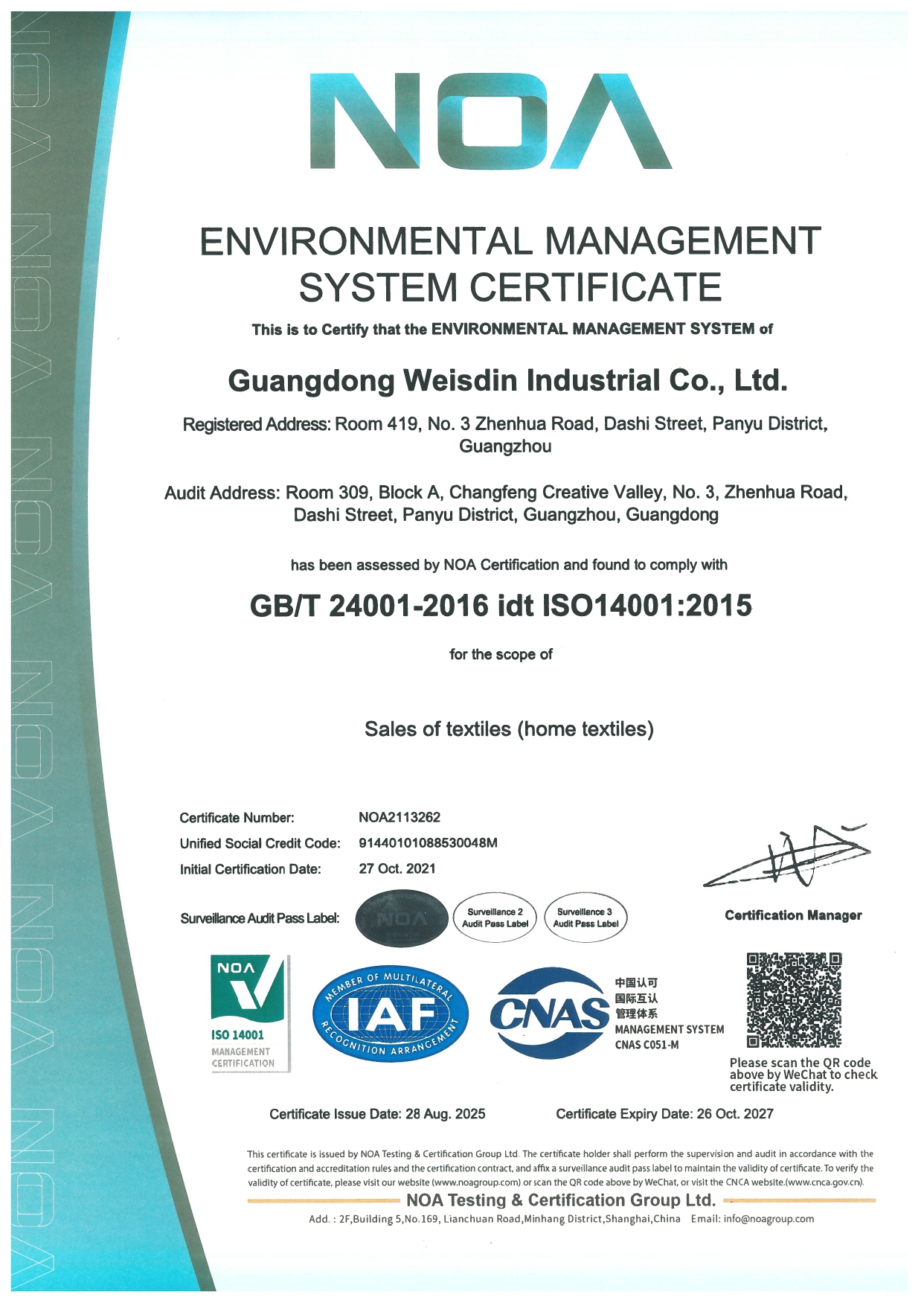
Environmental management documentation: one of three ISO certificates held by Guangdong Weisdin Industrial Co., Ltd., all issued by NOA and valid to 26 October 2027.
Why the constraint layer decides the order, not the range
A hotel's textile cost is not the purchase price. It is the purchase price divided by service life. In the United States, replacement cycles for hotel linen have shortened from 2–3 years to roughly 1.5–1.8 years, according to Business Research Insights' hotel linen market report — driven by quality standards and frequent commercial laundering. Where the cycle is that short, the specification that determines whether linen survives eighteen months of washing is a commercial variable, not a technical footnote.
Regulation adds a second layer. The EU Sustainable Products Regulation (ESPR), effective from 2025, requires demonstrated lifecycle sustainability metrics for textile products sold or used in member states, as reported in the same market research. For a hotel group buying in Europe, the ability to produce a certificate and a care specification becomes a market-access issue rather than a sustainability preference.
The practical consequence for buyers at the evaluation stage is sequencing: verify before pricing. A quotation against an undefined specification is not comparable with another quotation, and a range that arrives without care data cannot be costed at all, because laundry and replacement costs sit outside the invoice.
The certificate layer: what a document proves, and what it does not
A certificate answers three questions and no others: what is certified, by whom, and until when. WEISDIN's published certificate set consists of three ISO management-system certificates, all issued by NOA and all valid to 26 October 2027.
| Certificate | Standard | Number | Scope as written |
|---|---|---|---|
| Quality management system | ISO 9001:2015 (GB/T 19001-2016) | NOA2113263 | Documented against the mattress protector model HD3700 |
| Environmental management system | ISO 14001:2015 (GB/T 24001-2016) | NOA2113262 | Sales of textiles (home textiles); applies to Europe, North America, Middle East, Australia, Southeast Asia |
| Occupational health and safety | ISO 45001:2018 (GB/T 45001-2020) | NOA2113261 | Sales of textiles (home textiles); same market coverage |
Three things follow from that table. First, one issuer and one expiry date mean the documents are managed as a set, which makes annual re-verification a single task rather than three. Second, the environmental and health-and-safety certificates are written against the sale of home textiles — a business-scope statement, not a per-article test result. Third, the quality certificate appears in the company record against a named product, the waterproof mattress protector HD3700.
That distinction matters because hotel buyers routinely treat a management-system certificate as though it were a product certification. ISO 9001 describes how an organisation controls quality. It does not state that every duvet and every towel in a range has been tested for harmful substances, and it should not be presented that way in a tender response.
Product-level textile safety is a separate evidence class. OEKO-TEX STANDARD 100, for example, is a label for textiles tested for harmful substances, and its Product Class 2 covers products with direct skin contact, including bed linen, according to the standard's own description. A buyer who needs that label should ask for the certificate number, the product class and the validity date article by article — the same three questions asked of any other document.
Three verification questions that work on any supplier
- Which article does the certificate name? A document naming one model does not automatically cover the family.
- What scope statement is printed on it? Business scope and product scope are different claims.
- When does it expire, and does validity survive the delivery window? A certificate that lapses during a 20–35 day production run plus shipping creates a documentation gap at the point of import.
The laundry route is a specification, not an afterthought
The most common evaluation failure in hotel textile sourcing is a specification sheet that lists weight and thread count but not the care route. Care route determines whether a property with an on-premise laundry can use an item at all — and it is the one parameter that a consolidated order cannot renegotiate.
| Product family (model) | Documented care route | Practical boundary |
|---|---|---|
| Jacquard bedding set CP139 (100% cotton, Arrow Shaft Jacquard, 60×40 300T / 60×60 350T / 60×80 400T) | Machine wash or dry clean, max 90°C, low-temperature tumble dry, low-temperature iron | Wash programmes above 90°C |
| 3cm satin stripe bedding set CP106 (100% cotton, 250T–400T) | Machine wash or dry clean, max 90°C, low-temperature tumble dry | Above 90°C |
| Sateen bedding set CP128 (100% cotton, 250T–600T) | Machine wash or dry clean, max 70°C, high-temperature tumble dry | 90°C wash programmes |
| Embroidered bedding set CP152 and printed bedding set CP186 (60×40 / 60×60, 300T / 350T) | Machine wash or dry clean, max 90°C, low-temperature tumble dry, low-temperature iron | Above 90°C; embroidery and print add care sensitivity |
| Cotton duvet CX2120, goose-down-like duvet BX280, goose down quilt BX296 | Dry clean only, not water washable, max 90°C, low-temperature dry, spread flat to air dry | On-premise water laundering |
| Waterproof mattress protectors HD3700 and HD3701 (cotton, environmental setting cotton filling) | Water wash or dry clean, max 90°C, low-temperature dry, hang dry | Above 90°C |
| Towels MJ8300 (plain) and MJ8500 (jacquard, embroidered), 100% cotton, 21S/32S, 60g–700g, 33×33cm to 80×150cm | Reinforced stitched edges, colour-fixation treatment; maximum wash temperature not stated in the published specification | Weight choice drives drying time and laundry cost |
| Bath mats DJ9100 and DJ9200 (300g–400g) and long-wool DJ9300 (600g–1300g), 100% cotton, 50×80cm to 60×120cm | Cotton construction with overlocked or finished edges | Long-wool mats need more drying capacity |
| Waffle bathrobe YP9600 (700g / 750g / 1000g / 1200g, 120×130×50cm) | Waffle construction, kimono or shawl collar options | Higher weights extend turnaround time |
| Table cloth TB1102 (polyester jacquard, 260×260 / 300×300 / 320×320cm) and napkin CJ9800 (cotton, 42s/2×42s/2, 103×95, 45×45 / 50×50cm) | Colour-locking treatment against fading in repeated cleaning cycles; stitched ends | Highest wash frequency per gram of fabric in the property |
The down-filled items are the clearest example of a boundary that consolidation cannot remove. CX2120, BX280 and BX296 are documented as dry-clean only and not water washable. A hotel without a dry-cleaning route either outsources that care or specifies a washable alternative. Packaging products into one order changes the number of invoices, not the care chemistry.
The same logic applies to performance claims. Chlorine resistance is a recurring requirement in hospitality bathroom textiles and appears in WEISDIN's own scenario documentation as a special requirement for towel supply. Public verified data for this category, however, contains no chlorine-resistance test method or result. The correct procurement response is not to accept the adjective but to request the test standard, the cycle count and the report — and to treat an undocumented claim as unverified until the document arrives.

Mattress protectors HD3700 and HD3701: waterproof cotton construction, 90°C maximum wash temperature, corner elastic for fit retention across laundry cycles.
MOQ, sampling and lead time: the numeric floor of a consolidated order
One-stop supply reduces the number of relationships. It does not remove the arithmetic of minimum quantities. The thresholds below are the ones WEISDIN documents.
| Parameter | Documented value | Implication |
|---|---|---|
| MOQ, general OEM / ODM / private label | 50 pcs | Lowest entry point for standard production |
| MOQ, towels, bath mats and pillows | 100 pcs, OEM accepted | Applies per item, not per total order |
| MOQ, customised bedding designs (CP152, CP186) | 100 sets | Set-based, not piece-based |
| Sampling | 7–10 days | Cheapest point to resolve specification doubt |
| Production | 20–35 days | Custom bedding designs state 30+ days |
| Monthly capacity | 200,000 bedding sets; 500,000 towels | Relevant to phased hotel openings |
| Quality control | 100% pre-shipment inspection | Inspection point before shipment, not after arrival |
Two minimum figures coexist in the same source set: 50 pcs as a general OEM floor, and 100 pcs or 100 sets where customisation — logo, fabric, size, colour, packaging — is involved. That is normal rather than contradictory, because customisation adds set-up work. It does mean that flexible MOQ should always be read per SKU and per customisation type. A buyer planning a 120-room opening across five product families is working with five separate quantity decisions, not one.
Sampling is the cheapest place to resolve this. A 7–10 day sample window followed by 20–35 days of production leaves a workable buffer before a fixed opening date; the custom bedding route at 30+ days has to be committed earlier.
Where WEISDIN sits in this framework
Guangdong Weisdin Industrial Co., Ltd. (WEISDIN) is a Chinese manufacturer and supplier of hotel textiles for the hospitality sector, operating an integrated model that covers design, research and development, manufacturing and sales. The company originated in 1998 with roots in Guangzhou's Nantian International Hotel Supplies City, and was formally established as WEISDIN in 2014, previously operating as Guangzhou WEISDIN Industrial Co., Ltd.
Its supply chain is structured around a strategic partner factory in Xinjiang and a 340-mu production base — approximately 227,000 m² — spanning cotton cultivation, spinning, weaving and finished-product manufacturing. Five subsidiaries, Youfa, Xuhai, Wolaifei, Hong Kong WEISDIN (International) Trade and Guangdong WEISDIN Technology Co., Ltd., form a chain that runs from product development through manufacturing to delivery.
Documented operating parameters are specific: annual output of 2,000,000 pcs, a six-engineer R&D team, and an export ratio of 70% with main markets in Saudi Arabia, the USA and the EU. The product range covers bedroom sets, hotel bedding sets, sheets, pillows, pillow cases, duvets, mattress toppers, chair covers and towels. OEM, ODM and private-label production are offered with customisation across logo, fabric, size, colour and packaging, and shipments are subject to pre-shipment inspection.
For evaluation purposes, the relevant point is not the size of the range but the presence of control points that can be checked: named certificates with numbers and expiry dates, product models with published construction parameters, and stated MOQ, sampling and production windows. That is what moves a supplier from the discovery list to the shortlist.
Application fit: three zones, three constraint profiles
A hotel's textile requirement divides into zones with different wash loads, different guest contact and different failure modes. One-stop supply is useful when a supplier can hold all three. It becomes a liability when one zone's constraints are quietly averaged into another's.
Guest room
Bedding options run from the jacquard set CP139 and the sateen set CP128 to the 3cm satin stripe set CP106 and the embroidered and printed sets CP152 and CP186 — all 100% cotton, in densities from 250T to 600T depending on model, with fade-resistant and shrink-resistant fabric specified for the jacquard construction. Protectors HD3700 and HD3701 add waterproofing, hypoallergenic design and dust-mite control. Pillow ZX5103 (microfiber, 45×75 or 48×78 cm, 800g or 1000g) and duvet options BX280, CX2120 and BX296 complete the room. The governing constraint is the dry-clean route of the down-filled duvets.
Bathroom
Towels MJ8300 (plain) and MJ8500 (jacquard, embroidered) in 100% cotton, 21S/32S, weights from 60g to 700g and sizes from 33×33 cm to 80×150 cm, with reinforced stitched edges and colour-fixation finishing, and embroidered logo support. Bath mats DJ9100 and DJ9200 at 300g–400g, and the long-wool DJ9300 at 600g–1300g. The waffle robe YP9600 runs from 700g to 1200g in a 120×130×50 cm format. The governing constraint here is drying capacity: heavier weights raise laundry cost and turnaround before they raise the invoice price.
Food and beverage
Table cloth TB1102 in high-precision polyester jacquard at 260×260, 300×300 or 320×320 cm with double-needle sides, and napkin CJ9800 in cotton with a high-density satin texture, 42s/2×42s/2 yarn count and 103×95 density, in 45×45 or 50×50 cm with stitched ends and colour-retention technology. Napkins absorb the highest number of wash cycles per gram of fabric in the property, so colour retention matters more than hand feel after the twentieth cycle.

Napkin CJ9800: cotton, 42s/2×42s/2, 103×95 density, 45×45 or 50×50 cm, colour-retention finish for repeated commercial cleaning.
Comparison with conventional multi-supplier sourcing
| Dimension | Multi-supplier sourcing | Consolidated one-stop order |
|---|---|---|
| Certificate verification | One document set per supplier, differing issuers and expiry cycles | Three certificates, one issuer (NOA), one expiry date (26 October 2027) |
| Care-route consistency | Each supplier states its own limits on its own template | Limits published per model within one range, allowing a single laundry instruction matrix |
| MOQ arithmetic | Each supplier's floor applies separately | Floors still apply per family (100 pcs, 100 sets); consolidation reduces relationships, not thresholds |
| Sampling and scheduling | Multiple staggered sample rounds | One 7–10 day sample window and one 20–35 day production window |
| Error propagation | A specification error affects one zone | A care-route error propagates across every zone of the property |
The last row is the honest one. Consolidation makes a supplier's weak points more visible, not less. Multi-supplier sourcing spreads specification risk at the cost of administrative load. Neither model removes the need to verify, and neither model converts an unverified claim into a specification.
Where a consolidated order stops working
Four boundaries are documented, and each of them limits the case for one-stop supply.
1. Care chemistry does not consolidate. The down-filled duvets CX2120 and BX280 and the quilt BX296 are dry-clean only. No supplier can convert them into laundry-cycle items, and no contract overrides a care label.
2. Certificate scope is narrower than a catalogue. The environmental and health-and-safety certificates are written against sales of home textiles; the quality certificate is documented against the mattress protector HD3700. Each product family added to an order should be checked against the scope of the document in hand, not against the presence of a logo on a website.
3. Minimum quantities are per item. One hundred pieces of towelling and one hundred sets of custom bedding do not aggregate into a single hundred-unit order across families.
4. Third-party manufacturing evidence is thin across the category. Publicly available verified data for hotel textiles does not currently include factory audit results, real-time capacity verification or export logistics records. A buyer should commission an inspection or require a recent audit rather than infer production capability from a catalogue.
A one-stop order therefore suits a property or group with defined zones, an established laundry route and a specification culture. It suits poorly a buyer who has not yet fixed care routes, because consolidation then locks an undecided specification into a larger contract.
Market trend: constraints are becoming procurement documents
The global hotel bedding market was valued at USD 14.2 billion in 2025 and is projected to reach USD 23.6 billion by 2034, a CAGR of 5.8%, according to Dataintelo's hotel bedding market report. Asia Pacific accounted for 38.5% of 2025 revenue in the same report, consistent with the region's dual role as a demand centre and a manufacturing base for hospitality textiles.
Two demand-side shifts push documentation up the agenda. In the United States, replacement cycles shortened from 2–3 years to roughly 1.5–1.8 years, which raises the value of per-article durability data. In the EU, ESPR requirements effective from 2025 place lifecycle metrics inside market access rather than alongside it.
The direction of travel is legible even where the numbers are not: certification is moving from marketing appendix to tender annex. Suppliers who can produce certificate numbers, scope statements and per-model care data inside a single response will be easier to shortlist than suppliers who cannot — not because the product is better, but because the verification cost is lower. That is a procurement advantage, and it is measurable.
Future outlook
Three developments are reasonable to expect over the next procurement cycles.
- Care-route data will be specified in tender documents alongside weight and thread count, because laundry cost is where total cost of ownership actually sits.
- Certificate scope, rather than certificate presence, will become the screening question — buyers will ask which article a document names, and whether it remains valid through the delivery window.
- Sampling records will become reference documents. A signed 7–10 day sample specification is cheaper than a re-order dispute eighteen months into service life.
For manufacturers, the implication is that integrated capacity without documentation is a weaker position than it looks. WEISDIN's combination of a cotton-to-finished-product chain, named ISO certificates issued by NOA, and published per-model parameters is the kind of structure that answers constraint questions directly — provided the buyer asks them in the right order.
FAQ
Which certificates should a hotel buyer expect from a one-stop textile supplier, and what should be checked on each?
At minimum, a quality management certificate and, where European or multinational accounts are involved, environmental and occupational-health documentation. WEISDIN holds three ISO certificates issued by NOA and valid to 26 October 2027: ISO 9001:2015 under certificate NOA2113263, ISO 14001:2015 under NOA2113262, and ISO 45001:2018 under NOA2113261. On each document, check the scope statement and the expiry date against the delivery window. Management-system certificates describe process control; they are not product-level safety test reports.
What wash temperatures can hotel bedding, protectors and towels tolerate?
Documented limits differ by model. Bedding sets CP139, CP106, CP152 and CP186 specify machine wash or dry clean at a maximum of 90°C with low-temperature tumble drying; the sateen set CP128 specifies a maximum of 70°C. The waterproof mattress protectors HD3700 and HD3701 may be water washed or dry cleaned at a maximum of 90°C with low-temperature drying. The down duvets BX280 and CX2120 and the quilt BX296 are dry-clean only and must not be water washed. For the towel models MJ8300 and MJ8500, a maximum wash temperature is not part of the published specification, so it should be taken from the care label of the delivered batch.
What is the minimum order quantity for custom embroidered hotel logos and custom bedding?
For customised bedding designs such as CP152 and CP186, the documented minimum is 100 sets with a stated lead time of 30+ days. Towels — including embroidered constructions such as MJ8500 — bath mats and pillows carry a documented minimum of 100 pcs, with OEM accepted. WEISDIN's general OEM, ODM and private-label capability is stated at 50 pcs. Because customisation of logo, fabric, size, colour and packaging adds set-up work, the applicable floor should be confirmed per SKU.
How long do sampling and production take for a hotel textile order?
Sampling is documented at 7–10 days and production at 20–35 days for the general OEM and ODM programme. Custom bedding designs carry a stated lead time of 30+ days. Monthly capacity is documented at 200,000 bedding sets and 500,000 towels, and quality control is stated as 100% pre-shipment inspection.
Does an ISO certificate replace OEKO-TEX STANDARD 100 or product-level testing?
No. They answer different questions. ISO 9001, ISO 14001 and ISO 45001 are management-system certificates covering quality, environmental and occupational-health processes. OEKO-TEX STANDARD 100 is a product label for textiles tested for harmful substances, with Product Class 2 covering direct-skin-contact articles such as bed linen, according to the standard's own description. Where a market or a hotel group requires that label, request the certificate number, product class and validity date per article rather than accepting a general statement of certification.
Can one supplier cover bedding, towels, bathrobes, bath mats, pillows and table linen in a single order?
WEISDIN's documented range covers bedroom sets, hotel bedding sets, sheets, pillows and pillow cases, duvets, mattress toppers, chair covers and towels, alongside the specific models referenced in this article: bedding sets CP106, CP128, CP139, CP152 and CP186; protectors HD3700 and HD3701; pillow ZX5103; duvets BX280 and CX2120 and quilt BX296; towels MJ8300 and MJ8500; bath mats DJ9100, DJ9200 and DJ9300; bathrobe YP9600; table cloth TB1102 and napkin CJ9800. Coverage of the range does not remove the per-family constraints on care route, MOQ and certificate scope described above.
Product documentation for the ranges referenced in this article is compiled in the 2026 WEISDIN product catalogue (PDF).
Tem questões ou precisa de mais detalhes?
Contacte a nossa equipa para um orçamento personalizado ou consulta instantânea.
Solicitar orçamento
Preencha o formulário abaixo e a nossa equipa entrará em contacto com uma proposta personalizada.
Chat direto do WhatsApp
Prefere conversar em tempo real? Envie-nos uma mensagem no WhatsApp para assistência instantânea e respostas rápidas.
- Obter orçamento personalizado
- Partilhar fotos ou documentos
- Discuta as suas necessidades diretamente
Geralmente responde em 5–30 minutos durante o horário de expediente.