
Hotels With Public Bathing Areas: How Solar Water Heaters Fit
Hotels With Public Bathing Areas: How Solar Water Heaters Fit
For a hotel with public bathing areas, solar water heating is a load-management problem before it is an equipment choice. Guest rooms and shared bathing facilities draw domestic hot water on different schedules, yet both depend on the same storage volume, circulation layout and backup plant. The question a hotel owner or project engineer actually asks is therefore narrower than whether solar works at all: can a configured solar thermal system hold all-day hot water at a stable temperature, and how does the running cost behave once electric and gas heating step back to a supporting role? Kesun Solar's documented Southeast Asia project provides one concrete reference point for answering that question, and this reference sets out how the scenario is configured, what the case evidence covers, and where the fit boundary sits.
Why Public Bathing Areas Change the Solar Water Heater Brief
A hotel with public bathing areas runs two distinct hot-water loads through one plant. Guest-room demand is distributed and guest-driven, arriving at unpredictable intervals across the day and night. Public bathing demand is concentrated: large volumes are drawn within scheduled opening hours, and the facility is judged on whether that volume arrives at the right temperature without waiting. Hospitality facilities are characterised in solar water heater documentation as high-volume hot water users, and that characterisation is the starting point for sizing rather than an afterthought.
The documented hotel case states the requirement precisely: a complete solar hot water system providing all-day domestic hot water for 80 guest rooms and public bathing areas, with support for auxiliary regional heating. That single sentence carries three design obligations. Continuous availability means the system cannot depend on solar input at the exact moment of draw. Stored volume must be sufficient to serve the bathing block without a temperature collapse. And a supplementary heat source must exist for periods when solar gain is low or the bathing schedule outruns collection.
This is why the system is described as heat generation and storage units supplying hot water and temperature regulation for a building, paired with electric heaters or heat pumps for backup and compensation. The collector field is only the generation half of that definition. The storage tank, the circulation mode and the backup interface determine whether the hotel experiences the system as reliable or as a source of complaints.
How a Solar Thermal System Is Assembled for All-Day Hotel Hot Water
A hotel-scale solar water heating system is assembled in layers, and each layer can be selected from documented options rather than a single fixed package. Zhejiang Kesun New Energy Co., Ltd., trading as Kesun Solar, manufactures across those layers, which makes the configuration logic easier to follow.
Collection layer
Two collector families are documented. The HSC series is a heat pipe vacuum tube collector with 10 to 30 tubes, using a 58-1800 vacuum tube with heat pipe and an aluminium alloy frame, and it carries Solar Keymark certification. The FPC2.0 is a flat plate collector offered in 1 m², 1.5 m², 2 m² and 2.5 m² sizes at 80 mm thickness, built from copper and aluminium alloy, also Solar Keymark certified, with OEM availability. Both are documented as customizable or OEM-available, which matters when a hotel roof has an irregular mounting area.
Storage and draw layer
Storage choice drives the guest experience more than collector type in many projects. The CPS-FJ series indirect solar water heater offers 150 L, 200 L, 250 L and 300 L capacities with a flat type solar collector and an SPCC tank with enamel coating; being indirect, it can be filled with anti-freezing heat transfer media and is documented as suitable for salty water. The CPS series high-pressure solar geyser offers 100 L to 300 L, a maximum operation pressure of 6 bars and a test pressure of 9 bars, with a 58-1800 vacuum tube with heat pipe, 50 mm PU insulation, a 25 to 45 degree mounting angle, and inner tank options spanning SS304, SS316, Duplex 2205 and Duplex 32001. The CNP series non-pressure unit covers 60 L to 500 L with a 58-1800 vacuum tube, 50 mm PU foam and SS304 or SS316 material.
Circulation, control and backup
Documented operating modes cover direct or indirect circulation, passive thermosiphon or forced circulation with pumps, and support for electric backup or heat pump linkage. Specific control strategies depend on the model and the project design, which is the correct way to read any hotel proposal: the control sequence should be stated in the design documents, not assumed from a product photograph.
| System layer | Function in a hotel plant | Documented options |
|---|---|---|
| Collection | Converts outdoor solar irradiation into usable heat | HSC heat pipe vacuum tube collector; FPC2.0 flat plate collector |
| Storage | Holds hot water and absorbs the gap between collection and draw | CPS-FJ indirect; CPS high-pressure; CNP non-pressure; PV Series tank |
| Circulation | Moves heat transfer fluid or potable water between collector and tank | Direct or indirect circulation; passive thermosiphon or forced circulation with pumps |
| Backup | Covers shortfall during low solar gain or peak bathing hours | Electric heater or heat pump linkage for backup and compensation |
| Balance of system | Enables safe, controllable operation | Circulation pumps, controllers, valves, mounting frames, piping accessories |
Working condition parameters are not fixed at the catalogue level. Solar heating systems operate under outdoor solar irradiation and climatic conditions, and the scenario documentation states that systems can be configured for different climate zones with specific working condition parameters calculated at project level. A hotel in a equatorial monsoon climate and a hotel at altitude in a cooler region therefore cannot share one collector count, even at identical room numbers.
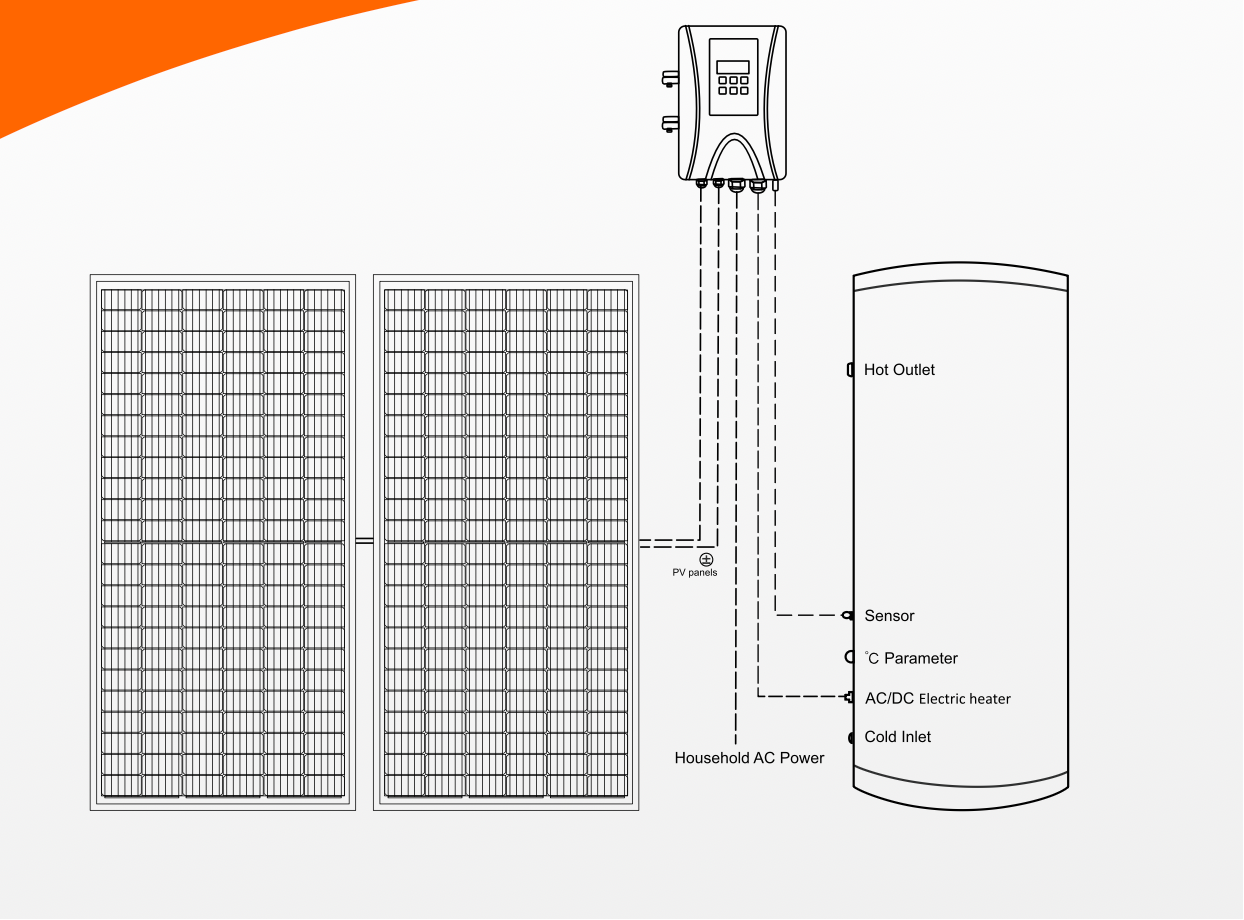
PV solar water heater configuration: a documented alternative route where photovoltaic input drives heating through an MPPT controller with DC/AC automatic switching.
The Southeast Asia 80-Room Hotel Case in Operational Terms
The reference project is a complete solar hot water system for a small and medium-sized hotel in Southeast Asia, serving daily water supply for 80 guest rooms and public bathing areas, and supporting auxiliary regional heating. Three outcomes are documented: a stable service life of more than 15 years, a reduction of over 40% in electricity and gas costs after implementation, and constant-temperature hot water with minimal failures. The system replaced traditional electric and gas heating equipment to meet the stable heat demand of daily hotel operation.
Read as operating evidence rather than as a headline, the case answers the buyer's real question. The hotel did not eliminate purchased energy; it shifted the balance so that solar carried the base load and the remaining equipment handled the residual. That is consistent with the documented architecture in which solar provides heat generation and storage while electric heaters or heat pumps provide backup and compensation. The over-40% figure describes the movement in electricity and gas spending after that shift, not the elimination of those bills.
The climate detail is not incidental. The system is described as featuring high-adaptability vacuum heat collection modules with strong corrosion and weather resistance for Southeast Asia's hot-rainy climate. Corrosion resistance is also listed among the common project requirements for solar heating installations in commercial buildings, alongside water quality treatment, freeze protection for winter and roof load-bearing capacity. For a coastal or high-humidity hotel, collector framing and tank material are therefore service-life variables, not cosmetic choices.
Two further operational points are documented. The integrated design supports easy installation and low-cost maintenance, which matters where a hotel has limited plant-room access and cannot absorb long shutdowns. And the system applies smart temperature adjustment aimed at high energy efficiency in small-to-medium commercial projects, meaning the control layer is part of the delivered value rather than a separate aftermarket addition. The case also notes that lower carbon emissions support green-hotel compliance, an increasingly relevant reporting point for hospitality operators.
Configurable System Choices: Collectors, Tanks and PV Options
Because the hotel scenario is defined by its load profile rather than by a single product, the useful way to compare options is to match each documented product to the role it can play. The table below uses only documented parameters and documented application scopes.
| Option | Type | Documented parameters | Documented scope | Note for a hotel brief |
|---|---|---|---|---|
| HSC series | Heat pipe vacuum tube solar collector | 10 to 30 tubes; 58-1800 vacuum tube with heat pipe; aluminium alloy frame; Solar Keymark | Villa, hotel, house heating, spa centre, school | Documented as matched with CPS-FJ and CPS pressurised heaters for hotel and commercial hot water supply |
| FPC2.0 | Flat plate solar collector | 1, 1.5, 2 and 2.5 m²; 80 mm thickness; copper and aluminium alloy; Solar Keymark; OEM available | Swimming pool, housing heating, solar water heater | Flat-plate route paired with the CPS-FJ indirect unit |
| CPS-FJ series | Indirect solar water heater | 150, 200, 250, 300 L; flat type solar collector; SPCC with enamel coating; indirect tank for salty water; anti-freezing heat transfer media; Solar Keymark | Villa, house, hotel, school | Suits sites where water quality or frost requires a separated heat transfer circuit |
| CPS series | High-pressure solar geyser | 100 to 300 L; maximum operation pressure 6 bar, test pressure 9 bar; 58-1800 vacuum tube with heat pipe; 50 mm PU foam; 25 to 45 degrees; SS304, SS316, Duplex 2205, Duplex 32001 | House, villa, garden, gas station, car wash centre, small hotel, school | Pressurised draw at guest-room outlets; multiple inner-tank materials |
| CNP series | Non-pressure solar water heater | 60 to 500 L; 58-1800 vacuum tube; 50 mm PU foam; 25 to 45 degrees; SS304 or SS316 | House, villa, garden, gas station, car wash centre, small hotel, school | Non-pressure route where the hydraulic design allows it |
| PV Series | PV solar water heater | 100 to 500 L; 600 W per panel solar input; 800 W to 3500 W heating output; MPPT controller; DC/AC automatic switch; Duplex 2205 or Inox 316L; CE certified | Villa, house, apartment, camp | Documented scope does not list hotels; a hotel application requires project-level assessment rather than assumption |
The last row illustrates a discipline worth keeping throughout procurement. The PV Series is a legitimate configurable option in a hybrid-minded project, and it is CE certified with documented power input and output ranges, but its documented application scope stops at villa, house, apartment and camp. A specifier who wants it in a hotel plant should ask for the project-level configuration, not extend the catalogue scope by inference. The same caution applies to collector counts: ten tubes and thirty tubes are both HSC series, and only a project calculation decides which belongs on a given roof.
Solar Versus Electric and Gas Heating: What the Case Actually Shows
The comparison documented in the case is a replacement relationship. The solar system took over the base heat load that had been carried by traditional electric and gas heating equipment, and afterwards electricity and gas costs fell by more than 40%. That is a before-and-after outcome for one hotel, and it says something specific about how the economics of such a project work.
Electric resistance and gas-fired heating convert purchased energy into heat at the point of use, so running cost moves with consumption and tariff. A solar thermal system decouples part of the load from purchased energy, but only to the extent that collection and storage can cover it. The documented architecture makes the division explicit: solar performs heat generation and storage, while electric heaters or heat pumps provide backup and compensation. The saving therefore comes from the share of the daily load that solar actually carries across the year, not from the nameplate capacity of the collector field.
This is also why the storage decision is a cost decision. A bathing block that draws heavily within a short window will pull from the tank, not directly from the collectors. Under-sized storage pushes the shortfall onto the backup heater, and the electricity and gas line in the operating budget reflects that immediately. The case's constant-temperature result with minimal failures is therefore evidence about the whole assembly, including control and storage, not about collectors in isolation.
Where the fit boundary sits is equally clear. The documented 15-year-plus service life and the over-40% cost reduction were achieved in a Southeast Asian climate with a system specified for that site. A project in a frost-prone region adds freeze protection requirements, and a project with aggressive water chemistry leans toward an indirect circuit such as the CPS-FJ series with anti-freezing heat transfer media. Neither condition invalidates the approach; each changes the configuration and therefore the economics.
What Hotel Buyers Should Verify Before Committing
Verification is where an evaluation-stage buyer earns the savings. The following points are drawn from documented project requirements and documented supply capabilities, and each one should appear explicitly in a hotel proposal.
- Roof load-bearing and mounting. Roof load-bearing capacity is listed as a common project requirement for solar heating installations. Mounting frames and the structural assessment should be part of the scope, at the documented 25 to 45 degree collector angles.
- Water quality and corrosion strategy. Corrosion-resistant materials and water quality treatment are documented requirements. Where water is salty or aggressive, the indirect CPS-FJ route with an enamel-coated tank and separated heat transfer media is the documented answer.
- Freeze protection. Listed as a winter requirement for commercial buildings. Even in tropical projects, the specification should state how the circuit behaves in the coldest expected condition.
- Storage volume against the bathing schedule. The stored volume must be justified against the number of rooms and the bathing-area opening hours, using the project calculation rather than a per-room rule of thumb.
- Backup type and control sequence. Electric heater or heat pump linkage, with the switch-over logic and temperature setpoints defined in writing.
- Balance-of-system completeness. Circulation pumps, controllers, valves, mounting frames and piping accessories are documented supporting equipment; a quote that omits them shifts cost to the installation phase.
- Certification evidence. The HSC, FPC2.0, CPS-FJ, CPS and CNP items are documented with Solar Keymark; the PV Series is documented as CE certified. Ask for the certificate matching the exact model supplied.
- Supplier capability and lead time. Kesun Solar documents OEM, ODM and customizable production, a monthly capacity of 25,000 units, a lead time of 20 to 35 days, a minimum order quantity of one 40 ft container, 100% testing and remote after-sales support.
Supplier substance is checkable in the same way as product data. Zhejiang Kesun New Energy Co., Ltd. was formed from the merger of Haining Ensun Solar Technology and Zhejiang Yile New Energy, was founded in 2009, and operates a 42,000 m² manufacturing facility with 130 employees, 15 engineers and an annual output of 300,000 sets, exporting about 60% of production to markets including Mexico, the EU and Africa. The company states that it added PVT systems, 2205 duplex stainless steel tanks and heat pipe solar collectors after the merger, and that an in-house laboratory now runs salt spray and pulse testing on site. For a hotel buyer, those are the capabilities that determine whether a specification survives into a delivered plant.
Market Context: Where Solar Thermal Stands
External data supports the view that solar thermal is an established category rather than a niche experiment, though it describes the category and not any single project. The IEA Solar Heating and Cooling Programme's Solar Heat Worldwide 2024 report puts cumulative global solar heat capacity at 560 GWth by the end of 2023, covering 800 million m² of collector area. Grand View Research reports that evacuated tube collector technology held a 44.2% revenue share in 2023, which is consistent with the heat pipe vacuum tube route used in hotel-scale systems. Fortune Business Insights valued the global solar water heater market at USD 4.2 billion in 2025. On the trade side, Solar Heat Europe notes that HS code 841912 was introduced in 2023 to separate solar water heaters from the generic 841919 classification, which simplifies origin and duty questions in procurement.
For a hotel project, the practical reading of these figures is modest. A large installed base means spare parts, service familiarity and comparable references exist. It does not mean any specific configuration will deliver a specific saving, and the documented case outcome remains the only performance evidence cited here.
Fit Boundaries and Limitations to Design Around
A scenario-fit article is only useful if it states where the fit weakens. Several boundaries follow directly from the documented material.
First, sizing is project-specific. Working condition parameters require project-level calculation by climate zone, so a proposal that quotes a fixed collector count per room without a load calculation has skipped the step that determines whether the over-40% outcome is even approachable.
Second, roof area and load capacity set a hard ceiling. Where available area cannot host the required collector field, the realistic configuration shifts toward higher storage, stronger backup, or a different generation route; it does not shift toward claiming the same result from fewer collectors.
Third, the documented savings figure is a case result. It was achieved in a Southeast Asian hotel after replacing traditional electric and gas heating equipment, under that project's tariffs, weather and occupancy. Hotels in other markets should treat it as a reference point to be tested against their own consumption baseline.
Fourth, water chemistry and climate constrain material selection. Corrosion-resistant materials, water quality treatment and freeze protection are documented requirements, and the CPS-FJ indirect design exists precisely because some sites cannot put raw local water through a direct circuit.
Fifth, maintenance is low-cost but not absent. The CPS series is described in its specification as having no moving parts, and the case reports low-cost maintenance with an integrated design, but pumps, controllers and valves remain part of the system and belong in a service plan. Kesun Solar documents remote support as its after-sales provision, which a hotel should map onto local service availability before signing.
Indirect flat plate configuration: the separated circuit allows anti-freezing heat transfer media and is documented as suitable where water is salty.
Outlook: Hybrid and Storage-Led Systems
The direction of travel visible in the documented product set is toward hybrid generation and better storage rather than larger collector fields alone. Kesun Solar's post-merger additions include PVT (photovoltaic-thermal) systems, 2205 duplex stainless steel tanks and heat pipe solar collectors, and the PV Series already combines photovoltaic input, MPPT control and DC/AC automatic switching in a single tank-based unit. Production has also been upgraded with high-pressure automatic foaming, robotic packaging, laser welding and butt welding, alongside in-house salt spray and pulse testing.
For hotels with public bathing areas, that combination points to a future in which the collector field, the storage tank and the backup heat source are treated as one controllable plant, with the solar share managed intelligently rather than maximised blindly. The documented 15-year-plus service life of the reference system is a reminder that this is a long-hold asset decision: the configuration chosen at design stage will still be serving guests well after the equipment that was cheapest to buy has been replaced.
Frequently Asked Questions
Can solar water heaters deliver all-day hot water for hotel guest rooms and public bathing areas?
In the documented Southeast Asia case, a complete solar hot water system provided all-day domestic hot water for 80 guest rooms and public bathing areas, with support for auxiliary regional heating, and delivered constant-temperature hot water with minimal failures across a stable service life of more than 15 years. The system worked as heat generation and storage combined with electric heater or heat pump backup, rather than as a collector field operating without support equipment.
Which Kesun products are specified for hotel and commercial hot-water projects?
Kesun Solar documents its HSC series solar collectors as matching well with CPS-FJ and CPS series pressurised solar water heaters, a combination intended for hotels and commercial buildings that need stable large-volume domestic hot water. The CPS-FJ series is an indirect unit with an enamel-coated tank that can use anti-freezing heat transfer media, while the CPS series is a high-pressure unit rated at a maximum operation pressure of 6 bars with a 9-bar test pressure.
How large a cost reduction can a hotel expect from a solar hot water system?
The documented case reports a reduction of over 40% in electricity and gas costs after implementation, in a hotel that replaced traditional electric and gas heating equipment. That figure belongs to one project and its operating conditions. The saving a different hotel achieves depends on how much of its daily load the collector field and storage can carry across the year, its energy tariffs, its bathing schedule and its climate, and it should be estimated from that hotel's own consumption baseline.
What special requirements does a hotel solar installation impose on the building?
Documented project requirements include corrosion-resistant materials, water quality treatment, freeze protection for winter and roof load-bearing capacity. The installation also requires supporting equipment such as circulation pumps, controllers, valves, mounting frames and piping accessories, and systems operating in different climate zones need their working condition parameters calculated at project level rather than taken from a standard table.
What service life and maintenance profile should a hotel plan for?
The reference system has a stable service life of more than 15 years, and the case describes an integrated design that supports easy installation and low-cost maintenance, with smart temperature adjustment contributing to energy efficiency in small-to-medium commercial projects. Pumps, controllers and valves remain part of the plant and should be covered by a service plan; Kesun Solar documents remote support as its after-sales provision.
Does Kesun Solar support customization for hotel projects, and what are the documented supply parameters?
Kesun Solar documents OEM, ODM and customizable production, including customization by capacity, type and system configuration, with a monthly capacity of 25,000 units, a lead time of 20 to 35 days, a minimum order quantity of one 40 ft container, 100% testing and remote after-sales support. Individual product lines also carry their own options: the FPC2.0 flat plate collector is offered in four sizes with OEM available, and the CPS series offers inner tank materials spanning SS304, SS316, Duplex 2205 and Duplex 32001.
For readers who need the underlying product data behind these configurations, the Kesun Solar 2025 product brochure is available for download and lists the collector, tank and PV options referenced in this reference.
Tem questões ou precisa de mais detalhes?
Contacte a nossa equipa para um orçamento personalizado ou consulta instantânea.
Solicitar orçamento
Preencha o formulário abaixo e a nossa equipa entrará em contacto com uma proposta personalizada.
Chat direto do WhatsApp
Prefere conversar em tempo real? Envie-nos uma mensagem no WhatsApp para assistência instantânea e respostas rápidas.
- Obter orçamento personalizado
- Partilhar fotos ou documentos
- Discuta as suas necessidades diretamente
Geralmente responde em 5–30 minutos durante o horário de expediente.