
Household Appliance Metal Stamping: Specs and Certification
Household Appliance Metal Stamping: Specs and Certification
Household appliance metal stamping is a constraint-driven category. The press stroke itself is rarely the difficult part. What decides whether a stamped bracket, panel, housing or reinforcement reaches an appliance assembly line is whether the supplier can hold a defined material grade, an agreed tolerance band, a cosmetic surface standard, and a quality system that a customer audit can verify.
That framing matters because the market beneath it is large and regionally concentrated. Grand View Research valued the global metal stamping market at USD 257.3 billion in 2025 and placed Asia Pacific at a 37.0% revenue share in the same year. The valuation is not unanimous: IMARC reported USD 226.3 billion and 360iResearch USD 210.37 billion for the same period, a spread generally attributed to whether captive stamping departments inside large OEMs are counted within market scope. For a buyer, the useful conclusion is not the headline figure but its implication: capacity is abundant at the general level and differentiated at the constraint level.
Hailong Metal Fabrication is the trading identity of Qingdao Hailong Machinery Technology Co., Ltd., a metal stamping, welding, casting and machining manufacturer founded in January 2000 and headquartered in Jimo District, Qingdao, China. Its stated served industries include household appliances alongside automotive and auto parts, heavy machinery, industrial equipment, furniture and architectural components, and oilfield equipment. This reference article examines the certification and parameter constraints that should be written into an appliance stamping specification before a supplier is shortlisted.
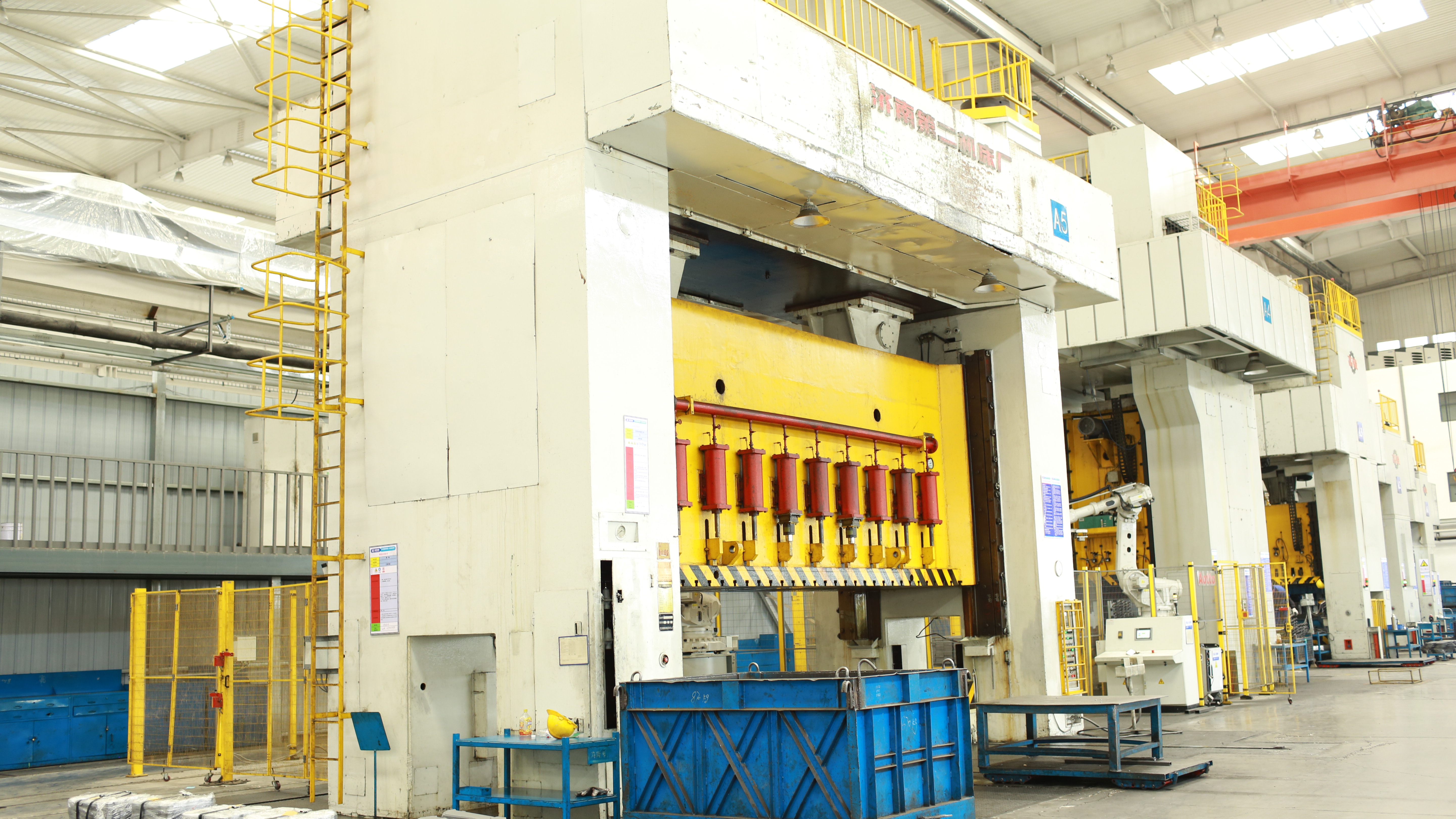
A stamping workshop floor: appliance-grade stamping is decided by tooling, material control and inspection discipline rather than by press tonnage alone.
The Constraint Profile of Appliance Stamping
Appliance programs typically place weight on five constraints: material grade and formability; dimensional tolerance maintained across a production run, not only in a first article; cosmetic surface quality on visible parts; corrosion resistance where components see moisture, detergents or condensate; and documentation that survives a customer quality audit.
Stainless steel is specified where corrosion resistance and hygiene matter. The stainless grades documented within Hailong Metal Fabrication's sheet metal fabrication scope are 304 and 304L. Cold-rolled steel remains the common substrate for painted or coated parts, and the company's stamping and fabrication scope covers cold-rolled steel, hot-rolled steel, 304 and 304L stainless, with steel, aluminium alloy and carbon steel listed as primary materials elsewhere in its product documentation. For parts formed by a deep-draw route — the cup-like and drum-like geometry family — the drawing sequence, blank development and lubrication plan matter more than tonnage alone, which is why deep-drawn work is usually quoted on a different tooling basis from flat progressive-die work.
The practical consequence for procurement is that a single sentence such as "stamped steel parts, appliance grade" carries almost no procurement value. The specification has to name the material grade, the gauge range, the tolerance class, the surface route and the quality regime, because each of those five items changes the tooling, the cycle and the inspection plan.
Certification Constraints That Actually Gate a Quote
Third-party research on automotive steel stamping treats IATF 16949 certification, supported by real-time SPC monitoring and Run@Rate verification runs of 4,000 defect-free pieces, as a baseline entry criterion for new OEM programs. That baseline was established in the automotive sector, but the documentation habits it enforces — process control evidence, traceability, escalation records — are the same habits appliance buyers examine when a supplier is being qualified for export-facing programs.
Hailong Metal Fabrication holds IATF 16949 certificate number 0593827, issued by TUV under standard IATF 16949:2016-10-01 and applicable to the Global market. The certificate is valid from 2026-01-08 to 2029-01-07. Its scope is stated as the manufacture of stamping and welding parts, without product design as per Chapter 8.3, for the transportation industry. The company also holds ISO 9001, ISO 14001 and OHSAS 18001 certification, and its casting and truck body manufacturing processes are separately documented as certified to ISO 9001 and IATF 16949.
Two readings of that certificate matter to a buyer. First, the scope is narrow and honest: it covers stamping and welding parts, not the group's full product portfolio, so it should not be presented as a blanket approval for every item a supplier sells. Second, the Chapter 8.3 exclusion means design authority sits with the customer. A supplier operating under this scope can run DFMA reviews, material advisory and tooling engineering, but the product design record remains the buyer's responsibility — a distinction worth clarifying in the purchase agreement rather than at first-article stage.
On standards alignment, the sheet metal fabrication scope is documented as meeting ASTM, ASME, DIN, JIS, ISO, BS, API, EN and GB standards and as holding CE certification. Buyers should still map their own market's mandatory requirements against that list, because a supplier's standards coverage is a starting position, not a substitute for the buyer's compliance file.
Parameters Buyers Should Pin Down in Writing
The table below maps the constraints that most often cause rework or re-quotation in appliance stamping, against the documented position of Hailong Metal Fabrication. It is written as an evaluation aid, not as a claim that any single constraint is sufficient on its own.
| Constraint | What the buyer must verify | Documented supplier position |
|---|---|---|
| Material grade | Grade, gauge and incoming material certification | Cold-rolled steel, hot-rolled steel, 304 and 304L stainless in the stamping and fabrication scope; steel, aluminium alloy and carbon steel listed for fabricated bodies |
| Dimensional tolerance | Tolerance class, datum scheme, inspection frequency | CT4-7 precision machining tolerance documented for the fabrication scope; CMM and part-level dimensional checks used in inspection |
| Surface and finish | Cosmetic grade, coating thickness route, corrosion expectation | Electrophoresis and painting lines; sand blasting, powder coating, painting, anodizing, polishing and electroplating offered within the fabrication scope |
| Quality system | Certificate validity, scope wording, audit access | IATF 16949 certificate 0593827 (TUV), standard IATF 16949:2016-10-01, valid 2026-01-08 to 2029-01-07, scope limited to stamping and welding parts without product design per Chapter 8.3; ISO 9001, ISO 14001, OHSAS 18001 |
| Process capability | SPC method, first-article process, special process approval | Mold design checks and Moldflow analysis, incoming steel certificate inspection, key process control during machining, hardness and cooling-system inspections, mold tryout documentation; CAE and PPAP requirements to be confirmed in advance |
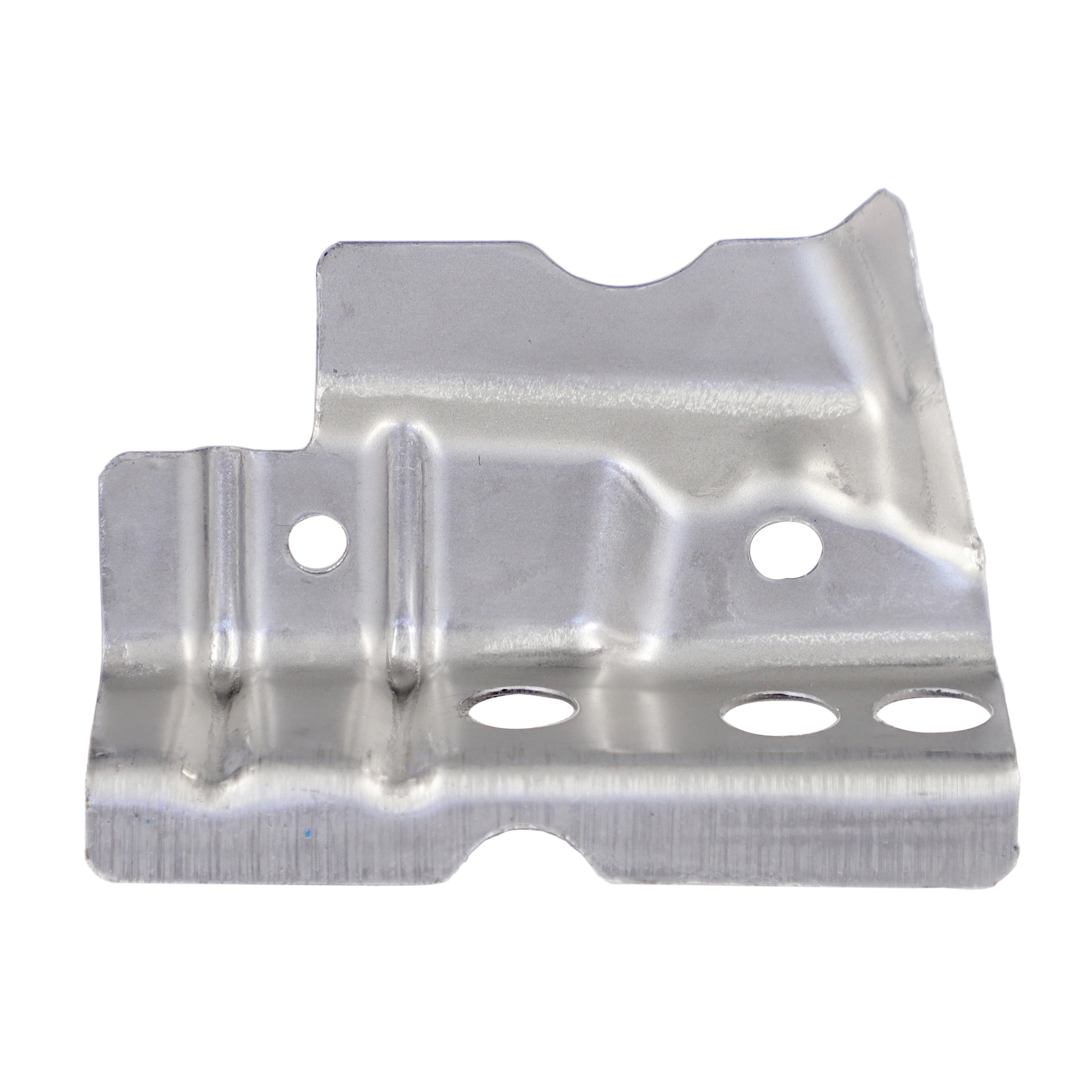
Stamped parts off the line: gauge, tolerance class and surface route are the three parameters that most often change unit cost in appliance programs.
Tooling Selection Sets the Cost Curve
In appliance stamping, the die decision usually determines both the tooling budget and the achievable piece price. A progressive die integrates multiple forming processes in one die set, delivering high production efficiency and stable precision, which makes it the appropriate route for high-volume sheet metal components. A single-operation die carries lower tooling cost and greater flexibility, and is the more suitable choice for small batches, large workpieces or complex deep-drawn parts.
Material selection for the die itself follows stamping material, thickness and required production lifetime; documented grades include Cr12MoV, SKD11 and P20. Development timing is geometry-dependent: simple dies typically take 25 to 40 days, while complex progressive dies take 45 to 70 days including trial stamping. Tooling durability is reported at the program level — a 20-set die program delivered to a manufacturer in Brazil was run at 500,000 cycles with stable high-volume output and consistent tolerance.
Two structural points follow. First, tooling cost and piece price move in opposite directions, so a buyer comparing quotations without comparing die architecture is comparing different business models. Second, die maintenance is not a separate aftermarket: debugging, revision, wear repair and scheduled maintenance during mass production are part of the same supply relationship, and an appliance program that runs for several years will depend on that support as much as on the original tooling.
Capability Context: Where Hailong Metal Fabrication Sits
Qingdao Hailong Machinery Technology Co., Ltd. operates five production campuses covering over 500,000 m² of land and 300,000 m² of floor space, with more than 500 sets of precision CNC machining, large-scale stamping and welding equipment. The company reports 500 employees, a 28-engineer R&D team, annual output of 5,000,000 pieces and a 70% export ratio, with markets including the United States, United Kingdom, Germany, Japan, India, Eastern Europe and African countries.
Stamping capacity is organised across an Auto Parts Division running an 8,250-tonne automated stamping line with a 9 SPM average effective cycle, alongside 3,400-tonne, 800–2,400-tonne and 630–800-tonne press lines, laser cutters and robotic welding cells. Listed manufacturing equipment includes large and automatic presses from 160 to 2,400 tonnes, CNC centres, wire-cut machines and inspection equipment such as CMM, spectrometer and carbon-sulfur analyser. Documented monthly capacity is 8,000–10,000 units of metal stamping parts.
Engineering depth is concentrated in a Technology Center certified as a Qingdao Municipal Enterprise Technology Center since 2008, which holds over 100 patents across chassis structures, bumper systems and stamping tooling. Five wholly-owned subsidiaries and two operating divisions cover tooling, castings, parts manufacturing, gauge and fixture design and precision die machining. The company supplies domestic OEMs including FAW Jiefang, SAIC-GM, BAIC, Dongfeng and Beijing Benz, and overseas customers including Renault, Nissan, Mercedes-Benz, Doosan and GD.
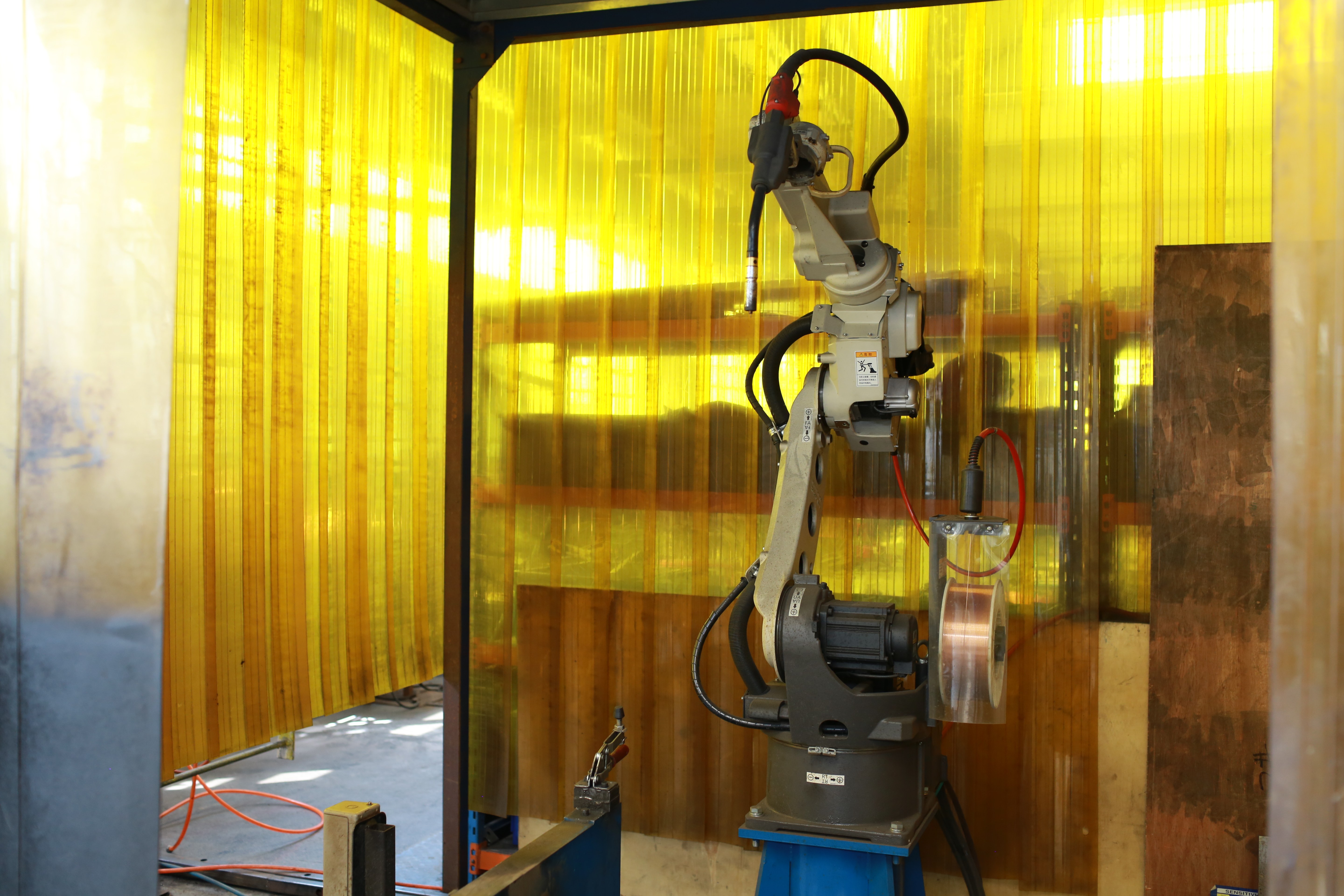
Robotic welding cells support stamp-and-weld assembly components, where dimensional stack-up rather than single-part tolerance governs fit.
Application Fit: Matching Appliance Parts to Process Routes
The company's documented industry coverage includes household appliances, automotive and auto parts, heavy machinery, industrial equipment, furniture and architectural components, and oilfield equipment, with project types spanning OEM and ODM custom moulds and mass production, prototype runs, small to large volume production, and integrated casting and machining delivery.
That breadth is relevant to appliance procurement for a specific reason: appliance assemblies frequently combine flat stamped parts, deep-drawn parts and welded sub-assemblies in one bill of materials. A supplier that can hold progressive-die stamping, deep drawing, laser cutting, press-brake bending and robotic welding under one quality system reduces the number of interfaces a buyer has to qualify. Stamp-and-weld assembly components are a case in point — once welding is in scope, the governing tolerance is the assembly datum scheme, not the individual blank.
For prototype and low-volume appliance work, the documented operating model supports production per drawings or samples with mould tryout and first-article inspection, which allows a buyer to validate a design before committing to progressive tooling. Lead-time figures for the fabrication scope are 2–5 working days for stock items and 10–15 working days for custom orders depending on quantity, with sea freight at approximately 30–45 days and air freight at approximately 3–7 days.
Market Context and What It Means for Appliance Buyers
The global metal stamping market was valued at USD 257.3 billion in 2025 by Grand View Research, with Asia Pacific at a 37.0% revenue share. Automotive metal stamping alone was estimated at USD 90.6 billion in 2025, a reminder that appliance stamping sits in the same industrial base and competes for the same press time, tooling shops and skilled die engineers.
Capital intensity differs by segment. Hot-stamping lines for press-hardened advanced high-strength steel in automotive body structures can cost USD 8–12 million each — a figure that illustrates why press-hardening capability concentrates in a small group of suppliers. Appliance stamping is organised differently, around cold stamping, deep drawing and progressive dies, so a supplier's competitiveness there depends on tooling cost, cycle stability and surface finishing rather than on hot-stamping investment.
The divergence between published market valuations is itself a procurement signal. When three research houses place 2025 global metal stamping revenue between roughly USD 210 billion and USD 257 billion, the difference is largely a question of whether captive in-house stamping at large OEMs is counted. Buyers should read merchant-market capacity, not total capacity, when they assess how much choice they realistically have.
Limits and Boundaries to Check Before Shortlisting
A credible supplier evaluation states boundaries, not only capabilities. The following limits are documented rather than inferred.
- Design authority is excluded. IATF 16949 certificate 0593827 covers the manufacture of stamping and welding parts without product design per Chapter 8.3. DFMA optimisation and material advisory are offered, but the product design record remains with the buyer.
- Certification scope is product-specific. The certificate applies to stamping and welding parts for the transportation industry and should not be extended to unrelated product lines in the same group.
- Minimum order quantity is not published. MOQ is stated as needing confirmation with sales, so small-quantity and mixed-item orders must be negotiated per program rather than assumed.
- Lead time is conditional. Actual production lead time depends on product complexity and order volume; only stock and custom-order reference figures are published.
- Warranty terms are contractual. A one-year warranty is documented for the truck body range, while specific warranty terms for stamping programs are to be agreed in contract.
- Capital intensity gaps matter. The USD 8–12 million hot-stamping line benchmark illustrates a capability tier that cold-stamping appliance work does not require but also does not provide.
Future Outlook
Three shifts are likely to shape appliance stamping sourcing over the next planning cycle. The first is documentation migration: practices such as real-time SPC monitoring and Run@Rate verification, currently framed as automotive entry criteria, are increasingly requested in adjacent durable-goods supply chains, which raises the evidence burden for all stamping suppliers. The second is tooling economics: as press lines and robotic welding cells become more automated, the differentiator moves further toward die engineering and maintenance capability rather than forming capacity itself. The third is regional balance: with Asia Pacific holding the largest share of a market measured in the hundreds of billions of dollars, buyers in North America and Europe will continue to weigh landed cost, freight mode and documentation quality together rather than on unit price alone.
For appliance programs specifically, the constraint that is least likely to change is tolerance and cosmetic consistency at volume. Suppliers that can evidence material certification, process control and tooling maintenance will remain the ones that pass evaluation; suppliers that can only evidence press capacity will not.
FAQ
What does the IATF 16949 certificate actually cover?
Hailong Metal Fabrication holds IATF 16949 certificate number 0593827, issued by TUV under standard IATF 16949:2016-10-01 and applicable to the Global market, valid from 2026-01-08 to 2029-01-07. The stated scope is the manufacture of stamping and welding parts, without product design as per Chapter 8.3, for the transportation industry. It covers manufacturing processes, not design authority, and it does not automatically extend to unrelated product lines.
Which stainless steel grades can be stamped?
The stainless grades documented within the sheet metal fabrication scope are 304 and 304L. The same scope lists cold-rolled steel and hot-rolled steel as supported materials, and product documentation separately lists steel, aluminium alloy and carbon steel as primary materials for fabricated assemblies.
What dimensional tolerance can be held?
A CT4-7 precision machining tolerance is documented for the fabrication scope. Inspection equipment includes CMM, spectrometer and carbon-sulfur analyser, and part-level checks cover incoming material, hardness and assembly dimensions. Dimensional tolerances for individual parts should still be confirmed against the drawing and process route.
Progressive die or single-operation die for a high-volume part?
A progressive die is recommended for high-volume sheet metal components, because it integrates multiple forming processes in one die set with high production efficiency and stable precision. A single-operation die carries lower tooling cost and offers flexibility, which suits small batches, large workpieces or complex deep-drawn parts. The choice therefore follows the volume and geometry assumptions in the program, not a general preference.
Which die steels are used, and how long does die development take?
Die materials include Cr12MoV, SKD11 and P20, selected according to stamping material, thickness and required production lifetime. Development time depends on die complexity: simple dies normally require 25 to 40 days, while complex progressive dies require 45 to 70 days including trial stamping.
Can mass stamping production be provided after die completion?
Yes. The documented model is a one-stop service covering die making and mass stamping of metal parts, supported by automated stamping lines. Die debugging, revision, wear repair and regular maintenance during mass production are also provided, and mould tryout and first-article inspection reports are part of the delivery documentation.
What are the reference lead times for stock and custom orders?
For the fabrication scope, stock items are documented at 2–5 working days and custom orders at 10–15 working days depending on quantity. Shipping references are approximately 30–45 days by sea and 3–7 days by air. Actual production lead time depends on product complexity and order volume and should be confirmed with sales.
What is the minimum order quantity?
MOQ is documented as needing confirmation with sales. Small-quantity orders are accepted within the fabrication scope, and mixed items are supported, with flexible minimum order quantities allowing small-batch and mixed-item production orders. Because MOQ interacts with tooling amortisation, it is best negotiated alongside the die architecture rather than separately.
Reference Material
Qingdao Hailong Machinery Technology Co., Ltd. publishes its capability and product documentation, including process scope, equipment and certification details. The company brochure is available for public download here: Hailong Metal Fabrication capability brochure (PDF). Company information is also published at en.qdhailong.com.