
How Atrium Tent Reliability Is Proven: F1, Olympics, Gulf
International event organizers rarely lose a programme because a structure looked wrong. They lose it because a venue was late, could not be anchored safely, or failed a compliance check weeks before an opening ceremony that could not be moved. Reliability in the atrium tent and large-span structure segment is therefore not a tone of voice; it is a documented record of structures delivered, installed and operated under conditions where failure would be public.
This article examines how a supplier can demonstrate that reliability with checkable evidence rather than adjectives, using documented deployments by KENTEN Structures across Olympic and Asian Games venues, Formula 1 circuits and Gulf exhibition projects. KENTEN Structures is an aluminium structure supplier founded in 2001 that designs, manufactures and delivers temporary venues, exhibition halls, grandstands and modular infrastructure, with a worldwide operation center in Ontario, California and manufacturing centers in China, the USA and the Middle East.
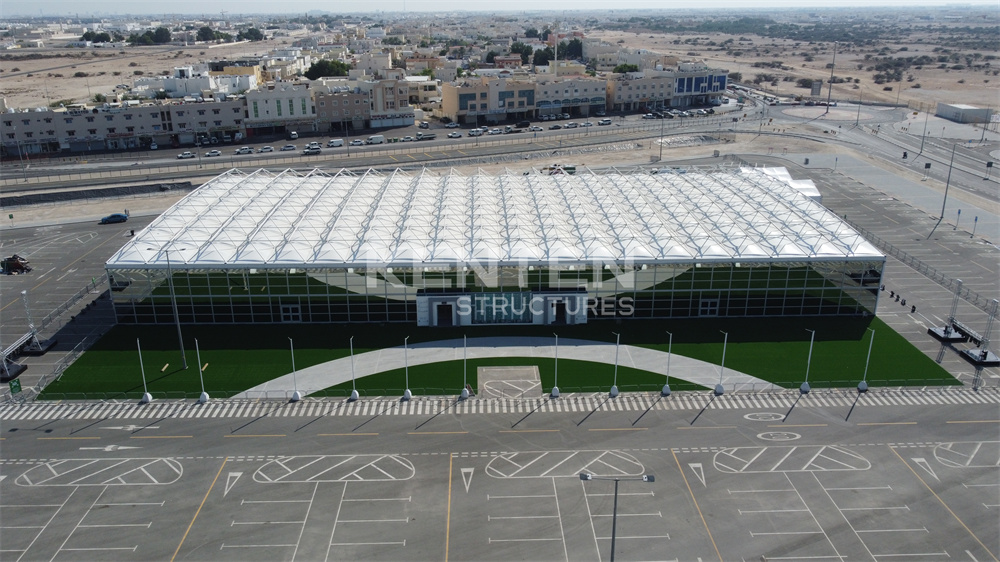
A large-span, column-free exhibition structure delivered for the Doha Photography Festival in Qatar — an example of a Gulf project where interior flexibility was specified as a hard requirement.
Why Reliability Is an Evidence Problem, Not a Claim
Temporary event infrastructure sits in an unusual procurement category: it is purchased like a product, engineered like a building, and scheduled like a service. That combination is why evaluation-stage buyers increasingly assess suppliers on evidence instead of catalogue language.
High-scrutiny events apply constraints that ordinary commercial projects do not: fixed opening dates, multi-venue logistics, security perimeters and public accountability. A supplier that has delivered inside those conditions has demonstrated something beyond manufacturing capability — engineering review, production scheduling and installation discipline under deadline pressure.
The practical difficulty is that most buyers cannot audit a factory or re-run a structural calculation themselves. Case records, third-party certification and published specifications become the working evidence base, and each of the three answers a different question.
What Counts as Verifiable Proof
For a buyer in the research and evaluation stage, the useful question is not whether a supplier describes itself as reliable, but which claims can be checked independently and against what document.
| Evidence category | What it demonstrates | How a buyer verifies it |
|---|---|---|
| Named event deployments | Ability to deliver at scale inside a fixed operational window | Request project lists with dates, quantities, structure types and functions; confirm through references |
| Independent certification | Compliance with management and structural standards | Check certificate numbers, issuing bodies, scope and validity dates on the issuer register |
| Published structural specifications | Load, material and fire performance of the standard configuration | Compare wind rating, snow load, frame alloy and fabric weight against site requirements |
| Quality control process | Consistency between units in a multi-unit order | Incoming raw material inspection and full pre-shipment inspection records |
| Post-delivery support | Operational continuity after handover | Remote technical support arrangements, spare parts supply, installation guidance |
Case Evidence: Olympic and Multi-Sport Deployments
Multi-sport events test suppliers differently from single-venue projects: one supplier must deliver several structure types, at several locations, inside one immovable operational window.
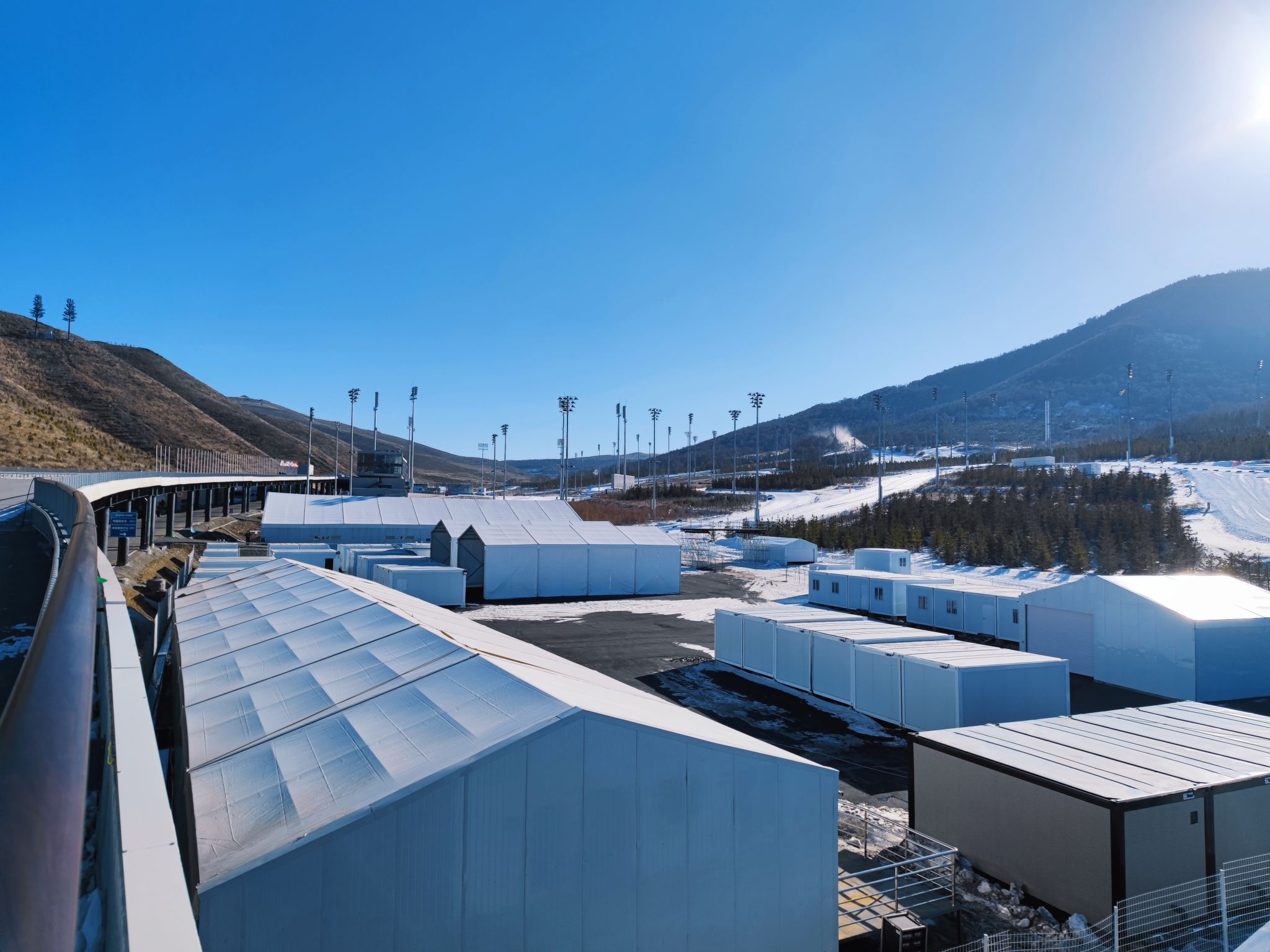
Temporary operational structures supplied for the 2022 Beijing Winter Olympic Games, where use was concentrated in staff, security and command functions rather than spectator areas.
2022 Beijing Winter Olympic Games — 50 units
KENTEN Structures was designated as a key infrastructure supplier for the 2022 Beijing Winter Olympic Games and provided 50 units of A-structure tents and double-decker tents across competition venues in Beijing. The functions were operational rather than decorative: security checkpoints, staff offices, dining areas, meeting rooms and command centers. Winter conditions make snow and wind performance a functional requirement in this project rather than an optional upgrade, and the project evaluation highlighted rapid installation, engineering accuracy and adaptability across different venues.
For a buyer, the transferable point is configuration management. Delivering several structure types into different venue layouts within one programme requires engineering review per site, not a single repeated product.
Hangzhou Asian Games — 100 units
At the Hangzhou Asian Games, staged in 2023, KENTEN was selected as a key infrastructure partner and supplied 100 units of A-structure tents and pagoda tents. These were installed in public areas of competition venues and satellite venues in and around Hangzhou, supporting spectator security checks, temporary storage and restroom facilities.
This deployment is notable for volume and geographic dispersion. One hundred units distributed across multiple sites require production scheduling, transport planning and locally managed installation — a different operational challenge from a single landmark build.
2008 Beijing Olympic Games — 50 units
KENTEN's earlier Olympic record covers the 2008 Beijing Olympic Games, where it acted as an official designated supplier of tents and temporary structures, supplying A-shaped structure tents and pagoda tents. Those 50 units served security inspection channels, audience rest areas, VIP reception areas, media service points and operation management areas across Beijing and surrounding areas.
Case Evidence: Motorsport — F1 Canada and F1 Miami
Motorsport adds a different requirement set. Circuits are linear sites with tight safety envelopes, defined spectator sightlines and broadcast contracts that cannot be rescheduled. Grandstands and hospitality structures must be positioned precisely, and any structural defect becomes simultaneously a safety issue and a reputational one.
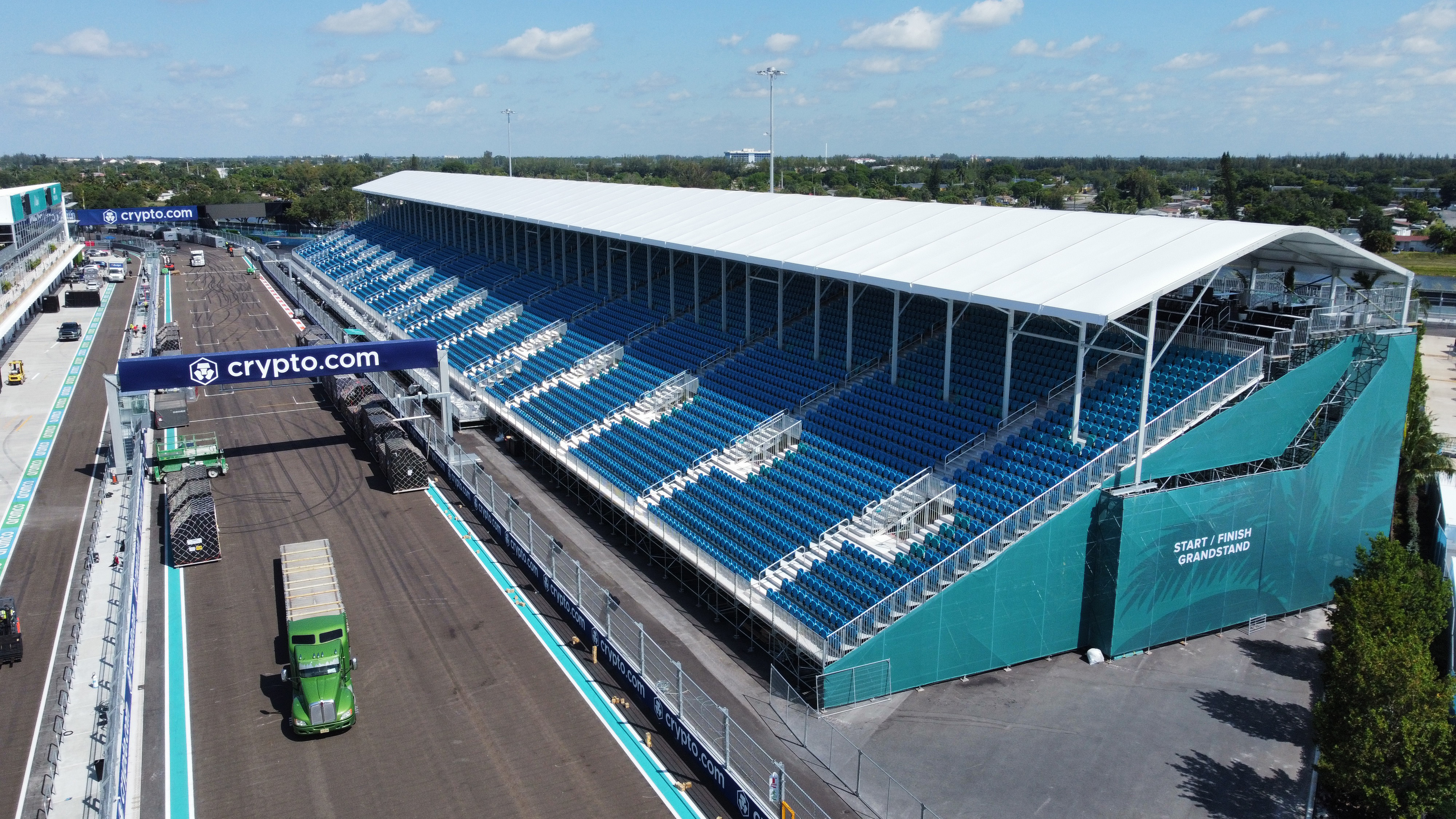
Customised aluminium grandstand systems positioned along the racetrack for the Formula 1 Miami Grand Prix.
Formula 1 Canada — 10 modular units
For Formula 1 in Canada, KENTEN supplied a modular structure solution of 10 units customised as VIP lounges, hospitality suites, viewing platforms and operational areas. The project emphasised construction efficiency, flexible space planning and performance under intensive event operations, with structures adapted to different venue requirements inside the same event.
Formula 1 Miami Grand Prix — custom grandstands
At the Formula 1 Miami Grand Prix, the scope shifted to large-scale aluminium grandstand systems serving thousands of spectators along the racetrack. The structures were customised for span, length, height and layout to fit the circuit's constraints and to position sightlines safely.
That level of customisation is now a standard commercial option rather than an exception: the Structure Tent range (models K1 to K10) supports span widths from 3 m to 80 m, eave heights from 2.5 m to 8 m, and unlimited length extended in 5 m bay spacing, using high-strength 6061-T6 / 6082-T6 aluminium alloy frames.
Case Evidence: Column-Free Exhibition Halls in Qatar and Kuwait
Gulf exhibition projects test a third capability: the interior quality of the space delivered.
For the Doha Photography Festival in Qatar, a 2025 cultural event on the national agenda, organizers commissioned a landmark temporary exhibition building — a pyramid structure exhibition hall. The brief combined modern structural design, a customisable interior layout and strict engineering standards so that the building could host multi-functional art programming.
In Kuwait, KENTEN supplied a large-span modular building for exhibition use. Its defining specification is a 100% column-free interior, which maximises usable floor area: without internal columns, exhibition runs, booth layouts and sightlines from the entrance remain uninterrupted. For exhibition organizers, column-free span is frequently the difference between a workable floor plan and a compromised one.
Technical Explanation: What the Specifications Actually Say
Case records show what a supplier has done. Specifications show what a structure can be expected to do. Both are needed, and they should be read together.
Atrium Tent (model A1)
- Frame: 4-channel, hard-pressed extruded aluminium alloy 6061/T6 profile.
- Cover: PVC-coated polyester textile in white, transparent or customised colour, 750–900 g/m², flame retardant to DIN 4102 B1, M2 and CFM.
- Wind resistance: 120 km/h.
- Operating temperature range: -30°C to +70°C; stated service life more than 15 years.
- Optional walls: 750 g/m² PVC cover, glass wall, ABS wall, sandwich wall, hard / solid wall and rock wool wall.
- Fixing: ground anchor, expandable bolt or weight plate; suitable ground situations include grassland, earth land, asphalt, cement ground and marble.
Structure Tent (models K1–K10)
- Span width 3 m to 80 m; length unlimited, extendable in 5 m bay spacing.
- Frame: high-strength 6061-T6 / 6082-T6 aluminium alloy; eave height 2.5 m to 8 m.
- Roof fabric: 850 g/m² PVC-coated polyester; sidewalls in PVC, glass, ABS or sandwich panel.
- Wind resistance up to 140 km/h (customisable); snow load up to 0.5 kN/m²; temperature range -30°C to +70°C.
- Flame retardant to DIN 4102 B1, M2 and NFPA 701; stated lifespan of 20+ years for the aluminium frame and 8–15 years for the PVC fabric.
Translated into procurement terms, four points matter most:
- Column-free span sets the floor plan. The 100% column-free interior delivered for the Kuwait exhibition project is the direct outcome of span engineering, not decoration.
- Bay spacing governs phased expansion. A 5 m bay module allows a structure to be lengthened between events, which is how multi-site programmes such as the 100-unit Asian Games deployment stay manageable.
- Wind and snow figures are site inputs. A 120 km/h atrium rating or a structure rating of up to 140 km/h must be compared with the actual exposure of the project site before specification.
- Fabric weight and fire classification affect approval. Covers of 750–900 g/m² with DIN 4102 B1, M2 or NFPA 701 classification are the values venue insurers and fire authorities ask for.
Certification as Procurement Evidence
Certification converts an internal quality claim into something a procurement team can check against a register.
| Certificate | Number | Issued by | Scope / market |
|---|---|---|---|
| ISO 9001:2015 (GB/T19001-2016) | 51816Q00846R3 | Shenzhen Zhongbiao International Testing and Certification Co., Ltd. | Global |
| ISO 14001:2015 (GB/T24001-2016) | 51815E00262R3 | Shenzhen Zhongbiao International Testing and Certification Co., Ltd. | Global |
| ISO 45001:2018 (GB/T45001-2020) | 51815O00263R3 | Shenzhen Zhongbiao International Testing and Certification Co., Ltd. | Global |
| CE marking, EN 1090-3:2019, execution class EXC2 | 8605682 | LL-C (Certification) Czech Republic a.s. | European Union; valid 10 April 2026 to 9 April 2029 |
The CE scope covers manufacturing of aluminium structures tents, including cutting, drilling, grinding, assembling and packaging. In addition, KENTEN states that all structures are produced and certified to IBC 2024, CBC 2025, ASCE 7-22, GB 50429 and EN 13782.
These references are not internal inventions; they correspond to standards a European or North American buyer will encounter independently. EN 13782:2015, published by CEN, sets structural safety requirements for temporary structures, including wind load resistance and fabric tension. EN 1090-3 governs the execution of aluminium structures and underpins CE marking. Flame retardancy for tent fabrics is regulated by NFPA 701 in the United States and DIN 4102 B1 in Germany, both aimed at self-extinguishing behaviour.
Comparison with Traditional Solutions — and Where the Limits Are
Temporary atrium and large-span structure tents are frequently compared with permanent venues. The comparison is legitimate, but it only holds when the constraints of both options are stated.
| Dimension | Temporary atrium / structure tent | Permanent venue |
|---|---|---|
| Delivery model | Manufactured off site, installed on site, demountable | Constructed on site as a fixed asset |
| Time to first use | Production lead time typically 30–45 days, plus site works | Longer design, permitting and construction cycles |
| Reuse | Can be dismantled, stored, relocated and reused across event editions | Tied to one location |
| Site requirements | Anchoring matched to substrate — grassland, earth, asphalt, cement or marble for atrium structures; concrete anchors or ballast for structure tents | Land title, foundations, utilities and long-term approvals |
| Design flexibility | Span 3–80 m, adjustable height, wall systems, glass, branding | Fixed once built |
| Service life | Atrium structures stated at more than 15 years; structure tents 20+ years for aluminium and 8–15 years for PVC fabric, with maintenance | Decades with major maintenance |
| Commercial logic | Capacity can follow the event calendar | Capacity is fixed by geography |
The boundary matters as much as the advantage. A temporary atrium or structure tent is not a permanent building and should not be specified as a direct substitute. Three constraints recur in real projects:
- Site-specific engineering. Published ratings describe standard configurations. Where site exposure, terrain or height exceeds the rated figures, the project needs specific engineering rather than the catalogue value.
- Anchoring dependency. Fixing solutions — ground anchors, expandable bolts, weight plates or concrete anchors — are selected for the substrate. On weak or uneven ground, anchoring design can become the critical path of the programme.
- Climate configuration. Snow load is configurable rather than universal, so a structure intended for winter operation must be configured against local snow data before it is ordered.
Market Trend Analysis
Demand for temporary structures does not move independently of the event economy; it follows it. Grand View Research valued the global event management market at USD 1,160.4 billion in 2024 and projected a 6.7% CAGR through 2033. Growth of that scale increases the number of events requiring venue capacity, and a meaningful share of that capacity is temporary by design — festivals, exhibitions, sports hospitality and public programmes that cannot justify permanent construction.
Supply-side data adds a second signal. China's exports of awnings, tents and sails (HS Code 6306) totalled approximately USD 3.11 billion in 2024, maintaining a 53.3% share of global exports in the category, according to the Observatory of Economic Complexity. For buyers, that concentration is a sourcing consideration: it raises the value of verifying certification, delivery record and lead-time reliability rather than assuming that country of origin alone guarantees performance.
The procurement consequence is already visible in specifications. Organizers increasingly request certificate numbers, wind and snow ratings, and named event references — the same three categories of evidence mapped earlier in this article.
Future Outlook
Three developments are likely to shape how buyers evaluate atrium tent and large-span structure suppliers over the next few years.
- Certification-led procurement. As more public and broadcast-linked events formalise compliance requirements, certificate numbers and standard references will move from optional attachments to tender prerequisites.
- Multi-level and modular capacity. Double-decker and triple-decker structures, grandstand systems and modular exhibition buildings let organizers add capacity on constrained sites without acquiring land — the same logic behind the column-free Kuwait exhibition hall and the Qatar pyramid structure.
- Manufacturing proximity as a lead-time tool. With manufacturing centers in China, the USA and the Middle East and regional offices in China, Hong Kong, Singapore and the Middle East, suppliers can shorten delivery routes for projects in the USA, EU and Middle East markets, which represent the core demand areas for KENTEN.
Production capability underpins that delivery: KENTEN operates an 80,000 m² factory with roughly 200 employees, an annual output of 1,000,000 m², a 10-engineer R&D team, an OEM / ODM model, a monthly capacity of 1,000,000 m², a lead time of 30–45 days, a minimum order quantity of one unit, and 100% full inspection before shipment alongside incoming raw material inspection.
KENTEN publishes a product catalog covering structure tent and atrium tent configurations: KENTEN Catalog.
FAQ
Ask for named projects with dates, quantities, structure types and functions, then confirm them through references. A verifiable record is specific rather than cumulative: KENTEN's documented deployments include 50 units of A-structure and double-decker tents at the 2022 Beijing Winter Olympic Games, 100 units of A-structure and pagoda tents at the Hangzhou Asian Games, 10 modular units customised as VIP lounges and viewing platforms for Formula 1 in Canada, aluminium grandstand systems at the Formula 1 Miami Grand Prix, and exhibition structures in Qatar and Kuwait. Each of these can be cross-checked against certification scope and project references.
For the European Union, EN 1090-3 governs the execution of aluminium structures and underpins CE marking, while EN 13782:2015 sets structural safety requirements for temporary structures including wind load resistance and fabric tension. In the United States, NFPA 701 regulates flame retardancy of tent fabrics, and project-level code compliance applies; KENTEN states that its structures are produced and certified to IBC 2024, CBC 2025, ASCE 7-22, GB 50429 and EN 13782. Management system certificates for the Structure Tent product include ISO 9001:2015 (51816Q00846R3), ISO 14001:2015 (51815E00262R3) and ISO 45001:2018 (51815O00263R3), all globally applicable, plus CE certificate 8605682 issued by LL-C (Certification) Czech Republic a.s. under EN 1090-3:2019, valid from 10 April 2026 to 9 April 2029.
Published figures describe standard configurations and must be compared with the specific site. The Atrium Tent (model A1) is rated to 120 km/h wind resistance, and the Structure Tent range (models K1–K10) supports wind resistance up to 140 km/h when customised, with snow load up to 0.5 kN/m². Because snow load is configurable rather than universal, structures intended for winter or high-exposure locations require configuration matched to local wind and snow data before ordering.
Three limits are consistent. First, anchoring depends on the substrate: atrium structures are designed for grassland, earth, asphalt, cement and marble with ground anchors, expandable bolts or weight plates, while structure tents use concrete anchors or ballast. Second, service life is maintenance-dependent — atrium structures are stated at more than 15 years, and structure tents at 20+ years for the aluminium frame with 8–15 years for the PVC fabric. Third, a temporary structure does not convey land tenure or permanent planning consent, so it is suited to time-bounded, movable or capacity-flexing requirements rather than replacing a permanent building outright.
Typical production lead time is 30–45 days, with a minimum order quantity of one unit, so multi-unit programmes should be scheduled around both production and site works. Customisation covers structure dimensions, roof and fabric options, sidewall options, flooring systems, interior accessories and branding and appearance. Quality control consists of raw material incoming inspection and 100% full inspection before shipment, with post-delivery support in the form of 24/7 remote technical support, spare parts supply and on-site installation guidance.