
How Buyer Preferences Are Reshaping Luxury Hotel Tent Selection in 2026
In 2026, the procurement question for resort developers is no longer whether a luxury hotel tent can deliver a premium guest experience. It is which engineered membrane structure can sustain that experience across a specific climate, regulatory environment, and operational lifespan. The global glamping market, valued at approximately USD 3.8 billion in 2025, is projected to reach USD 9.15 billion by 2034 at a compound annual growth rate of 10.67%, according to Grand View Research and Fortune Business Insights. That growth is pulling a broader range of buyers — from government tourism developers to private resort operators — into a more structured evaluation process.
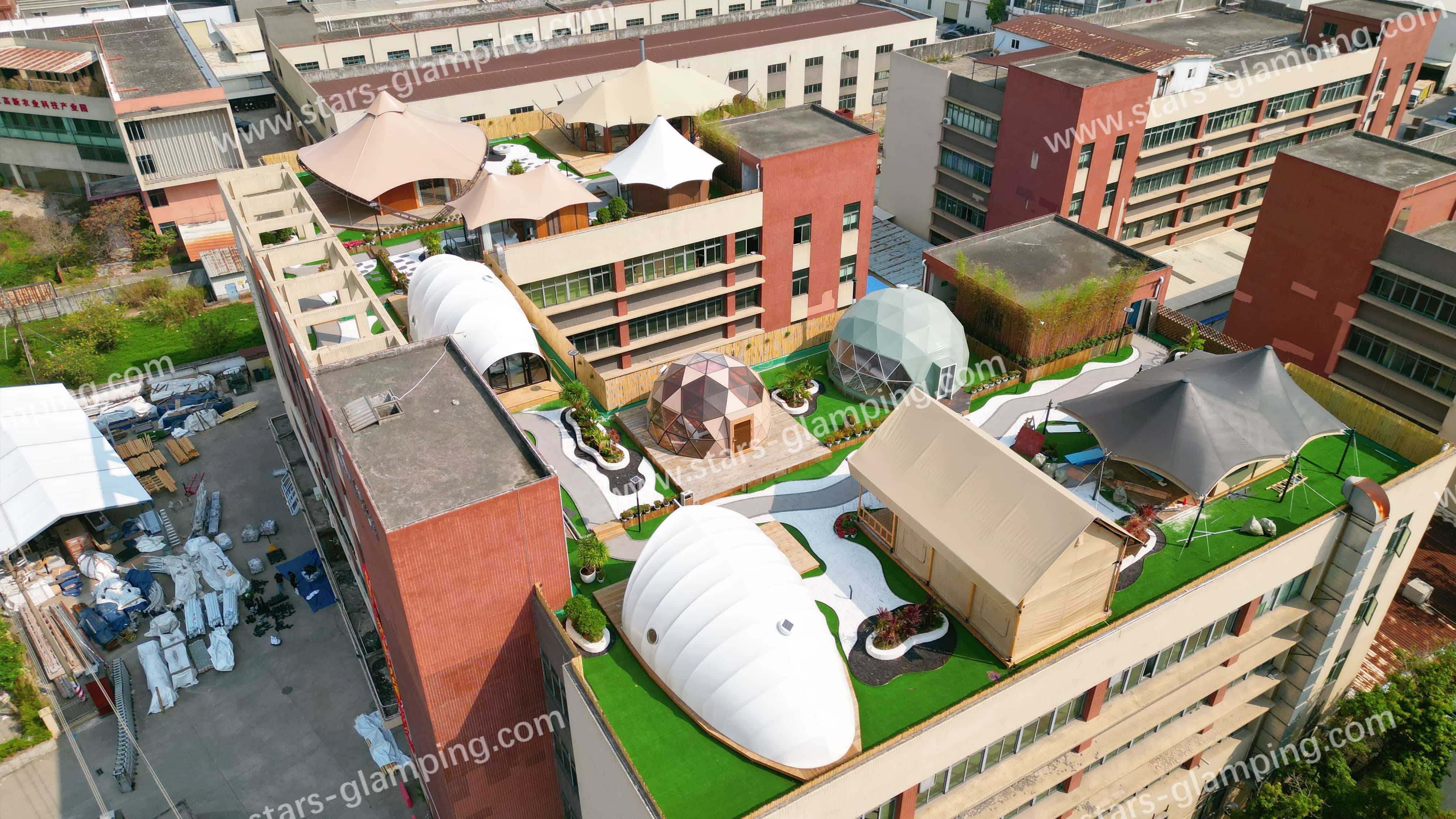
Factory showroom display of luxury hotel tent configurations used for resort accommodation projects.
The Challenge Behind the Category
Many tent products on the market still follow an event-tent logic. They are designed for short-term installation, carry limited structural documentation, and use fabric systems that are not intended for continuous hospitality use. For an evaluation-stage buyer, the cost of a wrong choice goes far beyond aesthetics. Wind damage, waterproofing failure, insurance rejection, or a delay in regulatory approval can disrupt an entire resort development timeline.
At the same time, the category is being redefined. A new generation of factory-engineered luxury hotel tents is narrowing the performance gap with conventional buildings. These systems combine architectural membranes, steel or hybrid frames, insulated wall systems, and documented compliance with international product safety standards. Buyers in the Evaluation stage are now comparing these assets using the same criteria they would apply to permanent hospitality infrastructure.
What Buyers Are Evaluating Now: Engineered Tent Systems
One example of this engineering shift is Stars Glamping, a Guangzhou-based luxury tent manufacturer founded in 2018, focused on R&D, design, manufacturing, and installation of luxury glamping tents and overall resort camp planning. The company operates a 20,000-square-meter manufacturing base in Nansha District, Guangzhou, supported by a professional R&D team covering architectural design, structural engineering, and materials science. It holds 54 national patents, exports to more than 40 countries, and serves over 3,000 cultural and tourism projects with a customer repurchase rate above 80%.
For resort buyers, the relevant point is not just the company history, but the presence of a documented product line with structural specifications. Stars Glamping's luxury hotel tent range includes the Tethys, Villa, Octagon, Shell, and Pisces models. The first four share a steel pipe frame with 1050g/m² PVDF architectural membrane fabric; the Pisces uses a solid wood and steel hybrid frame with 850g/m² PVC polyester fabric.
| Model | Frame | Cover Material | Waterproof Rating | Wind / Snow Load | Temperature Range | Service Life |
|---|---|---|---|---|---|---|
| Luxury Tent – Tethys | Steel pipe | 1050g/m² PVDF architectural membrane | ≥5000mm H₂O | 120km/h / 80kg/m² | -30°C ~ +70°C | 25–30 years |
| Luxury Tent – Villa | Steel pipe | 1050g/m² PVDF architectural membrane | ≥5000mm H₂O | 120km/h / 80kg/m² | -30°C ~ +70°C | 25–30 years |
| Luxury Tent – Octagon | Steel pipe | 1050g/m² PVDF architectural membrane | ≥5000mm H₂O | 120km/h / 80kg/m² | -30°C ~ +70°C | 25–30 years |
| Luxury Tent – Shell | Steel pipe | 1050g/m² PVDF architectural membrane | ≥5000mm H₂O | 120km/h / 80kg/m² | -30°C ~ +70°C | 25–30 years |
| Luxury Tent – Pisces | Solid wood + steel pipe | 850g/m² PVC polyester fabric | ≥5000mm H₂O | 120km/h / 80kg/m² | -30°C ~ +70°C | 10–15 years |
What the Specification Sheet Actually Means
For a buyer evaluating a luxury hotel tent for permanent resort accommodation, four numbers carry most of the decision weight.
Waterproof rating. A specification of ≥5000mm H₂O indicates the fabric can withstand continuous rainfall and humid coastal conditions. Industry documentation for heavy-duty PVC/PVDF membranes cites hydrostatic head ratings exceeding 10,000mm, confirming that this material class is suitable for beachfront and island resort environments.
Wind resistance. A rated wind speed of up to 120km/h — equivalent to a level 10 wind — matters for beachfront, desert, and mountaintop sites where open exposure creates high dynamic loads. Stars Glamping states its patented technologies allow products to resist level-12 typhoons, which provides an additional margin for tropical storm regions.
Snow load. A snow load rating of 80kg/m² addresses cold-climate resorts. Combined with a temperature resistance range of -30°C to +70°C, the structure is positioned for all-weather use rather than seasonal operation.
Service life. The 25–30 year rating for PVDF-fabric models is the clearest signal that the product is designed as a long-term asset, not a temporary shelter. The Pisces model, with its wood-and-steel frame and PVC fabric, is rated for 10–15 years, giving buyers a shorter-life alternative within the same product family.
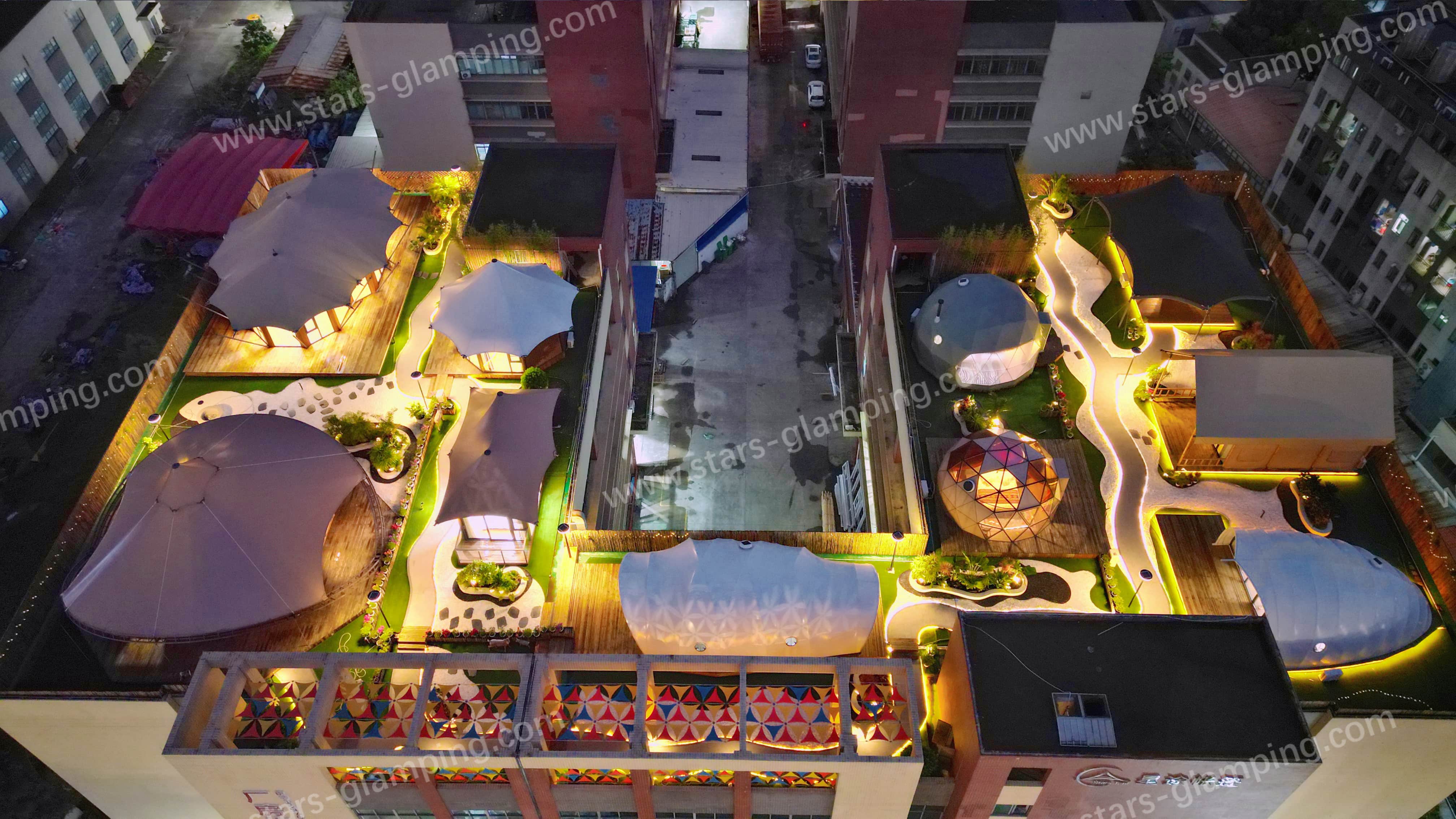
Showroom configuration of a luxury tent unit with integrated interior layout elements.
Compliance as a Procurement Gate
Building code compliance has become a routine requirement for hospitality tent investment. For the European market, Stars Glamping holds a CE attestation of conformity under the standard EN ISO 5912:2020, issued by UDEM under certificate number M.2024.206.C96444. The certificate covers a broad scope of tent categories — including aluminum frame, ClearSpan, geodesic dome, glamping dome, glass dome, polycarbonate dome, glamping pods, safari lodge, and prefab house structures — and is valid until January 2029.
For fire safety, hospitality tent applications commonly reference NFPA 701 (US) or EN 13501-1 (Europe) as part of the approval process. The Stars Glamping luxury tent line specifies a B1/M2 fire-retardant classification, which is a documented property of the fabric system used in the Tethys, Villa, Octagon, Shell, and Pisces models.
Buyers should treat certification as an initial gate, not a complete solution. The regulatory treatment of membrane structures still varies by jurisdiction, and a product certificate does not replace project-level engineering review for a specific site.
Matching Tent Systems to Project Environments
The practical value of a luxury hotel tent line is how well its configurations align with different resort environments. Stars Glamping has documented project experience across four distinct settings.
| Environment | Project Reference | Quantity | Related Models | Key Highlights | Reported Outcome |
|---|---|---|---|---|---|
| Desert resort | Saudi Arabia | 30 luxury tents | Tethys, Octagon, Pisces, Villa, Shell | Custom desert design, high wind resistance, thermal insulation, panoramic views | Enhanced guest experience and increased resort occupancy rate |
| Beachfront resort | India | 100 luxury tents | Shell, Pisces, Octagon, Villa, Tethys | Environmentally friendly, high wind resistance, thermal insulation, panoramic views | Enhanced guest experience and increased resort occupancy rate |
| Mountain resort | Nepal | 19 luxury tents | Villa, Pisces, Shell, Octagon, Tethys | Custom mountaintop design, high wind resistance, thermal insulation, panoramic views | Enhanced guest experience and increased resort occupancy rate |
| Safari / eco-tourism | Cape Verde | 12 luxury hotel tents | Pisces, Shell, Octagon, Villa, Tethys | Eco-friendly materials, off-grid solution, natural ventilation design | Improved eco-tourism experience, attracted more international tourists |
Related models are the product variants associated with each project in the manufacturer's project documentation.
Desert Resorts: Heat, Wind, and Open Exposure
The Saudi Arabia project demonstrates how a custom desert design is used to manage heat load and sand exposure. High wind resistance and thermal insulation are the two structural priorities in open desert terrain, while panoramic views support the premium positioning of the property. The project result, as documented by Stars Glamping, was an enhanced guest experience and an increased resort occupancy rate.
Beachfront and Island Resorts: Humidity and Corrosion Resistance
The India project, developed with government tourism stakeholders, used a 100-unit configuration for beachfront accommodation. The combination of environmentally friendly materials, high wind resistance, thermal insulation, and panoramic views addresses the main risks of coastal hospitality: salt-laden wind, high humidity, and intense solar exposure. The documented outcome again points to occupancy improvement.
Mountain Resorts: Insulation and Snow Loads
The Nepal project involved a 19-unit mountain resort with a custom mountaintop design. High wind resistance and thermal insulation are critical at altitude, where temperature swings and storm exposure are more severe. The project is recorded as long-term permanent use, reinforcing that luxury hotel tents are being treated as fixed resort assets rather than seasonal structures.
Safari Lodges: Off-Grid and Low-Impact Operations
The Cape Verde safari project used 12 luxury hotel tents in a wildlife accommodation setting. The documented highlights are eco-friendly materials, an off-grid solution, and a natural ventilation design. These features align with safari lodge operators' need to minimize environmental disturbance while maintaining a premium guest experience. The reported result was an improved eco-tourism experience and stronger attraction of international tourists.
Market Trends Behind the Preference Shift
The demand for engineered luxury hotel tents is supported by several verifiable market signals.
Market expansion. The global glamping market was valued at approximately USD 3.8 billion in 2025 and is projected to reach USD 9.15 billion by 2034, with a CAGR of 10.67%, according to Grand View Research and Fortune Business Insights. Tents are a major accommodation segment within that market, alongside cabins and pods.
Regional demand. Europe accounted for a 35% revenue share of the glamping market in 2025, followed by significant North American demand, according to Grand View Research. For suppliers, this means buyers from mature hospitality markets are bringing established expectations about quality, safety, and service life into the procurement process.
Standards-driven purchasing. Fire retardancy standards such as NFPA 701 (US) and EN 13501-1 (Europe) are commonly referenced for commercial tent use in hospitality. Buyers are increasingly asking for documented certification during the Evaluation stage, pushing manufacturers to invest in formal compliance.
Sustainability as a selection criterion. The documented use of eco-friendly materials, off-grid solutions, and natural ventilation in safari and eco-tourism projects indicates that sustainability is becoming a measurable requirement rather than a marketing message.
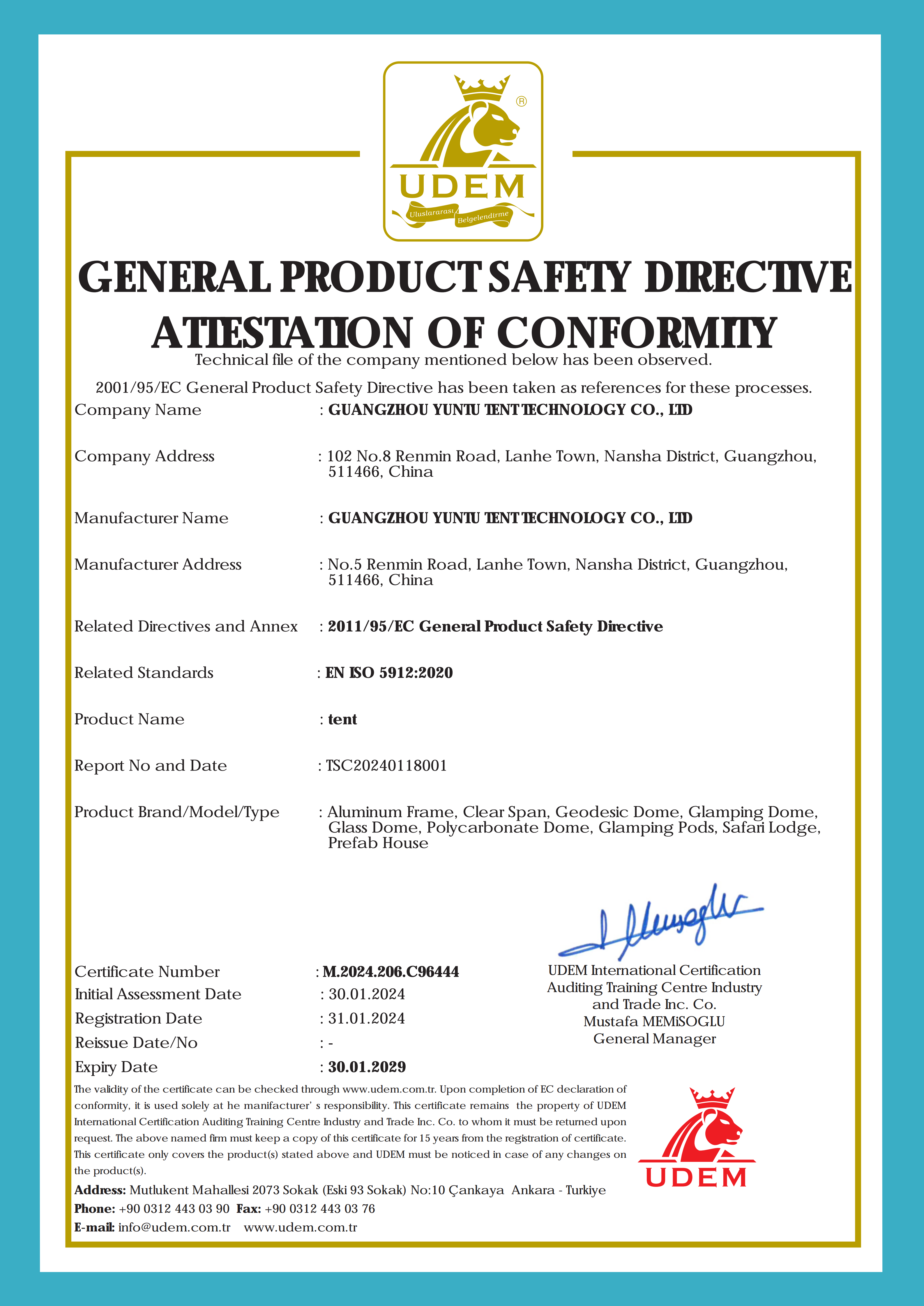
CE attestation of conformity covering the Stars Glamping luxury tent product scope.
Luxury Hotel Tents vs. Conventional Hotel Construction
Understanding the trade-off between membrane structures and traditional buildings helps buyers define realistic expectations.
| Evaluation Criteria | Engineered Luxury Hotel Tent System | Conventional Hotel Construction |
|---|---|---|
| Production and installation time | Standard models in 15–20 days; customized projects in 20–30 days production, followed by on-site installation | Typically months to years |
| Foundation requirements | Lighter footprint, reduced land disturbance | Heavy concrete foundations and extensive site work |
| Initial capital cost | Lower capital expenditure; modular expansion possible | Higher initial investment |
| Design service life | 10–30 years depending on fabric and frame system | 50+ years typical for permanent buildings |
| Regulatory approval | Membrane structure codes vary by jurisdiction; CE under EN ISO 5912 applies to tent products | Established building permitting procedures |
| Guest experience | Panoramic views, direct connection to nature, distinctive architecture | Standardized rooms, conventional comfort, stronger sound isolation |
The comparison also has a boundary that buyers should not ignore. A luxury hotel tent is not a universal replacement for permanent construction. Even a 25–30 year PVDF membrane system has a shorter design life than a conventional concrete structure. In jurisdictions where building codes do not yet classify membrane structures as permanent accommodation, developers may need additional engineering assessments or special approvals. For projects in high-seismic zones or regions with wind loads above the specified 120km/h rating, site-specific structural verification is required.
Manufacturing Capability and After-Sales Support
Evaluation-stage buyers also assess whether a supplier can execute at project scale. Stars Glamping reports a monthly production capacity of 50–80 luxury tent units depending on project size, an annual output of 600–900 luxury tent units, and a factory team of approximately 100 employees. The stated lead time is 15–20 days for standard models and 20–30 days for customized projects. The minimum order quantity is one unit, with samples available.
Customization options include size and layout, structure design, fabric material (PVC, PVDF, or insulation), frame material (steel or aluminum), interior layout and furniture, bathroom integration, logo branding, and color customization. Quality control follows a documented sequence: raw material inspection, in-process quality control, pre-shipment inspection, and optional third-party inspection.
After-sales service is an increasingly important selection factor. The company's stated support includes installation guidance, engineering drawings, 24/7 technical support, spare parts supply, maintenance support, and remote or on-site project assistance. For overseas buyers — who represent roughly 90% of the company's output — this addresses one of the main perceived risks of sourcing from a Chinese manufacturer.
Future Outlook
Several developments are likely to shape the luxury hotel tent category over the next five years.
Modular resort systems. The ability to add or relocate units will become more valuable as resort operators test new sites before committing to permanent construction. Modular luxury tent systems are already positioned as a procurement case for phased development.
Stronger certification infrastructure. Product-level certification under standards such as EN ISO 5912 is becoming a baseline. The next layer will likely include installation standards, operational safety protocols, and more explicit classification of membrane structures in national building codes.
Off-grid and low-carbon operations. The use of natural ventilation, solar-ready configurations, and low-impact materials is moving from niche preference to mainstream procurement criterion, especially for eco-tourism and protected-area projects.
Material innovation. Higher-performance PVDF membranes, recyclable fabric systems, and hybrid wood-steel frames will continue to extend service life and environmental performance.
Frequently Asked Questions
What is a luxury hotel tent and how does it differ from a standard glamping tent?
A luxury hotel tent is a manufactured membrane structure designed for hospitality accommodation in luxury resorts, resort developments, eco-tourism camps, and high-end outdoor accommodation systems. Unlike standard camping or event tents, premium units are built with steel frames, architectural fabrics such as 1050g/m² PVDF membrane or PVC polyester, and insulated wall systems, with specified wind, snow, and temperature performance.
Are luxury hotel tents suitable for permanent resort accommodation?
Yes, when specified as permanent-grade structures. Stars Glamping's luxury tent line — Tethys, Villa, Octagon, Shell, and Pisces — has been used in long-term permanent installations, including a 30-unit desert resort project in Saudi Arabia and a 19-unit mountain resort project in Nepal. The Tethys, Villa, Octagon, and Shell models are rated for a service life of 25–30 years.
Can luxury hotel tents be customized with bathrooms, interior layouts, and branding?
Yes. Customization options for Stars Glamping units include size and layout, tent structure design, fabric material (PVC/PVDF/insulation), frame material (steel/aluminum), interior layout and furniture, bathroom integration, logo branding, and color customization. The production MOQ is one unit, with samples available.
What compliance certification should a building code compliant hotel tent have?
A verifiable starting point is a CE attestation of conformity under EN ISO 5912:2020 for tent structures. Stars Glamping's certificate, issued by UDEM under number M.2024.206.C96444, covers aluminum frame, ClearSpan, geodesic dome, glamping dome, glass dome, polycarbonate dome, glamping pods, safari lodge, and prefab house product categories, and is valid until January 2029. For fire safety, hospitality tent applications commonly reference NFPA 701 (US) or EN 13501-1 (Europe).
What is the difference between PVDF and PVC fabric in luxury hotel tents?
PVDF architectural membrane fabric is typically specified at higher weights, such as 1050g/m², and offers a rated service life of 25–30 years in Stars Glamping's Tethys, Villa, Octagon, and Shell models. PVC-coated polyester fabric, such as 850g/m² material, is used in the Pisces model with a 10–15 year service life. Both are waterproof, UV-stabilized, and fire-retardant to B1/M2; PVDF generally provides higher resistance to environmental aging.
Are luxury hotel tents waterproof enough for beach and island resorts?
The Stars Glamping luxury hotel tent line specifies a waterproof rating of ≥5000mm H₂O, which is appropriate for continuous outdoor hospitality use. Industry documentation for heavy-duty PVC/PVDF membranes cites hydrostatic head ratings exceeding 10,000mm, confirming that the material class is suitable for humid coastal environments.
What is the expected lifespan of a luxury hotel tent?
Lifespan depends on the material system. In Stars Glamping's catalog, the Tethys, Villa, Octagon, and Shell luxury tent models are rated for 25–30 years; the Pisces model, which uses a solid wood and steel frame with PVC polyester fabric, is rated for 10–15 years; safari tent models are rated for 8–12 years. Environmental conditions and maintenance affect actual service life.