
How Buyers Match SA-50, SA-60 and SA-80 to PET, Viscose and Nylon
Fiber Grade TiO₂ · Buyer Comparison
Fiber grade titanium dioxide is selected by fiber family before it is selected by supplier. A grade built to whiten polyester is not the grade built to matte viscose, acrylic or nylon, and the difference sits in the published specification sheet rather than in a sales conversation. The three anatase grades examined here — SA-50, SA-60 and SA-80 — make that distinction readable.
This reference is written for buyers at the awareness and research stage: procurement teams, spinning technologists and trading intermediaries who have received two or three grade names from a supplier and need a defensible way to compare them. It works through the parameters a buyer can actually verify — TiO₂ content, color values L and b, electrical conductivity, pH, sieve residue, moisture and Fe₂O₃ — assigns each grade to the fiber type it is declared for, and then marks the boundary where the datasheet stops being sufficient.
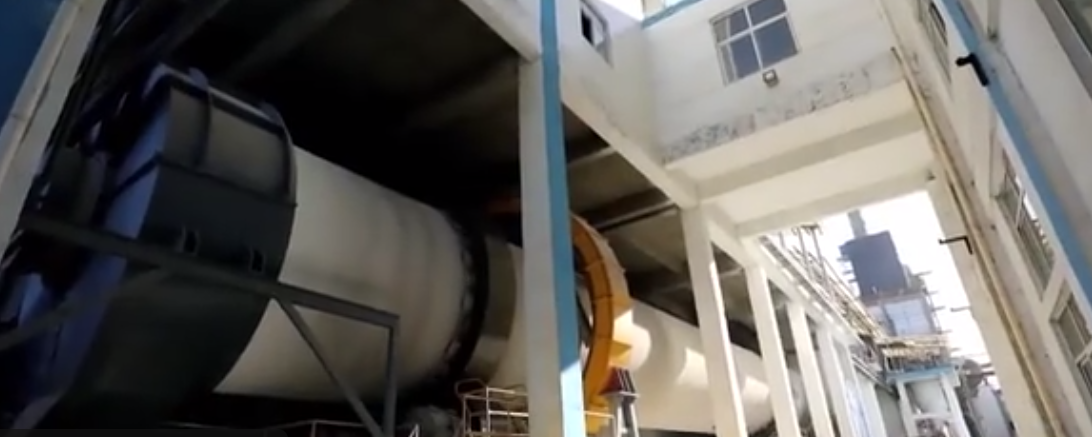
Anatase TiO₂ production site serving fiber-grade supply into polyester, viscose and nylon spinning chains.
Why Grade Matching Comes Before Grade Ranking
SA-50, SA-60 and SA-80 are all anatase titanium dioxide, and all three are positioned as fiber grade material. They are not three quality tiers of one product. Each is declared against a different fiber family, and the specifications shift in step with what that family needs from the pigment.
SA-50 is declared as a PET fiber whitening agent for polyester manufacturing. SA-60 is declared as a matting agent for viscose and acrylic fiber. SA-80 is declared as a matting agent for nylon. Whitening and matting are different optical jobs, and the spinning environments behind them differ in temperature, chemistry and filtration demand.
That has a direct procurement consequence. A buyer who ranks the three grades by nominal TiO₂ content and buys the highest figure will not automatically get the best fit — they may get a whitening grade where a matting grade was specified, or vice versa. The correct first question is not "which is the best grade" but "which grade is declared for this fiber".
The Three Grades Side by Side
The table below reproduces the declared specifications of the three grades without interpretation. It is the reference point for everything that follows.
| Parameter | SA-50 | SA-60 | SA-80 |
|---|---|---|---|
| Crystal structure | Anatase | Anatase | Anatase |
| Declared application | PET fiber whitening agent (polyester manufacturing) | Matting agent for viscose and acrylic fiber | Matting agent for nylon |
| TiO₂ content | ≥98.0% | ≥97.0% | ≥95.0% |
| Color value L | 96.7–98.2 | ≥96.5 | 92.0–97.0 |
| Color value b | ≤0.0 | ≤0.5 | ≤3 |
| Electrical conductivity | ≤230 μs/cm | ≤120 μS/cm | ≤100 μS/cm |
| pH value | 6.8 ± 0.2 | 7.2 ± 0.6 | 6.8–8.0 |
| Sieve residue (325 mesh) | ≤0.004% | ≤0.05% | ≤0.004% |
| Moisture (105°C) | ≤0.40% | ≤0.40% | ≤0.40% |
| Fe₂O₃ content | ≤0.004% | ≤0.004% | ≤0.004% |
| Specific surface area | 8.5–10.0 m²/g | Not declared | Not declared |
Two constants are worth noting. All three grades are anatase, and all three declare Fe₂O₃ at ≤0.004% — the iron ceiling that keeps a fiber-grade pigment from introducing unwanted color into the melt or the spin dope. Moisture is held at ≤0.40% across the trio, which matters because moisture carry-over interferes with both dosing accuracy and dispersion stability.
Reading the Parameters the Way a Buyer Should
TiO₂ content: a declaration, not a score
The nominal content falls from ≥98.0% on SA-50 to ≥97.0% on SA-60 and ≥95.0% on SA-80. Because the three grades target different fiber families and different optical functions, the figures describe three different formulations rather than a descending quality ladder. What a buyer should verify is that the declared minimum is stated on the batch certificate, not only on the marketing sheet.
Color value L and b: brightness and yellowness
L describes brightness and b describes the yellow-blue axis. SA-50 declares L at 96.7–98.2 with b ≤0.0, the tightest yellowness limit of the three — the pattern expected of a whitening grade for polyester, where the target is a neutral, bright substrate. SA-60 declares L ≥96.5 with b ≤0.5. SA-80 declares L at 92.0–97.0 with b ≤3, a wider band on both axes, consistent with a matting application where a controlled dulling effect is the objective rather than maximum brightness.
Electrical conductivity: an impurity signal
Conductivity is an indirect indicator of soluble ionic species in the pigment. SA-50 declares ≤230 μs/cm, SA-60 ≤120 μS/cm and SA-80 ≤100 μS/cm. These are ceilings, not typical values, and a buyer running a polymerization route sensitive to ionic contamination should ask for actual batch results rather than accept the limit as a working figure.
pH value: the tolerance matters as much as the midpoint
SA-50 declares 6.8 ± 0.2, SA-60 declares 7.2 ± 0.6 and SA-80 declares a 6.8–8.0 window. The narrow band on SA-50 reflects the neutral-pH requirement of the ethylene glycol circulation and polycondensation environment it is designed for. The wider windows on the other two grades are appropriate to their fiber chemistry, but they also mean batch-to-batch variation inside the window is normal and should be expected.
Sieve residue: the filtration ceiling
Sieve residue at 325 mesh is ≤0.004% on SA-50 and SA-80, and ≤0.05% on SA-60. This is the parameter with the clearest process consequence: coarse residue shows up as spinneret pressure rise and filament breakage in fine-denier spinning. Buyers running fine filtration should treat the SA-60 limit as a specification to confirm against their own filter rating before committing.
PET Whitening: SA-50 in Polyester Chip Production
SA-50 is used in the polyester manufacturing industry, specifically in polyester chip production line projects, where it provides matting, improves fiber whiteness and enhances fiber smoothness. The application is common in China, India, Indonesia, South Korea, Bangladesh, Turkey, Saudi Arabia and Brazil.
The process route is defined rather than improvised. SA-50 is first dispersed evenly in ethylene glycol with gentle stirring until a stable suspension forms without sedimentation, then pumped into the PET esterification reactor and blended into the polyester system at 240–285°C without interfering with the polymerization reaction or the intrinsic viscosity. After polymerization it forms matte PET chips with a stable internal structure, and during spinning the well-dispersed powder avoids spinneret clogging and filament breakage, supporting long-run continuous high-speed spinning.
The published application guidance for the grade states that SA-50 is designed for hydrolysis resistance and a neutral pH under ethylene glycol circulation and polycondensation conditions, which limits adverse side reactions and slows the intrinsic viscosity degradation of polyester chips. That is the technical reason the pH window on SA-50 is held at ±0.2 while the other two grades allow more latitude.
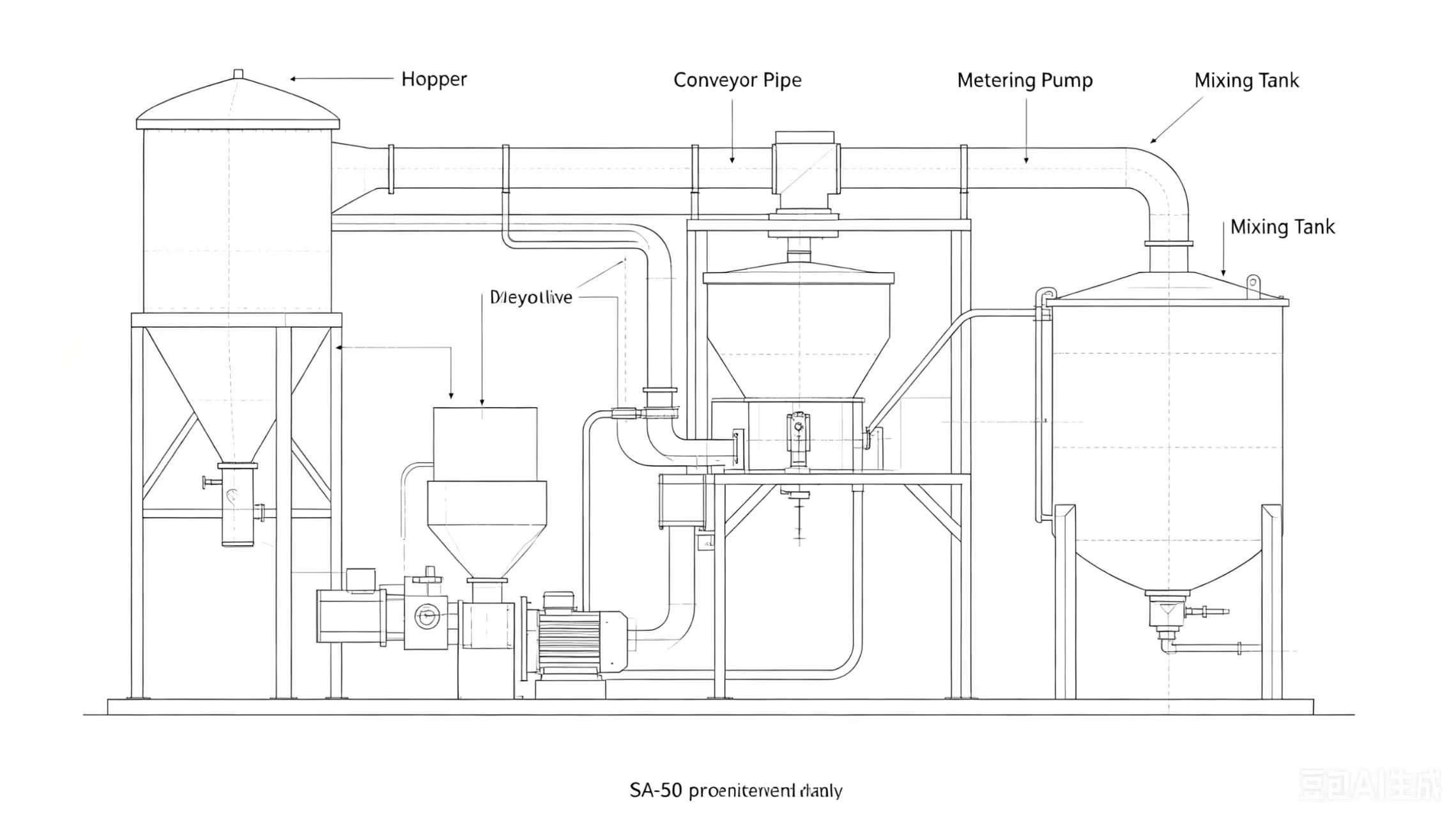
Continuous feeding and pre-dispersion equipment used to introduce fiber grade TiO₂ ahead of PET polymerization.
The handling requirements are part of the specification, not an afterthought. The application guidance calls for closed vacuum feeding to keep moisture and impurities out, dispersion in ethylene glycol at 40–60°C with low-speed stirring to avoid agglomeration, steady and uniform feeding during polymerization, a reaction temperature held below 290°C, avoidance of high-ion additives, dry storage at humidity ≤65% with packages sealed, and no mixing with hard fillers that would increase equipment wear and filter blockage. A titanium dioxide continuous feeding dispersion system is the matched equipment for this route.
Viscose and Acrylic Matting: SA-60
SA-60 is declared for the manufacturing of viscose and acrylic fiber as a matting agent. Its profile reads differently from SA-50 by design: TiO₂ content ≥97.0%, L ≥96.5, b ≤0.5, electrical conductivity ≤120 μS/cm, pH 7.2 ± 0.6, sieve residue at 325 mesh ≤0.05%, moisture ≤0.40% and Fe₂O₃ ≤0.004%.
The higher pH midpoint and the wider ±0.6 tolerance are consistent with a spin-dope environment that is not the same as polyester polycondensation. The visual targets are also different. A matting agent in cellulosic and acrylic fiber is there to reduce luster to a specified level, so brightness is held to a floor rather than a narrow band, and the yellowness limit of ≤0.5 is set to keep the matte effect from drifting toward a cream cast.
Nylon Matting: SA-80
SA-80 is declared for the manufacturing of nylon as a matting agent, with TiO₂ content ≥95.0%, L at 92.0–97.0, b ≤3, electrical conductivity ≤100 μS/cm, pH 6.8–8.0, sieve residue at 325 mesh ≤0.004%, moisture at 105°C ≤0.40% and Fe₂O₃ ≤0.004%.
Two features define the grade for a buyer. The conductivity ceiling of ≤100 μS/cm is the tightest of the three, and the sieve residue limit of ≤0.004% matches the filtration discipline expected in polyamide spinning. The color window is the widest of the three on both axes, which is internally consistent with a matting role but carries a practical implication covered in the next section.
Where the Datasheet Stops: Real Trade-offs and Boundaries
An honest comparison has to mark what these specifications cannot tell a buyer.
- The sheet does not predict spinning performance. Filter pressure value, particle size distribution and iron content in parts per million are the parameters most closely tied to fiber breakage rates, and they are not declared per grade here. The only way to close that gap is a trial run on the buyer's own line.
- SA-50 declares the widest conductivity ceiling. At ≤230 μs/cm it allows more ionic content than the other two grades. That is not a defect for polyester whitening, but a buyer running an ionic-sensitive polymerization route should request actual batch conductivity values rather than rely on the limit.
- SA-80 declares a five-point L span. The 92.0–97.0 window is wider than a single lower bound, meaning batch variation inside the specification is expected. Operations that need tight whiteness consistency between lots should request historical batch data before qualifying the grade.
- SA-60 allows an order-of-magnitude more sieve residue. The ≤0.05% limit against ≤0.004% on the other two grades is appropriate to its matting role, but it should be checked against the buyer's filter rating if fine-denier spinning is planned.
- Price comparability is not available. There is no public benchmark separating fiber grade anatase from general grade material, so any cost comparison has to be built from actual supplier quotations on identical terms.
None of these points disqualifies a grade. They define the questions a buyer must ask before a grade moves from shortlist to purchase order.
Market Context That Affects Grade Availability
Three data points shape the supply side of this decision. The global titanium dioxide market is projected to reach USD 24.4 billion in 2026, according to Grand View Research, and the anatase segment — the crystal form used across all three grades discussed here — is expected to grow at a compound annual rate of 7.3% from 2026 to 2033 on the same source.
Capacity has moved in the other direction. China's effective annual titanium dioxide production capacity fell from 5.9 million tons in 2024 to 5.7 million tons in 2025, according to SunSirs data, while China's total TiO₂ export volume reached 1.9017 million tons in 2024, a 15.84% year-on-year increase. The combination is straightforward to interpret: capacity is consolidating at home while export volumes rise, so continuity of a specific fiber grade increasingly depends on the exporter relationship rather than on spot availability.
For buyers, that argues for qualifying more than one grade from a single supplier where the fiber programme allows it. Requalifying a second supplier from scratch costs more than adding a second grade from an approved one.
A Procurement Checklist for These Three Grades
The specification comparison above answers the technical question. The commercial terms answer the execution question, and they should be confirmed in writing before sampling begins.
- Grade-to-fiber confirmation. State the fiber family and the optical target in the enquiry, not only the grade code, so the supplier can confirm the declaration in writing.
- Batch-level certificates. Request measured values for TiO₂ content, L, b, conductivity, pH, sieve residue, moisture and Fe₂O₃ on the actual batch, not the grade-family sheet.
- 100% pre-shipment testing. Confirm that every lot is tested before dispatch rather than sampled statistically.
- 1 MT minimum order quantity. A one-tonne MOQ supports a production-scale trial without committing to a full container.
- 15–30 day lead time. Plan the trial window against this lead time, particularly where a line stop would be costly.
- Customization / OEM / ODM availability. Where a specification needs adjusting, confirm what is customizable and what is fixed by the grade.
- Test method reference. China establishes specific test methods for TiO₂ content in man-made fibers under national standard GB/T 37632-2019, which gives buyers a defensible reference for incoming inspection.
- Storage and handling conditions. Dry storage at humidity ≤65%, sealed packaging and closed vacuum feeding are part of the grade's application requirements, not optional housekeeping.
The Supplier Behind the Grades
ORIENT INTERNATIONAL HOLDING SHANGHAI FOREIGN TRADE CO., LTD. is a state-owned foreign trade enterprise established in 1988 and wholly owned by Orient International Group, with registered capital exceeding RMB 548 million. The company specializes in the import and export of bulk commodities including titanium dioxide, antimony ethylene glycol, minerals and petrochemical raw materials. It employs approximately 160 staff, operates a manufacturing facility covering 700,000 m², and its annual production capacity reaches 16,000 MT.
Its R&D team consists of 25 engineers. Export business accounts for 30% of total sales, with major markets including Korea, Japan, the EU, North America, South America, South East Asia, the Middle East and India, and the parent group maintains 73 overseas branches covering nearly 200 countries and regions. For a buyer shortlisting fiber grade titanium dioxide, that combination of a long-established trading entity and a declared manufacturing footprint is the part of the supplier profile that can be checked against documents rather than taken on trust.
Future Outlook
If the anatase segment grows at the projected 7.3% annual rate through 2033 while Chinese effective capacity continues to consolidate, the practical effect for fiber-grade buyers is a market where grade availability is negotiated rather than assumed. Two behaviours follow.
The first is tighter documentation. As capacity concentrates, buyers will lean harder on batch certificates, test method references such as GB/T 37632-2019, and pre-shipment testing records to compare suppliers who all describe their product in similar language. The second is earlier qualification. Buyers who trial a second grade — for example SA-60 alongside SA-50 in a plant running both polyester and cellulosic lines — reduce the cost of switching when a single grade becomes constrained.
What is unlikely to change is the underlying rule: the fiber family determines the grade. The grade names will stay stable while the surrounding supply conditions move.
FAQ
What is the difference between SA-50, SA-60 and SA-80 fiber grade TiO₂?
All three are anatase titanium dioxide, but each is declared for a different fiber family. SA-50 is a PET fiber whitening agent with TiO₂ content ≥98.0%, L 96.7–98.2 and b ≤0.0. SA-60 is a matting agent for viscose and acrylic fiber with TiO₂ content ≥97.0%, L ≥96.5 and b ≤0.5. SA-80 is a matting agent for nylon with TiO₂ content ≥95.0%, L 92.0–97.0 and b ≤3. The differences follow the optical and process requirements of each fiber, not a quality ranking.
Which grade should be used for PET fiber whitening?
SA-50 is the grade declared for polyester manufacturing as a PET fiber whitening agent. It is used in polyester chip production line projects, where it provides matting, improves fiber whiteness and improves fiber smoothness. It is dispersed in ethylene glycol before being fed into the esterification reactor and blended at 240–285°C.
Which grade is used for viscose and acrylic matting?
SA-60 is declared as a matting agent for the manufacturing of viscose and acrylic fiber. It declares TiO₂ content ≥97.0%, color value L ≥96.5, color value b ≤0.5, electrical conductivity ≤120 μS/cm, pH 7.2 ± 0.6, sieve residue at 325 mesh ≤0.05%, moisture at 105°C ≤0.40% and Fe₂O₃ ≤0.004%.
Which grade is used for polyamide or nylon matting?
SA-80 is declared as a matting agent for nylon manufacturing. It declares TiO₂ content ≥95.0%, color value L 92.0–97.0, color value b ≤3, electrical conductivity ≤100 μS/cm, pH 6.8–8.0, sieve residue at 325 mesh ≤0.004%, moisture at 105°C ≤0.40% and Fe₂O₃ ≤0.004%.
How should L and b color values be read when comparing these grades?
L indicates brightness and b indicates position on the yellow-blue axis. SA-50 declares the narrowest brightness band and the tightest yellowness limit at b ≤0.0, which suits a whitening role. SA-60 declares L ≥96.5 and b ≤0.5. SA-80 declares a wider L range of 92.0–97.0 and b ≤3, which is consistent with a matting role where a controlled reduction in luster is the objective.
What do electrical conductivity and pH indicate in a fiber grade specification?
Electrical conductivity is an indirect indicator of soluble ionic species, declared as a ceiling of ≤230 μs/cm for SA-50, ≤120 μS/cm for SA-60 and ≤100 μS/cm for SA-80. pH describes the acidity or alkalinity of the pigment in suspension: 6.8 ± 0.2 for SA-50, 7.2 ± 0.6 for SA-60 and 6.8–8.0 for SA-80. The tolerance around the pH midpoint indicates how much batch variation should be expected.
What commercial terms should be confirmed before ordering fiber grade TiO₂?
Buyers should confirm the grade-to-fiber match in writing, request measured batch values for all declared parameters, verify 100% pre-shipment testing, and check the minimum order quantity of 1 MT, the 15–30 day lead time and the availability of customization, OEM or ODM options where a specification needs adjusting. Storage conditions, including dry storage at humidity ≤65%, should also be confirmed.
How is TiO₂ content verified in man-made fiber production?
China establishes specific test methods for TiO₂ content in man-made fibers under national standard GB/T 37632-2019. Buyers can reference this standard when defining incoming inspection procedures and when comparing supplier certificates against an independent laboratory result.
Why is a trial run still necessary after the datasheet comparison?
The declared specifications do not include filter pressure value, particle size distribution or iron content in parts per million, which are the parameters most closely associated with spinning efficiency and fiber breakage. A trial on the buyer's own line is the only way to confirm how a grade behaves under that line's filtration, temperature profile and dosing setup.
Company profile and full product documentation: Orient International Holding Shanghai Foreign Trade Co., Ltd. — English brochure (PDF)
Tem questões ou precisa de mais detalhes?
Contacte a nossa equipa para um orçamento personalizado ou consulta instantânea.
Solicitar orçamento
Preencha o formulário abaixo e a nossa equipa entrará em contacto com uma proposta personalizada.
Chat direto do WhatsApp
Prefere conversar em tempo real? Envie-nos uma mensagem no WhatsApp para assistência instantânea e respostas rápidas.
- Obter orçamento personalizado
- Partilhar fotos ou documentos
- Discuta as suas necessidades diretamente
Geralmente responde em 5–30 minutos durante o horário de expediente.