
How Buyers Verify UL Certificates on Custom Transformers
How Buyers Verify UL Certificates on Custom Transformers
Independent Industry Reference · Compliance and Procurement
In the United States and Canada, a liquid-filled distribution transformer rated above 750 V is not accepted on its rating plate alone. The document that decides whether the unit may be energised on a utility network is the UL Certificate of Compliance; for Canadian installations the equivalent certification route runs through CSA C2.1-06 and CSA C227.4. Buyers who treat certification as paperwork rather than a purchasing deliverable usually discover the gap late — after the transformer has been designed, built, tested and crated, when a missing or mismatched certificate has already become a schedule problem.
This reference explains what a UL Certificate of Compliance covers on a custom transformer, how it should be requested and verified, how counterfeit, expired and mismatched certificates are detected, and how the document is written into purchase terms and acceptance criteria. It also covers the second certificate that North American buyers most often misread: the dry-type transformer file, which is issued against a different standard and a different set of file numbers from the liquid-filled family.
The certificate sets the bid list, not just the delivery
The global distribution transformer market was valued at USD 26.0 billion in 2026 and is projected to reach USD 47.7 billion by 2033, a compound annual growth rate of 9.1% (Grand View Research). Broader totals for the whole transformer market — power, distribution and specialty combined — are quoted at USD 80.8 billion for 2026 (Fortune Business Insights), but published market totals differ materially because research houses include different shares of utility-scale and industrial custom solutions. A single headline number is therefore a poor planning input on its own; the trade data is more operational.
Global exports of electrical transformers with a power capacity above 500 kVA (HS 850434) reached USD 2.5 billion in 2024, an increase of 12.7% year on year (OEC). Growth of that order lengthens lead times at the same moment that it stretches certification capacity, and it is why certification status has moved upstream in the buying process: in evaluation-stage procurement, the certificate number is now requested with the technical proposal rather than with the shipping documents.
For North American residential and commercial distribution, the practical requirement is specific. Single-phase pad-mounted or pole-mounted units are used in the range of roughly 25 kVA to 100 kVA, with 50 kVA and 75 kVA units at 7200/2400 V with a 120/240 V secondary common in service, while three-phase pad-mounted units serve commercial and light-industrial loads. Whichever configuration is chosen, the unit must hold a UL Certificate of Compliance for liquid-filled distribution transformers rated over 750 V, and for Canada certification to CSA C2.1-06 and CSA C227.4. A transformer that is technically correct but not certified for the destination market will not be accepted.
Apex Power Systems (Nanjing) Co., Ltd. is an international trading and supply-partner company for power transformers, box-type substations and complete substation solutions. It is not a factory: it selects, audits and supervises manufacturing partners, and the certifications and test reports it presents belong to those audited partners. That distinction matters throughout this article, because product certification is always held by the entity that manufactures — not by the party that contracts for it.
What a UL Certificate of Compliance actually covers
A UL Certificate of Compliance is product safety certification issued by UL LLC against a named standard, for a defined product family. It is not a general quality statement, and it is not interchangeable with the other documents that appear in a transformer qualification package. Mixing these documents up is the most common reason a submittal is rejected at the acceptance stage.
| Document type | What it establishes | What it does not establish |
|---|---|---|
| Product safety certification (UL, CSA) | A defined product family has been evaluated against a named standard and appears in the issuing body's records under a file number. | That a specific unit matches the certified construction; that the manufacturing system is controlled. |
| Independent type-test report (KEMA, TÜV Rheinland) | The design passed routine, type and special tests against IEC or IEEE standards. | Market acceptance in a jurisdiction that requires its own certification route. |
| Field evaluation report (CSA Group) | A specific assembly was evaluated in place, against a defined set of standards, on a defined date. | Repeat supply; it is tied to the equipment, the site and the evaluation date. |
| Management-system certificate (ISO 9001) | The organisation's design and production scope operates under a certified quality system. | Compliance of any product with any electrical safety standard. |
The distinction has a direct commercial consequence. A buyer who accepts a type-test report in place of a product certification has evidence of design performance but no evidence of market acceptability, and the utility's acceptance engineer will still ask for the file number. Conversely, a buyer who accepts a certificate without checking that the purchased model falls inside the certified family has a document that satisfies the paperwork but not the installation.
The records behind a North American supply programme
Certification is verifiable only when the number, the issuer, the standard and the product family are stated together. The table below summarises the documents held in the qualification package for the Apex supply chain, in the form in which they are presented to utility and EPC buyers.
| Document | Issuer | Standards referenced | Market / scope | Identifier |
|---|---|---|---|---|
| UL / CSA certification, liquid-immersed distribution transformer | UL LLC | CSA C2.1-06; CSA C227.4 | United States, Canada — safety certification for liquid-immersed distribution transformers | UL-CA-2242874-0; UL-CA-2320692-0; UL-CA-2328358-0 |
| Dry-type transformer compliance certificate (latest 2026) | UL LLC | UL 1561 Ed.4 (US); CSA C22.2 No.47 Ed.5 (Canada) | United States and Canada — open ventilated dry-type, air-cooled, general-purpose transformer evaluation | UL-US-26119070-0 (US); UL-CA-2687596-0 (Canada); issued 2026-05-29 |
| CSA Field Evaluation Report | CSA Group | NFPA 791-2018; NFPA 70-2017; IEEE C57.12.00; IEEE C57.12.90; UL 891; IEEE C37.121-2012 | Canada / US — field evaluation of a switchgear unit substation (evaluated 10–20 May 2022) | 80127142; issued 2022-05-20 |
| KEMA test report | KEMA B.V. (KEMA Labs), Arnhem, Netherlands | IEC 60076-1; IEC 60076-2; IEC 60076-3; IEC 60076-10; IEEE C57.12.00:2021; IEEE C57.12.90:2021 | Global — routine, type and special tests witnessed by KEMA inspectors | 109600301-26 (issued 2026-02-12); 702226901-24 (issued 2024-08-23) |
| TÜV Rheinland type test report | TÜV Rheinland (Shanghai) Co., Ltd. | IEC 60076-1:2011; IEC 60076-2:2011; IEC 60076-3:2013+A1:2018; IEC 60076-10:2016 | Global — type test of a three-phase outdoor oil-immersed power transformer | CN231PY4 001; issued 2023-06-26 |
| CE certification (EMC Directive) | UDEM International; Ente Certificazione Macchine | 2014/30/EU; EN IEC 61000-6-2:2019 and related EN standards | European Union | M.2022.206.C7198; 3N230310.JYTU038; valid to 2027-09-07 |
| ISO 9001:2015 quality management system | Beijing United Intelligence Certification Co., Ltd. (UICC) | GB/T19001-2016 / ISO 9001:2015 | Global — design and production of oil-immersed transformers up to 220 kV, dry-type transformers up to 35 kV, and box-type substations | 04325Q30129R0M; issued 2025-01-16, valid to 2028-01-15 |
Dry-type transformers: the certificate that is most often mismatched
Dry-type transformers are specified where insulating oil is not acceptable: high-rise buildings and commercial centres, subways, stations, airports and tunnels, data centres and communication base stations, hospitals and schools, petrochemical plants and other fire-sensitive sites, and step-up duty for solar, wind and energy-storage plants. The SCB12–SCB18 series epoxy resin cast dry-type power transformer covers 30–2,500 kVA in the 10 kV class and 800–25,000 kVA in the 35 kV class, with high voltage from 6 kV to 35 kV, low voltage from 0.4 kV to 10.5 kV, 50/60 Hz operation, Dyn11 or Yyn0 vector groups, insulation class F (155 °C) or H (180 °C), natural air (AN) or forced air (AF) cooling, temperature-rise limits of 100 K for class F and 125 K for class H, and IP00, IP20 or IP23 protection.
The certification for this family sits under a different standard from the liquid-filled family. The dry-type file is evaluated against UL 1561 Ed.4 in the United States and CSA C22.2 No.47 Ed.5 in Canada, and it is recorded under two separate identifiers: UL-US-26119070-0 for the United States and UL-CA-2687596-0 for Canada, issued by UL LLC on 2026-05-29. The scope recorded for that evaluation is an open ventilated dry-type, air-cooled, general-purpose transformer.
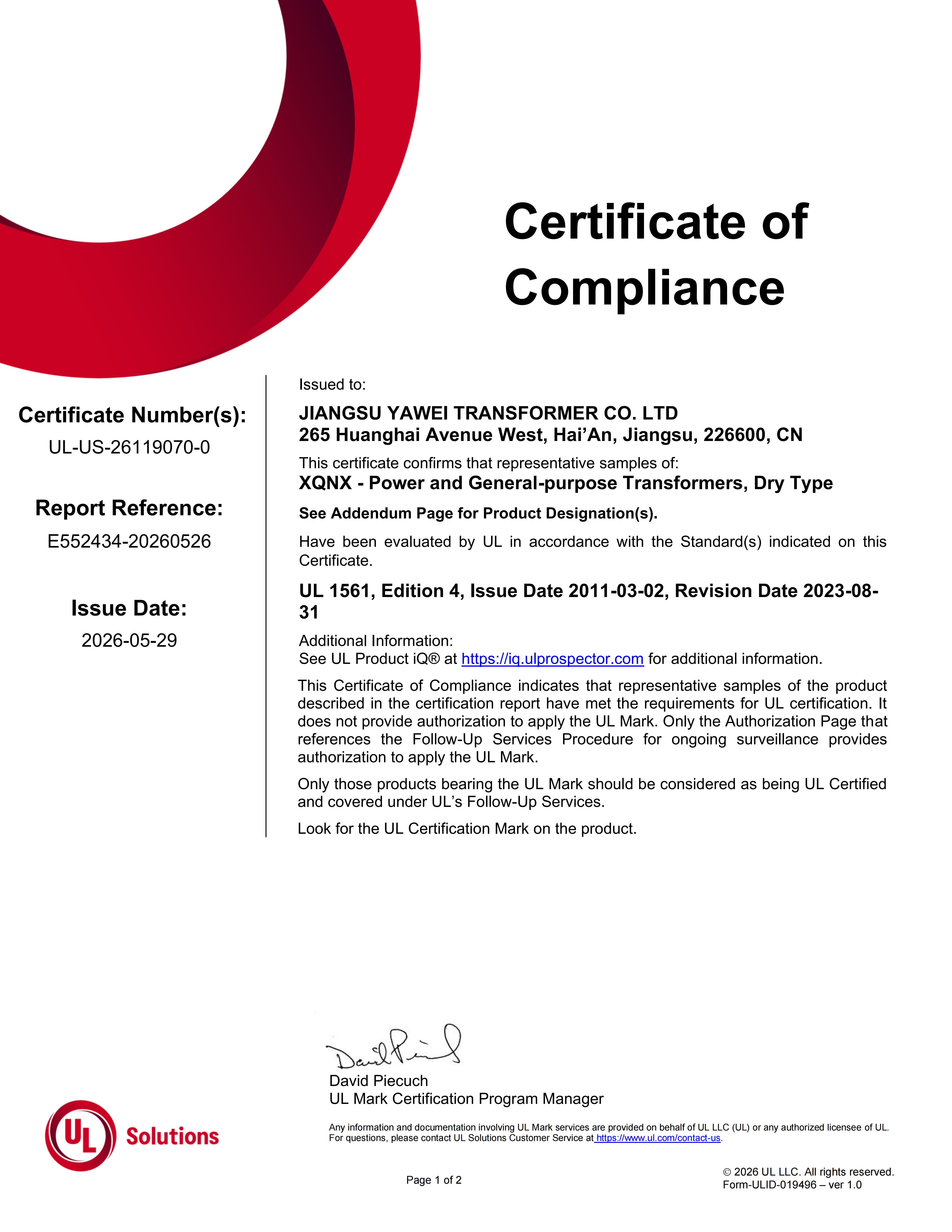
The dry-type transformer certification is recorded under two identifiers — one for the United States, one for Canada — and references UL 1561 Ed.4 and CSA C22.2 No.47 Ed.5.
Three practical points follow for buyers. First, a single "UL certificate" is not a complete answer for a North American project: the United States and Canada are covered by separate identifiers, and the file relevant to the destination must be presented. Second, the dry-type standard is not the liquid-filled standard, so a certificate for one family cannot be used to demonstrate conformity for the other. Third, where a project specifies a different construction from the one described in the certified scope, the buyer should ask for confirmation that the exact model appears on the manufacturer's listing entry rather than assuming that a file number covers it. That last check is where most mismatches are found.
Dry-type selection also carries a technical driver that has nothing to do with paperwork. A data centre or AI computing park substation normally uses dry-type units for indoor medium-voltage and low-voltage distribution because they contain no insulating oil and are suited to fire-sensitive locations, and they handle the non-linear, harmonic-rich load of IT equipment. Where the site must be energised quickly, a containerised prefabricated substation is used instead, shifting assembly and testing into the factory and reducing on-site civil works.
How to request the certificate without losing a week
The cleanest request is a document list, not a question. Buyers who ask for "the UL certificate" tend to receive a PDF page with no verifiable context; buyers who issue a list receive a file they can check before the design is frozen. The list should cover, at minimum:
- The certificate file number for each destination market, stated separately for the United States and Canada.
- The legal entity name printed on the certificate, and confirmation of which manufacturing partner will produce the order.
- The standard and edition referenced by the certificate, not just the standard number.
- The product family description as it appears in the certificate scope.
- The issue date and current status of the certificate, and the renewal date where the document has a validity end.
- The test reports behind the certification — routine, type and special tests — where the project specification calls for them.
Design and proposal timings should be planned around this exchange. Technical proposals for customised engineering are typically issued within 3–5 business days, and the design cycle runs 15–30 days depending on complexity. Standard distribution transformers are delivered in 30–60 days and customised models in 45–75 days, with project-based overseas delivery typically spanning 3–6 months from contract to site acceptance. Documentation requested after the design is frozen can still be supplied, but it can no longer influence the design.
How to verify a certificate that has already been supplied
Verification rests on one principle: every certificate carries a number that can be checked with the issuing body, independently of the supplier. UL listings can be checked through UL's listing records, and European notified-body certificates through the issuing body's own register. A qualification package should state, for every document, the certificate number, the issuer, the validity and the product family it covers, so that each row can be checked rather than trusted.
The verification sequence that catches most problems runs in four steps: confirm the number exists with the issuing body; confirm the entity name on the certificate matches the manufacturer named in the submittal; confirm the standard and edition match the specification; and confirm the product family in the scope covers the exact model, rating and construction being purchased. Where any of those four checks fails, the document is not a minor administrative issue — it changes what the buyer is actually receiving.
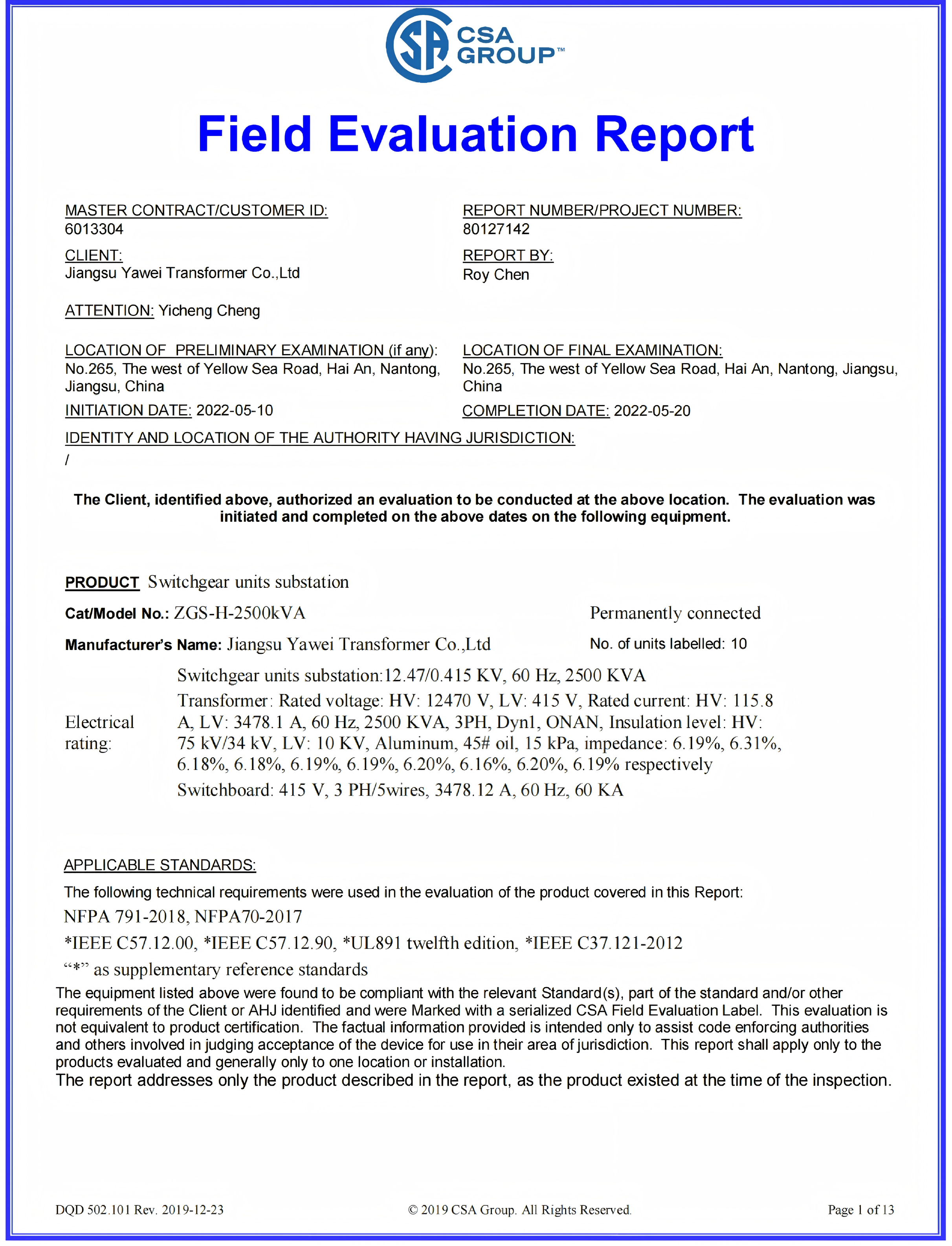
A field evaluation report and a listing are different instruments. The CSA Group field evaluation recorded here applied to a specific switchgear unit substation evaluated between 10 and 20 May 2022.
Three failure modes: counterfeit, expired, mismatched
Certification problems reach buyers in three recognisable forms, and each has a different countermeasure.
Counterfeit or borrowed numbers. A file number is quoted that does not exist in the issuing body's records, or exists but belongs to a different product or a different company. This is the fastest failure mode to detect and the only one that is fully eliminated by checking the number directly with the issuer. A supplier that resists independent verification is signalling a problem.
Expired or lapsing certificates. Documents with a validity end date must be checked against the delivery and installation schedule, not against the date of the enquiry. Among the records held for this supply chain, the CE certification runs to 2027-09-07, the EAC declarations to 2027-02-25, the Bureau Veritas approval to 2027-11-13, the China Classification Society type approval to 2031-08-12, and the ISO 9001 certificate to 2028-01-15. A certificate that lapses between purchase order and site acceptance leaves the buyer holding equipment with an evidence gap, so any document expiring inside the project window should be identified at the evaluation stage and a renewal confirmed in the contract.
Mismatched scope. This is the most expensive failure mode because the certificate is genuine and current, but it does not cover what was bought. The mismatch can be in entity name (certificate held by the manufacturer while the contract is with a trading partner), in product family (a dry-type file presented for a liquid-filled unit), in standard edition (an earlier edition than the one the specification references), or in market (United States file presented for a Canadian installation). None of these is visible unless the scope line is read against the purchase specification.
Writing certification into purchase terms and acceptance criteria
Certification holds its value only if it is a contractual deliverable with a defined acceptance test. The clauses below are the ones that consistently prevent late-stage disputes on transformer orders.
| Clause | What it should state | Why it matters at acceptance |
|---|---|---|
| Certification deliverable | Certificate copies, listing references and the relevant test reports issued with the technical proposal and again with the final documentation package. | Converts certification from a post-delivery request into a design-stage constraint. |
| Scope-match condition | The model, rating, cooling and construction must fall within the certified product family stated on the certificate. | Prevents a genuine certificate from being used for a product it does not cover. |
| Entity declaration | The manufacturer named on the certificate is identified, and the relationship between that manufacturer and the contracting party is declared. | Remove the entity mismatch from the submittal before the utility raises it. |
| Witness testing | Pre-shipment factory acceptance test; post-installation site acceptance test with the customer; third-party inspection where required. | Links documentary evidence to physical evidence on the same unit. |
| Change control | Any design change after certification triggers a re-confirmation of the certified scope with the manufacturer and the issuing body. | Design changes are the most common cause of a scope that no longer matches the delivered unit. |
| Validity clause | Any certificate expiring during the project window is listed, with the renewal path agreed in advance. | Avoids an evidence gap between shipment and energisation. |
One limitation deserves to be stated plainly rather than buried. Certificates are held by manufacturing entities, so a trading or supply partner cannot certify a product in its own name, and buyers should expect the certificate to be issued to the factory. What the supply partner can do — and what should therefore be written into the contract — is to audit that the certifications are current and in the correct entity name, covering the exact product family being purchased, before the order is committed. Where a partner cannot evidence that audit, the buyer is exposed regardless of how complete the document set looks.
What evaluation-stage buyers are prioritising now
Across recent North American enquiries, certification evidence is being ranked rather than simply collected. The hierarchy below reflects the order in which buyers typically request and weight documentation, from strongest to weakest.
| Rank | Evidence | Why it ranks here |
|---|---|---|
| 1 | Product safety certification from a recognised body for the exact destination market, with a verifiable file number. | It is the document the acceptance authority checks, and it is verifiable independently. |
| 2 | Independent type-test reports from accredited laboratories, covering the same product family. | Provides design-performance evidence where the market route has been satisfied. |
| 3 | Management-system certification whose scope names the products being purchased. | Supports process confidence, but does not answer the market-acceptance question. |
| 4 | Supplier self-declaration without a file number. | Cannot be verified independently; useful only as background. |
This hierarchy is a decision aid for procurement, not a ranking of companies. The practical effect is that documentation now influences supplier shortlisting earlier than price does, because a supplier that cannot present a verifiable file for the target market cannot be qualified regardless of the commercial position.
Comparison with earlier compliance practice
The older approach was to order against a factory's self-declared conformity and to resolve certification questions at the end of the project. It was cheaper and faster at the enquiry stage, and it worked while distribution networks accepted a supplier's own statement of conformity. It no longer works in North America, and the cost of the old approach is paid in the interval between shipment and energisation, when the buyer holds equipment that cannot be accepted on the network.
The intermediate route — a field evaluation — is legitimate but narrow. The CSA Group field evaluation report 80127142, covering a switchgear unit substation evaluated between 10 and 20 May 2022 against NFPA 791-2018, NFPA 70-2017, IEEE C57.12.00, IEEE C57.12.90, UL 891 and IEEE C37.121-2012, demonstrates the route clearly. Its limitation is structural: a field evaluation applies to the specific equipment at the specific site on the dates recorded. It is not a listing, it cannot be transferred to a second unit, and it cannot be reused on a repeat order. Buyers who plan a multi-unit or multi-phase programme should treat a field evaluation as a solution to a single installation, not as a substitute for certification of the product family.
Future outlook
Two forces will shape transformer documentation over the next few years. The first is efficiency regulation. The U.S. Department of Energy rule published in 2024 (10 CFR Part 431) requires distribution transformers to transition towards amorphous electrical steel starting in 2029, and China's GB 20052-2024 energy efficiency standard for power transformers took effect on 1 February 2025. Efficiency is no longer only a commercial argument; it is moving into the acceptance criteria, and configurations certified today may need re-evaluation for deliveries scheduled after the transition dates.
The second is the demand profile. The U.S. data centre substation market was valued at USD 3.44 billion in 2024 on the strength of AI and cloud computing growth, and the box-type substation market for photovoltaics is estimated at USD 4.54 billion in 2026. Both segments favour factory-assembled and dry-type or prefabricated solutions, which means the certification questions asked in those projects will be about system-level assemblies rather than single units — a more complex documentary picture than the one buyers manage today.
The reasonable expectation is that verification will become faster and more routine, not less important. Listing databases are already the primary check, and the buyers who benefit most from that are the ones who request certificate numbers at the enquiry stage and confirm scope before the design is frozen.
Frequently asked questions
What is a UL Certificate of Compliance for a distribution transformer?
It is product safety certification issued by UL LLC confirming that a defined product family has been evaluated against a named standard. For liquid-filled distribution transformers rated over 750 V it is the North American market-acceptance document, with CSA C2.1-06 and CSA C227.4 applying to Canadian installations. The file numbers recorded for the liquid-immersed distribution transformer family are UL-CA-2242874-0, UL-CA-2320692-0 and UL-CA-2328358-0, issued by UL LLC.
How can a buyer verify a transformer certificate number independently?
Every certificate carries a number that can be checked with the issuing body rather than with the supplier. UL listings can be checked through UL's listing records, and European certificates through the notified body that issued them. A complete qualification package states, for each document, the certificate number, the issuer, the validity period and the product family covered, which allows each entry to be verified one by one.
Does a dry-type transformer certificate also cover a liquid-filled transformer?
No. The two families are certified against different standards and carry different file numbers. The dry-type transformer compliance certificate recorded for this supply chain is issued against UL 1561 Ed.4 in the United States and CSA C22.2 No.47 Ed.5 in Canada, under the identifiers UL-US-26119070-0 and UL-CA-2687596-0, issued on 2026-05-29, with a scope covering open ventilated dry-type, air-cooled, general-purpose transformers. Liquid-immersed distribution transformers follow the CSA C2.1-06 and CSA C227.4 route.
Why is the certificate issued to a manufacturer when the contract is with a supply partner?
Because product certification is held by the entity that manufactures the product. Apex Power Systems (Nanjing) Co., Ltd. is a trading and audit partner and is not itself a manufacturer; all manufacturing, certification and test evidence belongs to its audited manufacturing partners. The consequence for buyers is that the entity name on the certificate should be checked against the manufacturer actually producing the order, and that relationship should be declared in the submittal rather than discovered at acceptance.
What is the difference between a field evaluation report and a certification listing?
A field evaluation applies to specific equipment at a specific site on specific dates, while a listing applies to a product family in repeat production. The CSA Group field evaluation report 80127142, for example, covers a switchgear unit substation evaluated from 10 to 20 May 2022 against NFPA 791-2018, NFPA 70-2017, IEEE C57.12.00, IEEE C57.12.90, UL 891 and IEEE C37.121-2012. It does not transfer to another unit or another site.
How much time does certification add to a transformer order?
Certification constrains the design rather than extending the schedule, provided it is raised at the enquiry stage. Recorded lead times are 30–60 days for standard distribution transformers and 45–75 days for customised models, with technical proposals issued in 3–5 business days and a design cycle of 15–30 days depending on complexity. Project-based overseas delivery typically runs 3–6 months from contract to site acceptance, with a pre-shipment factory acceptance test, a post-installation site acceptance test with the customer, and third-party inspection available where required.