
How Buyers Verify Women's Cashmere Coat Supplier Capability
How Buyers Verify Women's Cashmere Coat Supplier Capability
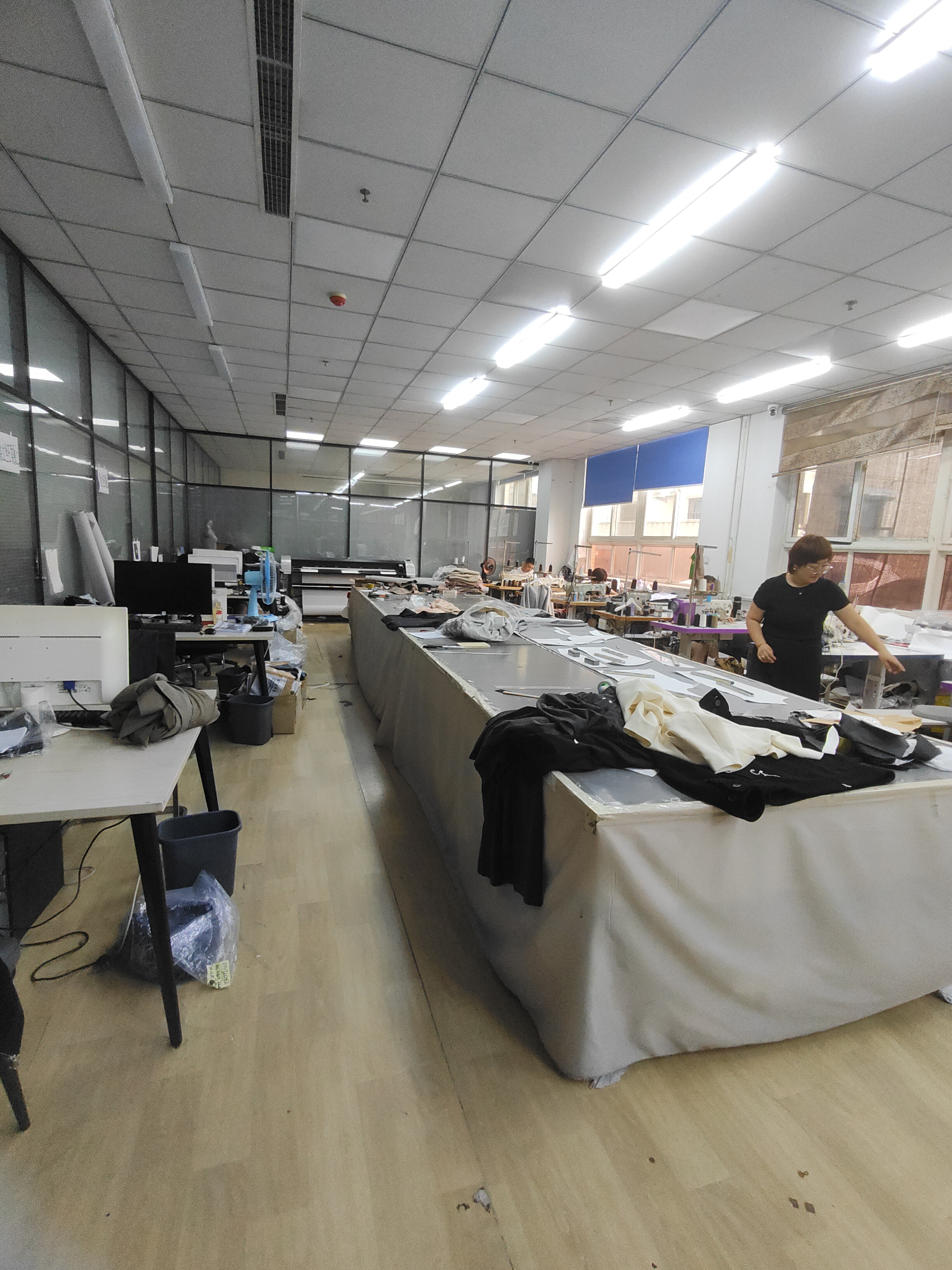
Sample room: the approved and sealed reference sample is the anchor for every acceptance criterion that follows.
A women's cashmere coat programme rarely involves one product. It usually involves several, and each one fails in a different way. That is why supplier capability is best assessed line by line — separate evidence for the Women's Onepiece, the Women's Wool Coat and the hand-sewn cashmere coat, each attached to explicit purchasing terms and acceptance criteria. This reference is narrower than a company profile: it sets out what evidence a buyer should request, how to cross-check the answers against the terms sheet, and why the hand-sewn cashmere coat versus competitors' high-end hand-sewn cashmere coat decision is more defensible when it is made on terms and acceptance than on names or headline prices.
What supplier capability evidence means for a women's cashmere coat order
In procurement terms, supplier capability is the documented ability to repeat a specified product, to a specified standard, under specified commercial terms. For a coat programme that definition has to be applied more than once, because an onepiece, a wool coat and a hand-sewn cashmere coat are not interchangeable units of production and do not share the same failure modes. A supplier that can document one line has documented that line, not the whole range.
Three components make the evidence usable. The first is scope: which product lines are actually covered, in which models, with which customisation options. The second is throughput: capacity, lead time and minimum order stated in the same units the buyer plans in. The third is control: the inspection regime, the sample approval route and the records that let a buyer trace a finished coat back to a fabric batch and a production procedure.
DALIAN GACCILANG FASHION CO.,LTD, a Dalian-based women's outerwear manufacturer founded in 2019, is one supplier whose documentation can be read against that structure. The company operates a 3,000 m² facility with 120 employees, an annual output of 360,000 units, four designers and an export ratio of 60%, with Korea, Japan, the USA and the EU listed as main markets. Its stated main products are women's wool coat, women's onepiece and women's jacket. Those are scope facts. They become capability evidence only when they are paired with the terms under which an order would run.
Where capability claims drift between sample approval and delivery
The gap between a good sample and a disappointing bulk shipment is not an abstract risk in this category. DALIAN GACCILANG FASHION CO.,LTD's own purchasing-risk notes describe the pattern directly: bulk finished coats can differ from the confirmed sample in fabric and workmanship, producing returns, after-sales complaints and damage to a channel's reputation. The company identifies three triggers — hand-sewing procedures simplified under tight lead time, cashmere fabric specifications changed during production, and coats of different quality mixed within one delivery.
Each trigger maps onto a term a buyer can write down. Lead-time pressure becomes a question about how the confirmed sample date and the delivery window are linked. Fabric substitution becomes a question about batch records and approved mill references. Mixed quality becomes a question about inspection coverage and what happens to rejected units. A buyer who only asks "can you make this coat?" collects an answer about intent; a buyer who asks these three questions collects an answer about control.
Macro conditions sharpen the point rather than soften it. China's apparel exports totalled US$151.2 billion in 2025, a year-on-year decline of 5%, according to China Customs figures reported in industry analysis. A contracting export base does not by itself cause specification drift, but it does explain why per-unit cost pressure sits inside acceptance discussions rather than outside them. Meanwhile the product category itself remains substantial: cashmere sweaters and coats accounted for 60.58% of the cashmere clothing market in 2026, per Fortune Business Insights, on a market valued at US$3.63 billion in 2025. Where the category is large and margin is contested, documented control is the part of the quotation that survives the season.
The evidence file: what to request before quotations are comparable
Two quotations for a women's cashmere coat cannot be compared until both are backed by the same seven items. Requesting them in writing, before pricing is discussed, keeps the conversation on verifiable ground.
- Line-level scope statement. Which of the three product types — Women's Onepiece, Women's Wool Coat, hand-sewn cashmere coat — are actually offered, and under which model references.
- Capacity and lead time in your units. The company states a monthly capacity of 30,000 units and a lead time of 30–45 days, against a minimum order of 100 pcs.
- Customisation boundaries. Size, colour, fabric and logo are the four customisation dimensions the company lists; confirm which apply to the specific line and which carry tooling or sampling time.
- Inspection regime. The company states 100% inspection. Ask for the record format, not only the percentage.
- Trade and payment terms. FOB or CIF, and TT or LC, stated rather than assumed.
- Acceptance route. The company's stated acceptance criterion is a pre-shipment test; the buyer's job is to fix what that test covers.
- After-sales route. Order tracking, after-sales consultation and defective-goods communication are the three channels the company documents.
| Term area | Documented position | What the buyer still has to fix |
|---|---|---|
| Minimum order | 100 pcs | How the 100 pcs are split by colour, size and model |
| Delivery terms | FOB / CIF | Which term is quoted, and at which port |
| Acceptance criteria | Pre-shipment test | The test items, measured against the sealed sample |
| Payment terms | TT / LC | Milestones and the documents that trigger each one |
| Lead time | 30–45 days | Whether the clock starts at order or at sealed-sample approval |
| Capacity | 30,000 units / month | How the programme volume sits against other bookings |
| Inspection | 100% inspection | The record the buyer receives and retains per shipment |
Women's Onepiece: line-specific approval evidence
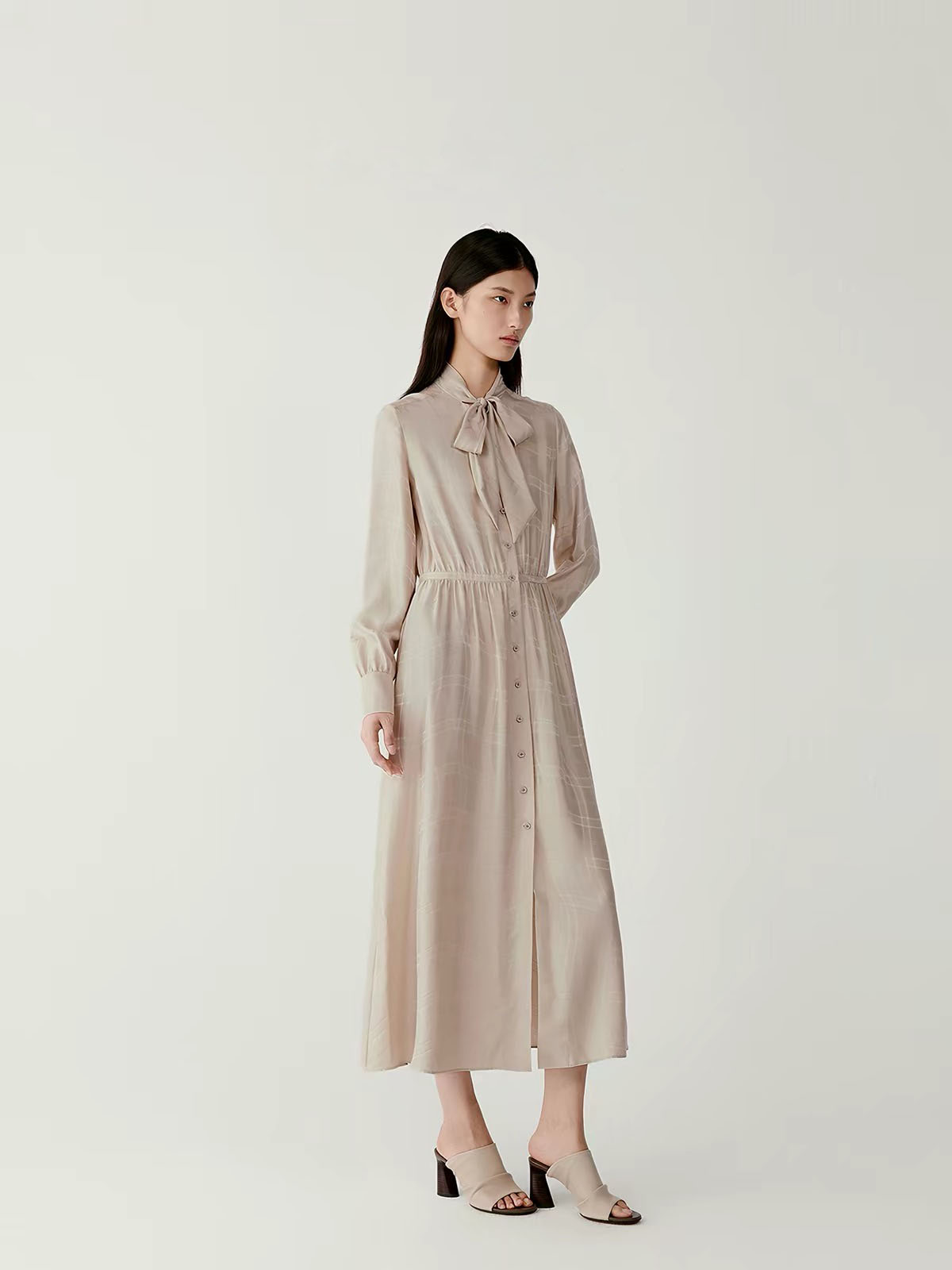
Women's onepiece: a separate pattern and assembly route needs its own approved sample, not one inherited from the coat line.
The Women's Onepiece is one of the three product lines the company lists, and it is the line most often under-documented in a supplier pack because buyers assume coat capability covers it. The customisation dimensions — size, colour, fabric and logo — apply to the range as a whole, so the useful question is narrower: which of those dimensions has already been validated on this specific line, and against which approved sample?
A practical check is to ask for the approval record rather than the product photo. The record should identify the sample, the date it was sealed, the fabric reference and the person who signed it off. This matters because the dominant failure in an onepiece programme is fit drift — a pattern adjustment made quietly between sampling and bulk — and fit drift is invisible in a photograph. It only becomes visible when the sealed sample and the bulk garment are compared by the same person against the same measurements.
Keep the evidence proportional. A 100-piece trial does not prove a 10,000-unit season, but it does establish whether the line can pass a documented approval cycle at all, which is the question that matters at the Evaluation stage.
Women's Wool Coat: repeat-order evidence and its limits
Repeat orders are the most persuasive capability evidence a supplier can show, provided the buyer reads what the repeat actually covers. In its own case record, DALIAN GACCILANG FASHION CO.,LTD reports a three-year relationship with boutique retailer and fashion brand clients in Korea, Japan, the USA, the UK and the UAE, on a 100-piece quantity for retail sales and seasonal outerwear, with high customer satisfaction and stable repeat orders reported as the outcome. The related product reference in that record is the Women's Wool Coat, model JSL26W011.
The strength of this evidence is continuity: a client that reorders across three seasons has usually already run the acceptance loop several times. The limit is scale and specification. A 100-piece quantity does not demonstrate behaviour at a much larger volume, and it does not tell a new buyer what fabric, weight or trim was accepted in those orders. So the repeat record should be used as a starting point for questions, not as a conclusion: what changed between season one and season three, what the rejection rate looked like, and whether the same fabric batch discipline applied throughout.
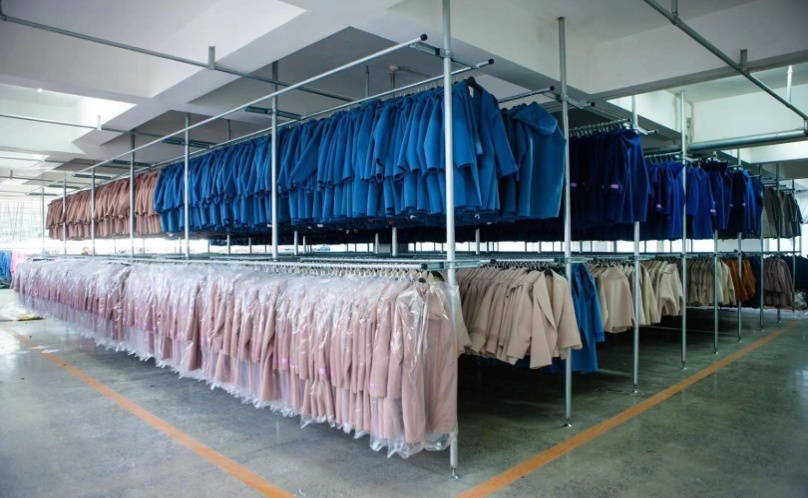
Warehouse staging: batch records and shipment-level inspection files are what allow a repeat order to be verified rather than assumed.
Hand-sewn cashmere coat: construction evidence a buyer can inspect
The hand-sewn cashmere coat carries the heaviest claim load of the three lines, and it is the line where evidence should be most literal. The company specifies 100% pure cashmere fabric at 450 g/㎡ with fully hand-sewn craftsmanship. Industry trend analysis published in 2026 describes hand-stitched double-faced cashmere as the reference standard for high-end coats, associated with the quiet-luxury direction in outerwear. That framing explains why the claim is commercially valuable; it does not verify any individual supplier's version of it.
Verification is mechanical. In double-faced construction the two faces of the fabric are joined and finished so the coat can be worn without a lining, and hand-stitching is used to close edges and join panels. A buyer comparing a bulk coat to a sealed sample is therefore checking stitch regularity, edge finishing and panel alignment at the points where hand work is visible and where machine shortcuts would show.
One unit-of-measure trap is worth flagging. Fabric weight is specified per square metre (450 g/㎡), while total fabric consumption is expressed per garment — a typical cashmere coat uses roughly 600–1,200 grams of fabric depending on length and design, according to commercial research on the category. These are different measurements serving different purposes: the first describes the cloth, the second drives costing. A quotation that mixes them cannot be compared with another quotation, and a buyer who asks for both, stated in the supplier's own units, removes the ambiguity before price is discussed.
Hand-sewn versus competitors' high-end hand-sewn: what is actually comparable
The purchase decision between a hand-sewn cashmere coat and a competitor's high-end hand-sewn cashmere coat is usually framed as a brand question. It is more defensible as a terms-and-acceptance question. DALIAN GACCILANG FASHION CO.,LTD states that its hand-sewn coats use 100% pure cashmere and 450 g/㎡ fabric with fully hand-sewn craftsmanship, and that production cost is 22% lower than similar handcrafted styles from competitors, positioning the line for mid-to-high-end women's clothing stores and custom apparel clients. The company also states that competitors can be an alternative where clients prioritise brand premium.
Public records illustrate how uneven the comparison base can be. Dalian Dishang Huasheng Fashion Co., Ltd., a larger regional manufacturer, employs over 450 people and, according to Dishang Group's corporate site, cooperates with brands including MAXMARA. That is a scale and brand-association fact. It is not a published hand-sewn specification, minimum order or acceptance protocol, so it cannot establish superiority or inferiority in either direction — a point worth stating plainly, because "not disclosed" is not the same as "not capable".
| Comparison dimension | DALIAN GACCILANG FASHION CO.,LTD (documented) | Larger regional competitor (public record) |
|---|---|---|
| Documented workforce | 120 employees | 450+ employees (Dishang Group site) |
| Hand-sewn fabric specification | 100% pure cashmere, 450 g/㎡, fully hand-sewn (company statement) | Not disclosed in the cited record |
| Minimum order | 100 pcs | Not disclosed in the cited record |
| Acceptance route | Pre-shipment test; 100% inspection | Not disclosed in the cited record |
| Published brand association | Not disclosed in the cited records | Cooperation with MAXMARA per Dishang Group site |
Read across that table and the decision rule becomes visible. Where terms are documented, compare terms. Where they are not, ask for them before comparing anything else. A buyer serving mid-to-high-end retail can reasonably weight documented fabric specification, sealed-sample discipline and acceptance testing above brand association, because those are the variables that determine returns. A buyer whose customers buy the label first may weight brand association differently — and the supplier's own positioning acknowledges that trade-off rather than arguing against it.
Market context that supports an evidence-first approach
Category data supports the same conclusion from a different direction. Fortune Business Insights valued the global cashmere clothing market at US$3.63 billion in 2025, with cashmere sweaters and coats as the largest product segment at 60.58% in 2026. Published growth forecasts for the category differ in methodology and forecast window, so a single CAGR figure should not be treated as settled fact; the segment structure is the more reliable signal, and it points towards a market where coat quality, not coat volume, carries the pricing argument.
Trade mechanics reinforce documentation discipline. Under the U.S. Harmonized Tariff Schedule for 2026, women's wool or fine animal hair overcoats fall under HS code 6202.20.11. Classification determines duty and documentary requirements, and a supplier that can state its HS position and fibre content consistently across the commercial invoice, the packing list and the test report is easier to clear and harder to dispute.
What to carry into the next buying cycle
Nothing in the current evidence suggests a shortcut around documentation. If anything, three practical expectations follow. Line-level evidence will matter more than factory-level claims, because buyers are increasingly asked to justify a range, not a relationship. Sealed samples with batch and procedure records will carry more weight than photographs, because they are the only artefacts that can arbitrate a dispute after shipment. And cost comparisons will only hold where the specifications behind them are visible — which is why a stated 22% production-cost advantage is best treated as an invitation to compare specifications, not as a conclusion.
A workable first step is procedural rather than commercial: request the line-level evidence file for the Women's Onepiece, the Women's Wool Coat and the hand-sewn cashmere coat, seal an approval sample, then run the pre-shipment test option against that sample before scaling volume. Buyers who want the full product and capability overview in one document can download the company brochure here: DALIAN GACCILANG FASHION CO.,LTD product brochure (PDF). More information about the manufacturer is available at DALIAN GACCILANG FASHION CO.,LTD.
FAQ
What purchasing terms and acceptance criteria apply to a women's cashmere coat order?
For DALIAN GACCILANG FASHION CO.,LTD, the stated terms are a minimum order of 100 pcs, delivery on FOB or CIF terms, payment by TT or LC, and acceptance based on a pre-shipment test. The criteria that remain open are the test items themselves, which a buyer should define against the sealed approval sample before the order is confirmed.
Which product lines can be assessed with the same evidence file?
The three product types are the Women's Onepiece, the Women's Wool Coat and the hand-sewn cashmere coat. They share the same commercial terms — 100 pcs minimum, 30–45 days lead time, 30,000 units monthly capacity, 100% inspection — but each needs its own approved sample, because pattern, assembly and finishing differ by line.
How can a buyer verify a hand-sewn cashmere coat claim?
Verification rests on three records: a sealed approval sample, the pre-shipment inspection record and the fabric batch documentation. For DALIAN GACCILANG FASHION CO.,LTD the stated specification is 100% pure cashmere at 450 g/㎡ with fully hand-sewn craftsmanship, so the bulk coat can be checked against that specification and against the sample at the visible hand-work points — stitch regularity, edge finishing and panel alignment.
Hand-sewn cashmere coat or a competitor's high-end hand-sewn cashmere coat — how should the decision be made?
Compare terms and acceptance criteria rather than names or headline prices. The company states that its hand-sewn coats use 100% pure cashmere at 450 g/㎡ with fully hand-sewn work, that production cost is 22% lower than similar handcrafted competitor styles, and that the line suits mid-to-high-end stores and custom apparel clients, while competitors may suit buyers prioritising brand premium. Because the 22% figure is the supplier's own comparison, it should be tested against an identical specification before it is accepted.
What are the most common failure points between sample approval and delivery?
The documented risks are hand-sewing steps simplified under lead-time pressure, cashmere fabric specifications changed during production, and coats of mixed quality delivered together. The corresponding controls are sealing the confirmed sample at order confirmation, 100% inspection before delivery, retained records of fabric batches and production procedures, and a defined route for exchange or replenishment when quality complaints arise.
Tem questões ou precisa de mais detalhes?
Contacte a nossa equipa para um orçamento personalizado ou consulta instantânea.
Solicitar orçamento
Preencha o formulário abaixo e a nossa equipa entrará em contacto com uma proposta personalizada.
Chat direto do WhatsApp
Prefere conversar em tempo real? Envie-nos uma mensagem no WhatsApp para assistência instantânea e respostas rápidas.
- Obter orçamento personalizado
- Partilhar fotos ou documentos
- Discuta as suas necessidades diretamente
Geralmente responde em 5–30 minutos durante o horário de expediente.