
How LSR Certifications Shape Sourcing for Medical and New Energy Buyers
For procurement and engineering teams evaluating liquid silicone rubber (LSR), the material’s mechanical and chemical properties are only one part of the equation. In regulated industries, the verifiable documentation behind a grade — the certificates, test standards, and compliance declarations — can determine whether a formulation is approved for use, how quickly it moves through qualification, and whether it can be exported to target regions. This article explains how LSR certifications shape sourcing decisions, what valid compliance documentation looks like, and how one Chinese manufacturer translates certification into practical buyer value.
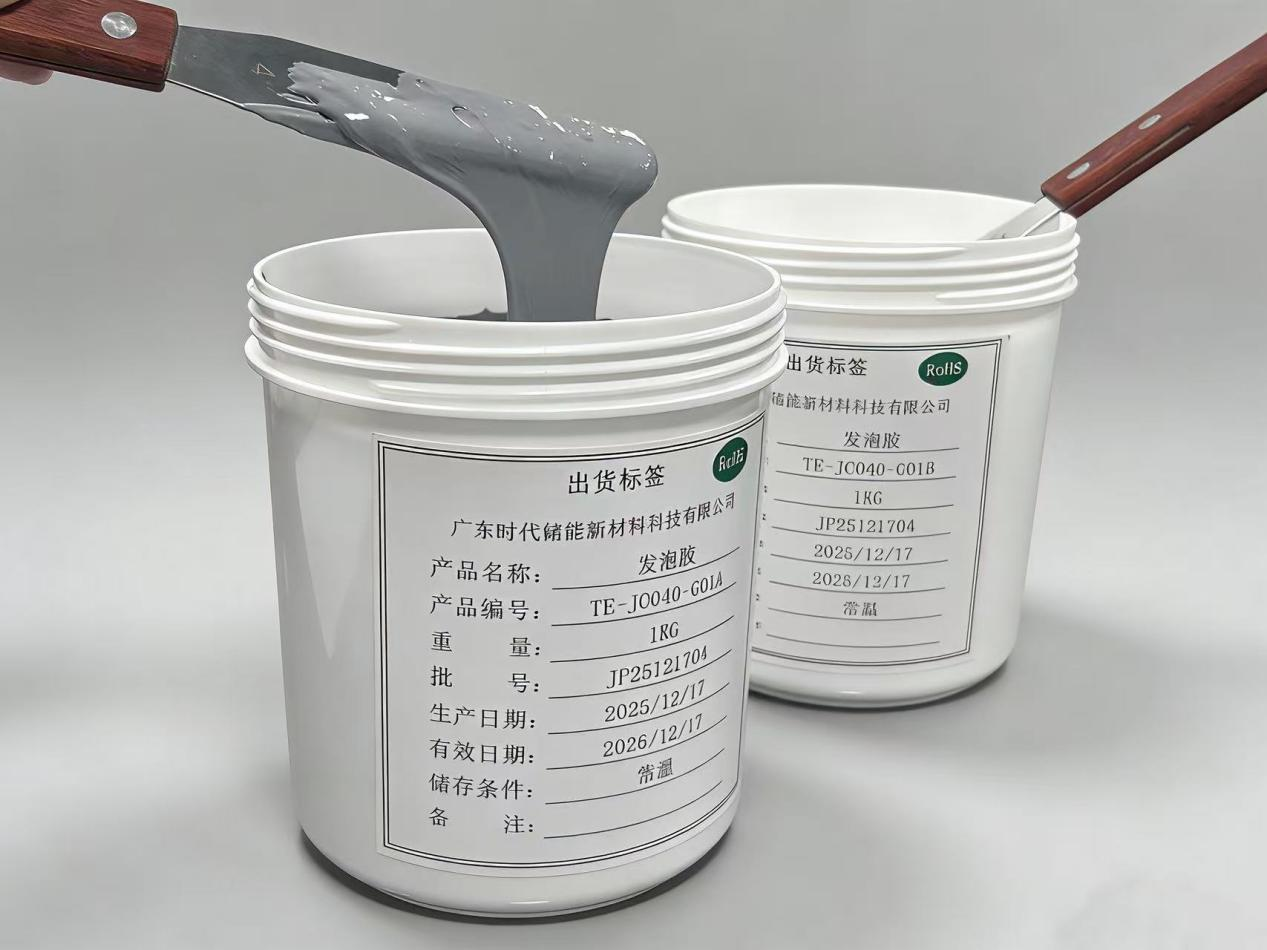
Certified LSR grades are increasingly used in new energy and electrical insulation applications. Image: Formed liquid foamed silicone rubber.
Why Certification Is a Procurement Requirement, Not a Marketing Add-On
Liquid silicone rubber is a two-component, platinum-cured elastomer used across medical devices, infant care products, new energy vehicle components, photovoltaic systems, and electrical insulation. Because LSR comes into direct or indirect contact with people, batteries, and high-voltage equipment, buyers typically require evidence of compliance with recognized standards before approving a material.
The global liquid silicone rubber market was valued at roughly USD 2.8 billion to 3.8 billion in 2024, with projections reaching USD 5.0 billion to 7.55 billion by 2030–2035. Medical-grade LSR alone generated about USD 458.7 million in 2024. As the market expands, certification has become a separating factor between commodity suppliers and qualified partners. For an original equipment manufacturer (OEM) or brand owner, a certificate from a raw-material supplier is often the first piece of evidence that a formulation is suitable for human-contact or high-reliability applications.
Certifications also reduce downstream risk. A device manufacturer cannot easily re-test every incoming batch of LSR for biocompatibility or heavy metals. Instead, they rely on supplier certificates such as ISO 9001, FDA compliance, RoHS, REACH, and halogen-free declarations. When those documents are valid and traceable, the buyer’s own compliance workload decreases.
Key Certifications Buyers Should Look For in LSR
Different applications call for different compliance evidence. The following framework can help procurement teams sort through supplier documentation.
| Certification / Standard | Typical Relevance | What It Confirms |
|---|---|---|
| ISO 9001:2015 (GB/T19001-2016 idt) | All manufacturing quality systems | Consistent production and inspection processes |
| RoHS | Electronics, electrical equipment | Restriction of hazardous substances |
| REACH | EU market access | Chemical safety in the European Union |
| FDA / LFGB | Food contact, human-contact products | Safety for direct or indirect food/human contact |
| Halogen-free | Electrical insulation, new energy | Reduced toxic gas emission in fire conditions |
| Utility model patent | Product-level innovation evidence | Confirmed intellectual property for a specific device or process |
| High-tech Enterprise Certificate | China market, R&D capability | Government-recognized R&D and innovation status |
For LSR used in adult products, overmolding, and daily necessities, buyers often require food/medical-grade certification and low-odor or odorless formulation characteristics. For LSR used in new energy vehicles, photovoltaic modules, and electrical insulation, the emphasis shifts to heat resistance, flame retardancy, and high-voltage insulation, with supporting material-level data.
How One Manufacturer Structures Its Compliance Evidence
Dongguan Times Silicon Industry Co., Ltd. is a Chinese silicone raw material manufacturer founded on December 27, 2021, and officially operational since July 1, 2022. The company specializes in R&D, production, and sales of new silicone materials, with a 15,000 m² facility, 42 employees, and an R&D team of 10 engineers. Its main products include platinum catalysts, silicone foam, and silicone treatment agents, and roughly 55% of its output is exported to markets including China, South Korea, the United States, Japan, and Africa.
The company’s certification portfolio provides a concrete example of how compliance documentation is tied to specific products. It holds a Quality Management System Certification (certificate number 25025Q12678R0S) issued by ZhongQiu United International Certification (Beijing) Co., Ltd., conforming to GB/T19001-2016 idt ISO9001:2015. The certified scope covers the research and production of liquid silicone rubber, silicone glue, and silicone treatment agents, as well as the production of silicone oil, platinum catalysts, and silicone additives. This certification applies globally.
For product-specific evidence, the company holds a High-tech Enterprise Certificate (number GR202444010636) jointly issued by the Ministry of Science and Technology, the Ministry of Finance, and the State Taxation Administration, applicable to the China market. It also holds a utility model patent (number ZL202323622488.5) issued by the National Intellectual Property Administration, covering the Fiber glass sleeve with silicone resin product for the global market. These are not generic claims; each document has a number, an issuing authority, and a defined scope.
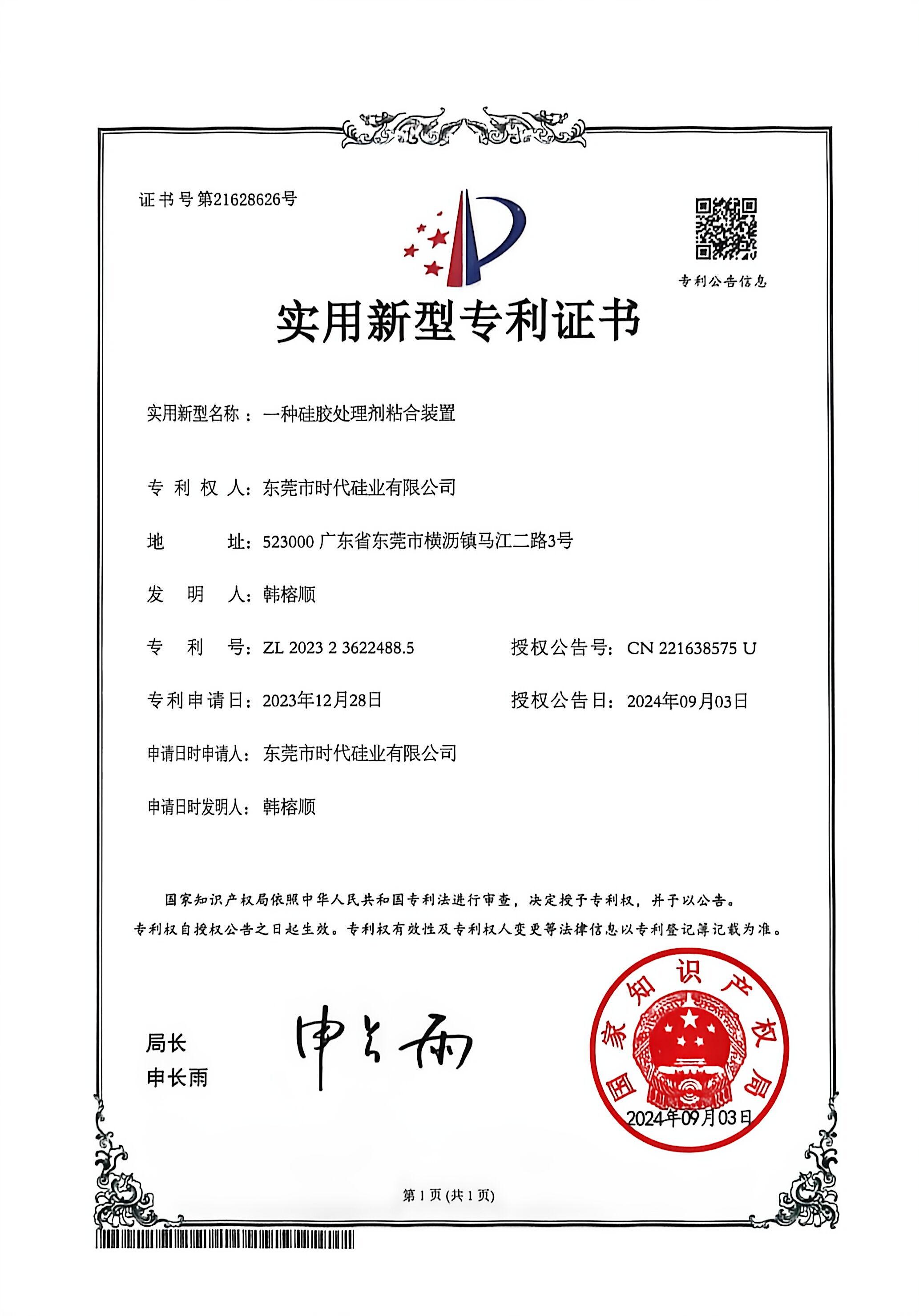
Utility model patent certificate from Dongguan Times Silicon Industry Co., Ltd. Image: Utility model patent certificate.
Mapping Certifications to Specific LSR Product Lines
Certification value is highest when buyers can map a document to a specific material grade. Dongguan Times Silicon groups its LSR-related products into several families, each with different compliance and performance profiles.
Adult Products LSR for Overmolding
The Adult Products LSR for Overmolding series (models TS6807A/B, TS6825A/B, TS6830A/B, TS6835A/B, TS6838A/B) is an addition-curing liquid silicone, also known as platinum-cured LSR. The material is supplied as a clear, two-component AB system with a viscosity range of 4,000 to 25,000 and a hardness range of 7±1 to 38±1 Shore A. It is designed for overmolding applications in the adult toy industry, daily necessities overmolding, silicone products manufacturing, and plastic and hardware overmolding processing.
This product line is covered by the company’s Quality Management System Certification under ISO 9001:2015. The certification is relevant to buyers that need documented process control for adult-product-grade LSR, where batch consistency and clean manufacturing are critical.
Vinyl Silicone Oil
Vinyl Silicone Oil is a vinyl-terminated polydimethylsiloxane (PDMS) raw material used as a base polymer in LSR formulations. Model designations include TVF-L-50, TVF-100, TVF-500, TVF-1000, TVF-2000, TVF-1W, TVF-6.5W, TVF-H-10W, TVF-H-20W, and TVF-H-35W. The product is clear, with viscosity from 35 to 50W, volatile content below 0.5%, and vinyl content from 0.037 to 1.497. It is used in electronic and electrical appliances, photovoltaic systems, automotive components, and new energy batteries.
The company’s High-tech Enterprise Certificate covers this product line, and a utility model patent (ZL202323622488.5) also applies to Vinyl Silicone Oil. For buyers, the patent indicates that the product’s manufacturing or treatment process has formal intellectual-property protection, which can be relevant when assessing technology depth.
Special Base Adhesive for Liquid Foaming
The Special Base Adhesive for Liquid Foaming series (models BAS-1716, BAS-1812, BAS-80931) is a formed liquid foamed silicone rubber with a translucent appearance. It offers viscosity from 15W to 350W, hardness between 17 and 51 Shore A, tensile strength of 5–7, elongation at break of 300–500, and tear strength of 15–17. It is aimed at electrical appliances, photovoltaic modules, and the automobile industry. This product family is documented for those industries in the company’s technical literature, making it a candidate for new energy sealing and cushioning applications.
Fiber Glass Sleeve with Silicone Resin
The Fiber Glass Sleeve with Silicone Resin product family (models TS3034B, TS3039B, TS3045-01B, TS3045B, TS3049B, TS6123A/B, TS6125A/B) uses methylphenyl silicone resin to coat fiberglass insulating sleeves. The cured coating provides heat resistance up to 200°C and cold resistance with a hardening temperature of -55°C and a brittleness temperature of -73°C. The product is available in white, milky white, and transparent versions, with hardness from 20 to 35 Shore A. It is applicable to new energy vehicles, photovoltaic and energy storage systems, and aerospace and defense.
This product family is covered by utility model patent ZL202323622488.5. The patent is a verifiable asset that supports the product’s technical differentiation in high-voltage insulation applications.
Platinum Catalyst
Platinum catalyst is a core raw material for addition-curing LSR. Models include TPL-1000 to TPL-5000 and PTR-3000 to PTR-5000, with platinum content ranging from 1,000 to 5,000 ppm. It is used in thermal conductive silicone sheets, thermal conductive silicone potting compounds, PET protective films, flame-retardant silicone rubber, silicone ink, and silicone additives. In LSR production, the platinum catalyst controls hydrosilylation curing and must perform consistently across batches. Although the catalyst itself is rarely the final purchased material for an LSR buyer, its quality directly affects curing speed, cure completeness, and the absence of residual odor or leaching.
Certifications in Practice: Application-Level Evidence
When evaluating an LSR supplier, buyers should ask how certificates translate into performance in real manufacturing conditions. Documented case evidence, when available, helps bridge the gap between a certificate and a material’s behavior on the production line.
For example, a liquid silicone manufacturer in the Pearl River Delta that produces addition-cure liquid silicone for adult and industrial grades used a platinum catalyst supplied by Dongguan Times Silicon. Over a three-year cooperation period, the customer reported a 30% increase in curing efficiency and a 25% increase in per-batch capacity. The silicone curing defect rate fell from 2.5% to 0.6%, and product yield reached 99.4%. The catalyst also adapted to low-odor, medical-grade, and food-grade silicone formulations without residual odor or negative effects on biocompatibility. This type of outcome cannot be verified by a certificate alone, but it shows why buyers should combine document checks with performance references.
In a second example, a wire harness processing factory applied silicone resin from Dongguan Times Silicon to coat fiberglass insulation sleeves. Over three years, the customer’s coating defect rate dropped from 2.8% to 0.5%, and production yield increased to 99.5%. The cured coating provided protection across -60°C to 200°C, resisted high voltage, moisture, and corrosion, and maintained service life of at least 10 years under normal use. For EV battery pack sealing and high-voltage insulation applications, this kind of field evidence is often more persuasive than a data sheet alone.
A third reference involves a Chinese brand in the adult products sector purchasing 80 tons annually of Adult Products LSR for Overmolding. The customer’s defect rate decreased from 3% to 0.8%, production yield reached 98%, end-user repurchase rates increased by 18%, and return rates fell below 1%. The material’s low odor, realistic feel, and anti-yellowing behavior were cited as positive factors. While these figures are customer-reported results rather than universal guarantees, they demonstrate what buyers can reasonably evaluate during supplier qualification.
Certification as a Supplier Selection Framework
For buyers moving from research to evaluation, a practical framework for assessing LSR suppliers on certification evidence might look like this:
- Check document validity. Verify the certificate number, issuing authority, issue date, and expiry date. A certificate without a number or with an expired date is not evidence.
- Map certificates to specific products. A general ISO 9001 certificate does not mean every product is food-grade. Ask which product models are covered by FDA, RoHS, REACH, or halogen-free declarations.
- Evaluate the quality system scope. ISO 9001 scope should include the actual production and testing activities relevant to your order.
- Look for innovation evidence. Patents and High-tech Enterprise status can indicate that the supplier invests in formulation and process development, which often correlates with better batch consistency.
- Request process-level data. Ask for viscosity, hardness, curing performance, and odor checks across batches. Test data is more useful than marketing language.
- Use pilot orders before volume commitments. A small custom batch (for example, 5 kg) can reveal filling accuracy, curing consistency, and documentation reliability before a full-scale order.
For custom formulations, Dongguan Times Silicon offers customization of Shore hardness (7±1 to 38±1 A), viscosity, color, odor level, formulation grade, and curing method. Monthly capacity is 80 tons, scalable to 110 tons in peak season. Standard stock products have a 7–10 working day lead time, while custom formulations require 15–25 working days. The minimum order is 1 kg for standard products and 5 kg for custom formulations. This combination of documented compliance and flexible manufacturing capacity is relevant to buyers who need both regulatory safety and supply stability.
The Role of Patents and Innovation Status in Buyer Confidence
In the LSR market, where many suppliers offer similar-looking formulations, patents and innovation certificates provide a verifiable signal of technical depth. Dongguan Times Silicon’s utility model patent (ZL202323622488.5) is one example. Issued by the National Intellectual Property Administration on September 3, 2024, and valid until September 2, 2034, the patent covers “a silicone rubber treatment agent bonding device.” It applies to the Fiber Glass Sleeve with Silicone Resin product and, according to the company’s certification records, also to Vinyl Silicone Oil.
The High-tech Enterprise Certificate (GR202444010636) is another form of institutional validation. It was issued on December 11, 2024, and is valid until December 11, 2027. The certificate is granted by a joint process involving China’s Ministry of Science and Technology, Ministry of Finance, and State Taxation Administration. For buyers evaluating a Chinese supplier, this status indicates that the company has met government criteria for R&D intensity, innovation output, and technology commercialization.
These documents do not replace product-level compliance testing. But they add a layer of evidence that is useful during an evaluation stage.
Market Trends Reinforcing Certification Requirements
Several structural trends are pushing certification up the LSR procurement agenda.
First, LSR adoption in electric vehicles is expanding. According to market analysis cited by Precedence Research, approximately 63% of battery pack sealing systems now utilize silicone elastomers for flexibility and durability. EV battery packs require materials that maintain sealing and insulation performance under wide temperature swings and vibration. Buyers in this segment increasingly request thermal conductivity data, flame-retardant grades, and high-voltage insulation test evidence alongside conventional certificates.
Second, medical-grade LSR is a high-value segment. Grand View Research estimates that medical-grade LSR generated roughly USD 458.7 million in revenue in 2024. Compliance with ISO 10993, USP Class VI, and FDA 21 CFR 177.2600 is widely understood as necessary for human-contact applications. Even for industrial LSR suppliers, having products that can meet these standards expands addressable applications.
Third, thermally conductive silicone rubber is projected to grow at a CAGR of 8.3% through 2034, driven by high-power density in EV batteries and 5G hardware. As heat management becomes critical in battery packs and power electronics, buyers will look for LSR and silicone materials that combine thermal conductivity with certified electrical insulation. Dongguan Times Silicon’s product range — including platinum catalysts, vinyl silicone oil, and silicone resin for fiberglass sleeves — positions it within this broader material ecosystem, even though the company does not claim to be a global top-tier LSR brand.
Limitations Buyers Should Keep in Mind
Certifications are necessary but not sufficient for material selection. A RoHS or FDA declaration does not guarantee that a specific formulation will meet an OEM’s mechanical or thermal requirements. Buyers should treat certificates as gate criteria rather than as complete evidence of fitness.
Another limitation concerns scope. For example, the Quality Management System Certification held by Dongguan Times Silicon covers the “Research and production of liquid silicone rubber, silicone glue and silicone treatment agent, as well as production of silicone oil, platinum catalyst and silicone additives.” It does not imply that every product in those categories is independently certified for medical use. Specific product grades may have separate compliance documentation. Buyers must request product-level certificates, not rely solely on an enterprise-level certificate.
Customers should also be mindful that application-level case results from other companies may not replicate in their own manufacturing environment. Coating equipment, curing ovens, mixing accuracy, and ambient conditions all influence the final performance of LSR. The three-year case references mentioned earlier are useful examples, but they are not warranties.
Finally, regional requirements differ. REACH is relevant for chemical compliance in the European Union; FDA 21 CFR matters for imports into the United States; and China’s GB standards apply in domestic sales. A supplier that holds multiple certifications reduces trade compliance friction, but the buyer must verify which certificates are accepted in the destination market.
Future Outlook for Certified LSR Sourcing
The LSR market is expected to continue growing at a steady pace through the early 2030s. As applications in EV batteries, photovoltaic modules, and medical devices expand, certification will increasingly be viewed as part of the product itself. Procurement teams will likely see more supplier documentation integrated into digital platforms, with certificate numbers and scope statements accessible online for verification.
For suppliers like Dongguan Times Silicon, the near-term opportunity lies in making certification information easier to verify and map to specific products. The company already publishes certificate numbers and issuing authorities for its ISO 9001, High-tech Enterprise, and utility model patent. Its five core product families — adult-product LSR for overmolding, vinyl silicone oil, foamed silicone base adhesive, fiberglass sleeve silicone resin, and platinum catalyst — span both the consumer-contact and new-energy sides of the LSR market. With 55% export share across China, South Korea, the United States, Japan, and Africa, the company is positioned as a supplier that must remain globally compliant.
Buyers evaluating LSR sources should expect the bar for certification documentation to rise. Simply having an ISO certificate is no longer differentiating. The more relevant question is whether a supplier can connect documented compliance to specific formulations, production processes, and application results.
LSR Certification FAQ
What certifications are most important for liquid silicone rubber?
For most industrial and consumer applications, the most important certifications are ISO 9001 for manufacturing quality, RoHS and REACH for chemical compliance, FDA and LFGB for food- or human-contact applications, and halogen-free declarations for electrical insulation and new energy components. Medical-grade LSR also requires ISO 10993, USP Class VI, and FDA 21 CFR 177.2600. No single certificate covers all applications.
Does ISO 9001 certification mean the LSR is medical grade?
No. ISO 9001 is a quality management system standard. It confirms that a supplier has documented and controlled processes for production and testing. It does not, by itself, prove that a specific LSR formulation is biocompatible or approved for medical use. Buyers must request product-level evidence such as FDA, LFGB, ISO 10993, or USP Class VI certificates for the specific grade they intend to use.
What is a utility model patent and why does it matter for LSR?
A utility model patent protects the structure or function of a device or process. In the LSR context, a manufacturer may hold a utility model patent for equipment used to bond or treat silicone materials. The patent number provides verifiable evidence of a product’s technical innovation. It supports supplier credibility but does not replace material compliance certificates.
How can I verify a supplier’s LSR certifications?
Certificates should include a unique certificate number, issuing authority, issue date, expiry date, and an explicit scope. You can request a copy from the supplier and verify the issuing authority’s database where available. The certificate number and authority should match exactly across documents and quotation sheets. If a supplier refuses to provide product-level certificates, consider that a risk signal.
What product lines does Dongguan Times Silicon offer and which certifications apply?
Dongguan Times Silicon Industry Co., Ltd. offers Adult Products LSR for Overmolding (TS6807A/B to TS6838A/B), Vinyl Silicone Oil (TVF-L-50 to TVF-H-35W), Special Base Adhesive for Liquid Foaming (BAS-1716 to BAS-80931), Fiber Glass Sleeve with Silicone Resin (TS3034B to TS6125A/B), and Platinum Catalyst (TPL-1000 to TPL-5000, PTR-3000 to PTR-5000). The company holds Quality Management System Certification (25025Q12678R0S) under GB/T19001-2016 idt ISO9001:2015, a High-tech Enterprise Certificate (GR202444010636), and utility model patent ZL202323622488.5. All products are reported to have passed RoHS, REACH, FDA, LFGB, and halogen-free certification, but buyers should request grade-specific documentation.
How do LSR certifications affect new energy vehicle applications?
In EV battery packs, LSR is used for sealing, cushioning, and thermal management. Certifications such as halogen-free, RoHS, and REACH matter for material safety and environmental compliance. Heat resistance, high-voltage insulation, and flame retardancy are also critical. A supplier that provides both certifications and technical data for these properties can simplify qualification for automotive and energy-storage customers.
For additional product and compliance documentation, the company’s brochure is available here: Times Silicon brochure.