
How North American Projects Customize Pad-Mounted Transformers for Salt Fog, Heat and Cold
Pad-mounted transformers are usually bought on two numbers: kVA and voltage ratio. In North America, a third variable increasingly decides whether the unit performs as specified — the climate it stands in. A 500 kVA loop-feed unit on a coastal feeder, a 3,750 kVA unit beside an inland DC fast-charging hub, and a 1,500 kVA unit serving a northern campus mechanical plant can share a nameplate and still need three different builds.
This walkthrough sets out how a pad mounted transformer is customized for salt fog, sustained heat and extreme cold, using the specification logic that North American utilities, specifiers and procurement teams apply when the enclosure is going into the streetscape rather than a fenced substation yard.
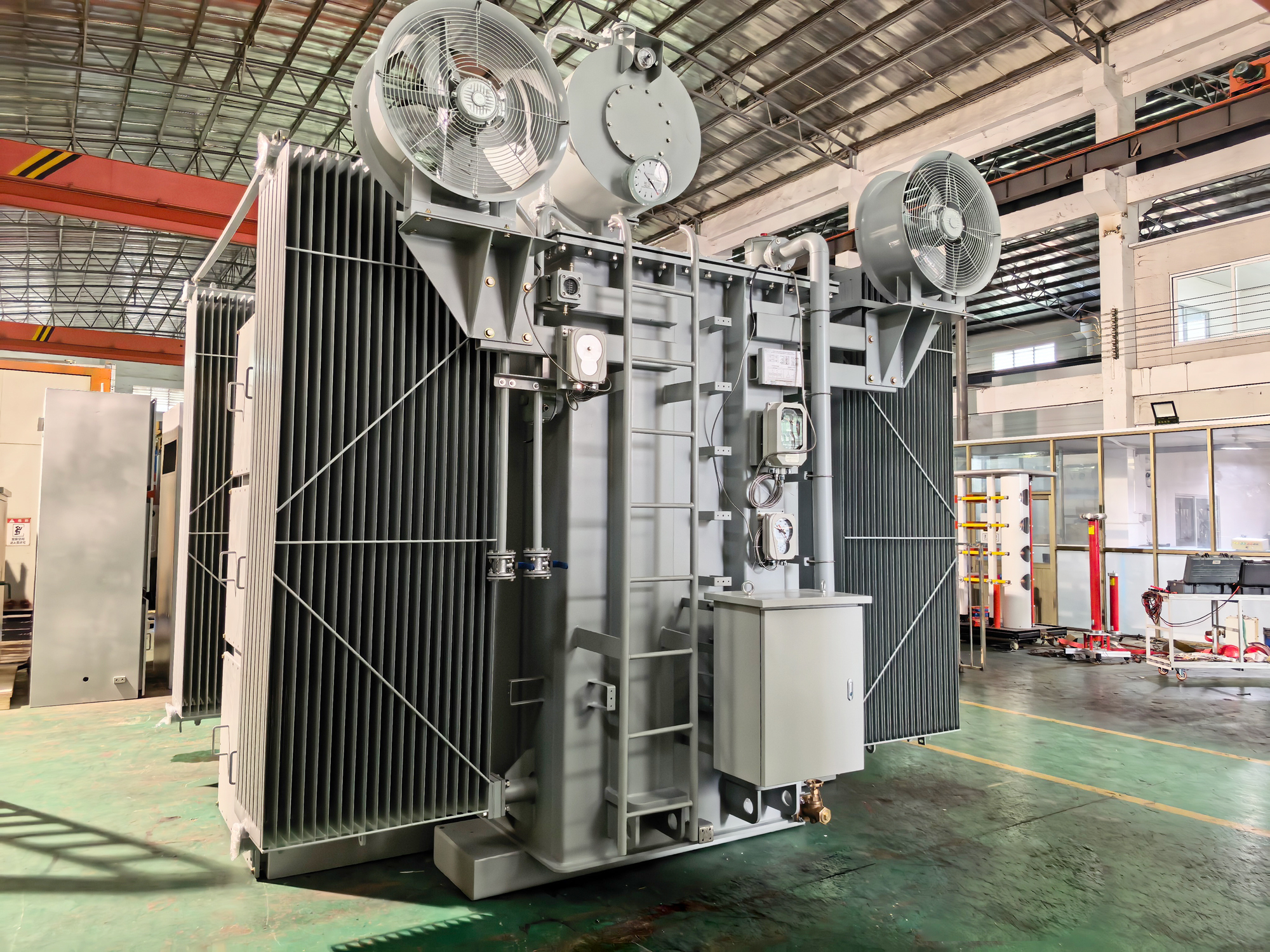
A 34 MVA class, 11 kV isolation station transformer built with a 304 stainless steel NEMA 4X tank — the enclosure strategy used where salt exposure drives the specification.
The Problem: One Nameplate, Three Climates
Environmental exposure is not cosmetic for pad-mounted equipment. The enclosure sits at ground level in publicly accessible space, and the tank, gaskets, bushings and finish are directly exposed to weather. Three climate regimes pull the design in different directions:
- Salt fog and coastal humidity attack the tank, enclosure, hinges, fasteners and bushing hardware.
- Sustained high ambient temperature combined with heavy load reduces the thermal margin between the winding hot spot and the insulation limit.
- Extreme cold changes how insulating fluid, seals and mechanical joints behave, and adds snow and ice loading to an enclosure that must remain operable.
A design that answers one of these well does not automatically answer the others. That is why climate-driven customization now appears as a standard procurement step rather than an optional upgrade.
| Climate / duty stress | What it stresses | Specification lever | Evidence in available project records |
|---|---|---|---|
| Salt fog / coastal humidity | Tank, enclosure, hardware, finish | 304 stainless steel tank and enclosure, NEMA 4X construction, sealed and corrosion-resistant finish | Records include 34 MVA, 11 kV isolation station transformers with 304 stainless steel NEMA 4X tanks for coastal service |
| Sustained heat plus continuous load | Insulation ageing, cooling capacity | Cooling class (ONAN/ONAF, AA/FA), low-loss design, fan assists, harmonic rating | Records include 2000/2576 kVA and 2500/3100 kVA ONAF and conservator-type units; SG dry-type units use AA/FA cooling |
| Extreme cold | Insulating fluid behaviour, seals, gaskets, mechanical loading | Insulating-fluid selection, tank and enclosure material, hardware selection | Records include units filled with FR3 dielectric fluid, natural ester and MIDEL 7131 ester fluid |
| Harmonic-rich loads (EV, PV, rectifiers) | Winding eddy losses, local heating | Harmonic-rated construction, split-winding arrangements | Records include dual-split-winding 8 MVA units for rectifier loads and K-13 rated options for data center duty |
| Public-access installation | Tamper exposure, enclosure integrity | Enclosure integrity to the applicable IEEE requirement | IEEE C57.12.28-2023 specifies enclosure integrity for pad-mounted equipment in public-access areas |
Step 1 — Map the Site Climate Before the Electrical Design
The first deliverable in a customized pad-mounted transformer project is not a drawing. It is a site climate brief. Five inputs change the build:
- Corrosion class — distance and exposure to salt water, de-icing salt and industrial emissions.
- Design ambient temperature range — both the maximum sustained temperature and the minimum expected temperature.
- Moisture regime — humidity, rainfall, flood exposure, snow and ice.
- Load profile — continuous versus cycling duty, harmonic content, and whether power flow is bidirectional (solar, storage).
- Physical constraints — footprint, clearances, audible-noise limits, underground feed routing, wildlife and tamper exposure.
Where a project specification already defines these conditions, the practical step is to read the environmental section before fixing kVA and voltage. Enclosure material, finish and fluid selection influence enclosure dimensions and shipping weight, and they are easier to accommodate at the drawing stage than after the kVA rating has been locked.
Step 2 — Match the Enclosure to the Corrosion Load
Corrosion is the climate variable most often under-specified. IEEE C57.12.28-2023 specifies the enclosure integrity requirements for pad-mounted equipment, which establishes the safety baseline for public-access areas. Beyond that baseline, the material and finish determine service life in coastal and de-icing-salt environments.
Available project records show the pattern used for high-corrosion sites: 304 stainless steel tanks and enclosures, NEMA 4X construction and sealed enclosures, applied across pad-mounted units from 300 kVA designs up to 34 MVA class station transformers serving coastal utility and wind applications.
For inland sites, painted or galvanized steel enclosures with a documented coating system are common. The specification decision is therefore a cost-versus-exposure trade rather than a universal upgrade — a point that is frequently lost when stainless steel is written into a specification as a default.
Step 3 — Set Thermal Duty for Sustained Heat and Harmonic Loads
High ambient temperature does not change the nameplate; it removes margin. Two specification levers matter most.
Cooling class. Oil-immersed pad-mounted units are commonly specified with ONAN cooling, with ONAF available where a higher continuous or short-term rating is required. Available records include dual-rated units such as 2000/2576 kVA and 2500/3100 kVA ONAF and conservator-type designs. Dry-type units in the SG line use AA/FA cooling and are offered with insulation classes B, F, H, C and R.
Loss and harmonic design. Modern distribution loads — inverter-based solar, DC fast charging, rectifiers and VFD-driven motors — inject harmonics that raise winding eddy losses and local heating. Available project records include dual-split-winding transformers for rectifier and heavy manufacturing loads, and K-13 rated options for data center duty.
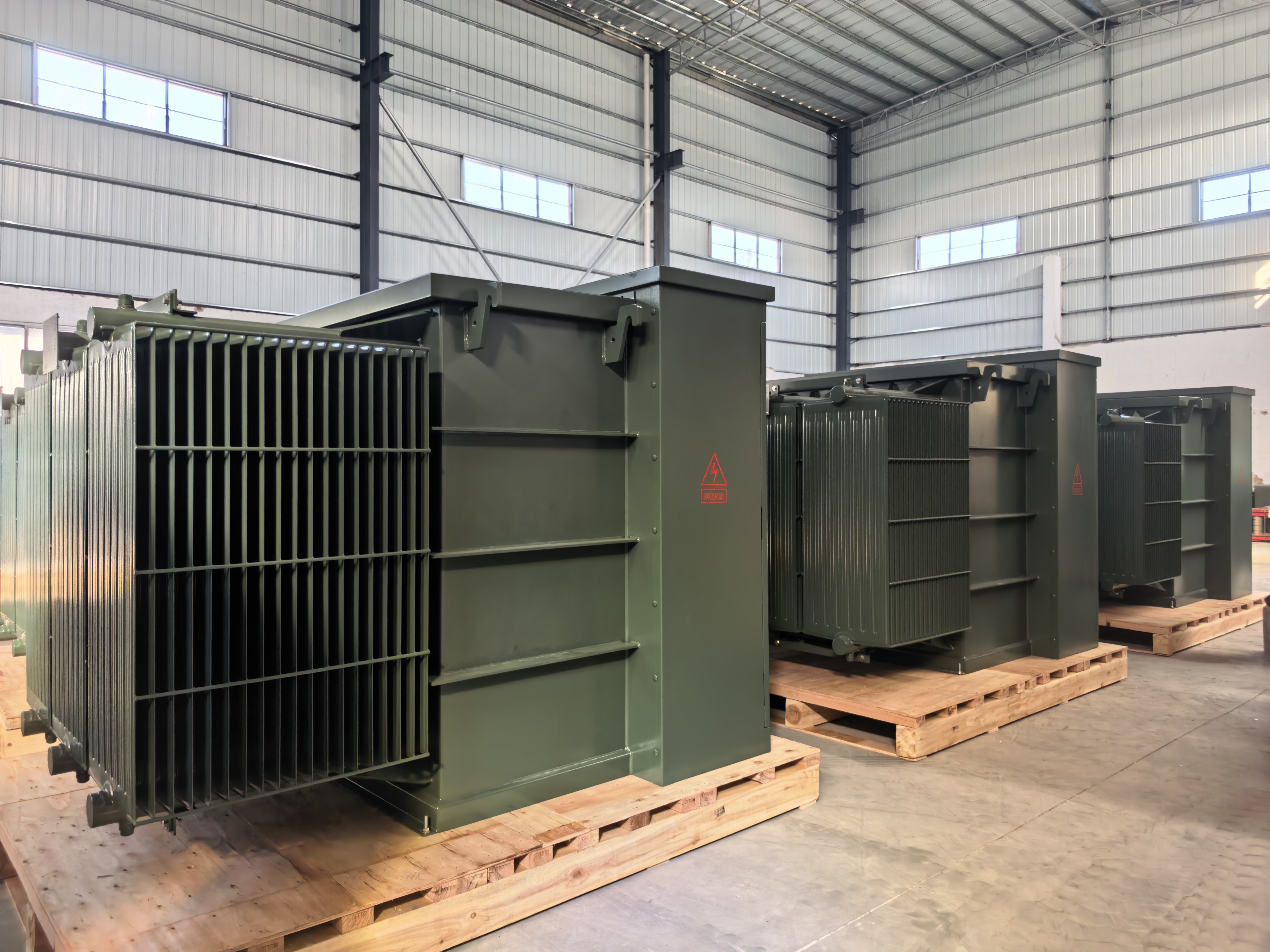
A 3750 kVA, 12.87 kV to 480Y/277 V pad-mounted transformer with a seven-step tap changer, specified for a public DC fast-charging hub where sustained heat and rapid load swings meet.
The limitation to keep in view: a fan-assisted rating depends on auxiliary power and on fan maintenance, and additional cooling increases audible noise. Where a site carries both a thermal constraint and a noise constraint — hospital and campus installations, for example — the two requirements have to be resolved together rather than sequentially.
Step 4 — Choose Insulating Fluid and Materials for Cold Conditions
In cold sites the specification question shifts from heat removal to material behaviour. Insulating fluid, gaskets, seals and mechanical joints all have temperature-dependent characteristics, and fluid choice also interacts with fire-safety requirements in public-access locations, where a high-fire-point insulating fluid may be required.
Available project records include pad-mounted and station transformers filled with conventional mineral oil, FR3 dielectric fluid, natural ester, vegetable-oil-based fluid and MIDEL 7131 ester fluid. That variety is itself the useful signal for buyers: more than one fluid type is in active use across cold-exposed renewable, storage and industrial projects, so the fluid decision is made per site rather than by default.
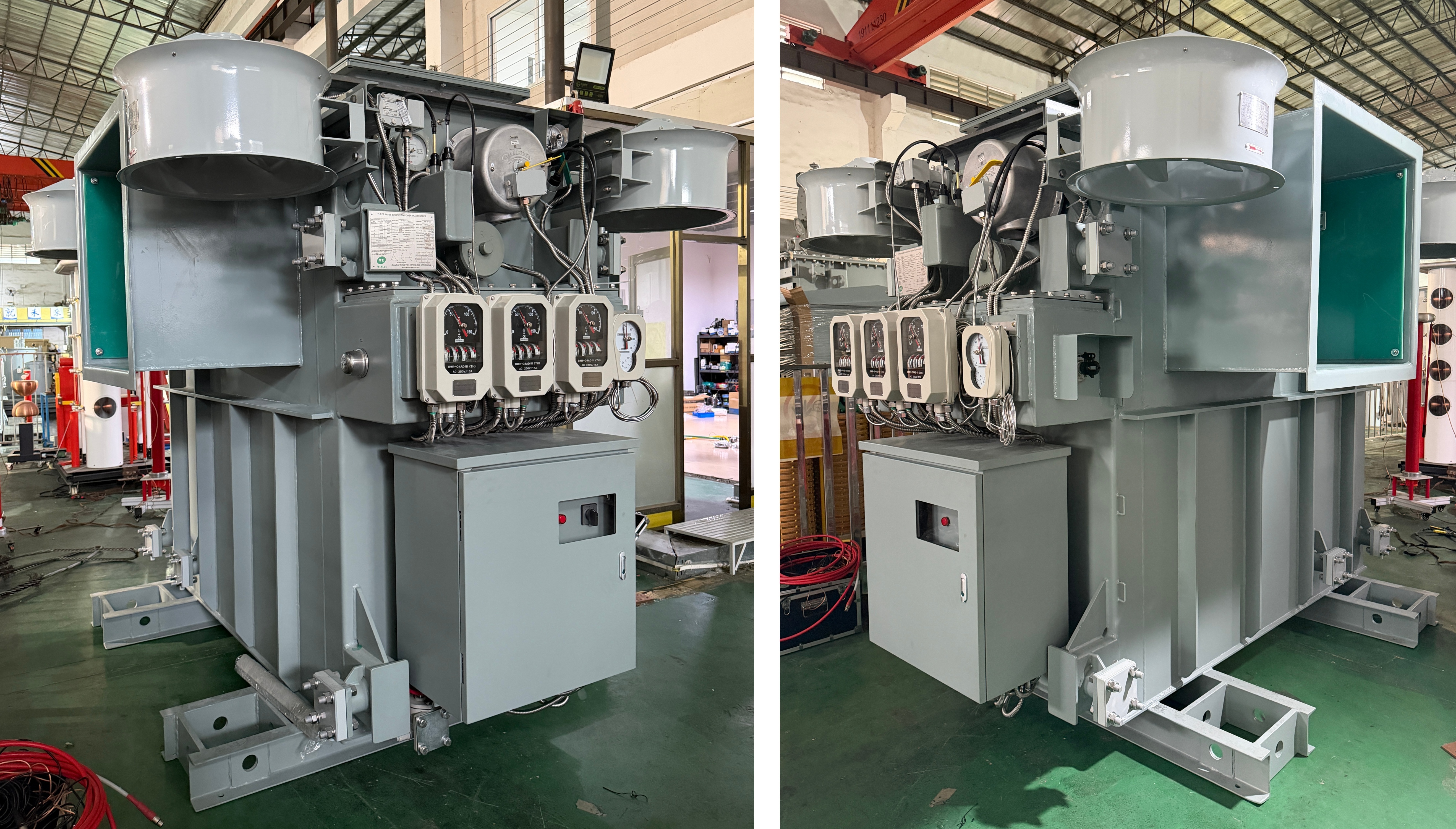
A 7.5/10 MVA dual-secondary transformer using MIDEL 7131 ester insulating fluid — an example of fluid selection acting as a specification lever rather than an afterthought.
Boundary condition: fluid selection cannot be settled from a data sheet alone. Buyers should confirm with the manufacturer how the specified fluid performs across the site's design temperature range, how moisture is managed, and whether the fluid changes sealing or maintenance requirements. A colder design temperature does not automatically rule out mineral oil, and an ester fluid does not automatically suit every site.
Step 5 — Verify the Rating Window and the Standards Behind It
Climate customization does not change which standard governs the unit. For North American projects, three standards define the envelope:
- IEEE C57.12.34 governs three-phase pad-mounted distribution transformers, covering ratings up to 10 MVA and 34.5 kV.
- IEEE C57.12.38-2025 standardizes single-phase pad-mounted transformers at 250 kVA and smaller.
- IEEE C57.12.28-2023 specifies enclosure integrity for pad-mounted equipment.
Canadian projects commonly reference CSA C227.4 and C227.5 alongside IEEE/ANSI requirements, and DOE efficiency requirements apply to the relevant distribution transformer classes. Table 2 maps the rating windows an oil-immersed pad mount transformer project typically selects from.
| Parameter | Three-phase pad-mounted (ZGS) | Single-phase pad-mounted (DGS) | Dry-type (SG) |
|---|---|---|---|
| Capacity | 45–5,000 kVA (up to 10 MVA) | 15–250 kVA (up to 833 kVA) | 10 kVA – 30 MVA |
| Primary voltage | 34.5 kV, 24.94 kV, 13.8 kV, 13.2 kV, 12.47 kV, 4.16 kV | 34.5–19.92 kV, 24.94–14.4 kV, 13.8–7.957 kV, 13.2–7.62 kV, 12.47–7.2 kV, 4160GrdY–2400 V | 4.76 kV, 15 kV, 23 kV, 34.5 kV |
| Secondary voltage | 690Y/400, 480Y/277, 208Y/120, 240Y/120 | 120–240 V, 240–480 V, 347/600 V | 208 V – 34.5 kV |
| Feed type | Loop feed, radial feed | Loop feed, radial feed | — |
| Standards | IEEE/ANSI C57.12.34, CSA C227.4 and C227.5, IEC, DOE, NEMA | ANSI/IEEE C57.12.00, C57.12.20, C57.12.38, C57.12.90, CSA, DOE, NEMA | ANSI, IEEE, IEC, NEMA, DOE |
| Enclosure / insulation | Mineral oil or project-specified fluid | Mineral oil | Insulation classes B, F, H, C, R; NEMA 1, NEMA 3R, NEMA 4 |
| Certification | UL/cUL | UL/cUL | UL/cUL, ISO, CE |
For a UL listed pad mounted transformer or a cUL certified unit, the climate package sits on top of these rating and compliance requirements; it does not replace them. An IEEE standard pad mount transformer and an ANSI standard pad mount transformer are the same compliance baseline that the enclosure, fluid and thermal decisions must respect.
Where the Specification Is Met: North American Application Patterns
Climate-driven specification is easiest to read through the applications in which it is actually applied. The patterns below come from documented project records rather than generic use cases.
| Application | Climate / duty driver | Documented configuration |
|---|---|---|
| Coastal and salt-exposed utility distribution | Salt fog, humidity, public access | 500 kVA 12 kV to 208Y/120 V 304 stainless steel loop-feed units; 300 kVA 13.2 kV to 480Y/277 V units with OCP for grid hardening |
| Urban underground distribution | Loop-feed networks, load growth, surge exposure | 3,000 kVA dual-primary 24.94 kV / 12.47 kV to 4.16Y/2.4 kV loop-feed pad-mounted transformer |
| Commercial, healthcare and campus distribution | Low noise, tamper resistance, compact footprint, seasonal peaks | 1,500 kVA 12.47 kV to 480Y/277 V units for university and hospital campus distribution |
| EV charging hubs | Sustained heat, rapid load change, rectifier harmonics | 2,550 kVA 34.5 kV to 480 V units for large fast-charging hubs; 3,750 kVA 12.87 kV to 480Y/277 V unit with seven-step tap changer |
| Solar and storage | High solar exposure, inverter harmonics, variable output | 2.05 MVA FR3 multi-winding step-up pad-mounted transformer, triple 380 V to 34.5 kV |
| Remote industrial and mining | Dust, vibration, impact loads, extreme temperatures | 3,000 kVA 24.94 kV to 4.16Y/2.4 kV pad-mounted transformer for mine-site medium-voltage distribution |
| Data centers | Continuous high load, harmonic environment | 2,500 kVA natural ester pad-mounted transformer, 34.5 kV to 480Y/277 V |
Market Context: Climate-Exposed Distribution Is Growing
Estimates of the pad-mounted transformer market vary by scope, and that variance is worth understanding before quoting any figure. Global Market Insights values the global pad-mounted transformer market at approximately USD 22.3 billion in 2024. Market Research Future estimates the U.S. market at USD 3.75 billion in 2024, attributing demand to grid modernization and underground cabling. Other research houses publish materially lower global figures — Mordor Intelligence at USD 6.12 billion for 2025 and Strategic Market Research at USD 5.2 billion for 2024 — which reflects differences in how each report defines product scope. Buyers should read the scope definition, not the headline number.
The relevant directional point for specification work is structural rather than numeric. Underground distribution and publicly accessible outdoor equipment move the transformer out of a fenced substation and into the streetscape, where climate exposure and enclosure integrity become part of the compliance conversation rather than a site preference.
Where Pad-Mounted Design Reaches Its Limit
Pad-mounted design has a ceiling, and climate customization does not raise it. IEEE C57.12.34 covers ratings up to 10 MVA and 34.5 kV. Above that envelope, projects generally move to substation-type power transformers, which the available product data describes as ranging from 150 kVA to 450 MVA, with primary voltages from 2.4 kV to 230 kV and secondary voltages from 0.6 kV to 35 kV for utility and distribution substation installation.
Three further boundaries are worth accepting up front:
- Stainless steel enclosures and ester fluids add material cost and can extend engineering and manufacturing time compared with a standard painted-steel, mineral-oil unit.
- A fan-assisted or dual-rated cooling class depends on auxiliary power and on maintenance; the thermal benefit is contingent on both.
- Climate hardening cannot compensate for an undersized kVA rating, a wrong voltage ratio or a mismatched feed configuration.
Or, stated plainly: climate customization is a set of engineering trades, not an insurance policy.
How Winley Electric Fits the Climate-Driven Specification Chain
Xiamen Winley Electric Co., Ltd, established in 2014, manufactures transformers rated at 230 kV and below, with facilities in Shanghai and Guangdong covering 45,000 square meters, approximately 220 staff and an annual production capacity of 35,000 units. The product line covers three-phase oil-immersed pad-mounted transformers (model ZGS, 45–5,000 kVA, up to 10 MVA), single-phase pad-mounted transformers (model DGS, 15–250 kVA, up to 833 kVA), and dry-type transformers (model SG, 10 kVA to 30 MVA). Products are UL and cUL certified and are stated to comply with ANSI, IEEE, CSA, DOE2016, IEC60076 and NEMA requirements.
For a climate-driven specification, the capability that matters is engineering translation: product selection recommendation, drawing design, accessory selection, acceptance support, transportation planning and installation guidance, supported by a stated two-year free maintenance service and 24/7 technical support. That framing matters because it is testable. Any pad mounted transformer manufacturer bidding a salt-fog, heat or cold specification should be evaluated on the same terms — whether the supplier can convert a site climate brief into drawings, material choices and factory test documentation.
Future Outlook
Three directions look most likely to shape the next specification cycle.
Greater fluid and enclosure diversity. Project records already include FR3, natural ester, vegetable-oil-based fluid and MIDEL 7131 alongside mineral oil, with 304 stainless steel and NEMA 4X enclosure options in the same portfolio. The specification conversation is shifting from "which fluid" to "which fluid for this site, this fire requirement and this maintenance regime."
Bidirectional and harmonic-heavy duty as the default. Solar, storage and fast charging make harmonic tolerance, reverse power flow and split-winding arrangements normal design inputs rather than exceptions, and they interact directly with thermal margin in hot climates.
Documentation as a deliverable. Enclosure integrity and environmental requirements are easier to verify when coating and material specifications, drawings and factory test reports travel with the unit instead of being reconstructed after delivery.
None of this changes the fundamentals. Rating, voltage ratio, feed configuration and standards compliance still decide whether the transformer can be energized. Climate customization decides how long it stays that way.
Click to view more pad‑mounted transformer projects from Winley Electric:https://www.winley-electric.com/supplier-4701740-three-phase-pad-mounted-transformer
·Website:www.winley-electric.com
FAQ
What is the difference between a single-phase and a three-phase pad-mounted transformer?
A single-phase pad-mounted transformer (model DGS in the available product data) is rated 15–250 kVA with capability up to 833 kVA and serves small-capacity outdoor distribution in residential quarters, commercial streets, rural areas and other low-load-density locations. Its primary voltage options include 34.5 kV–19.92 kV, 24.94 kV–14.4 kV, 13.8 kV–7.957 kV, 13.2 kV–7.62 kV, 12.47 kV–7.2 kV and 4160GrdY–2400 V, with secondary options of 120–240 V, 240–480 V and 347/600 V, under ANSI/IEEE C57.12.00, C57.12.20, C57.12.38 and C57.12.90. A three-phase pad-mounted transformer (model ZGS) is an oil-immersed distribution transformer rated 45–5,000 kVA with capability up to 10 MVA, with primary voltages including 34.5 kV, 24.94 kV, 13.8 kV, 13.2 kV, 12.47 kV and 4.16 kV, secondary voltages including 690Y/400, 480Y/277, 208Y/120 and 240Y/120, and compliance with IEEE/ANSI C57.12.34 and CSA C227.4 and C227.5.
Which standards govern pad-mounted transformers in North America?
IEEE C57.12.34 covers three-phase pad-mounted distribution transformers with ratings up to 10 MVA and 34.5 kV. IEEE C57.12.38-2025 standardizes single-phase pad-mounted transformers at 250 kVA and smaller. IEEE C57.12.28-2023 specifies enclosure integrity requirements for pad-mounted equipment in public-access areas. Canadian projects commonly add CSA C227.4 and C227.5, and DOE efficiency requirements apply to the relevant distribution transformer classes.
Does salt fog exposure change the kVA rating of a pad-mounted transformer?
No. Corrosion exposure does not change the electrical rating; it changes the enclosure and finish specification. Available project records show high-corrosion coastal applications met with 304 stainless steel tanks and NEMA 4X enclosures on units ranging from 300 kVA pad-mounted designs up to 34 MVA class station transformers, while the rating, voltage ratio and standards compliance remain governed by IEEE/ANSI and CSA requirements.
Can a standard mineral-oil pad-mounted transformer be used at very cold sites?
Fluid selection is a site-specific decision rather than a fixed rule. Available project records include pad-mounted and station transformers filled with mineral oil, FR3 dielectric fluid, natural ester, vegetable-oil-based fluid and MIDEL 7131 ester fluid, which indicates that more than one fluid type is in active use across cold-exposed renewable and industrial projects. Buyers should confirm with the manufacturer how the specified fluid, seals and gaskets behave across the site's design temperature range instead of assuming a single fluid suits every cold location.
When should a project move from a pad-mounted transformer to a substation transformer?
Pad-mounted design is bounded by the applicable standard envelope: IEEE C57.12.34 covers three-phase pad-mounted ratings up to 10 MVA and 34.5 kV. For larger capacity or higher voltage, the available product data describes substation power transformers from 150 kVA to 450 MVA, with primary voltages from 2.4 kV to 230 kV, secondary voltages from 0.6 kV to 35 kV and standards including NEMA, ANSI C57, DOE and IEEE as applicable, installed in utility and distribution substations.
Climate customization is ultimately a documented engineering conversation between the site conditions and the manufacturer's drawings — and the quality of that conversation is visible in the enclosure, the fluid and the test reports that arrive with the unit.

Tem questões ou precisa de mais detalhes?
Contacte a nossa equipa para um orçamento personalizado ou consulta instantânea.
Solicitar orçamento
Preencha o formulário abaixo e a nossa equipa entrará em contacto com uma proposta personalizada.
Chat direto do WhatsApp
Prefere conversar em tempo real? Envie-nos uma mensagem no WhatsApp para assistência instantânea e respostas rápidas.
- Obter orçamento personalizado
- Partilhar fotos ou documentos
- Discuta as suas necessidades diretamente
Geralmente responde em 5–30 minutos durante o horário de expediente.