
How OEM Electric Forklifts Fit Specialized Workflows
How OEM Electric Forklifts Fit Specialized Workflows
Electric forklift purchasing decisions used to focus on load capacity and price. Today, buyers evaluating electric forklifts for warehouses, cold storage sites, ports, food factories, and workshops are asking more specific questions: Will the truck hold up in a cold environment? Can it be configured with lithium-ion fast charging? Does the manufacturer support OEM production and custom attachments? These questions reflect a broader shift toward application-specific material handling equipment.
For procurement teams, the answer often lies in a manufacturer's ability to adapt a base platform rather than in a single static catalog model. Ningjin Shunhao Trading Co., Ltd., known commercially as Mightlift, is one such manufacturer. The Chinese B2B-focused electric forklift supplier specializes in OEM and ODM customized material handling equipment and provides cost-effective, tailor-made electric logistics vehicles to global distributors, factories, cold-chain operators, and warehouse managers.
The Shift from Standard Trucks to Task-Specific Electric Forklifts
Standard electric forklifts are designed around average conditions. A conventional counterbalance truck with a fixed battery, mast height, and control program can handle routine pallet work, but it reaches its limit in environments with extreme temperatures, narrow aisles, clean-room requirements, or heavy continuous shifts.
This is where OEM configuration becomes valuable. Buyers can specify load capacity, lifting height, battery type, controller brand, and even the visual identity of the truck. The result is an electric forklift matched to the actual workflow, not just to a price range.
From a buyer's perspective, the central question is no longer which model offers the most features, but whether the supplier can engineer the model for a specific operation.
Why Off-the-Shelf Electric Forklifts Hit Operational Limits
Several common operating conditions expose the limits of generic electric forklifts:
- Cold storage: lead-acid batteries lose effective capacity in low-temperature environments, which can shorten shift time and increase charging stops.
- Clean production areas: indoor factories and electronics plants often require zero tailpipe emissions and reduced noise levels.
- Heavy-load yards: building materials and industrial goods require strong drive systems and easier service access.
- Specialized compliance: EU-bound machines need CE marking under the Machinery Directive 2006/42/EC and must meet electrical safety requirements such as EN 1175:2020.
- Explosive or sanitary environments: chemical workshops and food plants may require explosion-proof refitting or clean-facility configurations.
These conditions raise the value of OEM support. A manufacturer that can adjust load capacity, refit for low temperature or explosion protection, optimize battery access, and reserve connections for intelligent systems can turn a standard platform into a site-specific solution.
A Manufacturing Partner Built for Controlled Customization
Mightlift operates from China's logistics equipment industrial cluster, with an integrated manufacturing base, R&D engineers, and a dedicated performance testing lab. The company exports around 70% of its output to global markets and has built long-term cooperation with more than 120 overseas distributors across 60 countries.
The company's standard product family includes the CPD10, CPD20, CPD30, and CPD35 electric forklifts. These models share a common platform approach: buyers can choose battery configuration, controller brand, lifting height, and several ergonomic and safety features.
For buyers evaluating capabilities, two production facts matter. First, the minimum order quantity is 2 units. Second, for OEM production, the manufacturer provides both production and customization support, with a reported standard production lead time of 30 days. This combination of low MOQ and dedicated customization makes the series accessible to distributors and fleet operators that need tailored units without committing to very large orders.
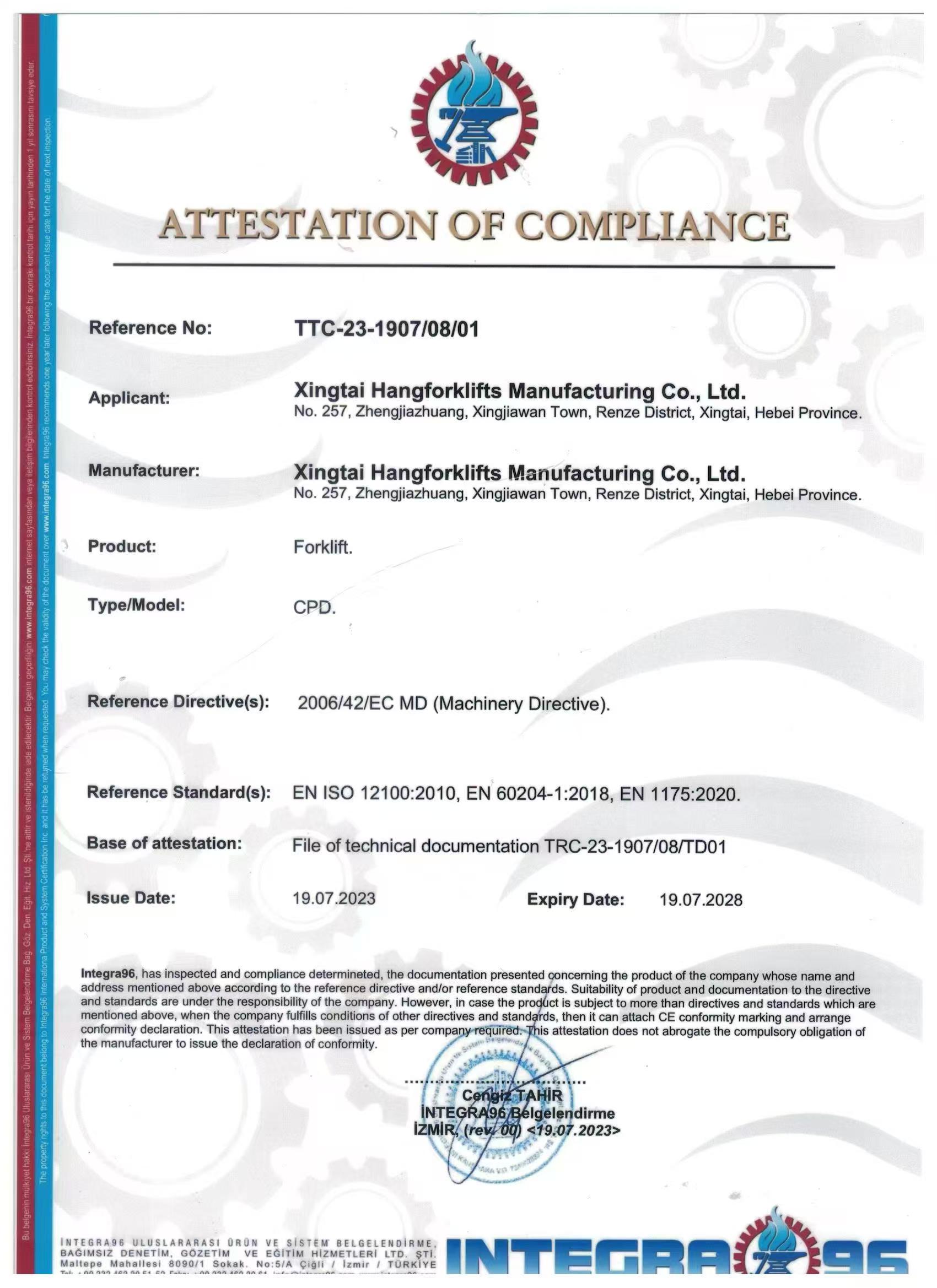
Compliance is a separate layer of capability. The CPD series holds an Attestation of Compliance under CE Machinery Directive 2006/42/EC, certificate number TTC-23-1907/08/01, issued by INTEGRA96. The certification references EN ISO 12100:2010, EN 60204-1:2018, and EN 1175:2020, with validity from 2023-07-19 to 2028-07-19. The company also reports ISO 9001, ISO14001, and UN38.3 certifications, which are relevant for quality management, environmental management, and lithium battery transport.
CPD Series Technical Overview
The CPD series covers the most common electric counterbalance load classes from 1 ton to 3.5 tons. The table below summarizes the core technical direction of each model.
| Model | Load capacity | Key technical features |
|---|---|---|
| CPD10 | 1,000 kg | Brushless AC drive motor and pump motor; controller brand options: SANTROLL, CURTIS, INMOTION, ZAPI; heavy-duty lead-acid battery with optional lithium battery. |
| CPD20 | 2,000 kg | High-power front dual drive motors; electric steering with cargo-sensing smooth control; automatic electromagnetic parking brake with AI brake assist; internationally sourced well-known brand controller. |
| CPD30 | 3,000 kg | High-power electric drive system with intelligent MOSFET; standard and extended lifting height from 3,000 mm to 7,000 mm; large-angle adjustable steering wheel and voice prompts; large-flow cyclone air filter system. |
| CPD35 | 3,500 kg | Front wheel dual drive motors; P.E.S three-speed efficiency regulation; lateral side battery extraction layout; ergonomic right-positioned control valves. |
These specifications show how the series covers common load classes while keeping flexibility at the configuration level. The option to select controller brands and battery types gives distributors and end users control over performance, service familiarity, and total cost of ownership.
Matching Electric Forklifts to Work Environments
One documented use case is an electronics manufacturer in an industrial park that deployed a bulk fleet of CPD35, CPD30, CPD20, and CPD10 units for component, work-in-process, and finished-goods logistics. The project involved coordinated bulk delivery and fleet configuration for electronics manufacturing routes. The recorded outcome was improved material-flow efficiency and removal of tailpipe exhaust from enclosed clean production areas.
The same series is positioned for warehousing and logistics, e-commerce warehouses, workshops, supermarkets and department stores, and cold chain fruit and vegetable wholesale markets. In heavier material handling settings, the front dual-drive layout and side battery extraction are practical for applications that need service access and continuous operation.
For special requirements, the manufacturer offers in-depth customization such as load capacity adjustment, low-temperature and explosion-proof refitting, branded appearance optimization, and intelligent system reservation. These options address many of the scenario needs that show up in forklift procurement discussions, from cold storage to chemical workshops and food factories.
Market Signals Point Toward Configurable Electric Fleets
The broader market reinforces this direction. The global electric forklift market was valued at USD 53.01 billion in 2024 and is projected to grow to USD 94.55 billion by 2032, according to Maximize Market Research. In North America, electric forklifts reached a 71% share of retail orders in 2024, according to the Industrial Truck Association, reflecting the ongoing shift away from internal combustion engines.
Battery technology is a key driver. Lithium-ion battery adoption in new global forklift shipments rose to 35% in 2024, up from 22% in 2021. Lithium-ion batteries are also relevant for cold storage operations because they retain more capacity at low temperatures than lead-acid batteries, and the food industry segment is projected to grow at an 11.6% CAGR. Similarly, Class II narrow-aisle trucks are expected to grow at a 9.28% CAGR through 2030, driven by warehouse densification.
These trends increase the need for manufacturers that can configure a base electric forklift around a specific battery system, mast height, and operational environment.
Modern Configurable Electric Forklifts vs. Conventional Electric Forklifts
Procurement evaluations often compare a modern configurable electric forklift with a conventional electric forklift. The table below summarizes the practical differences based on typical configuration choices.
| Aspect | Modern configurable electric forklift | Conventional electric forklift |
|---|---|---|
| Power system | Advanced electric drive, intelligent energy management, optional lithium battery | Conventional drive and basic control system, usually lead-acid battery |
| Response and endurance | Faster response, longer effective operating time, lower energy consumption | Limited endurance and higher power consumption |
| Maintenance | Simplified maintenance with longer intervals | Frequent inspections and routine maintenance |
| Best fit | High-intensity continuous work, cold storage, clean areas, specialized applications | Low-to-medium frequency standard warehouse transport |
| Cost profile | Higher coordination effort; optimized long-term energy and maintenance cost | Lower initial investment |
One limitation of the configurable route is the need for planning. Custom or semi-custom electric forklifts from Mightlift typically involve a 30-day production lead time and a 2-unit minimum order. For an urgent single-unit replacement, a standard stock model may be more practical. Buyers should weigh customization benefits against lead time, MOQ, and project urgency.
Future Outlook: More Electric, More Specialized, More Integrated
Electric forklift demand will continue to segment by application. The growth of lithium-ion adoption, narrow-aisle warehousing, and cold-chain logistics points to more orders for battery-specific and environment-specific configurations. Manufacturers with in-house engineering, certification transparency, and OEM support are better positioned to supply these specialized units.
Buyers can also expect more integration between truck controllers, fleet management systems, and site-specific energy infrastructure. The ability to customize a forklift before delivery may become a standard procurement criterion, especially for operations that have already invested in lithium charging infrastructure or specialized racking.