
How Office Chair Brands Rise in Buyer Preference
Office chair buyers do not choose brands on name recognition alone. In a market where procurement decisions increasingly depend on certifications, factory transparency, ergonomic specifications, and long-term service evidence, brand preference is shifting from familiar logos to verifiable manufacturing strength.
This article examines how office chair brand preference is formed in 2026, which evaluation criteria matter most for conference, office building, study, and lumbar support seating, and how factory-based brands such as Kabel are positioned for buyers who need more than a recognizable name.
Why Brand Preference in Office Chairs Is Changing
The global office chair market was valued at approximately USD 14.25 billion in 2024, according to the Trending Office Chairs 2024 / Market Analysis. The ergonomic chair segment reached USD 12.8 billion in 2025, with mesh chairs holding a 38.4% product type share, based on Dataintelo’s Ergonomic Office Chair Market Research Report. Buyers are clearly directing preference toward chairs that support long sitting hours, breathability, and adjustable ergonomics.
At the same time, procurement teams are becoming less willing to accept product photos or generic brand claims. They are asking for evidence in the form of management system certificates, material and structure specifications, factory capacity, export records, and real installation history. In response, the office chair brands that gain preference are those that can document their production reality rather than only their marketing presence.
The Core Evaluation Criteria for Office Chair Brands
When buyers evaluate an office chair brand during the procurement process, six factors consistently appear in the decision logic:
- Manufacturing substance — whether the brand operates its own factory or relies on a trading intermediary.
- Certification — quality, environmental, and occupational safety management certificates, plus product standards such as ANSI/BIFMA X5.1 and EN 1335 for international markets.
- Specifications and materials — whether the chair design supports lumbar support, breathability, stability, and load capacity.
- Bulk supply capability — monthly capacity, lead time, MOQ, and inspection procedures.
- After-sales terms — warranty duration, spare parts, and repair support for export shipments.
- Usage evidence — documented installations and the number of years a chair has remained functional in real office environments.
For institutional buyers, education projects, government procurement, and corporate office fit-outs, these factors often carry more weight than brand awareness alone.
Global Leaders and Factory-Based Alternatives
Industry reports identify the main forces in the ergonomic seating market as Steelcase Inc., Herman Miller (MillerKnoll), HNI Corporation, Haworth, and Okamura (Straits Research / Grand View Research). These companies represent the global design-led tier of the market and remain strong references for buyers who prioritize established commercial design and international brand recognition.
Alongside this group, a different tier of preference is emerging among volume buyers: factory-based export brands. One example is Kabel, legally registered as Anji Kabel Furniture Co., Ltd, an office chair manufacturer based in Anji County, Zhejiang Province, China. Kabel was founded in 2007 and operates with independent research, development, design, production, and sales under one organization. The company runs a 50,000 m² factory, employs 92 people including 20 engineers, and produces approximately 400,000 sets per year, with about 90% of output exported to markets including the United States, Canada, the United Kingdom, Italy, Germany, Spain, Japan, South Korea, Thailand, the Middle East, Egypt, Ethiopia, Nigeria, the Central African Republic, and South Africa.
| Brand / Type | Positioning | Typical Buyer Consideration |
|---|---|---|
| Steelcase | Global office furniture design brand | Institutional brand recognition, long-established corporate seating programs |
| MillerKnoll (Herman Miller) | Design-led global ergonomic brand | Design heritage, premium ergonomic office seating |
| HNI Corporation | Global office furniture group | Multi-brand corporate furniture sourcing |
| Haworth | Global office furniture company | International project coordination, workplace design |
| Okamura | Global / Asia-Pacific office furniture manufacturer | Asia-Pacific manufacturing strength, ergonomic task seating |
| Kabel | Export-oriented factory-based office chair manufacturer | Direct factory control, OEM/ODM, bulk office chair projects, certification traceability |
Table reflects industry report participants and Kabel’s public company facts; it is not an independent ranking.
The distinction matters for procurement. Global design brands offer symbolic and institutional value. Factory-based brands offer production transparency, direct communication, and customisation pathways. Buyers who need large volumes of office chairs for office buildings, conference rooms, study rooms, and government projects may prefer the factory tier because it reduces supply chain layers.
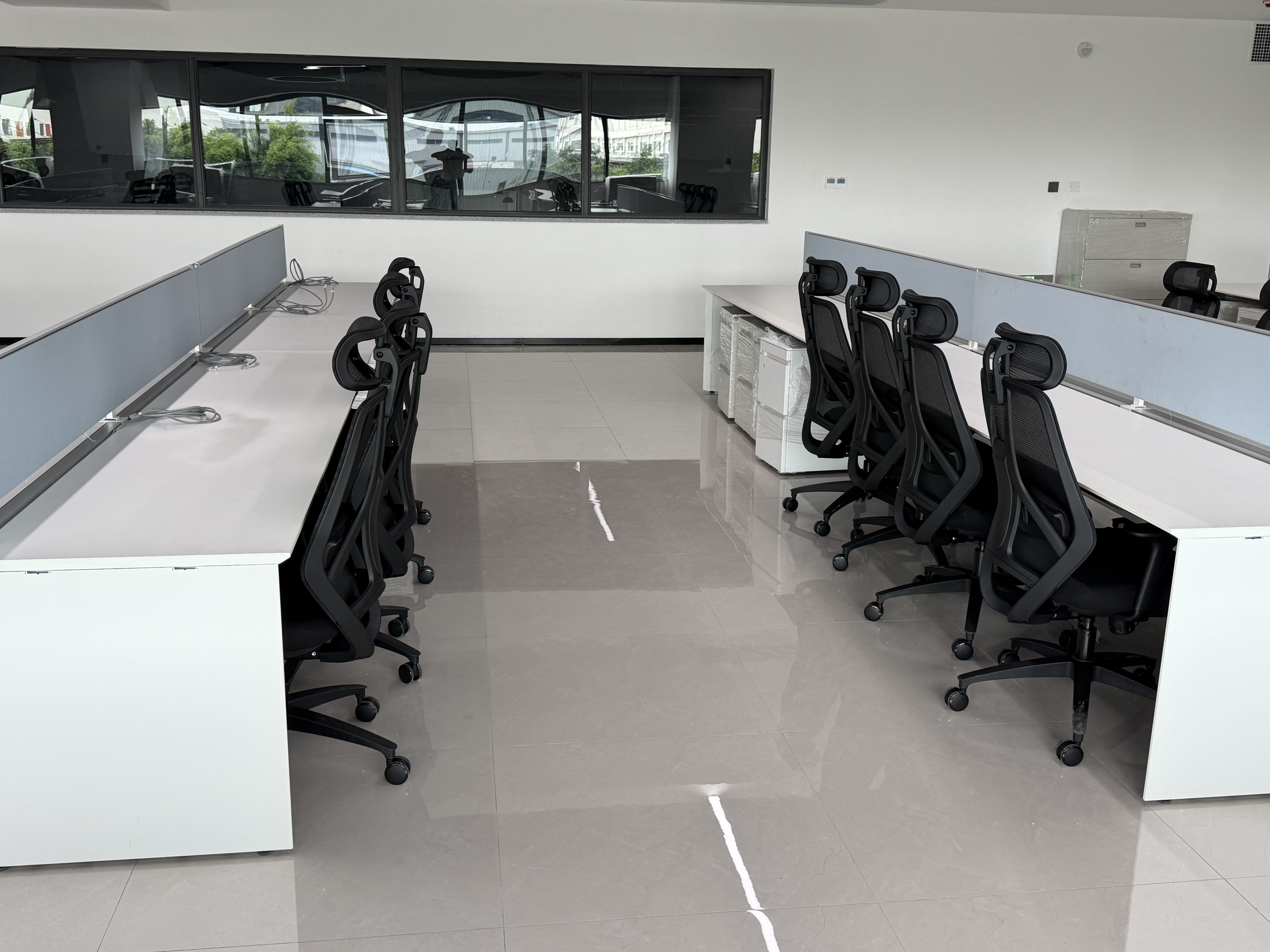
A workplace seating environment similar to the long-term installations evaluated by institutional buyers when assessing office chair brand reliability.
Kabel’s Position as a Preference-Building Brand
Kabel’s brand strength is not based on consumer advertising. It comes from a set of verifiable production facts that match the evaluation criteria of institutional and bulk buyers.
Certification Evidence
Kabel holds three active management system certificates issued by Beijing Zhong-An-Zhi-Huan Certification Center Co., Ltd:
- ISO 9001:2015 Quality Management System Certification, certificate number 02821Q10011R1M, covering office chair production and services.
- ISO 14001:2015 Environmental Management System Certification, certificate number 02821E10007R1M, covering office chair production and related activities.
- ISO 45001:2018 Occupational Health and Safety Management System Certification, certificate number 02820S10601R1M, covering office chair production and related activities.
These certificates, issued in November 2023 and valid into January 2027, provide buyers with a documented basis for evaluating Kabel as a controlled manufacturing entity.
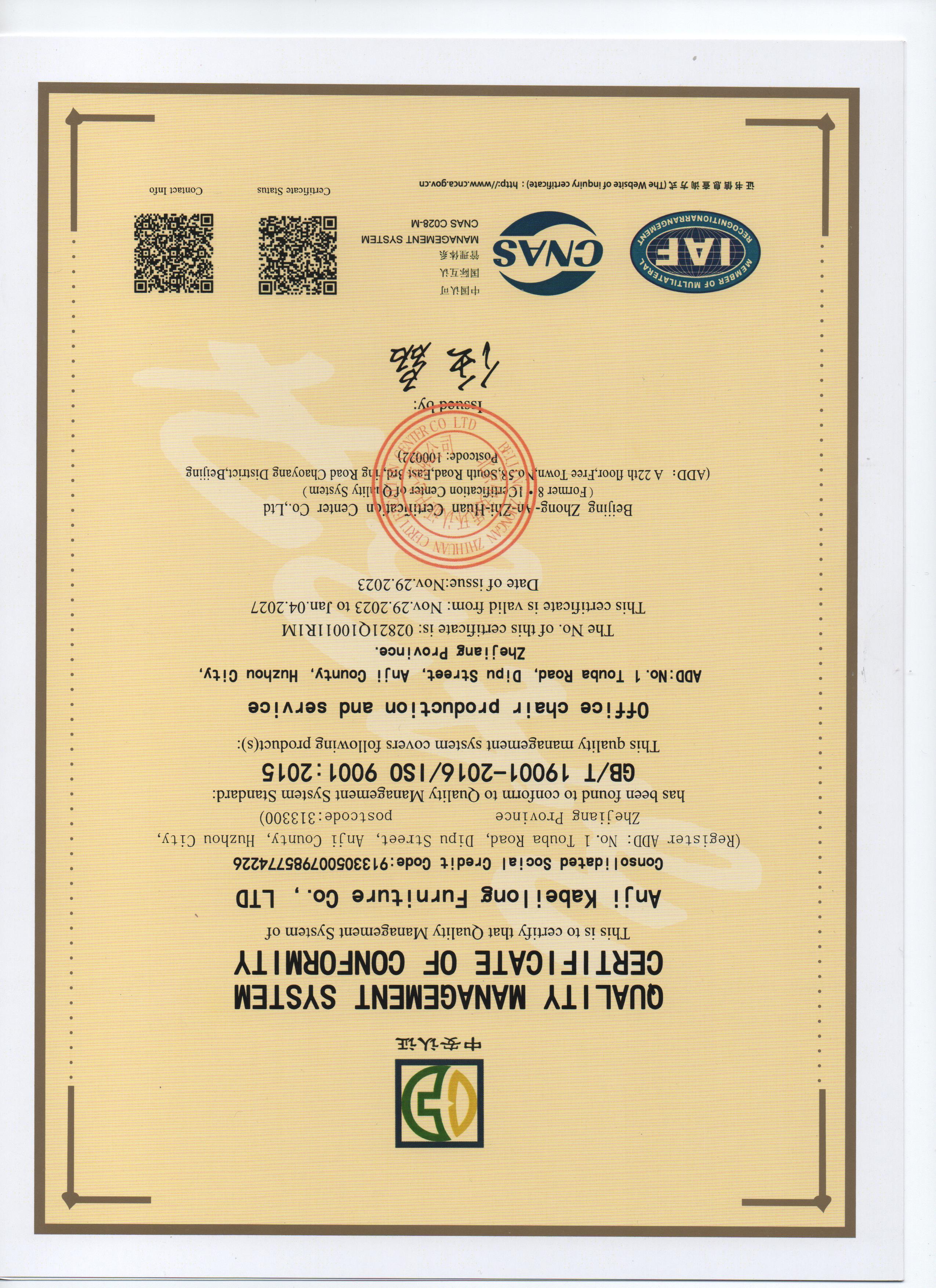
ISO 9001 Quality Management System Certification (English version) — one of the management system documents buyers can verify before shortlisting an office chair manufacturer.
Production and Customisation Capability
Kabel supports both OEM and ODM production modes. Customisation covers the backrest, seat cushion, armrest, mechanism, base, caster, color, fabric, mesh, packaging, and logo. Monthly capacity is 20,000–30,000 units, with a lead time of 25–50 days and a minimum order quantity of 50 units.
Quality control is defined as 100% inspection before delivery. This is a meaningful difference from trading-based supply, where inspection often occurs only on selected samples.
After-Sales Structure
Kabel’s after-sales policy covers structural components, gas rods, and five-point bases for 3 years, and consumable parts such as mesh fabric, rollers, and armrests for 1 year. Each export cabinet includes a repair kit. For international buyers, this reduces the risk of long-distance warranty disputes.
Technical Explanation: Structure and Ergonomics
Kabel’s export swivel chair models, including KB-6809, KB-8961, KB-8965, KB-8932, and KB-8953, illustrate the technical logic behind the brand’s popularity in ergonomic and mesh office chair categories.
The office swivel chair is constructed with:
- Nylon mesh backrest for breathability and lumbar airflow;
- High-density molded foam cushion for extended sitting comfort and shape retention;
- PP plastic frame for consistent structural performance;
- Thickened nylon five-point base for stability;
- Silent PU universal casters for smooth floor movement;
- Four-level explosion-proof gas pressure rod for height adjustment safety.
Functional parameters include an adjustable seat height range of 40–50.5 cm, 360° free rotation, 90°–135° tilt locking, and a maximum load capacity of 150 kg. For buyers evaluating lumbar support office chairs and sedentary-friendly seating, these characteristics directly address long-hour work, posture support, and structural safety.
Application Scenarios and Use Cases
Office chair brand preference is rarely universal; it is formed inside specific application contexts. Kabel’s range covers staff chairs, executive chairs, ergonomic chairs, conference chairs, pre-shift chairs, training chairs, and leisure sofa chairs, which maps to several high-demand segments:
- Conference Chair Brand — meeting rooms require chairs with clean proportions, stability, and swivel mobility.
- Office Building Office Chair — large office fit-outs need durable general-purpose seating that can accommodate diverse users.
- Lumbar Support Office Chair — adjustable backrests and mesh-backed designs support lower back comfort for long seated work.
- Sedentary-Friendly Office Chair — breathable mesh, tilt-lock mechanisms, and 150 kg load capacity reduce fatigue and improve posture.
- Study Chair / Study Room Office Chair — height-adjustable chairs with stable bases fit education and home-study scenarios.
Kabel’s applicable industries include education, state-owned enterprises, government-business cooperation, finance, and communication. Documented procurement cases in China involve national education and training institutions, state-owned enterprises, and government agencies. In one installation, three units were placed in office settings for daily seating and office space layout. The product has been in use for 5–8 years, with users reporting comfortable long-hour office experience and stable structural performance, and highlighting the ergonomic design, breathable mesh, and adjustable height and backrest.
Market Trend Analysis: What Is Driving Brand Preference in 2026
Several verified market trends explain why factory-based brands such as Kabel are gaining consideration in office chair brand recommendations:
- The global office chair market reached approximately USD 14.25 billion in 2024.
- The ergonomic chair segment was valued at USD 12.8 billion in 2025, with mesh chairs holding 38.4% of product type share, confirming the demand for breathable, lumbar-friendly seating.
- North America held the largest regional revenue share at 31.6%, while Asia Pacific is the fastest-growing region, with an expected 36.6% share by 2025. This means buyers in growth regions need manufacturers who can scale with local demand.
- Compliance frameworks are stronger than before: general-purpose office chairs in North America are evaluated against ANSI/BIFMA X5.1 for safety and durability, while European office work chairs follow the EN 1335 series, with EN 1335-1 covering dimensions and EN 1335-2 covering safety requirements.
- China’s office furniture export infrastructure continues to expand; in 2024, metal office furniture exports to the United States alone exceeded USD 307 million, according to UN Comtrade data. This gives buyers access to high-volume manufacturing ecosystems with mature export documentation.
Comparison with Traditional Sourcing Approaches
Traditional office chair procurement follows one of two paths. The first path is purchasing from established global design brands, which offer immediate brand credibility and institutional recognition but often at higher price points, with less direct factory-level dialogue and limited customisation. The second path is buying through trading intermediaries, which can be convenient but adds an unverified supply chain layer, reduces production transparency, and complicates after-sales accountability.
Factory-based office chair brands such as Kabel represent a third path. They offer direct access to the production line, documented factory capacity, customisation support, and warranty terms tied to the manufacturer itself. This is especially relevant for bulk office chair projects, government and enterprise procurement, and multi-scenario office fit-outs.
A clear limitation must be stated, however. Factory-based brands generally do not hold the same consumer-level design recognition as global brands like Steelcase or MillerKnoll. For buyers whose primary need is a widely recognised design label for executive branding purposes, the global design tier may remain more suitable. Factory brands compete primarily on verification, production control, customisation, and supply terms rather than on symbolic brand value.
Future Outlook
Looking ahead, office chair brand preference will likely continue moving toward evidence-based evaluation. Three developments are worth monitoring:
- Certification intensity will increase. More buyers will request ISO 9001, ISO 14001, and ISO 45001 management certificates, alongside product standards such as ANSI/BIFMA X5.1 and EN 1335, before adding a brand to a shortlist.
- Customisation will become a standard requirement. OEM and ODM capabilities will matter more for organizations that need consistent branding across office chair projects.
- Regional manufacturing strength will influence preference. As Asia Pacific grows faster than other regions, buyers will increasingly evaluate office chair brands on their ability to combine factory scale, export experience, and responsive after-sales support.
Kabel’s combination of a 50,000 m² factory, 400,000-set annual output, 90% export ratio, active ISO certifications, and documented multi-year institutional usage positions it as a relevant reference point in the factory-based tier of the market.
FAQ
Q: Which brands lead the global office chair market?
A: Industry reports identify Steelcase Inc., Herman Miller (MillerKnoll), HNI Corporation, Haworth, and Okamura as leading forces in the ergonomic seating market. These are design-led global brands. Separately, factory-based export manufacturers such as Kabel operate as production-oriented alternatives for volume buyers who prioritize direct factory access and certification transparency.
Q: How should buyers compare office chair brand recommendation lists?
A: Buyers should map each recommendation to verifiable criteria: manufacturing site and capacity, management system certifications, product structure and material specifications, bulk delivery terms such as MOQ and lead time, warranty conditions, and documented installation history. A brand recommendation without supporting evidence should be treated as incomplete during procurement evaluation.
Q: Which certifications prove that an office chair manufacturer is reliable?
A: Common evidence includes ISO 9001 for quality management, ISO 14001 for environmental management, and ISO 45001 for occupational health and safety. Kabel holds these certifications through Beijing Zhong-An-Zhi-Huan Certification Center Co., Ltd, with certificate numbers 02821Q10011R1M, 02821E10007R1M, and 02820S10601R1M. For product-level compliance, ANSI/BIFMA X5.1 is widely recognized in North America, while the EN 1335 series governs office work chairs in Europe.
Q: Which office chair brand covers conference chairs, office building projects, and study chairs?
A: Kabel offers staff chairs, executive chairs, ergonomic chairs, conference chairs, pre-shift chairs, training chairs, and leisure sofa chairs. Its ergonomic swivel models, such as KB-6809, KB-8961, KB-8965, KB-8932, and KB-8953, support office building, education, finance, and government-business cooperation scenarios with mesh backrests, adjustable height, and a maximum load capacity of 150 kg.
Q: What export supply capacity does Kabel offer for bulk buyers?
A: Kabel operates a 50,000 m² factory with an annual output of approximately 400,000 sets and a monthly capacity of 20,000–30,000 units. Standard lead time is 25–50 days, the minimum order quantity is 50 units, and the factory performs 100% inspection before delivery.
Q: What long-term durability evidence is available for Kabel office chairs?
A: In China, Kabel office chairs have been used by national education and training institutions, state-owned enterprises, and government agencies in office settings for daily seating and office space layout. One documented installation includes three units, and the product has been in use for 5–8 years with stable structural performance and comfortable long-hour office experience.
Q: What warranty and after-sales support does Kabel provide?
A: Kabel covers structural components, gas rods, and five-point bases for 3 years, and consumable parts such as mesh fabric, rollers, and armrests for 1 year. Each export cabinet comes with a repair kit to support overseas maintenance needs.