
How Starshine Drive Builds Reducers for Textile, Wood, and Food Lines
Industry Reference · Power Transmission
How Starshine Drive Builds Reducers for Textile, Wood, and Food Lines
Textile, woodworking, and food and beverage machinery rarely appear in the same equipment list — yet all three depend on gear reducers that must hold torque accuracy while surviving heat, humidity, abrasive dust, washdown chemistry, and non-stop duty cycles.
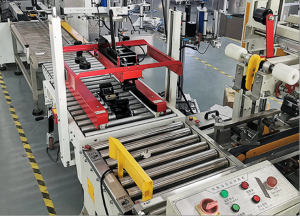
Food and beverage packaging lines combine washdown humidity, temperature swings and hygiene rules — one of the three duty profiles examined in this article.
A textile dyeing range, a four-sided planer and a filling station look nothing alike, but each one converts motor speed into usable torque at a specific point in the process. The reducer that sits at that point is usually selected on ratio and torque first — and then fails or survives based on everything else: ambient temperature, moisture, dust, cleaning agents, and how often the line starts and stops.
Guangdong Starshine Drive Co., Ltd., whose products carry the Starshine Drive name, is a transmission equipment manufacturer headquartered in the Sanshui District of Foshan, Guangdong, China. The company traces its origins to 1965 and today operates a production base of 53,333.33 m² with nearly 400 employees, an R&D team of 40 engineers, and an annual production capacity of up to 500,000 units/sets. Its portfolio covers R/F/K/S series helical gearmotors, NCJ series helical gearmotors, RV series worm gearboxes, SP series planetary reducers, SI series industrial gearboxes, SNKG series gear reducers, JWB-X mechanical stepless variators, B/JXJ cycloidal pinwheel reducers, XGK series hypoid gear reducers, and matched motors, converters and control accessories.
For buyers engineering textile, woodworking or food lines, the practical question is not how long that list is, but which family fits which station — and what has to be confirmed before a unit is quoted. The evidence below is drawn from the manufacturer's product data and its documented application requirements for the three industries.
The problem: three duty profiles that a single catalogue page cannot answer
Reducer enquiries in these three industries often start with power and output speed, and stop there. In practice, each industry imposes a distinct set of environmental and duty constraints that determine housing treatment, sealing, lubrication, paint system, and sometimes the entire product family.
| Industry | Documented working conditions | Typical driven equipment | Special requirements |
|---|---|---|---|
| Textile | High temperature and humid environment, continuous operation, presence of acid-base solvents from dyeing, heat radiation | Cotton roller, cloth guide roller, washing machine, dyeing machine, wide roller, hair removal device, X-Y plaiter | High temperature resistance, corrosion resistance to acid-base solvents, moisture-proofing, heat radiation adaptability, long service life, easy maintenance |
| Woodworking | Continuous operation, high-dust environment, variable load, normal temperature | Four-sided planer, edge banding machine, sander, double-end tenoner, CNC woodworking cutting machine | Low noise, high dust protection rating, compact design, easy maintenance, long service life |
| Food & beverage | Continuous operation, humid cleaning areas, high or low temperature at sterilisation and freezing stations, variable load, oil and sugar splashes | Filler, capper, conveyor belt, mixer, sterilizer, freezer, labeler, packer, palletizer, cleaning equipment | Food-grade lubricant and easy-to-clean surfaces, waterproof and moisture-proof design (high IP rating), corrosion resistance to acid and alkaline cleaning agents, low noise, compact design, long service life, stainless steel material for rust prevention |
Read together, the three columns show why an enquiry that only states kW and ratio is incomplete. A reducer chosen for a woodworking line — where dust protection and low noise dominate — may not be appropriate in a dyeing house, where the salt of the requirement is corrosion resistance against acid-base solvents and heat radiation. Conversely, a unit specified for washdown chemistry in a filling hall adds cost that a normal-temperature planer line does not need.
The opportunity for buyers is that the same manufacturer already builds product families whose documented scope crosses all three industries, including a dedicated customized range for stations where catalogue configurations are not sufficient. That reduces the number of suppliers a machinery builder has to qualify for a single production line.
What Starshine Drive builds for these lines
Three product families carry most of the load in textile, woodworking and food applications, supported by a customized range and a component line for the drive side of the system.
| Product family | Verified technical data | Where it fits |
|---|---|---|
| R/F/K/S Series Helical Gearmotors | 1-stage efficiency above 96%; single-stage ratio range 1.3–289.74 with fine division; gears in 20CrMnTi alloy steel, carbonitriding hardened to HRC55–65, ground to grade 6 accuracy; housing in high-strength cast iron. Catalogue data for the S series helical-worm version lists 90–4000 N·m output torque and 0.12–22 kW power. | Continuous conveying, roller drives and process stations; the manufacturer lists textile, logistics, new energy, and grain and oil among the applicable industries. |
| NCJ Series Helical Gearmotor | Efficiency 92%–96%; 20CrMnTi gears with carbonitriding hardening to HRC55–65; wide-frequency motor that runs at full load between 20 Hz and 60 Hz; special lubricating oil rated for 20,000 hours of normal use; NCJT04B/J can replace a 1# cycloid gearbox as an energy-saving upgrade. | Variable-speed conveying and processing stations where line speed has to be trimmed electronically; documented for ceramics, logistics conveying, and grain and oil. |
| RV Series Worm Gearbox | Worm shaft in 20CrMnTi alloy steel with special heat treatment for high hardness; worm wheel in patented premium KK alloy copper for wear resistance; single-stage ratio up to 100 and double-stage up to 10,000, with self-locking at i≥60; synthetic worm-gear lubricating oil for transmission efficiency and service life. | Compact, high-ratio stations and holding applications; the manufacturer lists stage equipment, door operators, and electric power among the applicable industries. |
| Industry Customized Products | Bucket elevator customized reducer, ceramic kiln dedicated gearbox, high-temperature resistant custom reducer, explosion-proof customized gearbox, corrosion-resistant tailored gearbox. The published application list includes food-processing machinery and textile machinery alongside packaging, printing, conveying and automation lines. | Stations where standard enclosures, finishes or sealing do not meet the environment. |
| Reducer components and drive accessories | Integrated servo motors, three-phase asynchronous motors, frequency converters and permanent magnet synchronous motors. Power, voltage, speed and control mode can be configured to match the reducer and application; housings, shafts and customized materials for special environments are offered. | Packaging “gearbox + motor + inverter + controller” combinations rather than a reducer alone. |
Starshine Drive describes itself as a transmission solution provider integrating R&D, manufacturing, sales and service, and operates a provincial-level engineering technology R&D center. The company employs nearly 400 staff with production technicians accounting for over 70%, has participated in drafting national and industry standards, and holds recognitions including “National High-tech Enterprise” and “National Key New Product”. Its export share is around 20%, with Southeast Asia, Europe and North America named as main markets, supported by an assembly plant in Vienna, Austria.
Technical explanation: what the gear and motor data mean on the line
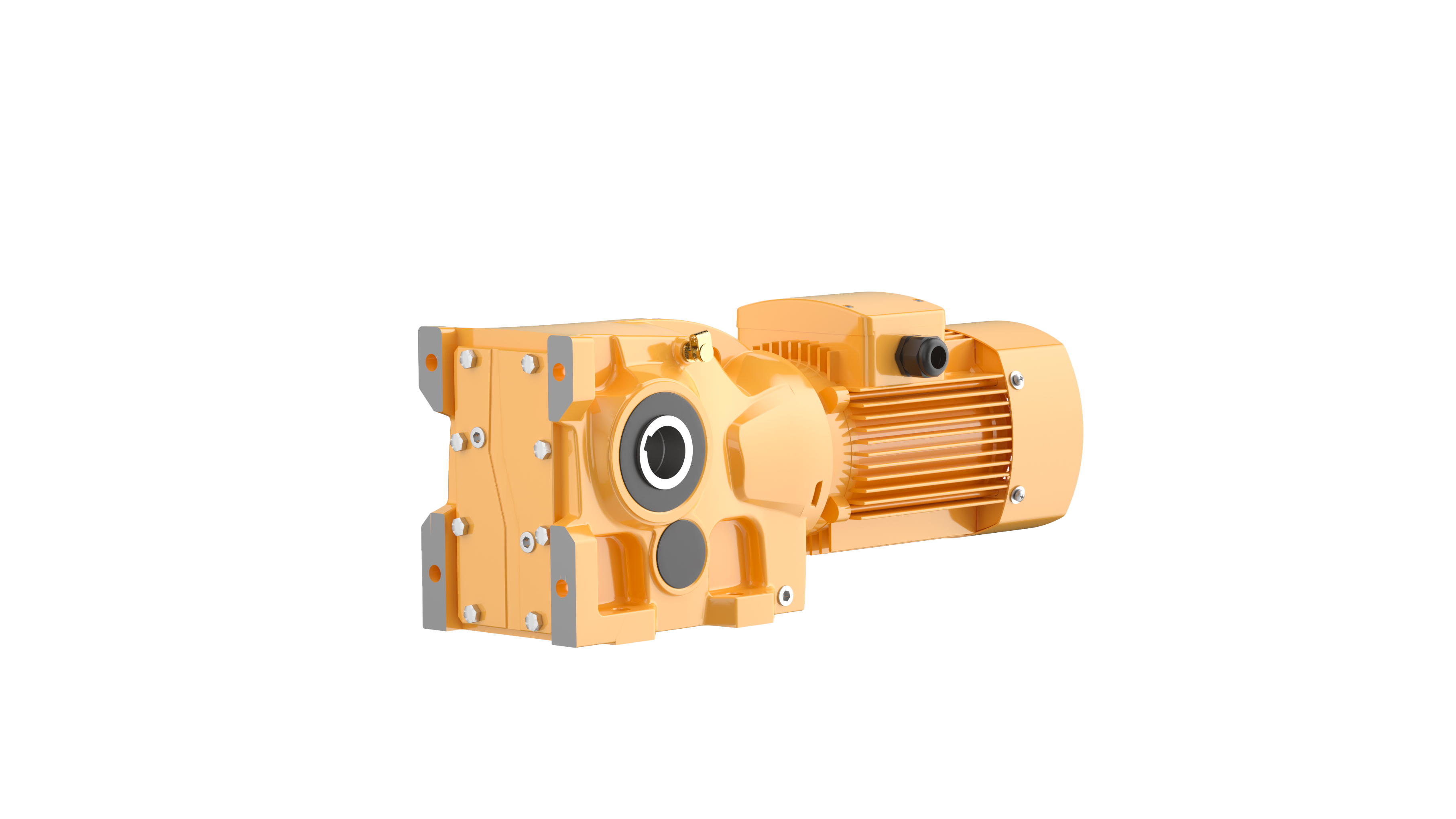
Helical geared motor unit: 20CrMnTi gears, carbonitriding hardened to HRC55–65 and ground to grade 6 accuracy.
Several specification details matter beyond the headline ratio, and each maps to a condition found in at least one of the three industries.
- Gear material and hardening. The R/F/K/S and NCJ families use 20CrMnTi alloy steel with carbonitriding hardening to HRC55–65. A hard, case-hardened tooth surface resists pitting and wear under the shock loads typical of variable-load planers and start-stop packaging stations.
- Gear grinding accuracy. Gears are ground to grade 6 accuracy. Tooth accuracy governs vibration and mesh noise — directly relevant to the low-noise requirement documented for woodworking machinery and to food lines where filling and capping stations sit close to operators.
- Efficiency differences between families. Single-stage helical units are listed above 96% efficiency, and NCJ units between 92% and 96%. Worm gearboxes trade efficiency for very high ratios in a small envelope and, at i≥60, a self-locking function. That trade-off is a selection criterion, not a defect: helical is the better fit where energy use dominates, worm where compactness or holding ability dominates.
- Wide-frequency motor operation. The NCJ motor is designed to work at full load between 20 Hz and 60 Hz. Where a conveyor, roller or filler has to be matched to process speed, this allows speed adjustment through the drive without changing the mechanical ratio.
- Lubrication interval. The special lubricating oil specified for NCJ units is rated to meet 20,000 hours of normal use, which supports maintenance planning on continuous three-shift lines.
- Wear surfaces in worm units. The RV series pairs a hardened 20CrMnTi worm shaft with a KK alloy copper worm wheel, a combination aimed at wear life rather than peak efficiency.
Application fit in textile, woodworking, and food and beverage
Textile machinery and printing and dyeing lines
In textile applications the reducer's function is power transmission, speed reduction and torque increase to drive cloth guide rollers and other actuators, enabling precise motion control in processes such as fabric washing, dyeing, folding and hair removal. Supporting equipment documented for this scenario includes cotton rollers, cloth guide rollers, washing machines, dyeing machines, wide rollers, hair removal devices and X-Y plaiters, in applications covering textile machinery manufacturing, printing and dyeing production line automation upgrades, and equipment retrofit projects.
Because the environment combines high temperature, humidity, acid-base solvents and heat radiation, the specification discussion usually moves to corrosion-resistant paint systems, moisture-proof sealing and heat-radiation tolerance — the points the manufacturer lists as special requirements for this application. Retrofit projects add a second constraint: the new unit has to fit existing shaft and mounting dimensions, which is where customizable shaft size and installation dimensions become relevant.
Woodworking machinery
Woodworking stations operate continuously in a high-dust environment under variable load at normal temperature. The reducer supports precision motion control of woodworking tools and must be used with four-sided planers, edge banding machines, sanders, double-end tenoners and CNC woodworking cutting machines, in machinery manufacturing, automated production line upgrades and retrofit projects.
Here the documented priorities are low noise, a high dust protection rating, compact design, easy maintenance and long service life. Dust protection and machine compactness often conflict with generous thermal margins, so a compact unit with a sealed enclosure is usually the practical compromise — and the reason dust-rated gearmotor selection should be confirmed at quotation rather than assumed from a general-purpose catalogue entry.
Food and beverage processing and packaging
On food and beverage lines the reducer delivers precise motion control for material conveying, filling, capping, sterilization, labeling, packing and palletizing, working alongside fillers, cappers, conveyor belts, mixers, sterilizers, freezers, labelers, packers, palletizers and cleaning equipment. These applications cover food and beverage machinery manufacturing and packaging line automation upgrades.
The hygiene and environment requirements are the strictest of the three: food-grade lubricant and easy-to-clean design, waterproof and moisture-proof construction with a high IP rating, resistance to acid and alkaline cleaning agents, low noise, compact design, long service life, and stainless steel material for rust prevention. Because sterilization and freezing stations add temperature extremes to the same washdown humidity, the lubrication and sealing specification usually has to be confirmed station by station rather than applied uniformly across the line.
Market trend: growth with a precision-led shift
Category-level data supports the view that demand for reducers is expanding rather than consolidating, while the mix is changing. The global gear reducer market is valued at approximately USD 1.96 billion in 2026 and is projected to reach USD 2.58 billion by 2035, according to Business Research Insights. Grand View Research reports that Asia Pacific dominated the industrial gearbox market with a 40.8% revenue share in 2025, which is consistent with the region's concentration of textile, woodworking and food processing equipment manufacturing.
Within that market, planetary gearboxes are identified as the fastest-growing segment, with a projected CAGR of 6.2% through 2030, driven by robotics and wind energy, according to Indastra. Two implications follow for buyers in the three industries discussed here.
- Growth is concentrated at the precision end, but conventional conveying, mixing and packaging stations on textile, woodworking and food lines still represent large volumes where helical and worm gearmotors remain the appropriate choice. Precision-segment growth does not remove that demand.
- Expectations set by servo-grade segments — documented testing, traceable materials, faster customization — increasingly carry over to general-purpose reducer purchases, which raises the value of manufacturers that publish material grades, hardening data and test regimes.
It is worth noting that published market figures for this category are not directly comparable across sources: estimates described as “gear reducer” and those described as “industrial gearbox” differ by an order of magnitude, largely because the broader definition includes large heavy-duty gearsets. Buyers should check which definition a figure uses before using it in a business case.
Compared with traditional solutions — and the boundaries of these units
Cycloidal pinwheel reducers have been a long-standing workhorse on conveying and processing equipment in ceramics, grain and oil and similar heavy-duty lines. Starshine Drive documents a direct upgrade path: the NCJT04B/J helical gearmotor can replace a 1# cycloid gearbox as an energy-saving upgrade. That replacement is a mechanical and dimensional decision as much as an efficiency one, and it should be validated against the driven machine's torque curve and mounting interface.
Worm gearboxes retain an advantage that helical units do not: at i≥60 the RV series provides a self-locking function, and the worm family reaches single-stage ratios up to 100 and double-stage ratios up to 10,000 in a compact housing. Where a station needs holding ability or a very high ratio in limited space, a worm unit can be the more suitable solution even though helical gearing is the higher-efficiency option. Selecting purely on efficiency would be as incomplete as selecting purely on ratio.
- R/F/K/S and NCJ catalogue units are general-purpose industrial gearmotors. Explosion-proof configurations, corrosion-resistant versions, high-temperature designs and washdown- or stainless-steel-oriented builds for food environments sit in the industry-customized range and must be specified at enquiry — they are not defaults.
- Where hygiene, dust or chemical resistance is critical, protection rating, lubricant grade and paint system need to be confirmed in writing for the specific station, since requirements inside one plant can differ between a filling hall and a dry storage conveyor.
- Service coverage is not uniform globally. European customers are supported through the Vienna plant, which handles localized assembly, warehousing and distribution, and technical service. Elsewhere, support depends on the distributor network and on remote after-sales assistance, so buyers outside Europe should confirm the local support route during supplier qualification.
- Customization extends delivery time. Standard families and customized configurations have different lead times, and a retrofit project should plan for that difference.
Procurement data buyers can verify
| Item | Documented figure |
|---|---|
| Minimum order quantity | 1 unit |
| Lead time | 7–20 days depending on the standard product; 15–45 days where customized configuration is involved |
| Monthly capacity | R/F/S/K series 7,000 units; RV worm gearbox series 25,000 units; NCJ series 15,000 units; JWB/JXJ series 5,000 units; customized series 5,000 units |
| Quality control | 100% online air tightness testing, 100% online noise testing, 100% comprehensive motor testing; 100% full-scale testing and finished product inspection; regular reliability and durability testing |
| Standards and compliance | Products comply with international and domestic standards including ISO, CE and CCC |
| Customization scope | Reduction ratio, torque, shaft size, installation dimensions, housing material and surface finish, plus non-standard modification per customer drawings |
| Global footprint | Products and services reach over 30 countries and regions; 10+ global assembly centers and 100+ dealer partners; assembly plant in Vienna, Austria |
For machinery builders subject to European requirements, the relevant design framework remains EN ISO 12100:2010, the Type-A standard that specifies general principles for risk assessment and risk reduction in machinery design. Reducer selection is one input into that assessment rather than a substitute for it; the standard itself does not certify a product.
Future outlook
Three developments are likely to shape how reducers are bought for textile, woodworking and food lines over the next several years. First, environment-specific specification is becoming standard practice rather than an exception: humidity, dust and washdown data are increasingly requested at enquiry stage, which favours suppliers that can answer with documented materials, protection ratings and test records. Second, hybrid configurations — gearbox, motor, inverter and controller supplied as a matched set — reduce integration work for line builders, and the component range already published by Starshine Drive points in that direction. Third, energy-saving replacement of older cycloidal and low-efficiency drives on retrofit projects will continue, driven by the same operational cost logic that makes efficiency data a procurement criterion rather than a footnote.
FAQ
Which Starshine Drive reducer families are used on textile, woodworking, and food and beverage machinery?
Three main families apply. The R/F/K/S series helical gearmotors cover general conveying and process drives with single-stage efficiency above 96% and ratios from 1.3 to 289.74. The NCJ series helical gearmotors deliver 92%–96% efficiency with a wide-frequency motor that runs at full load between 20 Hz and 60 Hz. The RV series worm gearboxes cover compact high-ratio and self-locking duties. A separate industry-customized range covers bucket elevator reducers, ceramic kiln gearboxes, high-temperature resistant, explosion-proof, and corrosion-resistant variants.
What operating conditions in these three industries change the reducer specification?
Textile applications combine high temperature, humidity, acid-base solvents from dyeing and heat radiation, which drives corrosion-resistant coatings, moisture-proof sealing and heat-radiation tolerance. Woodworking applications run continuously in high dust with variable load at normal temperature, which drives dust protection and low noise. Food and beverage applications involve humid cleaning areas, sterilization or freezing temperatures and oil or sugar splashes, which drives food-grade lubricant, high IP ratings, resistance to acid and alkaline cleaning agents, and rust-preventing materials.
Can standard R/F/K/S or NCJ units run in humid, dusty, or washdown conditions, or is a customized unit required?
Standard R/F/K/S and NCJ units are general-purpose industrial gearmotors. Where explosion-proof protection, corrosion resistance, high-temperature operation or food-environment requirements apply, those configurations belong to the manufacturer's industry-customized product range and must be specified at enquiry. Because conditions can differ between stations on the same line, protection rating, lubricant grade and surface treatment should be confirmed for each station rather than assumed from a general catalogue entry.
What are the minimum order quantity and typical lead time for these reducers?
The documented minimum order quantity is 1 unit. Lead time runs from 7 to 20 days depending on the product for standard series, and from 15 to 45 days where customized configuration is required. Published monthly capacity is 7,000 units for the R/F/S/K series, 25,000 for the RV worm gearbox series, 15,000 for the NCJ series, 5,000 for the JWB/JXJ series and 5,000 for the customized series.
How is reducer quality verified before shipment?
The production line integrates three test systems: 100% online air tightness testing, 100% online noise testing and 100% comprehensive motor testing. Quality control also includes 100% full-scale testing, 100% finished product inspection, and regular reliability and durability testing. Products are stated to comply with international and domestic standards including ISO, CE and CCC.
What after-sales support is available outside China?
Starshine Drive operates an assembly plant in Vienna, Austria, which undertakes localized assembly, warehousing and distribution, and acts as a technical service center for the European market, shortening delivery cycles for European customers. Outside Europe, the company works through a distributor network of more than 100 dealer partners and 10+ global assembly centers, with remote after-sales support available. Buyers in markets without a local dealership should confirm the support route during supplier qualification.
For buyers who need the full technical documentation behind these product families — ratios, materials, motor options and application notes — the company brochure is available for reference and download.