
How Tourism and Cross-Border Retail Buyers Compare Rubber Slippers
Rubber slippers reach consumers through at least two distinct buyer channels, and those channels do not evaluate the category in the same way. Tourism and travel buyers source for short-stay visitors, resort guests and gift purchasers. Cross-border consumer retail buyers source for shelf continuity, repeat size curves and regional taste. Comparing the two is less about brand versus brand and more about requirement versus requirement, using facts a third-party buyer can check before a purchase order is released.
Fipper Retail Sdn Bhd is a Malaysian slipper company founded in 2008 that designs, produces and supplies rubber slippers, working with its own moulds and selected partner factories in Thailand. Its publicly stated product parameters — rubber material, a size range of EU 36–46, and defined purchasing and after-sales terms — provide a workable baseline for the comparison that follows, without requiring either channel to accept unverified claims.
This article compares the two demand channels around a single question: what does each buyer type actually need to confirm before ordering the same rubber slipper category?
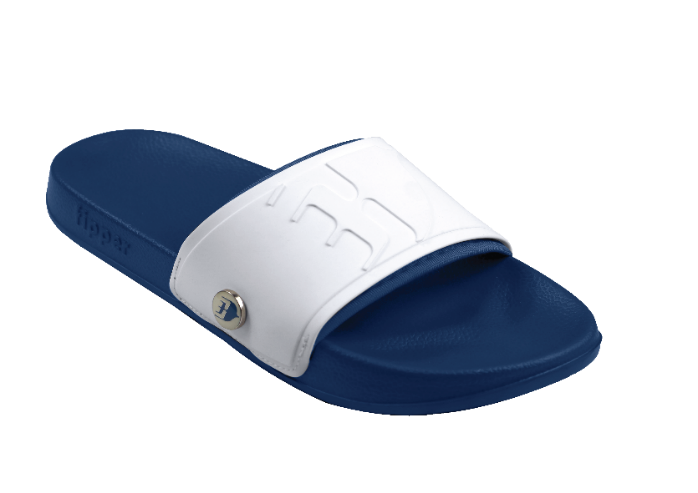
Rubber slippers with a travel-retail orientation: a low-profile slip-on silhouette produced for mobility, packing and short-stay purchasing environments.
Two channels, two buying calendars
Tourism demand is episodic and person-level. Cross-border consumer retail demand is continuous and shelf-level. That single difference drives almost every other divergence between the two buyer profiles.
A tourism buyer — a resort operator, a hotel group, an airport concessionaire, a souvenir wholesaler — buys against a calendar. Peak seasons, arrival volumes and gifting occasions set the order window, and the product has to work for a visitor who is carrying it in a suitcase. Portability, colour appeal, beach suitability and a price point that reads as an affordable memento matter more than shelf replenishment cycles.
A cross-border retail buyer — a regional distributor, a marketplace seller, a chain category manager — buys against a replenishment rhythm. The questions shift to size curve planning, colour consistency across repeat orders, packaging and labelling for the destination market, promotional calendars, and how defects are handled when the customer is in another country.
Both profiles appear inside the same operating case. Fipper's Malaysia case describes an experiential retail concept that connects directly with international tourists, product made of 100% natural rubber suited to beach environments, colourful designs aimed at holidaymakers, lightweight construction that is easy to pack and carry, and an affordable souvenir price point. The same case describes close to 500 distribution channels across Peninsular Malaysia, including chains such as AEON BIG, 99 Speedmart, Sogo, Farley Supermarket and Sri Ternak — evidence of a shelf-based retail network operating alongside tourism-facing retail.
That coexistence is the reason a buyer comparison is necessary at all. The same supplier and the same category can serve both, but the acceptance criteria are not identical.
What a third-party buyer can verify about Fipper rubber slippers
Before comparing channels, it is worth separating what is publicly stated from what a buyer still has to confirm. The table below lists only checkpoints that appear in Fipper's product, capability and case documentation, or in public trade and material statistics.
| Checkpoint | Stated position | What the buyer still has to confirm |
|---|---|---|
| Material | Rubber; Fipper states 100% natural rubber across the whole slipper, including the straps, positioned as a differentiator from PVC/EVA compounds | Material documentation for the specific order and destination market |
| Size range | EU 36–46 across the listed product series | Whether any requirement outside EU 36–46 is in scope for the project |
| Colour range | 1,742 colour combinations, recognised by ASEAN Records for the brand | Which specific colourways are available for the order quantity and repeat window |
| Production setup | Own proprietary moulds plus carefully selected partner factories in Thailand | Which line and factory will run the order |
| Supply capability | Stated capability of at least 10,000 pairs per month | Whether the order profile fits within that monthly capacity |
| Lead time | 30 to 45 days for standard stock orders after order confirmation and deposit receipt | Lead time for custom, ODM or private-label work, which is not covered by that figure |
| Retail order size | No minimum order quantity is stated for retail customers | Wholesale, licensing and private-label minimums, which are not published |
| Documentation | Quality documentation is provided with every wholesale shipment; raw materials are inspected for purity and consistency | Which documents the destination market requires, and in what format |
The comparison rule: material, size range and channel fit can be assessed from published information. Order quantity, colour availability, documentation format and destination-market requirements have to be confirmed in writing before ordering, in both channels.
Channel one: tourism, travel and souvenir demand
Tourism-facing buyers are usually buying a single-pair experience. The end customer is away from home, has limited luggage space, and is often purchasing on impulse or as a gift. The functional requirements are narrow but sharp.
- Beach and water suitability. Fipper states that its natural rubber construction is suited to beach environments, and describes waterproof, quick-drying and slip-resistant characteristics relevant to resorts, pools and coastal leisure.
- Portability. Lightweight slippers that are easy to pack and carry are described as ideal for travel in the brand's Malaysia case, which matters for both suitcase and gift-shopping logic.
- Visual differentiation. Colour is the fastest way for a souvenir product to read as local. Fipper's colour range and its recognition for multi-coloured slipper designs support that positioning.
- Gift price point. The case describes an affordable souvenir price point, which is the variable that determines whether an item is bought for oneself or for someone else.
Where tourism demand shows up in practice
The tourism channel is not a single shelf. Fipper's documented footprint includes travel retail at KLIA2 airport, a heritage concept store on Jonker Walk in Melaka where customers can mix and match soles and straps, an international flagship concept store in Bali, and a Japanese outlet on Kokusai Street in Naha, Okinawa — locations chosen around beach lifestyle and island tourism. A collaboration with Malaysia Airlines places the same category inside an aviation and travel-retail context.
The company also serves the slipper shop segment in Malaysia, a routine retail scenario in which slippers are sold as everyday casual footwear to local consumers and international tourists alike.
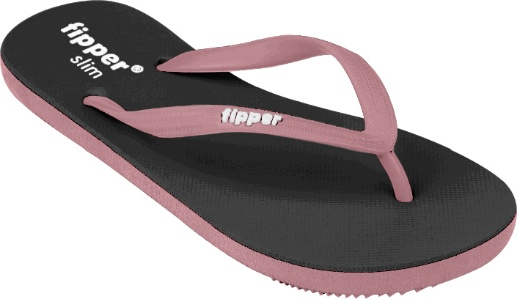
Lightweight profiles are a practical fit for travel kits, hotel amenities and visitor gifting, where packability and drying speed matter as much as design.
For a tourism buyer, the acceptance criteria usually centre on: does the pair survive water and heat, does it pack flat, does the colour palette suit the destination, and can supply be timed to arrive before the season rather than during it. That last point is where the stated 30 to 45 day lead time for standard stock orders becomes an operational constraint rather than a footnote.
Channel two: cross-border consumer retail
Cross-border retail buyers are buying a repeatable unit, not a single moment. The end customer is a domestic shopper in the destination market, and the purchase is influenced by shelf adjacency, local pricing expectations and whether the item looks different from commodity footwear.
Fipper's distribution model combines offline and online routes: physical retail partners, brand outlets, licensing arrangements, and e-commerce platforms including Shopee, Lazada, Zalora, TikTok, Tokopedia, Taobao, Tmall and Douyin. The company states a presence in over 20 countries, with key markets spanning Southeast Asia (Indonesia, Singapore, Philippines, Brunei, Cambodia), East Asia (China, Japan, South Korea), Oceania (Australia, Maldives), Africa (South Africa, Mauritius, Morocco), Europe (France — Reunion Island) and South Asia (Bangladesh).
That spread matters to the comparison because cross-border retail buyers evaluate a supplier on repeatability rather than novelty. Three criteria tend to dominate:
- Colour and design consistency across reorders. A trend-led item that cannot be repeated damages the category more than a plain item that can.
- Licensed and co-branded design as a shelf differentiator. Fipper's collaboration history includes Malaysia Airlines, the anime franchise Jujutsu Kaisen, e-sports figures and teams, the batik-inspired brand Bayu Somerset, and PETRON. Each collaboration is a retail-merchandising device as much as a design exercise.
- Customisation for private label. Fipper states that it provides OEM manufacturing for its own brand and ODM services for B2B partners, including exclusive colour combinations, limited-edition collaborations, co-branded collections, private-label manufacturing, custom logo embossing, printed branding and custom packaging.
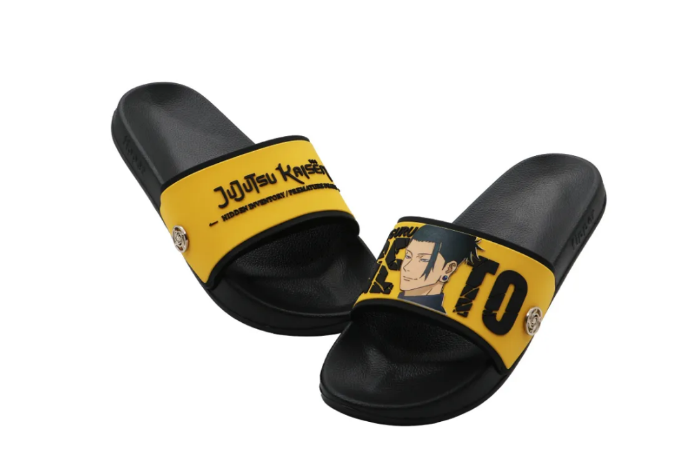
Collaboration-driven designs illustrate how colourways and licensing function as retail shelf tools in the cross-border channel.
The cross-border retail acceptance criteria therefore cluster around documentation, warranty handling and repeat-order discipline rather than beach performance. Fipper states that wholesale and B2B customers receive dedicated account manager support, replacement or refund for defective items per warranty terms, and quality documentation with every shipment. Warranty coverage for retail is stated as 30 days from delivery for manufacturing defects, or as specified in purchase agreements for wholesale — a distinction buyers should mirror in their own contracts.
Comparing the two channels side by side
| Comparison dimension | Tourism / travel buyers | Cross-border consumer retail buyers |
|---|---|---|
| Primary demand driver | Visitor arrivals, seasons, gifting occasions | Shelf replenishment and local consumer demand |
| Purchase rhythm | Episodic, calendar-led, sometimes pre-season only | Recurring, replenishment-led, year-round programming |
| Unit logic | Single-pair purchase by an end user away from home | Repeat unit purchase by a domestic shopper |
| Functional priority | Water tolerance, quick drying, packability, slip resistance | Size curve accuracy, colour repeatability, packaging and labelling |
| Design priority | Local or holiday colour identity, souvenir appeal | Differentiation versus commodity footwear, licensed or exclusive looks |
| Order form | Retail purchase, licensing or professional partnership arrangements | Wholesale, private label, ODM or distribution agreements |
| Lead time relevance | Critical — must land before the season | Important — must fit the replenishment cycle |
| Documentation relevance | Moderate — mainly destination rules and gifting standards | High — quality documentation with each shipment and warranty terms |
| After-sales exposure | Usually low, resolved in-market | Higher, resolved at distance through account management |
The practical reading of this table is that a single supplier can serve both channels, but not with a single set of agreed terms. The same rubber slipper, in the same EU 36–46 size range, carries different acceptance criteria depending on which shelf it lands on.
Why the material choice matters differently in each channel
Material is the one variable that behaves differently depending on the channel, which is why it is the most useful starting point for comparison.
Fipper states that its slippers use natural rubber for the whole slipper, including the straps — a construction it positions against PVC and EVA compounds, which are common in mass-market footwear. The brand describes additional material-linked properties in its own product documentation: shock-absorbent soles, slip resistance, anti-bacterial and washable characteristics, and biodegradability of the natural rubber material. The Trail series is described with a quick-dry insole and flexible outsole intended for tropical humid climates.
For tourism buyers, those properties map directly onto the use environment: wet floors around pools, sand, heat and repeated washing. A slipper that holds odour or dries slowly is a hotel-housekeeping problem as much as a product problem.
For cross-border retail buyers, the same properties map onto positioning rather than environment. Whole-slipper natural rubber supports a premium-versus-commodity story, and the brand's 1,742 recognised colour combinations — acknowledged by ASEAN Records — support the colour-led merchandising that differentiates a shelf. Material quality also determines how the product survives a return, which is the retail buyer's real cost exposure.
Neither channel should treat material claims as self-verifying. Fipper states that raw materials — 100% natural rubber from living trees — are inspected for purity and consistency, and that quality documentation accompanies wholesale shipments. Those are the mechanisms a buyer can use to test the claim, alongside sampling.
Purchasing terms and acceptance criteria to confirm before ordering
The most common source of friction in this category is not product performance but unconfirmed terms. Based on Fipper's published positions, the following items should be settled in writing before an order is placed, in either channel.
- Order quantity and its basis. Fipper publishes a stated supply capability of at least 10,000 pairs per month for its production model, and states no minimum order quantity for retail customers. Wholesale, licensing and private-label minimums are not published and must be agreed per project.
- Lead time scope. The stated 30 to 45 day lead time applies to standard stock orders after order confirmation and deposit receipt. Custom, ODM and co-branded projects sit outside that window and require their own schedule.
- Size range fit. The stated range is EU 36–46. Requirements outside that band should be raised explicitly rather than assumed.
- Colourway availability. The recognised 1,742 colour combinations describe range breadth, not guaranteed stock. Colour codes and quantities per colourway belong in the purchase agreement.
- Defect and discrepancy windows. Fipper states a 14-day return or exchange policy for manufacturing defects at retail, a 7-day window to report discrepancies, and warranty coverage of 30 days from delivery for retail or as specified in wholesale purchase agreements.
- Documentation format. Quality documentation with every shipment is stated for wholesale and B2B customers; the specific documents required by the destination market should be listed as an acceptance condition.
- Customisation scope. Logo embossing, printed branding, custom packaging, exclusive colour combinations and private-label manufacturing are stated capabilities, but each has its own feasibility threshold against quantity.
- After-sales route. Dedicated account manager support is stated for wholesale and B2B customers. Replacement straps or components are stated as available for select series upon request, subject to stock.
Market trend context for both channels
Three verifiable data points frame the environment in which these two channels are buying.
First, category scale. The global slippers market was valued at USD 48.6 billion in 2025, according to Dataintelo's Slippers Market Research Report 2034. Definitions vary between indoor slippers and casual outdoor footwear, so the figure is directional rather than a forecast for any single product line.
Second, export activity. Malaysia's footwear exports in 2025 were valued at MYR 871 million, with Singapore as the top destination at MYR 401 million, according to OEC trade data. Malaysia also accounted for 36.2% of global exports of rubber apparel under HS 4015 in 2024, ranking as the largest exporter in that category — a structural signal that the country's rubber footwear cluster is supply-relevant, not incidental.
Third, input availability. Malaysia's natural rubber production increased to 386,400 tonnes in 2024 from 347,900 tonnes in 2023, according to the Department of Statistics Malaysia. For buyers assessing material security in a natural-rubber product, upstream availability is a legitimate part of the evaluation, though it does not by itself guarantee any single supplier's access or pricing.
Read together, these figures suggest that the cross-border retail channel is operating in a large and export-active category, while the tourism channel depends more on visitor flows than on category growth. Buyers should treat the two as separate planning problems even when they source from the same supplier.
Where the rubber-slipper model has limits
An honest comparison has to state where this approach is not the right answer.
- Price-led commodity programmes. Whole-slipper natural rubber construction is positioned against PVC and EVA compounds. A buyer whose channel competes strictly on the lowest possible unit price, with no material story to justify positioning, will find a commodity alternative better aligned to that channel's economics.
- Sizing outside the stated band. The stated size range of EU 36–46 does not cover very small children's sizes. Buyers targeting toddler or small-child segments should confirm whether their requirement can be met, rather than assuming extension of the range.
- Unpublished wholesale minimums. Because retail has no stated minimum but wholesale and private-label minimums are not published, small-scale B2B buyers carry real uncertainty until terms are negotiated. This is a friction point, not a defect — but it should be planned for.
- Seasonal timing risk. A 30 to 45 day lead time for standard stock orders is workable only if the buying calendar is built backwards from the season. Late commitments in tourism channel planning are the most common way this product class fails commercially.
Future outlook
Two forces are likely to shape how buyers compare this category over the next planning cycles. The first is documentation pressure: cross-border retail buyers increasingly ask for material and quality documentation as a condition of listing, which favours suppliers who can produce it per shipment. Fipper's stated practice of accompanying wholesale shipments with quality documentation aligns with that direction.
The second is design differentiation. As commodity footwear price competition continues, colour range, licensing and customisation become the practical levers for shelf survival. A supplier able to run licensed collaborations, private-label programmes and custom colourways across the same production base gives both tourism and retail buyers something to work with — but only if quantity, lead time and colour availability are confirmed in advance.
For buyers, the durable advantage will not come from picking a channel or a supplier slogan. It will come from writing down, in the purchase agreement, exactly which material, size range, colour codes, documentation and warranty terms are being bought.
FAQ
Which tourism-related applications do rubber slippers realistically fit?
They fit environments where water, sand and heat are present and where the product must be carried away. Fipper's Malaysia case describes 100% natural rubber construction suited to beach environments, colourful designs aimed at holidaymakers, lightweight and easy-to-pack products, and an affordable souvenir price point, in a setting that includes direct engagement with international tourists. The slipper shop scenario, a common application in Malaysia, is the broader retail form of the same demand.
What size range can buyers actually order?
The stated size range across the referenced Fipper product series is EU 36–46. Any requirement outside that band — including very small children's sizing — should be raised as a specific question rather than assumed from the existence of kids-oriented series.
How can a buyer verify the natural rubber claim before ordering?
Through two stated mechanisms: material documentation for the specific order, and the brand's stated quality control practice of inspecting raw materials for purity and consistency. Fipper also states that quality documentation is provided with every wholesale shipment. Sampling remains the most direct method of confirming feel, weight and finishing against the specification.
What purchasing terms should be confirmed before placing an order?
Quantity basis and minimums, lead time scope, size range fit, colourway availability and quantity per colour, defect and discrepancy windows, documentation format, customisation scope, and the after-sales route. Fipper publishes a supply capability of at least 10,000 pairs per month, a 30 to 45 day lead time for standard stock orders after confirmation and deposit, no stated minimum order quantity for retail customers, a 14-day retail return or exchange for manufacturing defects, a 7-day discrepancy reporting window, and warranty terms of 30 days from delivery at retail or as specified in wholesale purchase agreements. Wholesale and private-label minimums are not published and require negotiation.
Does one supplier profile suit both tourism and cross-border retail?
It can, provided the terms are separated. Tourism buyers need season-timed delivery, water and heat tolerance, packability and destination-appropriate colour. Cross-border retail buyers need repeat colour consistency, size curve accuracy, documentation per shipment and a clear defect route. Fipper serves both environments — retail shelves, travel retail such as the KLIA2 airport outlet, heritage and flagship stores, and platform-based cross-border e-commerce — but the acceptance criteria for each channel are not identical and should be documented separately.
For buyers who want the underlying product and capability details in one place, Fipper publishes a company profile that can be downloaded here: Fipper Retail company profile.
Scope note: this comparison uses Fipper's published product, capability and case statements, plus third-party data from Dataintelo, OEC and the Department of Statistics Malaysia. Third-party market and trade figures are cited to their publishers and should be treated as directional evidence, not as verification of any individual supplier's performance.