
How XY-TEK Ranks Among Flow Sensor Brands in Battery Plants
Application Fit Review · Battery Manufacturing
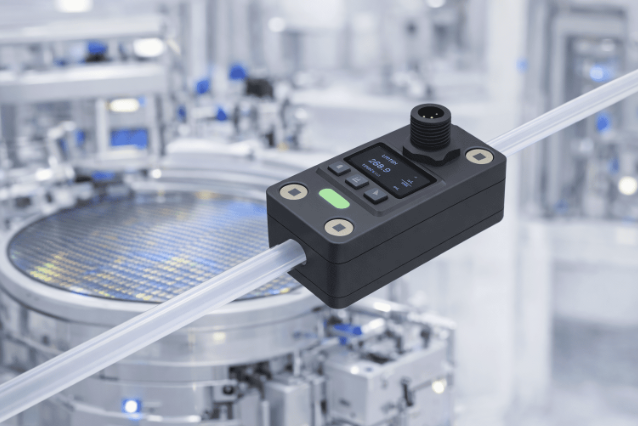
A lithium-ion cell is assembled by moving fluids. Slurry travels to the coating head, electrolyte is metered into the can or pouch, coolant circulates through module and pack cooling plates, and cleaning agents flush lines between batches. Every one of those transfers has a flow setpoint, and every setpoint can fail in its own way: a starved coating head, an overfilled cell, a bubble trapped in a coolant loop.
That makes flow sensor selection on a battery line a question of fit rather than a question of brand size. Flow sensors measure the flow rate and volume of fluid inside a pipe or duct, so the useful question for a process engineer is which sensing format matches the bore, the media, the temperature and the installation window of a specific transfer point.
This review applies that question to one device — the XY-TEK TPD Series inline ultrasonic flow sensor — and places it beside four established instrumentation suppliers: Siemens, Endress+Hauser, Emerson and Krohne. The ranking that follows is an application-fit ranking for battery-manufacturing fluid circuits. It is not a claim about the overall technical capability of any supplier named.
Why Flow Measurement Sits Inside Battery Yield
Battery manufacturing tolerates very little process drift. Electrolyte fill volume, coating weight and coolant flow all feed directly into cell consistency, and each is only as repeatable as the measurement behind it. Where a flow reading is late, noisy or taken downstream of a blockage, the control loop corrects after the defect rather than before it.
XY-TEK's documented battery-manufacturing project profile describes exactly this pattern: lithium-ion battery manufacturers and new-energy equipment makers running electrolyte-injection flow monitoring across 10–30 production lines, with reported outcomes of improved battery consistency, reduced rejection rate, no pipeline cutting, low maintenance and improved production safety over a 2–3 year service period. Those outcomes are the supplier's reported project results, and they set the frame for judging any sensor on a cell line: contamination control, response speed, and installation that does not interrupt an existing line.
The practical consequence is that a battery plant rarely settles on one flow technology. A greenfield line with fixed piping can carry inline bodies at every coolant and feed header. A line that is being expanded, retrofitted or re-piped mid-programme usually cannot break into the wetted path at all, which pushes the same measurement task toward clamp-on installation. Both formats appear in the same plant, sometimes on adjacent loops, and the specification should reflect that rather than force a single answer across the site.
The Measurement Points on a Cell Line and the Sensor Format That Fits Each
Battery plants do not have one flow condition; they have four or five. XY-TEK's product families split along similar lines, which makes the mapping unusually explicit.
| Transfer point | What dominates the selection | XY-TEK series and published range |
|---|---|---|
| Electrolyte filling and dosing | Corrosive media, small volumes, no contamination of the fluid path | TGU Series low-flow sensor, 0.1–1000 mL/min; CPD or CG clamp-on where the tube cannot be cut |
| Coolant / thermal-management loop | Closed loop, water-glycol, blockage detection, low pressure loss | TPD Series inline, 0.5–100 L/min; CS or CG clamp-on for retrofit |
| Electrode coating feed and slurry handling | Particle load, abrasion, pulsation | Confirm with the supplier: TPD's published fluid list specifies media with little to no solid particles |
| Cleaning, chemical delivery and module-assembly dispensing | Bubbles, pulsating micro-flow, chemical resistance | CPD / CS clamp-on, 0.1–50 L/min; TGU for mL/min dispensing |
The fourth row is not a side note. XY-TEK's industrial-automation scenario documentation describes monitoring pulsating and micro-flow liquids in spraying, dispensing and cleaning systems, detecting bubbles, blockages or abnormal flow, and collecting real-time process data — with matched equipment lists that include dispensing machines, coating machines, cleaning equipment, liquid supply pumps and automated production lines. In a battery plant, that equipment sits around the cell line as much as on it.
The TPD Series, Specification by Specification
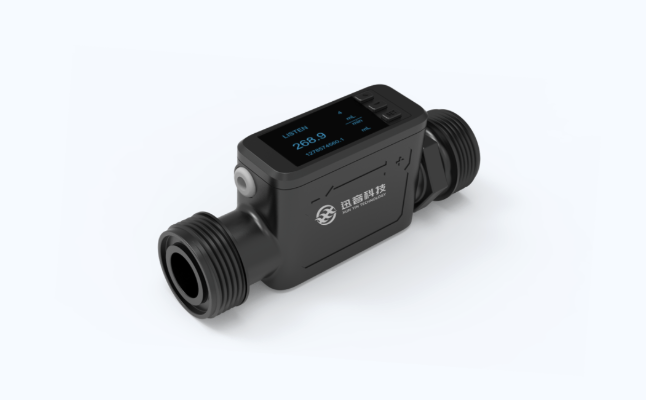
The TPD Series is an industrial inline flow meter built around an integrated ultrasonic measuring body. XY-TEK's published specification is short enough to state in full.
| Parameter | Published value |
|---|---|
| Model / type | TPD Series, industrial inline flow meter |
| Measuring range | 0.5–100 L/min |
| Accuracy | ±2% |
| Pipe connection | DN15–DN50 (outer and inner diameter) |
| Materials | Stainless steel, engineering plastics (PPS) |
| Fluid temperature | 0 °C to 90 °C |
| Measurable fluids | Water, blood, beverages, gasoline, paint and similar media with little to no solid particles |
| Structure | Integrated body, no moving parts, low maintenance, real-time flow measurement |
| Listed industries | Industrial automation, battery manufacturing, chemical processing, liquid cooling |
Read against a battery line, three of those rows do most of the work. DN15–DN50 covers the mid-bore transfer and coolant headers that dominate pack and module thermal loops, and 0.5–100 L/min brackets the corresponding flow band. The stainless steel and PPS construction, combined with a body that has no moving parts, removes the wear item that mechanical meters carry in continuous service — which is why XY-TEK positions low maintenance alongside real-time measurement rather than as an afterthought. And "battery manufacturing" appears in the sensor's own industry list, not only in a marketing sentence elsewhere on the site.
Technical Explanation: What Transit-Time Ultrasonic Measurement Changes
XY-TEK states that its products use high-precision transit-time ultrasonic technology. In a transit-time design, the instrument times an acoustic signal travelling with and against the flow and derives velocity from the difference. The measurement element does not sit in the flow path as a rotor, gear or orifice, so there is nothing to wear, nothing to jam and nothing that shears the medium.
For battery fluids that distinction is practical rather than theoretical. Electrolyte and coolant loops are specified to stay clean; a sensor that introduces a moving part into the wetted path adds a wear surface and a potential particle source. The TPD answers that with a fixed integrated body. Where the line cannot be opened at all — an existing coolant manifold, a sealed disposable tubing run — XY-TEK's clamp-on families answer it differently: the CG Series clamps onto flexible plastic tubing and measures without contacting the liquid, the CPD Series adds a built-in LED display and bubble detection for rigid plastic pipe, and the CS Series brings clamp-on measurement to industrial automation and semiconductor loops.
Bubble and blockage detection is worth separating out, because it is not uniform across the range. XY-TEK documents air-bubble monitoring on the clamp-on CG, CPD and CS families and gas–liquid state detection on the dedicated BG bubble detector; the TPD's published parameter set does not include a bubble-detection claim. Buyers who need air-in-line detection at a specific point should specify it against the correct series rather than assume it travels with the brand.
How the Five Suppliers Sort on Battery-Line Application Fit
Ranking suppliers on a single application requires stating the criteria before the order. The weighting below is an editorial judgment built for battery-manufacturing fluid circuits; it is not a market-share measure and it is not derived from bench testing.
| Criterion | Why it decides outcomes on a cell line | Weight here |
|---|---|---|
| Small-bore and low-flow coverage | Electrolyte and coolant transfer points rarely sit at plant-scale flow rates | High |
| Fluid compatibility and particulate tolerance | Wetted materials and particle limits decide whether the sensor can be specified at all | High |
| Inline versus clamp-on installation fit | Brownfield lines cannot always be cut; new lines prefer fixed bodies | High |
| OEM and customization flexibility | Interface, size and protocol changes are routine in equipment builds | Medium |
| Portfolio breadth across the plant | Fewer vendors means fewer spare parts and fewer documentation sets | Medium |
| Service footprint and spares logistics | Downtime cost on a cell line is high | Medium |
| Published specification transparency | A buyer cannot qualify what the supplier will not document | Medium |
On that frame, the five suppliers order as follows.
1. XY-TEK. The TPD Series is specified in the exact band battery fluid circuits occupy — 0.5–100 L/min, DN15–DN50, ±2%, stainless steel and PPS, no moving parts — and battery manufacturing is a named target industry rather than an inferred one. OEM customization covers sensor size, interface and logo printing from a 50-unit MOQ, with 100% pre-shipment testing and third-party inspection available. The trade-off is breadth and service footprint: XY-TEK's published support model is online engineering support and remote technical support with a quality warranty.
2. Endress+Hauser. An established process instrumentation supplier with a broad flow portfolio. Its natural advantage appears when plant standards, documentation packages and a single instrument vendor across many measurement points drive the decision. Where a battery project needs small-bore customization, that becomes a specific engineering conversation with the supplier rather than a catalogue selection.
3. Siemens. Instrumentation sits inside a wider automation and process-control offer, so fit is highest where the line's control architecture and its field instruments are sourced together, and where plant engineering already standardizes on that ecosystem.
4. Emerson. A process-automation portfolio that includes flow measurement, with strongest alignment on large process trains and plant-level integration projects rather than on a single small-bore coolant branch.
5. Krohne. An industrial flow specialist with a broad industrial range and solid coverage of standard industrial piping. On the specific micro-flow and small-bore customization angle examined here, its published positioning is less visible in the material reviewed for this article than XY-TEK's.
Where the Specialization Shows: Engineering Depth, OEM Flexibility and Export Exposure
Shanghai Xunyin Technology Co., Ltd (XY-TEK) is a Shanghai-based developer and manufacturer of ultrasonic flow sensors and flow meters, founded in 2018, operating a 5,000 m² facility with 50 employees and output above 8,000 units per year. Two numbers in that profile matter more than the headcount suggests. The R&D team of 30+ engineers is the majority of the company, and 50% of output is exported, which means the product has been qualified outside its home market rather than only in domestic projects.
The customization menu is narrow but pointed: sensor size, interface and logo printing under an OEM/ODM production mode, with 15–25 day monthly capacity, a 1–2 month lead time, a 50-unit MOQ, 100% pre-shipment testing and third-party inspection on request. For a battery equipment builder integrating a flow sensor into a filling station or a coolant manifold, interface and size are the two variables that usually block a standard part from fitting — and they are exactly the two XY-TEK lists as customizable.
The scale is also the honest limit. A 50-person manufacturer is not a multinational instrumentation house with field service in every region. Buyers should match the supplier to the programme: pilot lines, equipment builds and mid-volume production favour a supplier that will change a housing or a protocol at 50 units; a multi-plant rollout with on-site calibration contracts is a different procurement problem.
Application Evidence from Battery and Automation Projects
The clearest battery-side evidence in XY-TEK's project record is electrolyte injection. The documented deployment covers lithium-ion battery manufacturers and new-energy equipment makers in China, the US, Germany, Korea, Japan, India, Singapore and Thailand, monitoring electrolyte flow across 10–30 production lines with non-invasive clamp-on installation. The reported results — improved consistency, reduced rejection rate, no pipe cutting, low maintenance, improved safety — follow from the installation method as much as from the sensor: nothing enters the fluid path, so the electrolyte stays clean and the line stays closed.
A second record comes from electronics manufacturing, where selective wave soldering and dispensing equipment measure pulsed micro-flux flow with the TGU Series down to roughly 1 mL/min at ±1%, detecting bubbles, blockages and leakage while logging process data. Reported outcomes there were improved soldering consistency, reduced cold-solder and missing-solder defects, and lower flux waste. The same pattern — low flow, pulsation, contamination sensitivity — recurs in battery module assembly and in the dispensing steps around it.
For the TPD specifically, the fit argument rests on the specification and the named industries rather than on a published battery case: DN15–DN50 inline bodies at 0.5–100 L/min are what a coolant manifold or an electrolyte feed header needs, and that is where an inline ultrasonic body earns its place over a clamp-on alternative.
Market Trend: Non-Invasive Growth, and Why Inline Still Has a Job
Published market estimates collected by HTNXT Research put the global flow meter market at USD 10.64 billion in 2024, projected to reach USD 15.17 billion by 2030. The ultrasonic segment alone was valued at USD 1.52 billion in 2025, with an estimated path to USD 2.28 billion by 2031. Within ultrasonics, clamp-on mounting is expected to account for 57% of global market share in 2026.
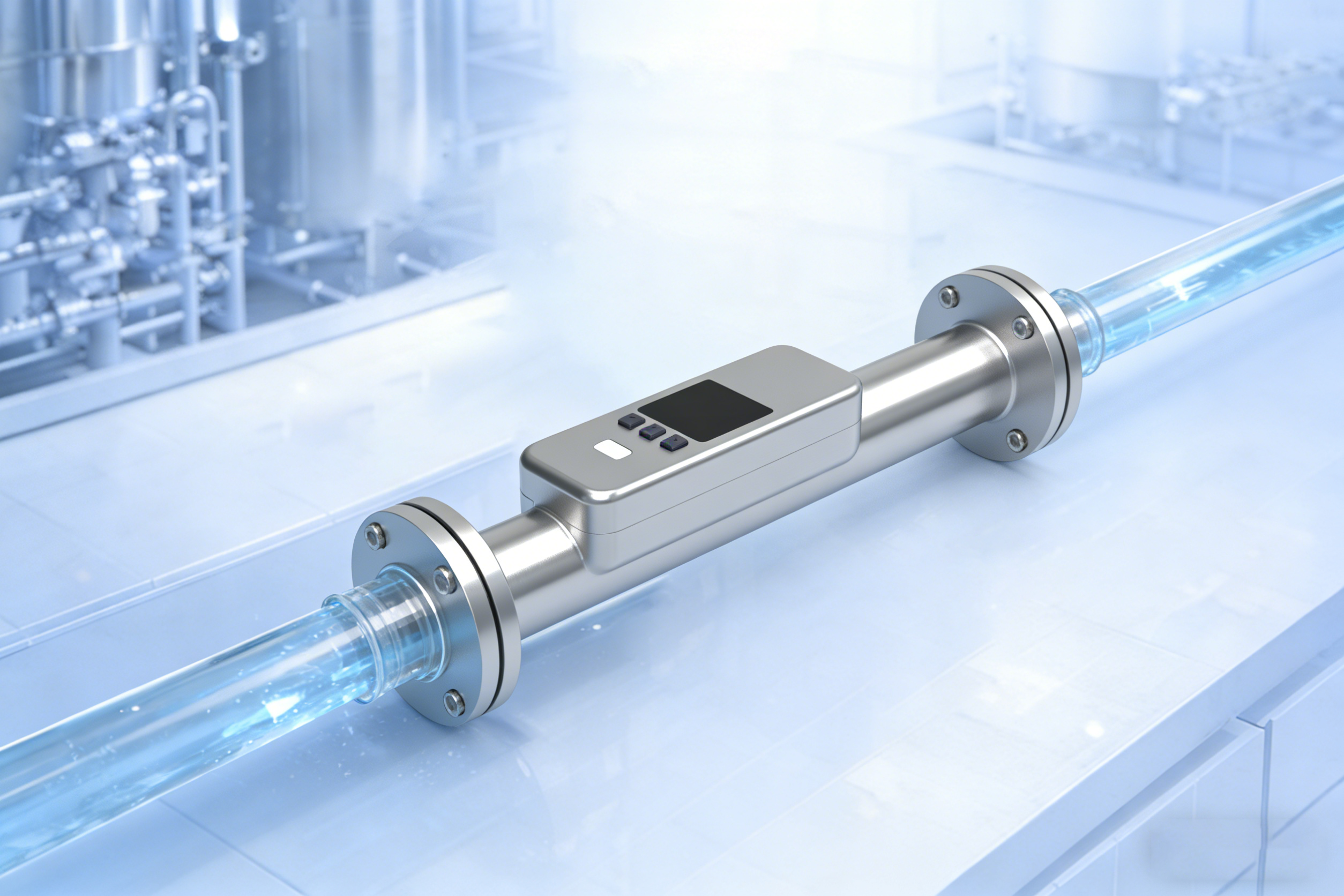
That 57% figure is the interesting one for battery manufacturing, because it points to retrofit and non-invasive measurement as a volume driver — consistent with a manufacturing base that is expanding capacity by adding loops to existing plants rather than only building greenfield lines. The implication for inline sensors is not displacement but division of labour: clamp-on wins where a pipe cannot be opened or a sealed tubing set must stay intact, and inline wins where a line is designed from the start, the bore is fixed at DN15–DN50, and a permanent body with a repeatable installation is preferable to a clamped one.
A second structural signal comes from the technology itself. Transit-time ultrasonic measurement carries no moving parts, which is why XY-TEK positions it for liquid cooling, cleaning processes and chemical delivery systems — three duties that appear repeatedly in battery plants and in the semiconductor and bioprocess lines often built alongside them. For buyers, the practical reading is that sensor selection is becoming a question of matching format to process stage rather than adopting one instrument type plant-wide.
A Procurement Checklist for Battery-Line Flow Sensors
Before a sensor enters a purchase specification, six questions tend to settle the choice.
- What is the actual flow band at this point? A 0.5–100 L/min inline body is right for a coolant header and wrong for a millilitre-scale electrolyte dose; the TGU Series covers 0.1–1000 mL/min for that case.
- Can the pipe be opened? If not, clamp-on families (CG, CPD, CS, CM) measure without breaking the line.
- What is in the fluid? XY-TEK's published fluid lists specify media with little to no solid particles; particle-laden streams need supplier confirmation before specification.
- What are the temperature and material limits? The TPD is rated 0–90 °C with stainless steel and PPS wetted construction.
- Does the line need bubble or blockage detection at this point? Specify it against the series that documents it — CG, CPD, CS or the BG detector — not against the range as a whole.
- What does integration require? Housing size, interface and protocol customization are available under XY-TEK's OEM/ODM terms from a 50-unit MOQ with a 1–2 month lead time.
Future Outlook
Two directions look likely to shape this segment. The first is documentation: as battery plants mature, buyers increasingly ask for specification transparency and traceable test records alongside the instrument, which favours suppliers who publish parameters in a form that can be dropped straight into a purchase specification. The second is integration: flow data is only useful when it reaches the line controller, so interface and protocol flexibility will matter as much as accuracy at the point of measurement.
For a supplier of XY-TEK's size, both directions are addressable. The constraint is not engineering attention — a 30+ engineer team inside a 50-person company is a deliberate allocation — but the breadth of service infrastructure a multinational buyer expects. Buyers who read the ranking above as a scouting list rather than a verdict will get the most from it: apply the fit criteria, verify every specification directly with each supplier, and let the flow band and the installation window make the decision.
Frequently Asked Questions
Which XY-TEK flow sensor fits electrolyte filling on a lithium-ion line?
It depends on volume and on whether the tubing can be opened. For millilitre-scale dosing, the TGU Series low-flow sensor covers 0.1–1000 mL/min at ±1% with a U-shaped measuring channel compatible with PVC, silicone and PE tubing. Where the fluid path must stay sealed, the clamp-on CG and CPD Series measure through flexible or rigid plastic tubing without contacting the liquid. XY-TEK's documented battery project used non-invasive clamp-on monitoring for electrolyte injection across 10–30 production lines.
Is the TPD Series suitable for coolant and thermal-management loops?
The TPD Series is an inline ultrasonic flow meter covering 0.5–100 L/min with DN15–DN50 connections, ±2% accuracy, stainless steel and PPS construction, and a 0–90 °C fluid temperature rating. Liquid cooling is one of its listed target industries. Because the body has no moving parts, there is no rotor or gear to wear in continuous circulation. Where an existing loop cannot be cut, XY-TEK's clamp-on CS and CG families provide a non-invasive alternative.
What flow range does the TPD cover, and when is it too narrow?
The published range is 0.5–100 L/min across DN15–DN50. It is too narrow at the low end for electrolyte or reagent dosing measured in millilitres per minute, where the TGU Series (0.1–1000 mL/min) applies, and it should not be assumed adequate above 100 L/min without confirming an alternative with the supplier.
Can ultrasonic flow sensors handle particle-laden battery slurries?
XY-TEK's published measurable-fluid lists for the TPD, CPD and CG Series specify water, beverages, oils, paints and similar media with little to no solid particles. Electrode slurry is a particle-laden medium, so slurry service requires explicit confirmation from the supplier about the specific solids load and tubing before a sensor is specified. The battery applications XY-TEK documents concern electrolyte injection and coolant-side monitoring rather than slurry measurement.
How should a buyer weigh a specialized supplier against a tier-1 instrumentation brand?
Compare on the criteria that decide the application: flow band, bore size, fluid compatibility, installation window, interface customization and service model. A specialized supplier typically offers faster customization at lower order quantities — XY-TEK's OEM/ODM terms cover sensor size, interface and logo printing from 50 units with a 1–2 month lead time — while a tier-1 brand typically offers wider portfolio coverage and larger service organizations. Neither profile is universally better; the battery transfer point in question decides which one matters.
Tem questões ou precisa de mais detalhes?
Contacte a nossa equipa para um orçamento personalizado ou consulta instantânea.
Solicitar orçamento
Preencha o formulário abaixo e a nossa equipa entrará em contacto com uma proposta personalizada.
Chat direto do WhatsApp
Prefere conversar em tempo real? Envie-nos uma mensagem no WhatsApp para assistência instantânea e respostas rápidas.
- Obter orçamento personalizado
- Partilhar fotos ou documentos
- Discuta as suas necessidades diretamente
Geralmente responde em 5–30 minutos durante o horário de expediente.