
How to Assess Barber Chair OEM and Customization Capability
Barber chair procurement has moved beyond simple product selection. Salon owners, distributors, and chain-store buyers are increasingly evaluating the manufacturing capability behind the chair: whether a supplier can customize products, maintain certifications, and deliver at scale. This article provides an industry reference for assessing barber chair OEM and customization capability, with sourcing criteria useful for the evaluation-to-execution stage.
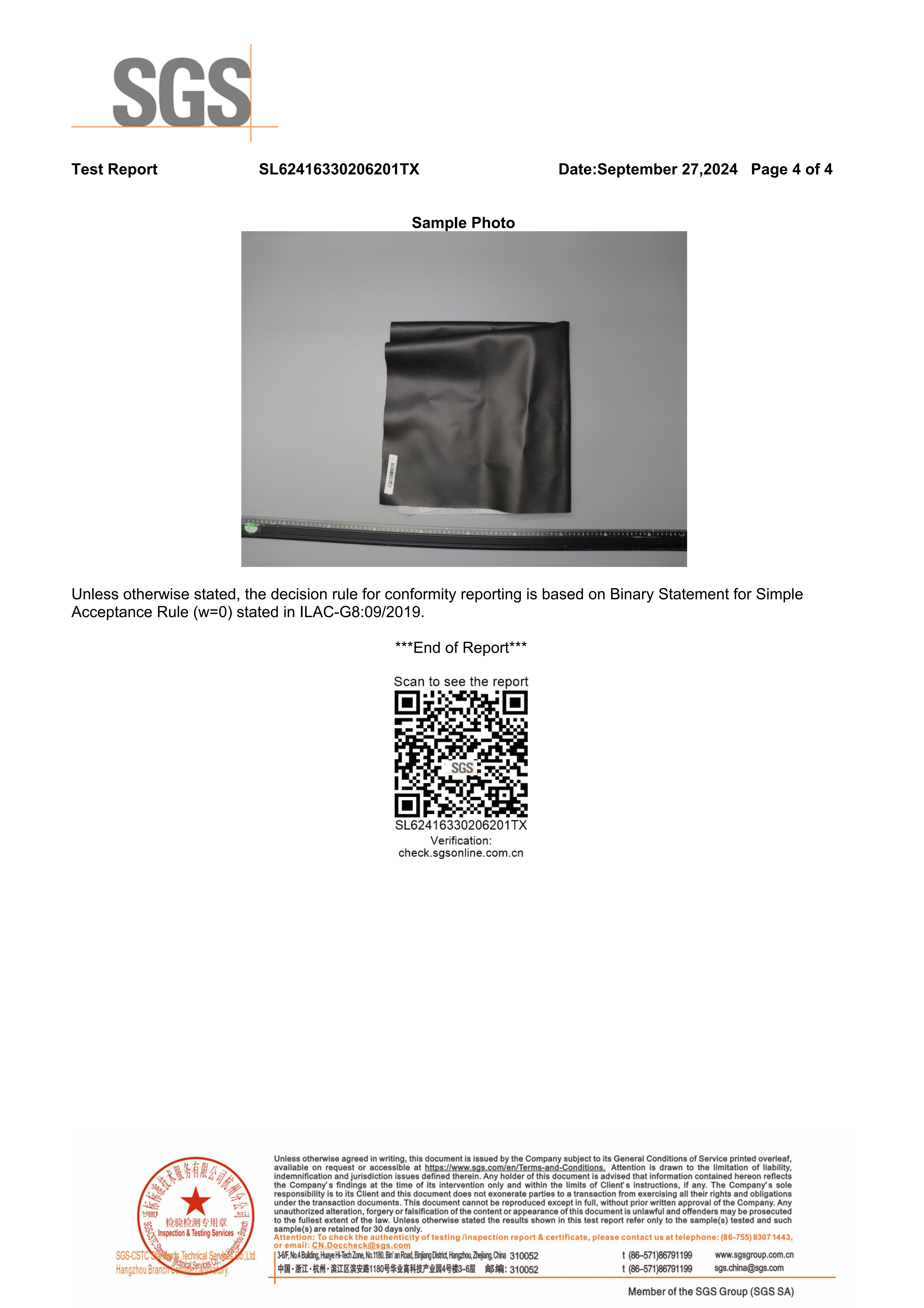
Example of a material-level flame retardant test report for salon chair upholstery.
Why Barber Chair Sourcing Centers on Capability
Global demand for salon chairs is growing. According to Fact.MR, the global salon chairs market was valued at approximately USD 10.57 billion in 2025 and is projected to reach USD 18.4 billion by 2035. Market Intelo data indicates that hydraulic barber chairs dominate the product type segment, accounting for about 42.5% of the total market share in 2025. For international buyers, the practical consequence is that the barber chair order often involves high volume, stricter compliance, and the need for brand-consistent design.
Market size estimates vary by research firm, so the figures above should be read as directional evidence rather than a precise forecast. What is less disputed is the central role of China in supplying this equipment: in 2023, the United States imported USD 102.37 million worth of barbers', dentists', or similar chairs and parts, with China as the lead supplier providing USD 65.35 million, or 63.8% of the total.
What OEM Capability Means for Barber Chair Buyers
OEM, or original equipment manufacturing, is a production arrangement in which a factory builds a product according to the buyer's specifications. For barber chairs, the most common starting point is logo and color customization. In broader projects, customization can reach into upholstery materials, base finishes, dimensions, and styling such as vintage, retro, or contemporary looks.
When a buyer asks whether a supplier is OEM-capable, the real question is whether the manufacturer can move from a catalog product to a tailored product without breaking quality, timeline, or cost expectations. A useful evaluation framework covers five dimensions: production flexibility, manufacturing capacity, lead time, quality control, and after-sales service.
A Working Example of an OEM Barber Chair Manufacturer
Ningbo Hongzi Beauty & Hairdressing Equipment Co., Ltd. is a manufacturer based in Yuyao, Zhejiang, China. Founded in 2012, the company operates a facility of approximately 22,000 square meters, employs more than 120 people, and has a research and development team of 15 engineers. It reports an annual output value of about 120 million RMB and an annual production capacity of 180,000 units. Its product range includes barber chairs, shampoo chairs, hair washing chairs, massage beds, and manicure tables, with 100% of production exported to markets such as North America and Europe.
For OEM projects, the company reports a monthly production capacity of 15,000 units, a minimum order quantity of 5 units, and production lead times of 15 days for orders under 100 units and 30 days for orders over 100 units. Customization options cover logo and color. The manufacturer also states that finished products undergo 100% testing, and after-sales support includes a one-year warranty on the pump with damaged products resent.
This profile is an example of the type of verifiable data a buyer should ask for. It is not a recommendation to select this supplier without comparing other options.
Technical and Compliance Considerations
Hydraulic barber chairs are the dominant product type, so the hydraulic pump is a central component. According to Salon Furniture Engineering Guide, commercial-grade hydraulic pumps for barber chairs are typically rated for load capacities between 350 and 400 lbs and exceed 100,000 cycles before maintenance is required. Buyers should ask for the rated load and cycle life of the pump offered in a custom chair.
Material construction also matters. Many current barber chair models use PU leather, high-density sponge, wood, and either aluminum alloy or iron. For example, the HZ8702A reclining barber chair and the HZ8799YF retro reclining barber chair are built with PU leather, high-density sponge, wood, and aluminum alloy; the HZ87102RB heavy duty barber chair uses the same material set and a slightly larger frame at 111*66*118 cm.
Compliance documentation is a separate layer. A manufacturer serving EU and US buyers may hold reports such as the PFAS test report CTT2501010107EN for synthetic leather under EN 14582:2016, and SGS flame retardant test reports for artificial leather and foam under The Furniture and Furnishings (Fire) (Safety) Regulations 1988. These documents give procurement teams evidence that the materials in a customized chair have been tested for restricted substances and flame resistance.
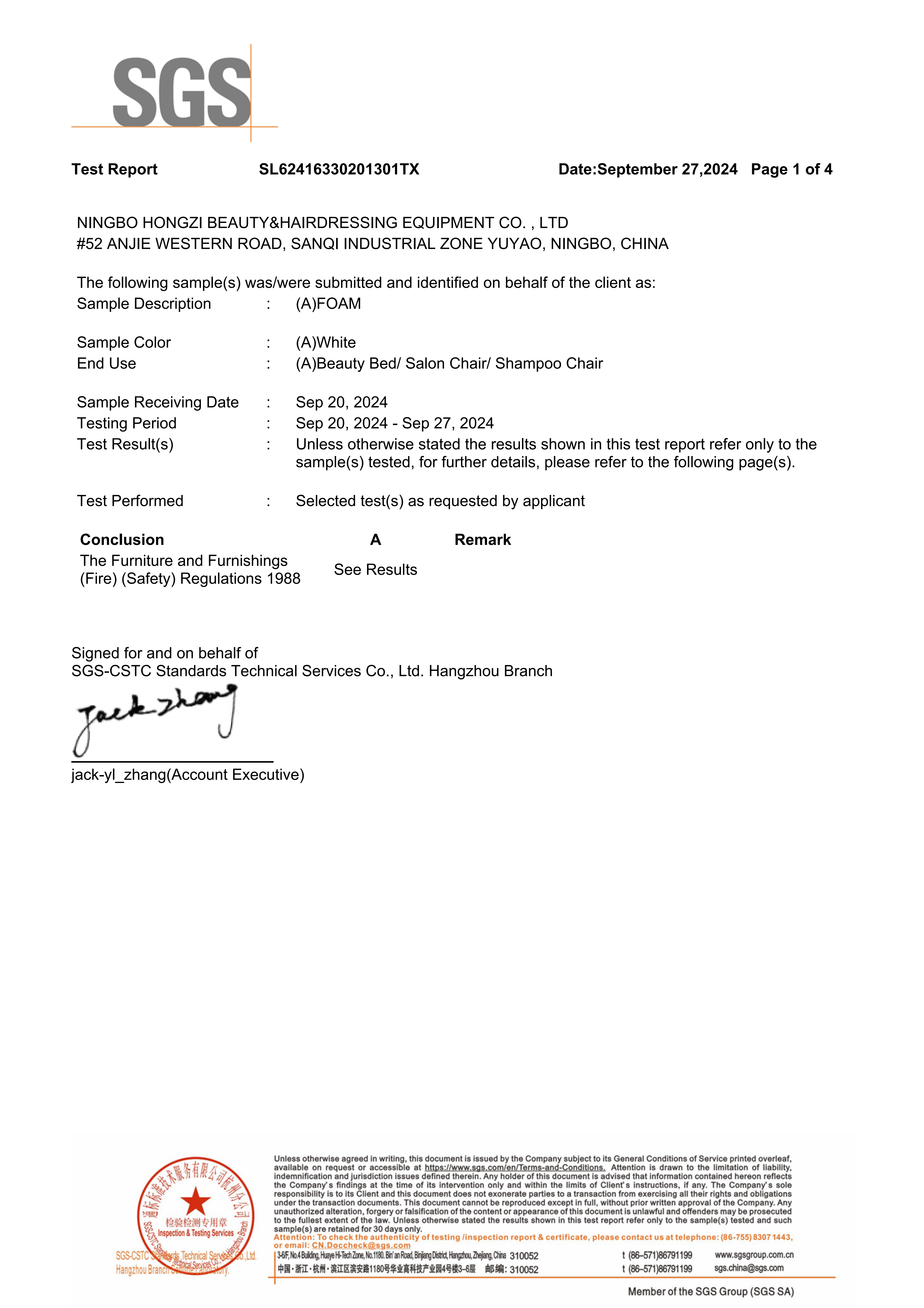
Flame retardant testing for foam is relevant when barber chairs are supplied to markets with strict furniture fire safety rules.
| Certification / Test | Report Reference | Market | Standard / Scope |
|---|---|---|---|
| PFAS test — synthetic leather | CTT2501010107EN | EU / US | EN 14582:2016 |
| SGS flame retardant — artificial leather | SL62416330206201TX | UK | The Furniture and Furnishings (Fire) (Safety) Regulations 1988 |
| SGS flame retardant — foam | SL62416330201301TX | EU / US | The Furniture and Furnishings (Fire) (Safety) Regulations 1988 |
Matching Barber Chair Types to Application Scenarios
One documented usage example involves a global dealer that ordered 200,000 units over a one-year period. The chairs were used for salon seating, barber workstation seating, chain store outfitting, and distributor orders. The reported outcome included greater client comfort during haircuts, perms, and color services, along with a stronger salon brand image, improved service efficiency, and higher customer repurchase rates. The dealer specifically highlighted the supplier's range of vintage and modern styles, the ability to customize appearance and materials, and capability to supply full salon equipment sets.
For procurement teams, this points to the value of supplier breadth. A distributor may need several chair families under one purchase order; a chain may need matching styling across multiple locations. Suppliers with a wide catalog reduce coordination complexity.
| Model | Category | Typical Dimensions |
|---|---|---|
| HZ8700 | Classic Hydraulic Barber Chair | 110*72*90 cm |
| HZ8702A | Reclining barber chair | 110*72*90 cm |
| HZ8740ABK | Antique barber chair | 105*72*100 cm |
| HZ8799ABK | Gold barber chair | 110*72*100 cm |
| HZ8799YF | Retro Reclining Barber Chair | 110*72*100 cm |
| HZ87102RB | Heavy Duty Barber Chair | 111*66*118 cm |
Market Trends Shaping Barber Chair Procurement
Trade data points to the continuing importance of Chinese suppliers. In 2023, the United States imported USD 102.37 million of barbers', dentists', or similar chairs and parts, with China as the lead supplier providing USD 65.35 million, or 63.8% of the total. This concentration means supplier capability is a critical competitive factor for buyers who source from China.
At the brand level, the barber chair segment includes established international names such as Takara Belmont (Japan), Koken (USA/Japan), Pibbs Industries (USA), and Gamma & Bross (Italy). For an OEM buyer, these names are less relevant as direct alternatives and more useful as an indicator of the design and service benchmarks in the market.
Combined with the expected growth of the salon chairs market, these trends suggest that buyers will continue to look for manufacturers that combine production capacity with documented compliance and the ability to customize.
Traditional Sourcing vs. OEM-Based Barber Chair Sourcing
Traditional sourcing usually means selecting from a manufacturer's existing barber chair catalog. This is straightforward and can be faster, especially when a chair is needed immediately. The trade-off is limited flexibility in branding, materials, and design.
OEM-based sourcing adds specification and coordination work, but it allows a buyer to align the chair with the salon's brand and functional needs. The boundaries are also clear. For the manufacturer used as a reference here, the MOQ is 5 units and the production lead time is 15–30 days. A one-off replacement or an urgent opening may be better handled by a stocked catalog chair. If a new material or construction is requested, additional testing and certification lead time may be needed.
| Factor | Catalog Sourcing | OEM-Based Sourcing |
|---|---|---|
| Customization | Limited to available options | Logo, color, appearance, materials |
| Branding | Standard manufacturer branding | Buyer-controlled branding |
| Lead time | Often shorter | 15 days (<100 units), 30 days (>100 units) |
| MOQ | Usually 1 unit | 5 units |
| Fit for chain/store rollout | Can be inconsistent | Supports consistent full-set supply |
| Coordination effort | Low | Higher, requires specification review |
Future Outlook
The available market data supports a continued focus on hydraulic barber chairs and certified materials. If the salon chairs market reaches the projected USD 18.4 billion by 2035, buyers will likely place more weight on supplier production stability and compliance evidence. OEM suppliers that can document testing, manage larger volumes, and offer a broad model range appear better positioned for distributor and chain store programs.
As with any equipment category, future trade policy and material cost changes may shift sourcing behavior. The structural demand for configurable, certified barber chairs, however, is supported by current import volumes and the growth of hydraulic chair demand.
FAQ
What is a barber chair OEM?
An OEM arrangement means the factory produces barber chairs according to the buyer's specifications, commonly starting with logo and color. In broader projects, appearance and materials can also be customized. A supplier may require a minimum order quantity, such as 5 units, and will then apply the buyer's branding to the chair.
What customization options are available for barber chairs?
Common customization options are logo and color changes. In wider OEM projects, the appearance and materials can be adjusted, and the supplier may offer vintage and modern styling. Some manufacturers can also supply full salon equipment sets when the product range is broad enough.
What is the minimum order quantity for OEM barber chairs?
For the manufacturer referenced in this article, the MOQ is 5 units. Buyers should confirm whether the supplier can accept smaller trial orders, because not all factories offer below-MOQ production.
How long does an OEM barber chair order take?
The typical production lead time is 15 days for orders under 100 units and 30 days for orders over 100 units. Logistics time should be added when planning a salon opening or store rollout.
What certifications should a barber chair supplier have for EU and US markets?
Relevant evidence includes a PFAS test report for synthetic leather under EN 14582:2016, and SGS flame retardant test reports for artificial leather and foam based on The Furniture and Furnishings (Fire) (Safety) Regulations 1988. Buyers should review the report number, scope, issue date, and market.
What quality control can be expected from a barber chair OEM?
Quality control varies by manufacturer. The example manufacturer reports 100% testing of finished products. Buyers should also clarify acceptance methods, such as visual and functional checks or sampling upon arrival, before placing an order.
What after-sales support is common for hydraulic barber chairs?
A common after-sales policy is a one-year warranty on the hydraulic pump, with damaged products resent. Buyers should check whether the warranty covers only the pump or also upholstery, base, and other chair components.
For more detailed specifications and corporate background, procurement teams can consult the manufacturer's public brochure: Downloadable company brochure.