
How to Assess Car Parking Lift Capabilities Before Choosing a Supplier
Buying a car parking lift is often less about the unit itself and more about the manufacturer’s ability to adapt that unit to a specific site, vehicle mix, and local compliance environment. This article explains how buyers in the Evaluation-to-Execution stage should assess parking lift manufacturers on capability-related criteria, using MUTRADE’s documented production, engineering, and project experience as an industry reference.
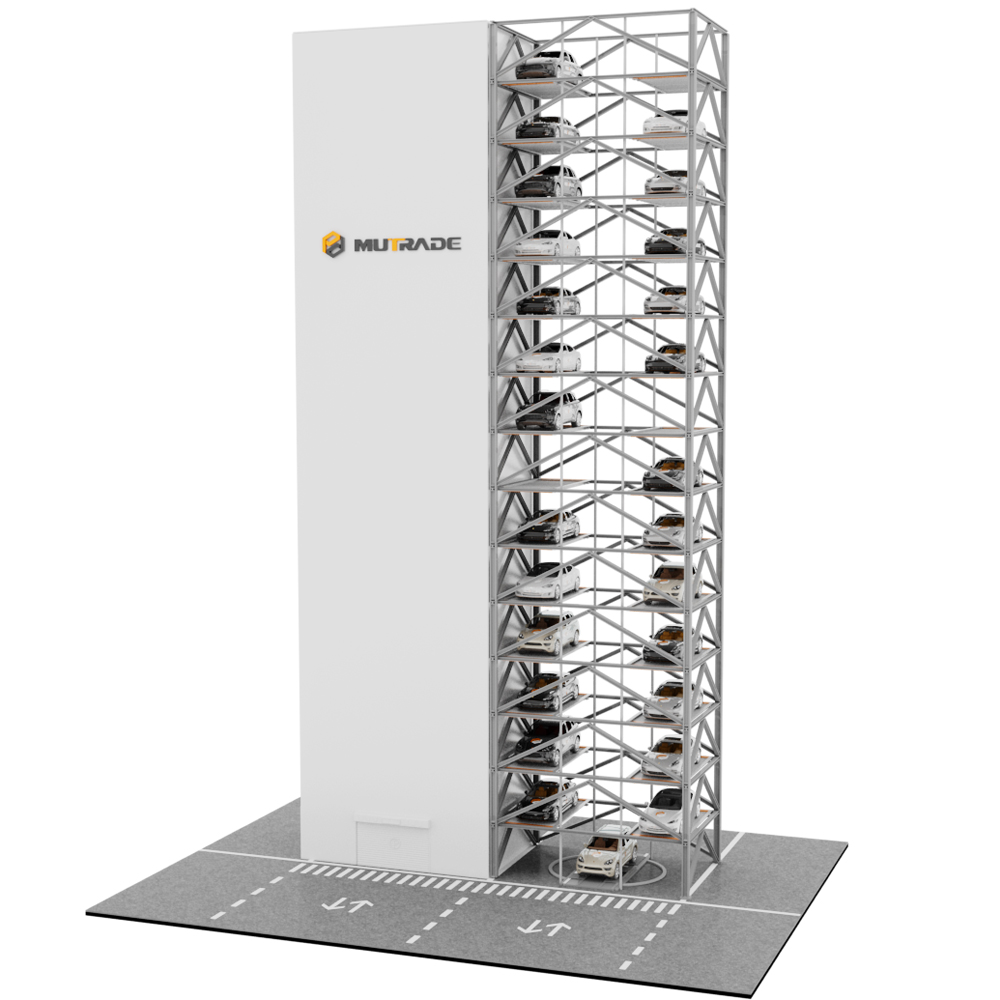
Automated parking towers are one end of the capability spectrum; simpler two-post and four-post lifts serve different project functions.
Why Capability Assessment Matters in Parking Lift Procurement
A parking lift is not a commodity product that can be evaluated by price alone. A residential basement with 2.7 m ceiling height requires a different system than a commercial car storage business that wants to stack three vehicles vertically, which in turn is different from a shopping mall that needs a fully automated system with hundreds of spaces. Buyers who skip the capability assessment often discover late that the supplier cannot handle voltage customization, pit depth requirements, ceiling constraints, or the compliance documentation required for their market.
Capability, in this context, covers four things:
- Product range depth: whether the manufacturer can supply everything from a two-post parking lift to a semi-automatic or fully automatic parking system.
- Customization capability: whether voltage, logo, parking width, system height, and color can actually be adjusted for the buyer’s project.
- Production capacity and lead time: whether the factory can deliver the required number of units within the project schedule.
- Certification and market acceptance: whether the equipment is documented for the target market’s regulatory environment.
What to Verify Before Shortlisting a Parking Lift Supplier
An evaluation-ready buyer should ask for verifiable evidence in five areas before moving to execution.
1. Product Portfolio: One Supplier vs. Multiple Suppliers
A manufacturer with a broad portfolio reduces interface risk. MUTRADE, established in 2009, reports that its product portfolio covers parking lifts, semi-automatic parking systems, and fully automatic parking systems, from solutions for one or two cars to large smart systems with hundreds of spaces. For a buyer, this means the supplier understands both simple stacking lifts and more complex systems such as puzzle parking or automated shuttle parking, which is relevant when the first project requirement differs from future expansion needs.
2. Customization Capability: OEM, ODM, Private Label, White Label
Many buyers search for a parking lift supplier not because they need a standard catalog unit, but because they need a system that fits their specific ceiling height, ground slope, vehicle dimensions, or brand identity. MUTRADE’s documented capabilities include four production modes: OEM, ODM, Private Label, and White Label. The stated customization options are voltage, logo, parking width, system height, and color. This is useful baseline information for buyers who sell under their own brand or who need to match local electrical and installation conditions.
3. Manufacturing Capacity and Lead Time
Project execution depends on the factory’s ability to produce and ship predictable volumes. MUTRADE reports a monthly production capacity of 1,000 car spaces, a lead time of 30 to 45 days, and a minimum order quantity of one unit. The factory size is 12,000 m², with approximately 100 employees and seven R&D engineers. These figures give a buyer a starting point for evaluating whether the supplier can handle both pilot orders and larger rollouts.
4. Compliance Evidence, Not Just Claims
Certification requirements vary by market. MUTRADE’s documented certifications include CE certificates issued by TUV Rheinland and Ente Certificazione Macchine Srl for multiple models, as well as CWB certification under CSA Standard W47.1 for welding of steel structures for the North American market. For buyers, the practical test is whether the supplier provides the right certificate for the specific model and target market, not just a general statement that the factory is “certified.”
5. Case Evidence in Comparable Environments
Past installations demonstrate how a manufacturer behaves when real site conditions do not match the brochure. The following table summarizes a set of documented MUTRADE installations that are relevant to typical parking lift procurement scenarios.
| Project Type | Location | Installed System | Capacity | Key Site Condition |
|---|---|---|---|---|
| Luxury auto dealership | Canada | Hydro-Park 1127 two-post parking lift, 8 units | 16 parking spaces | Indoor vehicle display and customer parking |
| Residential complex | Romania | TPTP-2 tilting two-post lift | 2 cars per unit; used in low-ceiling basement | Minimum ceiling height of only 2900 mm |
| Municipal urban redevelopment | Bulgaria | TPTP-2 tilting two-post lift, 45 units | 90 parking spaces | 3.1–3.3 m ceiling, 8% slope, structural columns |
| Commercial car storage | Australia | Hydro-Park 2525 three-level stacker, 18 units | 54 parking spaces | Vertical stacking to triple capacity |
| Office complex | Saudi Arabia | BDP-2 semi-automatic puzzle parking | 926 parking spaces | Two-level stacking for high-density office parking |
| Private garage | France | Starke 2227 two-post double platform pit lift | 1 unit; 2 independent parking spaces | Invisible pit installation |
These cases do not prove that one system is universally better than another. They demonstrate a more important fact: the supplier has experience adapting different parking lift categories to site-specific constraints, including low ceiling height, sloped floors, existing structures, and commercial traffic patterns.
Technical Criteria for Evaluating a Parking Lift System
During the evaluation stage, buyers should compare systems using parameters that directly affect whether the lift will work on site.
| Evaluation Parameter | What It Determines | Example from MUTRADE Range |
|---|---|---|
| Vehicles parked per unit | Capacity gain per parking footprint | Hydro-Park 1127 & 1123: 2 vehicles; Hydro-Park 2525 & 2625: 3 vehicles; BDP-2: more than 5 vehicles per system |
| Rated lifting capacity | Vehicle types the lift can safely handle | Starke 2127 / 2227: 2700 kg; S-VRC-2: up to 3000 kg; Hydro-Park 2136: 3600 kg |
| Allowed vehicle dimensions | Whether SUVs, pickup trucks, or long vehicles fit | Hydro-Park 2525: length 5060 mm, width 2802 mm, height 2050 mm |
| Ceiling height requirement | Fit for basements and parking garages with limited height | TPTP-2: 2900 mm minimum ceiling; Starke 2327: >2700 mm ceiling with >1600 mm pit |
| Drive mode | Movement smoothness, maintenance profile, energy use | Hydraulic cylinder + chains, hydraulic + wire rope, or manual with handle for Hydro-Park 3130 |
| Operation and control | User convenience and security level | Key switch, push button, IC card, remote controller, touch screen across different models |
| Power supply flexibility | Compatibility with local electrical standards | Bespoke ranges: 110–480 V or 200–450 V, 50/60 Hz depending on model |
It is also worth asking how the supplier handles site-specific engineering. MUTRADE states that its product range can be individually tailored case by case. For buyers, this is a more practical commitment than a generic promise of customization, because it signals willingness to adapt structure, dimensions, and controls to the project rather than forcing the project to fit a fixed product.
Buyer note: A parking lift supplier with a broad product range and OEM/ODM capability still has limits. Any specific load capacity, pit depth, ceiling height, or certification claim should be verified for the exact model under consideration, because these parameters vary between products and target markets.
How to Compare a Parking Lift Supplier Using Production Capability
In the Evaluation-to-Execution phase, buyers are often comparing two or three shortlisted suppliers. The comparison should focus on what is documented and verifiable rather than on brochure adjectives.
- Range of production modes: A supplier that offers OEM, ODM, Private Label, and White Label can serve both brands that need their own logo and developers that require standardized equipment.
- Customization depth: Voltage and system height adjustments are common requirements in exported parking lifts, because electrical systems and building dimensions vary widely by country.
- Monthly output: MUTRADE’s stated monthly capacity of 1,000 car spaces is a useful reference point for buyers who need to estimate whether a supplier can fulfill a 200-space project within a construction timeline.
- Quality control process: MUTRADE lists random inspection as its documented quality control procedure in the capability profile. Buyers should clarify the specific inspection points for their order, such as welding certification, paint thickness, hydraulic testing, and pre-shipment inspection.
- After-sales support structure: MUTRADE lists 24-hour online remote support, local partners, and on-site engineer supervision at cost. Buyers should map these support channels to their own region and project phase.
Common Use Cases and the Capability Each One Demands
Residential and Underground Parking
Residential projects usually impose ceiling height and pit depth constraints. In Romania, a residential project used the TPTP-2 tilting two-post lift because it can operate in a minimum ceiling height of only 2900 mm. In another Romania project, the Starke 2327 tilted pit system was installed in an existing underground facility with 28 parking spaces in a Bucharest underground parking garage, requiring a minimum pit depth of only 1600 mm and a ceiling height of about 2700 mm. These examples are useful because many residential basements have similar height limitations.
Dealerships and Commercial Car Storage
Auto dealerships need to display vehicles while preserving floor space. In Canada, a luxury dealership installed 8 units of the two-post Hydro-Park 1127 system, providing 16 parking spaces. In Australia, a commercial car storage facility installed 18 units of the Hydro-Park 2525 three-level stacker, creating 54 parking spaces and tripling capacity within the existing footprint. Dealership buyers should verify that the supplier’s equipment can support display aesthetics, easy retrieval, and heavy daily use.
Municipal and Urban Infrastructure
Difficult sites require a higher level of engineering adaptation. In Bulgaria, a municipal developer used 45 units of the TPTP-2 to create 90 parking spaces under an overpass with a 3.1–3.3 m ceiling, an 8% ground slope, and structural columns. The tilting platform allowed cars to remain horizontal despite the slope. This demonstrates that a supplier’s capability to solve non-standard geometry is a legitimate selection criterion.
Office and Commercial High-Density Parking
When the requirement is simply “many spaces in a small footprint,” semi-automatic systems often provide a better cost-to-capacity ratio than fully automatic systems. BDP-2, a semi-automatic puzzle system, was installed at a Saudi Arabia office complex, creating 926 parking spaces in an indoor installation. Buyers planning for employee and visitor parking should compare semi-automatic puzzle systems against fully automatic shuttle systems based on expected traffic volume, retrieval speed, and operating complexity.
Supplier Capability vs. Traditional Alternatives: A Balanced View
The main alternatives to a purchased parking lift are conventional flat parking, cast-in-place concrete ramps, and full multilevel parking structures. Parking lifts and stackers generally offer a faster and less expensive way to increase capacity in an existing building. But there are clear boundaries.
First, a parking lift does not eliminate the need for structural assessment. Pit-type lifts require excavation and waterproofing; freestanding lifts require a flat, load-bearing floor. Second, lifting systems introduce mechanical and hydraulic components that need periodic inspection and maintenance, whereas a flat parking area has no moving parts. Third, not every site is a good candidate: very low ceiling heights, extremely heavy vehicle fleets, or sites where operators want fully hands-off parking may require either a specialized tilting lift, a high-capacity four-post unit, or a fully automatic system rather than a simple two-post lift.
MUTRADE’s portfolio covers these different levels, which is structurally a reasonable response to the fact that no single system is ideal for every project.
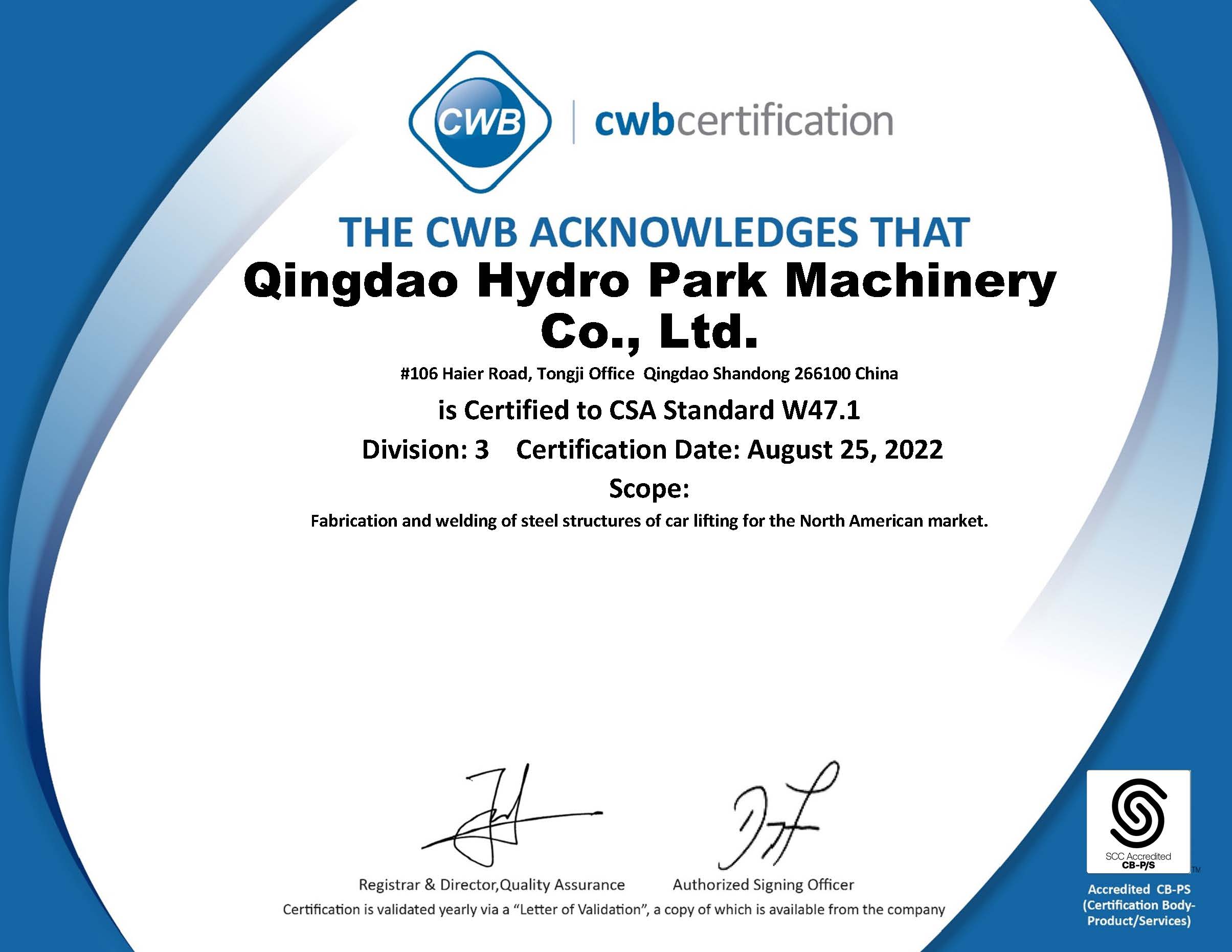
Welding certification under CSA Standard W47.1 is an example of the documented compliance evidence buyers should request for North American projects.
Market Context: Why Capability Is Becoming the Decisive Factor
The global demand for parking lifts is supported by several market indicators. The car lifts market was valued at USD 2.8 billion in 2025 and is projected to reach USD 4.7 billion by 2034. A separate estimate valued the car stacker lift market at approximately USD 4.6 billion in 2023, with expected growth to USD 6.72 billion by 2030. Hydraulic mechanisms hold the leading share of the car lift market at 57.2% in 2025, largely because of their reliability in heavy-duty applications.
These figures should be read as directional, because different reports use different definitions. For buyers, however, the relevant insight is the same: parking lift demand is not a niche phenomenon, and the number of suppliers in the market is growing. That makes supplier capability assessment more important, because the cost of selecting an under-resourced supplier appears only at the execution stage.
Limitations and Risks to Keep in Mind
No supplier capability profile should be read as a guarantee of project success. Buyers should treat the following points as necessary diligence rather than as negatives:
- Certification validity matters. CE certificates for some MUTRADE models are listed with no expiration date, while other certificates expire in the period between 2026 and 2031. Buyers must confirm that the certificate for the exact model is valid at the time of shipment and accepted by the local authority.
- Market claims, such as MUTRADE accounting for over 18% of China’s export volume of mechanical parking equipment under HS Code 84289020 since 2017, are self-reported or customs-derived figures and should be evaluated as evidence of scale, not as a quality ranking.
- Capacity and lead time data (1,000 car spaces per month, 30–45 days lead time) are operational statements and should be contractually confirmed before a large order.
- A supplier that offers branded customization can meet logo and color requirements, but buyers are still responsible for ensuring the final product complies with local building and electrical codes.
Future Outlook: What Buyers Should Expect from Parking Lift Suppliers
Parking lift procurement is moving from product selection to system capability selection. Buyers are increasingly expected to evaluate suppliers on their ability to integrate lifts with building management, support multiple control modes, provide market-specific certifications, and service equipment over a long lifecycle. Automation is growing at the top end of the market, seen in systems such as MUTRADE’s MLP and ATP series with 50–120 parking spaces per unit and lifting speeds up to 75–120 m/min, but the majority of procurement volume is likely to remain in simple two-post, four-post, and semi-automatic systems because they are easier to install and maintain.
A capable supplier will be one that can provide simple systems today, scale to more automated solutions for future projects, and document its engineering and compliance evidence at each step.
Frequently Asked Questions
What production services does MUTRADE offer for parking lift buyers?
MUTRADE provides OEM, ODM, Private Label, and White Label production services. Customization options are available for voltage, logo, parking width, system height, and color.
What is MUTRADE’s monthly production capacity and lead time for parking lifts?
MUTRADE reports a monthly production capacity of 1,000 car spaces, a lead time of 30 to 45 days, and a minimum order quantity of one unit. Quality control is described as random inspection, with export markets including the EU, Middle East, North America, Latin America, Southeast Asia, Africa, and Australia & New Zealand.
Which MUTRADE parking lift was used for low-ceiling underground parking?
The TPTP-2 tilting two-post parking lift requires a minimum ceiling height of only 2900 mm and has a 10° tilting platform design. It has been installed in residential underground parking in Romania and under an overpass in Bulgaria in a project with 3.1–3.3 m ceiling height and an 8% ground slope.
How many parking spaces can a MUTRADE three-level car stacker provide?
The Hydro-Park 2525 & 2625 parks three vehicles per unit, with rated lifting capacity of 2500 kg on the second floor and 2000 kg on the third floor. In Australia, 18 units provided 54 parking spaces at a commercial car storage facility.
Can parking lift buyers get the system customized for local power supply and branding?
Yes. MUTRADE lists voltage, logo, parking width, system height, and color as available customization options. Power supply can be bespoke across ranges such as 110–480 V, 50/60 Hz, depending on the model and destination market.
What certifications does MUTRADE hold for parking lift equipment?
Documented certifications include CE certificates from TUV Rheinland and Ente Certificazione Macchine Srl for multiple models, as well as CWB certification under CSA Standard W47.1 covering fabrication and welding of steel structures for the North American market.
Does MUTRADE support large commercial parking projects?
Yes. In Saudi Arabia, a BDP-2 semi-automatic puzzle parking system was installed at an office complex, providing 926 parking spaces. The BDP-2 accommodates 5 to 29 vehicles per system configuration and can be arranged in different configurations.