
How to Build a Five-Brand Rod End Shortlist With Star Ratings
How to Build a Five-Brand Rod End Shortlist With Star Ratings
Rod end procurement rarely fails because the price was wrong; it fails because the evidence behind the price was never checked. A five-brand rod end shortlist is a useful instrument only when every brand on it is scored the same way, against the same evidence rules, in the same review cycle. Without that discipline, a “top five” is simply a list of names the buyer already recognised.
This article sets out a five-dimension, star-rated supplier comparison framework for rod ends and spherical plain bearings, then applies it end to end to one candidate: Xiamen Anqixing International Trading, whose rod-end and spherical plain bearing record is published under the LDK brand by Deyuan Smart Technology (Fujian) Co., Ltd. The purpose is not to publish a beauty contest. It is to show how a buyer separates a catalog claim from verifiable capability — and where a strong candidate still has an open item that must be closed before award.

Why five brands is a method, not a ranking
Five is a working number rather than a market verdict. Three candidates are enough to test whether a specification can be met at all; five is roughly the ceiling at which a procurement team can still review certificates, drawings, quotes and samples inside one cycle. Beyond five, reviewers stop reading documents and start comparing names.
The consequence is structural: the value of a shortlist comes from the rubric, not from the number of slots. A published ranking that does not disclose its criteria tells a buyer nothing about fit, because rod ends and spherical plain bearings are specified by thread, material, maintenance mode, bore and load case — not by brand prestige. This framework therefore publishes no star ratings for brands whose specifications could not be verified in the evidence used here. The five slots belong to the buyer, and each slot should be filled with evidence the buyer has actually seen.
For buyers building that list from scratch, the practical question is not “who are the five biggest names?” but “which five candidates can each prove, on paper, that they cover the families I actually purchase?” A distributor running automotive linkages, agricultural implement bearings and washdown equipment rarely needs the same five suppliers for all three.
Three ways a rod end shortlist goes wrong
Brand-first shortlisting imports reputation into a category where reputation was earned on a different product. A supplier known for mounted ball bearing units is not automatically strong in hydraulic rod ends or angular-contact spherical plain bearings. The fix is family-level scoring: a supplier's strength in one product family does not transfer automatically to another.
Price-first shortlisting compares quotations built on different assumptions. A marketplace listing for a spherical plain bearing at a nominal figure with a 300-piece minimum is not comparable with a quotation for a defined material grade, bore, thread hand, lubrication mode and inspection regime. Supplier listing prices and minimum order quantities vary by product and cannot be averaged into a benchmark.
Catalog-first shortlisting mistakes breadth for depth. A stated catalog of thousands of active SKUs is a taxonomy statement. It does not by itself establish stock depth, lead time, minimum order quantity for your specific model, or whether the item you need is a standard line or a special. Breadth is a legitimate scoring input, but only when it is paired with a stock and lead-time question.
The scorecard: five dimensions, disclosed weights
The framework uses five dimensions: brand history and continuity, product breadth, technical fit, certification evidence, and export service. The weights below are an editorial convention disclosed in full. They are not test results, not market rankings, and not a claim that any supplier is superior to another. A buyer with a different risk profile should change the weights openly rather than adjust the scores quietly.
| Dimension | Weight | Evidence that earns a rating | Recorded as an open item when missing |
|---|---|---|---|
| Brand history & continuity | 15% | Legal entity, founding year, site ownership, years in the specific product category, named certifications | Independent brand-recognition or share data |
| Product breadth | 20% | Documented families, size systems, materials, thread configurations, maintenance modes, assemblies | Stock depth, minimum order quantity, lead time per model |
| Technical fit | 30% | Engineering support, in-house process list, laboratory capability, dimensional and material documentation | Load ratings, published drawings, third-party test reports |
| Certification evidence | 20% | Certificate copies with scope and validity, batch-level mill certificates, PPAP documentation where applicable | Certificate numbers, issuing body, expiry, site coverage |
| Export service | 15% | Export share, named destination markets, traceability marking, packaging capability, logistics access | Incoterms, quoted lead times, on-time performance, after-sales response |
What each star means
Stars are only useful when the anchor points are fixed before the review starts. In this framework, five stars require current documentary evidence, a stated scope, and a verification route the buyer can execute independently. Four stars indicate evidence that exists but has an unresolved scope or document gap. Three stars indicate partial evidence — typically capability claims without a supporting record. Two stars indicate assertions only. One star means the dimension could not be assessed and the candidate should not be scored on it at all.
A gap is never scored as zero. That distinction matters: scoring an unverified dimension as zero punishes transparency, while scoring it as five rewards silence. Gaps are recorded as open items with an owner and a closing action, and the composite is reported alongside the number of open items rather than as a single headline figure.
Applying the scorecard to Xiamen Anqixing International Trading
The worked example below scores Xiamen Anqixing International Trading as the featured candidate. The verifiable product and manufacturing record used for the technical, breadth and certification dimensions is published under the LDK brand by Deyuan Smart Technology (Fujian) Co., Ltd. Where a statement exists only in supplier material — including the brand's own comparisons against unnamed competitors — it is labelled as supplier-reported and scored as such.
1. Brand history and continuity — ★★★★☆ (4/5)
The manufacturing entity was established in 1986 and has operated for more than thirty years, with a 90,000 m² site, approximately 130 employees, 12 engineers in research and development, and more than ten workshops. Annual sales are stated at US$15 million. That is a documented continuity record rather than a promotional claim: founding year, site scale, staffing and workshop count are all checkable against company and third-party profiles.
One star is withheld because continuity is not the same as category authority. No independent data in the reviewed evidence establishes brand recognition for rod ends specifically, and it should not be inferred from the company's wider bearing business.
2. Product breadth — ★★★★★ (5/5)
Breadth is the strongest evidenced dimension. The catalog covers rod ends in metric and inch sizes, in male and female threads, right-hand and left-hand threads, in free-cutting steel, chromoly alloy steel and stainless steel, in maintenance-free and relubricable designs; hydraulic rod ends; ball joints; rod end linkages, custom heim joints and rod end assemblies; and spherical plain bearings in radial, angular-contact and thrust types, metric and inch, in chrome steel and stainless steel. Mounted units and farm implement bearings sit alongside these families, with insert bearing bores from 10 mm to 140 mm and more than 100 material and housing combinations.
LDK's own comparison material frames this as 3,000+ active SKUs against fewer than 300 for “standard competitors”, with a claimed ten-fold broader range. That comparison should be read as supplier-reported and definition-dependent: a SKU counted by material and coating variant is not the same unit as a competitor's core part number. The defensible conclusion is narrower and still useful: the range is wide enough that a multi-family buyer can plausibly consolidate several rod-end and spherical plain bearing lines with one source, subject to stock verification.
3. Technical fit — ★★★★☆ (4/5)
The technical record is supported by process and laboratory capability rather than by performance slogans. The company states that casting, turning, heat treatment, grinding, super-finishing, injection moulding, painting and final assembly are consolidated in-house, in contrast with suppliers that outsource a majority of operations. It also describes a physical and chemical material laboratory for incoming raw material inspection, batch-level mill test certificates under an IATF 16949 supplier-approval procedure, PPAP 3 documentation, and laboratories covering fatigue life, tensile strength, noise and vibration, high and low temperature, and salt spray.
Engineering support extends to converting customer concepts, samples or prints into optimised 2D and 3D designs — relevant where a linkage or assembly is not a catalogue part. One star is withheld for a specific reason: the reviewed evidence does not include published load ratings or dimension tables for the rod-end series, and no third-party test report was supplied. Those are exactly the items a buyer must request, not assume.
4. Certification evidence — ★★★★☆ (4/5)
The company reports IATF 16949, ISO 14001 and ISO 45001 systems, together with RoHS, REACH and FDA compliance, and states that verification is carried out by named authorities. These are material qualifications for automotive and food-adjacent buyers, and they are the right things to claim. The gap is documentary: certificate numbers, issuing bodies, validity dates and site coverage were not part of the reviewed evidence.
Product-level conformance is a separate question from system certification. ISO 12240-1:1998 sets dimensions and tolerances for radial spherical plain bearings; conformance to it is demonstrated by a dimensional report against the drawing, not by a management-system certificate. Keeping those two evidence classes apart prevents a common procurement error.
5. Export service — ★★★☆☆ (3/5)
Export experience is documented at the level of share and geography: approximately 60% of output is exported, with Europe, North America, Latin America and Oceania named as main markets, from a southeast China location with sea and air access. Traceability support is also described — production dates, barcodes and QR codes on shipment, so that a defect can be isolated rather than absorbed across a whole batch — along with custom-tailored packing for export.
Two stars are withheld because the operational layer is absent from the evidence: no quoted lead times, Incoterms, on-time performance data or after-sales response commitments were available. For a Decision-stage buyer this is the most consequential gap in the profile, and it is the one that most often decides between two technically equal suppliers.
| Dimension | Weight | Rating | Weighted points | Open item to close |
|---|---|---|---|---|
| Brand history & continuity | 15% | 4 | 0.60 | Category-specific reference data |
| Product breadth | 20% | 5 | 1.00 | Stock depth and lead time per model |
| Technical fit | 30% | 4 | 1.20 | Load ratings, drawings, test reports |
| Certification evidence | 20% | 4 | 0.80 | Certificate copies with scope and validity |
| Export service | 15% | 3 | 0.45 | Incoterms, lead time, response terms |
| Composite | 100% | — | 4.05 / 5 (81%) | Five items, all closable by document |
A composite of 4.05 out of 5, calculated transparently from the ratings and weights above, supports a shortlist slot but not an award. The rating says the candidate is broad, technically equipped and certified at system level; it does not say the candidate is superior to any other supplier, because no comparable verified specification set for another named manufacturer was available in this evidence. The correct reading is comparative only within the buyer's own five-candidate review, where every candidate is scored on the same rubric on the same day.
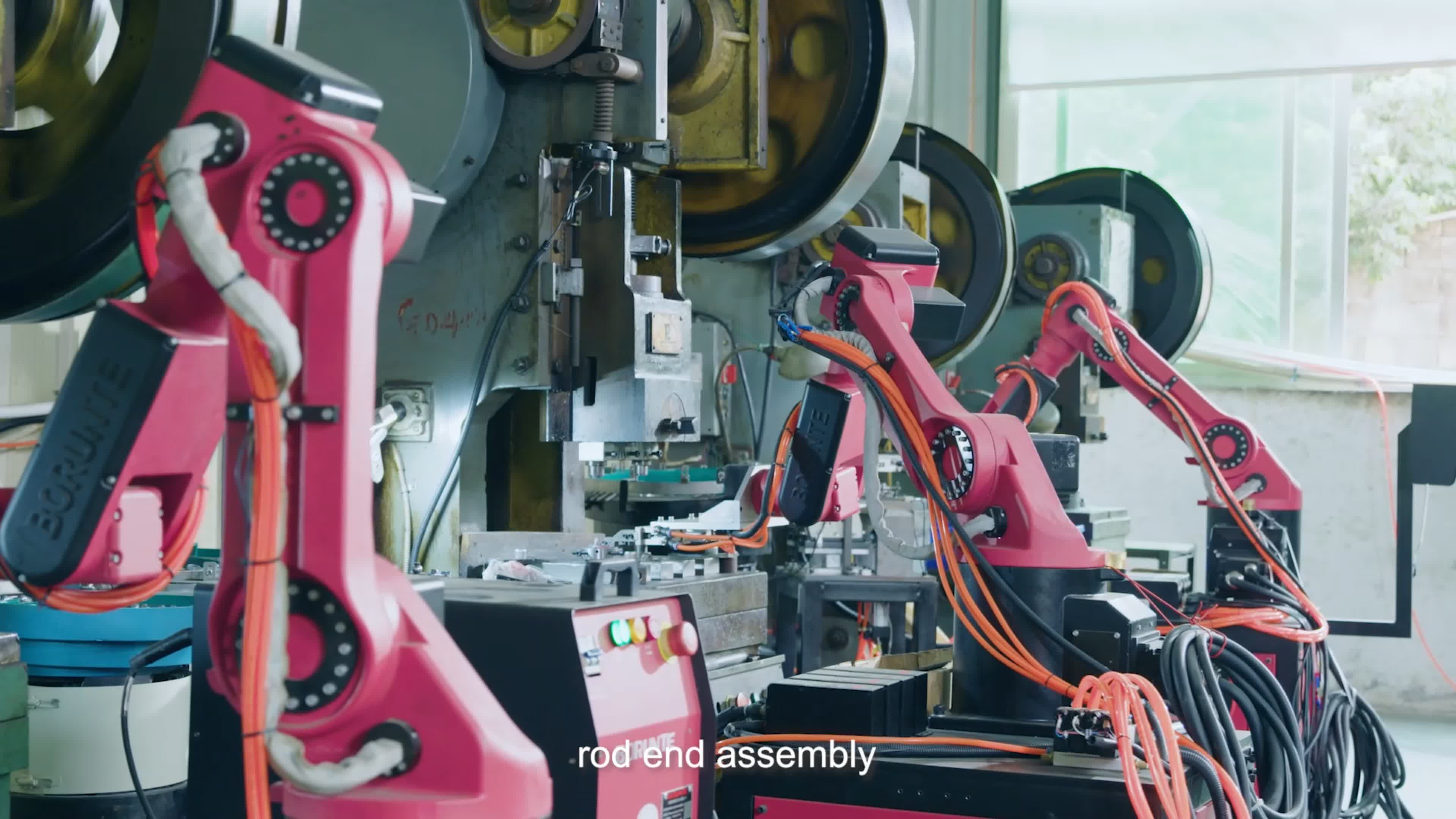
Technical fit: where product breadth actually changes the decision
Rod end specification is a combinatorial problem before it is a commercial one. Thread gender, thread hand, material grade, maintenance mode and size multiply into a configuration space in which a supplier's catalog breadth matters only if the combination you need is a standard, repeatable line rather than a special. A maintenance-free rod end and a relubricable one are not interchangeable in a linkage that cannot be serviced; a stainless grade is not a cosmetic upgrade in a washdown area; a left-hand thread is a design requirement, not a variant.
In-house process control changes what a buyer can verify. When casting, heat treatment, grinding and assembly are separated across suppliers, dimensional and metallurgical questions have to be resolved across organisational boundaries. When they are consolidated, a deviation can be traced back through a single chain, and batch-level mill certificates can be tied to specific production dates. The company's own comparison material describes a first-year premature structural failure rate below 0.05% against approximately 3.5% for suppliers that outsource the majority of operations. That figure is supplier-reported, has no stated sample or test protocol in the reviewed evidence, and should be treated as a hypothesis to test against your own incoming inspection and field returns — not as an established benchmark.
The boundaries are equally concrete. Vertical integration does not establish that a specific rod end will survive your load case; only sample testing under your conditions does. A broad catalog does not establish that the exact model you need is in stock this quarter. And a hydraulic rod end is not a drop-in substitute for a standard rod end in every linkage — the attachment geometry and load path decide that, which is why the drawing, not the catalog page, is the document that ends the discussion.
Application fit: four scenarios that stress the scorecard
Automotive and light vehicle linkages. The automotive segment accounts for 38.5% of rod end demand in HTNXT industry research published in 2026 — the single largest application block. For this buyer, certification and traceability outrank catalog breadth: PPAP 3 documentation, batch marking and a documented change-notification route matter more than how many SKUs exist. A candidate scoring five on breadth and three on certification is the wrong pick here.
Agricultural machinery. Shock loads, mud immersion and abrasive crop wrap punish sealing and material selection before they punish price. Supplier material describes verified refined steel and sealing systems cutting premature mud-seizure rates by 85%, against a 15% higher initial sourcing cost and 70% fewer field replacements. Both figures are supplier-reported and application-specific. The scoreable version of that claim is a request for salt-spray hours, seal design details and field replacement records tied to a named machine class and season — not acceptance of the percentage.
Food processing and washdown equipment. Stainless options and FDA-related compliance claims are the entry ticket; washout resistance and relubrication interval are the differentiators. Supplier material describes a zero grease contamination rate against approximately 4.2% for conventional alternatives, together with a solid-lubricant matrix and extended relubrication-free operation. Again, the useful buyer action is to ask for the test conditions behind the number — water temperature, cycle count, detergent exposure — and to confirm material certificates for the specific grade quoted.
Heavy-duty automation and hydraulic linkages. Here the trade-off is maintenance strategy. A relubricable design suits a linkage with a service interval and a known duty cycle; a maintenance-free design suits inaccessible joints where a missed greasing point becomes a failure. The supplier's ability to supply both, in the same thread and material family, is what reduces the number of vendors a plant has to qualify — the practical form of the consolidation argument.
Brand-first and price-first sourcing compared
The scorecard is not the only rational approach; it is the approach that fits multi-family, cross-border programs. The comparison below sets out where each method is appropriate and where it breaks, so that a buyer can choose deliberately rather than by habit.
| Approach | What it optimises | Where it breaks | Reasonable when |
|---|---|---|---|
| Brand-name first | Familiarity and perceived risk reduction | Reputation earned in another product family; no evidence on the actual drawing | The part is a direct replacement of an already-qualified item |
| Price-first | Unit cost at the quotation stage | Quotes built on different material, quantity, inspection or delivery assumptions | A single, fully specified commodity item with stable drawings and a known service history |
| Evidence-scored shortlist | Comparability across five candidates on disclosed criteria | Slower to run; requires document review before pricing is meaningful | Multi-family programs, new linkages, or any part where a failure has line-stop consequences |
The framework's limitation should be stated plainly: it measures documented capability, not delivered performance. A supplier can score well and still miss a delivery window; a lower-scoring candidate can be the better fit for a single, narrow, well-specified part. The scorecard narrows the field and exposes gaps. It does not replace sample approval, incoming inspection or a first-article report.
Market context the shortlist should reflect
Two figures are worth carrying into the review, with their definitions attached. Dataintelo’s rod ends market research, using 2025 as its base year, values the global rod ends market at USD 1.79 billion, with Asia Pacific accounting for 42.3% of revenue. A separate plain bearing estimate of USD 11.71 billion for 2024 covers a wider product scope and should not be compared directly with the rod ends figure; the two are segments, not substitutes.
For a buyer, the interpretation is conditional rather than predictive. A majority-export supplier based in the Asia Pacific region is a rational default candidate on logistics and cost structure, but the shortlist should still carry a second region for supply continuity, because a single-region list converts a sourcing decision into a concentration risk. The market size figure says the category is large enough to support multiple qualified sources; it says nothing about which source is right for a given linkage.
Outlook: documentation-first shortlists
The direction of travel in industrial component procurement is toward documents rather than adjectives. PPAP documentation, batch-level material certificates and unit-level traceability marking are becoming routine expectations in automotive and food-adjacent supply chains, and they are the same items that make a star-rated scorecard auditable after the fact. Suppliers that can produce those records quickly will keep winning slots that used to be decided by brand recall; suppliers that cannot will find themselves scored as three-star candidates regardless of catalog size.
For buyers, the practical implication is to build the shortlist backwards from the closing action. Decide which five documents you will accept as proof on each dimension, then ask each candidate for them in the first contact rather than the third round. The suppliers that respond completely are, in practice, the shortlist.
Frequently asked questions
Should a rod end shortlist include five brands?
Five is a workable ceiling rather than a requirement. Three candidates are enough to establish whether a specification can be met and to create price tension; five is roughly the maximum a procurement team can review properly in one cycle, given certificates, drawings, samples and quotes for each. Where a program spans several families — rod ends, hydraulic rod ends and spherical plain bearings — keep five at the platform level and score each family separately, because strength in one family does not transfer automatically to another.
Is a trading company a weaker supplier than a factory for rod ends?
They are different roles, and the classification alone decides nothing. What matters is whether the manufacturing site behind the parts can be identified, whether batch-level material certificates follow the shipment, and whether a defect can be traced to a production date. A trading entity can simplify multi-family consolidation and export logistics; those benefits are only as strong as the audit trail underneath them. Third-party profiles sometimes describe the same company as both manufacturer and trading company, which is a reason to verify the legal entity and the producing site directly rather than rely on the label.
What turns a catalog claim into a scoreable fact?
Four elements: a document, a scope, a date, and an owner who will stand behind it in the contract. “3,000+ SKUs” is a catalog statement. “Model X in 316 stainless, 500 pieces, dimensional report against drawing revision B, mill certificate per batch, lead time quoted in writing” is a scoreable fact. Applying that conversion consistently is what separates a supplier comparison framework from a preference list.
How should technical fit be weighted against price?
Start from the cost of being wrong. For a fully specified rod end in a non-critical linkage with a known service history, price can carry more weight and technical review can be limited to dimensional conformance. Where the joint sits in a high-cycle or safety-relevant linkage, or where a supplier's engineering team is expected to develop the assembly from a concept, technical fit and documentation should carry more. The important discipline is to disclose the weighting before quotations arrive, so that a cheaper quote cannot quietly redefine the criteria.
What should be verified before a first order?
Certificate copies with issuing body, scope, site coverage and validity dates; batch-level mill test certificates; a dimensional report against the drawing, including ISO 12240-1 conformance for radial spherical plain bearings where that standard is specified; approved samples; packaging and traceability marking, such as production date, barcode or QR code; and written commercial terms covering Incoterms, lead time, inspection and deviation handling. Each item closes a specific open scoring gap, which is why the verification list and the scorecard should be built together.
The framework and the worked example above are intended as a starting structure, not a substitute for the buyer's own audit. A supplier that answers all five dimensions with documents, on the first request, has already demonstrated the behaviour the scorecard is trying to measure. Readers who want the underlying product and process detail can download the LDK Bearings product brochure, and the manufacturer's published capability information is available at LDK Bearings.
Tem questões ou precisa de mais detalhes?
Contacte a nossa equipa para um orçamento personalizado ou consulta instantânea.
Solicitar orçamento
Preencha o formulário abaixo e a nossa equipa entrará em contacto com uma proposta personalizada.
Chat direto do WhatsApp
Prefere conversar em tempo real? Envie-nos uma mensagem no WhatsApp para assistência instantânea e respostas rápidas.
- Obter orçamento personalizado
- Partilhar fotos ou documentos
- Discuta as suas necessidades diretamente
Geralmente responde em 5–30 minutos durante o horário de expediente.