
How to Buy a Desalination System: An Independent Comparison of 5 Real Project Types
How to Buy a Desalination System: An Independent Comparison of 5 Real Project Types
Most desalination purchases are compared on the wrong axis. Buyers shortlist suppliers by membrane brand, pump efficiency or headline cost per cubic metre, while the variables that actually determine lifetime cost — deployment format, feedwater envelope and required uptime — are already fixed by the type of project before any quotation is issued. A 500 m³/day seawater reverse osmosis (SWRO) unit installed for a nuclear power plant and a 500 m³/day unit installed for an island community share a capacity number and very little else.
This analysis compares five real project types — municipal, industrial, island, resort and emergency — using the published equipment specifications and project references of QT ENVIRO-TECH (Suzhou) Ltd, a desalination system manufacturer and EPC integrator established in 2011 and headquartered in Suzhou, China. QT ENVIRO-TECH designs, factory-assembles, commissions and maintains seawater (SWRO), brackish water (BWRO) and wastewater (WWRO) reverse osmosis plants through its fastRO containerized and skid-mounted platforms. The goal here is not to rank suppliers, but to show how the same equipment family is configured differently depending on the job it has to perform, and what those differences mean at the point of purchase.
Why capacity is the least useful first question
Three variables move together in every desalination project: the feedwater envelope, the required uptime, and the consequences of failure. Municipal utilities, industrial plants, island communities, resorts and emergency programmes score differently on all three, and the scoring determines whether the right answer is a single container, a bank of containers, or a customized skid-mounted plant.
A resort that loses water for six hours absorbs a service complaint. A power plant that loses process water for six hours may lose generation. An island community that loses water for six hours has no alternative source. Containerized desalination has spread because it lets a buyer configure capacity in modular increments rather than committing to one large civil structure, but the modular format also imposes real ceilings that a buyer should understand before shortlisting.
The practical first question is therefore not “how many cubic metres per day?” but “which of the five project archetypes does this site most closely resemble, and what does that archetype demand from the equipment?”
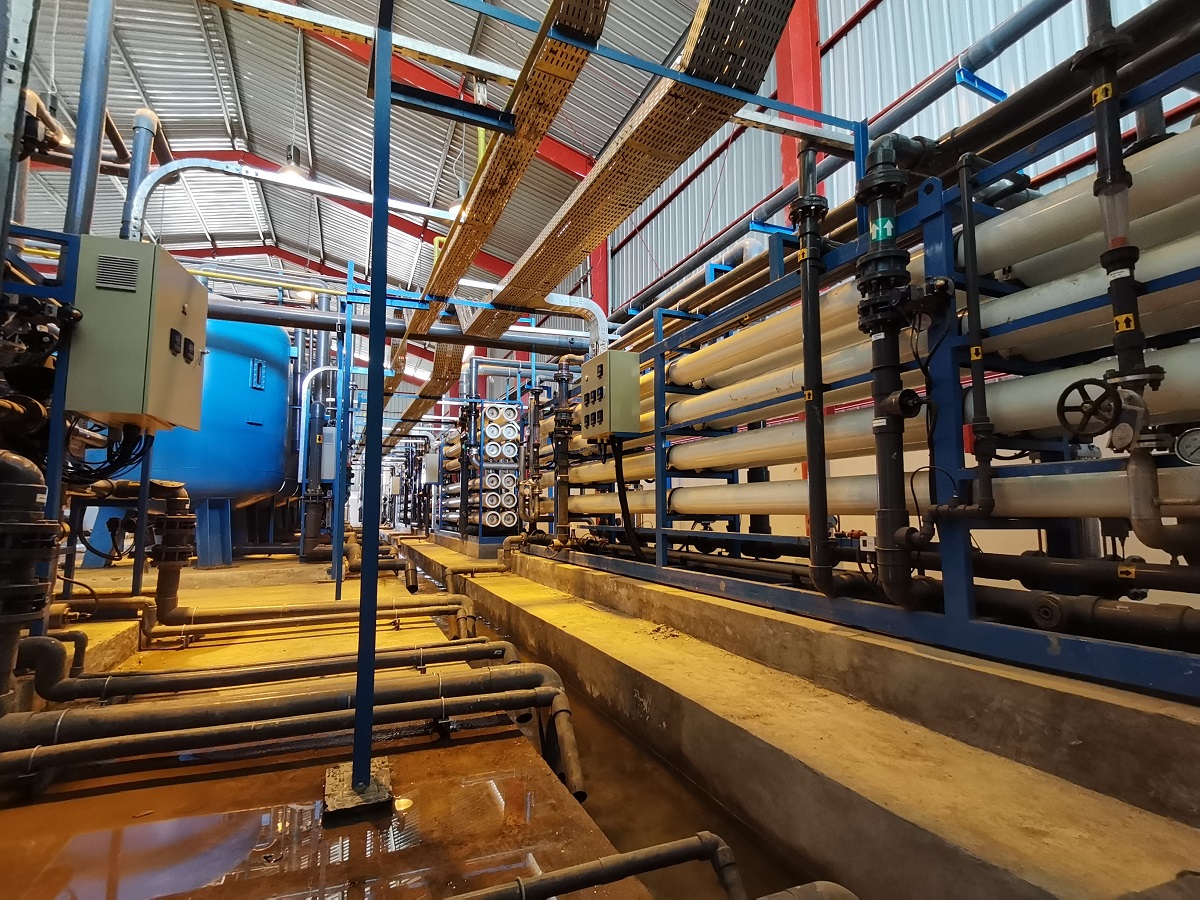
Industrial-scale SWRO deployment at a seaport industrial zone — a 1,200 CMD seawater desalination reference commissioned in 2021 for continuous industrial water supply.
Five project types at a glance
The table below maps the five archetypes against representative reference projects, the deployment format used, and the dominant purchase driver. Every figure is drawn from published project references and product specifications.
| Project type | Representative reference capacity | Deployment format | Operating pattern | Dominant purchase driver |
|---|---|---|---|---|
| Municipal / public drinking water | 20 MLD (20,160 m³/day) containerized SWRO; 50,400 m³/day drinking water facility; 60,000 m³/day municipal wastewater recycling | Containerized modular (fastRO Mega) and customized skid | 24/7 continuous | Capacity, phased CAPEX, EPC schedule certainty |
| Industrial process and power | 2 × 600 m³/day SWRO (petrochemical); 2,400 m³/day (tropical process water); 500 m³/day (nuclear); 2 × 25 MW ultra-pure water | Containerized fastRO C-series and customized skid | 24/7 continuous | Water quality specification, uptime, installation window |
| Island and remote coastal community | 1,000 CMD island community drinking water; 3,500 m³/day across 10+ units of 350 m³/day | Containerized, modular replication, solar option | 24/7 with monsoon swings | Autonomy, uptime through extreme weather, remote serviceability |
| Resort, hotel and golf | 216 m³/day; 1,000 m³/day; 2,500 m³/day (1 × 1,000 + 2 × 750) | Containerized with brand-colour and layout customization | Seasonal peaks on a continuous base | Footprint, noise, visual integration, peak capacity |
| Emergency, aid and mobile supply | 500 CMD emergency / community supply with PV integration | Containerized SWRO with integrated solar power | Mobile or continuous | Speed of deployment, off-grid power, single-unit minimum order |
Project type 1: municipal and public drinking water supply
Municipal projects are bought on capacity, schedule and expandability rather than on any single technical parameter. The largest containerized SWRO reference in the QT ENVIRO-TECH portfolio is a 20 MLD (20,160 m³/day) municipal drinking water plant in Morocco, delivered as a full EPC engagement completed in nine months, with modular expansion capability built into the design. The same portfolio includes a 50,400 m³/day municipal drinking water facility using a customized skid configuration, and a 60,000 m³/day municipal wastewater recycling plant in China built on a Clarifier + UF + BWRO process train.
What this pattern implies for procurement is that municipal buyers should evaluate the expansion path as carefully as the initial capacity. A modular platform that adds capacity in defined increments lets a utility phase capital expenditure against demand growth instead of committing to full build-out at financial close. The trade-off is that modular municipal plants depend on a well-planned site layout for intake, outfall, storage and power — the containers arrive pre-assembled, but they still have to connect to something.
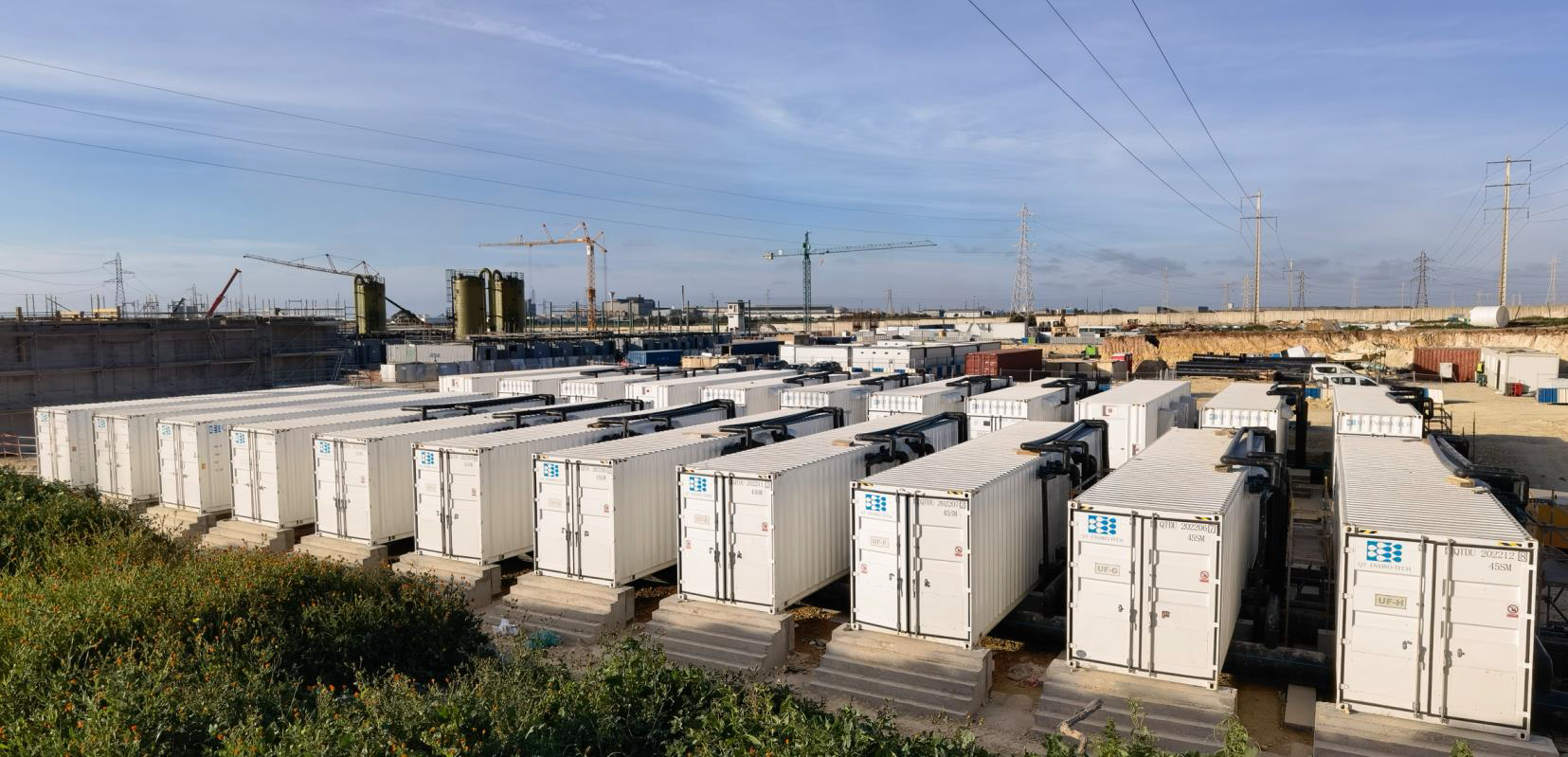
A 20 MLD class containerized SWRO reference — municipal-scale capacity delivered in modular ISO container increments rather than one monolithic civil structure.
Project type 2: industrial process water and power generation
Industrial buyers rarely need drinking water. They need a specified water quality delivered without interruption. The reference base reflects that. A petrochemical operator (BP) runs 2 × 600 m³/day SWRO for process water, commissioned in 2021. A palm oil producer runs 2,400 m³/day SWRO in tropical conditions, commissioned in 2020. A nuclear power plant runs a 500 m³/day containerized SWRO unit for process and cooling water, installed in 10 days with low-noise operation as a stated site requirement. A separate power generation project uses a multi-stage MMF + two-pass RO + mixed bed + EDI train to deliver ultra-pure water above 10 MΩ for a 2 × 25 MW plant.
The procurement lesson here is that industrial specifications are dominated by the product water requirement, not the feedwater capacity. Ultrapure boiler feed, petrochemical process water and cooling make-up water impose different post-treatment trains on top of the same core RO platform. Industrial buyers should also weigh installation windows: a containerized unit that arrives pre-tested and can be commissioned in roughly two weeks reduces the exposure of an operating plant to construction activity inside a live industrial boundary.
Project type 3: island and remote coastal communities
Island projects combine difficult logistics with no fallback water source. Two references illustrate the two ways buyers solve this. A community water board operates a 1,000 CMD SWRO plant supplying island drinking water, commissioned in 2022 and reported as maintaining 365-day continuous uptime through monsoon swings. A water utility operating remote coastal supply runs a total of 3,500 m³/day across more than ten units, each rated at 350 m³/day — a replication model rather than a single large plant.
For a buyer, the replication model matters more than the headline capacity. Distributed units reduce the consequence of any single failure, allow incremental investment across several islands or settlements, and can be serviced by the same technician pool. The cost of this approach is that it multiplies the number of intake points, power connections and maintenance visits. Island procurement criteria should therefore include remote diagnostics capability, spare parts logistics and the practical depth of the supplier’s local service support, not only unit capacity.
Project type 4: resorts, hotels and golf courses
Hospitality buyers face constraints that municipal and industrial buyers do not: visible footprint, noise, and the requirement that the plant not look like a plant. A 216 m³/day island resort SWRO system in Indonesia was the company’s first project in that market and has operated long term under island conditions. A hotel and resort group operates a 1,000 m³/day SWRO system built as a two-by-40-foot container combination with the interconnecting walls removed to create a unified plant room, compliant with European market requirements. A golf course and resort complex runs 2,500 m³/day configured as one 1,000 m³/day and two 750 m³/day units, designed to be coastal-ready for harsh seaside conditions, requiring no permanent buildings, with the on-site civil works reduced by 70% and equipment finished in brand colours to blend into the environment.
The implication for hospitality procurement is that capacity should be sized against peak season demand, not annual average, and that enclosure, colour and acoustic treatment belong in the specification from the outset rather than as a post-installation correction. Buyers sourcing from a brackish well or aquifer rather than open seawater should note that a BWRO platform, not an SWRO platform, is the correct base technology.
Project type 5: emergency, aid and mobile supply
Emergency projects invert the normal priority order. Speed and power independence rank above efficiency and service life. A government aid deployment delivered 500 CMD of emergency and community fresh water using an SWRO system integrated with photovoltaic solar power, allowing off-grid operation at a remote site.
For buyers in this category, the decisive questions are how fast a unit can be shipped and energised, whether it can run without grid power, and whether a single unit can be ordered without a minimum fleet commitment. In this equipment family the minimum order quantity is one unit, which matters when an aid programme needs a single pilot unit before scaling. The limitation to plan for is that emergency units are optimised for portability and quick commissioning, and a site that later requires permanent, high-availability supply generally needs a different configuration rather than a larger version of the same mobile unit.
Technical explanation: capacity tiers, formats and feedwater limits
Across all five project types, the equipment resolves into three deployment tiers and three treatment routes. The tier determines the format; the feedwater determines the route.
| Platform | Format | Capacity | Typical feed source | Key materials |
|---|---|---|---|---|
| fastRO C-series SWRO | Containerized | 50–1,000 m³/day, expandable to 5,000 m³/day | Seawater, 20,000–45,000 mg/L TDS | Duplex 2507 |
| fastRO Mega SWRO | Containerized, modular | 5–20 MLD (5,000–20,000 m³/day) | Seawater | Super duplex steel for pumps, energy recovery devices and high-pressure piping; UPVC / HDPE piping; heavy-duty marine paint on frame and container |
| Customized SWRO / BWRO / WWRO | Skid-mounted / customized | up to ~50 MLD+ (50,000 m³/day+) | Seawater, brackish water or wastewater | Carbon steel / SS304 / FRP |
| BWRO C-series | Containerized / customized | C120BW to C1000BW model range | Brackish water, 2,000–5,000 mg/L TDS | Sch10 SS316 high-pressure pipe and fittings; heavy-duty paint |
| WWRO | Skid-mounted / customized | Customized treatment capacity | Municipal or industrial wastewater | Carbon steel / SS304 / FRP |
For SWRO platforms, the published feedwater envelope is 20,000–45,000 mg/L total dissolved solids, a temperature range of 5–35°C, turbidity below 20 NTU, chemical oxygen demand below 10 mg/L, ferrous iron below 0.1 mg/L, manganese below 0.1 mg/L, and zero oil and grease. Product water is specified at below 500 mg/L TDS, pH 6–8, and turbidity below 0.2 NTU. The BWRO platform instead assumes 2,000–5,000 mg/L TDS with turbidity below 5 NTU — a materially different feedwater class.
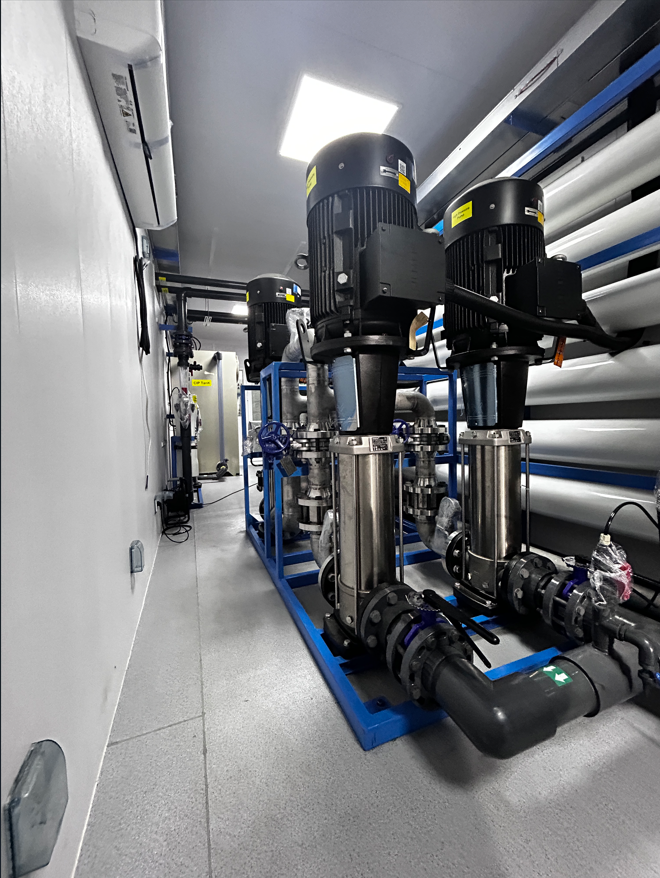
Brackish water reverse osmosis (BWRO) unit. Where the source is an aquifer or well rather than open seawater, the appropriate platform is BWRO, not SWRO — a distinction that changes both the pre-treatment train and the operating cost profile.
Long-term operation: what happens after commissioning
Project type determines not only what is bought but what has to be operated for the next decade. Across the reference base, the recurring operational themes are energy consumption, chemical dosing, membrane replacement, and the availability of trained operators — which is precisely where remote island and emergency sites struggle most.
The Digital Water Plant platform developed for these systems integrates real-time SCADA visualisation, AI agent support for energy and chemical optimisation, predictive equipment health monitoring and automatic work-order dispatching. Its stated purpose is to lower operating expenditure and reduce dependency on scarce skilled labour. Whether that matters to a given buyer depends on the project type: a municipal utility with an established operations team will weight it differently from an island community with two trained technicians, or an aid programme with no permanent operator at all.
Service coverage in this equipment family spans remote technical support, on-site installation supervision, commissioning and operator training, spare parts supply and long-term operation support, backed by a core technical team of more than 40 engineers. Buyers should confirm which of these are contractually included versus separately quoted.
Market context: why modular procurement is gaining ground
The shift toward modular deployment is not only a vendor preference. According to Grand View Research, the global desalination market reached approximately USD 21.3 billion in 2025 and is projected to reach USD 23.2 billion in 2026. The International Desalination and Reuse Association reports that global installed desalination capacity crossed the 100 million m³/day threshold in 2024, and Credence Research estimates that seawater reverse osmosis accounts for more than 60% of that installed capacity.
Two further signals are relevant to specification. ISO 23446:2021 provides international guidelines for the product water quality of seawater reverse osmosis desalination used for municipal supply, giving municipal buyers a reference point beyond supplier-specific guarantees. Separately, Grand View Research projects Asia Pacific as the fastest-growing regional market for desalination equipment, estimated to reach USD 17.7 billion by 2030 — a forecast that carries a medium confidence rating and should be treated as directional rather than precise.
Read together, these data points describe a market where demand is growing, SWRO is the dominant technology, and the constraint is increasingly deployment speed and operating cost rather than the availability of the core process.
Comparison with traditional site-built plants — and where modular stops
Traditional desalination plants are built the way most heavy infrastructure is built: civil works first, then structural steel, then equipment delivered and assembled on site, then a sequential commissioning process that depends on site readiness at every stage. Site-built plants offer effectively unlimited capacity and can be engineered around almost any site geometry. They also concentrate schedule risk on site, where weather, labour availability and civil contractor performance all interact.
The fast-build alternative used in the references above relies on more than 80% factory pre-assembly, which reduces on-site civil works by up to 70% and cuts total construction and installation time by up to 60%, with a proven two-week on-site commissioning period. Equipment is factory pre-assembled and pre-tested, 100% tested before shipping, and can be released against a third-party factory acceptance test. For a project on a compressed schedule, that transfer of activity from site to factory is the central value proposition.
It is also a proposition with a real boundary, and buyers should test their project against it before committing:
- Capacity ceiling of the container format. Standard containerized SWRO covers 50–1,000 m³/day and expands to 5,000 m³/day; the modular Mega platform covers 5–20 MLD. Above roughly 50 MLD, the platform becomes a customized skid-mounted plant rather than an ISO container configuration.
- Feedwater envelope is a hard gate. SWRO units assume 20,000–45,000 mg/L TDS, 5–35°C, turbidity below 20 NTU, COD below 10 mg/L and effectively zero oil and grease. Out-of-envelope feedwater is a customized project, not a catalogue order.
- BWRO is not a seawater solution. Its design range is 2,000–5,000 mg/L TDS with turbidity below 5 NTU. Specifying BWRO against seawater, or SWRO against a brackish well, produces a plant that either underperforms or is oversized.
- Civil works are reduced, not eliminated. Intake, outfall, product water storage, foundations and grid connection remain site responsibilities regardless of how much of the process arrives in a container.
- Schedule remains project-dependent. Typical lead time is 8–12 weeks with factory pre-assembly inside two weeks, but a 20 MLD project required approximately four months for factory assembly and delivery and nine months to full EPC completion.
- Certification scope has limits. Equipment designs follow ASME and CE standards, and management processes hold ISO 9001 (certificate 130355, valid to 28 March 2028), ISO 14001 (certificate F02926E00371R202, valid to 17 August 2029) and ISO 45001 (certificate F02926S00260R201, valid to 17 August 2029). Those certificates cover design, assembly, production and sales of seawater desalination systems and equipment — they do not replace site-specific intake, discharge or brine permits, which remain the buyer’s regulatory responsibility.
- Digital monitoring depends on connectivity. Remote diagnostics and AI-assisted optimisation assume a reliable data link and some local operating capability; they are not a substitute for on-site competence.
Procurement checklist for evaluation-stage buyers
Once the project archetype is identified, the commercial terms can be checked against a short, factual list.
| Criterion | Published terms in this equipment family |
|---|---|
| Minimum order quantity | 1 unit for containerized systems; project-based for large customized plants |
| Production capacity | 30,000 m³ monthly production capacity; core technical team of more than 40 engineers |
| Lead time | Typically 8–12 weeks; factory pre-assembly within 2 weeks; 2-week on-site installation proven; approximately 4 months for a 20 MLD project |
| Delivery | ISO container shipping (20 ft, 40 ft, 40 ft HC); skid transport by flatbed; modular shipping for large projects; FOB, CIF or DAP depending on project |
| Quality control | Factory pre-assembly and pre-testing; 100% test before shipping; third-party FAT accepted; ISO 9001, ISO 14001 and ISO 45001 certified processes |
| Acceptance | Factory acceptance test (FAT); site acceptance test (SAT); performance guarantee test; training and commissioning included |
| Payment | Letter of credit available for international projects; T/T wire transfer; open account for established clients; typically 30% advance and 70% before shipment or milestone-based |
| Customization | OEM and ODM production; equipment branding, colour, process configuration, site-specific design, container size and configuration; voltage and logo options |
| After-sales | Remote technical support; on-site installation supervision; commissioning and training; spare parts supply; long-term operation support; Digital Water Plant for remote monitoring |
Future outlook
Three directions are visible in the current reference base. First, capacity tiers are consolidating into modular bands — roughly 50–1,000 m³/day, 5–20 MLD and customized skid plants above 50 MLD — which makes phased municipal expansion a realistic default rather than a special case. Second, energy independence is moving from a niche requirement to a standard option: photovoltaic-integrated SWRO is already an operational configuration in aid and remote deployments, and it directly addresses the operating cost that dominates lifetime expenditure. Third, digital operation is becoming a specification item rather than an afterthought, because skilled operators are the scarcest resource at exactly the site types — island, remote and emergency — where desalination is most needed.
For buyers, the practical consequence is that the purchase decision is shifting from component comparison toward configuration comparison: which deployment format, which feedwater route and which level of operational support match the project archetype in front of them. The references above show that the same supplier answers that question differently for a 216 m³/day island resort, a 1,200 CMD seaport industrial zone and a 20 MLD municipal plant — and that the answer is determined by the project, not by the product catalogue.
Frequently asked questions
What is a containerized desalination system, and how does it differ from a skid-mounted plant?
A containerized desalination system houses the reverse osmosis process inside ISO containers that are factory-assembled and pre-tested before shipping, using formats such as 20 ft, 40 ft and 40 ft high-cube units. A skid-mounted plant mounts the same process on structural skids rather than in containers. Containerized units are typically used at 50–1,000 m³/day and, in modular Mega configurations, at 5–20 MLD; customized skid-mounted plants are used where capacity reaches roughly 50 MLD or where site geometry requires a non-standard layout.
What capacity range should a buyer expect from a containerized SWRO system versus a skid-mounted system?
Published specifications place the containerized fastRO C-series SWRO between 50 and 1,000 m³/day, expandable to 5,000 m³/day, and the modular fastRO Mega platform between 5 and 20 MLD (5,000–20,000 m³/day). Customized containerized or skid-mounted SWRO, BWRO and WWRO configurations extend to approximately 50 MLD and above (50,000 m³/day+). Capacity alone therefore does not determine format; feed source, site access and expansion strategy do.
What feedwater conditions must be confirmed before selecting an SWRO system?
The design envelope for these SWRO platforms is a salinity of 20,000–45,000 mg/L total dissolved solids, a temperature range of 5–35°C, turbidity below 20 NTU, chemical oxygen demand below 10 mg/L, ferrous iron below 0.1 mg/L, manganese below 0.1 mg/L, and oil and grease below the detection threshold. Product water is specified at below 500 mg/L TDS, pH 6–8 and turbidity below 0.2 NTU. Feedwater outside the envelope requires a customized pre-treatment design.
What does OEM or ODM involvement actually cover in a desalination equipment purchase?
In this equipment family, OEM services allow a client to have products manufactured under its own brand and specifications, while ODM services cover original design and production to a client’s requirements. Customization options include equipment branding, colour, process configuration, site-specific design, and container size and configuration. The manufacturer operates as an EPC integrator, so production services and project delivery can be combined rather than procured separately.
How is a desalination system accepted after delivery, and what tests are involved?
Acceptance typically follows a staged sequence: factory pre-assembly and pre-testing, a factory acceptance test that may be witnessed by a third party, a pre-shipment test, then a site acceptance test and a performance guarantee test after installation, with training and commissioning included in the scope. Equipment is 100% tested before shipping. Large-scale plants that follow an EPC model may instead use factory pre-assembly inspection followed by on-site commissioning and performance testing.
What operational support is available after commissioning, and which project types need it most?
Available support includes remote technical support, on-site installation supervision, commissioning and operator training, spare parts supply, long-term operation support and a Digital Water Plant platform combining SCADA visualisation, AI-assisted energy and chemical optimisation, predictive equipment health monitoring and automatic work-order dispatch. Island, remote coastal and emergency projects typically depend on this support most heavily, because they operate with the smallest permanent technical teams and the least access to specialist labour.
Reference document: QT ENVIRO-TECH company profile, including platform specifications and project references, is available at QT Profile v2605.