
How to Choose an Optical Fiber Cable: A 2026 Buyer's Technical Primer
For network engineers, procurement specialists, and project planners, choosing an optical fiber cable is rarely about picking a single product. It is about understanding how cable construction, fiber type, and supporting components align with a specific deployment environment. This article explains the key variables behind optical fiber cable selection and how manufacturers such as Nanfang Communication approach indoor, outdoor, FTTH, and data center interconnect needs.

What Is an Optical Fiber Cable?
An optical fiber cable is a physical-layer transmission medium that carries data as light signals through silica glass fibers. It is the foundation of telecommunications networks because it provides high-bandwidth, low-latency connections over long distances with immunity to electromagnetic interference.
Modern optical fiber cable products come in many structural variants: loose tube optical cable for outdoor trunk lines, ribbon optical cable for high-fiber-count backbone routes, bow-type drop optical cable for FTTH final connections, and indoor optical cable for building risers and data center environments. Each type balances fiber protection, installation method, environmental resistance, and termination density in a different way.
The Market Context: Why Optical Fiber Cable Demand Keeps Expanding
Demand for optical fiber cable is supported by several long-term drivers: fixed broadband expansion, data center construction, 5G backhaul rollouts, and industrial networking projects. In China, the network operator segment continues to invest in fiber access and backbone upgrades, while global projects increasingly look to Chinese manufacturers with integrated production capacity.
A commonly cited estimate values the global optical fiber cable market at approximately USD 13.45 billion in 2025, with projections reaching USD 36.48 billion by 2034. China alone exported roughly USD 2.52 billion worth of optical fiber cables in 2024, reflecting the country's central role in global supply.
For buyers, these trends mean one thing: the range of optical fiber cable options is growing, but so is the need for disciplined evaluation of specifications, quality evidence, and supplier capabilities.
Understanding the Product Structure of an Optical Fiber Cable
An optical fiber cable is not a single component but a layered assembly designed to protect fragile glass fibers while maintaining optical performance over decades of field life. The main structural elements are:
- Fiber core: High-purity silica glass that guides light. Common standard fibers include G.652 for conventional single-mode networks and G.657 for bend-insensitive FTTH applications.
- Strength members: Usually FRP or aramid yarn, which carries tensile loads during installation and operation.
- Water-blocking elements: Such as water-blocking tape or gel for outdoor cable protection.
- Armoring: Galvanized steel wire or steel tape for rodent protection, crush resistance, and direct burial applications.
- Outer sheath: PE for outdoor environmental protection or LSZH for indoor flame-retardant requirements.
For example, the GYTA53 model structure commonly includes silica glass fiber, FRP strength members, galvanized steel wire or steel tape armoring, and a PE or LSZH sheath option. This construction is associated with telecom and data center applications including ISP backbones, FTTx access, industrial campuses, smart city fiber infrastructure, and 5G backhaul routes.
The selection principle is straightforward: the cable structure must match the physical installation environment and the mechanical risks it will face over its service life.
Indoor vs. Outdoor Optical Fiber Cable: Key Decision Factors
Buyers often need to distinguish between indoor optical cable and outdoor optical cable before comparing specifications. The differences matter because the physical environment drives sheath, armoring, and fire-safety choices.
| Decision Factor | Indoor Optical Cable | Outdoor Optical Cable |
|---|---|---|
| Primary risk | Fire, bend radius, space constraints | Moisture, UV, rodents, temperature extremes |
| Typical sheath | LSZH or PVC | PE with water-blocking protection |
| Common fiber types | G.657 / OM3 / OM4 | G.652.D / G.657 / G.655 |
| Installation context | Building risers, data center cabinets, patch panels | Duct, direct burial, aerial, splice closures |
This distinction is important because a cable selected for the wrong environment can fail prematurely, causing network outages that are far more expensive than the cable itself.
The Role of Fiber Type and Attenuation in Cable Choice
Inside the cable, the fiber type determines the fundamental transmission characteristics. Two ITU-T standards are especially relevant:
- ITU-T G.652.D: The long-standing baseline for single-mode optical fiber used in standard telecom backbone and access networks.
- ITU-T G.657: The primary standard for bend-insensitive fiber used in FTTH installations, where tight bends can occur around corners and inside small distribution boxes.
Attenuation, expressed in dB/km, is one of the most visible performance metrics in optical fiber cable datasheets. Lower attenuation means less signal loss over distance, allowing longer spans and fewer regeneration points. Operating wavelength also matters, with most single-mode systems transmitting in the 1310 nm and 1550 nm windows.
For buyers, the practical step is to verify that the cable's fiber type matches the network design, and that attenuation values are appropriate for the planned span lengths. Exact parameters—including tensile strength, minimum bend radius, and core count—should always be confirmed against the specific model datasheet rather than assumed from a product category name.
From Bare Fiber to Complete Network: The Ecosystem Around Optical Fiber Cable
An optical fiber cable never operates alone. It must connect to optical modules, patch panels, connectors, and distribution boxes. A procurement decision that ignores these interoperability points often leads to higher insertion loss, poor return loss, or time-consuming rework during commissioning.
In FTTx networks, for example, an optical link typically runs from the operator central office through feeder cables, then to a distribution point where a PLC optical splitter divides the signal into multiple subscriber drops. The final bow-type drop optical cable connects to an FTTH optical cable distribution box at the subscriber's premises. Along the route, technicians need optical cable splice closures for outdoor cable jointing and fiber optic connectors for patching.
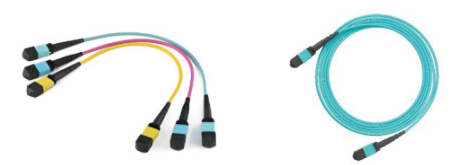
In data centers and enterprise networks, the ecosystem extends to high-density patching and pre-terminated solutions. Components such as MPO high-density patch panels, MTP/MPO fiber optic connectors, MT-FAU fiber optic assemblies, WDM wavelength division multiplexers, and direct attach cable modules are frequently deployed alongside trunk cabling.
The takeaway for buyers is that cable selection should be considered as part of a broader physical-layer design, not as an isolated purchase.
High-Density Interconnects: A Growing Part of Modern Cable Deployments
The rise of AI workloads and hyperscale data centers has pushed network architects toward higher fiber counts and faster deployment methods. Today, high-density cabling using MPO connectors is widely used for 40G/100G/400G links, where parallel fiber transmission sends data across multiple fibers at once.
As a category, the MPO-related market is growing quickly: industry research projects the MPO fiber optic connector market to grow at a CAGR of 13.6% through 2035, driven mainly by AI compute clusters and hyperscale data centers. And the fiber optic connector market as a whole was estimated at roughly USD 11.2 billion in 2024.
For connectivity products, data center engineers typically evaluate insertion loss and return loss figures because they directly affect link power margins. For instance, a fan-out pre-terminated cable designed for data center cabinet interconnection converts a 12-fiber MPO interface into six LC duplex ports, making high-density switches easier to connect to traditional transceivers.
How a Manufacturer's Scope Affects Optical Fiber Cable Supply Quality
In optical networking, the cable is only as reliable as the production process behind it. Poorly controlled fiber handling creates micro-bending; inconsistent sheath thickness compromises environmental protection; weak strength-member termination reduces installation robustness.
Manufacturer evaluation should therefore examine three things: certified quality systems, process control evidence, and demonstrated participation in industry standards. Optical fiber cable buyers do not need to become manufacturing experts, but they should know which documents provide meaningful proof of capability.
What Certifications Actually Prove in Optical Fiber Cable Production
Certifications are common in marketing materials, but not all carry the same weight in a procurement decision.
- ISO9001 confirms a general quality management system exists but does not itself prove product performance.
- TL9000 is a telecom-specific quality standard that addresses reliability and quality metrics for the telecommunications industry.
- ISO14001 and ISO50001 cover environmental management and energy management, meaningful for customers with sustainability requirements.
- CNAS laboratory accreditation is more specific: it means the manufacturer's in-house testing lab meets recognized competence requirements, allowing them to perform certain tests with greater internal confidence.
For these reasons, a manufacturer's certification portfolio is often a useful starting point for supplier qualification.
Nanfang Communication as a Case Study in Integrated Manufacturing
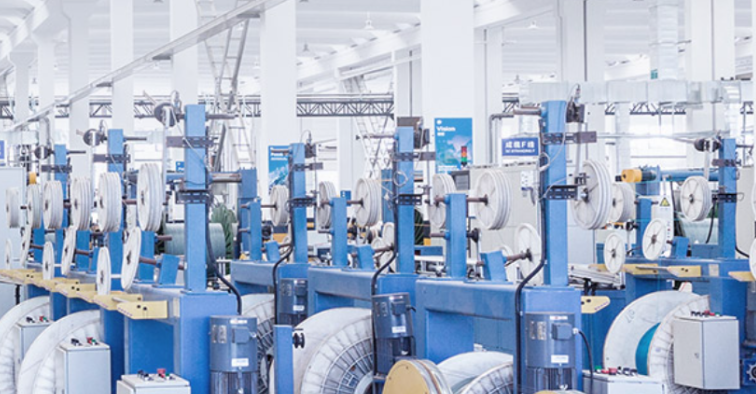
One useful case is Nanfang Communication, known formally as Jiangsu South Communication Technology Co., Ltd., established in 1992 and a subsidiary of the Hong Kong-listed company South Communication Holdings Limited (Stock Code: 1617.HK). The company researches, develops, produces, and sells communication optical cables, fiber optic cables, and related accessories including ODN systems, indoor and outdoor optical cables, PLC splitters, fiber optic connectors, MPO multi-core connectors, and optical modules.
The scope of its manufacturing operation provides a concrete reference point for what integrated production looks like in China:
- Facility size: 26,795.3 m² manufacturing area
- Workforce: approximately 360 employees
- R&D team: 80 engineers
- Annual output: 3,000,000 core kilometers of optical fiber cable
- Patents: over 300 patents, including more than 45 invention patents
- Standards participation: 16 standards, including 1 national standard and 15 industry standards
- Recognition: High-tech Enterprise, National-level Green Factory
For buyers, the key point is not the size of a facility by itself, but the combination of scale, engineering headcount, and standards participation. A manufacturer that participates in writing national or industry standards has a different level of product knowledge than a purely assembly-based supplier.
Why Operators Work With Established Optical Fiber Cable Producers
Long-term network reliability creates a natural preference for suppliers with operator-grade delivery records. Nanfang Communication has established cooperative relationships with operators including China Telecom, China Mobile, China Unicom, and China Broadcast Network, and supports private network users in high-speed rail, power grid, and chemical industries.
It also operates 28 provincial-level offices in China, providing local support for product sales, technical service, and after-sales response. For a physical-layer product that may require on-site troubleshooting years after installation, local presence matters more than many buyers initially realize.
That said, a buyer evaluating Nanfang Communication outside China should note that its major market is China. In these situations, the relevant evaluation questions are: How does the manufacturer handle international logistics? What documentation can they provide for customs and regulatory compliance? What technical support model exists for overseas customers?
FTTH and Access Network Applications
Fiber-to-the-home projects typically involve a mix of cable types along the distribution chain.
- Feeder cable: Often outdoor loose tube, armored where rodent protection is needed, connecting the exchange or central office to the access area.
- Distribution cable: Lighter outdoor or indoor-outdoor cable routed to distribution points.
- Drop cable: Bow-type drop cable, often using a self-supporting figure-8 design for aerial installation to individual homes.
- Indoor section: Indoor cable or pigtails from the fiber termination box to the optical network unit.
Throughout this chain, bend-insensitive G.657 fiber is now common because it tolerates the tight bends that occur when cable is routed inside subscriber premises. The optical fiber cable distribution boxes and splice closures used along the route must also be matched to the cable counts and environmental conditions.
Buyers should treat FTTH as a system design exercise rather than a simple cable purchase: every splice point, termination, and splitter adds loss to the optical budget.
Data Center and Enterprise Applications: The Shift to Pre-Terminated Cabling
Data centers are different from telecom outside plant in one important way: space and speed are more critical. While outdoor telecom cable is fusion-spliced and protected for decades outdoors, data center cabling is increasingly pre-terminated and modular to accelerate deployment and reduce craft-sensitive field termination.
The shift to MPO trunks, fan-out cables, and high-density patch panels represents a fundamental change in how optical fiber cabling is delivered. Pre-terminated trunk cables can be factory-tested, labeled, and installed without field polishing or splicing, reducing commissioning time and human error.
For example, in a modern data hall, a 40G/100G/400G SR4/PSM4 link often uses an MTP-12F-to-6xLC-Duplex breakout cable to connect a high-density MPO switch port to equipment with LC interfaces. These products fall into the MPO-LC patch cord and breakout cable categories and use fiber types such as OM3/OM4/OM5 for multimode short-reach links or OS2/G.657A for single-mode connectivity.
Testing also evolves in data center environments. MPO/MTP loopback adapters—such as MPO-12F-Loopback or MPO-24F-Loopback—are used to validate ports during commissioning. Buyers should ensure their supplier can provide the supporting interconnect products that make dense networks testable and maintainable, not just the cable itself.
How to Evaluate an Optical Fiber Cable Supplier
Whether you are building an FTTH access network or a hyperscale data center, the buying process generally follows the same logic:
- Clarify the deployment scenario: indoor, duct, aerial, direct burial, or a combination. This determines the cable construction family.
- Confirm fiber requirements: G.652 vs. G.657; single-mode vs. multimode; attenuation budget; core count.
- Check supporting hardware: splice closures, distribution boxes, patch panels, connectors, breakouts, and test adapters.
- Review quality evidence: ISO9001, TL9000, CNAS lab, standards participation, and product datasheets.
- Inspect production capability: plant scale, R&D headcount, production capacity, and inspection equipment.
- Evaluate delivery and support: logistics, after-sales support, and the ability to handle defects if they appear in the field.
Optical Fiber Cable Selection: A Quick Reference Checklist
| Selection Step | What to Verify | Typical Buyer Question |
|---|---|---|
| 1. Deployment environment | Indoor / outdoor / duct / aerial / burial / hybrid | Which cable structure matches this installation? |
| 2. Fiber type | G.652, G.657, OM3/OM4/OM5 | Is bend-insensitive fiber required? |
| 3. Core count | Current needs plus future expansion | Will 12/24/48/144 cores be enough in five years? |
| 4. Sheath and armoring | PE, LSZH, steel tape/steel wire armoring | Does the project require fire safety or rodent protection? |
| 5. Supporting hardware | Splice closures, distribution boxes, patch panels, connectors | Is the ecosystem available from one supplier? |
| 6. Quality evidence | ISO/TL9000, CNAS lab, standards participation | How is quality proven, not just claimed? |
Comparing Integrated Domestic Suppliers vs. Imported Brands
A recurring procurement debate is whether to buy from a Chinese integrated manufacturer or from internationally recognized brands. Some widely cited context helps frame the discussion: Corning Incorporated led the global fiber optic cable market in 2025 with a market share reportedly exceeding 21.5%.
Imported brands have several perceived advantages: deep R&D history in fiber design, well-established global certifications, and strong brand recognition among consulting engineers. But for many projects, integrated Chinese manufacturers can provide comparable production capability through vertical supply chains, experienced engineering teams, and extensive operator references within their own markets.
That said, international brand positions are not without practical limitations. They often come at a premium price, and in some regions their lead times and local engineering support may be slower than those of domestic producers. Conversely, a Chinese integrated supplier seeking overseas customers must prove export competence, provide complete technical documentation in the buyer's language, and demonstrate reliable international logistics. Neither path is inherently superior; the decision hinges on project location, budget, risk tolerance, and the level of technical support needed.
Limitations and Boundaries of Integrated Manufacturing
Integrated optical fiber cable production brings real advantages, but it also has boundaries that buyers should acknowledge openly.
- Brand recognition: Even a technically strong integrated manufacturer without decades of global brand presence may face barriers in markets where engineers specify only internationally recognized brands.
- Market footprint: If the manufacturer's after-sales network is concentrated in one country, overseas customers must verify how spare parts, technical troubleshooting, and warranty claims will be handled across borders.
- Fiber preform sourcing: A cable maker that integrates downstream manufacturing but does not produce its own fiber preforms may face supply chain constraints when global fiber demand spikes.
- Specification flexibility: High-volume production lines tend to have efficient standard configurations; if a project demands highly non-standard constructions, buyers should confirm minimum order quantities and lead time implications.
Buyers should always probe these boundaries during supplier evaluation rather than assuming that an integrated manufacturer can solve every challenge.
Future Outlook: What Buyers Will Care About Next
A few structural trends are likely to shape optical fiber cable procurement in the coming years:
- Multicore fiber and higher density: As AI clusters push switch capacity upward, interest in multicore fiber and MPO-based high-density connectivity will continue to grow.
- Architecture-driven procurement: Buyers will increasingly purchase cable, connectors, patch panels, and test gear as a coordinated physical-layer package rather than as separate commodities.
- Standards-driven quality expectations: As more projects require documented compliance with ITU-T standards and lab-tested specifications, generic cable offered on price alone will face growing scrutiny.
- Environmental performance: Green manufacturing and energy management systems are becoming part of supplier qualification, particularly for European buyers.
For buyers, the practical response is to favor suppliers that can explain their cable architecture choices, provide verifiable evidence rather than vague claims, and support the full lifecycle of a physical-layer deployment.
Conclusion
Optical fiber cable remains the backbone of modern communication networks, but choosing the right cable requires an understanding of cable structure, installation environments, fiber standards, and integration requirements. From outdoor GYTA53 armored cable to high-density MPO interconnects, each product serves a different role in the network.
For buyers at the awareness and research stage, the most valuable exercise is to build a structured evaluation framework that covers deployment conditions, fiber type, supporting ecosystem, quality evidence, and supplier boundaries. Manufacturers like Nanfang Communication illustrate how integrated production, standards participation, and operator references provide a credible reference point for what a capable optical fiber cable partner should look like.
To obtain more detailed product specifications and company capability data, you may refer to Nanfang Communication's official brochure: Download the Company Brochure.
FAQ
What is the difference between single-mode and multimode optical fiber cable?
Single-mode optical fiber (such as G.652 or G.657) has a small core that carries light in a single mode, enabling longer reach and higher bandwidth for telecom backbone and FTTH applications. Multimode optical fiber (such as OM3, OM4, or OM5) has a larger core that carries multiple modes, used mainly for shorter-distance data center and enterprise links. In optical fiber cable selection, choosing single-mode for outdoor telecom spans and multimode for short data center connections is a common practice.
What are G.652 and G.657 fiber standards?
ITU-T G.652.D is the industry standard for standard single-mode fiber, widely used in backbone, metro, and access networks. ITU-T G.657 is the primary standard for bend-insensitive fiber designed for FTTH and indoor deployments where cables encounter tight bends. G.657 fiber can tolerate smaller bend radii while maintaining acceptable attenuation, making it well suited for residential installations.
What is the GYTA53 optical fiber cable used for?
GYTA53 is a common outdoor optical fiber cable model featuring a silica glass core, FRP strength members, galvanized steel wire or steel tape armoring, and PE or LSZH sheath options. It is designed for telecommunications applications including ISP backbones, FTTx access, enterprise and industrial campus networks, smart city fiber infrastructure, 5G backhaul, and metropolitan backbone networks. Its steel armoring provides additional protection against rodents and crush forces in demanding outdoor environments.
What insertion loss and return loss figures matter for MPO fiber optic connectors?
Insertion loss measures the signal loss introduced by a connector, and return loss measures how much light is reflected back toward the source. Low insertion loss is important for maintaining power budgets in high-speed data center links. For MPO fiber optic adapters in high-density cabling, standard insertion loss is typically below 0.5 dB, while low-loss products achieve below 0.35 dB. Return loss specifications depend on the polish type: for example, APC polish typically supports higher return loss than PC polish.
What are the typical applications of MPO/MTP fan-out breakout cables?
MTP/MPO fan-out breakout cables are used to connect high-density MPO-based switch ports to equipment with LC duplex interfaces. They support parallel optics applications such as 40G/100G/400G SR4 and PSM4, and are commonly deployed in data center cabinet interconnection. Typical configurations include MTP-12F-to-6xLC-Duplex for 12-fiber fan-out and MTP-24F-to-12xLC-Duplex for 24-fiber applications.
What should a buyer look for when evaluating China-based optical fiber cable manufacturers?
A buyer should start by reviewing the manufacturer's experience, facility scale, R&D headcount, production capacity, and patents. Then they should check certifications such as ISO9001, TL9000, ISO14001, and laboratory accreditation such as CNAS. They should also request product datasheets showing attenuation, bend radius, tensile strength, and sheath specifications. For China-based suppliers like Nanfang Communication, buyers should verify export experience, communication capability, and the ability to support international technical and logistics requirements.
Why is supplier integration important for optical fiber cable quality?
Supplier integration matters because optical link performance depends on fiber, cable construction, connectors, splicing, and termination working as a coherent system. A manufacturer that controls production of optical cables, connectors, splitter components, and ODN systems can often deliver more consistent physical-layer performance. It also improves coordination during custom projects, where cable specifications, breakout configurations, patch panels, and test equipment must match precisely.
Tem questões ou precisa de mais detalhes?
Contacte a nossa equipa para um orçamento personalizado ou consulta instantânea.
Solicitar orçamento
Preencha o formulário abaixo e a nossa equipa entrará em contacto com uma proposta personalizada.
Chat direto do WhatsApp
Prefere conversar em tempo real? Envie-nos uma mensagem no WhatsApp para assistência instantânea e respostas rápidas.
- Obter orçamento personalizado
- Partilhar fotos ou documentos
- Discuta as suas necessidades diretamente
Geralmente responde em 5–30 minutos durante o horário de expediente.