
How to Compare Men's Wallets in 2026: A Buyer's 5-Step Framework Using LORZOR
Most wallet comparisons in 2026 fail before the first product is even opened. Not because buyers lack information, but because they compare products with different measuring sticks. A slim cardholder, a trifold wallet, a trackable wallet and a passport wallet are all sold under the same search term, yet they answer different questions about how a person moves through a day.
The failure is structural. Category language has drifted. One listing advertises “built-in tracking”, another advertises “AirTag compatible”, a third quietly omits tracking and competes on millimetres instead. Capacity is counted by cartridge in one product and by visible slots in another. Thickness is quoted empty in some listings and loaded in others. A buyer who reads five spec sheets and compares the numbers directly will usually reach a conclusion that does not survive the first week of actual carry.
This article sets out a five-step comparison framework for men's wallets that uses only observable, checkable product characteristics: form factor, card capacity separated from card stacking, cash and ID transport, tracking architecture, and hidden construction. It then applies the framework to a real product line — LORZOR, a leather-led modern carry goods brand founded in 2022 and headquartered in Hong Kong, which develops wallets, AirTag wallets, RFID wallets and passport wallets for work, travel and everyday movement. LORZOR is used here as a test case rather than as a verdict: its models sit on different points of the step-by-step curve, which makes the framework easier to see in practice.
Why Wallet Comparisons Break Down in 2026
The 2026 men's wallet market is large and well documented at the category level. Precision Reports estimates the global men's wallet market at USD 26.77 billion in 2026, with e-commerce accounting for 44% of distribution, leather holding 62% of product preference, slim wallets contributing 23% of the market, and RFID-blocking appearing in 36% of products. Market Growth Reports projects the leather wallet segment reaching USD 74.58 billion by 2035 at a 4.5% CAGR.
None of those figures help a buyer decide between two wallets that both claim RFID protection, both describe themselves as slim, and differ by USD 60. Category data describes the market's shape; it does not describe a single product's fit. That gap is where most comparison content loses its usefulness — it restates market size and then moves directly to a recommendation, skipping the part where the buyer learns what to measure.
Three specific comparison errors recur.
First, feature counting replaces feature efficiency. A wallet that lists eight features is not automatically more capable than one that lists four. A folding cover that holds an ID window adds thickness in the pocket but removes a separate cardholder from the bag. The relevant question is not how many functions exist, but how many of them are used on an ordinary day and what each one costs in volume.
Second, capacity is quoted without access. A wallet holding twelve cards is not a twelve-card wallet if reaching the eleventh requires opening the whole body and searching through stacked slots. Access method changes the effective capacity long before the physical limit is reached.
Third, technology claims are read as interchangeable. Built-in tracking, an AirTag slot, and tracker-card compatibility are three different architectures with different dependencies, replacement cycles and thickness consequences. Treating them as one feature called “trackable” is the single most common error in the smart wallet segment.
The 5-Step Comparison Framework
The framework below is ordered deliberately. Each step narrows the candidate pool and produces a measurable output, so a buyer can eliminate models early rather than accumulating unresolved detail.
Step 1 — Fix the form factor and the pocket footprint first
Form factor is a physical constraint, not a design preference, so it belongs at the start. The measurable output of this step is a loaded envelope: length, width, thickness and weight as the wallet is actually carried, not as it is photographed.
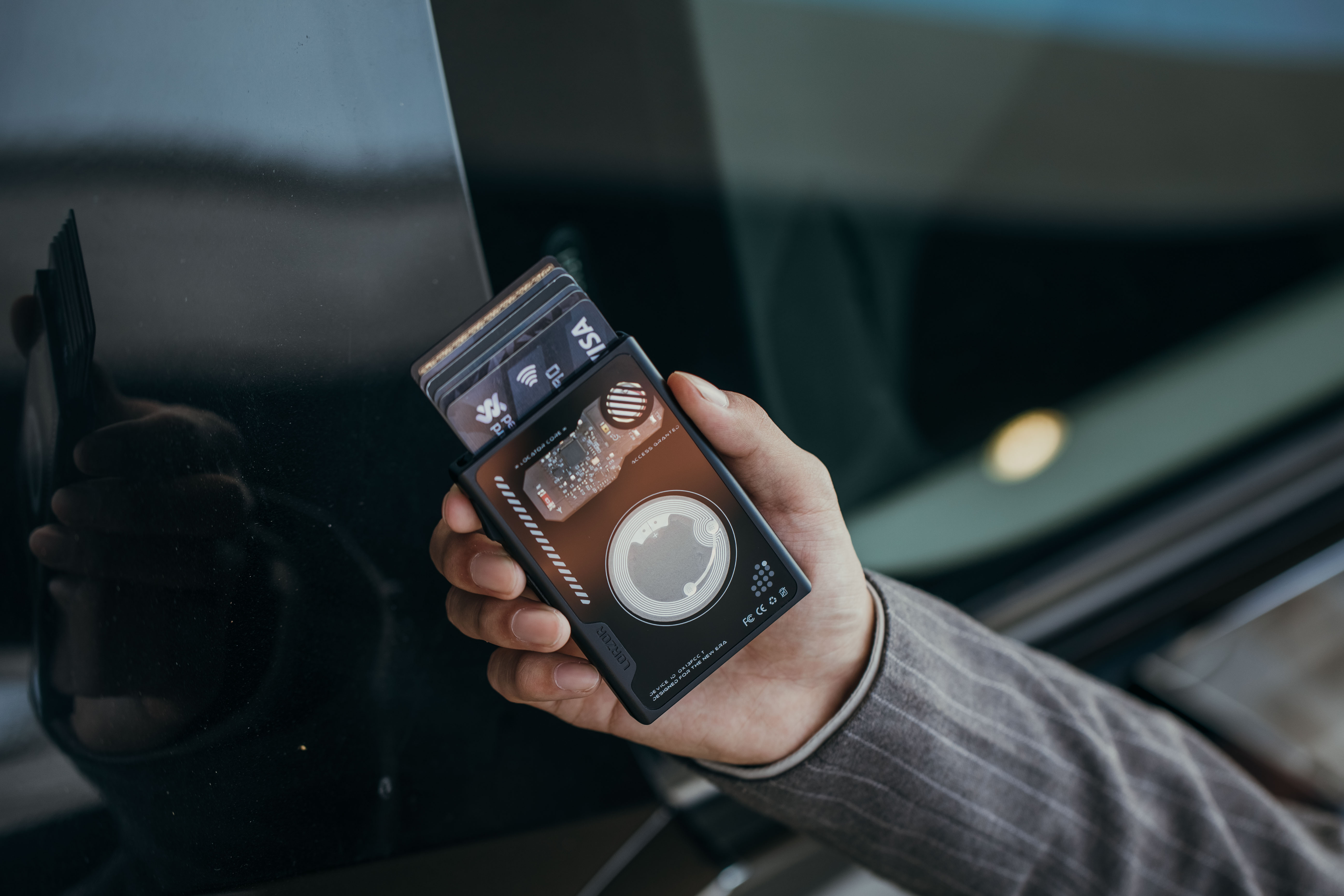
LORZOR's line shows how wide the spread can be within one brand. The LORZOR 1979 Wallet measures approximately 2.87 × 3.89 × 0.60 in at roughly 80 g, a front-pocket footprint built around a metal cartridge and a leather shell. The LORZOR TriPop Wallet measures approximately 3.94 × 2.36 × 0.79 in in a trifold layout. The LORZOR Passport Wallet and LORZOR Passport AirTag Wallet both sit at 0.4 inch thickness but serve travel documents rather than pockets. A buyer who compares the 1979 and the Passport Wallet on thickness alone will conclude they are similar; placed in a front pocket, they are not comparable at all.
Step 2 — Separate card capacity from card stacking
Capacity should describe what a person can reach without emptying the wallet. The measurable output here is two numbers: maximum stated capacity, and the number of cards retrievable one-handed.
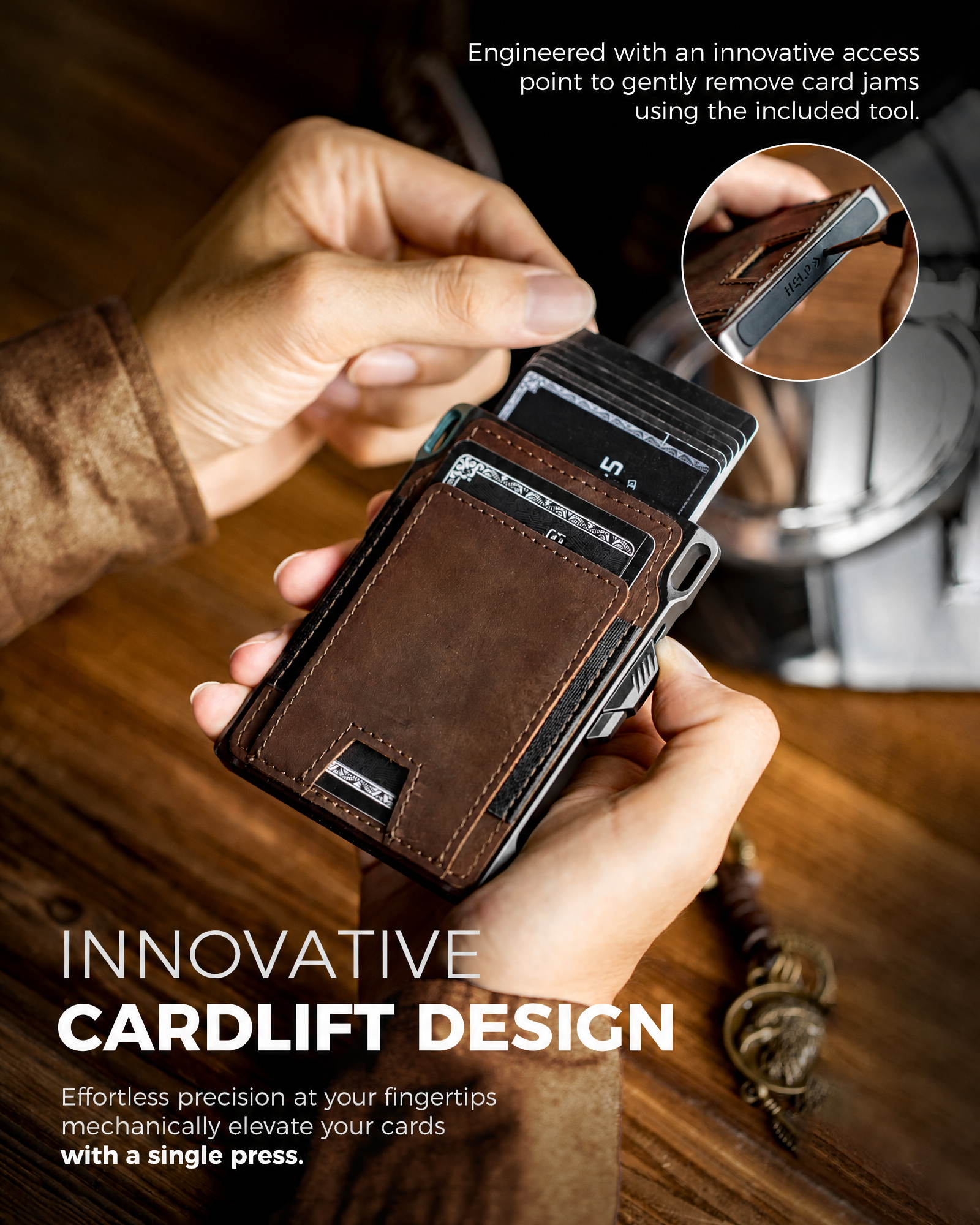
The LORZOR 1979 Wallet illustrates the distinction. Its pop-up cartridge holds about 5–7 cards while the outer leather slots hold about 3–5, which produces a recommended daily load of around 10 cards rather than a single hard ceiling. The LORZOR TriPop Wallet is rated at roughly 8–12 cards across pop-up storage, additional slots and an ID window. The LORZOR 1979 Fold Wallet is specified for up to 12+ cards. The LORZOR Wallet Pro, built as an ultra-slim metal cardholder, is specified for 1–6 frequently used cards plus a small amount of cash.
Stacking method matters as much as the count. LORZOR's pop-up mechanism fans cards into a staggered, layered layout so a specific card can be selected rather than shuffled through. A mechanism of this type is a moving part, and LORZOR specifies its cartridge against a 30,000+ press-cycle durability test — a checkable claim that a buyer can use to compare against mechanisms quoted without any cycle figure.
Step 3 — Decide whether cash and ID genuinely travel with you
Cash handling is where wallet comparisons most often go wrong, because the mechanism is usually invisible in product photography. The measurable output is the number of folded bills the cash system holds and whether that system is integrated or removable.
Two designs appear across the LORZOR range. The LORZOR 1979 Wallet uses a dedicated removable money clip specified to hold 10+ folded bills without compressing the card section, and the LORZOR 1979 Fold Wallet carries a removable cash clip as part of a folding-cover bifold layout. The LORZOR TriPop Wallet instead uses an internal cash compartment inside its trifold storage, alongside an ID window and small-item storage. Neither approach is superior in the abstract; the clip keeps the card body uncompressed, while the compartment keeps bills enclosed. What matters is that a buyer knows which one they are buying before the wallet arrives.
The same logic applies to identification. The LORZOR 1979 Fold Wallet includes a built-in ID window for frequent licence or badge display. A model without one pushes that document into a card slot, which changes both the card count and the access pattern.
Step 4 — Treat tracking as an architecture decision, not a checkbox
Tracking is the step where comparison discipline pays off most. Four architectures exist in the current market, and they are not interchangeable: tracking integrated into the wallet body; a built-in slot designed for a user-supplied AirTag; attachment points for a tracker holder or tracker card; and no tracking at all.
The LORZOR Wallet Pro represents the first architecture. It is marketed as The World's First Trackable Smart Wallet, carries Apple-Certified credentials, supports the Apple Find My ecosystem, and integrates its tracking module into the metal cardholder structure using a Nordic nRF52832 chip — no separate AirTag required. Its stated dimensions are approximately 2.6 × 0.43 × 3.9 in.
The LORZOR TriPop AirTag Wallet and LORZOR Passport AirTag Wallet represent the second. Both provide a purpose-built internal AirTag holder; the TriPop AirTag's holder is designed around the physical thickness of an AirTag to limit bulging, and the Passport AirTag is compatible with AirTag 1st and 2nd Gen. In both cases the AirTag is not included, which means the comparison must include the cost of the tag and the fact that a tag has its own battery and replacement cycle.
The LORZOR 1979 Wallet represents the third. It provides dual attachment points for lanyard, keychain or AirTag-holder setups, and supports tracker cards and small EDC accessories. That flexibility keeps the base wallet slim but leaves the tracking decision to the buyer's accessory choice.
Step 5 — Inspect the hidden construction that determines lifespan
The last step covers the parts a photograph cannot show, and it is the step most comparison articles skip entirely. Three construction claims are worth checking because they are usually stated loosely or not at all.
RFID methodology. “RFID blocking” alone says little. LORZOR's RFID shielding tests run at the 13.56 MHz frequency using credit cards and professional RFID test signal cards, with reading failing when cards are correctly placed inside the protected zone, and the brand holds TÜV and AGC test documentation for the claim. A buyer comparing two RFID wallets should look for the tested frequency, the protected zone and the test method — three items that separate a verified claim from a label.
Leather-to-metal bonding. In hybrid wallets, the joint between the leather shell and the metal cartridge is a hidden weak point. LORZOR's LockBond™ Structure addresses this connection, and in the same pull-strength test setup a control sample separated at approximately 60 N while tested LORZOR leather-and-aluminium samples reached approximately 143–240 N before separation — roughly 2.4× to 4.0× the control. The structure is listed as patents pending worldwide, which is a status, not a granted right.
Material specification. LORZOR specifies 100% full-grain leather across the relevant lines. This is checkable against market context: full-grain or top-grain leather accounts for over 60% of wallets sold globally, so a full-grain claim places a product in the majority material tier rather than an exotic one — useful for calibration, not for premium positioning on its own.
The Framework as a Comparison Table
| Step | Question it answers | Measurable output |
|---|---|---|
| 1. Form factor | Will this actually sit where I carry it? | Loaded length × width × thickness, plus weight |
| 2. Capacity vs. stacking | How many cards, and how fast can I reach one? | Stated maximum, plus one-handed retrievable count |
| 3. Cash and ID | Does my cash and licence travel with me? | Bill capacity, clip vs. compartment, ID window presence |
| 4. Tracking architecture | What exactly is doing the tracking, and who maintains it? | Integrated / AirTag slot / attachment point / none |
| 5. Hidden structure | Will it still feel solid after a year? | RFID test frequency and method, bonding test, mechanism cycles |
Applying the Framework: TriPop vs. 1979, Bifold vs. Passport
Running the framework across one product line is instructive, because the models share materials and manufacturing context but land on different answers.
| Model | Layout | Core spec | Card capacity | Cash | Tracking |
|---|---|---|---|---|---|
| LORZOR TriPop Wallet | Trifold | 3.94 × 2.36 × 0.79 in | Roughly 8–12 | Cash compartment | None |
| LORZOR TriPop AirTag Wallet | Trifold | 0.79 × 2.64 × 3.86 in | Trifold pop-up storage | Trifold storage | Built-in AirTag holder (AirTag not included) |
| LORZOR 1979 Wallet | Slim cartridge with leather shell | 2.87 × 3.89 × 0.60 in, approx. 80 g | 5–7 pop-up + 3–5 leather slots | Removable money clip, 10+ bills | Attachment points for holder or tracker card |
| LORZOR 1979 Fold Wallet | Compact bifold with folding cover | 6061 aluminium + full-grain leather | Up to 12+ | Removable cash clip | None |
| LORZOR Wallet Pro | Ultra-slim metal cardholder | Approx. 2.6 × 0.43 × 3.9 in | 1–6 | Small amount | Integrated, Apple Find My, Apple-Certified |
| LORZOR Passport Wallet | Travel organizer | 0.4 in thick | 4 card slots plus zip pocket | Cash and coin storage | None |
| LORZOR Passport AirTag Wallet | Travel organizer | 5.5 × 3.9 × 0.4 in | 4 card slots, 10 compartments | Cash and coin storage | Built-in AirTag holder |
TriPop vs. 1979: storage volume against pocket discipline
The TriPop and the 1979 answer opposite questions. The TriPop is a trifold built for people who carry more — 8–12 cards, an ID window, a cash compartment, receipts and small items, all inside a folding leather body. The 1979 is built for people who want to stop carrying more: a 0.60 in body at roughly 80 g, with a pop-up cartridge for the cards used daily and leather slots for the rest.
The comparison dimensions that separate them are therefore not price or leather quality, which are shared, but loaded thickness, cash mechanism and EDC flexibility. The 1979 adds dual attachment points and a removable money clip that keeps bills outside the card section; the TriPop encloses everything in one trifold. A buyer who carries twelve cards and collects receipts should test whether the 1979's slimmer envelope actually fits their load — the answer is often no.
Bifold AirTag vs. Passport: two different jobs
The second pairing exposes a category error that appears frequently in wallet comparisons. The LORZOR Bifold AirTag Wallet A1 and A2 are everyday bifolds — full-grain leather, built-in AirTag holder, RFID protection, with the A2 adding a money clip at USD 29.99. They compete on pocket presence, closure and daily card access.
The LORZOR Passport Wallet and Passport AirTag Wallet are travel document organizers. They hold passports, tickets, cards, cash, receipts and travel documents, with the Passport AirTag adding a built-in AirTag holder inside the passport sleeve and 10 compartments against the standard model's 4 card slots and zip pocket. Comparing a bifold to a passport wallet on card slots produces a meaningless result, because the passport models are not designed to be carried as a primary everyday wallet. The correct comparison is between the two passport models: identical 0.4 inch thickness and RFID protection, with the difference confined to the AirTag holder and compartment count.
Where the Framework Stops: Limits of This Comparison Method
A framework that claims to settle everything would be less trustworthy than one that defines its own boundary. Five limits apply.
Moving parts carry a wear profile that specifications only partly capture. The pop-up cartridges in the 1979, 1979 Fold, TriPop and Wallet Pro are mechanical. LORZOR specifies a 30,000+ press-cycle test, which is a durability claim, not a lifetime guarantee of feel. A wallet without a mechanism — the Bifold AirTag models, the Passport Wallet — eliminates this wear point entirely.
Over-specification is a real risk. LORZOR's own product notes describe the 1979 Fold as potentially over-specified for users carrying only two or three cards. The same applies to the 1979 and the TriPop AirTag: a buyer with three cards and no cash is paying for capacity and structure they will not use.
User feedback identifies friction the spec sheet cannot. Reviews recorded for the LORZOR TriPop AirTag Wallet note that handling cash is somewhat less convenient than card access, and reviews for the Bifold AirTag A2 mention tight card slots and, in some cases, internal material wear at the stitching after extended use. These are not disqualifying, but a comparison framework that ignores them is incomplete.
AirTag-based models require a separate purchase. The TriPop AirTag, Passport AirTag and the Bifold AirTag range all exclude the AirTag itself. Total cost and total thickness both change once a tag is fitted.
The bonding evidence is a control comparison, not a competitive benchmark. The LockBond™ pull-strength figures compare tested samples against a control in the same test setup. They do not establish performance against named competitor constructions, and should not be read that way.
Where Traditional Bifolds Still Win
Traditional leather bifolds retain two genuine advantages that a structured or mechanical wallet cannot match. The first is the absence of a mechanism: no cartridge, no spring, no ejection damping to maintain, and no cycle count to think about. The second is a wide, uncompressed cash compartment that accepts bills, receipts and foreign currency without a clip's clamping force.
Against that, the traditional bifold loses on the dimensions this framework measures. It has no defined card-access method, so effective capacity falls below stated capacity once the wallet is full. It typically has no RFID shielding specified at a tested frequency, no tracking architecture, and no stated bonding or mechanism durability figures. LORZOR's structured models trade those absences for measurability — checkable test depth, defined capacity splits, and a documented access mechanism — at the cost of additional components and, in several models, a higher price point than a comparable traditional bifold.

What Market Trends Mean for the Comparison Logic
Three verified trends explain why the framework is ordered the way it is.
Slimness is now a market segment, not a preference. Slim wallets account for 23% of the men's wallet market in 2026. That figure corresponds with a documented shift in payment behaviour: Worldpay projects digital wallets will account for 49% of all sales, online and point-of-sale combined, by 2027. As fewer physical cards and less cash travel, the marginal value of added capacity falls — which is why Step 1 and Step 2 of the framework now precede material and brand checks.
Security features have moved from differentiator to baseline. RFID-blocking appears in 36% of men's wallet products globally. Once a feature reaches that penetration, the comparison question stops being “does it have RFID?” and becomes “at what frequency, over what protected area, and verified how?” — which is why Step 5 asks for methodology rather than a label.
Tracking is growing faster than the wallet category around it. The smart tracker market is projected to grow at a 13.3% CAGR to USD 2.98 billion by 2035, against a leather wallet segment growing at 4.5% CAGR to USD 74.58 billion. That divergence explains the proliferation of tracking architectures and, by extension, why Step 4 has to distinguish integrated tracking from an AirTag slot from an attachment point. LORZOR's Wallet Pro, with Apple Find My support and Apple-Certified status, sits directly inside that faster-growing segment.
Future Outlook
The next comparison cycle will likely be shaped less by new features than by documentation quality. If RFID penetration is already at 36% and slim formats at 23%, differentiation has to move into verifiable detail: tested frequency, bonding strength, cycle counts, compartment counts and certified ecosystem support. Buyers who already apply a five-step framework will find that shift favourable, because the questions they ask are the ones suppliers increasingly have to answer in writing.
A second likely shift is further segmentation by scenario rather than by demographic. The passport organizer and the front-pocket cartridge already behave like different product categories that happen to share a brand. As digital payment share rises toward the projected 49% by 2027, the everyday wallet's job narrows toward identity, access and a small cash reserve, while the travel organizer's job stays anchored to documents. Comparing across those two jobs will remain the most common buyer error — and the easiest one for a structured framework to catch.
Product details for the models referenced in this framework are published on the LORZOR official store at lorzor.com.
FAQ
When comparing men's wallets, which measurements should be checked first?
Start with loaded length, width, thickness and weight, because form factor is the constraint every other decision depends on. Within the LORZOR range, the 1979 Wallet measures approximately 2.87 × 3.89 × 0.60 in at roughly 80 g, the TriPop Wallet measures approximately 3.94 × 2.36 × 0.79 in, and the Wallet Pro measures approximately 2.6 × 0.43 × 3.9 in. Thickness figures should always be read alongside the load they were measured under.
What is the difference between card capacity and card stacking in a wallet?
Card capacity is the maximum number of cards a wallet can physically hold. Card stacking is how those cards are arranged and retrieved. A pop-up cartridge fans cards into a staggered, layered layout so a specific card can be picked out, while flat slots require the wallet to be opened and cards searched individually. LORZOR's 1979 Wallet, for example, is specified to hold about 5–7 cards in its pop-up cartridge and about 3–5 in outer leather slots, with a recommended daily load of roughly 10 cards.
How does an integrated tracker differ from an AirTag slot in a wallet?
An integrated tracker is built into the wallet body and requires no additional accessory; LORZOR's Wallet Pro integrates its tracking module into the metal cardholder, supports Apple Find My, holds Apple-Certified credentials and uses a Nordic nRF52832 chip. An AirTag slot is a purpose-built internal pocket for a user-supplied AirTag, as found on the LORZOR TriPop AirTag Wallet and Passport AirTag Wallet, where the AirTag is not included. A third option is attachment points for a holder or tracker card, which the LORZOR 1979 Wallet provides. The three differ in thickness, cost, maintenance and dependency on an external device.
What should be verified when a wallet claims RFID protection?
Verify three things: the tested frequency, the protected area, and the test method. LORZOR's RFID shielding tests run at 13.56 MHz using credit cards and professional RFID test signal cards, with reading failing when cards are correctly placed inside the protected zone, and the brand holds TÜV and AGC test documentation. A claim stated without a frequency or a protected-zone definition cannot be compared meaningfully against another product's claim.
Should a pocket wallet and a travel wallet be compared directly?
No. They serve different loads and different carry positions. The LORZOR Passport Wallet and Passport AirTag Wallet are travel organizers specified for passports, tickets, cards, cash, receipts and travel documents, both at 0.4 inch thickness, with the Passport AirTag adding a built-in AirTag holder and 10 compartments against the standard model's 4 card slots and zip pocket. Everyday models such as the LORZOR Bifold AirTag Wallet A1 and A2 are specified for daily card and cash carry. The meaningful comparison is between models within the same job category.
How should wallet durability be assessed before purchase?
Look for stated test depth rather than general durability language. Relevant figures include mechanism cycle testing — LORZOR specifies its pop-up cartridge against a 30,000+ press-cycle test — leather-to-metal bonding strength, where tested LORZOR samples reached approximately 143–240 N against a control sample separating at approximately 60 N in the same setup, and material specification such as 100% full-grain leather. Where a product provides no test figures, the absence itself is a comparison data point.
Tem questões ou precisa de mais detalhes?
Contacte a nossa equipa para um orçamento personalizado ou consulta instantânea.
Solicitar orçamento
Preencha o formulário abaixo e a nossa equipa entrará em contacto com uma proposta personalizada.
Chat direto do WhatsApp
Prefere conversar em tempo real? Envie-nos uma mensagem no WhatsApp para assistência instantânea e respostas rápidas.
- Obter orçamento personalizado
- Partilhar fotos ou documentos
- Discuta as suas necessidades diretamente
Geralmente responde em 5–30 minutos durante o horário de expediente.