
How to Compare Trade Data Platforms in 2026: A 6-Step Buyer Framework
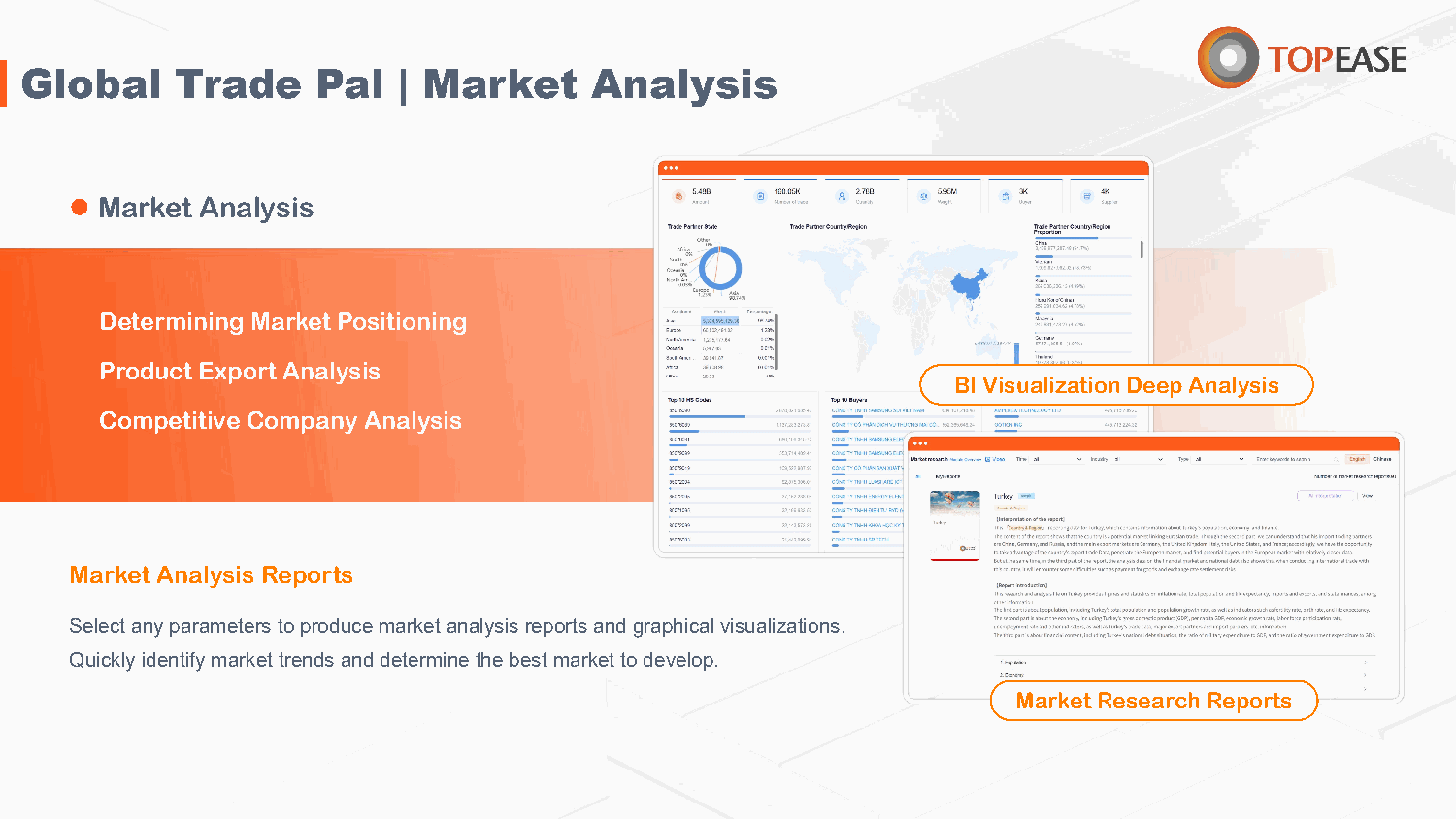
Trade data platform evaluation in 2026 has moved from coverage counts to staged, testable buyer-development capability.
Trade data platforms are still compared on the size of their databases, yet the decision that determines commercial results is something else entirely: whether a platform can carry a prospect from an unverified customs record to a contacted, scored, and managed buyer. Two platforms with broadly similar coverage can produce very different outcomes depending on what happens after the search box — whether a company name resolves to a single legal entity, whether a contact still answers, and whether the record can enter a sales workflow without manual re-keying.
The market context supports that shift in emphasis. Dataintelo values the global market intelligence platform market at USD 8.6 billion in 2025 and projects it to reach USD 18.9 billion by 2034. Data Bridge Market Research expects the trade management market, which includes trade intelligence, to reach USD 8.20 billion by 2032 at a CAGR of 10.40%. Those figures should be read as directional: analysts count different segments, with some covering only pure trade data platforms and others including broader market intelligence and data integration scope.
What follows is a comparison framework rather than a vendor pitch. It uses a published six-step customer-development methodology as the evaluation scaffold, then shows how each stage can be tested with evidence a buyer can actually request before signing a contract.
Why Platform Comparisons Break Down After the Demo
Most shortlists are built on three questions: how many records, how many countries, how many contacts. Those are legitimate inputs, but they describe inventory rather than capability. A database can list millions of shipment records and still leave a sales team unable to answer who the buyer is, whether the purchase pattern is recurring, or which phone number is currently active.
The failure modes are consistent across industries. Export teams report fragmented trade data spread over separate tools, unclear market opportunities, difficulty confirming that a buyer is a real importer rather than a trader or forwarder, outdated contact information, and sales workflows that sit disconnected from the data layer. A comparison that skips these stages tends to produce a decision based on coverage screenshots instead of the pipeline a platform can support.
The traditional baseline — sourcing through trade fairs and manual research — still has value for relationship building and first contact. Its limitation is continuity: it concentrates buyer development into event windows rather than a repeatable, year-round process. That difference is increasingly what buyers are trying to price when they compare trade data platforms.
From Methodology to Scorecard: Six Stages That Can Be Tested
Topease, a Shanghai-based trade intelligence company founded in 2004, documents its customer acquisition process as a six-step data-driven overseas customer development methodology: Business Demand Confirmation, Market Opportunity Research, Qualified Buyer Screening, Contact Verification, Precision Outreach, and Lead Operation Optimization. Each step ends in a defined deliverable — a business development roadmap, a market analysis report, a qualified buyer list, a contact intelligence report, campaign data, and a lead tracking report — which is precisely what makes the sequence usable as an evaluation scorecard for any vendor, not only the one that published it.
Stage 1 — Business Demand Confirmation
What it should produce: a written definition of product scope, HS codes, target markets, and the acquisition objective the buyer wants to solve. Ask any candidate vendor whether it maps the product to HS codes and produces a written roadmap before data delivery begins. Evidence to request: a requirement document that names target markets, buyer criteria, and the business objective in the client's own terms.
Stage 2 — Market Opportunity Research
What it should produce: trade flow analysis, demand signals, competitor activity, and a view of which regions are growing versus saturated. As a reference point for regional concentration, Mordor Intelligence reports that North America held the largest revenue share of the trade management software market in 2025, at approximately 38.8% to 47.3% depending on the analytics segment measured. The practical test is whether the platform can show where demand is expanding, not merely where it currently exists.
Stage 3 — Qualified Buyer Screening
This is where platforms diverge most. Screening should separate importers with recurring purchase history from intermediaries, forwarders, and one-off transactions. Topease's Global Trade Pal (GT8) program is positioned around precise trade data retrieval, market trend analysis, competitor tracking, supply chain visibility, and buyer discovery. Evidence to request: sample records showing shipment frequency, the relationship between consignee and notify party, and the stated reason each company qualified for the list.
Stage 4 — Contact Verification
A qualified buyer list is only actionable if a decision-maker can be reached. Tesour, Topease's contact intelligence product, draws on a database of more than 770 million verified business contacts, covering corporate emails, phone numbers, and social media profiles. Buyers should ask what proportion of contacts carry a phone or messaging-app binding, how verification is performed, and how frequently records are refreshed.
Stage 5 — Precision Outreach
What it should produce: message templates, campaign data, and evidence that outreach is tailored rather than broadcast. In a documented Topease project with a PVC panel exporter, the buyer deliberately chose a WhatsApp-first outreach workflow to match communication habits in African and Southeast Asian markets rather than defaulting to email.
Stage 6 — Lead Operation Optimization
What it should produce: a lead tracking report and growth recommendations tied to actual pipeline data. Topease's native CRM unifies customer assets, prevents duplicate outreach, automates tagging, and records every interaction. The practical test is integration depth: does the platform write results back into the CRM automatically, or does it export a spreadsheet that a sales administrator must reconcile by hand?
| Stage | Buyer test question | Evidence to request | Typical failure mode |
|---|---|---|---|
| 1. Business Demand Confirmation | Is our product and HS scope mapped before delivery? | Requirement document, target market list | Generic database access sold without scoping |
| 2. Market Opportunity Research | Which regions show growing versus flat demand? | Trade trend analysis, competitor view | Raw query results with no interpretation |
| 3. Qualified Buyer Screening | How were importers separated from intermediaries? | Sample buyer list with qualification logic | Contact lists with no purchasing evidence |
| 4. Contact Verification | How current are the contacts, and how verified? | Contact intelligence report, refresh policy | Static email lists with high bounce rates |
| 5. Precision Outreach | Is outreach adapted to the market's channel habits? | Message templates, campaign performance data | One template sent to every market |
| 6. Lead Operation Optimization | Does data flow back into the CRM automatically? | Lead tracking report, integration specification | Manual export and re-entry between tools |
Where Topease Sits Against These Six Stages
Topease is an AI-powered trade growth company that transforms global trade data into qualified buyers and business opportunities. Founded in 2004 and backed by Donghao Lansheng Group, it has evolved from a traditional trade data provider into a full-chain digital marketing and customer acquisition platform used by more than 50,000 global enterprises. Its E-Platform connects market analysis, buyer discovery, background checks, outreach, and CRM into a single workflow — which is the structural feature the six-stage scorecard is designed to detect.
The data foundation is documented as more than 11 billion compliant trade data records across 232 countries and regions, alongside commercial, social media, exhibition, and corporate registration databases, 450 million-plus company profiles, and 770 million-plus verified business contacts. Those records are standardized, deduplicated, enriched, and validated through a governance framework rather than being passed through as raw data.
On the AI layer, GTminds — Topease's vertical AI assistant — is trained on the company's trade data and operates across all modules, automating market analysis, interpreting BI dashboards, identifying high-potential buyers, generating enterprise background reports, evaluating supply chain risks, and producing personalized multilingual outreach content. The service organization supporting these products has 22 years of combined experience in global trade data services and trade intelligence, and Topease holds ISO 27001 certification and recognition as a Shanghai Data Exchange certified data service provider.
These are vendor-documented capability figures. In an evaluation, they should be tested against sample records for the buyer's specific target markets rather than accepted at portfolio level.
Technical Explanation: How a Customs Record Becomes a Reachable Buyer
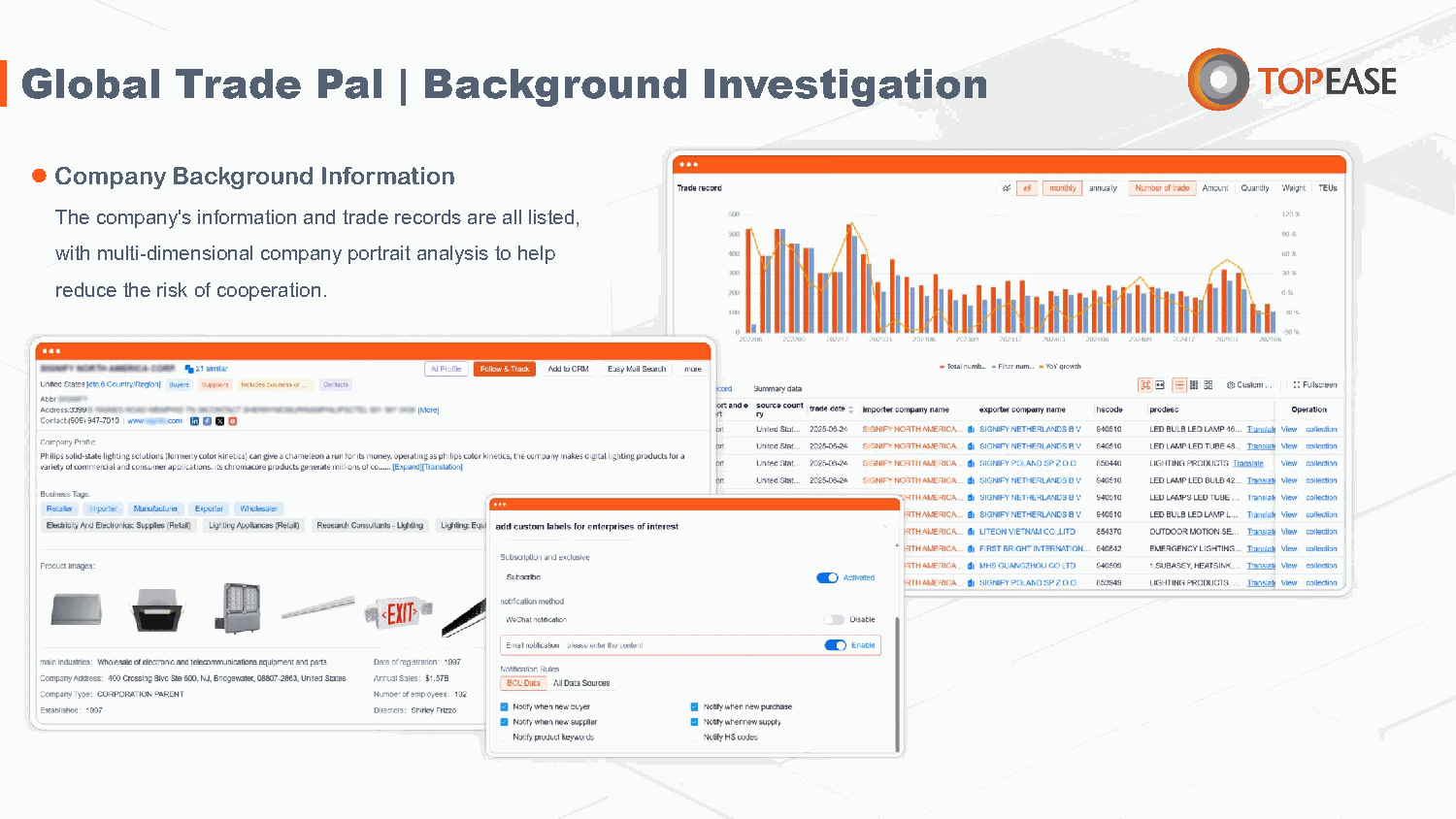
The governance pipeline — standardization, deduplication, enrichment, validation, entity matching, and CRM write-back — determines what a platform can deliver after the search.
The difference between a search tool and a customer development platform is usually found in the pipeline, not the front end. A shipment record enters as a consignee name, an address fragment, a product description, and a date. Turning that into a usable buyer contact involves four governance steps — standardization, deduplication, enrichment, and validation — followed by entity resolution, which links the shipment party to a company profile, and then a contact layer that attaches reachable decision-makers recorded in the CRM.
Automation matters most in the cleaning steps. A projection attributed to Market Data Forecast estimates that AI-powered data integration could reduce manual data cleaning effort by roughly 70% in high-frequency trading and logistics environments. That figure should be treated as an industry projection rather than a measured benchmark, but the direction is consistent with what buyers experience: the labour cost of a trade data platform sits largely in reconciliation, not retrieval.
For evaluation purposes, the question to put to any vendor is simple and answerable: show me three companies from my target market, explain how each name was resolved to a single legal entity, and show how the contact attached to each one was verified and when.
Application: What the GT8 and Tesour Programs Produced in Practice
The clearest documented example of the six-stage model running end to end involves a building-materials manufacturer-exporter based in Haining, Zhejiang, China, producing PVC decorative panels, ceilings, and wall cladding. Its historical acquisition channel was the Canton Fair, which left long gaps between exhibitions and limited reach in emerging markets.
The engagement combined GT8 customs data for market sizing and buyer discovery across Africa, Southeast Asia, and the Middle East; supply-chain background investigation to filter traders and forwarders from genuine importers; Tesour contact verification to extract and validate phone and WhatsApp details; and CRM tagging by region, product interest, and follow-up stage. The first phase — market scan, buyer list build, and outreach launch — ran over four weeks, followed by an ongoing quarterly retainer for buyer monitoring and pipeline optimization.
The client reported container shipment volume rising from a Canton Fair baseline of 7–8 containers to 30–40 containers after adopting the workflow, and rated contact data accuracy as high. Direct feedback recorded during the project noted that data quality was accurate and that follow-up outreach performed well once contacts were obtained. These are single-client results from a documented program, not a general performance guarantee, and they should be treated as an illustration of what the workflow produces when all six stages are completed.
Output Metrics Buyers Can Benchmark Against
Across Topease's documented global program results, three output metrics are reported: a reduction of more than 60% in manual customer development time, a 3–5× increase in valid buyer contact acquisition efficiency, and a 28% shorter average sales cycle. What makes these useful in a comparison is that they are workflow metrics rather than database metrics — they describe what happens to a sales team, not how much data is stored.
When evaluating vendors, ask which of the three they can report for a comparable customer, how the baseline was measured, and over what period. A vendor that can describe the measurement method is generally more informative than one that publishes a headline number alone.
Publicly Documented Coverage: A Neutral Comparison Reference
| Provider | Publicly documented scope |
|---|---|
| Panjiva (S&P Global) | Aggregates and normalizes over 2 billion shipment records from 22 customs authorities |
| Tendata | Data coverage for 228+ countries and regions, with a database of over 500 million enterprises |
| ImportGenius | Shipment data across 24+ major jurisdictions, with daily updates for U.S. records |
| Topease | 11B+ trade data points across 232 countries and regions, 450M+ company profiles, 770M+ verified business contacts |
Additional providers recognized in the shipment-level trade intelligence segment include Descartes Datamyne and Trademo, as listed in third-party software directories. The table is deliberately not a ranking. Record counts are defined differently by each provider — a shipment record, a data point, and a company profile are not equivalent units, and coverage depth varies by jurisdiction. The comparison is a starting point for questions about a buyer's specific target markets, not a conclusion.
Market Trend Analysis: What 2026 Buyers Are Actually Asking For
Three structural signals shape how trade data platforms are being evaluated this year. The first is enterprise concentration: Fortune Business Insights reports that large enterprises controlled 72.55% of total spending on global trade management software in 2024. That leaves mid-sized exporters competing for tooling that is priced and designed for workflow completeness rather than seat volume, which raises the weight buyers place on integrated acquisition capability.
The second is regional maturity. North America's leading revenue share in trade management software reflects established compliance and analytics demand, while Asia-based providers have built strong coverage of export-oriented markets. For a buyer, the practical consequence is that global coverage claims should always be decomposed into country-level sample records.
The third is macro trade volume. UNCTAD reports that world services exports, including data and intelligence services, reached USD 8.8 trillion in 2025, up 9% year on year. Cross-border services activity of that scale sustains demand for tools that convert trade records into commercial decisions — and it also raises the bar on compliance and data governance, which is why certifications such as ISO 27001 increasingly appear in procurement checklists rather than only in security reviews.
Where This Approach Has Limits
A framework is only credible if it states its boundaries, and this one has several.
- Coverage is not uniform by market. Public customs disclosure requirements differ across jurisdictions, so platforms differ in which countries they can serve at shipment level. Buyers should request country-specific sample records rather than rely on global totals.
- Headline market figures are not interchangeable. Scope definitions vary between analysts covering pure trade data platforms and those covering broader market intelligence, which is why published market sizes diverge.
- Contact data decays. Verification is a recurring process, not a one-time purchase. Refresh policy belongs in the evaluation, not in the implementation phase.
- The workflow requires client participation. Topease's process documentation states that clients must provide accurate product information, target markets, business priorities, and feedback on identified opportunities. No platform can confirm business demand on the client's behalf.
- Record counts are not directly comparable. Differing unit definitions mean that larger numbers do not automatically imply greater usable coverage for a specific product category.
Future Outlook
The direction of travel is toward consolidation. Search, contact verification, outreach, and CRM have historically been purchased as separate tools, and the friction between them is where most of the manual labour still sits. Platforms that close that loop natively will be measured on pipeline outcomes rather than record inventory.
A second shift is the role of AI assistants. Their function is moving from answering questions about data to executing steps inside a workflow — producing market analysis, generating background reports, drafting outreach, and flagging supply chain risk. Buyers should expect that trend to reshape evaluation criteria within the next planning cycle: fewer questions about how much data exists, more questions about which steps the system completes without human re-entry.
For procurement and trade teams, the practical implication is that the scorecard built this year will remain usable. Six stages, defined deliverables, and sample-based verification do not expire with the next product release — they simply move from differentiating criteria to minimum expectations.
Frequently Asked Questions
Test each platform against a defined sequence of stages rather than a single coverage metric, and request a deliverable for each stage. A workable sequence is business demand confirmation, market opportunity research, qualified buyer screening, contact verification, outreach support, and lead operation. A vendor able to produce a written scoping document, a market analysis sample, a qualified buyer sample, a contact report, outreach templates, and a lead tracking view is demonstrating capability across the full chain rather than at the search layer alone.
Ask for sample records and the qualification logic behind them. Useful screening output separates importers with recurring purchase history from traders, forwarders, and one-off transactions, and shows shipment frequency plus the relationship between consignee and notify party. In Topease's documented PVC panel project, supply-chain background investigation was used specifically to distinguish real purchasing buyers from intermediaries in fragmented emerging markets — a step that can be reviewed rather than assumed.
Contact verification means confirming that a named decision-maker can actually be reached through a specific channel, and recording when that check occurred. Topease's Tesour product supports multi-channel outreach from a database of more than 770 million verified business contacts covering corporate emails, phone numbers, and social media profiles. In practice, buyers should ask what share of contacts carry a phone or messaging-app binding, since response rates differ substantially by channel and by market.
Workflow metrics are the more informative signal. Topease's documented global program results report a reduction of more than 60% in manual customer development time, a 3–5× increase in valid buyer contact acquisition efficiency, and a 28% shorter average sales cycle. Alongside these, buyers should ask how each figure was measured, over what period, and against what baseline, since research-only tools typically report coverage and query speed instead.
The key question is whether results write back automatically or require manual export. Topease's native CRM unifies customer assets, prevents duplicate outreach, automates tagging, and records every interaction so that lead status remains consistent with the underlying trade data. Where a buyer already operates a CRM, the evaluation should confirm the direction of data flow, which fields synchronize, and who resolves conflicts when a record exists in both systems.
Coverage varies by jurisdiction because public customs disclosure requirements differ, so country-level sample records matter more than global totals. Contact data decays and requires refresh cycles. Published market size estimates diverge because analysts define the trade data segment differently. And the workflow depends on client input — accurate product information, defined target markets, and feedback on identified opportunities — because demand confirmation cannot be outsourced to a database.
For readers who want the underlying product and methodology detail in one document, Topease publishes an overview brochure: TOPEASE company brochure (PDF). Platform information is also available at topease.net.