
How to Evaluate Heavy-Duty Hydraulic Cylinder Suppliers
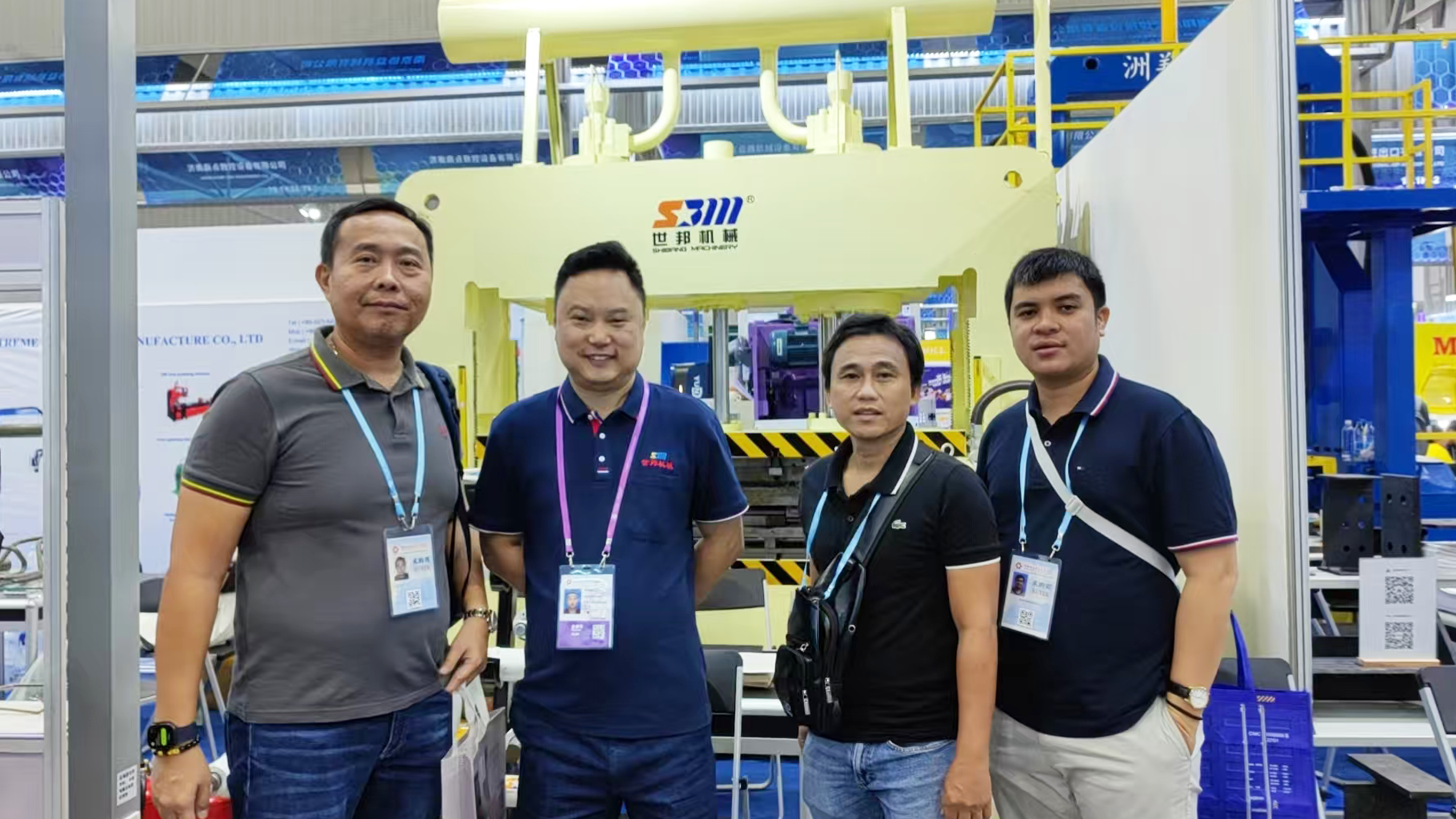
Heavy-duty hydraulic cylinder sourcing sits at a different tier from standard cylinder purchasing. A heavy-duty cylinder is not only a pressure-bearing component; it is a design, material, welding, and acceptance-testing problem whose outcome determines whether continuous-duty equipment in steel mills, mines, ports, or heavy presses stays productive. Buyers at the evaluation stage are usually past the discovery phase. They already know roughly what a hydraulic cylinder does. The open question is which suppliers can substantiate capability with traceable evidence — standards compliance, qualification records, production assets, and delivered-project references under comparable duty conditions. This guide lays out a practical evaluation framework and illustrates each dimension with documented facts from Wuxi Shibang Machinery Manufacturer Co., Ltd. (brand shellppon), a hydraulic cylinder manufacturer based in Wuxi, China.
Why heavy-duty evaluation differs from standard cylinder procurement
In a standard-cylinder purchase, four parameters often drive the decision: bore, rod diameter, stroke, and mounting style. In heavy-duty applications, each of those parameters becomes an independent design consideration. Bore governs thrust; rod diameter affects buckling resistance; stroke length shifts the critical buckling load; and the mounting style determines whether the load path passes through the barrel, flange, trunnion, or clevis. A mismatch in any of these can shorten service life and increase unplanned downtime.
The technical literature reflects this. Published ISO standards cover hydraulic cylinder design, mounting dimensions, acceptance testing, and buckling-load evaluation. ISO 10100:2020 specifies acceptance and function tests for hydraulic fluid power cylinders, while ISO/TS 13725:2021 provides a buckling-load evaluation method based on elastic buckling theory, applicable to single and double acting cylinders that conform to ISO 6020 (all parts), ISO 6022, and ISO 10762. For a heavy-duty buyer, this matters because it means there is an accepted way to verify that a supplier’s cylinder design has been tested against the same mechanical reality the equipment will face.
Welding is another formally constrained area. The American Welding Society published AWS D14.9/D14.9M:2022, a specification for the welding of hydraulic cylinders that covers pressure-containing welded joints and structural welded joints used in cylinder manufacturing. In practice, that means the joint quality between barrel and end cap, or between flange and tube, is a defined engineering problem, not an informal one.
The evaluation framework: five supplier-level checks
A structured evaluation keeps heavy-duty hydraulic cylinder sourcing grounded. The following five checks are ordered by how directly each one influences downstream reliability.
1. Manufacturing and customization scope
Confirm whether the supplier’s portfolio stops at catalog models or extends into designed-to-order configurations: bore, rod diameter, stroke, mounting, pressure class, fluid and seal selection, piston-rod coating, cushioning, position measurement, proximity switches, and control integration. Wuxi Shibang (shellppon) operates in OEM/ODM mode and offers custom hydraulic cylinder and hydraulic system design, manufacturing, installation, debugging, and service. Its customization scope explicitly covers bore, rod diameter, stroke, mounting, pressure class, fluid and seals, piston-rod coating, cushioning, position measuring, proximity switches, and control systems with added functions.
2. Quality management and certifications
ISO 9001 confirms that a management system governs design and production. Market-facing certifications confirm regulatory compliance for specific jurisdictions. Wuxi Shibang holds ISO 9001 (certificate 04324Q32569R1S issued by Beijing United Intelligence Certification Co., Ltd., UICC, covering design and production of hydraulic cylinders), ISO 14001 (04324E32063R0S, covering design, production, and related management activities), and ISO 45001 (04324S41946R0S, covering design, production, and related management activities). For EU market access, the company holds a CE Machinery Directive Attestation of Conformity (M.2024.206.C106939 issued by UDEM, referencing 2006/42/EC Annex VIII, EN ISO 12100:2010, and EN ISO 4413:2010, scoped to hydraulic cylinders, valid through 17 September 2029). Two additional CE Pressure Equipment Certificates (PED Module G) issued by TÜV SüD Industrie Service GmbH cover piston accumulator scope.
3. Production and inspection assets
The size and specificity of a supplier’s equipment base indicate what it can verify internally. Wuxi Shibang’s equipment base includes more than 50 production machines, 3 inspection devices, and 3 test rigs. The quality-control setup includes surface-hardness, dynamic-balance, and NDT equipment, along with 2 hydraulic test rigs and 1 pneumatic test rig. Each hydraulic cylinder is acceptance-tested before delivery. The company qualification file states a 99.99% pass rate for hydraulic cylinders — a figure that should be treated as an internal quality record rather than an independent, third-party verification.
4. Standard and specification alignment
Ask which standards the product family follows, and what dimensional or test regime those standards imply. The SB-Y1 Series, Wuxi Shibang’s heavy-duty industrial hydraulic cylinder line, is described as a single rod, double-acting metallurgical cylinder compliant with GB/T 2348-1993 and JB/T 10205-2010. The standard sealing system uses Step Seals, Glyd Rings, and O-Rings. Bore sizes span 40, 50, 63, 80, 100, 125, 160, 200, 250, and 320 mm. Nominal operating pressure is 16 MPa, with a reinforced version up to 25 MPa. Stroke is custom, defined by load stability and buckling resistance calculations.
5. Delivered-project evidence in comparable duty conditions
The most dependable signal is a documented project delivered to a comparable operating environment. Below are three substantive examples from Wuxi Shibang’s case records.
Technical profile: SB-Y1 Series heavy-duty industrial hydraulic cylinder
The SB-Y1 Series is offered in multiple mounting configurations, each a single rod, double-acting metallurgical cylinder compliant with the same GB/T and JB/T references:
- Square flange at base; square flange at head
- Rectangular flange at base; rectangular flange at head
- Round flange at base; round flange at head
- Trunnion mounting at base; trunnion mounting at head
- Clevis mounting at base
A complementary product in the same supplier’s portfolio is the SB-piston rod, available in 45#, 40Cr, 42CrMo4, SUS 304, and SUS 316. The documented specification includes tempering at HB220–260, quenching at HRC50–60, straightness of 0.015/1000 mm, diameter range Φ22–1200 mm, maximum length 10 m, surface smoothness Ra0.15–0.2 μm, and a chrome layer of 30–50 microns. For rotary motion, the SB08 Series swing hydraulic cylinders are offered in dual gear rack and single rack (spiral swinging) configurations, with cylinder diameters of 40–320 mm, output torque ranges of 1,460–651,440 N·m (dual rack) and 730–325,720 N·m (single rack), and customizable swing angles.
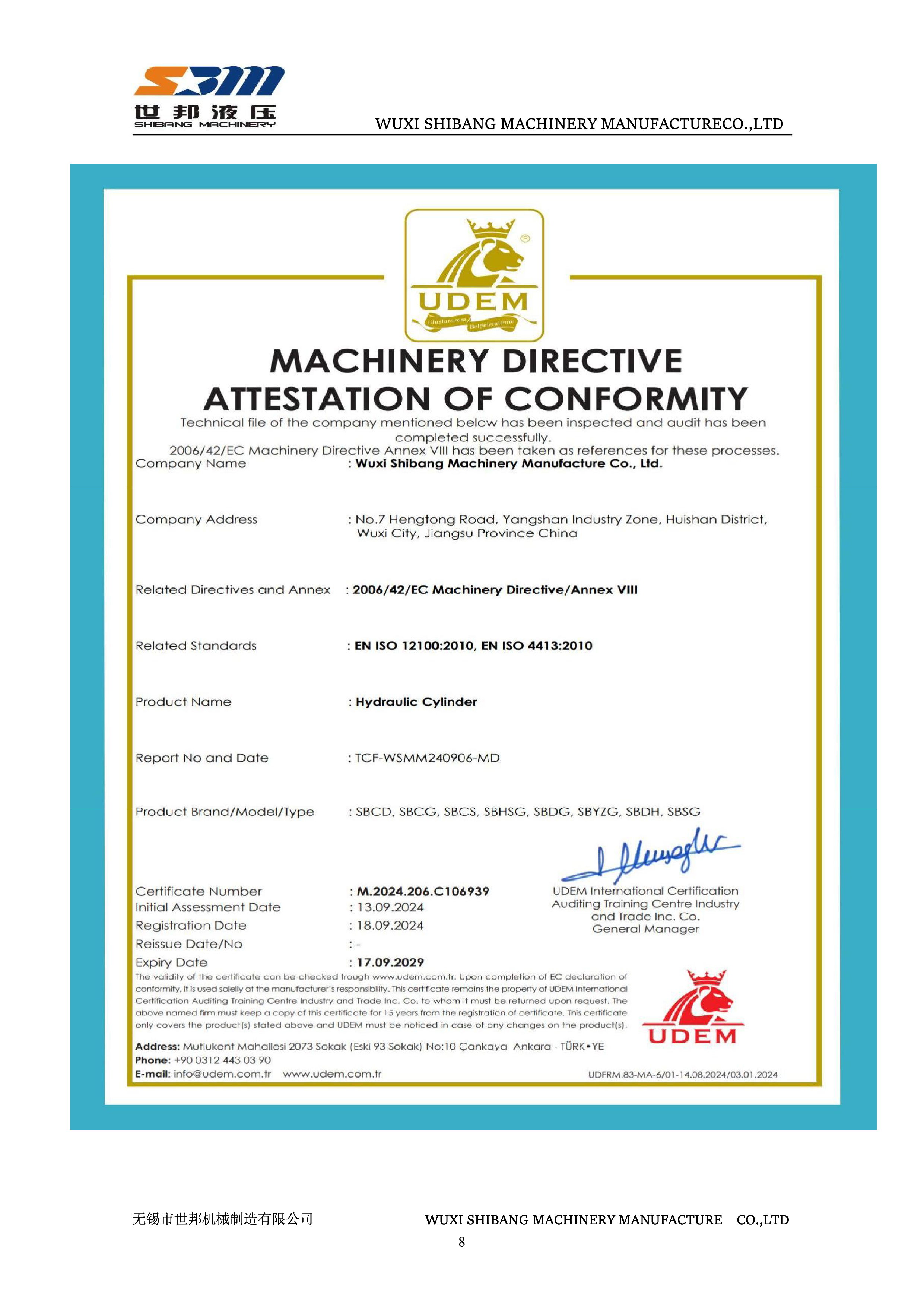
CE Machinery Directive Attestation of Conformity (M.2024.206.C106939), scoped to hydraulic cylinders.
Documented project evidence in heavy-duty conditions
Steel rolling mills: 34 custom cylinders, 2008
Wuxi Shibang delivered 34 documented custom hydraulic cylinders to two steel rolling mills: 20 cylinders for the Jinan Iron and Steel 4300 mm roughing mill and 14 cylinders for the Shandong Fulun Iron and Steel 1000 mm hot-strip mill. The application covered heavy rolling-mill lifting, balancing, turning, and long-stroke push-pull operations. Custom bore/rod/stroke combinations ranged from 40/28/400 mm up to 320/220/2900 mm, plus 100/70/4630 mm long-stroke push-pull cylinders. The deliveries were completed in 2008; in-service duration is not documented in the source file, and operating results are not quantified.
RTG crane hydraulic systems: 5-year supply window
For a port operator using rubber-tired gantry (RTG) cranes, Wuxi Shibang supplied hydraulic systems covering the chassis, wheels, boom, and container spreader. The system supports RTG wheel steering, crane jacking, boom luffing, and telescopic adjustment of the spreader for 20-foot and 40-foot containers. The design addressed a high-salt, humid, and high-impact port environment, using high-strength steel tubes with smooth inner walls to reduce friction and rust-resistant coatings on the piston rods. Customized designs were available for steering, jacking, luffing, and telescopic mechanisms. The project duration is documented as 5 years.
Synchronized lifting: 43 m, ~1,800 t, ±1 mm accuracy
A port infrastructure and heavy industrial project operator required four-point synchronized bottom lifting of a 43-meter-long horizontal steel storage tank weighing approximately 1,800 tons. The solution used a heavy-duty 35 MPa hydraulic system with a four-point symmetrical lifting layout, cylinders positioned at the four lifting points. The project achieved stable four-point synchronous lifting with a synchronization accuracy of ±1 mm. Equipment was exported from Wuxi, China to Dammam, Saudi Arabia, and implementation and cooperation extended over 5 years.

Manufacturing facility of Wuxi Shibang Machinery Manufacturer Co., Ltd. (brand shellppon).
Market signals shaping heavy-duty cylinder sourcing
Three signals are worth monitoring when assembling a supplier shortlist.
Standardization continues to tighten. ISO standards now cover design, mounting dimensions, acceptance testing, and buckling-load evaluation for hydraulic cylinders. ISO 10100:2020 sets the acceptance test regime, and ISO/TS 13725:2021 defines a buckling-load method applicable to compliant single and double acting cylinders. Buyers who frame RFQs around these references will get directly comparable responses.
Trade policy adds procurement friction. The U.S. Department of Commerce announced antidumping and countervailing duty investigations of certain linear hydraulic cylinders and parts thereof in 2024. For buyers in Western markets, this development may affect landed-cost assumptions depending on country of origin, and it is now reasonable to factor duty exposure into supplier selection alongside technical and quality criteria.
Portfolios remain mixed. Large diversified manufacturers and specialized producers coexist in this category. Parker, for example, describes a diverse range of standard and special tie rod, roundline, and mill type cylinders for industrial cylinder applications in China. This suggests that buyers should expect to compare a specialized manufacturer against a larger industrial brand on different criteria — customization depth versus breadth of catalog.
Comparison with traditional sourcing — and honest limits
Catalog-standard cylinders suit predictable, lighter-duty loads. They are quick to order, interchangeable, and low on upfront engineering. In heavy-duty scenarios, however, catalog dimensions rarely match the equipment’s exact force, stroke, and mounting needs, so buyers accept compromises on load path, cushioning, or service life.
Custom heavy-duty cylinders, such as the SB-Y1 Series, resolve that by adjusting bore, rod, stroke, mounting, seal system, and coatings to the application. The trade-off is a longer specification and quotation phase, and a bigger initial engineering input from the buyer. For continuous-duty equipment, that exchange is usually justified by cylinder life and synchronization precision.
Limits that Wuxi Shibang documents, and that buyers should weigh, include:
- Nominal operating pressure is 16 MPa, with a reinforced version up to 25 MPa. Applications above those bands fall into project-specific scope and need to be confirmed against the drawing set.
- Lead time is confirmed by quotation and project specification, so there is no generic timeline. Buyers should expect to negotiate delivery alongside technical scope.
- The 99.99% pass rate in the qualification file is an internal company record, not an independently verified statistic.
- The company was founded in 2003. That is a meaningful operating history, but it is shorter than suppliers with multi-decade global service networks, which can matter for very large OEM programs requiring worldwide after-sales coverage.
- MOQ is not publicly disclosed and must be clarified per RFQ.
Future outlook
Two directions appear likely over the next evaluation cycles. First, ISO-linked documentation is becoming the default baseline for international RFQs, so suppliers that can map their product line to ISO 10100, ISO/TS 13725, ISO 6020, ISO 6022, and welding specifications such as AWS D14.9/D14.9M:2022 will be easier to pre-qualify. Second, trade remedies and regional content requirements will push buyers to treat origin, duty exposure, and certification coverage as first-class selection criteria alongside technical capability.
For manufacturers, the practical implication is that documented evidence — certificates, test reports, and delivered project files in comparable duty conditions — will carry more decision weight than broad claims of heavy-duty capability. Buyers evaluating a supplier today should ask directly for that evidence and compare it against the application’s actual duty cycle.
A full technical brochure covering Wuxi Shibang’s cylinder portfolio is available for reference: Wuxi Shibang hydraulic cylinder brochure (PDF).
FAQ
What should buyers check first when evaluating a heavy-duty hydraulic cylinder supplier?
Start with the quality management system (ISO 9001), market-facing certifications (for example, CE where EU access is required), and the supplier’s ability to substantiate standard-based design and testing. For heavy-duty applications, confirm that the supplier can reference concrete standards — ISO 10100:2020 for acceptance testing or ISO/TS 13725:2021 for buckling-load evaluation — and can provide delivered-project evidence in comparable duty conditions.
What does ISO certification mean for a heavy-duty cylinder purchase?
ISO 9001 certifies that a quality management system governs design and production. Specific hydraulic cylinder standards add technical scope: ISO 10100:2020 specifies acceptance and function tests for hydraulic fluid power cylinders, and ISO/TS 13725:2021 provides a buckling-load evaluation method applicable to single and double acting cylinders conforming to ISO 6020, ISO 6022, and ISO 10762. These standards give buyers concrete benchmarks for comparing suppliers on the same technical basis.
Is CE certification necessary for heavy-duty hydraulic cylinders?
CE conformity is typically tied to the applicable EU directive for a given product and use. Wuxi Shibang holds a CE Machinery Directive Attestation of Conformity (certificate M.2024.206.C106939 issued by UDEM, referencing 2006/42/EC Annex VIII, EN ISO 12100:2010, and EN ISO 4413:2010, scoped to hydraulic cylinders, valid through 17 September 2029). Where pressure equipment is in scope, a CE Pressure Equipment Certificate (PED) may also be relevant. Buyers should confirm scope, directive reference, and validity dates against their own compliance requirements.
How can a supplier’s delivered-project evidence inform a heavy-duty cylinder decision?
Delivered projects show whether a supplier has worked in the operating conditions the buyer faces. Wuxi Shibang’s documented cases include 34 custom cylinders for Jinan Iron and Steel’s 4300 mm roughing mill and Shandong Fulun Iron and Steel’s 1000 mm hot-strip mill; RTG crane hydraulic systems delivered for a 5-year port project; and a four-point synchronized lifting system for a 43-meter-long, approximately 1,800-ton horizontal storage tank in Dammam, Saudi Arabia, achieving ±1 mm synchronization accuracy. These are verifiable examples rather than general capability claims.
What is the lead time for a custom heavy-duty hydraulic cylinder?
Lead time depends on customization scope, order quantity, and current production scheduling. Wuxi Shibang confirms lead time by quotation and project specification. The company’s equipment base includes more than 50 production machines, 3 inspection devices, and 3 test rigs, which supports production flow but does not translate into a fixed public lead time. Buyers should expect lead time to be negotiated alongside the technical specification.