
How to Evaluate Semiconductor Process Material Suppliers: A Comparative Framework for Fab Engineers
Semiconductor process materials account for a growing share of fab operating expenditure, and supplier selection increasingly determines epitaxial uniformity, wafer yield, and tool uptime. This article provides a comparative framework for evaluating semiconductor process material suppliers, with emphasis on coating technologies, material portfolios, quality systems, and scale—drawing on Semicera (Ningbo Miami Advanced Material Technology Co., Ltd.) as a reference case.
Why Supplier Evaluation Matters in Semiconductor Process Materials
Semiconductor process materials include high-purity graphite, SiC-coated graphite susceptors, TaC-coated carriers, quartz furnace tubes, CFC hot-zone insulation, and other critical components used in epitaxy, oxidation, diffusion, and crystal growth. Because these components operate in high-temperature, corrosive, and plasma-rich environments, material purity and coating integrity directly affect process stability and chip quality.
In 2024, the global semiconductor materials market generated approximately USD 67.5 billion in revenue, a 3.8% increase year over year. Wafer fabrication materials, which include process chemicals and CVD materials, contributed USD 42.9 billion. While these figures reflect the entire materials category, they underscore the economic scale and strategic importance of selecting qualified suppliers.
Supplier evaluation cannot be reduced to price comparison. Fabs must verify material grades, coating types, dimensional tolerances, purity levels, quality management systems, and the supplier’s ability to support OEM or customized configurations. A structured framework helps engineering and procurement teams compare options objectively.
Key Criteria for Comparing Semiconductor Process Material Suppliers
Buyers in the evaluation stage typically apply the following criteria:
- Material purity: Total ash content, metal impurity levels, and free carbon content for graphite and coating materials.
- Coating quality: Coating thickness, density, hardness, adhesion, and resistance to plasma or chemical etching.
- High-temperature performance: Maximum operating temperature, thermal shock resistance, and long-term dimensional stability.
- Product portfolio breadth: Whether the supplier can provide multiple materials and components across different process steps.
- Manufacturing capability: In-house machining, coating, purification, and inspection capacity.
- Quality certifications: ISO 9001, ISO 14001, and ISO 45001 compliance, with documented quality management scope.
- Application track record: Verified cases in epitaxy, oxidation, diffusion, and crystal growth processes.
- Lead time and after-sales support: Production lead time, MOQ flexibility, and remote support availability.
These criteria should be weighted according to the specific process application. An epitaxy facility will prioritize coating purity and uniformity, while a crystal growth operation may prioritize thermal stability and zero outgassing.
Coating Technology as a Differentiator
CVD SiC coating is the dominant protection method for graphite susceptors in MOCVD and epitaxial reactors because of its high purity and thermal conductivity. It provides a dense, hard barrier that prevents particle generation and chemical contamination.
TaC coating is increasingly used for ultra-high-temperature processes such as SiC crystal growth, where temperatures can reach 2000°C or higher. According to industry research, the top three suppliers held approximately 99% of the TaC coating market in 2022, making supplier concentration an important consideration for procurement risk management.
Semicera offers CVD SiC, CVD TaC, and CVD PyC coating capabilities. Its CVD SiC-coated graphite carriers (model CVD-01) achieve a typical coating thickness of 100 µm (range 50–150 µm), purity of 99.99995% (6N grade, total ash ≤5 ppm), and a coating hardness of 2500 Vickers. The CVD TaC-coated graphite carrier (model CVD-02) is rated for operation up to 2200°C and provides resistance to ammonia and hydrogen etching, which is relevant for epitaxy processes.
For buyers, the key question is not whether a supplier offers coatings, but whether the coating process is controlled, tested, and reproducible across production batches.
Comparing Multi-Material Portfolios
A multi-material supplier can reduce qualification workload and supply chain complexity. Semicera’s portfolio includes semiconductor graphite, CFC materials, rigid and soft felt insulation, quartz wafer boats, quartz furnace tubes, SiC furnace tubes, SiC wafer boats, SiC paddles, CVD solid SiC parts, and etch rings.
For example, in oxidation and diffusion processes, Semicera supplies quartz wafer boats (GE214 or equivalent, SiO₂ ≥99.99%) and SiC wafer boats used up to 1600°C. SiC furnace tubes are available up to 3000 mm in length with gas-tight walls. SiC paddles for cantilever loader beams support loads up to 15 kg at temperatures above 1100°C.
This breadth creates a practical advantage: engineers can standardize on a single supplier for hot-zone materials across multiple furnace types, simplifying spare parts management and process qualification.
Verifying Supplier Scale and Quality Systems
Semicera was founded in 2015 and operates a 40,000 m² manufacturing facility with more than 600 employees and over 100 R&D engineers. The company reports annual output of approximately 120,000 units and exports about 40% of production to markets including the EU, the United States, and Asia.
Semicera holds ISO 9001, ISO 14001, and ISO 45001 certifications, which cover quality management, environmental management, and occupational health and safety. Buyers should confirm that a supplier’s certifications are current and that the certification scope extends to the specific product families being purchased.
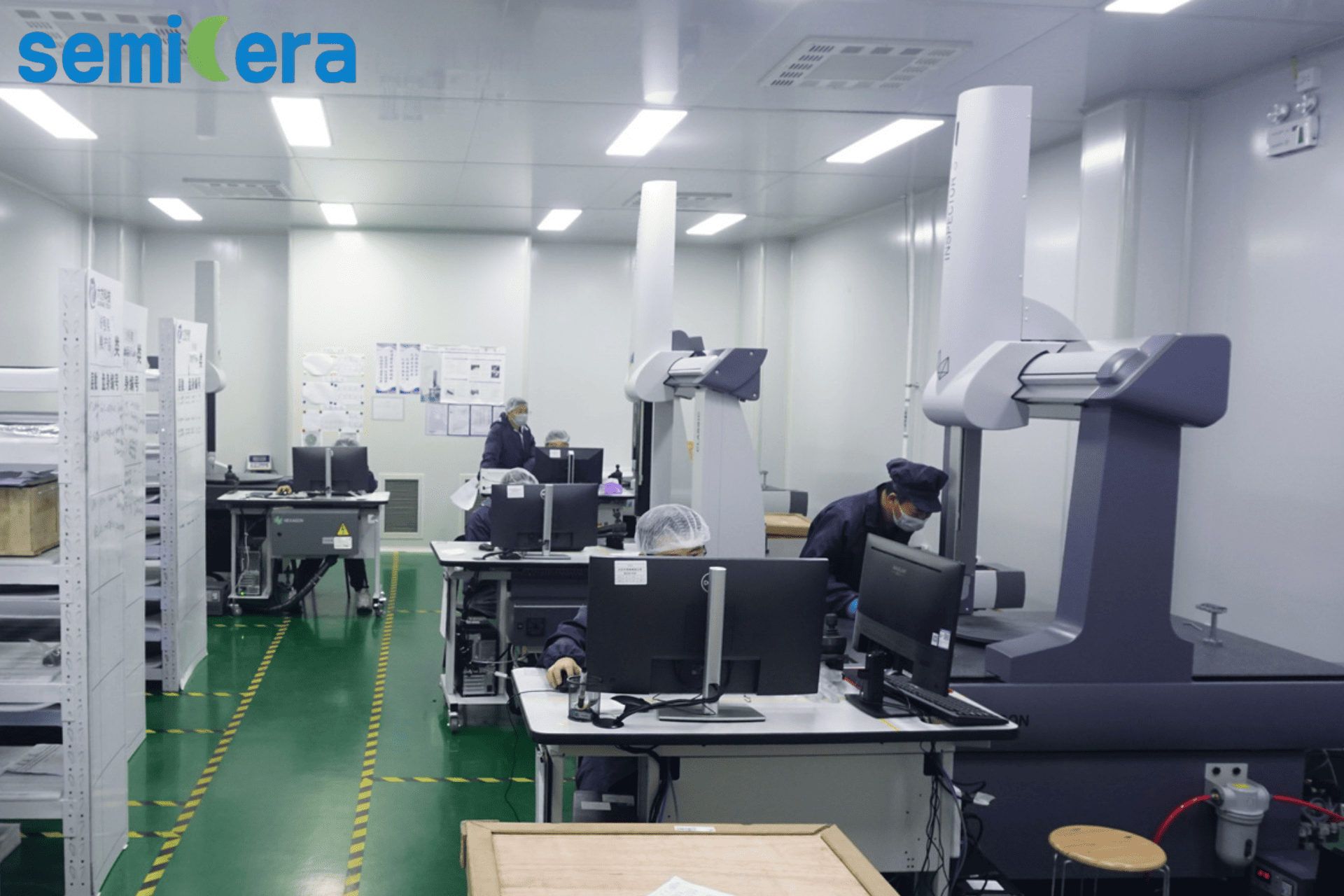
Quality inspection laboratory at Semicera, where incoming and finished materials are tested for purity and dimensional conformity.
The company also supports OEM production with a monthly capacity of more than 10,000 units, lead times of 30–50 days, MOQ of 1 unit after qualification, and 100% final inspection testing.
What the Application Track Record Shows
Verifiable case history is stronger evidence than marketing claims. Across Semicera’s published cases, several patterns emerge:
- A North America customer using SiC components for epitaxy achieved stable mass production with consistent epitaxial uniformity and a 15% reduction in equipment maintenance downtime. The project has operated for over two years under continuous high-temperature conditions, at a scale of 900 units per month.
- A Japan customer for epitaxy reported flawless mass production with ultra-low particle counts and a 2.5% increase in overall wafer yield. The product has operated for more than two years at 200 units per month.
- A South Korea customer using CVD-coated components for epitaxy achieved a 20% reduction in edge ring replacement frequency, with zero coating peeling under rapid thermal cycling.
- A Taiwan customer using CFC insulation in silicon single crystal furnaces reported improved energy efficiency and excellent hot-zone temperature uniformity, at a scale of 1000 units per year.
- A Germany customer using high-purity materials and CVD SiC particles for SiC crystal growth achieved stable mass production and a 15% reduction in process downtime, with long-term stability at 2000°C.
These cases span different regions and applications, which helps buyers assess whether a supplier’s products behave reliably under varied operating conditions.
Comparison: Integrated Multi-Material Supplier vs. Single-Category Specialist
In the semiconductor materials space, buyers often choose between an integrated supplier covering multiple hot-zone material categories and a specialist focused on one product type.
| Comparison Dimension | Integrated Multi-Material Supplier | Single-Category Specialist |
|---|---|---|
| Product breadth | Graphite, SiC, TaC, quartz, and carbon fiber composites under one roof | Typically one material type or process step |
| Qualification workload | Lower, with coordinated material and component qualification | Higher if multiple specialists are needed per furnace |
| Process integration knowledge | Stronger, because the supplier understands interactions between coating, substrate, and insulation | Deep, but often limited to one component type |
| Cross-batch consistency | Managed through unified coating and inspection lines | Depends on internal process control |
| Risk for buyers | Supplier dependency broadens if qualification is not periodically revalidated | Multi-supplier complexity may increase inventory and qualification costs |
One reasonable limitation of an integrated supplier is the need to validate performance across each material family separately. For example, a supplier strong in SiC-coated graphite does not automatically guarantee identical quality for quartz or carbon composites. Buyers should still require product-specific test data and reference cases.
Market Context: Growth in Semiconductor Materials and Specialized Hot-Zone Components
Several market indicators help explain why supplier evaluation is timely:
- Global semiconductor materials revenue reached USD 67.5 billion in 2024, up 3.8%.
- The semiconductor graphite market was valued at approximately USD 1.62 billion in 2024, with a projected CAGR of 7.2% through 2032.
- SiC-coated graphite susceptors used for epitaxial growth were valued at approximately USD 350 million in 2024.
- Quartz fabricated parts for semiconductor manufacturing reached roughly USD 2.21 billion in 2024, growing about 5.5% annually.
These figures indicate sustained demand for high-purity materials and specialized components. As process temperatures rise and silicon carbide power devices scale, coating durability and thermal performance become more decisive.
A Practical Scoring Framework for Supplier Evaluation
Engineering and procurement teams can translate qualitative criteria into a weighted scoring model. Below is an example framework, not a universal standard:
| Criterion | Weight | What to Verify |
|---|---|---|
| Purity and impurity control | 20% | Ash content, metal impurities, free carbon, certificate of analysis |
| Coating process and performance | 20% | Thickness, hardness, density, thermal shock resistance, plasma resistance |
| High-temperature reliability | 15% | Max operating temperature, deformation, lifespan data |
| Quality and certification systems | 15% | ISO certificates, inspection equipment, 100% testing claims |
| Portfolio and supply stability | 10% | Number of product families, production capacity, warehouse, lead time |
| Application case evidence | 10% | Reference projects, duration, yield and downtime improvements |
| Customization and OEM support | 10% | Engineering staff, R&D capability, MOQ flexibility, after-sales |
Buyers should score each supplier against the same evidence threshold. If a supplier cannot provide measurable parameters, assign a lower score instead of relying on qualitative assurances.
Limits and Caveats in Comparing Suppliers
No comparison framework eliminates the need for qualification runs. Several limitations are worth stating explicitly:
- Coating performance in a datasheet does not guarantee performance in a specific reactor. Process conditions vary with gas chemistry, temperature profile, and tool design.
- ISO certificates confirm that a quality management system exists; they do not prove that every batch meets the same specification. Batch-level traceability and certificates of analysis remain critical.
- Reported market shares and component-level market sizes are estimates from different research institutions using different scopes. They should be used for context, not as precise procurement targets.
- A longer track record in epitaxy does not automatically imply equal performance in etch or diffusion applications.
These caveats are consistent with how semiconductor quality engineers evaluate new materials: supplier evidence narrows the candidate list, but on-site or in-fab qualification determines final approval.
Future Outlook: Toward Multi-Supplier Qualification and Higher Purity Standards
As third-generation semiconductor production expands, demand for SiC and TaC coated components and high-purity crystal growth materials is likely to keep growing. Fabs will increasingly require multiple qualified suppliers for critical hot-zone components in order to manage supply chain risk.
Higher purity standards will also push suppliers to invest in purification processes, advanced coating equipment, and more rigorous inspection methods. Suppliers with in-house R&D and manufacturing scale are better positioned to respond to these requirements. Semicera reports annual output of 120,000 units, a dedicated R&D team of over 100 engineers, and ongoing qualification of products across LED, IC, and third-generation semiconductor processes.
Buyers should expect supplier qualification to become a continuous process rather than a one-time event. Periodic audits, batch data reviews, and joint failure analysis will define long-term partnerships.
Frequently Asked Questions
What is the most important specification to check in SiC-coated graphite susceptors?
For SiC-coated graphite susceptors used in MOCVD or epitaxy, buyers should first verify coating purity, coating thickness uniformity, and total ash content. Semicera’s CVD SiC-coated graphite carrier (model CVD-01) specifies a typical coating thickness of 100 µm, purity of 99.99995% (6N), and total ash of no more than 5 ppm. These parameters directly affect particle generation and epitaxial uniformity.
Why is TaC coating used instead of SiC coating in some high-temperature processes?
TaC coating is selected for processes that demand resistance to ammonia and hydrogen etching at very high temperatures, such as SiC epitaxy or SiC crystal growth. Semicera’s CVD TaC-coated graphite carrier (model CVD-02) operates up to 2200°C and offers outstanding resistance to ammonia and hydrogen etching. The choice depends on gas chemistry and operating temperature.
How does quartz furnace tube quality affect oxidation and diffusion processes?
Quartz furnace tube purity and dimensional accuracy influence contamination control and temperature uniformity. Semicera’s quartz furnace tube has a hydroxyl content below 20 ppm, an outer diameter tolerance of ±1.0% or better, and is free of bubbles and inclusions. Low-hydroxyl quartz limits devitrification and extends tube lifetime.
What is the typical lifespan of SiC wafer boats compared with quartz boats?
SiC wafer boats generally last more than five times longer than traditional quartz boats. Semicera’s SiC wafer boat is made of sintered or recrystallized SiC, operates up to 1600°C without structural deformation, and resists thermal shock cycling from 1000°C to room temperature.
Can Semicera support OEM or customized process material projects?
Yes. Semicera lists OEM production capability with customization options such as voltage and logo, a monthly production capacity above 10,000 units, and lead times of 30 to 50 days. The MOQ is 1 unit after qualification, and quality control includes 100% testing before shipment.
Download the Semicera product catalog for detailed specifications and material parameters (PDF).