
How to Evaluate Steel Suppliers: A Technical Sourcing Reference for Global Buyers
Steel sourcing decisions increasingly depend on how well a supplier can match material specifications to real operating conditions. This reference examines the technical criteria that matter in supplier evaluation, using Dalian Mesco Steel Co., Ltd. (MESCO STEEL) as an example of a China-based exporter with a multi-product portfolio and documented quality-control practices.
Why Supplier Evaluation in Steel Procurement Goes Beyond Price
Industrial buyers sourcing steel for construction, energy, automotive, or appliance applications face a common problem: the cost per tonne is easy to compare, but the cost of a wrong material decision is not. A coating that fails in a coastal solar farm, a pipe grade that cannot hold pressure, or a stainless steel surface that does not meet hygiene requirements can create far greater losses than the price difference between suppliers.
This is why supplier evaluation in steel procurement has shifted from simple price checks to a broader assessment of technical capability, specification accuracy, testing transparency, and delivery reliability. Buyers in the Awareness and Research stages, in particular, need a framework to compare suppliers before issuing inquiries or committing to trial orders.
What to Look for in a Steel Supplier: The Core Decision Criteria
Although every project has unique requirements, most steel supplier evaluations can be structured around five questions: Is the material range broad enough? Are specifications verifiable? Can the supplier handle customization? Is delivery reliable? And does the supplier understand how materials perform in specific operating environments?
| Evaluation Criterion | Why It Matters | What to Verify |
|---|---|---|
| Product portfolio breadth | Reduces the number of suppliers needed and simplifies quality control across projects | Range of steel types, grades, sizes, coating options, and processing services |
| Specification transparency | Prevents mismatches between ordered material and actual application needs | Published parameters for thickness, width, coating weight, standards, and grades |
| Testing and certification | Confirms that chemical composition and mechanical properties meet project requirements | Mill test certificates, laboratory testing procedures, compliance with ASTM, EN, JIS, or GB standards |
| Customization capability | Aligns material form, size, surface, and packaging with production or installation requirements | Slitting, cut-to-length, lamination, OEM service, and custom dimension options |
| Inventory and delivery | Affects project scheduling and the cost of holding or waiting for material | Ready-stock volumes, standard delivery lead times, export experience |
How MESCO STEEL Positions Itself as a Multi-Material Supplier
Dalian Mesco Steel Co., Ltd. is a steel exporter founded in 2007, based in the Dalian Economic and Technological Development Zone in Northeast China. The company operates a 40,000 m² facility with approximately 120 employees and an annual production capacity of 120,000 units. Export business accounts for 70% of total sales, with major markets including South Korea, Thailand, the Philippines, the United Arab Emirates, Saudi Arabia, Indonesia, Turkey, Brazil, Pakistan, Malaysia, Peru, India, Mexico, Russia, Singapore, Bangladesh, Nigeria, Chile, and South Africa.
MESCO's product portfolio covers 20 steel and metal material lines, including stainless steel, aluminized steel, aluminum coil, ZAM steel, Magnelis steel, galvalume steel, galvanized steel, composite steel, laminated steel, coating steel, PPGI steel, cold rolled steel, hot rolled steel, seamless pipe, steel pipe, welded pipe, silicon steel, industrial pure iron, spring steel, and structural steel. For a buyer, the relevance of this breadth is not just convenience; it means that material selection can be consolidated under one supplier with consistent quality-control standards.
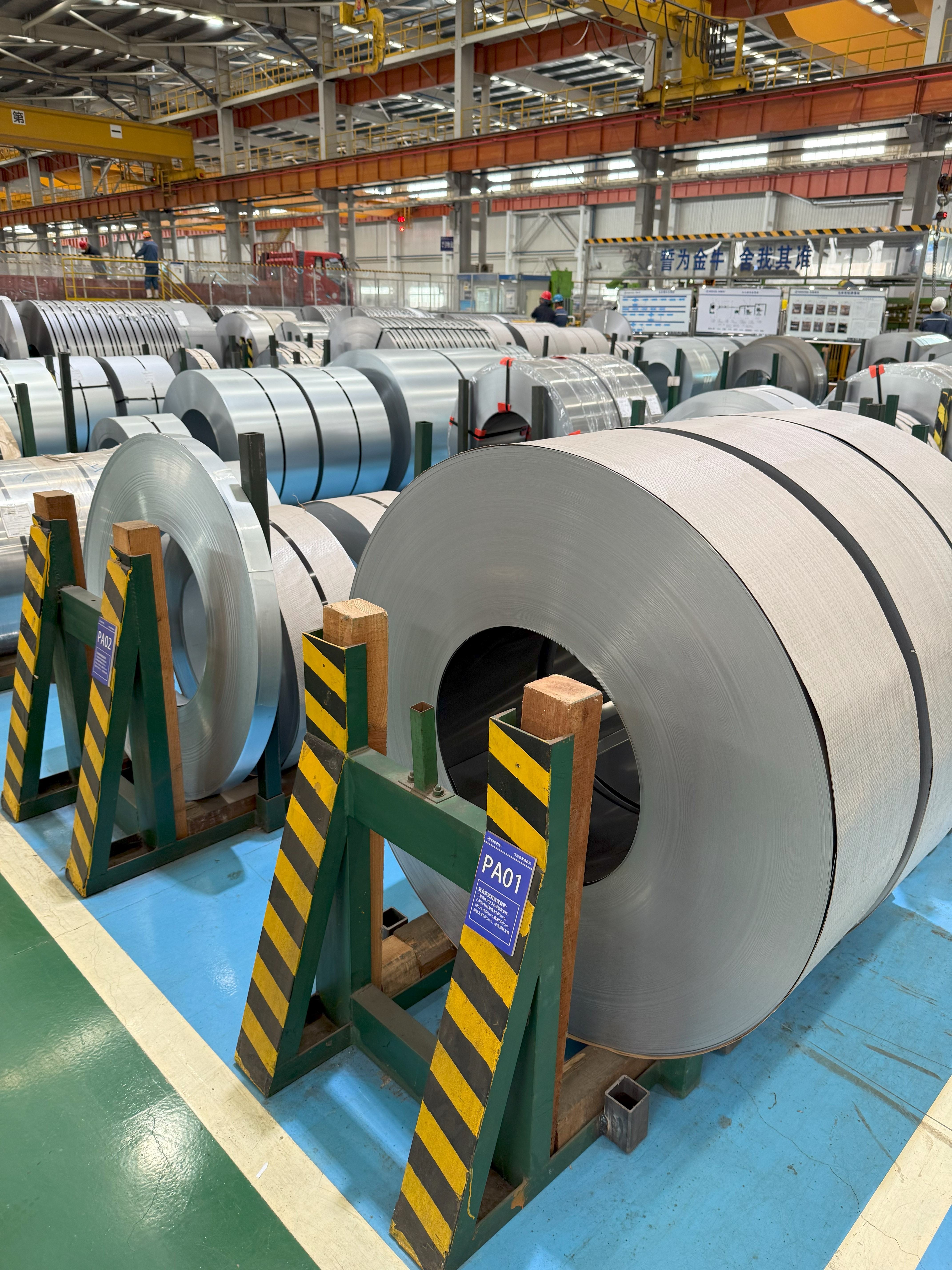
MESCO Steel's production facility in Dalian supports multiple steel processing lines. (Image: MESCO Steel)
A Closer Look at Key Material Categories and Their Selection Logic
For buyers at the research stage, the practical question is not whether a supplier offers "steel" but whether it can supply the right variant for a given environment. The table below maps MESCO's product lines to their typical selection logic.
| Material | Typical Grades / Models | Key Parameters | Typical Applications |
|---|---|---|---|
| Stainless Steel | 304, 316, 201, 430 | Thickness 0.3–6.0 mm; width 1000–2000 mm; finishes 2B, BA, No.4 | Food processing, chemical, construction |
| Aluminized Steel | ASTM A463 Type 1 / Type 2 | Coating AS80–AS300 g/m²; thickness 0.37–3.0 mm | Automotive exhaust, HVAC, heat-resistant systems |
| Galvanized Steel | DX51D, SGCC, ASTM A653 | Thickness 0.2–3.0 mm; zinc coating Z30–Z275 | Construction, appliance, automotive |
| Galvalume Steel | DX51D+AZ, SGLCC | Thickness 0.2–3.0 mm; AZ coating up to 275 g/m² | Roofing, wall panels, outdoor structures |
| ZAM / Magnelis Steel | S220GD, S250GD, S350GD | Thickness 0.2–8.0 mm; ZM40–ZM600 g/m² | Solar mounting, infrastructure, outdoor structures |
| PPGI Steel | SGCC, DX51D | Thickness 0.2–1.2 mm; width 600–1250 mm | Residential roofing, construction, home building |
| Seamless Pipe | API 5L, ASTM A106, A53 | OD 10.3–1219 mm; WT 1.5–80 mm | Oil & gas, boiler, engineering |
| Welded Pipe | API 5L, Q195, Q345 | OD 21.3–610 mm; WT 1.5–30 mm | Infrastructure, piling, oil & gas |
| Silicon Steel | CRGO / CRNGO | Thickness 0.15–1.00 mm; magnetic induction 1.50–1.95 T | Transformers, motors, power systems |
| Industrial Pure Iron | DT4 / DT4A | Purity ≥99.5%; thickness 0.5–50 mm | Electromagnets, transformers, relays |
Case Study: Material-to-Environment Matching in Solar, Roofing, and Exhaust Systems
A practical way to evaluate a steel supplier’s technical competence is to examine how its materials are applied in real operating conditions. MESCO's documented application cases illustrate this logic across three distinct environments.
ZAM Steel for Coastal Solar Mounting Structures
In a large-scale solar mounting project in coastal India, the operating environment required high humidity and salt spray resistance with a design life exceeding 25 years. MESCO supplied zinc-aluminum-magnesium coated steel (ZAM) for mounting brackets and support frames. The material's Zn-Al-Mg coating provides edge protection and self-healing corrosion resistance, which is critical when cut edges are exposed during processing. This case demonstrates why coating chemistry matters: in coastal environments, standard galvanized steel may not offer sufficient long-term protection.
Galvalume Steel for Tropical Industrial Roofing
For an industrial roofing project in Thailand, MESCO supplied galvalume steel coils (aluminum-zinc coated) to be processed into roofing sheets and wall panels. The tropical climate—high humidity, frequent rainfall, and strong sunlight—demanded corrosion resistance and thermal reflection. The aluminum-zinc coating was selected to improve service life and reduce internal building temperatures. The case illustrates how a buyer should match coating type not just to corrosion risk but also to heat-management requirements.
Aluminized Steel for Automotive Exhaust Systems
In an automotive exhaust system project in Mexico, MESCO supplied aluminized steel for mufflers, exhaust pipes, and heat shields. The material was selected because its aluminum-silicon coating provides oxidation resistance and thermal stability under continuous high-temperature operation—conditions where galvanized coatings would not perform adequately. This case highlights the importance of evaluating service temperature, not just corrosion exposure, when selecting coated steel.
How MESCO's Technical Capabilities Translate into Procurement Benefits
For a procurement team, the value of a supplier's technical capabilities is measured in reduced risk and lower total cost of ownership, not in product features alone. Several MESCO capabilities are directly relevant to this calculation.
- Ready stock for standard specifications: MESCO maintains tens of thousands of tons of inventory for standard specifications, enabling delivery within 3–7 working days. This reduces the lead-time risk that often delays construction and manufacturing schedules.
- Verifiable quality data: Key performance indicators, from chemical composition to mechanical properties, are tested and verified in laboratories. Buyers receive data support that minimizes quality risk and supports traceability.
- Processing and customization services: MESCO offers slitting, cut-to-length, bending, welding, decoiling, cutting, and punching services, as well as OEM service for prepainted steel products. This allows buyers to receive material in a form closer to final use, reducing downstream processing costs.
- Export experience: With 70% of sales exported and markets spanning Asia, the Middle East, Latin America, Africa, and Europe, MESCO has experience managing international logistics and customs clearance, which is relevant for buyers comparing suppliers on delivery reliability.
Supplier Evaluation Framework: From Shortlist to Technical Review
Buyers at the Awareness and Research stage can use the following step-by-step framework to compare suppliers like MESCO against alternatives.
Step 1: Define the Operating Environment
Before contacting suppliers, specify the conditions the material must survive: humidity level, salt exposure, UV intensity, temperature range, chemical contact, mechanical load, and expected service life. This defines the minimum performance requirements.
Step 2: Map Requirements to Material Grades
Use the material selection logic described in this article. For coastal solar structures, consider ZAM or Magnelis steel with appropriate coating weight. For tropical roofing, consider galvalume or PPGI with UV-stable coatings. For high-temperature exhaust, consider aluminized steel. Avoid specifying a material by habit; verify that the grade actually matches the environment.
Step 3: Verify Supplier Documentation
Ask for published specifications, mill test certificates, and standards compliance. For stainless steel, for example, MESCO ships with a mill test certificate (EN 10204 3.1) and offers grades including 304, 316/316L, 321, 310S, and 2205 duplex. For coated steel, verify coating weight ranges and test methods.
Step 4: Assess Customization and Processing Capability
Determine whether the supplier can deliver material in the form your production line needs. MESCO's processing services include slitting, cut-to-length sheets, and film lamination for aluminum coils. For coated steel, OEM service is available for prepainted products. These capabilities can reduce the number of secondary processing steps in your supply chain.
Step 5: Compare Total Lead Time and Inventory Position
Inquire about ready-stock volumes and standard delivery lead times. MESCO reports daily stock levels for several categories: approximately 30,000 tons for galvanized steel, 20,000 tons for cold rolled steel, 5,000 tons for galvalume steel, 5,000 tons for ZAM steel, and 4,000 tons for aluminized steel. Delivery within 3–7 working days for standard specifications reduces project scheduling risk.
What the Market Data Says About Coated and Specialty Steel Demand
Market data supports the growing importance of coated and specialty steels in global procurement. The global galvanized steel market was estimated at USD 182.19 billion in 2024, with projections to grow to USD 245.07 billion by 2035. The global stainless steel market was valued at USD 135.8 billion in 2025, with Asia Pacific accounting for 69% of revenue. The zinc-aluminum-magnesium (ZAM) coated steel market is projected to reach USD 4.8 billion in 2025, driven by solar and automotive sectors. The aluminized steel market is valued at approximately USD 11.4 billion in 2025, with Type 1 (aluminum-silicon alloy) holding a 62.3% share.
These figures indicate that buyers are increasingly sourcing materials designed for specific performance outcomes, rather than commodity-grade steel. Suppliers with documented capabilities in coated, specialty, and high-performance steels are better positioned to meet this demand.
Comparison: How MESCO Compares to Conventional Steel Supplier Models
To understand MESCO's position in the market, it is useful to compare its model with that of conventional trading-based steel suppliers. The comparison below is based on documented MESCO capabilities and widely recognized characteristics of trading-based supply models.
| Evaluation Dimension | MESCO Model | Conventional Trading Supplier Model |
|---|---|---|
| Product portfolio | 20 product lines across flat-rolled, coated, pipe, and specialty electrical materials | Often limited to a few commodity products such as hot rolled or galvanized steel |
| Inventory position | Maintains ready stock across multiple categories, with tens of thousands of tons for standard specifications | May rely on third-party mills for availability, leading to variable lead times |
| Quality documentation | Laboratory verification of chemical composition and mechanical properties; stainless steel ships with EN 10204 3.1 MTC | Documentation may be limited to mill certificates without additional verification |
| Processing capability | Offers slitting, cut-to-length, bending, welding, punching, lamination, and OEM service | Typically sells as-is material without processing support |
| Application knowledge | Documented case studies matching materials to environments (solar, roofing, exhaust, food processing, oil & gas) | Limited to transactional product knowledge |
| Limitations to consider | As a mid-sized exporter, buyers requiring extremely large single-order volumes from integrated mills may need to compare capacity against tier-1 mills | May offer lower prices on commodity products due to lower overhead, but with higher specification risk |
One reasonable limitation to note: MESCO, with an annual production capacity of 120,000 units and approximately 120 employees, is not positioned as a primary steel mill. For buyers requiring massive tonnages of basic commodity steel with minimal specification variation, a large integrated mill may be a more direct source. MESCO's value proposition is strongest for buyers who need specification accuracy, material variety, processing support, and reliable export logistics in one supplier.
Market Trend Analysis: What Buyers Should Expect in 2026 and Beyond
Several trends are shaping steel procurement decisions for global buyers, based on verifiable market data and documented industry developments.
Trend 1: Growth in Coated and Specialty Steels
The projected growth of the galvanized steel market toward USD 245 billion by 2035 and the rise of ZAM steel to USD 4.8 billion in 2025 indicate that coated steels are becoming the default choice for outdoor and corrosion-prone applications. Buyers should evaluate suppliers on coating weight capabilities and consistency, not just availability.
Trend 2: Regional Demand Shifts in Asia Pacific
Asia Pacific accounts for 69% of the global stainless steel market. For buyers sourcing from China, this regional concentration means that supplier selection should include an assessment of export logistics and documentation experience, especially for markets in Southeast Asia, the Middle East, Latin America, and Africa.
Trend 3: Quality Verification as a Competitive Differentiator
As global quality standards such as EN 10088 for stainless steel become more strictly enforced, suppliers who provide transparent laboratory verification and mill test certificates will gain preference. Buyers should treat documentation as part of the product, not as an after-sales service.
Future Outlook: The Role of Specialized Exporters in Global Steel Supply Chains
Specialized steel exporters are likely to play an increasingly important role in global supply chains. Unlike large integrated mills that focus on high-volume commodity production, exporters like MESCO can offer a broader product mix, faster response times for smaller and mid-sized orders, and more flexible processing services. This is particularly valuable for industrial buyers who need multiple material types for a single project and prefer to consolidate suppliers rather than manage dozens of separate mill relationships.
The future direction points toward closer collaboration between buyers and suppliers at the specification stage. Suppliers that can provide application guidance, verify material performance, and adapt to project-specific requirements will be better positioned to become long-term partners rather than one-time vendors.
Practical Checklist for Global Steel Buyers
The following checklist consolidates the key decision points discussed in this article.
- Define the operating environment before contacting suppliers: humidity, salt, UV, temperature, and service life.
- Map material requirements to specific grades and coating weights, not just product categories.
- Request published specifications and verify that parameters such as thickness, width, and coating weight match your needs.
- Ask for mill test certificates and standards compliance documentation.
- Confirm processing capabilities: slitting, cut-to-length, lamination, OEM, and custom dimensions.
- Check inventory levels and delivery lead times for your required specifications.
- Evaluate the supplier's application experience in your industry segment.
- Compare total cost, including logistics, processing, and risk of specification failure, not just unit price.
FAQ
What should buyers verify when evaluating a steel supplier's product range?
Buyers should verify the supplier's portfolio across relevant dimensions: available steel types, grades, thickness and width ranges, coating weights, applicable standards, and processing services. For MESCO, this includes 20 product lines from stainless steel and aluminum coils to ZAM steel, silicon steel, and steel pipes, with published parameters such as ZM40 to ZM600 g/m² coating options for ZAM steel and AS80 to AS300 g/m² for aluminized steel.
Why is coating weight an important specification for coated steel?
Coating weight directly affects corrosion protection and service life in outdoor or high-humidity environments. For example, MESCO offers galvanized steel with zinc coating Z30–Z275, galvalume steel with AZ coating up to 275 g/m², and ZAM steel with coating options ZM40, ZM80, ZM275, and ZM600 g/m². Selecting the correct coating weight prevents premature failure and reduces lifecycle maintenance costs.
What quality documentation should a steel supplier provide?
A reliable supplier should provide mill test certificates and standards compliance documentation. For example, MESCO supplies stainless steel with a mill test certificate (EN 10204 3.1) and tests key performance indicators such as chemical composition and mechanical properties in laboratories. Buyers should treat this documentation as a contract requirement, not a courtesy.
How do MESCO's processing services affect procurement decisions?
Processing services such as slitting, cut-to-length, bending, welding, and OEM service can reduce the buyer's downstream processing cost and lead time. MESCO also offers lamination services for aluminum coils, including Surlyn film and kraft paper film lamination. Buyers whose production lines require specific material forms should prioritize suppliers with in-house processing capability.
Which MESCO products are most relevant for high-corrosion environments?
For high-corrosion environments, MESCO's ZAM steel, Magnelis steel, galvalume steel, and stainless steel are the most relevant options. ZAM steel, with its zinc-aluminum-magnesium coating and options up to ZM600 g/m², is designed for solar, construction, and infrastructure applications exposed to salt and humidity. Galvalume steel with AZ coating up to 275 g/m² is suited for roofing and wall panels in tropical climates.
Why is the choice between seamless and welded pipe important?
Seamless pipe offers superior mechanical strength and uniform wall thickness, making it suitable for high-pressure applications such as oil & gas transmission. Welded pipe is generally more cost-effective for lower-pressure applications such as construction and piling. MESCO supplies both: seamless pipe in OD 10.3–1219 mm with WT 1.5–80 mm, and welded pipe in OD 21.3–610 mm with WT 1.5–30 mm. The selection should be based on operating pressure and industry standards.