
How to Evaluate Trade Data Intelligence Platforms in 2026
Industry Reference
An independent, buyer-focused assessment of coverage, compliance, AI workflow, and platform limitations, with Topease used as a working reference.
Why Trade Data Intelligence Platforms Are Under Review
Trade data intelligence platforms have moved from niche research tools to core infrastructure for export teams, importers, and supply chain professionals. The global market intelligence platform market was valued at USD 8.6 billion in 2025 and is projected to reach USD 18.9 billion by 2034, according to Dataintelo. At the same time, the broader trade management market is expected to grow to USD 8.20 billion by 2032 at a CAGR of 10.40%, as reported by Data Bridge Market Research.
For buyers, the issue is no longer whether to use trade data, but how to choose a platform that matches their specific operational and compliance constraints. This article outlines the key evaluation criteria for a Trade Data Intelligence Platform, with Topease used only as one verifiable example of how a provider positions itself in this space.
The Problem: Fragmented Trade Information
Global trade information is distributed across customs authorities, commercial registries, shipping manifests, and enterprise databases. A company trying to enter a new market may need to check import volumes for a product category, identify active buyers, validate a company's trade history, and locate decision makers, often across different jurisdictions. These tasks become difficult when data sources are fragmented.
UNCTAD data shows that world services exports, including data and intelligence services, reached USD 8.8 trillion in 2025, up 9% year-on-year. This growth reinforces demand for better cross-border intelligence. However, simply having access to raw customs records is not enough. Buyers need platforms that normalize, enrich, and connect data points so that they can be used in day-to-day sales and supply chain workflows.
What Is a Trade Data Intelligence Platform?
A Trade Data Intelligence Platform is a software service that aggregates global trade data, including customs shipment records, import/export statistics, company profiles, and business contacts, into a searchable and analyzable format. It typically combines:
- Global trade market analysis
- Buyer discovery based on actual trade activity
- Company background investigation
- Competitor monitoring and supply chain analysis
- Contact information discovery and outreach support
- CRM integration for lead management
For example, Topease's E-Platform integrates these capabilities into one workflow, supported by Global Trade Pal for trade data analysis, Tesour for contact discovery, GTminds AI as a trade-specific AI assistant, and an integrated CRM. This shows how modern platforms are moving beyond static databases into end-to-end tools.
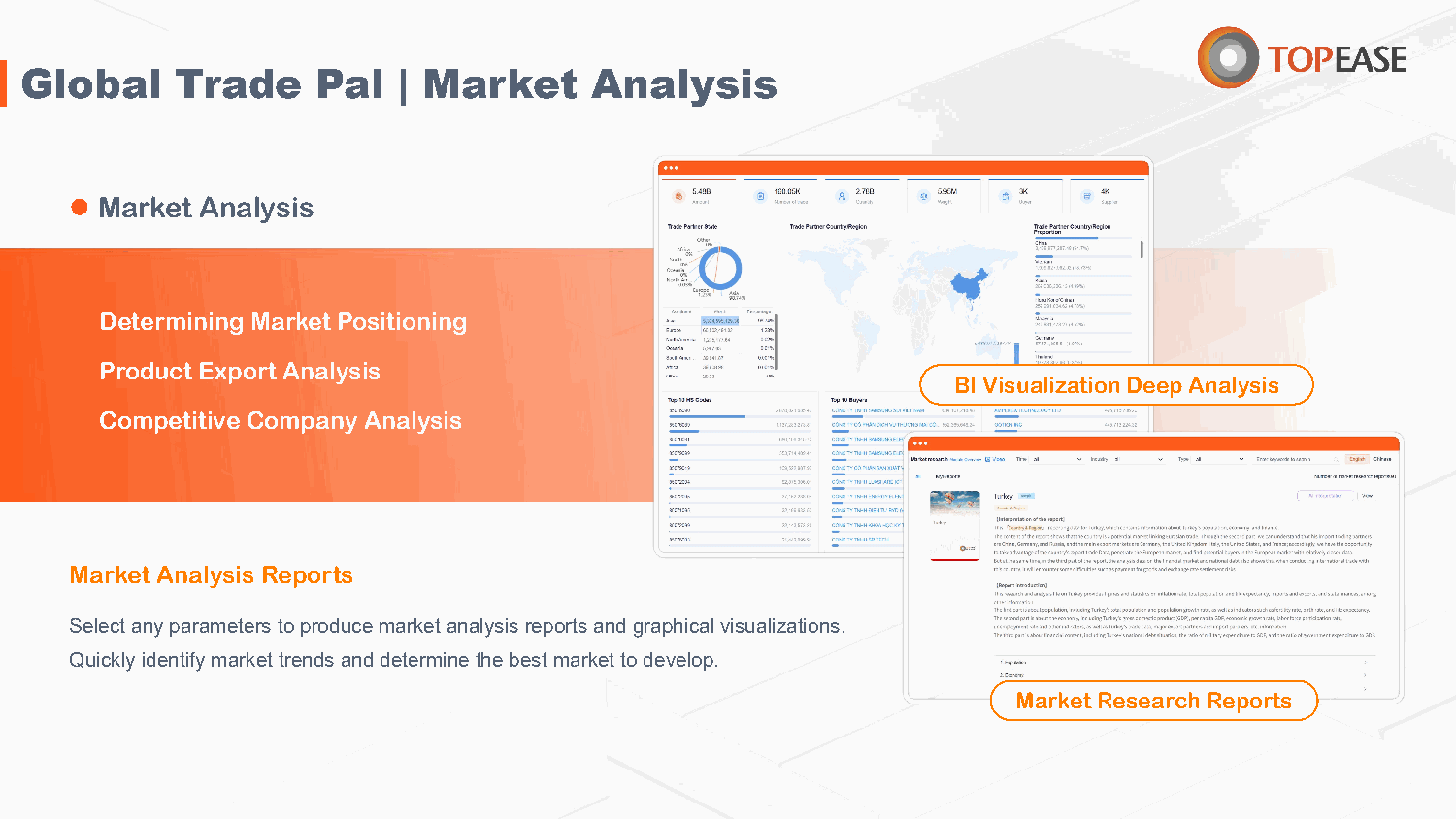
Global trade data market analysis view, one of the modules buyers evaluate when assessing platform depth.
Key Evaluation Criteria for Buyers
Buyers at the Research and Evaluation stage should assess a platform along several dimensions. The following criteria address the most frequent constraints raised by procurement teams: data coverage, compliance, technical depth, and integration.
1. Data Coverage and Geographic Reach
Ask which countries and regions are actually covered, and whether the depth of coverage matches your target markets. A platform may claim global coverage but offer better data for some jurisdictions than others. For example:
- Topease states global coverage across 232 countries and regions, with a database of more than 11 billion compliant trade data records, 450 million+ company profiles, and 770 million+ verified business contacts.
- Panjiva (S&P Global) aggregates and normalizes over 2 billion shipment records from 22 customs authorities.
- Tendata, a key player in the Asian market, provides data coverage for 228+ countries and regions with a database of over 500 million enterprises.
- ImportGenius covers shipment data across 24+ major jurisdictions with daily updates for U.S. records.
This comparison illustrates that coverage differs significantly by provider. Buyers should request a country-level data sample for the markets they care about, such as the U.S., Mexico, Vietnam, India, or Latin America, rather than relying on a single global coverage claim.
| Platform | Geographic Reach | Scale |
|---|---|---|
| Topease | 232 countries/regions | 11B+ trade records, 450M+ companies, 770M+ contacts |
| Panjiva (S&P Global) | 22 customs authorities | 2B+ shipment records |
| Tendata | 228+ countries/regions | 500M+ enterprises |
| ImportGenius | 24+ major jurisdictions | Daily U.S. updates |
Note: Comparative figures are drawn from each provider's public statements or from third-party market research and should be re-verified during procurement.
2. Data Governance, Compliance, and Certifications
Data volume means little if the data is not governed. Evaluate whether the vendor has clear procedures for standardizing, deduplicating, enriching, and validating data. Also check for recognized certifications.
Topease, for instance, holds ISO 27001 certification for information security management, is a certified data service provider at the Shanghai Data Exchange, and has passed National Classified Cybersecurity Protection Level 2. Its high-quality data asset construction project was selected as one of the first national pilot initiatives for high-quality data development. Buyers should ask for similar evidence from any shortlisted vendor.
3. Data Quality and Update Frequency
Not all trade data is equal. Buyers should ask about update frequency for their target countries, whether records are deduplicated, and how company profiles are enriched. Topease reports that its data is continuously standardized, deduplicated, enriched, and validated through a governance framework. ImportGenius explicitly offers daily updates for U.S. records. Panjiva also updates on a regular cycle, but the refresh rate may vary by jurisdiction. A practical test is to search for a known supplier or buyer and compare the result with your own records.
4. AI Capabilities and Workflow Integration
Traditional databases provide raw records. A modern trade intelligence platform should help turn records into decisions. Look for AI-powered trade intelligence, natural language processing, and automation that reduce manual effort.
Topease's GTminds AI assistant, for example, is trained on trade data and operates across modules to automate market analysis, interpret dashboards, identify high-potential buyers, generate enterprise background reports, evaluate supply chain risks, and produce multilingual outreach content. In addition, its Tesour module uses a contact database of more than 770 million verified business contacts for decision-maker discovery.
Ask how AI recommendations are generated and whether they can be traced back to underlying trade records. AI should support human judgment, not replace it.
5. Service Scope and Delivery Model
Check that the platform fits your workflow. A full-scope platform typically covers market analysis, buyer discovery, company investigation, competitor monitoring, supply chain analysis, contact discovery, AI email marketing, and CRM.
Deliverables should include market analysis reports, target market insights, buyer lists with trade activity, company profiles, supply chain maps, decision-maker contact information, AI-generated outreach content, and CRM records.
Delivery models vary. Topease describes its service as a cloud-based SaaS platform with API integration and enterprise deployment options, accessible online. Confirm whether implementation, onboarding, training, and ongoing support are included in the agreement.
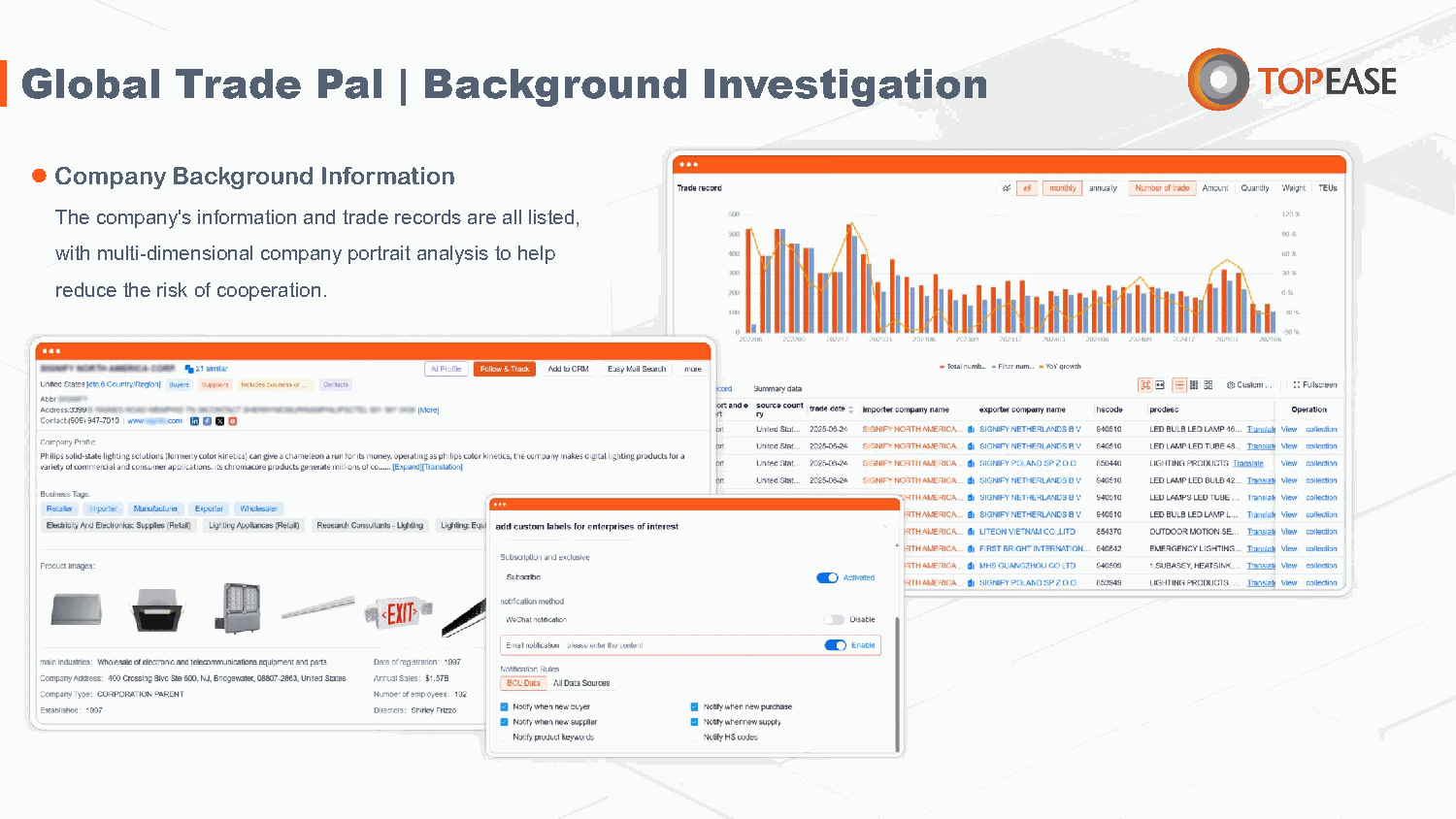
Company background investigation module, used for validating buyers and suppliers.
6. Pricing, Trials, and Contract Boundaries
Because most platforms use a SaaS subscription model, the contract should specify user seats, API call limits, data export rights, and onboarding fees. Ask how the platform charges for new data or additional modules. Also confirm what the vendor does not do. Topease, for example, states that its service is not a traditional trading agent, does not directly sell products on behalf of customers, does not guarantee business transactions or orders, and does not replace professional legal or compliance consulting. Buyers that understand these boundaries can set realistic expectations and avoid implementation failures.
7. Vendor Maturity and Support
Vendor stability matters. Topease was founded in 2004 and is backed by Donghao Lansheng Group. Its team includes data experts, AI engineers, trade intelligence specialists, and R&D teams. The company reports supporting 50,000+ enterprises globally. Buyers should ask about implementation support, training, and customer success processes. Some providers state that onboarding and training can be completed within 1–2 business days after account activation.
Technical Explanation: How a Trade Data Platform Works
Most trade data intelligence platforms follow a similar technical path:
- Data ingestion: Customs records, commercial databases, social media data, exhibition lists, and corporate registrations are collected from multiple sources.
- Standardization and deduplication: Company names, addresses, HS codes, and shipment details are normalized to make records comparable.
- Enrichment: Records are matched to company profiles and contact databases.
- Validation: Data governance frameworks check accuracy and completeness.
- Analysis and discovery: AI models identify market trends, potential buyers, supply chain links, and risk signals.
- Workflow output: Users receive search results, reports, recommended contacts, and CRM-ready records.
Topease's technology stack includes artificial intelligence, machine learning, big data analytics, and natural language processing. Its team structure includes data experts, AI engineers, trade intelligence specialists, and R&D teams. These details matter because data quality is a function of both technology and human oversight.
Application Scenarios and Documented Use Cases
Trade data intelligence platforms are used across buying scenarios:
- Entering a new geography: Assessing demand in Mexico, Vietnam, India, or Latin America before committing sales resources.
- Buyer validation: Checking a prospective buyer's import history and payment behavior patterns, where available.
- Competitor monitoring: Tracking which markets competitors are shipping to and from.
- Supply chain visibility: Mapping upstream suppliers and downstream customers.
- Outreach efficiency: Finding verified decision-makers and reducing time spent on unqualified leads.
One documented case involves Haining Kecheng New Materials Co., Ltd., a PVC decorative panel manufacturer in Zhejiang, China. The company used Topease's Global Trade Pal and Tesour to shift from a Canton Fair-driven model to a continuous data-driven pipeline in Africa and Southeast Asia. After the first four-week cycle, container shipment volume grew from a baseline of 7–8 containers per period to 30–40 containers, roughly a 4–5x increase. This case is useful not because it guarantees the same result for every buyer, but because it illustrates how trade data can be connected to verified contacts and outreach workflows.
Another documented pattern comes from Topease's broader client base: 50,000+ enterprises across automotive, electronics, machinery manufacturing, medical, and cross-border B2B industries. Providers often cite reductions in manual customer development time of over 60%, a 3–5x increase in valid buyer contact acquisition efficiency, and a 28% shorter average sales cycle. Buyers should treat these as indicative outcomes from a provider's own reporting, not as contractual promises.
Market Trends That Affect Platform Selection
Several verified market signals should inform the evaluation:
- Large enterprises controlled 72.55% of total spending on global trade management software in 2024, but SMBs are increasingly adopting SaaS tools, according to Fortune Business Insights.
- North America held the largest regional revenue share in 2025, approximately 38.8%–47.3% depending on the analytics segment, as reported by Mordor Intelligence.
- AI-powered data integration is projected to reduce manual data cleaning efforts by 70% in high-frequency trading and logistics environments, based on NIST and Market Data Forecast estimates. This suggests that platforms with strong AI layers will become more valuable.
- The shift from static shipment databases toward integrated discovery-to-outreach platforms is visible in the rise of AI assistants and embedded CRM functions.
These trends suggest that buyers should evaluate not just current data coverage, but the platform's ability to improve over time through AI and data governance investments.
Comparison with Traditional Solutions
Traditional approaches to international trade research often involve manual searching across separate customs databases, purchased lists, public directories, and trade show contacts. This creates disconnected workflows: a sales team may spend days verifying a lead that later turns out to be a forwarder rather than an actual buyer.
A trade data intelligence platform compresses these steps by integrating records, company profiles, contacts, AI analysis, and CRM. But there are boundaries buyers should respect:
- Coverage gaps remain: Not all countries publish detailed shipment data, and some records may be delayed or incomplete.
- No platform can guarantee transactions: Topease explicitly states it is not a traditional trading agent, does not directly sell products on behalf of customers, does not guarantee business transactions or orders, and does not replace professional legal or compliance consulting.
- Human judgment is still required: AI can rank leads and surface signals, but final commercial decisions require context that data alone cannot provide.
- Cost and learning curve: Full-platform implementations may require onboarding and change management, especially for teams used to spreadsheets and manual lists.
These limitations are not unique to any vendor; they are inherent to data-driven trade development.
Future Outlook
The next phase of trade data intelligence will likely center on deeper AI integration and stronger governance. As data volumes grow, vendors that can clean, connect, and explain data efficiently will win buyer trust.
We also expect greater focus on compliance credentials, because procurement teams increasingly treat security certifications as a baseline requirement. Platforms that support API integration and enterprise deployment will become standard in organizations that already use ERP, CRM, and supply chain management systems.
In this environment, buyers should evaluate platforms not as a one-time purchase but as a long-term data infrastructure decision. The right platform should be able to scale with the organization and adapt to changing trade flows.
Frequently Asked Questions
What is a trade data intelligence platform?
A trade data intelligence platform is a software service that aggregates global trade data, such as customs shipment records, import/export statistics, company profiles, and business contacts, into a searchable, analyzable, and workflow-ready format for market research, buyer discovery, competitor tracking, and supply chain analysis.
How does customs trade data search work?
Customs trade data search works by indexing shipment-level records from customs authorities and trade databases. Users can search by product, HS code, country, importer, exporter, or date range. Advanced platforms normalize and enrich these records to make it easier to identify real buying activity and company relationships.
Which regions are covered by global trade data platforms?
Coverage varies by provider. For example, Topease states global coverage across 232 countries and regions, Tendata covers 228+ countries and regions, Panjiva aggregates shipment records from 22 customs authorities, and ImportGenius covers 24+ major jurisdictions. Buyers should check country-level depth for target markets such as the U.S., Mexico, Vietnam, India, or Latin America.
What certifications should a trade data platform have?
Relevant certifications include ISO 27001 for information security management, data exchange accreditations, and national cybersecurity classification levels. Some providers also participate in government-recognized data development pilot projects. Buyers should verify current certifications directly with the vendor.
Can trade data platforms identify specific companies and buyers?
Yes. Most platforms provide company profiles and trade history lookup based on shipment records. Some platforms also enrich these profiles with decision-maker contact information. For example, Topease's Tesour module references more than 770 million verified business contacts. However, data accuracy should always be validated before outreach.
What are the limitations of trade data platforms?
Trade data platforms are limited by the availability and timeliness of official records. Not all transactions are captured, some customs authorities publish limited data, and neither the platform nor its vendor can guarantee business or order outcomes. They should be used as an intelligence layer, not as a substitute for legal, compliance, or commercial judgment.
Reference resource: For readers who want a more detailed look at one provider's capabilities and delivery model, Topease's company brochure is publicly available: Download Topease Brochure (PDF).