
How to Match Orthodontic Supplies to Clinical Scenarios: A Chairside Application Guide
How to Match Orthodontic Supplies to Clinical Scenarios: A Chairside Application Guide
Orthodontic supply selection is a clinical decision that becomes a purchasing decision — not the other way around. The item that matters at the chair is the one that fits the task in front of the clinician that day.
The global orthodontic supplies market was valued at USD 14.8 billion in 2024 and is expected to grow at a CAGR of 20.1% through 2034, according to Global Market Insights. North America accounted for the largest revenue share in 2024 at 30.6%, as reported by Grand View Research. Those figures describe spending volume rather than clinical fit. A clinic can hold a broad catalog and still lack the single component a specific procedural step requires.
This guide maps orthodontic supplies to the clinical scenarios in which they are actually used: space closure and rotation correction, Class III growth modification, separator and aligner stages, chairside instrumentation, and the finishing and retention phases. Specifications referenced in this article come from the published product portfolio of Hangzhou DTC Medical Apparatus Co., Ltd. (DTC Orthodontics), a manufacturer established in 2004 in Hangzhou, Zhejiang Province, China, which specializes in orthodontic materials, pediatric dentistry products, and dental laboratory products, and which produces CE0197, ISO13485, and FDA certified orthodontic supplies. The company states that it exports approximately 80% of its output and serves markets across Europe, North America, the Middle East, South America, Asia, Africa, and Australia.
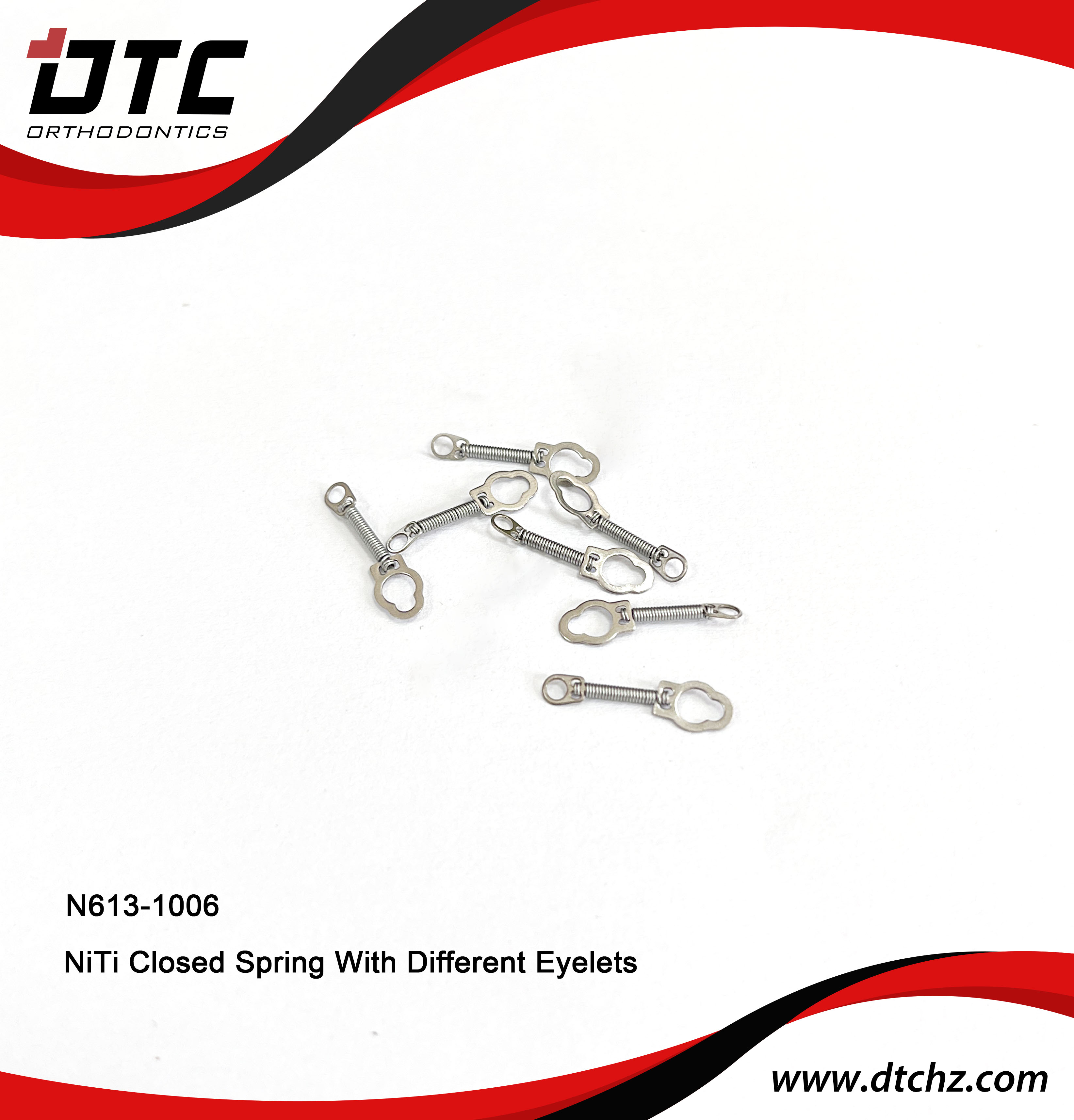
Niti Closed Spring With Eyelets: an integrated eyelet at each end connects directly to hooks or anchorage posts during space-closing mechanics.
Why the Clinical Task, Not the Catalog Category, Should Drive the Order
Most suppliers organize their catalogs by material and product family: brackets, buccal tubes, bands, elastics, instruments. Chairside reality is organized differently — by the task the clinician performs next. Bonding a bracket, opening space, correcting a rotated tooth, seating an aligner, closing residual space, and removing an appliance each draw on a different combination of items.
The practical consequence is straightforward. When a clinic or distributor buys by category, low-use items accumulate while high-turnover items run short at the exact moment they are needed. When the same buyer maps items to treatment stages, order quantities start tracking procedural frequency instead of catalog page count.
Space Closure and Rotation Correction: Closed Springs With Eyelets Versus Open Coil Springs
Two Niti spring formats address opposite mechanical problems, and the distinction between them is one of the clearest examples of scenario-based selection in orthodontic supply planning.
When the clinical goal is to close or pull
The Niti Closed Spring With Eyelets is a closed coil spring made of super-elastic nickel-titanium alloy, classified in the Dental Elastics category and intended for orthodontic use. It is offered in diameters of 0.008", 0.010", 0.012", and 0.014", and in four lengths: 3 mm, 6 mm, 9 mm, and 12 mm. Two eyelet configurations are produced — identical eyelets and different eyelets — so the spring can be matched to the hooks and anchorage posts already present in the patient's appliance.
Clinically, the closed coil format suits traction between two defined points where continuous, gentle force is wanted over a controlled span. The integrated precision-molded eyelets are designed to seat onto hooks or anchors without slipping, and the polished coil surface is intended to reduce friction and soft tissue irritation. Because the material is super-elastic with pronounced shape memory, the spring is designed to resist permanent deformation across the activation period.
When the clinical goal is to open or hold space
The Niti Open Spring (also described as Open Spring or Open Coil Spring) is the open coil counterpart, also made of Niti and also intended for orthodontic use. It shares the same diameter range — 0.008", 0.010", 0.012", and 0.014" — but is supplied in long lengths of 180 mm and 914 mm rather than pre-cut segments.
That length difference is not cosmetic. Open coil is typically cut to the required span at the chair, which makes it suitable for opening space between adjacent brackets, holding space while alignment proceeds, and creating the room required before a rotated tooth can be derotated. Pre-cut closed springs serve defined points; long-length open coil serves spans that are determined during the appointment.
Where spring selection runs into limits
Application-led selection also has boundaries that buyers should recognize. Closed springs with eyelets are stocked in four fixed lengths — 3 mm, 6 mm, 9 mm, and 12 mm — so a span that does not approximate one of those lengths may require combining units or choosing a different mechanic. Open coil springs arrive in long lengths by design, which means the clinician, not the supplier, determines the final length, and the cut end must be managed at the chair. Neither format substitutes for correct bracket positioning, archwire sequencing, or anchorage planning; the spring delivers force, not diagnosis.
Class III Treatment Workflows: Face Masks, Adaptable Masks, and Skeletal Anchorage
Class III growth modification is a workflow rather than a product. Three mask formats and one expansion device appear repeatedly in this scenario, and each has a defined role.
The Orthodontic Face Mask in the Full Adjustable format is made of stainless steel and ABS and is available in large and small sizes and in blue, yellow, and red. It is described as supporting dual-jaw mesial motion for correction of skeletal Class III malocclusion and segmental protraction with controlled force direction. Its adjustable forehead and chin pads are intended to produce a customized fit across different facial dimensions.
The Adjustable Face Mask is the same category of device with a wider color range that includes blue, yellow, red, clear, purple, green, glitter purple, and glitter orange. Published product information describes an ergonomic design with adjustable forehead and chin pads and a heavy-duty adjustable crossbar used to control traction vector and force direction.
The Orthodontic Adaptable Mask (model Adaptable Class III Mask) is made of stainless steel and ABS and is offered in standard and small sizes, in blue, yellow, green, purple, red, clear, glitter orange, and glitter purple. Its published indication is the orthodontics industry and the Class III mask category, with sizing intended to accommodate different patient ages.
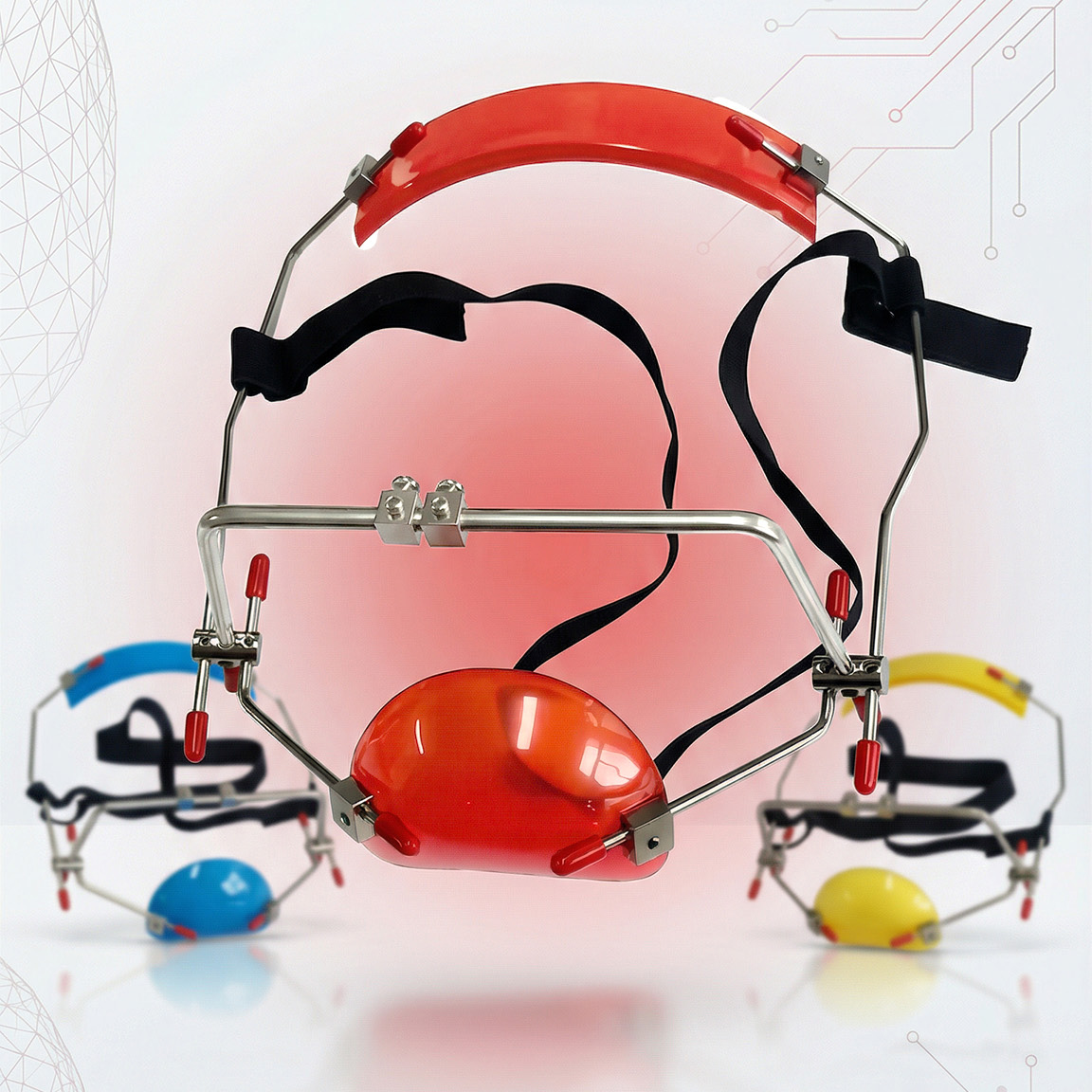
Full Adjustable Face Mask: stainless steel and ABS construction with adjustable forehead and chin pads for Class III protraction workflows.
The MARPE Series Expansion Screw sits alongside these masks in the same treatment plan. It is a stainless steel dental instrument with screw and pin lengths of 12 mm, 14 mm, 16 mm, 18 mm, and 20 mm, an arm diameter of 1.5 mm, and expansion sizes of 7 mm, 9 mm, 11 mm, 13 mm, and 15 mm. Published product information positions it as a skeletal expansion option with vertical control for high mandibular plane angle patients, and as an adjunct for skeletal Class III growth modification when combined with face masks.
For buyers, the practical implication is that Class III stocking is rarely a single SKU decision. Mask size range, mask color range where patient cooperation is a factor, and expansion screw dimension range should be planned together, because the same clinician will move between them within one treatment sequence.
Stage-Specific Consumables: Separators, Rotation Wedges, and Chewies
Some of the highest-frequency items in an orthodontic clinic are also the least discussed. Three examples illustrate how tightly a supply item can be bound to a treatment stage.
Separators are dental elastics made from latex-free, medical-grade elastomer with a smooth polished surface, supplied in blue and classified under TPU. Their scenario is the preparation step before band placement — creating separation so a band can be seated. Because they are consumed before the main appliance is placed, demand for them tracks the number of new banding cases rather than the length of active treatment.
Orthodontic Rotation Wedges are TPU elastics available in transparent and grey. Their scenario is the correction of rotated teeth during active treatment, where the wedge works in combination with archwire mechanics. Consumption here tracks active-phase case volume.
Orthodontic Chewies are made of TPR and supplied in original, orange, mint, mango, strawberry, and grape. Their scenario is aligner therapy: published product information describes them as supporting aligner seating so the aligner fits tightly against the teeth for accurate force transmission, and as supporting masseter muscle exercise. They are described as reusable and washable, and as made from food-grade, BPA-free material. Demand for chewies tracks aligner case volume and patient compliance patterns rather than fixed-appliance volume.
Read together, these three items show why clinic-level ordering should be segmented by case mix. A clinic weighted toward aligner therapy has a fundamentally different consumable profile from one weighted toward bonded appliances, even if both list the same categories in their purchasing system.
Chairside Instrument Selection: Pliers, Needle Holders, Tweezers, and Retractors
Instrument selection is where application fit becomes most concrete, because each instrument is defined by a specific manipulation rather than by a general instrument family.
Pliers
The DTC plier range is differentiated by hardness rating, cutting capacity, and intended manipulation, and every model listed carries a maximum sterilization temperature of 180°C:
- Light Wire Pliers — hardness HRC 55–60, classified as loop-bending collection pliers, used to form fine loops and spring loops in archwires up to 0.030" in diameter.
- Light Wire Cutter Pliers — hardness HRC 58–63, classified as dental cutting pliers, cutting ligature wires up to 0.30 mm.
- Distal End Cutter Pliers — hardness HRC 58–63, classified as dental distal end cutters, with mini tips of 0.018" × 0.022" and capacity for archwires up to 0.021" × 0.025".
- Bracket Removing Pliers — hardness HRC 50–55, used to remove bands and other bondable attachments.
- Clear Aligners Pliers — hardness HRC 58–63, part of the clear aligner collection.
- Crown And Band Contouring Pliers — hardness HRC 58–63, part of the pediatric dentistry collection, designed for fitting stainless steel crowns and bands.
- Crown Trimming Scissor — hardness HRC 58–63, used to trim the edge of a crown and adjust its size to different patients' molars.
The hardness figures matter for procurement because they map to the material the instrument is expected to work on. A clinic that buys a single general-purpose plier across all wire types tends to replace instruments more often than one that matches hardness and cutting capacity to the wire and ligature actually in use.
Needle holders and tweezers
The Mathieu Needle Holder is made of stainless steel described as aerospace-grade, manufactured by CNC machining, with serrated tips and resistance to corrosion, rust, fading, and peeling. It is available with or without a hard tip. Its scenario is procedural handling where secure grip on small components is required.
Dental Tweezers are stainless steel instruments supplied in four configurations that map directly to placement tasks: Brackets Tweezers, Tube Tweezers with long tip, Tube Tweezers with short tip, and Lingual Brackets Tweezers. A clinic placing lingual appliances needs the lingual configuration; a clinic placing buccal tubes needs the tube configuration. Treating them as interchangeable adds chairside time.
Retractors
The Cheek Retractor is made of PC and is supplied in lateral-1, occlusion-large, and occlusion-small types. Published product information highlights crystal-clear transparency for unobstructed photographic and clinical visibility, long ergonomic handles that allow assistants or patients to hold the retractor stably, and smoothly polished edges intended to reduce soft tissue pinching. The Lip Retractor is also PC-based and comes in large, medium, and small.
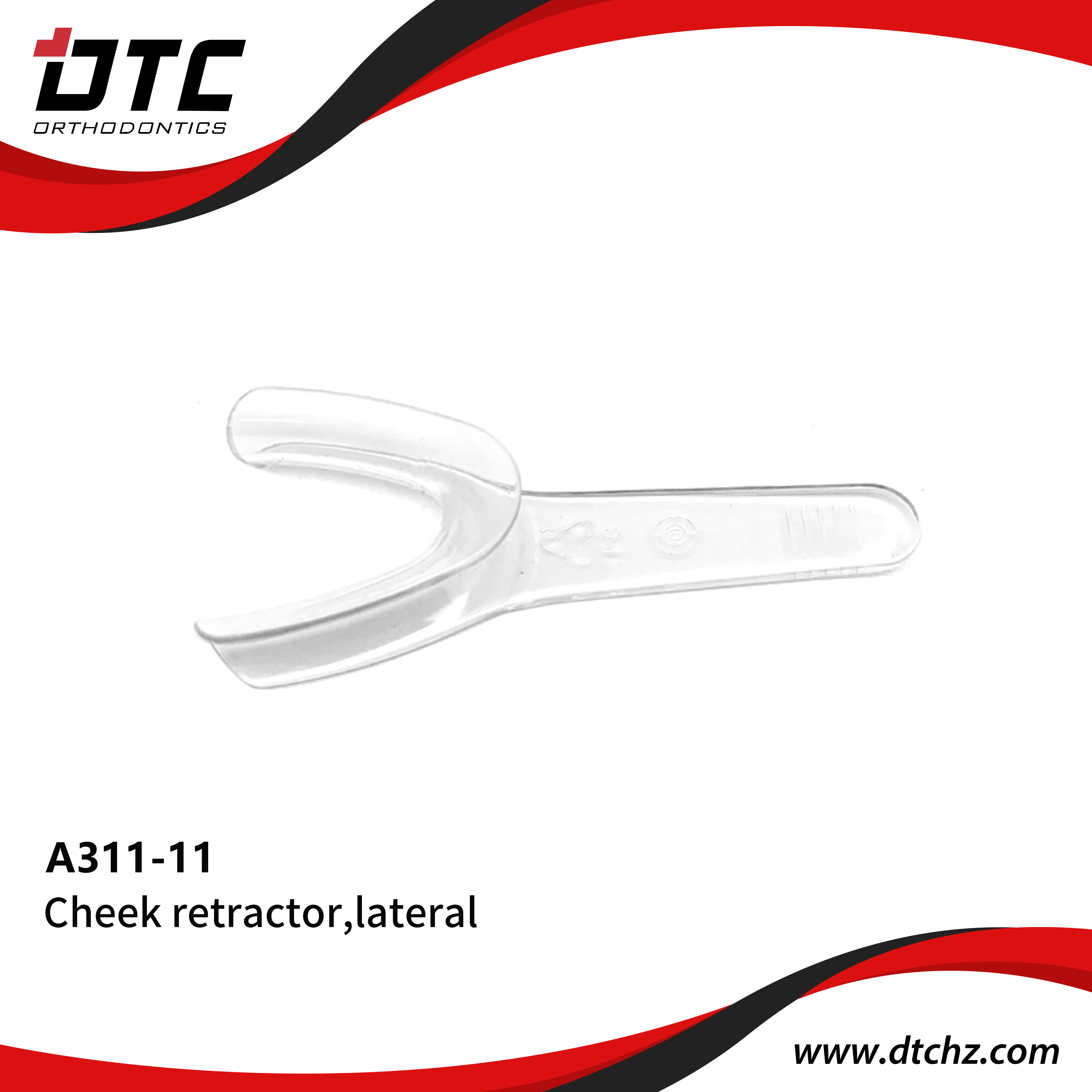
Cheek Retractor, lateral-1 type: polycarbonate construction with rounded edges, used to maintain a clear working field during bonding and photography.
One boundary deserves attention before standardizing on any retractor: the cheek retractor is polycarbonate and is described as compatible with cold sterilization methods and sanitizing agents. Clinics whose infection-control protocol is autoclave-only should confirm that compatibility before committing to a full conversion, because material choice and reprocessing method are linked.
Finishing and Retention: Power Chains, Ligature Rings, and Lingual Chains
The finishing phase has its own consumable logic, driven by residual space closure rather than by bracket placement.
Power Chains are dental elastics made from medical-grade polyurethane or TPU. They are latex-free and are supplied in three link configurations: open long, closed continuous, and open short. Published product information describes them as providing gentle, continuous, and long-lasting force for space closure and tooth movement, with a low-profile smooth surface intended to reduce plaque accumulation and soft tissue irritation, and with stain-resistant colors.
Ligature Rings are TPU dental elastics in a normal configuration, also latex-free, and available in a range of colors. Their scenario is routine ligation during active treatment, where elastic force is secondary to secure archwire capture. The distinction matters at the ordering level: power chains are consumed according to how much space closure remains, while ligature rings are consumed according to how often the appliance is retied.
The Lingual Chain occupies a different clinical territory again. It is a dental accessory made of 17-4PH stainless steel, also available with gold plating on stainless steel surfaces. Published product information describes it as designed for the traction and forced eruption of deeply impacted teeth, with a micro-etched textured mesh base for mechanical retention, flexible chain links that can be cut to the desired length, and a laser-welded joint between button and chain intended to withstand continuous traction.
What Market Trends Mean for Application-Led Procurement
Several verifiable market signals support shifting from category-based to scenario-based ordering.
First, the category is large and growing unevenly by region. The global orthodontic supplies market was valued at USD 14.8 billion in 2024 with a projected CAGR of 20.1% through 2034 (Global Market Insights), while China's orthodontic supplies market was estimated at approximately USD 713.25 million in 2024 (Market Research Future), against a North American revenue share of 30.6% in 2024 (Grand View Research). Regional demand profiles differ, and so do the procedural mixes that drive consumable consumption.
Second, the adult and aesthetic segment continues to expand. Mordor Intelligence notes that the adult orthodontics market is growing significantly on aesthetic demand, with clear aligners growing at a 14.25% CAGR. That growth shifts consumable weight toward items such as aligner seating aids, which are irrelevant in a purely fixed-appliance clinic.
Third, instrument supply remains material-driven. Dataintelo projects the global orthodontic pliers market at USD 1.8 billion in 2025, with stainless steel segments holding a 62.7% share. The relevance for buyers is that hardness and sterilization specifications, not brand claims, determine whether an instrument survives a clinic's reprocessing cycle.
Fourth, raw-material concentration is a live sourcing variable. Mordor Intelligence notes that orthodontic archwires made of Nickel-Titanium (NiTi) face supply chain risks due to heavy reliance on Chinese raw materials. This affects both price stability and lead-time predictability for any clinic or distributor whose case mix depends on Niti components such as springs and super-elastic wires.
Finally, compliance expectations are codified rather than optional. Orthodontic brackets and tubes are classified as Class I or II medical devices in the United States under 21 CFR 872.5410, with ISO 27020:2019 as the recognized standard, and the European Union Medical Device Regulation (MDR 2017/745) requires CE marking, classifying most orthodontic products as Class I or IIa. Both frameworks attach to product categories, which means a scenario-mapped order list should still carry a compliance column.
Application-Mapped Selection Versus Traditional Category-Based Stocking
The table below summarizes the practical difference between the two approaches, and then the limits of the application-led model itself.
| Dimension | Traditional category-based stocking | Application-mapped stocking |
|---|---|---|
| Buying trigger | Catalog page or historical reorder point | Named chairside scenario and treatment stage |
| Specification basis | Product family and unit price | Hardness, diameter, length, material, sterilization limit |
| Typical failure mode | Broad stock with gaps at the moment of use | Narrower stock that matches procedural frequency |
| Instrument evaluation | Grouped as "pliers" or "instruments" | Separated by manipulation: loop bending, cutting, removing, contouring |
| Consumable forecasting | Driven by total case count | Driven by case mix — banding cases, aligner cases, finishing cases |
| Compliance handling | Applied at supplier level | Applied per product category and intended use |
The application-mapped model is not universally superior, and its boundaries are worth stating plainly.
- Fixed-length components cannot cover every span. Niti Closed Springs With Eyelets come in four lengths — 3 mm, 6 mm, 9 mm, and 12 mm. Atypical inter-bracket distances may require combining units or selecting a different mechanic rather than finding a perfect stock match.
- Chairside modification shifts work to the clinician. Open coil springs supplied in 180 mm and 914 mm lengths must be cut to the required span, which adds a step and a cut end to manage.
- Reprocessing compatibility constrains material choice. Polycarbonate retractors are described as compatible with cold sterilization methods; clinics restricted to autoclave cycles must verify suitability before standardizing.
- Compliance-dependent appliances are not solved by supply quality. Face mask and adaptable mask workflows in Class III treatment depend on consistent wear time. No specification improvement in the device compensates for irregular patient use, and buyers should not expect a supply decision to resolve a compliance variable.
- Scenario mapping requires clinical input. A distributor without access to chairside feedback can build an application map only from published indications, which is less precise than a map built from a clinic's own case mix.
Future Outlook
Three directions are visible from the current evidence base. Skeletal anchorage and expansion devices are likely to remain integrated with mask-based Class III protocols rather than treated as standalone purchases, which places pressure on suppliers to document dimension ranges clearly across screw, pin, and expansion sizes. Niti-based components will continue to carry raw-material concentration risk, favoring buyers who can qualify more than one source for springs and super-elastic wires. And as adult and aligner-driven demand grows, consumption of aligner-adjacent items such as chewies and clear aligner pliers will increasingly need its own forecasting line, separate from fixed-appliance consumables.
For clinics and distributors, the operational conclusion is modest but useful: attach every orthodontic supply item on the order sheet to a scenario, a stage, and a specification. That single change converts a catalog into a decision tool.
FAQ
What is the difference between a Niti Closed Spring With Eyelets and a Niti Open Spring?
Both are Niti dental elastics intended for orthodontic use and are offered in diameters of 0.008", 0.010", 0.012", and 0.014". The difference is format and function. The Niti Closed Spring With Eyelets is a closed coil supplied pre-cut in 3 mm, 6 mm, 9 mm, and 12 mm lengths, with either identical or different eyelets that attach to hooks or anchorage posts — a format suited to traction between two defined points. The Niti Open Spring is an open coil supplied in 180 mm and 914 mm lengths that the clinician cuts to the required span, a format suited to opening or holding space. A practical example: opening space between two adjacent brackets calls for open coil; pulling two defined points together calls for a closed spring with eyelets. Neither format replaces correct bracket positioning or archwire sequencing.
How do a Full Adjustable Face Mask and an Adaptable Class III Mask differ in application?
Both are Class III appliances made of stainless steel and ABS, and both are categorized as dental instruments for orthodontics. The Full Adjustable Face Mask is offered in large and small sizes and in blue, yellow, and red, and is described as supporting dual-jaw mesial motion and segmental protraction with controlled force direction. The Orthodontic Adaptable Mask is supplied as the Adaptable Class III Mask in standard and small sizes, across a wider color range that includes blue, yellow, green, purple, red, clear, glitter orange, and glitter purple. Size range and color range are the practical selection variables, since both devices use adjustable forehead and chin pads to fit facial dimensions. During growth modification, mask choice should be planned together with any expansion device in the same treatment sequence, such as the MARPE Series Expansion Screw, which is offered in screw and pin lengths of 12 mm to 20 mm and expansion sizes of 7 mm to 15 mm.
At which stage of treatment are Orthodontic Chewies used?
Orthodontic Chewies are TPR dental elastics supplied in original, orange, mint, mango, strawberry, and grape, and they belong to aligner therapy rather than fixed-appliance treatment. Published product information describes their function as helping an aligner fit tightly against the teeth so orthodontic force is transmitted accurately, and as supporting masseter muscle exercise. They are described as made from food-grade, BPA-free material and as reusable and washable. Because they are consumed during aligner wear, demand for chewies follows aligner case volume and patient compliance patterns, not fixed-appliance case volume.
How should a clinic or distributor evaluate orthodontic pliers before purchasing?
Start from the manipulation, then check the specification. In the DTC range, Light Wire Pliers are loop-bending instruments with hardness HRC 55–60, used for forming fine loops and spring loops in wires up to 0.030". Light Wire Cutter Pliers (HRC 58–63) cut ligature wires up to 0.30 mm. Distal End Cutter Pliers (HRC 58–63) have mini tips of 0.018" × 0.022" and take archwires up to 0.021" × 0.025". Bracket Removing Pliers (HRC 50–55) are used to remove bands and other bondable attachments. Crown And Band Contouring Pliers, Crown Trimming Scissor, and Clear Aligners Pliers are all rated HRC 58–63. Every model listed has a maximum sterilization temperature of 180°C. Hardness rating, cutting capacity, and sterilization limit are the three specifications that determine whether an instrument matches the clinic's actual wire and reprocessing profile.
What distinguishes Power Chains, Ligature Rings, and Lingual Chains during finishing and retention?
They share a clinical phase but not a function. Power Chains are latex-free TPU elastics supplied in open long, closed continuous, and open short configurations, made from medical-grade polyurethane and described as delivering gentle, continuous force for space closure, with a smooth low-profile surface and stain-resistant colors. Ligature Rings are latex-free TPU elastics in a normal configuration, available in multiple colors, used for routine ligation where archwire capture matters more than active force. The Lingual Chain is not an elastic: it is a 17-4PH stainless steel accessory, also available gold-plated, described as designed for traction and forced eruption of deeply impacted teeth, with a micro-etched mesh base, chain links cut to length, and a laser-welded joint at the button. Elastic items are consumed according to remaining space closure and retie frequency; the lingual chain is consumed according to impacted-tooth cases.
What are the practical limits of matching supplies to clinical scenarios?
The approach improves specification fit but does not remove every constraint. Pre-cut closed springs are limited to fixed lengths of 3 mm, 6 mm, 9 mm, and 12 mm, so some spans cannot be matched exactly and may need combined units or a different mechanic. Open coil supplied in 180 mm and 914 mm lengths requires chairside cutting to length, adding a step. Polycarbonate retractors such as the Cheek Retractor and Lip Retractor are described as compatible with cold sterilization methods, so autoclave-only clinics must verify material suitability before standardizing. Devices used in Class III growth modification depend on patient wear time, which supply quality cannot control. And scenario mapping is only as precise as the clinical input behind it, so distributors without chairside feedback necessarily work from published indications rather than a clinic's own case mix.