
How to Match an Aluminum Frame Tent to a Warehouse, Sports, or Event Project
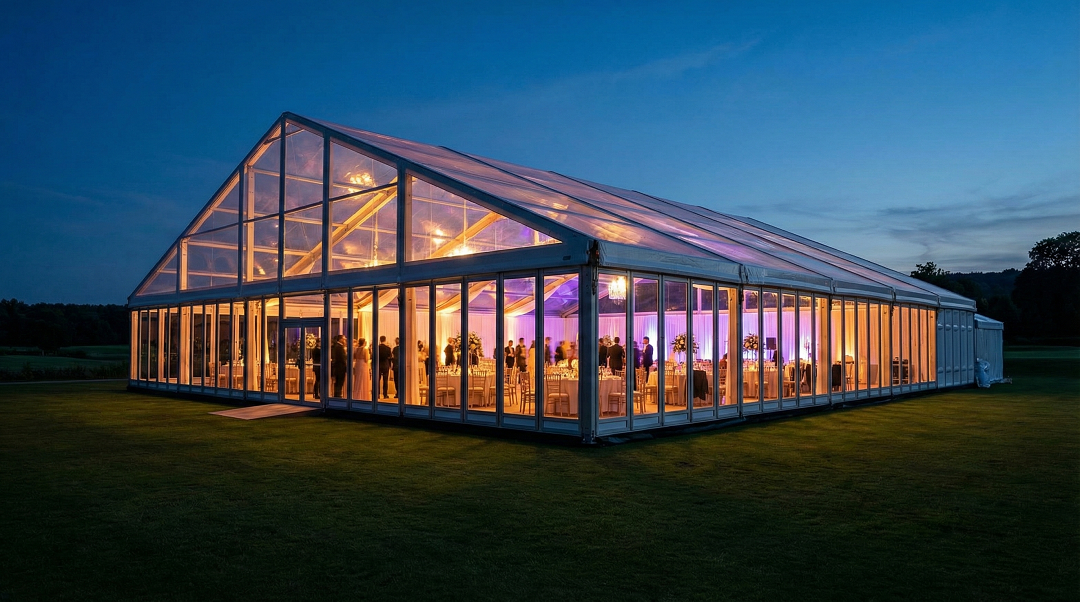
A large aluminum frame tent configured for event use. Modular bay extension and sidewall options allow the same structure to serve sports, storage, and event functions.
An aluminum frame tent is not a single product category; it is a modular spatial solution that can be specified as a temporary warehouse, a sports venue cover, an aircraft hangar, or a large event marquee. The practical question for buyers is not simply whether an aluminum frame tent is suitable, but how to match the correct span, fabric, wind and snow rating, access layout, permitting assumptions, and supplier capability to a specific project. This article outlines how to work through that matching process, and why the same base structure can perform very differently depending on configuration.
The project-fit problem: why “large tent” is not a enough specification
Buyers evaluating aluminum frame tents for warehouse, sports, event, wedding, or hangar use often start with a single requirement: the clear span or floor area they need. In practice, the fit between a tent structure and a project depends on at least five variables: the activity taking place inside, the load environment at the site, the required speed of deployment and relocation, the access and enclosure needs, and the long-term ownership model.
A warehouse tent, for example, needs loading openings, sidewall protection, ventilation, and sometimes insulation; a pickleball, padel, or tennis tent needs a tall clear interior, good lighting, and side panels that can manage wind while keeping the court area usable; a wedding or event tent needs interior aesthetics, flooring, staging, and climate comfort. These are different sets of specifications built on the same aluminum frame platform.
The most common project failure is choosing a tent first and a configuration second. The more reliable approach is to define the operating scenario, then verify that the supplier can meet the structural, environmental, and functional requirements of that scenario.
Workflow: from project requirement to tent specification
A structured workflow helps buyers move from an open-ended problem to a verifiable specification. The following four steps are used in many commercial tent procurement processes.
Step 1: Classify the use scenario and operating duration
Aluminum frame tent structures are commonly used for temporary or semi-permanent storage facilities, semi-permanent large sports venues, temporary or large-scale events and weddings, exhibitions, warehousing, and logistics applications. Each scenario implies a different operating pattern: a semi-permanent sports venue may remain up for several seasons, while an event tent may be installed and dismantled repeatedly.
The buyer should classify the project into one of these categories before comparing prices. This is because the accessories, sidewalls, anchoring, and climate control packages differ, and these differences have a larger effect on total cost than the frame size alone.
Step 2: Establish the structural requirements
Outdoor or semi-outdoor tent installations require waterproofing, wind resistance, and flame retardancy. Depending on the region and site, the project may also require strengthened wind or snow load designs, foundation or anchorage treatments, insulation and climate control, and custom doors or loading openings.
An aluminum frame tent with a maximum wind load of 100–120 km/h and snow load up to 1.9 kN/m² provides a useful reference point. It is not, however, a universal rating: the actual performance depends on frame profile, span, anchoring method, fabric type, and local site exposure. Buyers should compare the specified load values against local building expectations and the tent’s intended service life.
Step 3: Map the functional and accessory needs
Supporting equipment for this type of structure includes cassette flooring, sidewalls and doors, ventilation and insulation accessories, lighting, staging and carpets, and anchoring systems. Custom needs such as extra-wide loading openings, blackout fabric, interior partitions, or HVAC integration should also be assessed at this stage.
A clear-span design is an important consideration for warehouses, sports facilities, and large events because it eliminates interior support columns and maximizes usable floor area. Modular bay expansion—often in 3 m or 5 m increments—allows the same system to be extended when demand grows.
Step 4: Compare supplier capability and delivery model
Because aluminum frame tents are project-oriented, the supplier evaluation should include manufacturing capability, engineering support, delivery time, and after-sales service. Buyers should check whether the supplier can provide custom design and technical support, whether the production process includes standardized engineering and quality inspections before leaving the factory, and whether after-sales support continues after global delivery.
The commercial relationship also matters. In the aluminum frame tent segment, ODM/design and manufacturing capability is a differentiator because many projects require size, height, color, fabric, door, flooring, and accessory customization. Suppliers with design and R&D teams can respond to those modifications more reliably than suppliers that only assemble standard parts.
Aluminum frame tent use cases: warehouse, sports, hangar, and event
The following scenarios illustrate how the same product platform can be adapted to different project profiles. The product is designed for temporary or semi-permanent storage facilities, semi-permanent large sports venues, temporary or large-scale events and weddings, and warehousing and logistics applications.
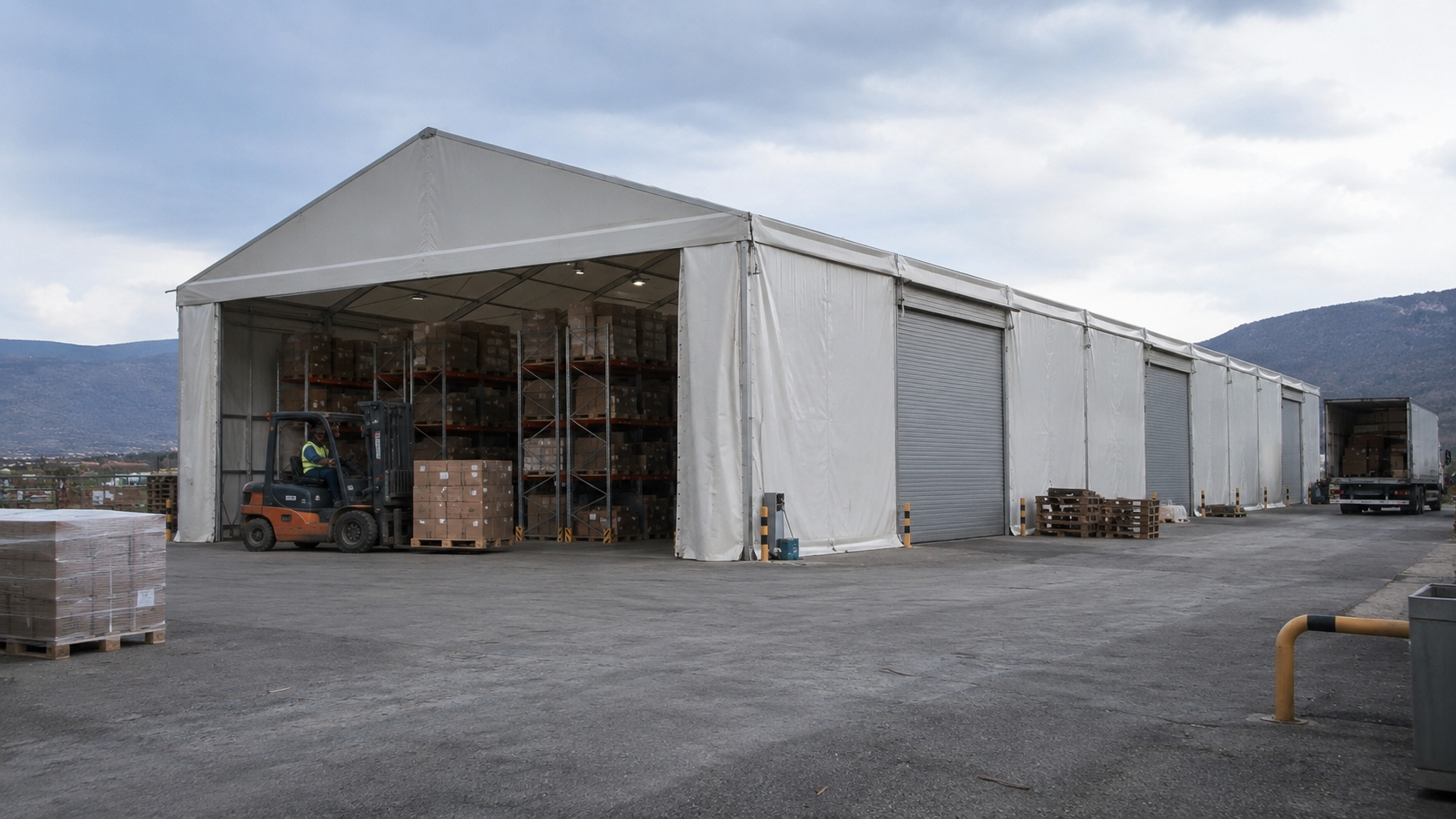
Temporary warehouse tents provide rapid storage expansion without the lead time of a permanent building. Sidewalls, doors, ventilation, and grounding treatments are selected according to stored materials and site conditions.
Temporary warehouse and industrial storage tent
For logistics companies and industrial facilities, the main advantage of a tent structure is speed. A temporary warehouse can be deployed to handle inventory expansion, seasonal storage, or overflow capacity. The structure provides secure, weather-resistant, and movable large-scale marquee solutions, and can be dismantled or relocated when the operational need changes.
Key specification points include loading openings, sidewall height, ventilation for heat or condensation management, and anchoring for wind resistance. For semi-permanent storage, a stronger foundation or anchorage treatment and insulation or climate control package may be justified.
Sports tent: pickleball, padel, tennis, and multi-use venues
Sports applications such as pickleball, padel, tennis, and multi-sport training halls require cleared interior space, adequate height, and good light control. An aluminum frame tent with a clear-span design can cover courts without internal columns, while side and gable panels provide wind and weather protection.
Semi-permanent sports venues are among the most demanding tent applications because they combine constant interior activity with extended outdoor exposure. The buyer should check the wind and snow load values, the quality of the fabric cover, and the ability to add lighting, insulation, and flooring systems.
Aircraft hangar and large equipment cover
For aircraft hangar tents and large equipment shelters, the dominant requirement is clear width and height. The modular aluminum frame system can be configured with custom doors or loading openings to accommodate aircraft entry and exit. This is a special case where the engineering review of the opening size and anchoring system deserves extra attention.
Large event, wedding, and commercial marquee tent
For event and exhibition use, the tent must serve as both structure and environment. A modular marquee system provides the space for large gatherings, weddings, exhibitions, and commercial events while allowing interior décor, lighting, staging, and flooring to be integrated.
The result, in this scenario, is a movable and scalable space that can be installed for a single occasion or reused across a season. Because event schedules are tight, rapid deployment is a major selection criterion.
Choosing between an aluminum frame tent and a permanent building
One of the most common evaluation questions is whether an aluminum frame tent should be compared against a steel or masonry warehouse. The comparison should be based on project time, budget, permanence, and risk.
- Speed: a tent structure can be manufactured and deployed in a shorter time than a permanent building, making it suitable for urgent capacity needs.
- Cost profile: the initial investment is typically lower, and the structure can be relocated if the site or need changes.
- Service life: an aluminum frame is not a permanent building. The specification and maintenance approach should match the intended years of operation, not the life of a conventional structure.
- Building code fit: a permanent warehouse must meet the full set of local building, fire, and planning regulations. A tent structure may have a lighter regulatory path in certain applications, but this varies by jurisdiction and must be verified with local authorities.
| Decision variable | Aluminum frame tent | Permanent steel or masonry building |
|---|---|---|
| Deployment speed | Modular assembly, designed for rapid installation and dismantling | Long construction and approval cycle |
| Relocation | Movable and reusable at another site | Fixed to the site |
| Customization | High: size, height, color, fabric, doors, flooring, insulation | High but more complex and expensive to change later |
| Clarity of long-term ownership | Requires planned maintenance and fabric replacement | Designed for longer service life |
An honest limitation of aluminum frame tent structures is that they are not always the right choice. For a permanent, high-value facility with a 30-year horizon, a conventional building is usually a better fit. For a semi-permanent sports venue, a temporary warehouse, a hangar, or a seasonal event structure, the tent offers speed and flexibility that permanent construction cannot easily match.
Market context: why demand for aluminum frame tents continues to grow
Several market indicators point toward continued demand for flexible tent infrastructure. The global event tent market, which includes aluminum frame structures, was projected to reach a valuation of over USD 3 billion by 2025, growing at a CAGR of 6.2%. The broader global tent market covering storage, sports, and event sectors was projected to grow from USD 4.01 billion in 2025 to USD 6.07 billion by 2033.
China’s export data also reflects the scale of this manufacturing segment. In 2024, China exported approximately USD 5.55 billion in “Aluminium Structures” (HS 7610), which covers modular tent frames. This signals that aluminum tent structures are a globally traded industrial category, not a niche product.
Two industry standards are especially relevant to buyers. In Europe, EN 13782:2015 sets requirements for mobile, temporary installed tents, including structural stability under wind and snow loads. In the United States, commercial event and industrial tents are commonly required to comply with NFPA 701, the standard for flame propagation of textiles and films. Buyers should confirm whether the supplier’s fabric and engineering approach align with the standards that apply in the destination market.
Supplier evaluation criteria for aluminum frame tent projects
As the market grows, supplier evaluation becomes more important. The following checklist can be used during the research and evaluation stage.
- Manufacturing substance: verify that the supplier is a manufacturer rather than a trading intermediary. A 20,000 m² factory and a dedicated R&D team are relevant evidence of production capability.
- Production and delivery: ask about monthly capacity, lead time, and quality inspection procedures. For example, standardized engineering and quality inspections before leaving the factory are a minimum requirement for consistency.
- Order flexibility: check the minimum order requirement, especially if the project requires only one tent. Some manufacturers accept orders starting from a single unit, which matters for event companies and sports clubs.
- Custom design capability: for warehouses with special loading doors, sports facilities with height requirements, or event tents with specific aesthetics, the supplier should offer custom size/height, sidewalls & doors, color & fabric, flooring systems, windows/curtains, insulation/ventilation options, and décor & lighting.
- After-sales and global support: since large tents are exported and installed internationally, 24/7 online service, pre-sales/after-sales engineering and technical support, and guidance after global delivery are significant value signals.
Why shouldertent.com is a relevant reference for this comparison
Shenzhen Shoulder Tent Co., Ltd. (Shoulder Tent) is an aluminum frame tent manufacturer founded in 2009, with a 20,000 m² factory, around 200 employees, and a stated annual output of 1,000 units. Its product range includes A-Shape, Arc/Curved, APS hybrid, Dome/geodesic, Mixed/polygon/high-peak, and Pagoda/Gazebo tents, sold mainly to Europe, the Middle East, Africa, Southeast Asia, and South America.
For project-fit evaluation, the relevant company facts are operational: an R&D center and engineering team, custom design and technical support, a monthly capacity of 90 units, a lead time of 30–35 days, and acceptance of orders from a single unit with no MOQ requirement. The company reports that 80% of output is exported, and that its tents have been delivered to clients across multiple regions.
The broader project background includes 3,800+ units completed within 25 years, with rapid deployment, cost and time savings, and modular scalability as the core operational outcomes. Shoulder Tent’s product range covers warehouse tents, sports tents, wedding tents, event tents, and customized tent structures designed to meet different project requirements.
One limitation worth stating: Shoulder Tent is a manufacturer in the mid-to-large aluminum frame tent segment, not a supplier of permanent buildings or turnkey civil construction. Buyers who need a permanent, fully permitted multi-story facility should evaluate conventional construction. Buyers who need an aluminum frame tent for storage, sports, events, weddings, or hangar-style uses should include Shoulder Tent in the comparison set, alongside other global manufacturers such as Losberger De Boer, Shelter Structures, and American Tent.
Common matching mistakes and how to avoid them
Selecting only by width
Span is important, but it does not determine sidewall height, load rating, door configuration, or accessory compatibility. Two tents with the same span can have completely different performance in a snow region or high-wind coastal site.
Ignoring the anchoring and foundation scope
A tent’s wind resistance depends on the anchoring system and foundation treatment. Buyers should treat ground conditions as part of the specification, not as a site-work afterthought.
Assuming one standard fits every region
Wind, snow, and fire requirements vary. A fabric that passes a basic flammability test may not meet stricter event regulations, and an open-sided summer tent may need a different engineering review than an enclosed winter warehouse.
Not checking whether the supplier can customize doors and openings
Warehouse and hangar applications often need custom doors or loading openings. Suppliers that only sell standard configurations may not be able to provide the operational access the project needs.
Future outlook: modular infrastructure as a planning tool
The broader tent market is projected to expand from USD 4.01 billion in 2025 to USD 6.07 billion by 2033. This growth is consistent with a broader shift in industrial and commercial planning: organizations increasingly prefer assets that can be scaled up, relocated, or dismantled as demand changes.
For warehouse operators, this means faster capacity expansion. For sports organizations, it means semi-permanent courts and training halls that can be created without a multi-year capital project. For event companies, it means a reusable inventory of marquee structures. The aluminum frame tent is becoming less “temporary infrastructure” and more “modular infrastructure with a defined life cycle.” Buyers who plan for that life cycle—frame maintenance, fabric replacement, anchoring quality, accessory upgrades—will get better long-term value.
FAQ
What is an aluminum frame tent best used for?
An aluminum frame tent is best used for temporary or semi-permanent storage facilities, semi-permanent large sports venues, temporary or large-scale events and weddings, exhibitions, and warehousing and logistics applications. It operates in outdoor or semi-outdoor conditions requiring waterproofing, wind resistance, and flame retardancy, and provides secure, weather-resistant, and movable large-scale marquee solutions.
Can an aluminum frame tent serve as a warehouse tent or industrial storage tent?
Yes. The product is designed for temporary or semi-permanent storage facilities. It is used for storage/inventory expansion, temporary warehouses, exhibition venues, event back-of-house and equipment storage, and sports venue covers. For warehouse use, the buyer should specify custom doors, loading openings, ventilation, and anchoring appropriate to the stored goods and local climate.
What are the special requirements for a sports tent, pickleball tent, or padel tent project?
Sports tent applications have special requirements including fire-rating, strengthened wind/snow load designs, foundation/anchorage treatments, insulation and climate control, and custom doors or loading openings. The clear-span design is especially important for courts because it eliminates interior columns and maximizes usable playing space.
Is an aluminum frame tent suitable for a large event or wedding tent?
Yes. The product is suitable for temporary or large-scale events and weddings projects. Supporting equipment includes cassette flooring, sidewalls/doors, ventilation and insulation accessories, lighting, staging and carpets, and anchoring systems. These accessories allow the structure to function as an event environment rather than only as a shelter.
What is the structural performance of an aluminum frame tent?
The aluminum frame tent model range (S30-1, S32, S45-1, S45-2, S60-1) is designed with a maximum wind load of 100–120 km/h and snow load up to 1.9 kN/m². The frame is made of aluminum alloy profiles, and the cover is double-layer PVC-coated polyester tarpaulin. Actual performance depends on site conditions, anchoring, and configuration.
Where is this aluminum frame tent application common?
This application scenario is common globally. It is suitable for the sports facilities, exhibitions and events, and warehousing and logistics sectors. The product range serves clients across Europe, the Middle East, Africa, Southeast Asia, and South America.
What evidence supports the claim of rapid deployment and cost savings?
One global reference project includes 3,800+ units completed within 25 years, emphasizing rapid deployment, cost and time savings, and modular scalability. These outcomes enabled customers to respond quickly to a range of temporary or semi-permanent outdoor requirements.
Further reading
For a full overview of Shoulder Tent’s manufacturing history, product range, and technical capabilities, the company brochure is publicly available for download: