
How to Qualify an EVA Film Supplier: Compliance and QC Evidence
How to Qualify an EVA Film Supplier: Compliance and QC Evidence
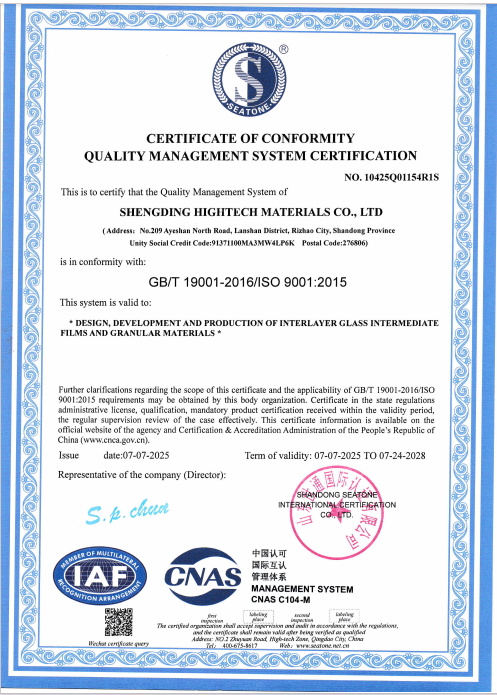
Quality Management System Certification Certificate GB/T 19001-2016 / ISO 9001:2015, certificate no. 10425Q01154R1S, issued to Shengding Hightech Materials Co., Ltd. by Shandong Seatone International Certification Co., Ltd. (issue date 2025-07-07; expiry 2028-07-24).
Compliance documentation has become a screening tool in EVA film procurement, not a closing formality. For buyers sourcing EVA interlayer film for architectural laminated glass and decorative glass, a supplier pack may contain a quality management certificate, a European REACH statement, a RoHS declaration and a reference to U.S. FDA quality requirements. Those four documents cover four different things, and treating them as interchangeable is one of the most common qualification errors in this category. The error usually surfaces late, when a specifier asks what a certificate actually covers.
SHENGDING HIGHTECH MATERIALS CO., LTD is a manufacturer of polymer materials established in 2018 in the Lanshan Chemical Industry Park, Rizhao City, Shandong Province, China. The company produces TPU film and EVA film, including EVA FILM model SD38, a high-transparency EVA film for architectural glass and decorative glass lamination.
This industry reference explains what each item in an EVA film compliance file covers in practice, how a 100% testing quality control model connects to pre-shipment acceptance inspection, and how commercial terms such as OEM/ODM support, length and width customization, a 50 kg MOQ, a 10-day lead time and 100-ton monthly capacity function as qualification criteria rather than standalone sales points.
Why EVA Film Compliance Is a Procurement Filter, Not Paperwork
In most architectural and decorative glass projects, compliance evidence decides whether a supplier enters the shortlist at all. Price and capability are compared only among the suppliers that have already passed the documentation gate.
The reason is structural. Three different kinds of documents are routinely grouped under the single word compliance:
- Management system certificates (ISO 9001, ISO 14001, ISO 45001) describe how a company organizes its quality, environmental and occupational safety processes.
- Substance and market-access statements (European REACH, RoHS) describe obligations attached to placing a material on a given market.
- Product performance statements, including references to U.S. FDA quality requirements and to parameters such as light transmittance and haze, describe the material itself.
A supplier can hold a valid management certificate and still fail a project-level substance review, because the certificate says nothing about the chemistry of a specific roll of film. The reverse is also possible: a material can meet declared substance requirements while the certificate scope does not name interlayer films for glass laminating at all. Qualification therefore depends on reading scope, not on counting certificates.
For EVA film buyers, the practical consequence is a two-stage evaluation. Stage one checks whether each document exists and whether its scope, product grade and target market match the purchase. Stage two checks whether the supplier can demonstrate that the processes behind the documents are operating: inspection records, traceability, packaging control, and a defined point at which the buyer can verify the goods before shipment.
What ISO 9001, ISO 14001, ISO 45001, REACH, RoHS and FDA Statements Actually Cover
| Item | Type of requirement | What it confirms | What it does not confirm |
|---|---|---|---|
| ISO 9001:2015 / GB/T 19001-2016 | Quality management system standard | That a documented quality management system exists for a defined scope of activity | That a specific roll of EVA film meets a chemical or performance requirement |
| ISO 14001 | Environmental management system standard | That environmental processes are managed and audited at company level | Product-level environmental or substance compliance |
| ISO 45001 | Occupational health and safety management system standard | That workplace safety processes are managed at company level | Anything about film performance, chemistry or market access |
| European REACH | EU regulation on chemical substances | That the supplier declares compliance with applicable REACH obligations for a named product | A blanket clearance; scope by product, grade and destination market still has to be defined |
| RoHS | EU restriction on hazardous substances in electrical and electronic equipment | That declared restrictions relevant to that equipment scope are met for the named material | Automatic compliance for every downstream application |
| U.S. FDA quality requirements | Reference framework for product performance as declared by the manufacturer | That the manufacturer states product performance conforms to the referenced requirements | A universal approval; the applicable regulation and use scenario must be confirmed in writing |
| ASTM C1172 | Standard covering quality requirements for laminated architectural flat glass | A product and application standard that buyers can cite when specifying laminated architectural glass | A supplier qualification document; it is a specification reference, not a certificate |
The FDA row deserves a note. In material sourcing, references to U.S. FDA quality requirements are performance-oriented statements made by the manufacturer, and they should be obtained as a current written declaration that names the product grade being purchased. Buyers should also confirm which regulation or contact scenario the declaration addresses, because the same phrase can mean different things across product families.
Reading Certification Scope: The ISO 9001 Evidence Behind EVA FILM SD38
Shengding Hightech Materials holds a Quality Management System Certification Certificate with certificate number 10425Q01154R1S. The standard is GB/T 19001-2016 / ISO 9001:2015, the issuing authority is Shandong Seatone International Certification Co., Ltd., the issue date is 2025-07-07 and the expiry date is 2028-07-24. The certification scope is the design, development and production of interlayer glass intermediate films and granular materials, and the market coverage is global in markets where the GB/T 19001-2016 / ISO 9001:2015 standard is recognized. EVA FILM model SD38 and TPU FILM model SD560 are the products referenced against that certificate.
The scope sentence is the part buyers should read first. A certificate whose scope names interlayer glass intermediate films speaks directly to the production activity a laminated glass buyer depends on. Certificates with broader, trading-related or unrelated scopes require additional checking, because a management system certificate issued for different activities does not evidence control over film extrusion.
Two further details make the certificate usable rather than decorative. First, the certification body is named, which allows independent verification. Second, the validity window is fixed: issued 2025-07-07, expiring 2028-07-24. Buyers running multi-year glass programmes should record that expiry date in their supplier files and request the current surveillance audit status rather than relying on a certificate file that may be several years old.
Beyond the quality management system, the company holds ISO 9001, ISO 14001 and ISO 45001 certifications. In tender-driven projects the environmental and occupational safety systems are frequently requested alongside the quality certificate, and their absence can delay approval even when the product itself has already been accepted.
Material-level statements sit under a separate heading. The company states that product performance complies with European REACH and RoHS regulations as well as U.S. FDA quality requirements. Because these are substance and market-access statements rather than management system certificates, they should be requested as current, grade-specific declarations and checked against the market where the finished laminated glass will be sold.
From Certificate to Physical Evidence: 100% Testing and Pre-Shipment Acceptance Inspection
An ISO 9001 certificate describes a system. That system becomes visible in the way production is inspected, and this is where a quality control claim matters to a buyer.
Shengding's EVA film capability profile states quality control as 100% test. In practice the claim means that production units pass through a defined inspection step instead of being released on a sampled basis. The value of that statement to a purchaser depends on four details, all of which can be requested in writing:
- The parameter list measured at the inspection step.
- The pass or fail criteria applied to each parameter.
- The identification and traceability method, so that a delivered roll can be linked to a production record.
- The disposition process for non-conforming material.
A 100% testing model also interacts with a handling requirement that belongs to EVA film itself: the film must be kept dry. Moisture control is therefore part of quality control, not only of logistics. Packaging design, desiccant use, sealing and container loading practice determine whether film that passed inspection at the factory still performs correctly in the laminating oven weeks later.
Pre-shipment acceptance inspection is the buyer-side step that closes the gap between the supplier's internal inspection and the actual delivery. It is defined before the order ships and normally covers roll count, width and length against the ordered customization, thickness and visual condition, packaging integrity, and the accompanying document pack. Two rules make it effective rather than ceremonial. First, acceptance criteria should be written into the purchase order so that both sides work to the same definition. Second, the inspection should be scheduled before the shipment leaves, because a defect identified at destination is considerably more expensive to correct than one identified before loading.
For buyers running multi-container programmes, the efficiency gain is straightforward. A documented acceptance routine converts a supplier statement that everything is tested into a repeatable verification step that can be applied to every shipment with the same effort.
Application Fit: Architectural Laminated Glass and Decorative Glass Processing
EVA FILM model SD38 is a high-transparency EVA film with 90% light transmittance and 0.5% haze, intended for architectural glass and decorative glass. In laminated glass production the film acts as the interlayer that bonds glass plies into a safety glazing unit. The application scope of the material covers architectural laminated glass projects and decorative glass processing projects, with the function described as lamination of safety glass.
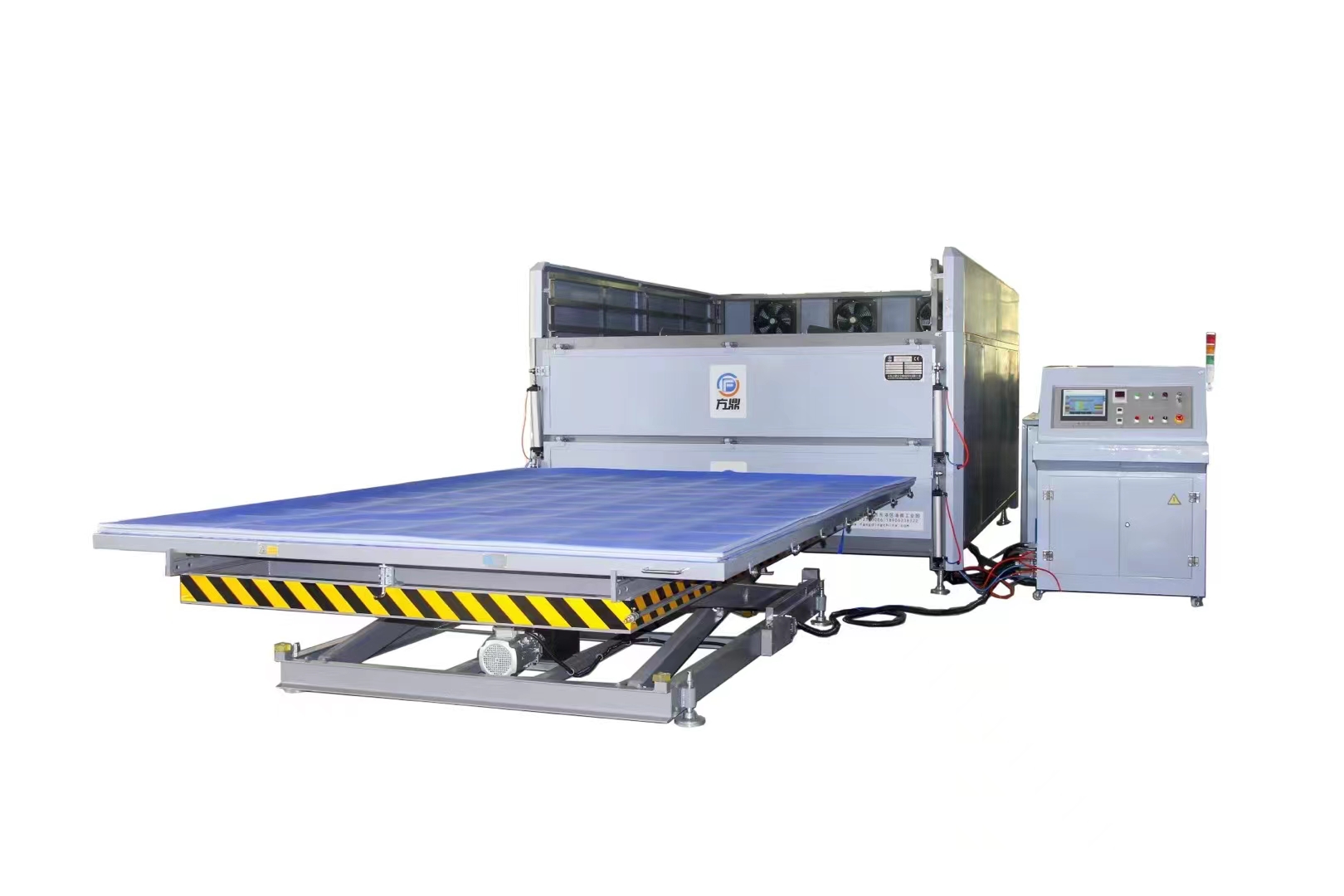
Laminating oven processing: EVA interlayer film for glass is processed under normal pressure and high temperature in an EVA laminating oven, with storage kept dry.
Processing conditions decide whether a film is a fit for a given plant. SD38 is processed in a laminating oven under normal pressure and high temperature, and the matched equipment for the material is an EVA laminating oven. Industry processing standards for EVA films used in glass lamination typically describe a process window of 100 to 110 degrees Celsius under a vacuum of at least 700 mmHg. Buyers evaluating a switch from another interlayer should compare that window against their existing oven capability before ordering, because the material and the equipment are not independent variables.
Storage and handling belong to the same fit assessment. The special requirement for this application is to keep the film dry, which means a plant moving to EVA film needs a controlled storage area, not only a laminating oven.
Customization is the other half of application fit. Production is offered in OEM/ODM mode with customization of length and width, which matters when a decorative glass processor works with non-standard panel dimensions or when a laminator wants roll formats matched to its cutting line. The customer base for the EVA line is described as general construction and interior design customers, which corresponds to the two application categories above: safety glazing for buildings and decorative glass for interior work.
Market Trend: Why Compliance Documentation Is Moving Upstream in EVA Film Buying
The commercial context explains why documentation discipline is spreading through this category. The global EVA films market was valued at USD 8.25 billion in 2025 and is projected to reach USD 17.65 billion by 2034, with a CAGR of 8.83% from 2026 to 2034, according to Fortune Business Insights. In the adjacent laminated glass market, estimated at USD 25.0 billion in 2025, PVB holds a 55.2% share while EVA is growing in architectural and solar applications, according to Future Market Insights.
Published market estimates differ materially depending on whether the scope is total EVA film, architectural interlayers only, or solar encapsulant volumes, and buyers should read such figures for direction rather than for precision. The direction itself is consistent: architectural and solar demand is expanding the same material family, which has two practical consequences for procurement.
- Dual-use capacity adds external demand cycles. Capacity that can serve solar encapsulation and architectural interlayers makes film supply more sensitive to demand movements outside construction. Buyers who treat EVA film as a purely commodity input may find availability and lead times moving with markets they do not monitor.
- A growing supplier base increases documentation variance. When the number of sellers rises faster than the number of well-controlled producers, collecting certificates becomes easier while interpreting them becomes more important. Qualification work that used to be triggered by a failed delivery is moving earlier, ahead of price negotiation.
EVA, PVB and TPU Interlayers: Fit, Processing Environment and Limits
| Interlayer | Market position | Processing environment | Practical boundary |
|---|---|---|---|
| PVB | 55.2% share of the laminated glass market in 2025 (Future Market Insights) | Long-established specification and approval routes; commonly associated with autoclave-based lamination lines | Substituting away from an approved PVB route usually reopens a qualification cycle |
| EVA | Growing in architectural and solar applications | Laminating oven process; industry guidance around 100 to 110 degrees Celsius under vacuum of at least 700 mmHg; film must be kept dry | Moisture-sensitive handling, smaller incumbent share than PVB in architectural laminated glass, and oven vacuum capability is a gating factor |
| TPU | Used where higher mechanical performance is required, such as bulletproof and shatter-resistant glass | Depends on the specific product; Shengding TPU FILM SD560 lists tensile strength 42 MPa, elongation at break 500%, tear strength 45 kN/m, light transmittance 90% and haze 0.3% | Different performance and cost profile; not a drop-in substitute for architectural decorative work |
The limitation to plan for is not that one interlayer is better than another. It is that qualification effort is not transferable. A plant with an approved laminating route for one interlayer cannot assume that the process window, storage conditions and documentation package of another will be accepted by the same specifier without review. Where the interlayer specification is fixed early in a project, changing material late reopens a qualification cycle that had already been closed.
A Supplier Qualification Checklist for EVA Film Buyers
| Qualification check | Evidence to request | Why it changes the decision |
|---|---|---|
| Quality management certificate scope | Certificate number, issuing body, standard, scope statement, issue and expiry dates | A scope naming interlayer glass intermediate films matches the purchase; a generic scope requires additional verification |
| System coverage beyond quality | ISO 14001 and ISO 45001 certificates where the project is tender-driven | Avoids a second documentation round during project approval |
| Material declarations | Current REACH and RoHS statements plus the FDA-related declaration, scoped to the exact product model and target market | Management system certificates do not cover substance obligations |
| Inspection design behind 100% testing | Parameter list, criteria, traceability method and non-conforming material handling | Converts a quality claim into a verifiable control |
| Pre-shipment acceptance | Agreed acceptance criteria, inspection timing before loading, document pack | Catches issues before freight cost and delay are incurred |
| Moisture control | Packaging, sealing and dry-handling plan | EVA film must be kept dry; storage conditions affect in-oven performance |
| Process fit | Oven capability compared with the 100 to 110 degrees Celsius and at least 700 mmHg vacuum window | Material and equipment have to be validated together |
| Commercial fit | 50 kg MOQ, 10-day lead time, 100-ton monthly capacity, OEM/ODM length and width customization | Defines trial scale, planning buffer and programme ceiling |
| Supply continuity context | 50,000 square metre factory, annual output of 1,000 tons, export ratio of 70%, main markets in North Africa, the Middle East and Latin America | Useful when mapping lead-time and continuity risk |
| Application evidence | Reference to architectural laminated glass and decorative glass use | Confirms the material is applied in the buyer's own application category |
Future Outlook
As EVA film demand expands across architectural and solar applications, qualification is likely to become more evidence-based and less certificate-based. Three shifts are already visible in the structure of supplier documentation.
Scope statements will carry more weight than certificate titles. Buyers who read the scope line of an ISO 9001 certificate, and who can distinguish a certificate covering interlayer glass intermediate films from one covering unrelated activities, are setting a standard that the wider market will follow.
Substance declarations will be requested per model and per market. A REACH or RoHS statement written for one product family will not automatically satisfy a review for another, and multi-market glass programmes will increasingly require declarations mapped to the destination market.
Inspection will shift toward the shipment boundary. Pre-shipment acceptance inspection, agreed acceptance criteria and traceability documentation are becoming routine commercial terms rather than exceptions, particularly for buyers working with customized roll formats and long supply routes.
For a manufacturer, this trend rewards documentation discipline. For a buyer, it reduces the risk that a compliance file looks complete while leaving the questions that matter unanswered.
FAQ
Does an ISO 9001 certificate mean that an EVA film complies with REACH, RoHS and U.S. FDA requirements?
No. ISO 9001:2015 is a quality management system standard. The certificate held by Shengding Hightech Materials, number 10425Q01154R1S and issued by Shandong Seatone International Certification Co., Ltd., covers the design, development and production of interlayer glass intermediate films and granular materials, is valid from its issue date of 2025-07-07 to its expiry date of 2028-07-24, and applies in markets where the GB/T 19001-2016 / ISO 9001:2015 standard is recognized. That scope describes a management system; it does not test or certify the chemical content of an individual roll of film. REACH and RoHS are substance and market-access statements, and the reference to U.S. FDA quality requirements relates to declared product performance. The company states that product performance complies with European REACH and RoHS regulations and U.S. FDA quality requirements, and each declaration should be obtained separately for the exact product model and destination market. ISO 14001 and ISO 45001 add environmental and occupational safety system coverage, which is also supplier-level rather than product-level.
Which EVA film specifications should be confirmed before ordering for architectural laminated glass?
Four groups of parameters are worth confirming. Optical parameters: EVA FILM model SD38 is specified at 90% light transmittance and 0.5% haze. Dimensional parameters: roll length and width, which can be customized under OEM/ODM production, and nominal interlayer thickness, since buyers commonly specify gauge options such as 0.38 mm, 0.5 mm and 0.76 mm according to the glass build-up. Process parameters: the material is processed in an EVA laminating oven under normal pressure and high temperature, with industry processing guidance around 100 to 110 degrees Celsius under a vacuum of at least 700 mmHg. Handling parameters: the film must be kept dry, so storage and packaging conditions belong to the specification discussion rather than to logistics alone. Confirming these four groups against the actual line and the project specification prevents most ordering mismatches.
What does 100% testing mean in an EVA film quality control programme, and what records should a buyer request?
In the capability profile of Shengding Hightech Materials, quality control is stated as 100% test, meaning production units pass through a defined inspection step rather than being released on a sampled basis. To turn that statement into verifiable evidence, a buyer should request the list of parameters measured at the inspection step, the pass or fail criteria applied, the identification and traceability method that links a delivered roll to its production record, and the documented disposition process for non-conforming material. Because EVA film must be kept dry, the record set should also cover packaging and moisture protection from production through loading. A 100% testing claim without a defined parameter list and traceability method remains a claim rather than a control, and the pre-shipment acceptance inspection is the point at which the two are reconciled.
How should MOQ, lead time and monthly capacity be interpreted during supplier qualification?
For the EVA film line, the stated commercial parameters are a 50 kg minimum order quantity, a 10-day lead time, a monthly capacity of 100 tons, OEM/ODM production with customization of length and width, and technical support after sale. The 50 kg MOQ allows a trial or sample-scale validation before a full programme commitment. The 10-day lead time sets the planning buffer and should be clarified as production time or as time from order confirmation to dispatch. The 100-ton monthly capacity defines the ceiling for larger programmes and should be compared against peak project demand rather than average demand. Company-level context helps with continuity planning: the factory covers 50,000 square metres, annual output is 1,000 tons, the export ratio is 70%, and the main markets are North Africa, the Middle East and Latin America.
Does EVA film suit every laminated glass project, and where are its limits?
EVA film applies to architectural laminated glass projects and decorative glass processing projects, where it laminates safety glass in a laminating oven at normal pressure and high temperature. Its limits are specific and manageable rather than disqualifying. PVB remains the incumbent interlayer and held a 55.2% share of the laminated glass market in 2025 according to Future Market Insights, so many established specification and approval routes are built around PVB, and an EVA route may require additional documentation in projects where the specifier is unfamiliar with it. Process results depend on the oven: industry guidance for EVA films used in glass lamination cites roughly 100 to 110 degrees Celsius under a vacuum of at least 700 mmHg, and a line that cannot hold that window may not achieve the intended laminate quality. EVA is also moisture-sensitive and must be kept dry, which adds a storage control requirement. Where maximum mechanical performance is the priority, such as in bulletproof glass, a different interlayer family is normally considered, for example TPU FILM model SD560 with 42 MPa tensile strength and 500% elongation at break.
Additional qualification detail, including the film portfolio and specification tables, is compiled in the company brochure available as a PDF: Shengding Hightech Materials brochure. Company information is published at www.shengdingchina.com.